

Saved Bookmarks
This section includes 7 InterviewSolutions, each offering curated multiple-choice questions to sharpen your Current Affairs knowledge and support exam preparation. Choose a topic below to get started.
| 1. |
Give the structure of A in the following reaction : |
Answer» SOLUTION :
|
|
| 2. |
Glucose is not oxidised to gluconic acid by |
|
Answer» `Bra_(2)//H_(2)O` |
|
| 3. |
Glucose is not |
|
Answer» hexose |
|
| 4. |
Give the structure of a compound that fits each description (There may be more than one correct answers for each). (a) A chiral primary C_(4)H_(7)N amine with no triple bonds. (b) Two secondary amines which when treated with CH_(3)I, then Ag_(2)O and heat, give propene and N, N-dimethylaniline. |
Answer» SOLUTION :
|
|
| 5. |
Give the structure of A, B and C In the following reactions : CH_(3)COOH overset(NH_(3))underset(Delta)(rarr)Aoverset(Br_(2)+KOH)(rarr)Boverset(CHCI_(3)+NaOH)(rarr)C |
| Answer» Solution :`CH_(3)COOHoverset(NH_(3))UNDERSET(Delta)(rarr)CH_(3)CONH_(2)overset(Br_(2)+KOH)(rarr)CH_(3)NH_(2)overset(CHCI_(3)+NaOH)(rarr)CH_(3)NC` | |
| 6. |
Glucose is hydrolysed by zymase into: |
|
Answer» Dicarboxylic acid |
|
| 7. |
Give the structure of A, B and C In the following reactions : CH_(3)Broverset(KCN)rarrAoverset("LiAH"_(4))(rarr)Boverset(HNO_(2))underset(273K)(rarr)C |
| Answer» SOLUTION :`CH_(3)Br overset(KCN)(rarr)CH_(3)CNoverset("LIAIH"_(4))(rarr)CH_(3)CH_(2)NH_(2)overset(HNO_(2))underset(273K)(rarr)CH_(3)CH_(2)-OH` | |
| 8. |
Give the structure for the following compound . (i) diamminesilver (I) dicyanidoargentater (I) (ii) Pentaammine nitrito-kN cobalt (III) ion (iii) hexafluorido cobaltate (III) ion (iv) dichloridobis (ethylenediamine) cobalt (III) sulphate (v) Tetracarbonylnickel (0) |
|
Answer» Solution :`(i)` diamminesilver (I) dicyanidoargentater (I)-`[Ag(NH_(3))_(2)][Ag(CN)_(2)]` `(ii)` Pentaammine nitrito-`kN` cobalt (III) ION `-[Co(NH_(3))_(5)NO_(2)]^(+)` `(iii)` hexafluorido cobaltate (III) ion `-[CoF_(6)]^(3-)` `(iv)` dichloridobis (ethylenediamine) cobalt (III) sulphate `[Co(en)_(2)Cl_(2)]SO_(4)` `(V)` Tetracarbonylnickel (0) `-[Ni(CO)_(4)]` |
|
| 10. |
Glucose is an aldose . Whichone of thefollowingreactionsreactions isnot expectedwithglucose ? |
|
Answer» It DOESNOT FORM OXIME |
|
| 11. |
Give the structure and the IUPAC name of the lowest molecular mass aliphatic monocarboxylic acid containing a chiral carbon. Or write the structure of active valeric acid. |
| Answer» SOLUTION :`CH_(3)CH_(2)-OVERSET(CH_(3))overset(|)(.^(**)C)H-COOH` (2-Methylbutanoic ACID) | |
| 12. |
Glucose is an aldose. Which one of the following reactions is not expected with glucose ? |
|
Answer» It dose not FORM OXIME |
|
| 13. |
Glucose is an________and is also known as________. |
| Answer» SOLUTION :ALDOHEXOSE, DEXTROSE | |
| 14. |
Glucose is an aldose. Which one of the following reactions is not expected with glucose? |
|
Answer» It does not FORM oxime |
|
| 15. |
Give the structures and names of various amines with the formula C_(7)H_(9)N |
Answer» SOLUTION :
|
|
| 16. |
Glucose is an example of |
|
Answer» aldohexose |
|
| 17. |
Give the structure and IUPAC name of vanillin. |
Answer» SOLUTION :STRUCTURE of vanillum is  The IUPAC name of VANILLIN is 4hydroxy - 3- methoxybezenecarbaldehyde. |
|
| 18. |
Glucose is added to one liter water to such an extent that DeltaT_(f)//k_(f) becomes equal to 1//1000, the weight of glucose added is : |
| Answer» Answer :D | |
| 19. |
Glucose is an aldose sugar but it does not react with sodium hydrogen sulphite. Give reason. |
| Answer» SOLUTION :The - CHO group REACTS with - OH group at C - 5 to form a cyclic HEMIACETAL. | |
| 20. |
Give the structure and IUPAC name of disaccharide, which gives the reactio given below: Given, (A) does not reduce Fehling's solution and does not mutarotate. |
|
Answer» Solution :(i). It does not reduce Fehling'ssolution and does not mutarotate, which suggests that hemiacetalic `OH` group at `C-1` of glucose and hemiketalic `OH` group at `C-2` of fructose are not free and are involved in glycosidic linkage. ii. Hydeoysis by maltose suggests `alpha-`linkage and HYDROLYSIS by emulsin suggests `beta-`linkage. ii. Hydrolysis by maltase suggests `alpha-`linkage and hydrolysis by emulsin suggests `beta-`linkage. iii. PRODUCTS obtained after the methylation and hydrolysis of `(A)` suggest `(C-1) (OH) (alpha)` of glucose and `(C-2) (OH) (beta)` of fructose are involved in glycosidic linkage. iv. Glucose is in puranose FORM which suggests a six-membered ring. v. Fructose is in FURANOSE form and this suggests a five-membered ring. All the observations suggest that `(A)` is SUCROSE. 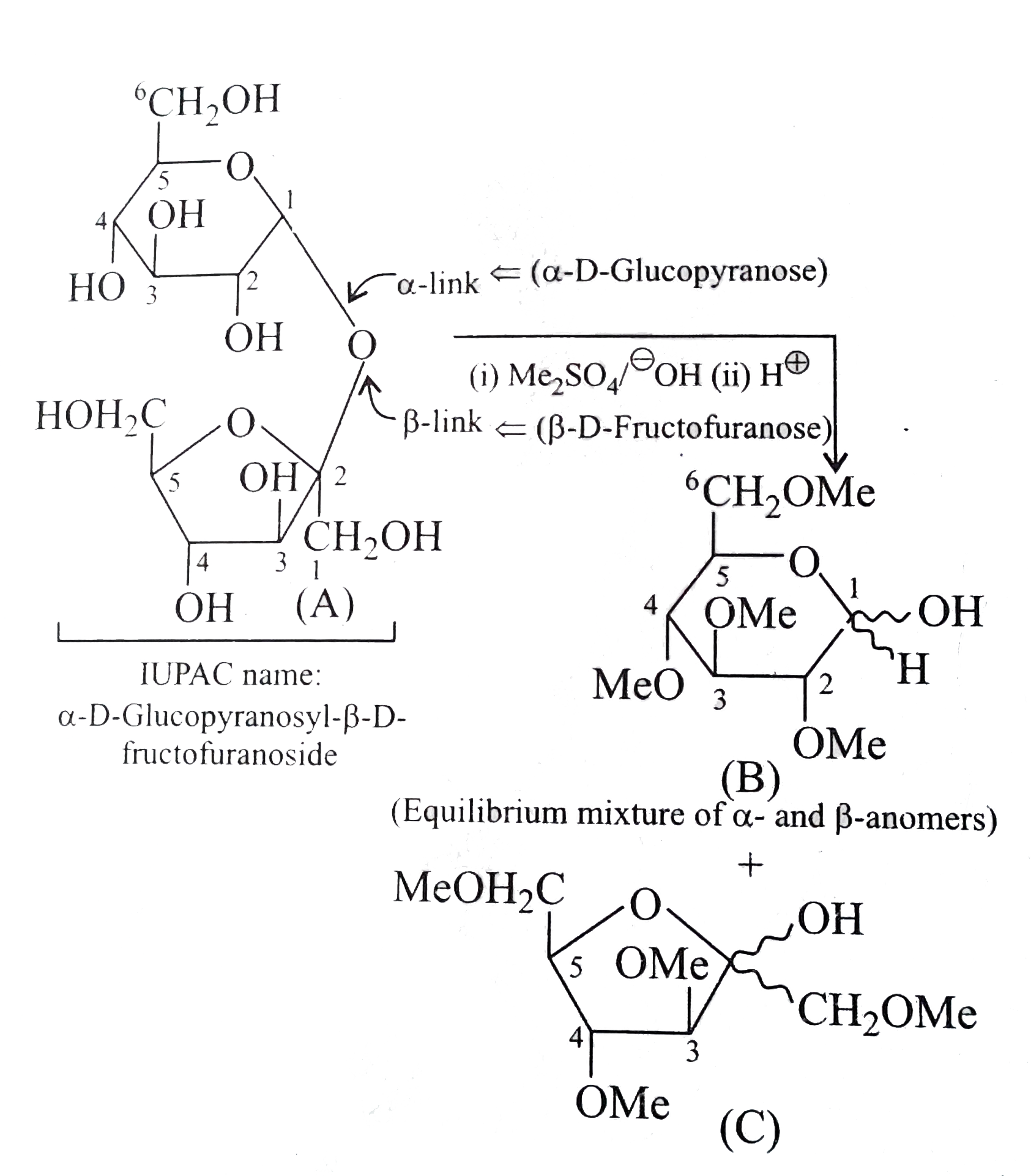
|
|
| 21. |
Glucose is added to 1 litre of water to such an extent that DeltaT_(f)//K_(f) becomes equal to 1//1000. The wt. of glucose added is |
|
Answer» 180g |
|
| 22. |
Give the structural formulae of the following : (i) potassium hexacyanoferrate (III) (ii) Chloro-bis (ethylenediamine) nitrocobalt (III) ion |
| Answer» Solution :(i) `K_(3)[Fe(CN)_(6)]` (ii) `[COCL(en)_(2)(NO_(2))]^(+)` | |
| 23. |
Glucose is also known as dextrose because |
|
Answer» it has D-CONFIGURATION |
|
| 24. |
Glucose is a monosaccharide which can be oxidised, reduced and acetylated. What happen when a glucose is treated with acetic anhydride |
| Answer» SOLUTION :GLUCOSE PENTAACETATE is FORMED | |
| 25. |
Glucose is a monosaccharide which can be oxidised, reduced and acetylated. What happen when a glucose is treated with HI//red P. |
| Answer» SOLUTION :GLUCOSE is REDUCED to n-hexane | |
| 26. |
Glucose is a monosaccharide which can be oxidised, reduced and acetylated. What happen when a glucose is treated with Br_2 water |
| Answer» SOLUTION :GLUCOSE is oxidised to GLUCONIC ACID | |
| 27. |
Give the structural formulae for the simplest chiral {:("(a) alkane","(b) alkene","(c) alkyne","(d) alcohol"),("(e) aldehyde ","(f) ketone ","(g) carboxylic acid ","(h) amine"):}. |
|
Answer» Solution :(a) `CH_(3)CH_(2)-CH(CH_(3))CH_(2)CH_(2)CH_(3)` (b) `CH_(3)CH_(2)-CH(CH_(3))-CH=CH_(2)` (c ) `CH_(3)CH_(2)overset(CH_(3))overset("|")"CH"-C-=CH` (d) `CH_(3)CH_(2)-CH(OH)CH_(3)` (e) `CH_(3)CH_(2)-CH(CH_(3))CHO` (f) `CH_(3)COCH(CH_(3))CH_(2)CH_(3)` (G) `CH_(3)CH_(2)CH(CH_(3))COOH` (h) `CH_(3)CH_(2)CH(CH_(3))NH_(2)` |
|
| 28. |
Glucose is a ketohexose.TRUE/FALSE |
|
Answer» |
|
| 29. |
Give the structural fomula of ethyl (3-chloro-2-methylbutanoate) |
Answer» SOLUTION :
|
|
| 30. |
Glucose in human blood about……..and it also known as ………. . |
| Answer» SOLUTION :100mg/dl,BLOODSUGAR | |
| 31. |
Give the structural formula and name of the product of the following reaction : Phenol is treated with excess of aqueous solution of bromine. |
Answer» SOLUTION :
|
|
| 32. |
Glucose is |
|
Answer» Monosaccharide |
|
| 33. |
Glucose in blood can be quantitatively determined with |
|
Answer» TOLLEN reagent |
|
| 34. |
Give the structural formula and IUPAC name of aspirin. |
Answer» Solution :Aspirin is ACETYL salicylic acid. Its STRUCTURAL FORMULA is IUPAC name is 2-acetoxy benzoic acid. |
|
| 35. |
Glucose(HCN) Product (hydrolysis )Product (HI+ Heat) A, the compound A is ……….. . |
|
Answer» Heptanoicacid |
|
| 36. |
Give the structural formua and IUPAC name of the following compounds. (i) Isopropyl amine (ii) Allyl amine (iii) Hexamehtyl diamine. |
|
Answer» SOLUTION :(i) Isopropyl amine:`""CH_(3)-underset(underset(..)(N)H_(2))underset(|)(CH)-CH_(3)""`Propane -2-amine (ii) ALLYL amine: `""CH_(2)=CH-CH_(2)OVERSET(..)(N)H_(2)""` prop-2-en-1amine (iii) Hexa methyl diamine : `""H_(2)overset(..)(N)-(CH_(2))_(6)-overset(..)(N)H_(2)""` Hexane 1,6-diamine |
|
| 37. |
Give the steroselective products. When cyclopentene is treated with (a) alkaline KMnO_(4) (B) HCOOH(c) Br_(2) |
Answer» SOLUTION :
|
|
| 38. |
Give the structural and diastereomers of pent-1-ene. |
Answer» SOLUTION : Structures (II) and (III) are diastereomers (GEOMETRICAL isomers.) |
|
| 39. |
Give the star mark to the hydrogen which is most acidic in the following compounds: (a) CH_(3)-CH_(2)-overset(O)overset(||)C-CH_(2)-CH_(3)(b) H_(2)C=CH-CH_(2)-overset(O)overset(||)C-H (c ) CH_(3)-overset(O)overset(||)C-O-CH_(2)-CH_(3)(d) CH_(3)-overset(OH)overset(|)"CH"-overset(O)overset(||)C-OH |
|
Answer» Solution :(a) Hydrogen of methylene GROUP will be most acidic. `CH_(3)-underset(**)CH_(2)-OVERSET(O)overset(||)C-underset(**)CH_(2)-CH_(3)` (b) In this compound, allylic hydrogen will be most acidic. `H_(2)C=CH-underset(**)CH_(2)-overset(O)overset(||)C-H` (c ) Hydrogen of methylene group will be most acidic. `CH_(3)-overset(O)overset(||)C-O-underset(**)CH_(2)-CH_(3)` (d) Hydrogen of carboxylic group will be most acidic. `CH_(3)-overset(OH)overset(|)"CH"-overset(O)overset(||)C-Ounderset(**)H` |
|
| 40. |
Give the special characteristics of enzyme catalysed reactions. |
|
Answer» Solution :(i) Effective and efficient conversion is the special characteristic of enzyme catalysed reactions. An enzyme may transform a million molecules of reactant in a MINUTE. For eg. `2H_2O_2 to 2H_2O + O_2` For this reaction, the ACTIVATION energy is18k cal/mole without a catalyst. With colloidal platinum as a catalyst the activation energy is 11.7kcal /mole But with the enzyme catalyst the activation energy of this reaction is less than 2kcal/ mole. (ii) Enzyme catalysis is highly specific in nature. (iii) Enzyme catalysed reaction has maximum rate at optimum temperature. The rate of enzyme catalysed reactions varies with the pH of the system. The rate is maximum at a pH called optimum pH. Enzymes can be INHIBITED i.e. POISONED. Activity of an enzyme is decreased and destroyed by a poison. The physiological action of DRUGS is related to their inhibiting action. (vi) Catalytic activity of enzymes is increased by coenzymes or activators. |
|
| 41. |
Glucose has optical isomers |
|
Answer» 8 |
|
| 42. |
Give the sources of vitamin A and E and list the deficiency disease caused by lack of vitamin A and E in diet. |
Answer» SOLUTION : 
|
|
| 43. |
Glucose (HCN) Product (hydrolysis)Product (HI + Heat) A, the compound A is |
|
Answer» Heptanoic ACID |
|
| 44. |
Give the sources of the enzymes, pepsin, urease and maltase. |
Answer» SOLUTION :
|
|
| 45. |
Glucose has functional group |
|
Answer» aldehydic `therefore` Glucose has alcohol and ALDEHYDE as functional GROUPS. |
|
| 46. |
Give the source and trivial names of (i) C_(3)H_(7)COOH and (ii) HCOOH. |
Answer» SOLUTION :
|
|
| 47. |
Glucose has how many optical isomers? |
|
Answer» 8 |
|
| 48. |
Give the significance of d^4 ions in octahedral field. |
|
Answer» <P> Solution :(i) If `Delta_0 LT P`, the `4^(TH)` electron enters into one of the `e_g` orbitals giving the configuration `t_2^3 e_g^1` . Ligands from which `Delta_0 lt P` are called weak field ligands. So they form HIGH spin complexes.(ii) If `Delta_0 gt P`, the `4^(th)` electron enters into `t_(2g)` orbitals giving the configuration `t_(2g)^4 e_g^0`. Ligands which produce this EFFECT are called strong field ligands. So they form low spin complexes. |
|
| 49. |
Glucose gives the silver mirror test with ammoniacal solution of silver nitrate because it contains : |
|
Answer» ALDEHYDE group |
|
| 50. |
Give the significance of a lattice point. |
| Answer» Solution :A LATTICE POINT is the POSITION occupied by the costituent particles in a crystal lattice. The representation of the lattice point in a crystal DIAGRAMMATICALLY is called crystal lattice. | |