

Saved Bookmarks
This section includes 7 InterviewSolutions, each offering curated multiple-choice questions to sharpen your Current Affairs knowledge and support exam preparation. Choose a topic below to get started.
| 1. |
Give the name of the compound having the structureCOOH - (CHOH)_(4) - COOH. |
| Answer» SOLUTION :Saccharic ACID | |
| 2. |
Given the standard electrode potentials K^(+)|K=-2.93V,Ag^(+)|Ag=0.80V,Hg^(2+)|Hg=0.79V Mg^(2+)|Mg=-2.37V,Cr^(3+|Cr=-0.74VThe metal having highest reducing power is |
|
Answer» K |
|
| 4. |
Given the standard electrode potentials K^(+)//K=-2.93V,Ag^(+)//Ag=0.80V, Hg_(2)^(2+)//Hg=0.79V,Mg^(2+)//Mg=-2.37V,Cr^(2+)//Cr=-0.74V Arrange these metals in their increasing order of reducing power. |
| Answer» Solution :Higher the OXIDATION potential, more EASILY it is oxidized and HENCE greater is the reducing POWER. Thus, increasing order of reducing power will be `Ag LT Hg lt Cr lt Mg lt K`. | |
| 5. |
Give the name of the compound: (CH_3)_3CCH_2CH_2CI |
|
Answer» 2,2-Dimethyl-4-chloro butane |
|
| 6. |
Given the standard electrode potentials: K^(+)|K=-2.93V, Ag^(+)|Ag=0.80V,""Hg^(2+)|Hg=0.79V, Mg^(2+)|Mg=-2.37V, ""Cr^(3+)|Cr=-0.74V Arrange these metals in their increasing order of reducing power. |
|
Answer» Solution :* The LOWER the reduction potential, the higher is the reducing power. The GIVEN standard electrode potentials increase in the order of `(E_(K^(+)|K)^(Theta)=-2.93V) lt (E_(Mg^(2+)|Mg)^(Theta)=-2.37V)lt(E_(Cr^(3+)|Cr)^(Theta)=-0.74V) lt (E_(Hg^(2+)|Hg)^(Theta)=0.79V) lt (E_(AG^(+)|Ag)^(Theta)=0.80V)` The metal which has low standard reduction potential will work as strong reducing agent. * HENCE, the reducing power of the given metals increases in the following order: `Ag lt Hg lt Cr lt Mg lt K`. |
|
| 7. |
Give the name of medicine used in the treatment of Hypertension ? |
| Answer» SOLUTION :TRANQUILIZERS | |
| 8. |
Given the standard electrode potentials F_(2)//F^(-)=+2.85" V ", Cl_(2)//Cl^(-)=+1.36" V ", Br_(2)//Br^(-)=+1.06" V " and I_(2)//I^(-)=+0.34" V ". The stronger oxidising and reducing agents respectively are : |
|
Answer» `F_(2)` and `I^(-)` |
|
| 9. |
Give the name of medicine used in the treatment of Typhoid ? |
| Answer» SOLUTION :ANTIBIOTICS | |
| 10. |
Given the standard electrode potentials, K^(+)//K = -2.93 V, Ag^(+)//Ag = 0.80 V, Hg^(2+)//Hg = 0.79 V Mg^(2+)//Mg = -2.37 V, Cr^(3+)//Cr = -0.74 V Arrange these metals in their increasing order of reducing power. |
|
Answer» Solution :More negative the reduction potential, more easily it is oxidised and HENCE greater is the reducing power. THUS, INCREASING order of reducing power will be : `Ag lt Hg lt Cr lt Mg lt K` |
|
| 11. |
Given the reaction between 2 gases represented by A_(2) and B_(2) to give the compound AD(g). A_(2)(g)+B_(2)(g)hArr2AB(g). At equilibrium, the concentration of A_(2)=3.0xx10^(-3)M of B_(2)=4.2xx10^(-3)M of AB=2.8xx10^(-3)M If the reaction takes place in a scaled vassel at 527^(@)C, then the value of K_(c) will be |
|
Answer» `2.0` `K_(C)=((2.8xx10^(-3))^(2))/(3xx10^(-3)xx4.2xx10^(-3))=((2.8))/(3xx4.2)=0.62` |
|
| 12. |
Give the name of medicine used in the treatment of Join pain (in Arthritis) ? |
| Answer» SOLUTION :Non-narcotic ANALGESICS | |
| 14. |
Giventhe products in each of the following reactions : (i) H_(3)C - CH_(2) - overset(O)overset(||)(C) - CH_(3) overset(C_(6)H_(5)-CO_(3)H)to , underset(H^(+))overset(C_(2)H_(5)Ona)to (ii) H_(3)C - CHO overset(C_(6)H_(5)-CO_(3)H)tounderset(H^(+))overset(CH_(3) - CH_(2)ONa)to(iii) H_(3)C - C -= CH overset(HgSO_(4)//H_(2)SO_(4))to , overset(C_(6)H_(5)-CO_(3)H)tounderset(H^(+))overset(CH_(3)ONa)to |
|
Answer» Solution :`H_(3)C - CH_(2) - overset(O)overset(||)(C) - CH_(3) underset("Bayer Villiger OXIDATION")overset(C_(6)H_(5) - CO_(3)H)toH_(3)C - overset(O)overset(||)(C)-OCH_(2) - CH_(3)` ` underset("Claisen condensation")overset(C_(2)H_(5)ONa//H^(+))toH_(2)C - overset(O)overset(||)(C) - CH_(2)- overset(O)overset(||)(C) - OCH_(2) - CH_(3)` (II) `OHCH_(3)C_(2) -CHO underset("Tischenko")overset(Al(OC_(2)H_(5))_(3))to H_(3)C - overset(O)overset(||)(C)- OCH_(2) - CH_(3)` ` underset("Claisen condensation")overset(C_(2)H_(5)ONa//H^(+))to H_(3)C - overset(O) overset(||)overset(C) - CH_(2) -overset(O)overset(||)(C)-OCH_(2) - CH_(3)` (iii) `H_(3)C- C -= CH overset(HgSO_(4)//H_(3)O^(+))to H_(3)C - overset(O)overset(||)(C) - CH_(3) overset(C_(6)H_(5) - CO_(3)H) toH_(3)C- overset(O)overset(||)(C)-O - CH_(3)` `underset("Claisen condensation")overset(CH_(3) ONa//H^(+))to H_(3)C - overset (O)overset(||)(C) - CH_(2)- overset(O)overset(||)(C) - CH_(3)` |
|
| 15. |
Give the name of medicine having – As = As – linkage. |
| Answer» SOLUTION :ARSPHENAMINE. | |
| 16. |
Given the reaction for the distance of a cobalt-cadmium battery Co(OH)_(3)+Cd+H_(2)O to Co(OH)_(2)+Cd(OH)_(2) Which species is oxidised during the discharge of the battery ? |
|
Answer» `Co^(3+)` |
|
| 17. |
Given the reaction at 975^(@)C and 1 atm. CaCO_(3)(s)toCaO(s)+CO_(2)(g),DeltaH=176kJ Then DeltaE is equal to |
|
Answer» <P>186.4kJ `T=975^(@)C=975+273=1248K` `CaCO_(3)(s)toCaO(s)+CO_(2)(g)` `Deltan_(g)=n_(p)-n_(r)=1-0=1` `DeltaE=DeltaH-Deltan_(g)RT` `=176-1xx8.314/1000x1248` `=176.10.375=165.63kJ` |
|
| 18. |
Give the name of element which is synthetic radioactive element having atomic number 116. |
| Answer» SOLUTION :LIVERMORIUM | |
| 19. |
Given : The products P and Q are |
|
Answer» <P>`{:("P","Q"),("p-bromonitrobenzene ","p-bromoaniline"):}` 
|
|
| 20. |
Give the name of a kind of adsorption isotherm. |
| Answer» SOLUTION : FREUNDLICH | |
| 21. |
Given the polymers I=Nylon-66, II=Buna-S, III=Polyethene Arrange these in increasing order of inter molecular forces (lower to higher). |
|
Answer» `IgtIIgtIII` |
|
| 22. |
Give the name of a carbohydrate antibiotic. |
| Answer» SOLUTION :STREPTOMYCIN | |
| 23. |
Given the polymers (i) Nylon 66, (ii) Buna-S , (iii) Polythene , arrange these in increasing of their inter-molecular forces (lower to high) |
|
Answer» (i) GT (ii) gt (III)  Correct ORDER of intermolecular forces is (i) gt (ii) gt(iii) |
|
| 24. |
Give the name and structural formula of the simplest amino acid. |
|
Answer» Solution :Glycine (2-aminoethanoic ACID) is the SIMPLEST amino acid. It has the structure : `overset(NH_(2))overset(|)(CH_(2)) - COOH` |
|
| 25. |
Given the polymers : A= Nylon , B= Buna-S, C=Polythene. Arrange these in increasing order of their intermolecular forces (lower to higher). |
|
Answer» `A GT B gt C` |
|
| 26. |
Give the Molecular Orbital Energy diagram of (a) N_(2) and (b) O_(2). Calculate the respective bond order. Write the magnetic nature of N_(2) and O_(2) molecules. |
Answer» Solution :a) MOLECULAR Orbital Energy diagram of `N_(2)` :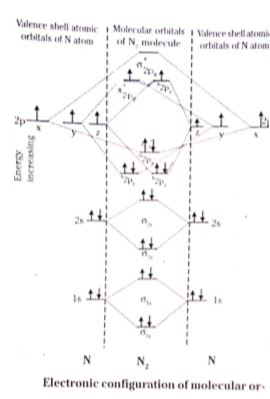 Electronic configuration of molecular orbital of `N_(2)` : `sigma1s^(2),sigma^(star)1s^(2), sigma2s^(2), sigma^(star)2s^(2), pi2p_(y)^(2)=pi2p_(z)^(2), sigma2p_(x)^(2)` Calculation of bond order of `N_(2)` : Number of bondingelectrons `(N_(b))` = 10 Number of anti-bonding electrons `(N_(a))` = 4 Bond order `=1/2(N_(b)-N_(a))` `=1/2(10-4)=3` Nitrogen is DIAMAGNETIC since all the electrons in `N_(2)` molecule are paired. b) Molecular Orbital Energy diagram of `O_(2)` : 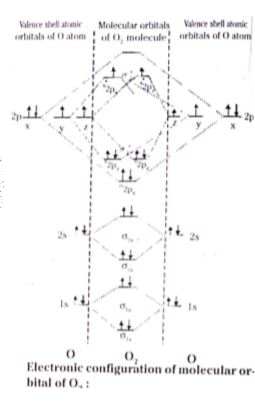 Electronic configuration of molecular orbital of `O_(2)` : `sigma1s^(2), sigma^(star)1s^(2), sigma2s^(2), sigma^(star)2s^(2), sigma2p_(x)^(2), pi2p_(y)^(2)=pi2p_(x)^(2), pi^(star)2p_(y)^(1)=pi^(star)2p_(z)^(1)` Calculation of bond order of `O_(2) :` Number of bonding electrons `(N_(b))=10` Number of anti-bonding electrons `(N_(a))=6` Bond order `=1/2(N_(b)-N_(a))=1/2(10-6)=2` Oxygen is paramagnetic as there are two UNPAIRED electrons in two antibonding `pi^(ast)2p_(y) " and " pi^(ast)2p_(z)` molecular orbitals. So oxygen is diamagnetic. |
|
| 27. |
Given the polymers: A=Nylon, B= Buna-S, C=Polythene. Arrange these in increasing order of their intermolecular forces (lower to higher) |
|
Answer» `AGT B GTC` |
|
| 28. |
Give the method to prepare hypophosphorous acid and pyrophosphoric acid? |
|
Answer» <P> Solution :(i) Hypophosphorous acid : Phosphorous REACTS with WATER to give hypophosphorous acid.`P_(4)+6H_(2)Orarr underset("(Hypophorous acid)")(3H_(3)PO_(2)+PH_(3))` (ii) Pyrophosphoric acid : Phosphorous acid is heated they produce pyrophosphoric acid. `underset("(Pyrophosphoric acid)")(2H_(2)PO_(3)overset(Delta)rarr H_(4)P_(2)O_(7)+H_(2)O)` |
|
| 29. |
Given the polymers A = Nylon 6,6, B = Buna - S , C = polythene . Arrange these in decreasing order of their intermolecular forces. |
|
Answer» `A GT B gt C` |
|
| 30. |
Give the methods of preparation of PVC and PTFE. Also give their uses. |
|
Answer» Solution : Polyvinyl chloride (PVC) and polytetra flouroethylene (PTFE) are two common examples of polyhalo-olefins. 1. Polyvinyl chloride, PVC`(-CH_2-underset(Cl)underset(|)CH-)` . It is an additional polymer obtained by heating VINYL chloride in an insert solvent in the presence of benzoyl peroxide (BPO). `underset("Vinyl chloride")(nCH_2=CHCl)(-CH_2-underset(PVC)underset(Cl)underset(|)CH-)_n` Uses. It is used (i) in the manufacture of RAIN coats, hand BAGS, table cloth, curtain cloth, plastic dolls and vinyl floorings. (ii) as an insulating coating for electrical wires, cables and other electrical goods. (iii) in the manufacture of gramophone RECORDS and hose pipes. 2. Polytetrafluoro ethylene PTFE, Teflon `(-CF_2 -CF_2 -)_n` . It is prepared by heating tetrafluoroethylene under high pressure in the presence of ammonium peroxosulphate `(NH_4)S_2 O_8` as catalyst. `underset("Tetrafluoroethylene")(nCF_2 = CDF_2) underset(Delta, "Pressure")overset((NH_4)_2 S_2 O_8)to underset("Teflon")((-CF_2 - CF_2-)_n)` Uses. It is used (i) for making gaskets, pump packing, valves etc. (ii) for making non-cooking utensils. |
|
| 31. |
Given the number of N and M |
|
Answer» 6, 6 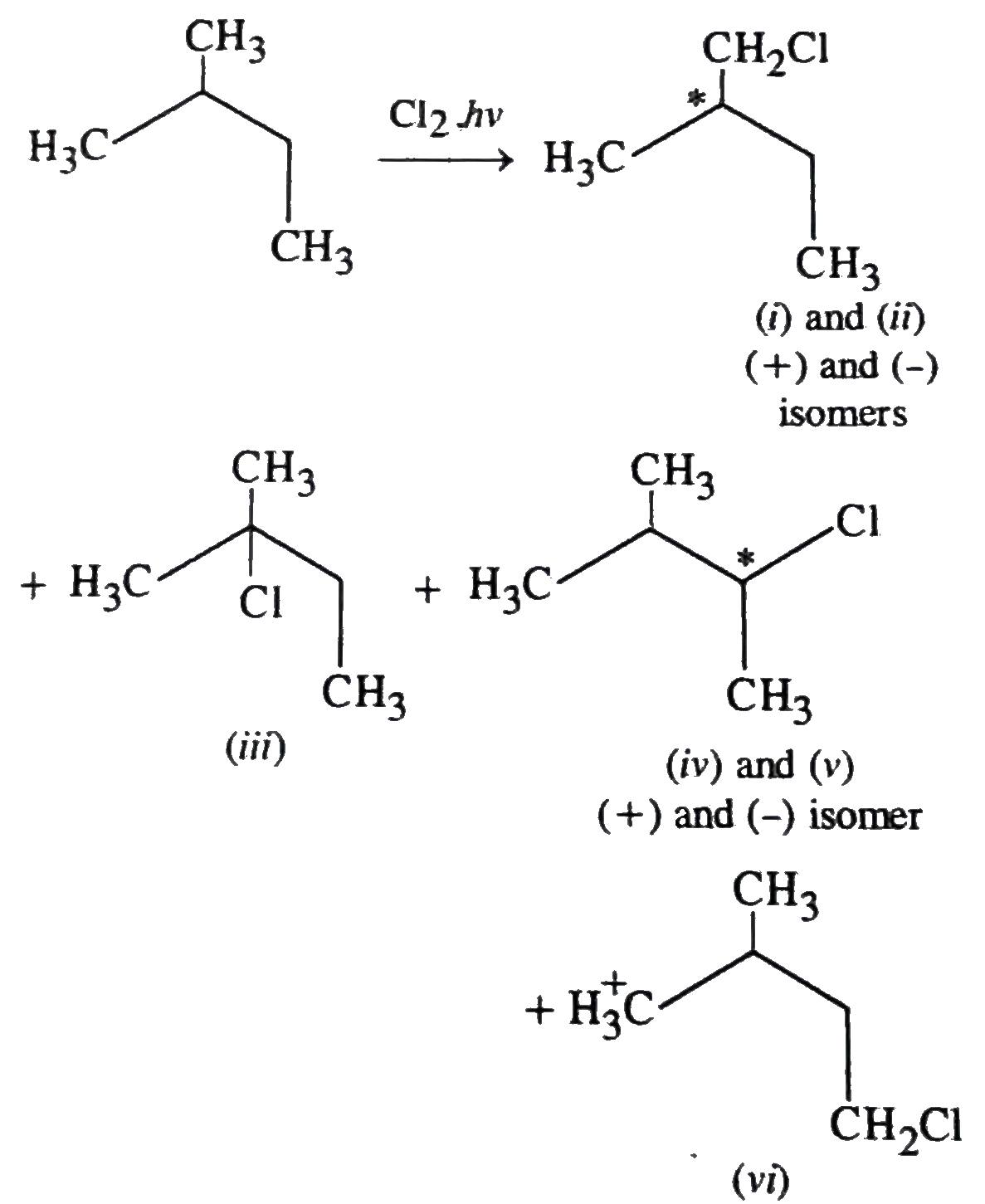 A TOTAL of 6 isomers will be FORMED. Since enatiomers have same b.p., they cannot be separeted by fractional distillation, i.e., (i) and (ii) will DISTILL together. Thus out of 6 isomers formed , four can be separated by fractional distillation. |
|
| 32. |
Give the method of preparation of polyacrylonitrile? |
Answer» SOLUTION :The ADDITION polymerisation of acrylonitrile in the presence of a peroxide catalyst leads to the FORMATION of polycrylonitrile. It is used as a substitute for WOOL in making fibres such as orlon or acrilan. 
|
|
| 33. |
Given the numbers : 161 cm, 0.0161 , 0.1060 cm. The number of significant figures for the three number are |
|
Answer» 3, 4 and 5 respectively |
|
| 34. |
Give the mechanisms of the reaction |
Answer» SOLUTION :
|
|
| 35. |
Given the IUPAC names of the following complex compounds. ltbr. i) [CoBr(NH_(3)_(5)]SO_(4) [Fe(NH_(3))_(6)][Cr(CN)_(6)] iii) Na_(3)[FeCl(CN)_(5)] iv) [Fe(OH)(H_(2)O)_(5)]^(2+) |
|
Answer» SOLUTION :i) pentamminebromidocobalt (III) sulphate ii) hexammineirono (III) hexacyanochromate (III) iii) pentaamminesulphatocobalt (III) ION IV) pentaaquahydroxoiron (III) ion. |
|
| 36. |
Give the mechanisms of the reaction |
Answer» SOLUTION :
|
|
| 37. |
Given the IUPAC name of C_(2)H_(2)-underset(CH_(3))underset(|)overset(C(CH_(3))_(3))overset(|)C-CH_(2)-underset(CH_(3))underset(|)overset(Cl)overset(|)C-C_(2)H_(5) |
|
Answer» 3-chloro -3,5-dimethyl-5-t-butylheptane |
|
| 38. |
Give the mechanism of preparation of ethoxy ethane from ethanol. |
|
Answer» SOLUTION :StepI: Protonation of alcohol `CH_(3)-CH_(2)-underset(..)OVERSET(..)(O)-H+H^(+)overset("slow")(to)CH_(3)-CH_(2)-underset(..)overset(H)overset(|)(""^(+)O)-H` Step II: Attack of nucleophile:  Step III: Removal of proton `CH_(3)-underset(H)underset(|)(""^(+)O)-CH_(2)-CH_(3)overset("FAST")(to)CH_(3)-CH_(2)-underset("Ethoxyethane")(O)-CH_(2)-CH_(3)-HI` |
|
| 39. |
Give the mechanism of dehydration alcohols. |
|
Answer» Solution :`to` The mechanism TAKES place in three steps as follows: `to` Step-1 : Formation of protonated alchohol.  Step-2 : Formation of CARBOCATION : It is the slowest step and HENCE, the rate determining step of the reaction.  Step-3 : Formation of ethene by elimination of a proton.  `to` The acid used in step-1 is released in step-3. To drive the equilibrium to the RIGHT. The ethene is removed as it is formed. |
|
| 40. |
Given the H-atom R_(n,l) = (1)/(9sqrt(3))((1)/(a_(o)))^(3//2)(6 - 6sigma + sigma^(2))e^(-sigma//2) where sigma = (2Zr)/(na_(o)), a_(o) = 0.53Å Select the correct statement for the given orbital ? |
|
Answer» Orbital is `3s` (B) 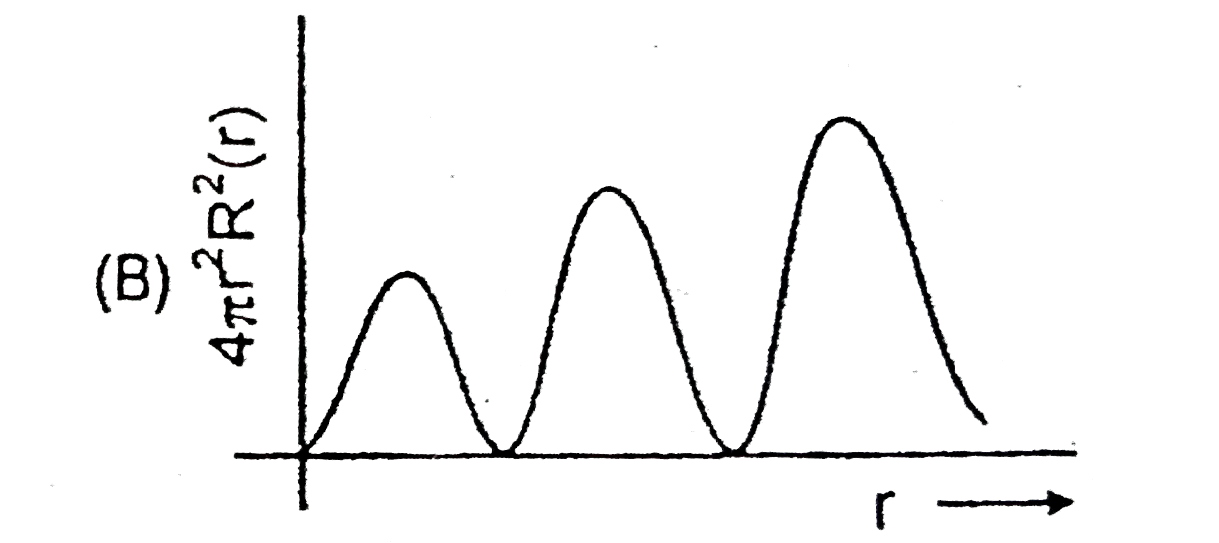 (c) For radial nodes `sigma = (+6 +- sqrt(36 - 24))/(2)` `(2r)/(3a_(o)) = 3 +- sqrt(3)` `r = (9 +- 3sqrt(3))/(2) a_(o)` first `R.N.` has `r =(9 - 3sqrt(3))/(2) a_(o)` `2^(nd) R.N.` has `r =(9 + 3sqrt(3))/(2) a_(o)` |
|
| 41. |
Give the mathematical expression of ohm's law. |
|
Answer» SOLUTION :i.e., `I" "alpha" V (or) "I=V/R rArr V=IR` Where .R. is the resistance of the solution in OHM `(Omega)` Here the resistance is the opposition that a cell offers to the flow of ELECTRIC CURRENT through it. |
|
| 42. |
Given the following thermochemical equations, Zn+(1)/(2)O_(2) to ZnO+84,000 cal Hg+(1)/(2)O_(2)toHgO+21,700 cal Accordingly the heat of reaction for the following reaction, Zn+HgO to Hg+heat is |
|
Answer» 105700 cal `underline(""HgO to Hg+(1)/(2)O_(2)-21700cal"")` `Zn+HgO to ZnO+Hg+(84000-21700)cal` So, HEAT of FORMATION of the REACTION `Zn+HgO to Hg,` `=(84000-21700)cal=62300cal` |
|
| 43. |
Give the mathematical statement of first law of thermodynamics. |
|
Answer» Solution :Mathematical statement of firstof thermodynamicsis, `DeltaU = Q +W` Where, `DeltaU =` CHANGE in internal energy. q =HEAT absorbed W = WORK performed |
|
| 44. |
Given the following reactions with their enthalpy changes, at 25^(@)C, N_(2)(g)+2O_(2)(g) to 2NO_(2)(g),DeltaH=16.18 kcal N_(2)(g)+2O_(2)(g) to N_(2)O_(4)(g),DeltaH=2.31 kcal Calculate the enthalpy of dimerisation of NO_(2) . Is N_(2)O_(4) apt to be stable with respect to NO_(2) at 25^(@)C ? |
|
Answer» |
|
| 45. |
Give the major products that are formed by heatingof the following ethers with HI.CH_(3)- CH_(2)- overset(CH_(3))overset(|)CH- CH_(2)-O- CH_(2)- CH_(3) |
| Answer» Solution :`CH_(3)-CH_(2)-UNDERSET(CH_(3))underset(|)CH- CH_(2)OH+ CH_(3)CH_(2)I` | |
| 46. |
Give the major products that are formed by heating of the following ethers with HI. CH_(3)-CH_(2)- CH_(2)- O- underset(CH_(3))underset(|)overset(CH_(3))overset(|)-CH_(2)-CH_(3) |
| Answer» SOLUTION :`CH_(3)CH_(2)CH_(2)OH+ CH_(3)CH_(2)- UNDERSET(CH_(3))underset(|)OVERSET(CH_(3))overset(|)C- I` | |
| 47. |
given the following standard heats of reaction at constant pressure: (i) Heat of formation of water =-68.3 kcal (ii) Heat of combustion of acetylene=-310.6 kcal (iii) Heat of combustion of ethylene =-337.2 kcal Calculate the heat of reaction for the hydrogenation of acetylene at constant volume (25^(@)C). |
|
Answer» Solution :Given that (i) `H_(2)(g)+(1)/(2)O_(2)(g) to H_(2)O(1),DELTAH=-68.3kcal` (ii) `C_(2)H_(2)(g)+2(1)/(2)O_(2)(g) to 2CO_(2)(g)+H_(2)O(1),DeltaH=-310.6kcal` (iii) `C_(2)H_(4)(g)+3O_(2)(g) to 2CO_(2)(g)+2H_(2)O(1),DeltaH=-337.2kcal.` we have to calculate `Deltamu` for the equation, (iv) `C_(2)H_(2)(g)+H_(2)(g) to C_(2)H_(4)(g),Deltamu=?` `C_(2)H_(2)` in eqns. (ii) and (iv), and `H_(2)` in eqns. (i) and (iv) are on the same sides, whereas `C_(2)H_(4)` in eqns. (iii) and (iv) is on opposite sides. Thus APPLYING [Eqn. (i) +Eqn. (ii) - Eqn. (iii)] we get `H_(2)(g)+(1)/(2)O_(2)(g)+C_(2)H_(2)(g)+2(1)/(2)O_(2)(g)-C_(2)H_(2)(g)-H_(2)(g) to ` `H_(2)O(1)+2CO_(2)(g)+H_(2)O(1)-2CO_(2)(g)-2H_(2)O(1),` `DeltaH=-68.3+(-310.6)-(-337.2)` or `C_(2)H_(2)(g)+H_(2)(g) to C_(2)H_(4)(g),DeltaH=-41.7kcal.` `DeltaH` is the heat of reaction at constant pressure and to calculate heat at constant volume, we determine `Deltamu` by using equation, `DeltaH=Deltamu+Deltan_(g)RT...(Eqn. 8)` `Deltan_(g)= "moles of gaseous product" - "moles of gaseous reactant" ` `=1-2=-1` `R=0.002kcal//K// "mole" ` `T=(273+(25)=298K` Thus we have, `Deltamu=-41.7-(-1xx0.002xx298)` `=-41.104kcal.` [Note: if the heat of reaction is given in KJ, R shouldbe taken as ` 8.314xx10^(-3)kJ//K// "mole"` ] |
|
| 48. |
Give the major products when 2-Bromo 3-methylbutane is reacted with sodium ethoxide. |
Answer» Solution :TWO products are formed in this reaction.   . . Please note that the tertiary CARBOCATION formed as a result of 1,2-hydride ion SHIFT is more STABLE than the secondary carbocation. |
|
| 49. |
Given the following standard electrode potentials , PbBr_2(s) + 2e^(-) to Pb(s)+ 2Br^(-) (aq) , E^@ - 0.248 VPb^(2+)(aq) + 2e^(-) to Pb(s) , E^(@) - 0.126 V . If the K_(sp) forPbBr_2 is 7.4 xx 10^(-x) , x is |
|
Answer» <BR> Solution :`E_(Br)^(-)//PbBr_2 // Pb = E_(Pb^(+2)//Pb)^(0) + (0.059)/(2) log_(10)^(K_(SP)) - 0.248 = -0.126 + (0.059)/(2) log K_(SP)``K_(SP) = 7.4 xx 10^(-5) implies x=5` |
|
| 50. |
Give the major products that are formed by heating each of the following ethers with HI. |
Answer» SOLUTION :
|
|
