

Saved Bookmarks
This section includes 7 InterviewSolutions, each offering curated multiple-choice questions to sharpen your Current Affairs knowledge and support exam preparation. Choose a topic below to get started.
| 1. |
Giving reasons indicate which one of the following would be coloured ? Cu^(+) , VO^(2+), Sc^(3+), Ni^(2+) ( At. Nos. Cu = 29 , V = 23, Sc = 21 , N i = 28] |
| Answer» SOLUTION :`NI^(2+)` due to INCOMPLETELY FILLED d-orbitals. | |
| 2. |
Give the percentage of sulphuric acid solution used in lead storage battery. |
|
Answer» |
|
| 3. |
Give the oxidation state of halogen in the following. (a) OF_(2) (b) O_(2)F_(2) (c ) Cl_(2)O_(3) (d) I_(2)O_(4) |
|
Answer» Solution :(a) `OF_(2)` `+2+2(x)=0` `+2=-2x` `2x=-2` `x=-1` (b) `O_(2)F_(2)` `2(+1)+2x=0` `2x=-2` `x=-1` (c ) `Cl_(2)O_(3)` `2(x)+3(-2)=0` `2x=+6` `x=+3` (d ) `I_(2)O_(4)` `2(x)+4(-2)=0` `2x=+8` `x=+4` |
|
| 4. |
Give the oxidation state of halogen in the following . (a) OF_(2)(b) O_(2)F_(2) (c) Cl_(2)O_(3)(d) I_(2)O_(4) |
|
Answer» Solution :(a) `OF_(2) " "rarr" " -1` OXIDATION STATE (b) `O_(2)F_(2) " " rarr" " -1` Oxidation state (c) `Cl_(2)O_(3)" " rarr" " +3` Oxidation state (d) `I_(2)O_(4)" " rarr " " +4` Oxidation state |
|
| 5. |
Give the pharmacological function of Analgesics ? |
| Answer» SOLUTION :Which REDUCE or ABOLISH PAIN. | |
| 6. |
Give the oxidation state of halogen in the following.(a) OF_(2)"(b)" O_(2)F_(2)"(c)" Cl_(2)O_(3)"(d)" I_(2)O_(4) |
|
Answer» |
|
| 7. |
Glacial acetic acid at low temperature is a |
| Answer» Answer :C | |
| 8. |
Giving one example for each to differentiate between thermosetting and thermoplastic polymers. |
| Answer» Solution :Thermosetting plastics are those which do not become soft on HEATING, for example, Bakelite. They are cross linked polymers and have STRONG forces of ATTRACTION. They cannot be reused. THERMOPLASTICS are those plastics which become soft on heating and can be moulded and used again and again, for example, polythene. | |
| 9. |
Giving examples, differentiate between roasting and calcination. |
Answer» SOLUTION :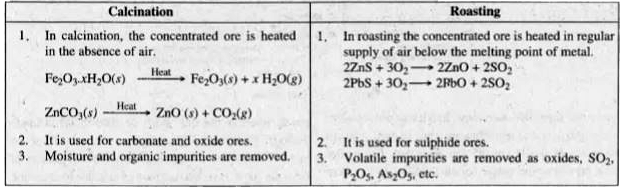
|
|
| 10. |
Give the oxidation state and co-ordination number of central metal ion in the following comkplexes respectively: (P)K_(3)[Co(Co_(2)O_(4))_(3)]""(Q)cis[Cr(en)_(2)Cl_(2)]Cl (R)(NH_(4))_(2)[CoF_(4)]""(S)[Mn(H_(2)O)_(6)]SO_(4) |
|
Answer» <P>`(P)+3,6(Q)+3,6(R)+2,4(S)+2,6` 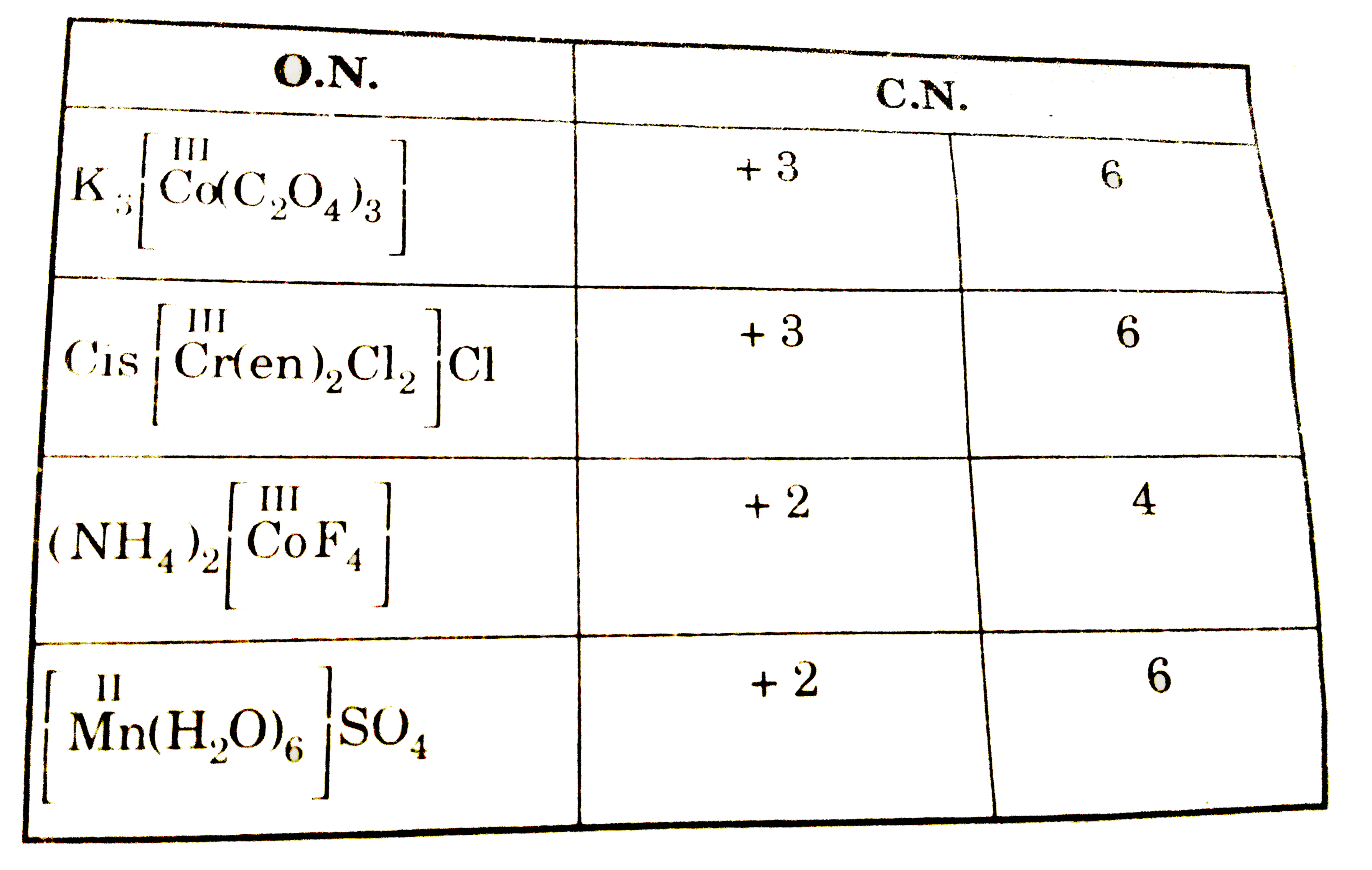
|
|
| 11. |
Giving appropriate examples (at least three), explain how the reactivity of a metal is related to its mode of occurrence in nature. |
|
Answer» Solution :Gold and platinum are least REACTIVE, therefore they occur in free state. Copper and SILVER can EXIST both in free state as well as in the COMBINED state. SODIUM, potassium and aluminium occur in the combined state because they are highly reactive. |
|
| 12. |
Give the oxidation state, d-orbital occuptation and coordination number of central metal ion in the following complexes : [K_(3)[Co(C_(2)O_(4))_(3)] (ii) (NH_(4))_(2)[CoF_(4)] (iii) cis-[Cr(en)_(2)Cl_(2)]Cl (iv) [Mn(H_(2)O)_(6)]SO_(4). |
| Answer» Solution :`{:(,"Complex","Oxidation state","Coordination No.","d-orbital occupation","Unpaired electrons"),((i),K_(3)^(+)[Co(C_(2)O_(4))_(3)]^(3-),x-6=-3,6("as "C_(2)O_(4)^(2-)" is didentate"),Co^(3+)=3D^(6),0),(,,x=+3,,=t_(2g)^(6)e_(g)^(0),),((ii),(NH_(4))_(2)^(+)[CoF_(4)]^(2-),x-4=-2,4,Co^(2+)=3d^(7),3),(,,x=+2,,=e^(4)t_(2)^(3),),((III),cis-[Cr(en)_(2)Cl_(2)]^(+)Cl^(-),x+0-2=+1,"6 (en is didentate)",Cr^(3+)=3d^(3),3),(,,x=+3,,=t_(2g)^(3),),((iv),[Mn(H_(2)O)_(6)]^(2+)SO_(4)^(2-),x+0=+2,6,Mn^(2+)=3d^(5),5),(,,x=+2,,=t_(2g)^(3)e_(g)^(2),),(,,,,,):}` | |
| 13. |
Giving examples differentiate between 'roasting' and 'calcination' |
Answer» SOLUTION :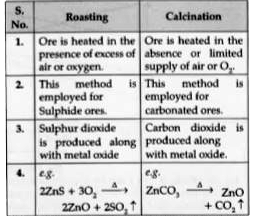
|
|
| 14. |
Give the oxidation state, d-orbital occupation and coordination number of the central metal ion in the following complexes: i) K_(3)[Co(C_(2)O_(4))_(3)] (ii) (NH_(4))_(2)[CoF_(4)] (iii) cis-[Cr(en)_(2)Cl_(2)]Cl (iv) [Mn(H_(2)O)_(6)]SO_(4) |
Answer» SOLUTION :The REQUIRED INFORMATION is GIVEN in the FOLLOWING table : 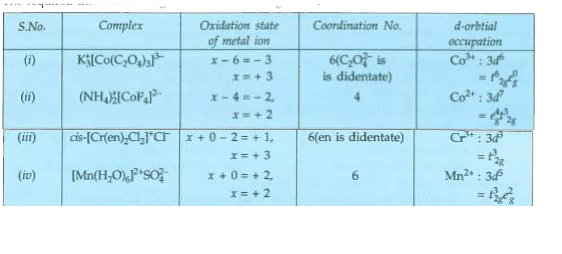
|
|
| 15. |
Giving examples, differentiate between ‘roasting' and 'calcination'. |
|
Answer» Solution :Calcination : The CONVERSION of carbonates and hydrated ores into their respective oxides by HEATING in LIMITED supply of air below its melting point is called calcination. For EXAMPLE : `CaCO_3cdot MgCO_3 overset(Delta)(rarr) CaO + MGO + 2CO_2` `Fe_2O_3 cdot 3H_2O overset(Delta)(rarr) Fe_2O_3 + 3H_2O`. Roasting : The conversion of sulphide ores into oxide ores by heating an ore below its melting point in excess supply of air is called roasting `2ZnS + 3O_2 to 2ZnO + 2SO_2` `2PbS + 3O_2 to 2PbO + 2SO_2` . |
|
| 16. |
Giving examples, differentiate between 'roasting' and 'calcination'. |
|
Answer» Solution :CALCINATION : The PROCESS of converting carbonates and hydroxide ores of metals to their respective oxides by heating them strongly below their MELTING points EITHER in absence or limited supply of air is called calcination. For example, `{:(Fe_(2)O_(3).3H_(2)O overset(triangle)(to)Fe_(2)O_(3)+3H_(2)O),(" LimoniteFerric oxide "),(CaCO_(3).MgCO_(3)overset(triangle)(to)CaO+MgO+2CO_(2)),(" Dolomite "),(CuCO_(3).Cu(OH)_(2)overset(triangle)(to)2CuO+H_(2)O+CO_(2)),(" Malachite "),(ZnCO_(3)overset(triangle)(to)ZnO+CO_(2)),(" Calamine "):}` Roasting : The process of convertinga sulphide ore into its metallic oxide by heating strongly below its melting point in excess of air is called roasting. For Example, `{:(2ZnS+3O_(2)to2ZnO+2SO_(2)uparrow),(" Zinc blendeZinc Oxide "),(PbS+3O_(2)to PbO+2SO_(2)uparrow),(" GalenaLead oxide "):}`. |
|
| 17. |
Give the oxidation and reduction half cell reaction taking place in the Daniel cell. |
|
Answer» Solution :Zinc is oxidised to `Zn^(2+)` ions and the `Cu^(2+)` ions are reduced to metallic COPER. The half reactions are represented as below. `""Zn_((s)) RARR Zn_((AQ))^(2+)+2e^-)" (OXIDATION)"` Loss of election oxidation `Cu_((aq))^(2+)+2e^(-) rarr Cu_((s))" (reduction)"` Gain of electron oxidation. |
|
| 18. |
gives : |
|
Answer»
|
|
| 19. |
Give the oxidation and the reduction reactions of phenols. |
Answer» SOLUTION :`to` PHENOL is converted to benzene on heating with zinc dust. This is the reduction reaction of phenol.  The oxidation of phenol with chromic acid produces a CONJUGATED diketone known as benzoquinone. In the presence of AIR, phenols are slowly oxidized to dark coloured mixture containing QUINONES. 
|
|
| 20. |
Give the order of reactivity towards SN^(2) reaction of the followig: a. i. 1- Bromopentane ii. 2- Bromopenatane iii. 2- Bromo -2 methyl butane b. i. n- Butybromide (C_(4) H_(9) Br) ii. Isobutyl bromide Me_(2) CHCH_(2)Br iii. sec- Buityl bromnide CH_(3) - CH(Me) CH_(2)Br iv. tert- Butyl bromide Me_(2)C-Br |
|
Answer» SOLUTION :a. `(i) gt (II) gt (iii) (1^(@) gt 2^(@) gt 3^(@))` b. `(i) gt (ii) gt (iii) gt (IV). SN^(2)` is slow for large `G` in `G - CH_()X`. |
|
| 21. |
Give the other name for polymers. |
| Answer» SOLUTION :MACROMOLECULES | |
| 22. |
Give the order of chelating effect of following ligands: (P)C_(2)O_(4)^(2-)""(Q)EDETA^(4-) (R)dien |
|
Answer» `RgtQgtP` |
|
| 23. |
Givingan example of each, describe the following reactions : (i) Hoffmann's bromamide reaction. "" (ii) Gatterman reaction. (iii) A coupling reaction. |
|
Answer» Solution :(i) Hoffmann.s bromamide reaction : <BR> `underset("Ethanamide")(CH_(3)-overset(overset(O)(||))(C)-NH_(2))+Br_(2)+4NaOH rarr underset("Methanamine")(CH_(3)NH_(2))+Na_(2)CO_(3)+2NaBr+2H_(2)O` The amine obtained contains one carbon atom less than the amide taken. (ii) Gatterman reaction : `""underset(underset("chloride")("Benzene diazonium"))(C_(6)H_(5)N_(2)^(+)Cl^(-)) overset(Cu//HCl)(rarr)underset("Chlorobenzene")(C_(6)H_(5)Cl+N_(2))+CuCl` (iii) Coupline reaction : 
|
|
| 24. |
Give the order of basic nature of three amines. |
| Answer» SOLUTION :TERTIARY `LT` PRIMARY `lt` SECONDARY. | |
| 25. |
gives |
|
Answer»

|
|
| 26. |
Give the numbers: 161 cm,0.161 cm:0161 cm . The number of significant figure for three numbers is: |
|
Answer» 3,4,5 |
|
| 27. |
Given : Zn(OH)_2(s) hArr Zn(OH)_2(aq) , K_1=10^(-6) Zn(OH)_2(aq) hArr [Zn(OH)]^(+) +OH^(-), K_2=10^(-7) [Zn(OH)]^+(aq) hArr Zn^(+2)+OH^(-), K_3=10^(-4) Zn(OH)_2(aq)+OH^(-)hArr [Zn(OH)_3]^(-), K_4=10^(3) [Zn(OH)_3]^(-) (aq) + OH^(-) hArr [Zn(OH)_4]^(2-) , K_5=10 Find out the negative of loganithm of the solubility of solid Zn(OH)_2 at 25^@C at pH=6.Consider Zn(OH)_2 makes saturated solution at 25^@C (Write down in OMR sheet if your answer is 1.23 then 1 2 3 etc. ) |
|
Answer» Now, `[Zn(OH)_2]_(aq)=10^(-6)` M in SATURATED solution. so `[Zn(OH)]^(+)+(10^(-6)xx10^(-7))/([OH^-])=10^(-13)/([OH^(-)])` Similarly`[Zn^(+2)]=10^(-17)/([OH^(-)]^2),[Zn(OH)_3]^(-)=10^(-3) [OH^(-)]` `[Zn(OH)_4^(2-)]=K_5[Zn(OH)_3^(-)][OH^-]=(10^(-2)M^(-1))[OH^(-)]^(2)` Dissolved `Zn(OH)_2=10^(-17)/([OH^(-)]^(2))+10^(-13)([OH^(-)])+10^(-6)+10^(-3)[OH^(-)]+10^(-2)[OH^(-)]^2` `=10^(-17)/10^(-19)+10^(-13)/10^(-8)+10^(-6)+10^(-3)xx10^(-8)+10^(-18)=10^(-1)+10^(-5)+10^(-6)+10^(-11)=10^(-1)` -log `Zn(OH)_2(aq)`=1 |
|
| 28. |
Give the number of unpaired electrons in the following complex ions: [FeF_(6)]^(4-) and [Fe(CN)_(6)]^(4-) |
|
Answer» Solution :`[FeF_(6)]^(4-)`: The metal (FE) is in `+2` oxidation state with configuration `[Ar]^(18)3d^(6)`. It has four unpaired electrons. `[Fe(CN)_(6)]^(4-)`: Same as above. |
|
| 29. |
Givenn are cyclohexanol (I), acetic acid (II), 2,4,6-trinitrophenol (III) and phenol (IV). In these, the order of decreasing acidic character will be |
|
Answer» IIIgtIVgtIIgtI 2,4,6-tribromophenol (III)gtacetic acid(II)gtphenol (IV)gtcyclohexanol (I), i.e., option (b) is correct. |
|
| 30. |
Give the number of N and M ? |
|
Answer» 6,6 |
|
| 31. |
{:("Given",,,,),("Gas", H_(2), CH_(4), CO_(2), SO_(2)),("Critical", 33, 190, 304, 630),("Temperature "//K,,,,):} On the basis of data given above, predict which of the following gases shows least adsorption on a definite amount of charcoal ? |
|
Answer» `CH_(4)` |
|
| 32. |
Give the number of characteristic bond found in the various oxy-acids of phosphorus as given below. (P)Number of P-O-P bonds in cyclotrimetaphosphoric acid. (Q)Number of P-P bond in hypophosphoric acid (R)Number of P-H bond in hypophosphorus acid (S) Number of P-OH bonds in pyrophosphoric acid |
Answer» 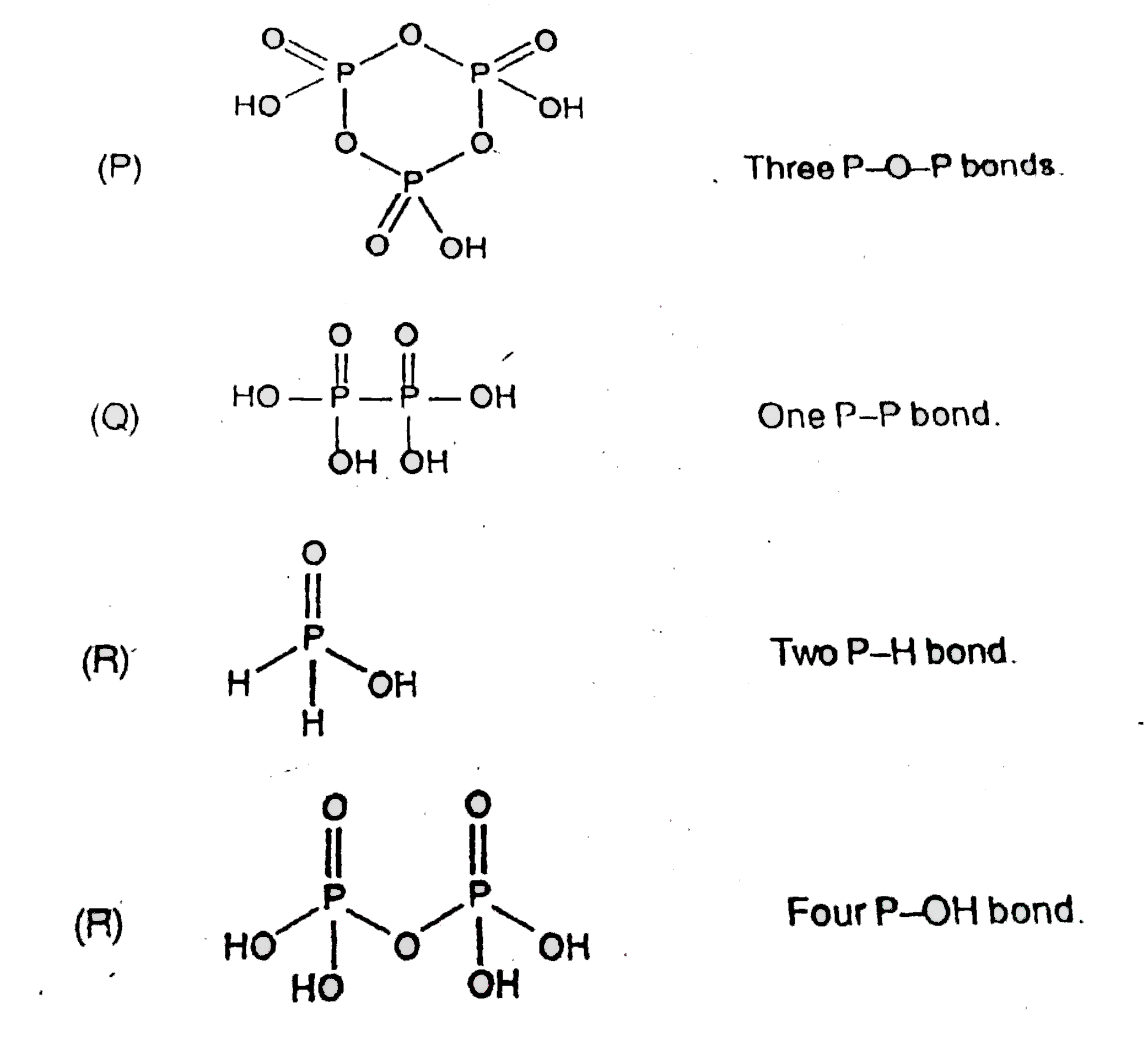
|
|
| 33. |
Given two exampoles of colloidal dispersion in which a liquid is dispersed in a solid. What are such colloidal dispersions called ? |
| Answer» SOLUTION :JELLY and CHEESE. These AER CALLED 'gels' | |
| 34. |
Givethe namesofthefourmostabundant elementsinthe earth'scrust?Arrange them indecreasingabundance. |
| Answer» Solution : ` O (46*6 %) gt Si (27*7 %) gt AL (8*3%) gtiron (4*7%)`. | |
| 35. |
Given triangle_(r)H^(@) ("kJ/mol") S_(m)^(@) ("J/mol-K") C Cl_(4)(l)-135.4" "214.4 C Cl_(4)(g) -103.0" "308.7 The boiling point of carbon tetrachloride is |
|
Answer» `8.25^(@)C` |
|
| 36. |
Give the names and formulae of three ores which are concentrated by froth floatation process. |
|
Answer» |
|
| 37. |
Given two examples Weak acid (ii) Weak base |
|
Answer» SOLUTION :Weak acid: `HF, CH_3COOH` (II) Weak base: `F^(-), CH_3COO^-` |
|
| 38. |
Give the name of the process used in the extraction of aluminium from bauxite. |
| Answer» SOLUTION :LEACHING. | |
| 39. |
Given the two allotropes of sulphur. |
| Answer» SOLUTION :(i) RHOMBUS (II) MONOCLINIC | |
| 40. |
Give the uses of zinc. |
|
Answer» Solution :Metallic zinc is used in galvanising metals such as iron and steel structures to protect them from rusting and corrosion. Zinc is also used to produce die-castings in the automobile, electrical and hardware industries. Zinc oxide is used in the manufacture of many products such as paints, RUBBER, cosmetics, pharmaceuticals, plastics, links, batteries, textiles and electrical equipment. Zinc sulphide is used in making luminous paints, fluorescent lights and x-ray SCREENS. BRASS an alloy of zinc is used in water VALVES and COMMUNICATION equipment as it is highly resistant to corrosion. |
|
| 41. |
Give the name of the polymer which is used for making non stick utensils. |
| Answer» SOLUTION :TEFLON, `[-CF_2 - CH_2 --]_n` | |
| 42. |
Given the structures of the compounds formed when the reaction takes place between benzaldehyde and formaldehyde . What is the name of the reaction ? |
|
Answer» Solution :`C_(6)H_(5)"HCHO"OVERSET(NAOH)rarrHCOONa + C_(6)H_(5) CH_(2)OH` This reaction is called as crossed Cannizzaro reaction . |
|
| 43. |
Give the name of the main product obtained when CO reacts with H_2 in the presence of nickel. |
| Answer» SOLUTION : METHANE | |
| 44. |
Given the structure of each of the prodcuts in the following reaction (i) Sucrose overset(H^(+))rarr A+B (ii) . |
|
Answer» `'A'` is `D(+)-` GLUCOSE `'B'` is `-F(-)-` FRUCTOSE |
|
| 45. |
Give the name of the polymer which is used for making non-stick utensils. |
Answer» SOLUTION :TERFLON , or POLY(TETRAFLUOROETHYLENE) 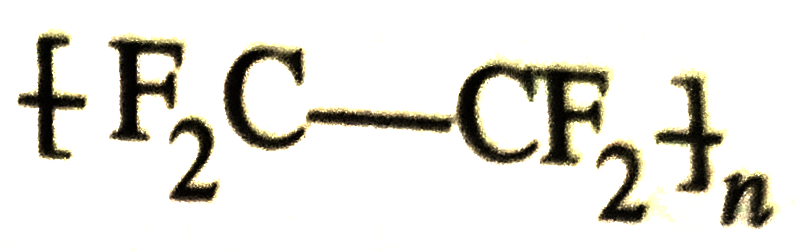
|
|
| 46. |
giventhe standardhalf-cellpotentials(E^@)of thefollowing as :Zn=Zn^(2+) +2e^(- ), E^@= + 0.76 V Fe = Fe^(2+) + we^(-) , E^@= 0.41V thenthe standarde,m,fof thecellwith thereaction |
|
Answer» `-0.35 V` `THEREFORE ` StandardEMFof thecell = Oxidationpotentialof anode+ Reductionpotentialofcathode `-(0.76) + ( -0.41 ) = +0.35V ` |
|
| 47. |
Give the name of the hydrolysed product formed by reacting benzene with ozone . |
|
Answer» |
|
| 48. |
Given the standard oxidation potential Feoverset(+0.4V) to Fe^(2+) (aq) overset(-0.8 V) to Fe^(3+) (aq) , Fe overset(+0.9V) to Fe(OH)_2 overset(0.6V) to Fe(OH)_3 It is easier to oxidize Fe^(2+)toFe^(3+) in : |
|
Answer» Acid MEDIUM |
|
| 49. |
Give the structure for (a) Sulphurous acid (b) Sulphuric acid (c) Peroxydisulphuric acid (d) Pyrosulphuric acid (Oleum). |
Answer» SOLUTION :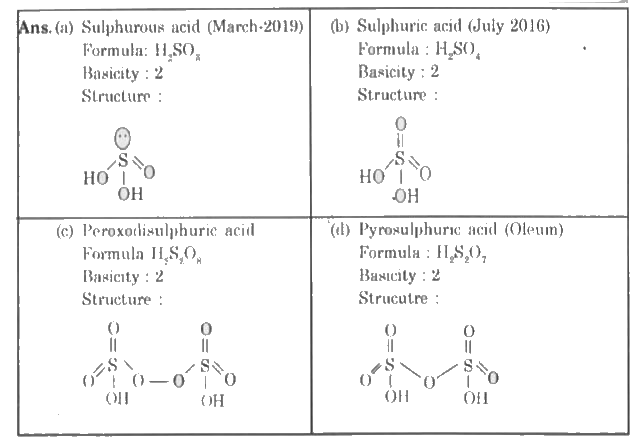
|
|
| 50. |
Give the name of the first antibiotic. |
| Answer» SOLUTION :PENICILLIN is the FIRST ANTIBIOTIC DISCOVERED. | |
 `</p>Answer :A)


