

Saved Bookmarks
This section includes 7 InterviewSolutions, each offering curated multiple-choice questions to sharpen your Current Affairs knowledge and support exam preparation. Choose a topic below to get started.
| 1. |
Given the following information : A^(-)(g) rarr A^(2+) (g) + 3e^(-) DeltaH_(1) = 1400 KJ//"mole" A (g) rarr A^(2+) (g) + 2e^(-) DeltaH_(2) = 700 KJ//"mole" DeltaH_(eg) [A^(+)(g)] = -350 KJ//"mole" IE_(1) + IE_(2) for A (g) = 950 KJ//"mole" The value of IE_(1) of A^(-) in KJ/mol is : |
|
Answer» 450 `{:(A^(-)rarrA+e^(-)),(ArarrA^(+)+e^(-)),(A^(+)rarrA^(+2)+e^(-)):}}1400 "kJ/mole"....("i")` `{:(ArarrA^(+)+e^(-)),(A^(+)rarrA^(+2)+e^(-)):}}IE_(1)+IE_(2) "of" A = 950 "kJ/mole" ....("ii")` Comparing (i) and (ii) `A^(-)rarrA+e^(-)rArr 450 "kJ/mole"` |
|
| 2. |
Give the major products obtained on heating the ether with one equivalent of HI. CH_(3)-overset(18)O-underset(CH_(3))underset(|)overset(CH_(3))overset(|)C-CH_(3) |
|
Answer» SOLUTION :The major PRODUCTS FORMED in the reactions with above ether is as follows: `CH_(3)OVERSET(18)OH +CH_(3)-underset(CH_(3))underset(|)overset(CH_(3))overset(|)C-I(S_(N)1)` |
|
| 3. |
Given the following molar conductivities are25^(@) C , HCl, 426 Omega^(-1) cm^(2) mol^(-1), NaCl , 126 Omega^(-1)cm^(2) mol^(-1), NaC( sodium crotonate ) , 83 Omega^(-1) cm^(2) mol^(-1) , what is the ionization constant of crotonic acid ? Ifthe conductivity of a 0.001 M corotonic acid solution is3.83 xx 10^(-5) Omega^(-1) cm^(-1) ? |
|
Answer» `10^(-5)` ` ^^_(M) = 3.83 xx 10^(-5)xx (1000)/(0.001) = 38.3 ` ` ALPHA = (^^)/(^^""^(oo)) =(38.3)/(383) = 0.1 = 10^(-1) , K_a = (C alpha^(2))/(1 - alpha ) = (10^(-3) xx (10^(-1))^(2) )/(1-0.1) = (10^(-3) xx (10^(-1))^(2))/(0.9) = 1.11 xx 10^(-5)` |
|
| 4. |
Give the major products obtained on heating the ether with one equivalent of HI. CH_(3)-CH_(2)-O-CH_(2)-CH_(3) |
|
Answer» Solution :The major products formed in the REACTIONS with above ETHER is as follows: `CH_(3)-CH_(2)-I+CH_(3)-CH_(2)-OH` |
|
| 5. |
Given the following equilibrium constants: (1) CaCO_(3)(s)toCa^(2+)(aq)+CO_(3)^(2-)(aq)K_(1)=10^(-8.4) (2) HCO_(3)^(-)(aq)toH^(+)(aq)+CO_(3)^(2-)(aq)K_(2)=10^(-10.3) Calculate the value of K for the reaction CaCO_(3)(s)+H^(+)(aq)=Ca^(2+)(aq)+HCO_(3)^(-)(aq) |
|
Answer» Solution :The net reaction is the sum of reaction 1 and the reverse of reaction 2: `CaCO_(3)(s)toCa^(2+)(aq)+CO_(3)^(2-)(aq)K_(1)=10^(-8.4)` `H^(+)(aq)+CO_(3)^(2-)(aq)toHCO_(3)^(-)(aq)K_(-2)=10^(-(-10.3))` `bar(CaCO_(3)(s)+H^(+)(aq)toCa^(2+)(aq)+HCO_(3)^(-)(aq)K=K_(1)//K_(2)=10^((-8.4+10.3))=10^(+1.9))` Comment: This net reaction describes the dissolution of limestone by acid, it is responsible for the eroding EFFECT of acid rain on BUILDINGS and statues. This is an example of a reaction that has practically no tendency to take PLACE by itself (the dissolution of calcium carbonate) begin “driven” by a second reaction having a large EQUILIBRIUM constant. From the standpoint of the LeChâtelier principle, the first reaction is “PULLED to the right” by the removal of carbonate by the hydrogen ion. “Coupled” reactions of this type are widely encountered in all areas of chemistry, and especially in biochemistry, in which a dozen or so reactions may be linked in this way. |
|
| 6. |
Give the major products obtained on heating the ether with one equivalent of HI. CH_(3)-overset(18)O-CH_(2)-CH_(2)-CH_(3) |
|
Answer» SOLUTION :The MAJOR PRODUCTS formed in the reactions with above ether is as FOLLOWS: `CH_(3)I+CH_(3)-CH_(2)-CH_(2)-overset(18)OH(S_(N)2)` |
|
| 7. |
Given the following equations calculate the standard enthalpy of the reaction: 2Fe_((s))+(3)/(2)O_(2_((g))) to Fe_(2)O_(3)(s)""DeltaH^(0)=? 2Al_((s))+Fe_(2)O_(3_((s))) to 2Fe_((s))+Al_(2)O_(3_((s)))""DeltaH^(0)=847.6kJ 2Al_((s))+(3)/(2)O_(2_((g))) to Al_(2)O_(3)(s)""DeltaH^(0)=-1670kJ |
|
Answer» `2Fe_((s))+(3)/(2)O_(2_((g))) to Fe_(2)O_(3_(s))""DeltaH_(1)^(0)=?` Given equations: `(ii)2Al_((s))+Fe_(2)O_(3_((s))) to 2Fe_((s))+Al_(2)O_(3_((s)))""Delta_(2)^(0)=847.6kJ` (iii) `2Al_((s))+(3)/(2)O_(2_((g))) to Al_(2)O_(3_((s)))""DeltaH_(3)^(0)=-1670kJ` By substructing eq. (ii) From eq. (iii), we get eq. (i) `DeltaH_(1)^(0)=DeltaH_(3)^(0)-DeltaH_(2)^(0)` `=-1670-(847.6)` `=-822.4kJ` `therefore Delta_(R)H^(0)=DeltaH_(1)^(0)=-822.4kJ` |
|
| 8. |
Give the major products obtained on heating the ether with one equivalent of HI. CH_(3)-CH_(2)-O-CH_(2)-Ph |
|
Answer» Solution :The major PRODUCTS formed in the reactions with above ether is as follows: `Ph-CH_(2)-I+CH_(3)-CH_(2)-OH` [`S_(N)1` (DUE to the FORMATION of benzyl carbocation)] |
|
| 9. |
Given the following entropy values ( in JK^(-1) "mol"^(-1)) at 298 K and 1 atm: H_(2)(g):130.6, Cl_(2)(g):223.0, HCl(g): 186.7. The entropy change (in JK^(-1) "mol"^(-1)) for the reaction H_(2)(g) + Cl_(2)(g) to 2HCl(g) , is |
|
Answer» `+540.3` `Delta_(I)S=sumS_(m)""^(@)(P) -sumS_(m)""^(@)(R)` `Delta_(I)S^(@)=2xxS_(m)^(@)(HCL) - [S_(m)^(@)(Cl_(2)) + S_(m)^(@) (H_(2))]` `=(2xx186.7)-(223+ 130.6)` `=373.4-353.6` `=+19.8 JK^(-) "mol"^(-)` |
|
| 10. |
Give the major products obtained on heating the ether with one equivalent of HI. |
Answer» Solution :The MAJOR products formed in the REACTIONS with above ETHER is as FOLLOWS: 
|
|
| 11. |
Give the major product formed by heating the following ethers with conc. HI and mentioning S_(N^(1))or S_(N^(2)) mechanism. (i) C_(6)H_(5)-O-CH_(3)(Methoxybenzene) (ii) C_(6)H_(5)CH_(2)-O-C_(2)H_(5)(Benzyl ethyl ether) (iii) C_(6)H_(5)CH_(2)-O-C_(6)H_(5)(Benzyl phenyl ether) |
|
Answer» Solution :[Hint] `underset("Phenol")(C_(6)H_(5)OH)+CH_(3)I(S_(N^(2))` REACTION, `1^(@)` R group) (ii) `underset("BENZYL iodide")(C_(6)H_(5)CH_(2)I)+underset("Ethanol")(C_(2)H_(5)OH)(S_(N^(1))` reaction, due to stability of benzyl `C^(+))` (iii) `underset("Phenol")(C_(6)H_(5)OH)+CH_(3)I(S_(N^(2))` reaction, `1^(@)` R group) (ii) `underset("Benzyl iodide")(C_(6)H_(5)CH_(2)I)+underset("Ethanol")(C_(2)H_(5)OH)(S_(N^(1))` reaction, due to stability of benzyl `C^(+))` 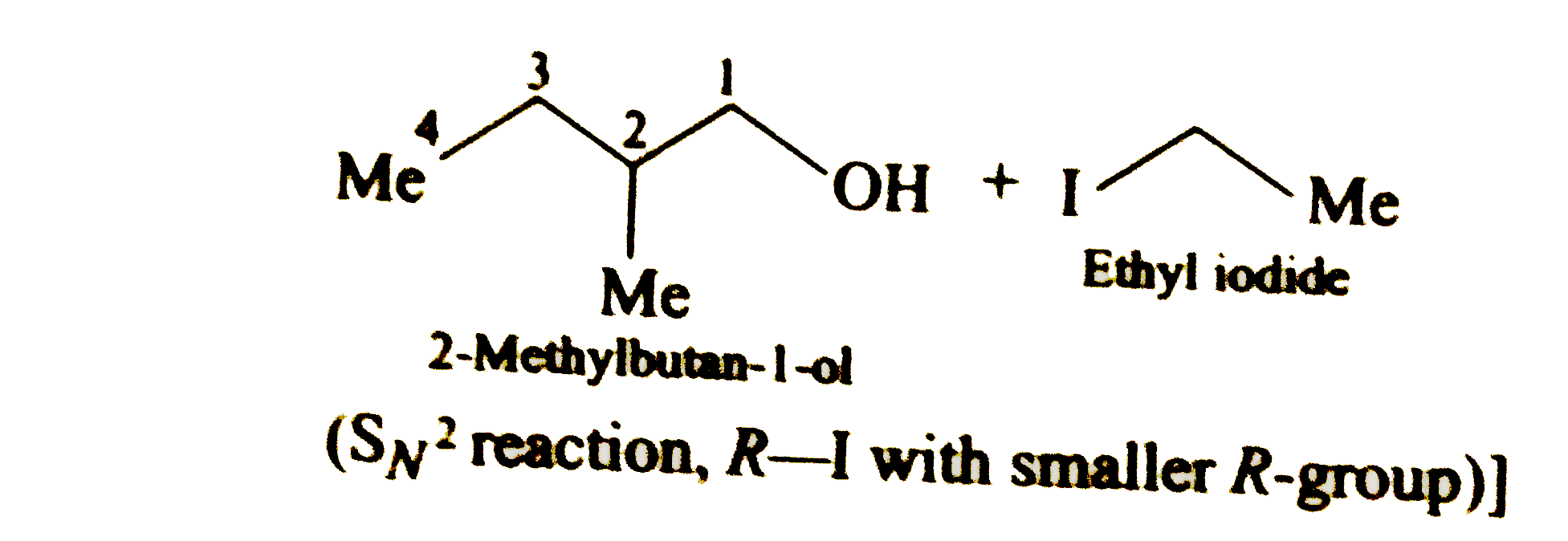 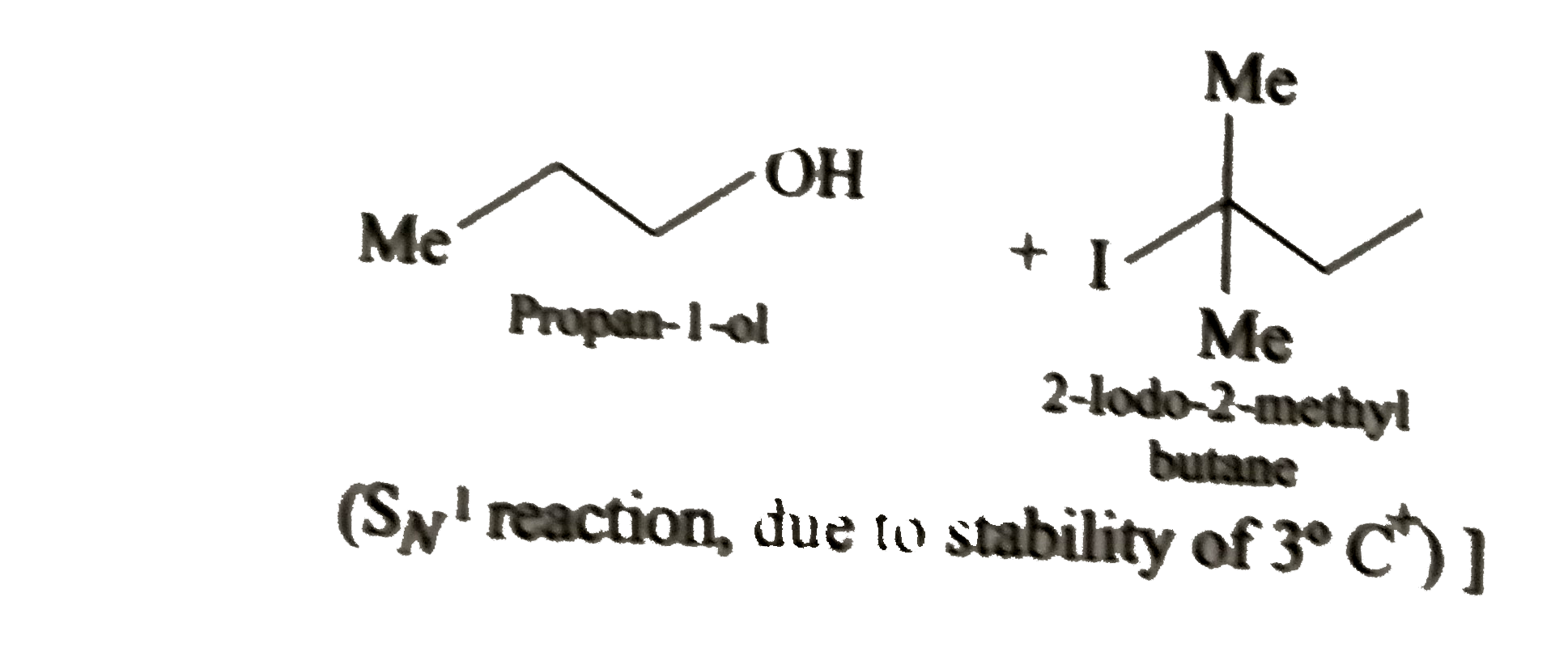
|
|
| 12. |
Given the following E^@ values at 25^@Ccalcualte K_(sp) for silver bromide, AgBr. Ag^+(aq)+e=Ag(s), E_1^0=0.80V AgBr(s)+e=Ag(s)+Br^(-) (aq), E_2^0=0.07V Also calculate Delta G^@ at 25^@C for the process AgBr(s) leftrightarrow Ag^+ (aq) + Br^(-) (aq) |
|
Answer» Solution :Reduction POTENTIAL `E_1^0 gt E_2^0` so cell REACTION is `Ag^+ (aq)+Br^(-) (aq)=AGBR(s)` for which, `E_(cell)^@=E_1^0-E_2^0=0.80-0.07=0.73V` We have `E^@=(2.303 RT)/(nF) logk` `=0.73=(2.303 times 8.314 times298)/(1 times 96500)log K` `logk=12.3515` or `K=2.246 times 10^12` THUS for the eqb, AgBr(s) `leftrightarrow Ag^+ (aq)+Br^(-) (aq)` `K_(sp)=1/K=1/((2.246 times 10^12))=4.45 times 10^-13` Further for the reaction `Ag^+ (aq)+ Br^(-) (aq) leftrightarrow AgBr(s)` `Delta G^@=-2.303 RT logk ` `=-2.303times 8.314 times 298 times 12.3515` `=-70475.7 J//mol e` `=-70.47//mo l e` `=-70.47kJ//mol e` `therefore for AgBr(s) leftrightarrow Ag^+ (aq)+Br^(-) (aq)` `Delta G^@=+70.47kJ//mol e` |
|
| 13. |
Give the major products obtained on heating the ether with one equivalent of HI. |
Answer» Solution :The MAJOR PRODUCTS formed in the reactions with above ETHER is as follows: 
|
|
| 14. |
Given the example for a zero order reaction. |
|
Answer» Solution :Example for a zero ORDER REACTION : (i) Photochemical reaction between `H_2 anda CI_2` `H_(2_((g)))+Cl_(2_((g)))overset(hv)rarr2HCl_((g))` (ii) Decomposition of `N_2O` on hot PLATINUM SURFACE `N_2O_((g))hArrN_(2(g))+1/2O_(2(g))` (iii) Iodination of acetone in ACID medium is zero order with respect to iodine . `CH_3COCH_3+I_2overset(H^+)rarrICH_2COCH_3++HI` Rate `k = [CH_3COCH_2][H^+]` |
|
| 15. |
Give the major product of the following reaction |
Answer» SOLUTION :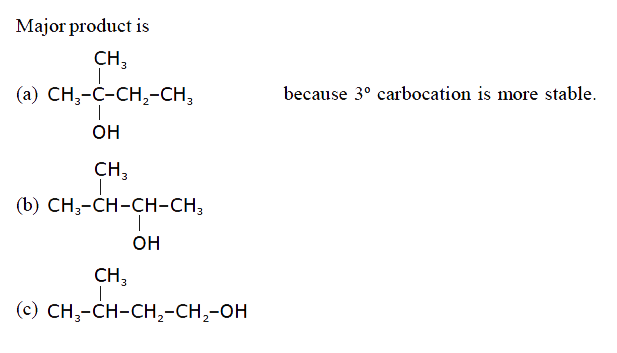
|
|
| 16. |
Given the following cell at 25^(@) C . What will be the potential of the cell ? Given pK_(a) of CH_(3) COOH = 4.74 |
|
Answer» `-0.42` V pHof `W_(A) = (1)/(2) ( pk_(a) - log c)` `= (1)/(2) (4.74 - log 10^(-3)) = 3.87` pH of NaOH = 14 - 3 = 11 `therefore E = -0.059 (pH_(c)- pH_(a))` `= -0.059 (11 - 3.87) = -0.42 V ` |
|
| 17. |
Give the major product for the reaction CH_(3)-CH_(2)-underset(OH)underset(|)CH-CH_(3) overset(HBr)to |
|
Answer» SOLUTION :The major products in the given REACTION is `CH_(3)-CH_(2)-overset(Br)overset(|)CH-CH_(3)` |
|
| 18. |
Given the equivalent conductance of sodium butyrate, sodium chloride and hydrogen chloride as 83, 127 and 426 mho cm^(2) at 25^(@)C respectively. Calculate the equivalent conductance of butyric acid at infinite dilution. |
| Answer» SOLUTION :`382 "MHO CM"^(2)` | |
| 19. |
Give the major product for the reaction |
Answer» SOLUTION :The MAJOR PRODUCTS in the GIVEN REACTION is 
|
|
| 20. |
Give the major product for the reaction |
Answer» SOLUTION :The MAJOR PRODUCTS in the GIVEN REACTION is 
|
|
| 21. |
Given the different types of batteries and explain the construction and working of each type of battery. |
|
Answer» Solution :The batteries which after their use over a period of time, becomes dead and the cell reaction is completed and this CONNOT be reused again are called primary batteries. Eg.: Leclanche cell, dry cell. Secondary BATTERY : A secodary battery is the battery in which after it's use can be reached and can be used again. A good secondary battery undergoes large no. of discharging and charging cycles. Lead stronge battery is an example of secondary battery. The cell reactions when the battery is in use are `Pb_((s))+ SO_(4(aq))^(-2)to PbSO _(4(s))+ 2e^(-)` (Anode) `PbO _(2(s))+SO_(4(aq))^(-2)to 4H_((aq))^(+)+2e ^(-) to PbSO_(4(s))+2H_(2)O_((l))`(Cathode) Overall cell reaction is `Pb_((s))+ PbO_(2(s))+2H_(2)SO_(4(aq))to 2PbSO_(4(s))+2H_(2)O_((l))` Construction and working of primary batteries : Dry cell : 1. This is a modification of Leclanche cell. The liquid state electrolytes (in Lecanche cell) are replaced by paste electrolytes. 2. A cylindrical 'Zn' vessel is covered with a cardboard. This is selected with pitch. Zn vessel acts as negative ELECTRODE. A carbon rod is introduced at the centre of the Zn vessel. This carbon rod acts as positive electrode. 3. Carbon rod is surrounded by a paste of `(C+ MnO_(2)).` The remaining space is filled with `(NH_(4)Cl+ZnCl_(2)).` The remaining space is filled with `(NH_(4)Cl+ZnCl_(2))` paste. The two pastes are separated by a porous sheet. 4. These cells are easy to handle and used in radios, watches, torch lights etc. The cell potential is approximately 1.5 V. 5. Electrode reactions : Cathode `: MnO _(2) +NH_(4)^(+)+e^(Θ)to MnO (OH)+ NH_(3)` Anode `:Zn +2MnO_(2)+ 2H_(2)O to Zn^(2+) +2OH^(Θ)+2MnO(OH)` Some of the secondary reactions are `2NH_(4)Cl+ 2OH^(Θ)to 2NH_(3)+ 2Cl^(-) +2H_(2)O` `Zn^(2+)+2NH_(3)+ 2Cl^(-) to[Zn (NH_(3))_(2) ]Cl_(2)` Secondary batteries - construction and working : A secdary cell after its use can be recharged and can be used again. A good secondary cell undergoes a large number of discharging and charging cycles. The most important secondary cell in use is the lead storage battery (gig (B)). This is commonly used in automobiles and invertors. It consists of a lead anode and a gird of lead packed with lead dioxide `(PbO_(2))` as cothode.` A38%` solution of sulphuric acid is used as electrolyte. The cell reactions when the battery is in use (discharging) are : Anode `: Pb_((s))+SO_(4(aq))^(2)to PbSO_(4(s))+2e^(-)` Cathode `:PBO_(2(s))+SO_(4(aq))^(-)+4H_((aq))^(+)+2e^(-)to PbSO_(4(s))+H_(2)O_((l))` i.e., overall cell reaction consisting of cathode and anode reactions is `Pb_((s))+PbO_(2(s))+2H_(2)SO_(4(aq))to 2 PbSO_(4(s))+2H_(2) O_((l))` These reactions occur during discharge i.e., during use of the bettery. On charginig the discharged battery the above reaction is reversed and `PbSO_(4)` (s) on anode and cathode is converteed into Pb and `PbO_(2),` respectively. 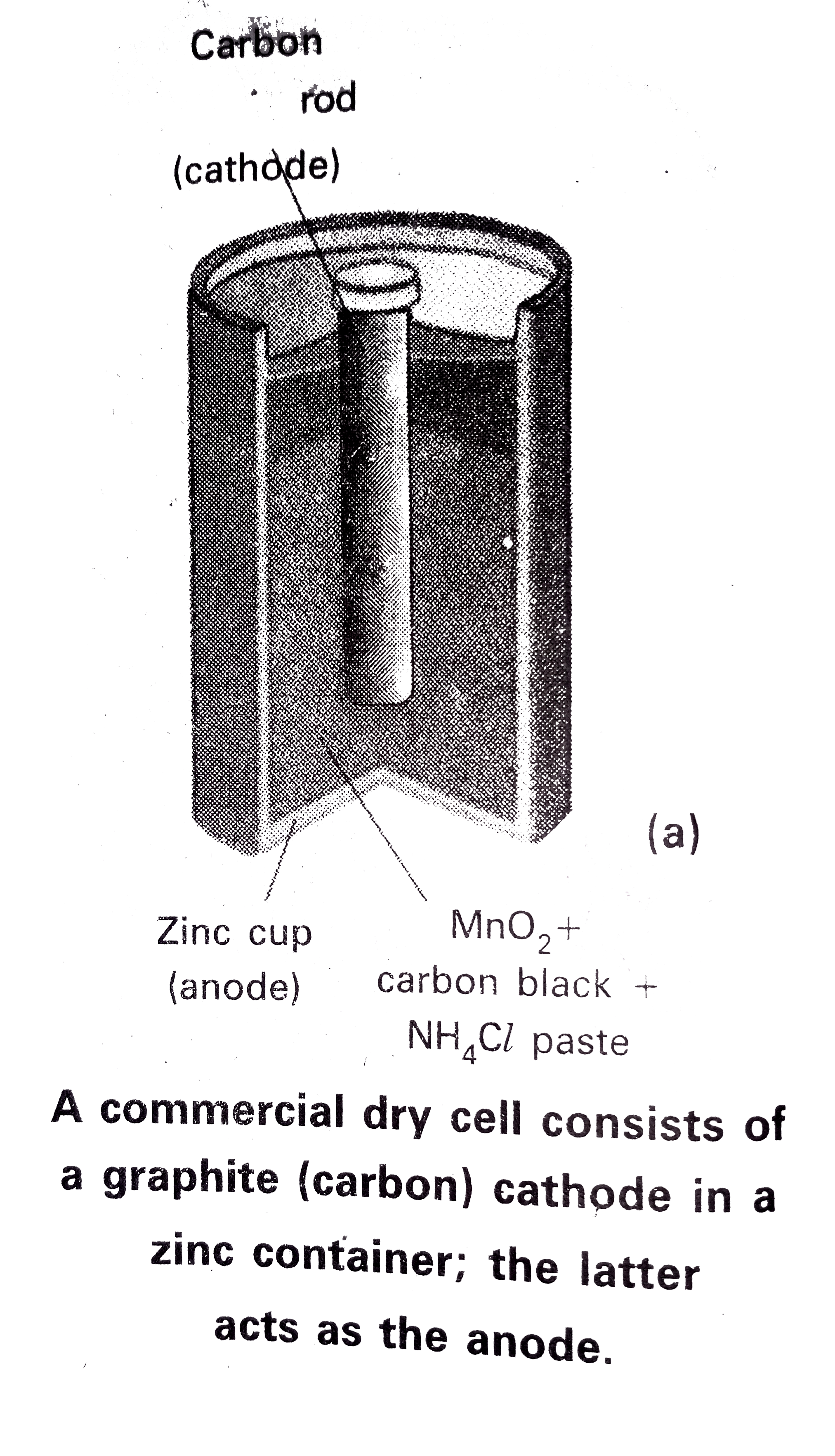 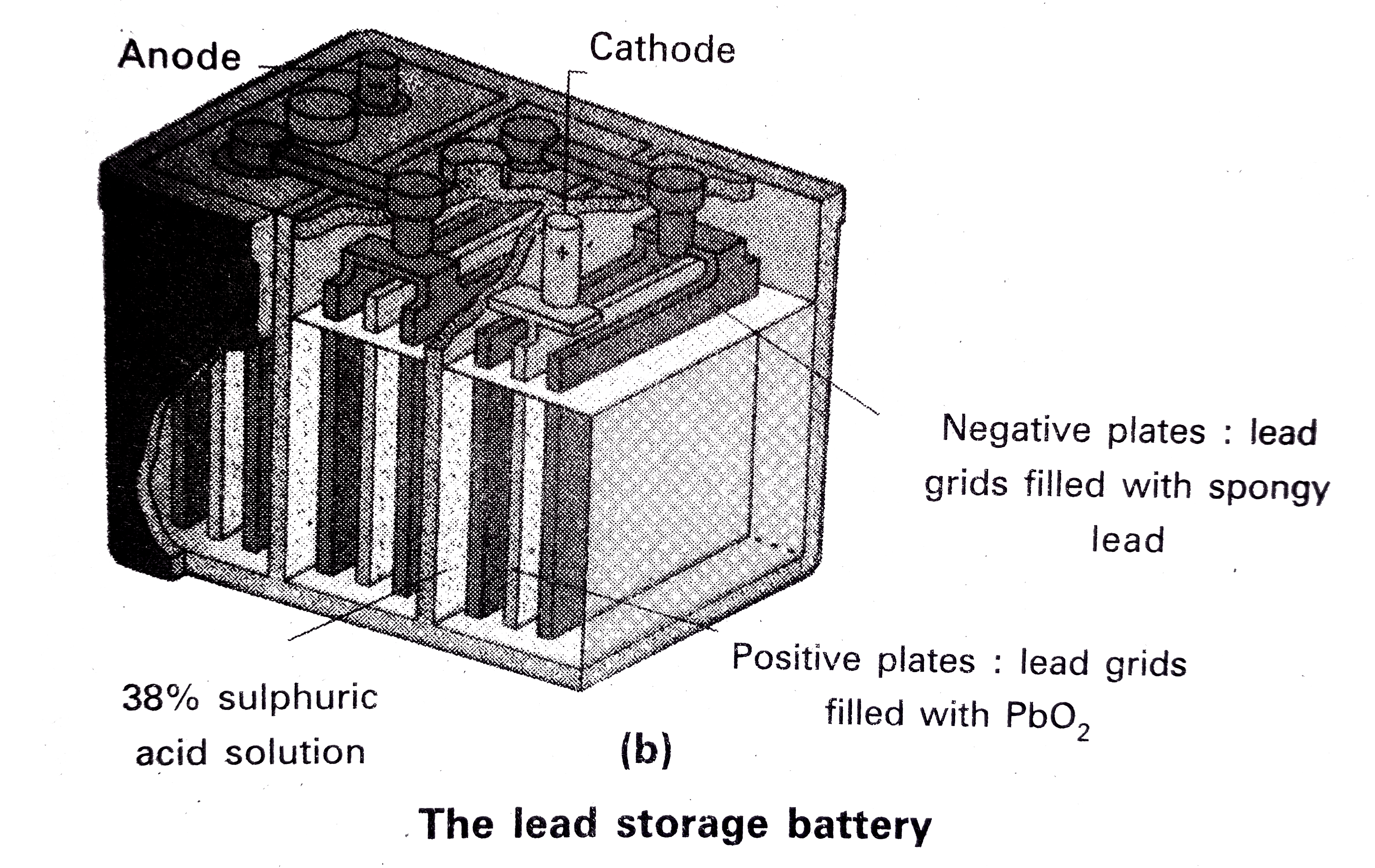
|
|
| 22. |
Give the main function Neurotransmitterin the body of human beings ? |
| Answer» SOLUTION :They CONTROL MOOD CHANGES in ORGANISMS. | |
| 23. |
Given the density of the chloroform is 1.510gcm^-3 , then the volume occupied by 20.050 g of chloroform (upto correct significant figures) is |
|
Answer» `13.3cm^3` |
|
| 24. |
Give the main function Receptor proteinsin the body of human beings ? |
| Answer» SOLUTION :IMPORTANT for the COMMUNICATION SYSTEM of the BODY. | |
| 25. |
Given the data at 25^(@)C, {:(AgI^(-) rarr AgI+e^(-),,E^(@) = 0.152 V),(Ag rarr Ag^(+) + e^(-),,E^(@) = -0.800 V):} What is the value of log K_(sp) for AgI (2.303 RT/F = 0.059 V) |
|
Answer» `-8.12` `E_(I^(-)|AgI|Ag)^(@) = E_(Ag^(+)|Ag)^(@) + 0.059 log K_(SP) (AgI)` `log K_(sp) (AgI) = (E_(I^(-)|AgI|Ag)-E_(Ag^(+)|Ag))/(0.09) = (-0.152-0.8)/(0.059) = -16.13` |
|
| 26. |
Give the major product for the reaction |
Answer» SOLUTION :The MAJOR PRODUCTS in the GIVEN REACTION is 
|
|
| 27. |
Given the decreasing order of reactivity of the following compounds with HBr. |
|
Answer» `III gt IV gt II gt I` |
|
| 28. |
Give the major product for the reaction |
Answer» SOLUTION :The MAJOR PRODUCTS in the GIVEN REACTION is 
|
|
| 29. |
Given the data at 25^(@)C, Ag+I^(-)toAgI+e^(-),E^(@)=0.152V AgtoAg^(+)+e^(-),E^(@)=-0.800V What is the value of log K_(sp) for AgI? (2.303RT/F=0.059V) |
|
Answer» `-37.83` `underset(Ag^(+)+e^(-)toAg,""E^(@)=0.800V)` `Ag^(+)+E^(-)toAgI,""E_(CELL)^(@)=0.952V` At equilibrium: `E^(@)=(2303RT)/(F)logK_(c)` but `K_(c)=([AGI])/([Ag^(+)][I^(-)])=(1)/(K_(sp))` `therefore0.952=-(2.303RT)/(F)"LOG "K_(sp)=-0.059" log "K_(sp)` or `lgoK_(sp)=-16.13` |
|
| 30. |
Give the major and minor product when glucose is reduced with Cone. HI/P. |
|
Answer» Solution :On reduction with CONCENTRATED HI and red phosphorus at 373K, GLUCOSE gives a mixture of n hexane and 2, iodohexane indicating that the six carbon atoms are bonded LINEARLY. `"Glucose "overset(HI//P)underset(327K)rarrCH_(3)(--CH_2--)_(4)underset("Major PRODUCT")underset("n-hexane")(CH_(3)+CH_2)(--CH_2--)_(3)underset("Minor product")underset("2-iodohexane")underset(I)underset(|)(CH)-CH_(3)` |
|
| 31. |
Given the data at 25^(@)C. Ag+I^(-) to Agl+e^(-) , E^(@)=-0.152" V " Ag to Ag^(+)+e^(-) , E^(@)=-0.800" V ". The value of log K_(sp) for AgI is : |
|
Answer» -8.12 `Ag to Ag^(+)+e^(-) , E^(@)=-0.800" V "` `Agl to Ag^(+)+I^(-) , E^(@)=-0.952" V "` `E_(cell)^(@)=(0.059)/(N)logK=(0.059)/(n)logK_(SP)` `logK_(sp)=(E_(cell)^(@)xxn)/(0.059)=((-0.952)XX1)/((0.059))=-16.135` |
|
| 32. |
Give the main function Enzymes in the body of human beings ? |
| Answer» SOLUTION :CATALYSE BIOCHEMICAL REACTIONS. | |
| 33. |
Given the bond energies N-=N, H-H and N-H bonds are 945,436 and 391 kJ "mole"^(-1) respectively, the enthalpy of the following reaction N_(2)(g)+3H_(2)(g)rarr2NH_(3)(g) is |
|
Answer» `-93` KJ NET. Energy released = 2346-2253=93 kJ i.e. `DeltaH=-93 kJ`. |
|
| 34. |
Give the list of reduction potential of some important electrode systems. |
Answer» SOLUTION :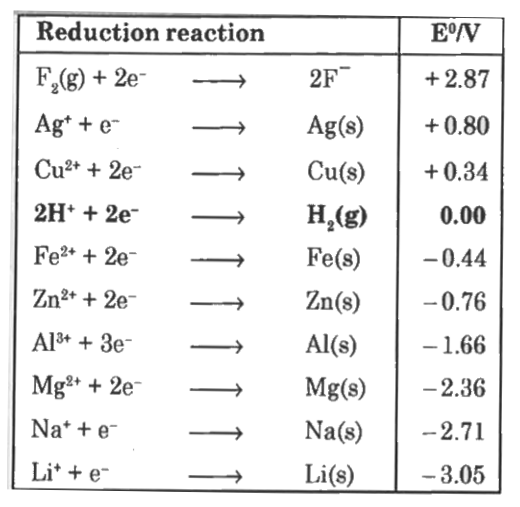
|
|
| 35. |
Give the limitations of Ellingham diagram. |
|
Answer» Solution :Limitations of Ellingham diagram: 1.Ellingham diagram is constructed based only on thermodynamic considerations.It gives informations about the thernodynamic feasibility of a reaction .It does not tell anything about the rate of the reaction.Moreover,it does not GIVE any IDEA about the possibility of other REACTIONS that might be TAKING place. 2.The interpretation of `DeltaG` is based on the assumption that the reactants are in equilibrium with the product which is not always true. |
|
| 36. |
Given the data at 25^@C Ag + I^(-) to AgI + e^(-) , E^@ = 0.152V Ag to Ag^(+) + e^(-) , E^@= -0.800VWhat is the value of log K_(sp) for AgI |
|
Answer» `-16.13` |
|
| 37. |
Givethe limitations of Ellingham diagram. |
|
Answer» SOLUTION :(i)Eilinghamdiagram is constructed basedonlyon thermodynamicconsiderations. (II)The interpretationof ` triangle`G isbased on the assumptionthat the reactantsare inequilibriumwith the productswhichis NOTALWAYS true. (III) It doesnot tellanythingaboutthe RATEOF the reaction. |
|
| 38. |
Given the bond energies of N=N, H-H and N-H bonds are 945, 436 and 391 kJ/mol respectively, the enthalpy of the reaction, N_(2)(g) + 3H_(2)(g) to 2NH_(3)(g) is |
| Answer» ANSWER :A | |
| 39. |
Give the IUPAC names off the following: (i) CH_(3)CH_(2)-underset(Br)underset(|)overset(CH_(3))overset(|)(C)-underset(Br)underset(|)(C)H-CH_(2)-Cl (ii) CH_(3)-underset(Cl)underset(|)overset(C_(2)H_(5))overset(|)(C)-CH_(2)-underset(Cl)underset(|)overset(C_(2)H_(5))overset(|)(C)-CH_(3) (iii) CH_(2)=CHCH_(2)Br (iv) (CH_(3))_(3)C CH_(2)Br. |
|
Answer» |
|
| 40. |
Given the chemical properties of lanthanoides. |
|
Answer» Solution :(i) They burn with OXYGEN to FORM `Ln_2O_3` `4Ln+ 3O_2 to 2Ln_2O_3` (ii) Lanthanoides combine with HYDROGEN when they are GENTLY heated forming hydrides. |
|
| 41. |
What are the limitations of Arrhenius concept? |
|
Answer» SOLUTION :(i) Arrhenius theory does not explain the behaviour of acids and bases in non aqueous solvents such as acetone, TETRAHYDROFURAN etc. (II) This theory does not account for the basicity of the substance LIKE ammonia `(NH_3)` which do not POSSESS hydroxyl group. |
|
| 42. |
Given the alcohol and alkene required to prepare the following ethers by alkoxy mercuration-demercuration. a.Di-se-butyl ether b. Di-isopropyl ether c.Di-t-butyl ether d.1-Methyl-1-methoxy cyclohexane e.1-Phenyl-1-ethoxy propane |
|
Answer» Solution :Write the STRUCTURE of there, and then remove the alkoxy group to GET the corresponding alkane and alcohol. a. 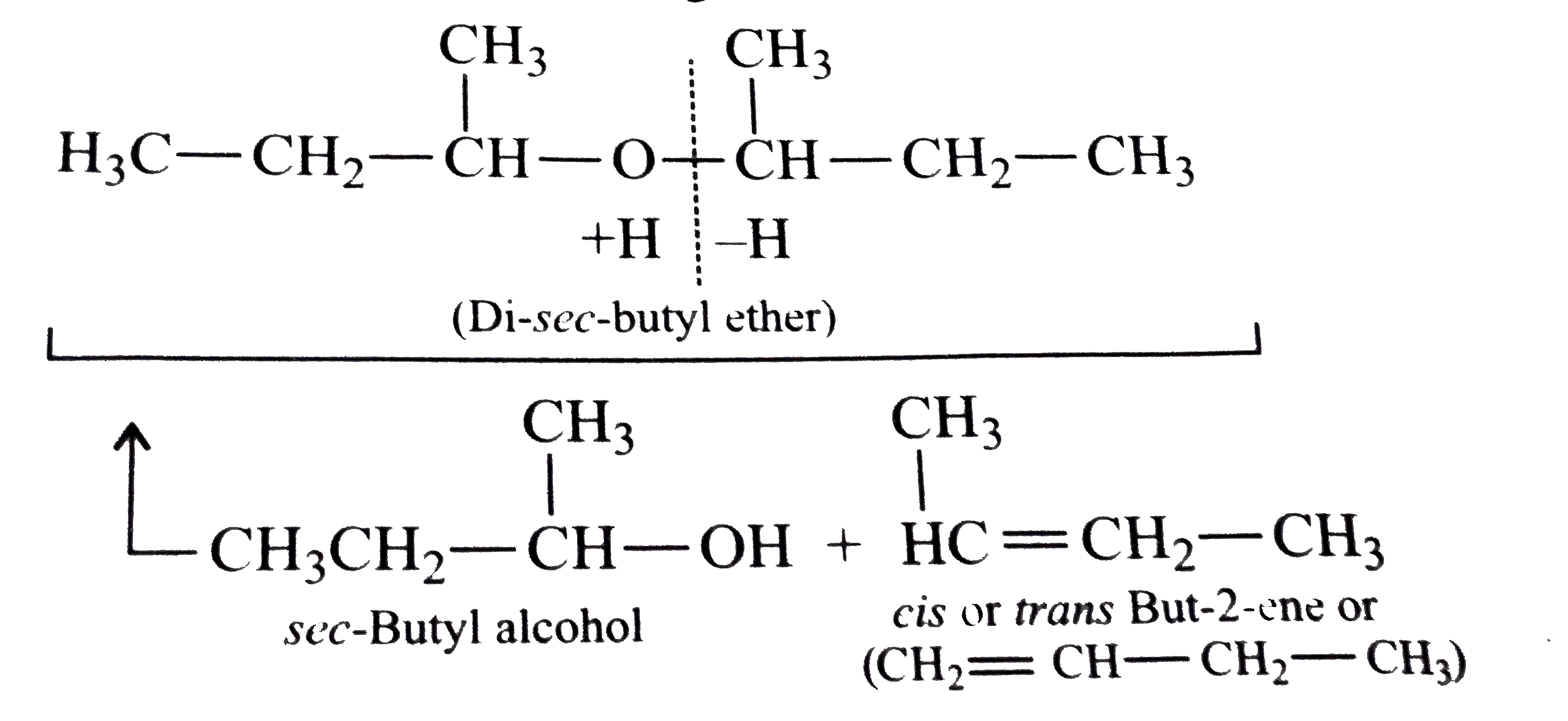 b. 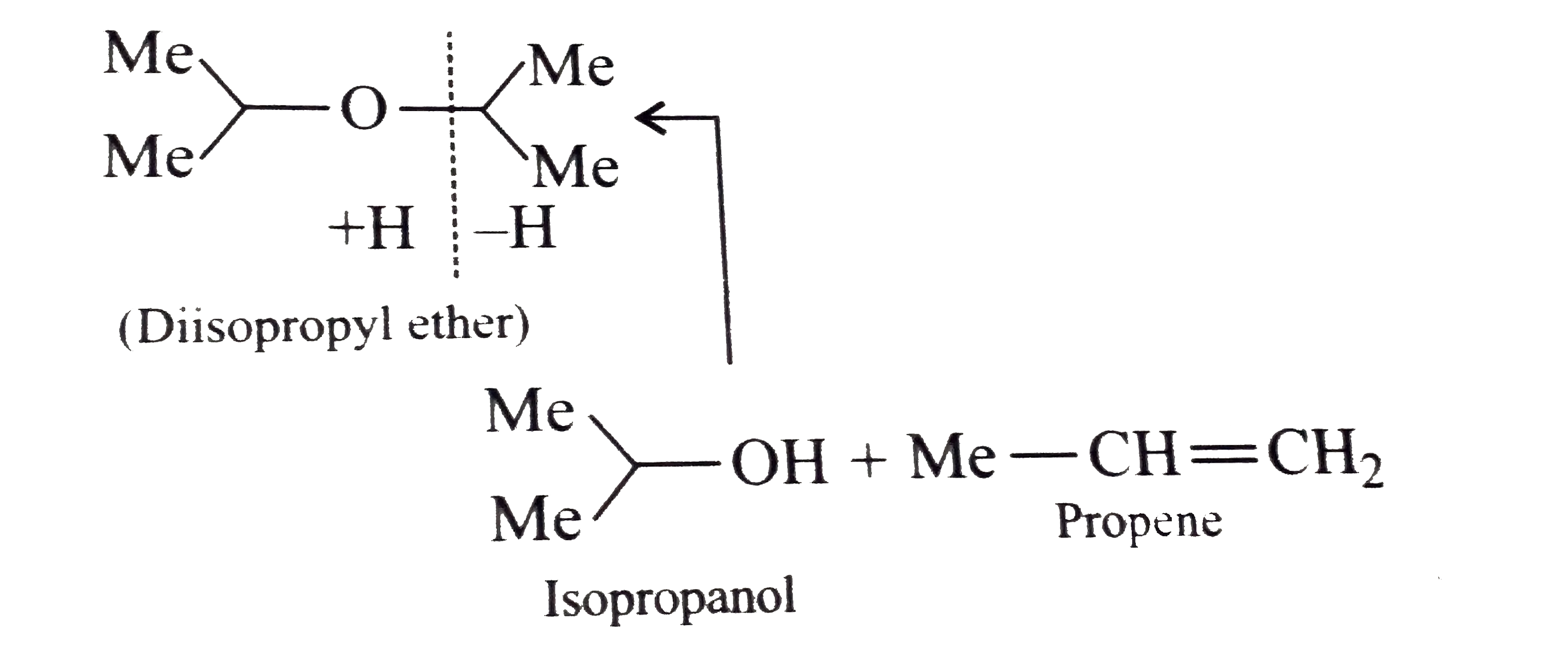 c. 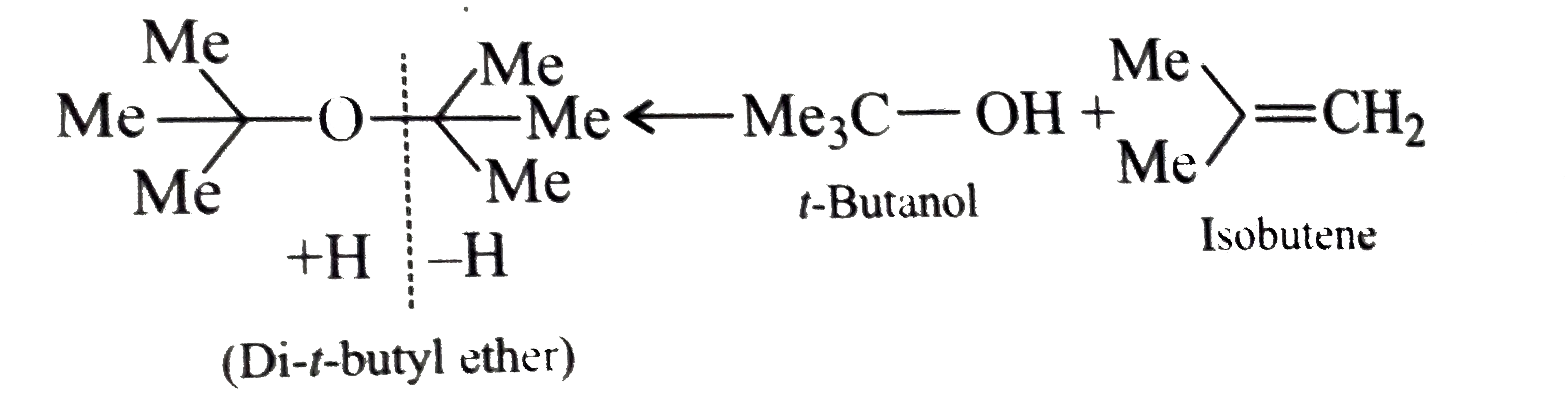 The yield of ethers with two `3^(@)` alkyl group is poor because of high steric hindrance. d. 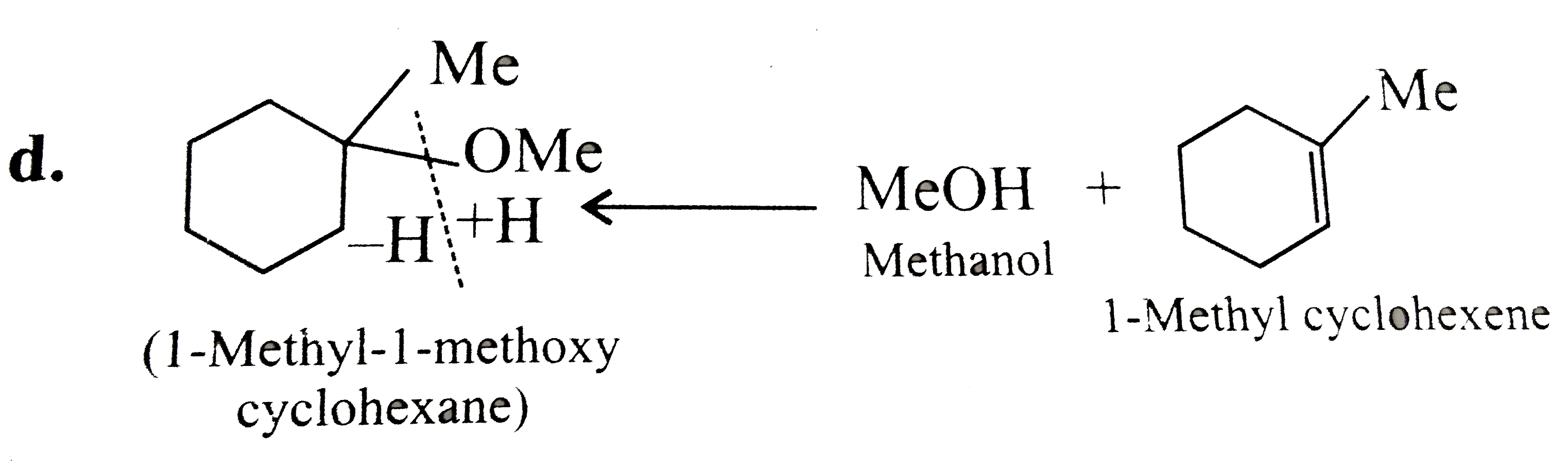 E. 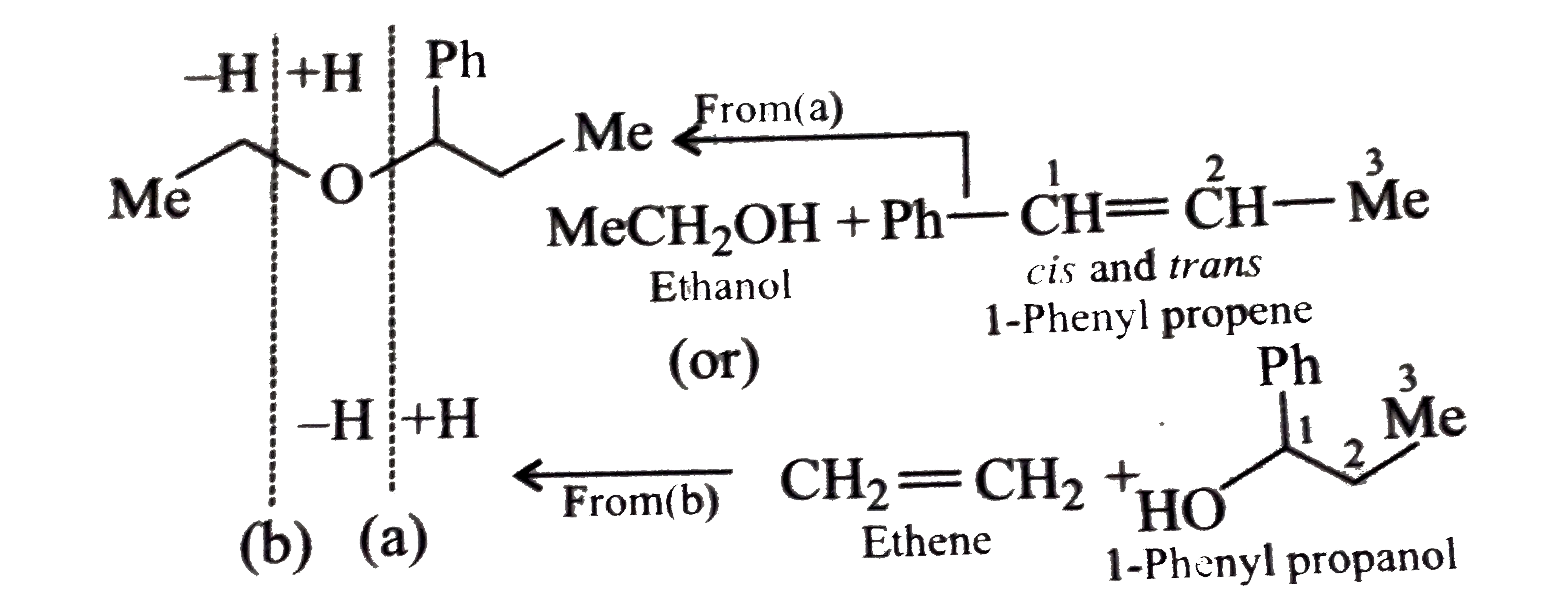 FORM (a): 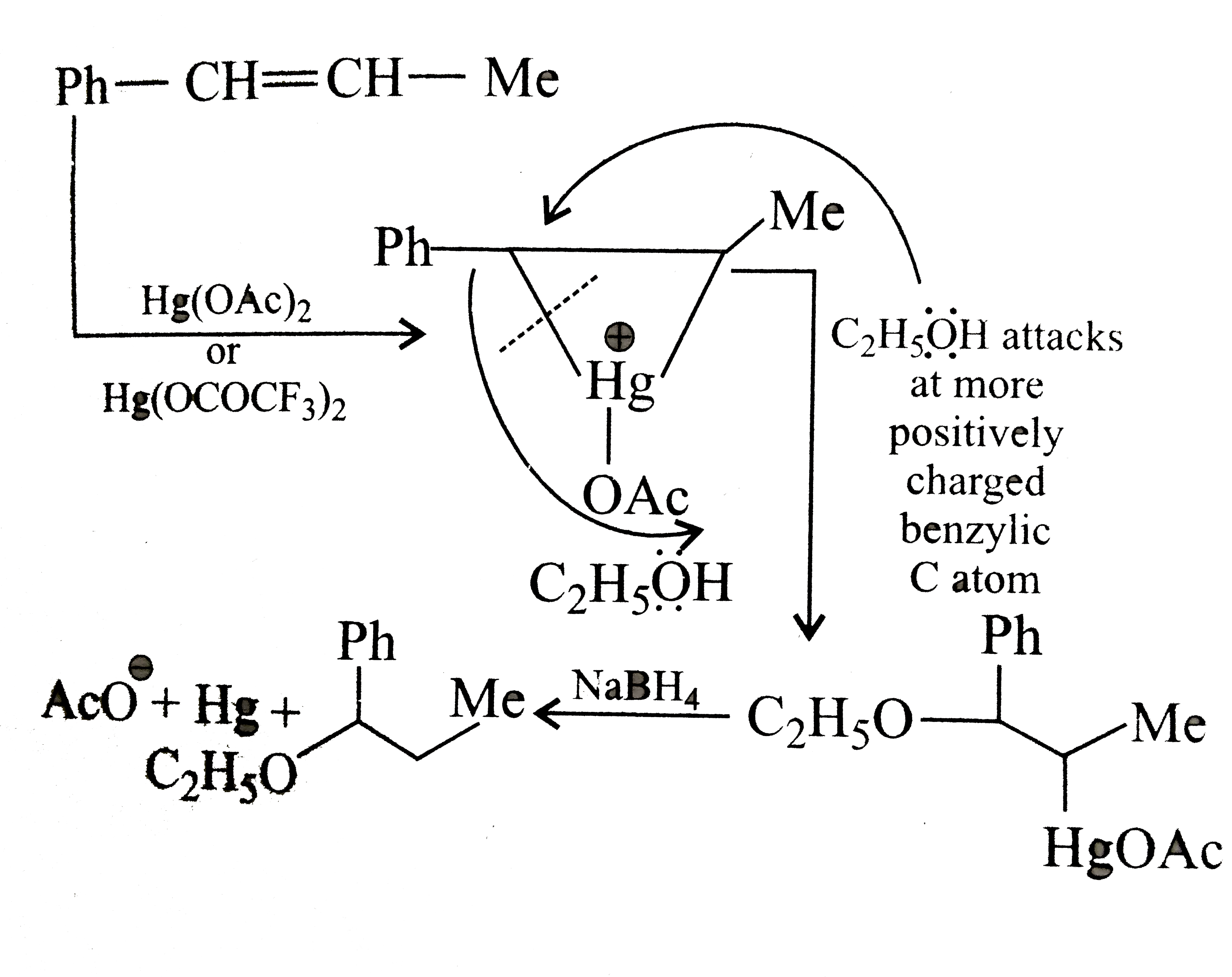
|
|
| 43. |
Given that triangleH^(@) _(ionization ) of HX and HY are 30 and 25 kJ//mol respectively, then which of the following relation is // are correct? |
|
Answer» `pK_(b)(X^(-))ltpK_(b)(Y^(-))` |
|
| 44. |
Give the IUPAC names of (ui) CH_(3)CH(OH)CH_(2)OH (ii) HO-CH_(2)-CH_(2)-OH (iii) CH_(3)-underset(OH)underset("|")"CH"-COOH |
|
Answer» SOLUTION :(i) propane-1, 2-diol (II) ethane-1,2-diol (III) 2-hydroxy PROPANOIC ACID |
|
| 45. |
Given that the temperature coefficient for saponification of ethyl acetate by NaOH is 1.75. Calculate the activation energy of the reaction. |
|
Answer» |
|
| 46. |
Give the IUPAC names of the following: P-NO_2 C_6 H_4 NH_2 |
| Answer» SOLUTION :p-nitrobenzenamine | |
| 47. |
Given that the standard potential , E^(@) of Cu^(2+)|Cu and Cu^(+)|Cu are 0.340 V and 0.522 V respectively. The E^(@) of Cu^(2+)|Cu^(+) is: |
|
Answer» 0.158 V `underline(Cu to Cu^(+) +e^(-))""E^(@)=-0.522V` `Cu^(2+)+e^(-) to Cu^(+)""E^(@)=(?)` Applying, `DeltaG=nFE^(@)` `(-1xxFxxE^(@))=(-2xxFxx0.340)` `=(-2xxFxx0.340)-(-1xxFxx-0.522)` `=-2xxFxx0.340+1xxFxx0.522` `-1xxFxxE^(@)=-1Fxx0.158V` `therefore E^(@)=0.158V` |
|
| 48. |
Given that the standard electrode potential (E^(@)) of metals are: K^(+)//K=-2.93V,Ag^(+)//Ag=0.80V,""Cu^(2+)//Cu=0.34V,Mg^(2+)//Mg=-2.37V, Cr^(3+)//Cr=-0.74V,Fe^(2+)//Fe=-0.44V Arrange these metals in an increasing order of their reducing power. |
| Answer» SOLUTION :Higher the oxidation POTENTIAL more easily it is oxidised and HENCE stronger is the reducing power. Therefore order is `Ag lt CU lt Fe lt Mg lt K`. | |
| 49. |
Give the IUPAC names of the following: N(CH_3 )(C_2 H_5) CH_2 CH(CH_3)_2 |
| Answer» SOLUTION : N-ethyl-N-methyl-2-methylpropanamine | |
| 50. |
Given that the standard electrode potentials (E^(@)) of metals are: K^(+)//K = -2.93 V, Ag^(+)//Ag = 0.80 V, Cu^(2+)//Cu = 0.34 V, Mg^(2+)//Mg = -2.37 V, Cr^(3+)//Cr = -0.74 V, Fe^(2+)//Fe = -0.44 V. Arrange these metals in an increasing order of their reducing power. |
|
Answer» Solution :Greater the NEGATIVE value of the standard ELECTRODE potential `(E^(@))`, greater is the reducing power of the electrode. The INCREASING order of reducing power is: `AG^(+)//Ag lt CU^(2+)//Cu lt Fe^(2+) //Fe lt Cr^(3+)//Cr lt Mg^(2+) //Mg lt K^(+)//K` |
|