Saved Bookmarks
This section includes 7 InterviewSolutions, each offering curated multiple-choice questions to sharpen your Current Affairs knowledge and support exam preparation. Choose a topic below to get started.
| 1. |
Given that DeltaH_("comb")of C(s) , H_(2) (g) and CH_(4) (g) are, -394 , -294 and -829 kJ//mol respectively. The heat of formation fo CH_(4) is |
|
Answer» `70 kJ//mol` `C(s)+2H_(2)(g)to CH_(4)(g),` ` DeltaH_(F)=(DeltaH_("comb"))_(R)-(DeltaH("comb")_(P)` ` =[-394+2 (-284)-(-892)kJ` `-962 + 892 =-70 kJ mol^(-1)` |
|
| 2. |
Give the IUPAC names of the following compounds :CH_(3)CH(Cl)CH(Br)CH_(3) |
| Answer» Solution :`underset("2-Bromo-3-Chloro BUTANE")(overset(4)(C )H_(3)-underset("Cl")underset("|")(overset(3)(C ))H-underset("Br ")underset("| ")(overset(2)(C ))H-overset(1)(C )H_(3))` | |
| 3. |
Given that DeltaH_(f)(H)=218 kJ//mol,express theH-H bond energy in kcal/mol |
|
Answer» 52.15 `DeltaH_(f)(H_(2))=2xx218=436 kJ//mol` 1 kcal = 4.184 kJ `436 kJ//mol = (1)/(4.184)xx436=104 kcal//mol`. |
|
| 4. |
Give the IUPAC names of the following compounds: (a) Glycerol (b)Acetone (c) Formic acid (d) Oxalic acid (e) Isopropyl alcohol (f) Acetaldehyde (g) Acetylene (h) Ethy l alcohol (i) Acetic acid (j) Ethylene (k) Vinyl cyanide |
|
Answer» (H) Ethanol (i) Ethanoic acid (j) Ethene (k) Prop-2-en-1-nitrile. |
|
| 5. |
Give the IUPAC names of the following compounds :(C Cl_(3))_(3)C Cl |
| Answer» Solution :`UNDERSET("2(Trichloromethyl)-1,1,1,2,3,3,3- heptachloropropane")(Cl_(3)overset(3)(C )-overset(C Cl_(3))overset("|")underset(underset(1)(C )Cl_(3))underset("|")(""^(2)C" ")-CL)` | |
| 6. |
Given that Delta T_(f) is the depression in freezing point of the solvent in a solution of a non-volatile solute of molality m, the quantity lim_(m rarr 0)((Delta T_(f))/(m)) is equal to |
| Answer» Answer :D | |
| 7. |
Given that C(s)+O_(2)(g)rarrCO_(2)(g), DeltaH=-394 kJ2H_(2)(g)+O_(2)(g)rarr2H_(2)O(l), DeltaH=-568kJCH_(4)(g)+2O_(2)(g)rarrCO_(2)(g)+2H_(2)O(l)DeltaH=-892 kJHeat of formation of CH_(4) is |
|
Answer» `-70` KJ `2H_(2)+O_(2)rarr2H_(2)O, DeltaH=-568 kJ "...(ii)"` `CH_(4)+2O_(2)rarrCO_(2)+2H_(2)O, DeltaH=-892 kJ "....(iii)"` (i) + (ii) - (iii) and find the REQUIRED result. |
|
| 8. |
Give the IUPAC names of the following compounds : 2-Chloro -3- methylpentane |
|
Answer» SOLUTION :Structures of the compounds are GIVEN below : `CH_(3) - UNDERSET(Cl)underset(|)CH - underset(CH_(3))underset(|)CH - CH_(2)CH_(3)` |
|
| 9. |
Give the IUPAC names of the following compounds : 4-tert -Butyl -3- iodoheptane |
|
Answer» Solution :Structures of the compounds are GIVEN below : `CH_(3) - CH_(2) - UNDERSET(I)underset(|)CH - underset(C(CH_(3))_(3))underset(|)(CH) - CH_(2)CH_(2)CH_(3)` |
|
| 10. |
Given that C(g)+4H(g)rarrCH_(4)(g),DeltaH=-166 kJ The bond energy C-H will be |
|
Answer» 208 KJ/MOLE |
|
| 11. |
Given that C+O_(2)rarrCO_(2),DeltaH^(@)=-xKJ and 2CO+O_(2)rarr2CO_(2),DeltaH^(@)=-yKJ The enthalpy of formation of carbon monoxide will be |
|
Answer» `(y-2x)` |
|
| 12. |
Give the IUPAC names of the following compounds : 1,4- Dibromobut -2-ene |
|
Answer» SOLUTION :Structures of the compounds are GIVEN below : `BrCH_(2)CH = CHCH_(2)Br` |
|
| 13. |
Given thatC+ O_2 to CO_2 , Delta H^@ = -x kJ 2CO +O_2to 2CO_2, Delta H^@ = -y kJThe heat of formation of carbon monoxide will be |
|
Answer» `(y - 2x)/(2)` `(2) 2CO + O_2 to 2CO_2 , Delta H_2^@ = - ykJ` Desired equation for formation of CO is `C + 1/2 O_2 to Co` This equation can be obtained by eqn(1) `+ 1/2 `(reverse of eqn. (2) i.e., `C+ O_2 + CO_2 to CO_2 + CO + 1/2O_2` ` therefore Delta H_f^@ (CO)= -x + 1/2 (+y) = y/2 -x = (y-2x)/(2) kJ` |
|
| 14. |
Give the IUPAC names of the following compounds : 2-(2-Chlorophenyl)-1-iodooctane |
Answer» SOLUTION :STRUCTURES of the COMPOUNDS are GIVEN below : 
|
|
| 15. |
Given that C + O_(2) rarr CO_(2) Delta H^(theta) = -x kJ 2CO + O_(2) rarr 2CO_(2)Delta H^(theta) = - y kJ The enthalpy of formation of CO is : |
|
Answer» `(y - 2x)/(2)` :. `DELTA H(CO) = Eq. (i) - (1)/(2) Eq. (ii)` `Delta H = - x + y//2 = (y - 2x)/(2)` |
|
| 16. |
Give the IUPAC names of the following compounds : 1-Bromo -4-sec - butyl -2-methylbenzene |
Answer» SOLUTION :STRUCTURES of the COMPOUNDS are GIVEN below : 
|
|
| 17. |
Give the IUPAC names of the following compounds : 1-Chloro -4- ethylclohexane |
Answer» SOLUTION :STRUCTURES of the COMPOUNDS are GIVEN below : 
|
|
| 18. |
Given that bond energies of H - H and Cl - Cl are 430 kJ mol^(-1) and 240 kJ mol^(-1) respectively and Delta_(r)H for HCl is -90 kJ mol^(-1). Bond enthalpy of HCl is |
|
Answer» 290 KJ `mol^(-1)` `DeltaH_(f)=[(1)/(2)DeltaH_(H-H)+(1)/(2)DeltaH_(CL-Cl)]-[DeltaH_(H-Cl)]` `-90=[(1)/(2)xx430+(1)/(2)xx240]-DeltaH_(H-Cl)` `-90=215+120-DeltaH_(H-Cl)` `DeltaH_(H-Cl)=335+90=425 kJ//mol` |
|
| 19. |
Give the IUPAC names of the following compounds : |
Answer» SOLUTION :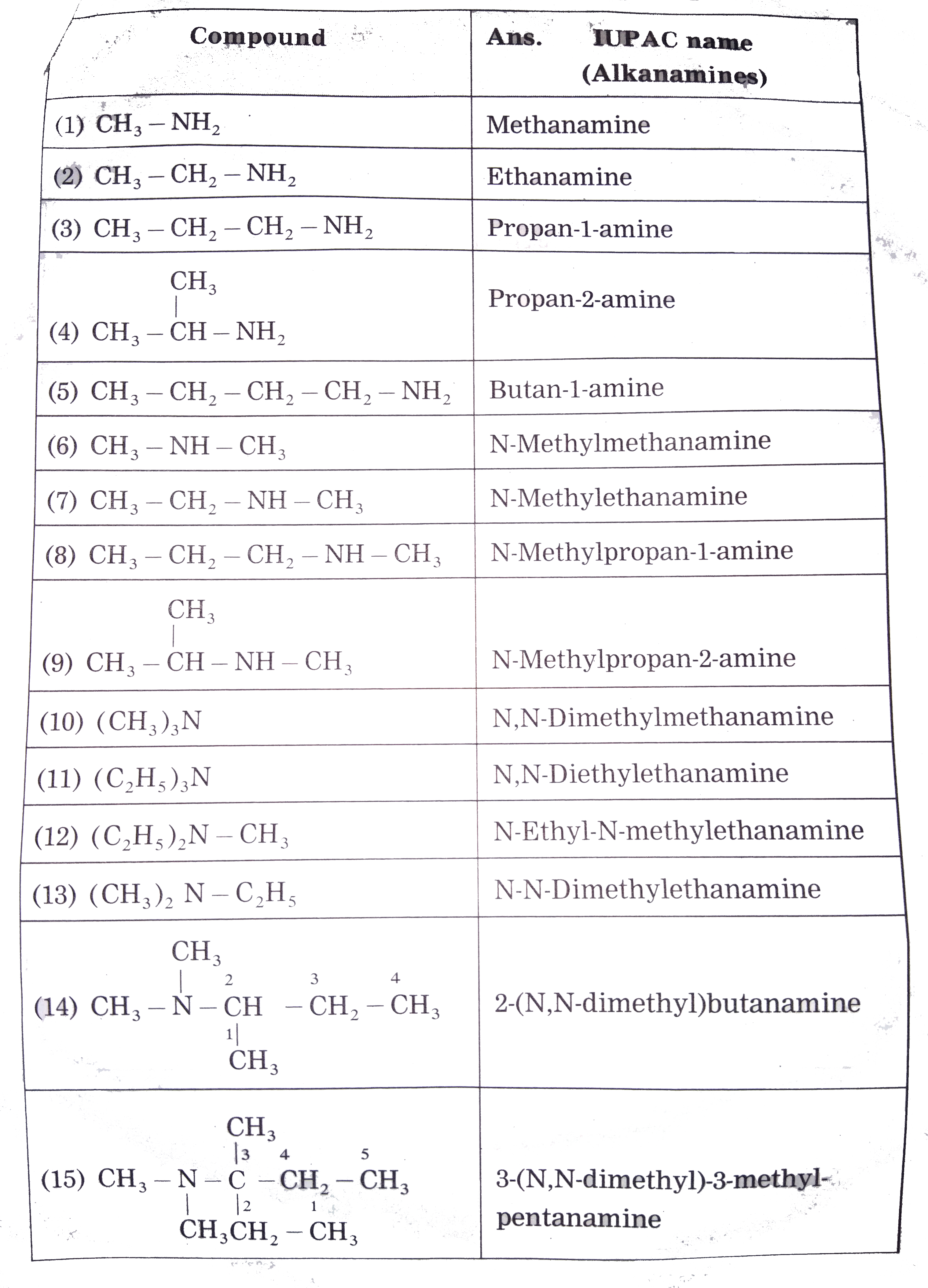
|
|
| 20. |
Given that 2C(s)+2O_(2)(g)rarr2CO_(2)(g), DeltaH=-787 kJ H_(2)(g)+(1)/(2)O_(2)(g)rarrH_(2)O(l), DeltaH=-286 kJC_(2)H_(2)(g)+2(1)/(2)O_(2)(g)rarr2CO_(2)(g)+H_(2)O(l), DeltaH=-1301 kJHeat of formation of acetylene is |
|
Answer» `-1802` kJ eq. (II) + eq. (iii) `rarr`eq. (iv) - eq. (i) find the required RESULT. |
|
| 21. |
Given that at 25^(@) C [Ag(NH_(3))_(2)]^(+) + e^(-) to Ag_(s) + 2NH_(3) ,E^(@) = 0.02 V and Ag^(+) + 1e^(-) to Ag(s) , E^(@) = 0.8 V Hence the order of magnitude of equilibrium constant of the reaction. [Ag(NH_(3))_(2)] to Ag^(+) + 2NH_(3) will be (antilog 0.22 = 1.66) |
|
Answer» `10^(-10)` |
|
| 22. |
Give the IUPAC names of the following: CH_3CH_2CH_2 N(CH_3)(C_2 H_5) |
| Answer» SOLUTION :N-Ethyl-N-methyl-1-propanamine | |
| 23. |
Given that bond energies H-H and Cl-Cl are 430 kJ mol^(-1) and 240 kJ mol^(-1) respecively and Delta_(f) H for HCl is - 90 kJ mol^(-1). Bond enthalpy of HCl is : |
|
Answer» `380 KJ mol^(-1)` `DELTA H = (1)/(2) B. E (H-H) + (1)/(2) B. E (Cl - Cl) - B. E (H - Cl)` `- 90 = (1)/(2) (430) + (1)/(2) (240) - B. E. (H - Cl)` `B. E. (H - Cl) = 215 + 120 + 90 = 425 kJ mol^(-1)` |
|
| 24. |
Given that 2C(s) + 2O_(2)(g) rarr 2CO_(2)(g) Delta H = -787 kJ H_(2)(g) + (1)/(2)O_(2)(g) rarr H_(2)O(l) Delta H = -286 kJ C_(2)H_(2)(g) + (2) (1)/(2) O_(2)(g) rarr 2CO_(2)(g) + H_(2)O(l) Delta H = -1301 kJ Heat of formation of acetylene is : |
|
Answer» `-1802 kJ` `2C + H_(2)(g) RARR C_(2)H_(2)(g)` ADDING eqns. (i) and (ii) and substracting equation (iii) `Delta H = 228 kJ` |
|
| 25. |
Given that a radioactive species decays according to exponential law N= N_(0) e^(-lamda t). The half-life of the species is |
|
Answer» `LAMDA` |
|
| 26. |
Give the IUPAC names of the following: CH_3 CH(NO_2) CH_2 NH CH_3 |
| Answer» SOLUTION :N-methyl-2-nitro-1-propanamine | |
| 27. |
Given that 10g of a dibasic acid (molar mass = 100) are present in 600 mL of the solution. The density of the solution is 1.02 g mL^(-1). Molality of solution is |
|
Answer» 0.17 |
|
| 28. |
Give the IUPAC names of the following: C_6 H_5N (CH_3) (C_2 H_5) |
| Answer» SOLUTION :N-ethyl-N-methylbenzenamine | |
| 29. |
Given : Strength of acid : HA(aq)gtHB(aq)gtHC(aq) Which is Incorrect statement ? |
|
Answer» Strength of conjugate base: `A^(-)(aq)LTB^(-)(aq)ltC^(-)(aq)`. |Enthalpy of neutralisation| `uarr` `K_(a)uarralphauarr"Vant hoff factor "v uarr` `DeltaT_(b)uarrT_(b)uarr` |
|
| 30. |
Give the IUPAC names of the following: C_6 H_5 N^(+) (CH_3)_3 Br^(-) |
| Answer» SOLUTION :Trimethylphenylammonium BROMIDE. | |
| 31. |
Given salt is a bromide or iodide. How will you identify it by treating the salt with chlorine water and CS_(2)? |
| Answer» Solution :If `CS_(2)` layer ASSUMES an orange COLOUR, it is `Br^(ɵ)` if `CS_(2)` layer assumes a VIOLET colour it is `I^(ɵ)` | |
| 32. |
Give reasons for the following (a) Acetylation of aniline reduces its activation effect. (b) CH_(3)NH_(2) is more basic than C_(6)H_(5)NH_(2). (c) Although -NH_(2) is o/p directing group, yet aniline on nitration gives a significant amount of m-nitroaniline. |
|
Answer» Solution :(i) Due to the reasonance , the electron pair of NITROGENATOM gets delocalised towards carbonyl group/resonating structures. (ii) Because of `+ I` effect in methylamine electron density at NITROGEN INCREASES whereas in aniline resonance takes place and electron density on nitrogen decreases/ resonating structures. (III) Due to protonation of aniline/ formation of ANILINIUM ion. |
|
| 33. |
Give the IUPAC names of the following: C_6 H_5 (CH_2)_2NH_2 |
| Answer» SOLUTION : 2-phenyl-1-ethanamine | |
| 34. |
Given reasons for the following features of transition meatal chemistry : (i) The lowest oxide of a transition metal ( say, chromium , atomicnumber 24 ) is basic whereas the highest oxide is usualy acidic. (ii) Transition metals sometimes exhibit very low oxidation states such as +1 and 0. |
|
Answer» SOLUTION :(i) Lowest oxide of Cr is CrOwhich is basic. The highest oxide is `CrO_(3)` which is acidic. ( In between `Cr_(2)O_(3)` is amphoteric ). Higher the oxidation state of the metal, more EASILY it can accept electron and hence greater is the acidic character. (ii) ` + 1` oxidation state is shown by Cu because after loss of one electron, it acqires stable CONFIGURATION of`3s^(10)`. Zero oxidation state is shown in forming metal carbonyls, e.g., `Ni(CO)_(4)` because`pi-` ELECTRONS donated by the ligands are accepted into the empty d orbitals. |
|
| 35. |
Given{:("Reaction","Energy Change (inKJ)",),(Li(s) rarr Li(g),161,),(Li(g) rarr Li^(+) (g),520,),((1)/(2) F_(2)(g) rarr F(g),77,),(F(g) + e^(-) rarr F(g),("Electron gain enthalpy"),),(Li^(+) (g) + F^(-)(g) rarr LiF(s),-1047,),(Li (s) + (1)/(2) f_(2) (g) rarr LiF(s),-617,):} Based on data provided, the value of electron gain enthalpy of fluorine would be : |
|
Answer» `-300 kJ mol^(-1)` 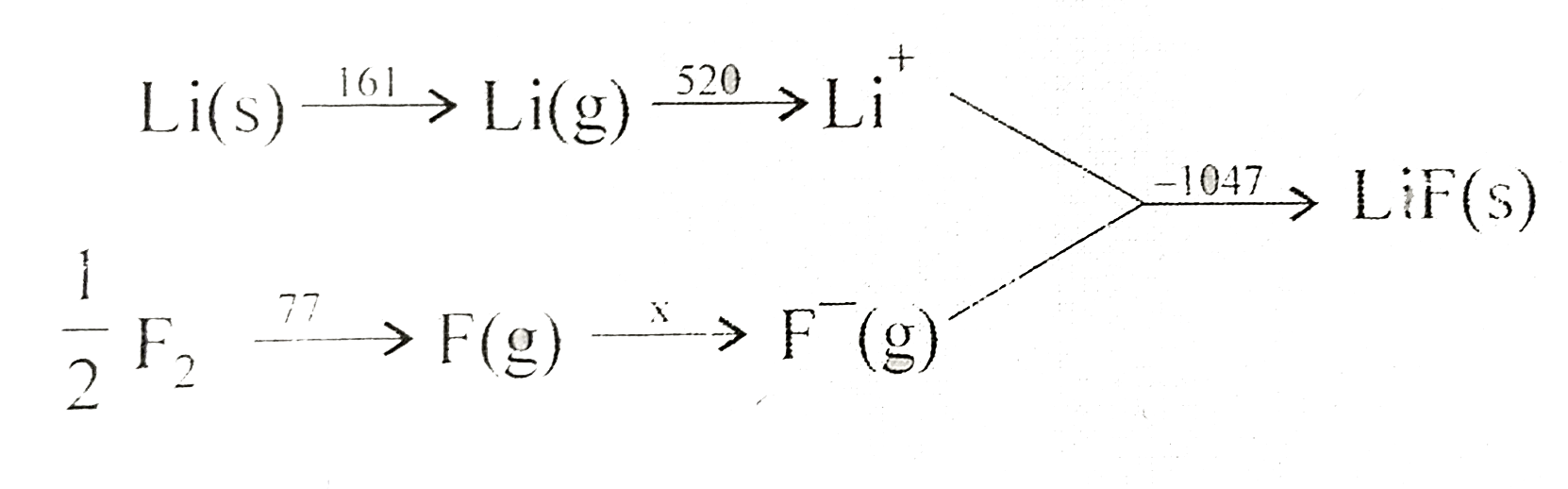 `Li (s) + (1)/(2)F_(2) (g) RARR LIF(s) = - 617` `DeltaH = -617 = 161 + 520 + 77 + x - 1047` `x = -328 kJ mol^(-1)` |
|
| 36. |
Give the IUPAC names of the following : |
Answer» SOLUTION :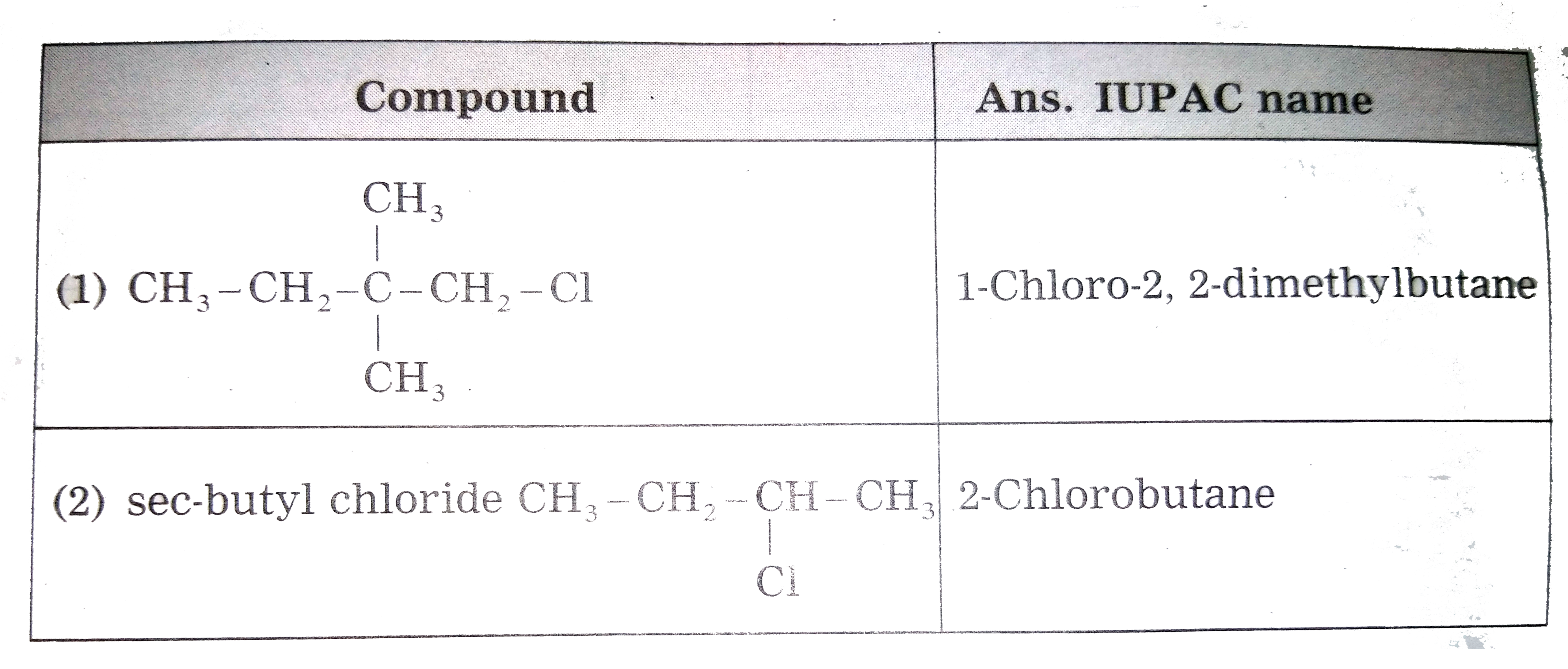 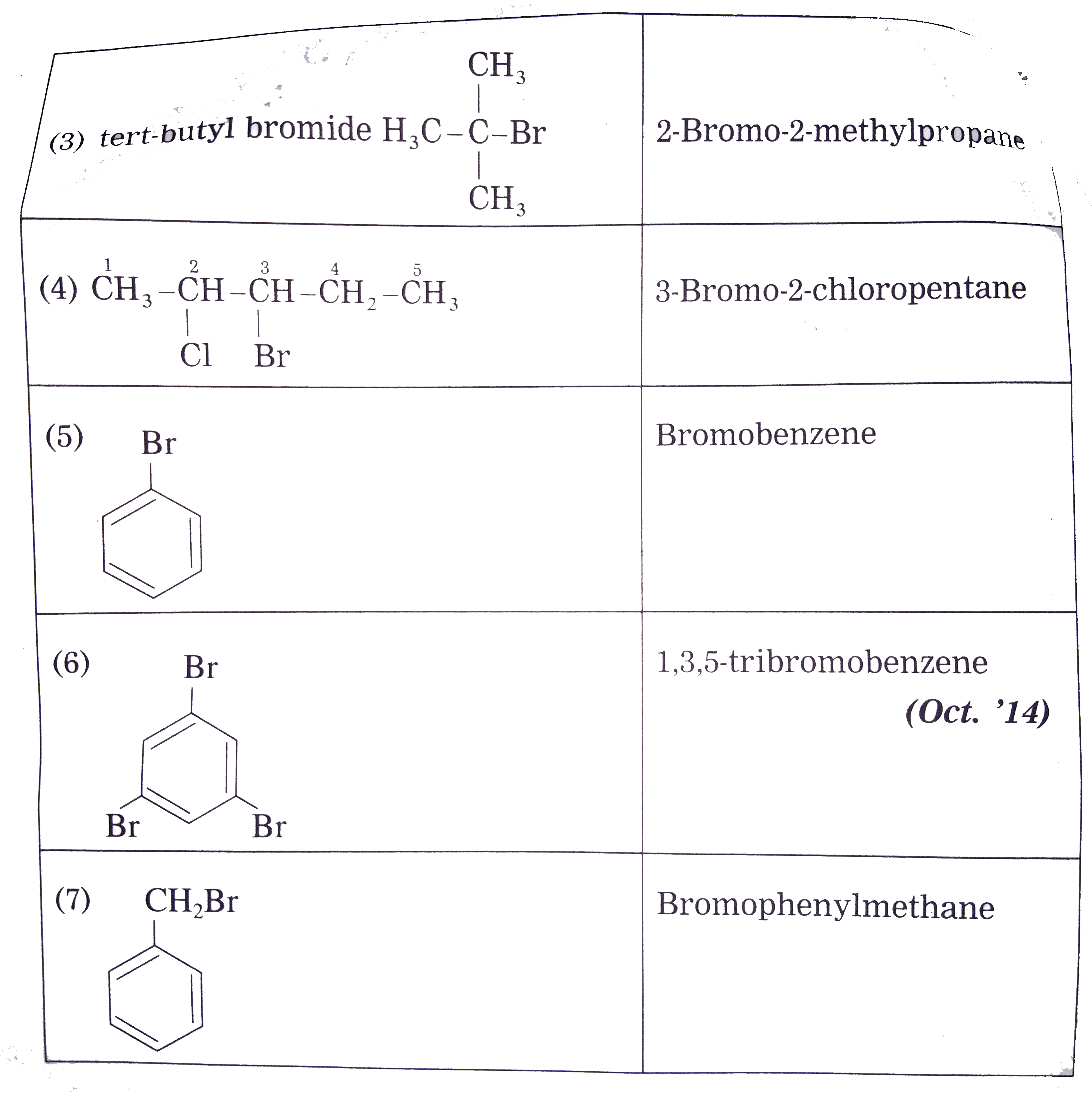
|
|
| 37. |
Given reason : Ti^(4+) salts are colourless where as Cr^(3+) salts are coloured. |
| Answer» SOLUTION :DUE to `d^(@)`- configuration of `TI^(+4)`. It is COLOURLESS when `CR^(+3)` has `d^(3)` configuration facilitating `d-d` transition. | |
| 38. |
Give the IUPAC names of the complexes (i) K [BF_(4)] (ii) [Fe(C_(5)H_(5))_(2)] (iii) [Mn_(3)(CO)_(12)] |
| Answer» Solution :(i) POTASSIUM tetrafluoridoborate (III) (II) BIS (cyclopentadienyl) IRON (iii) dodecacarbonyl trimanganese (0). | |
| 39. |
Given reaction is 2X_((gas))+Y_((gas))hArr2Z_((gas))+80 kcal Which combination of pressure and temperatue gives the highest yield of Z at equlibrium |
|
Answer» `1000atm and 500^(@)C` |
|
| 40. |
Give the IUPAC names of the compounds. Classify them as alkyl, allylic, benzylic, vinylic and aryl halides and also as primary, secondary and tertiary halides. (i ) (CH_3)_3 C CH_2CH (Cl) CH_3 (ii )CH_3 CH_2 CH=CHCH_2 Cl, (iii )(CH_3)_2CHCH_2 CH=C (Cl) CH_2 CH_3 and (iv )C_6 H_5C (Cl ) CH_3)_2 |
|
Answer» Solution :(i) `underset("2-Chloro-4, 4-dimethylpentante ALKYL HALIDE (secondary)")(H_3overset(5)(C)-underset(CH_3)underset(|)overset(CH_3)overset(4|)(C)-overset(3)(C)H_2-underset(Cl)underset(|)overset(2)(C)H-overset(1)(C)H_3)` (ii) `underset("1 -Chloropent - 2 - ene Allylic halide (primary)")(overset(5)(C)H_3overset(4)(C)H_2overset(3)(C)H=overset(2)(C)Hoverset(1)(C)H_2Cl)` (III) `underset("2-Chloro - 2 phenylpropane Benzylic halide (TERTIARY)")(C_6H_5-underset(CH_3)underset(|)overset(Cl)overset(|)(C)-CH_3)` |
|
| 41. |
Given, R=8.314JK^(-1)mol^-1), the work done during combustion of 0.090 kg of ethane (molar mass=30) at 300 K is |
|
Answer» `-18.7 kJ` hence `DeltaH=nC_(p)dT` `IMPLIES 3W=(0.090)/(30)XX(5)/(2)xx8.314xx300=18.7kJ` `implies W=6.23kJ` |
|
| 42. |
Given preparation of alkyl halides from alcohols. |
|
Answer» Solution :The hydroxyl group of an alcohol is replaced by halogen on reaction with concentrated halogen acids, phosphorus halides or thionyl chloride. (i) By reaction of alcohols with halogen acids (HX) :When alcohol is reacted with halogen acids (concentrated), the - OH group is replaced by - X and the haloalkanes are obtained. The `1^(@)` and `2^(@)` alcohols requires a catalyst `ZnCl_(2)` when reacted with HCl. (i) `R-OH+HCl overset(ZnCl_(2))rarr R-Cl+H_(2)O` (ii) `underset("ETHANOL")(CH_(3))-CH_(2)-OH+HCl overset(ZnCl_(2))rarr underset("CHLOROETHANE")(CH_(3)CH_(2))-Cl+H_(2)O` (iii)`underset("Propan-2-ol")(CH_(3)-underset("OH")underset("|")("CH")-CH_(3))+HCl overset(ZnCl_(2))rarr underset("2-chloropropane")(CH_(3)-underset("Cl")underset("|")("CH")-CH_(3))+H_(2)O` The reaction of tertiary alcohols with conducted HCl is carried out simply by shaking at a room temperature. `underset("2-methylpropane-2-ol")(CH_(3)-overset(CH_(3))overset("|")underset(CH_(3))underset("|")("C ")-OH+HCl) to underset("2-chloro-2-methylpropane")(CH_(3)-overset(CH_(3))overset("|")underset(CH_(3))underset("|")("C ")-Cl+H_(2)O)` Bromoalkanes are prepared by constant boiling of suitable alcohol with concentrated HBr (48%) or by reaction of alcohol with NABR in presence of `H_(2)SO_(4)`. `underset("Ethanol")(CH_(3))-CH_(2)-OH+underset(("Conc."))(HBr)to underset("Bromoethane")(CH_(3)CH_(2)Br)+H_(2)O` `underset("Ethanol")(CH_(3)CH_(2)OH)+NaBr+H_(2)SO_(4)to underset("Bromoethane")(CH_(3)CH_(2)Br)+NaHSO_(4)+H_(2)O` Good yields of iodoalkanes R - I may be obtained by heating alcohols with sodium or potassium iodide in 95% orthophosphoric acid. `KI+H_(3)PO_(4)to KH_(2)PO_(4)+HI` `underset("Ethanol")(CH_(3)CH_(2))-OH+HI to underset("Iodoethane")(CH_(3)CH_(2))-I+H_(2)O` The order of reactivity of alcohols with a given haloacid is `3^(@)gt 2^(@)gt 1^(@)` and that of haloacid is `HI gt HBr gt HCl` The preparation of alkyl chloride is carried out either by passing dry hydrogen chloride gas through a solution of alcohol or by heating a mixture of alcohol and concentrated aqueous halogen acid. (ii) By reaction of alchols with phosphorus halides :Chloroalkanes are prepared by the action of phosphorus trichloride `(PCl_(3))` or phosphorus pentachloride `(PCl_(5))` on alcohols. `underset("Ethanol")(3CH_(3)CH_(2)OH)+PCl_(3) to underset("Chloroethane")(3CH_(3)CH_(2)Cl)+H_(3)PO_(3)` `underset("Ethanol")(CH_(3)CH_(2)OH)+PCl_(5)to underset("Chloroethane")(CH_(3)CH_(2)Cl)+POCl_(3)+HCl` Bromoalkanes and iodoalkanes are prepared by the action of mixture of red phosphorus and `Br_(2)` and `I_(2)` on alcohols. The `PBr_(2)` and `PI_(3)` are produced in situ (Produced in the reaction mixture). `underset("(Red)")(P_(4))+6Br_(2)to 4PBr_(3)` `underset("Ethanol")(3CH_(3)CH_(2)OH)+PBr_(3)to underset("Bromoethane")(3CH_(3)CH_(2)Br)+H_(3)PO_(3)` (iii) By reactions of alcohol with thionyl chloride `(SOCl_(2))` : Thionly chloride is preferred by cause in this reaction alkyl halide is formed along with gases `SO_(2)` and HCl. The two gaseous product are escapable, hence, the reaction gives pure alkyl halides. `underset("Ethanol")(CH_(3)CH_(2)-OH)+SOCl_(2)to underset("Chloroethane")(CH_(3)-CH_(2)-Cl)+HCl_((g))+SO_(2(g))` These methods are not suitable for the preparation of aryl halides because the carbon - oxygen bond in phenols has a partial double bond character and is difficult to break being stronger than a SINGLE bond. |
|
| 43. |
Given R=8.314 JK^(-1) "mol"^(-1), the work done during combustion of 0.090 kg of ethane (molar mass= 30) at 300 K is |
|
Answer» `-18.7` kJ `=(0.090 kg)(30 xx 10^(-3) kg mol^(-1)) = 3` moles The combustion of `C_(2)H_(6)` (ethane) is as- `C_(2)H_(6)(g) + 7/2 O_(2)g to 2CO_(2)(g) + 3H_(2)O(l)` `Deltan = sum n_(g) ("product") - sum n(g)" reactants"` `=(2) - (3.5+1)` `=-2.5` `W = -Deltan RT` `=-(-2.5 xx 8.314 xx 300) = 6234.5` J `~= 6.234 kJ` (ii) For 3 moles: W =`3 xx 6.234 = 18.702 kJ` |
|
| 44. |
Given P_(C Cl_(4)^(0))=100 torr, P_(H_(2)O)^(0)=300 torr What will be total pressure after opening the valve? Give your answer after dividing 100. |
|
Answer» |
|
| 45. |
Give the IUPAC names of K_4[Fe(CN)_6]&[CO(NH_3)_6]Cl_3. |
| Answer» Solution :`K_4[FE(CN)_6]_2`: Potssiumhexacyanoferrate (II)`[Co(NH_3)_5CI]CI_2` : Chloropenta-aminecobalt (III) CHLORIDE. | |
| 46. |
Given : PCl_5(g)0. Mention two factors whose change at equilibrium will increase the yield of PCl_5(g) |
|
Answer» |
|
| 47. |
Give the IUPAC names of (i) {:(CH_(3)-CH-" C"-CH-OCH_(2)CH_(3)),("||||"),(""OCH_(3)"O"CH_(3)):} (ii) CH_(3)-CO-underset(C_(2)H_(5))underset("|")"CH"-CH_(2)-CH_(2)-Cl |
|
Answer» SOLUTION :(i) 2-ethoxy-4-methoxy-3-pentanone and (II) 3-ethyl-5-chloro-2-pentanone. |
|
| 48. |
Given pH of a solution A is 3 and it is mixed with another solution B having pH 2. If both mixed then resultant pH of the solution will be |
|
Answer» 3.2 `[H^(+)]_(B) = 10^(-3)M`. pH of the solution B = 2 `[H^(+)]_(B) = 10^(-2)M` `[H^(+)]_(B) = 10^(-3) + 10^(-2) = 10^(-3) + 10 XX 10^(-3) = 11 xx 10^(-3)`. `pH = -log(11 xx 10^(-3)) = 3 - log 11` `= 3 - 1.04 = 1.95`. |
|
| 49. |
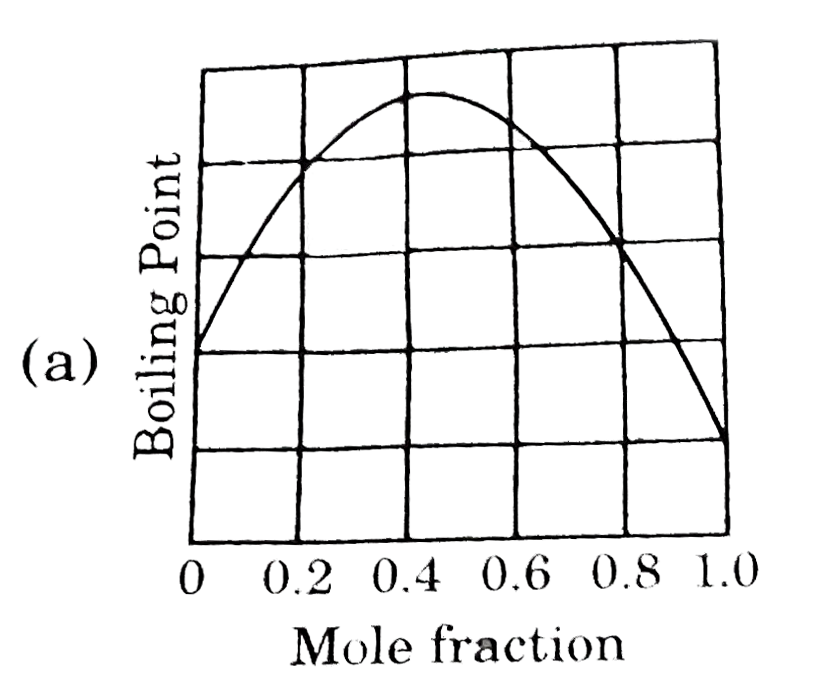
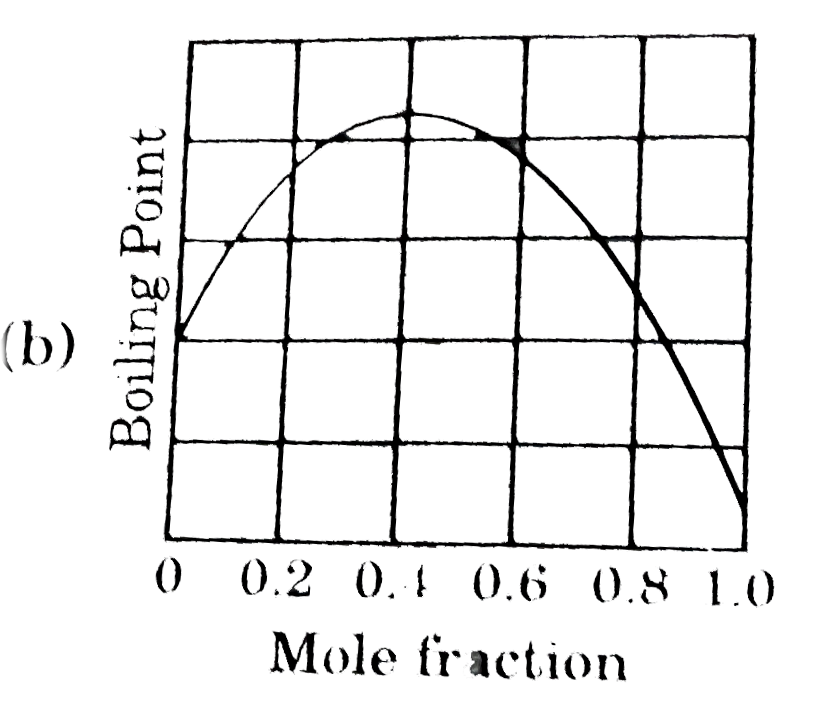
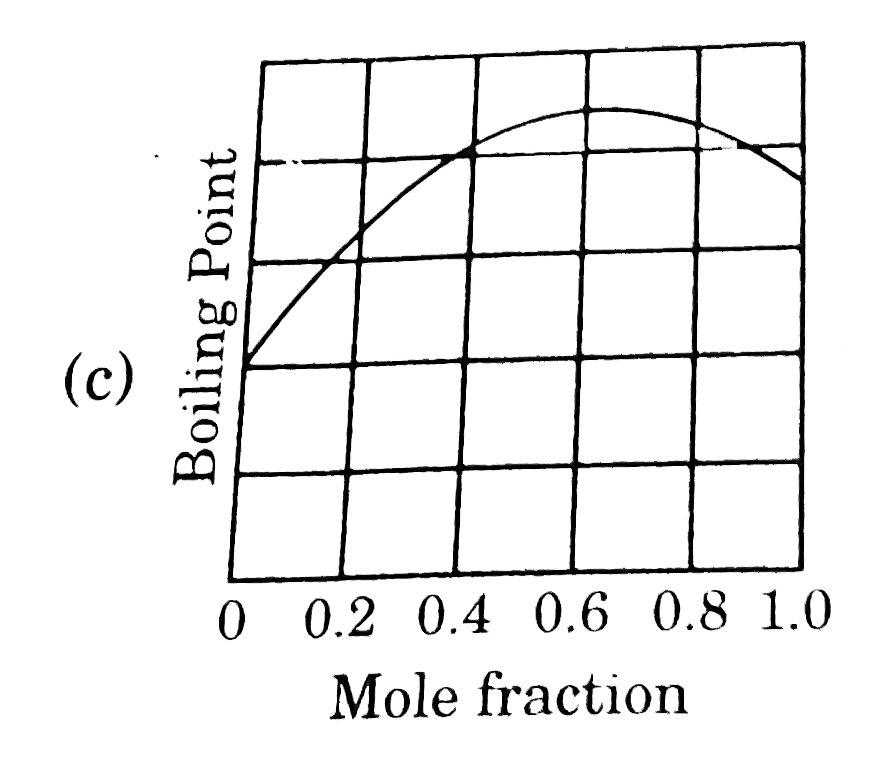
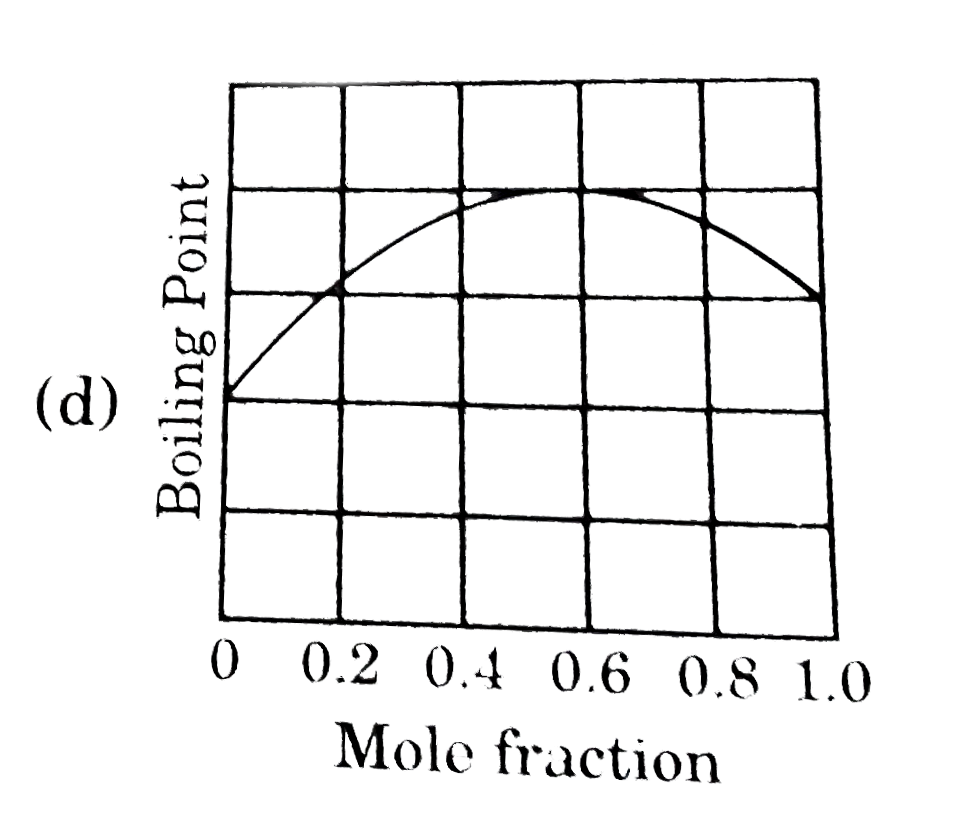
Given P-X curve for a non-ideal liquid mixture(fig). Identify the correct T-X curve for the same mixture. |
|
Answer»
|
|