

Saved Bookmarks
This section includes 7 InterviewSolutions, each offering curated multiple-choice questions to sharpen your Current Affairs knowledge and support exam preparation. Choose a topic below to get started.
| 1. |
Give the IUPAC names of the following: m-CH_3 C_6H_4 NH CH (CH_3)_2 |
| Answer» SOLUTION :N-isopropyl-m-toluenamine | |
| 2. |
Given that the equilibrium constant for the reaction 2SO_(2)(g)+O_(2)(g)hArr2SO_(3)(g) has a value of 270 at a particular temperaturee. What is the vlaue of the equilibrium constant for the following reaction at same temperaturee SO_(3)(g)hArrSO_(2)(g)+1/2O_(2)(g) |
|
Answer» `1.8xx10^(-3)` `SO_(3)(g)hArrSO_(2)(g)+1/2O_(2)(g)` `K=278` `K=1/K=sqrt((1)/(278))=sqrt(35.97xx10^(-4))=6xx10^(-2)` |
|
| 3. |
Give the IUPAC names of the following ketones : |
Answer» SOLUTION :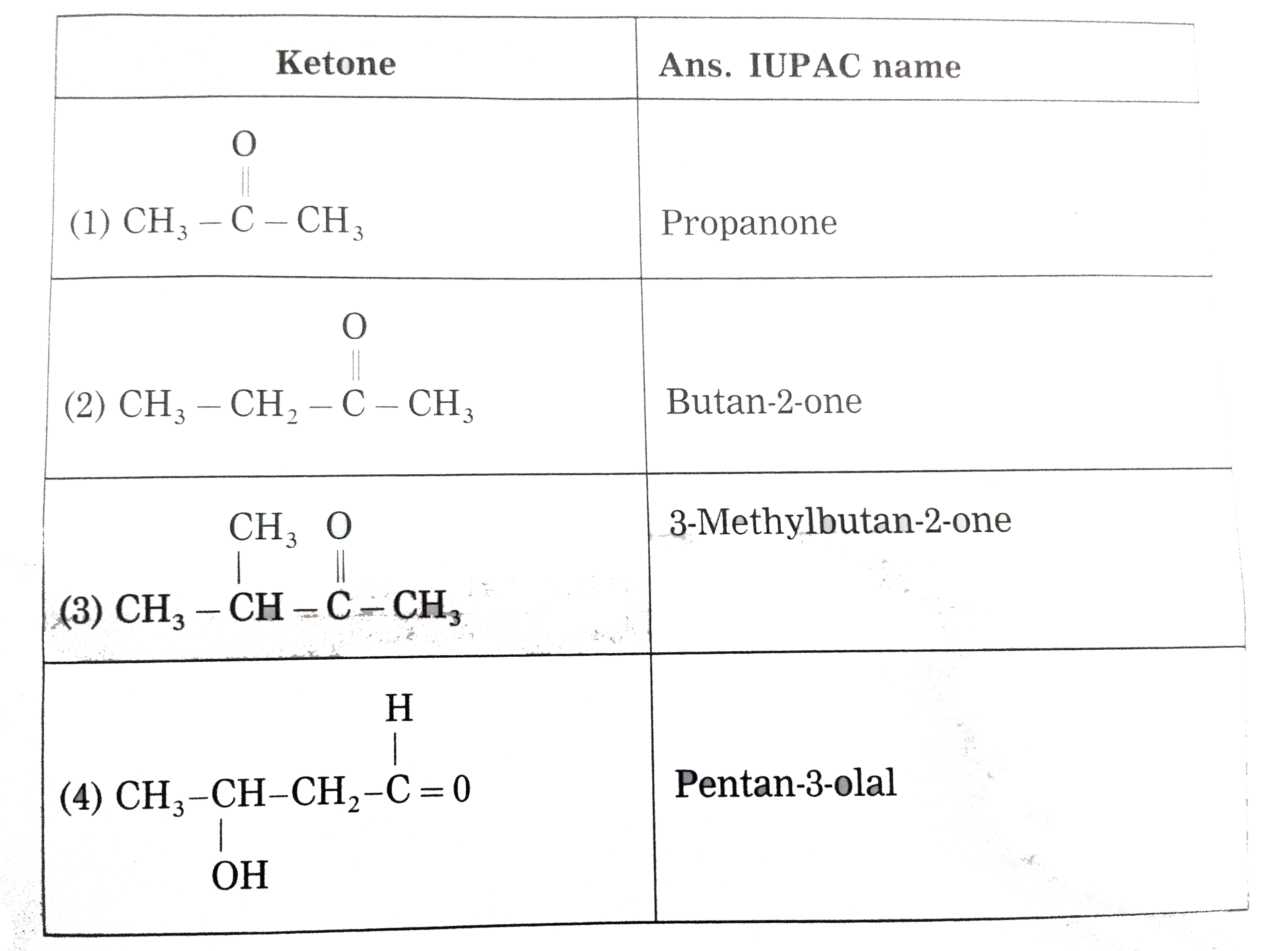 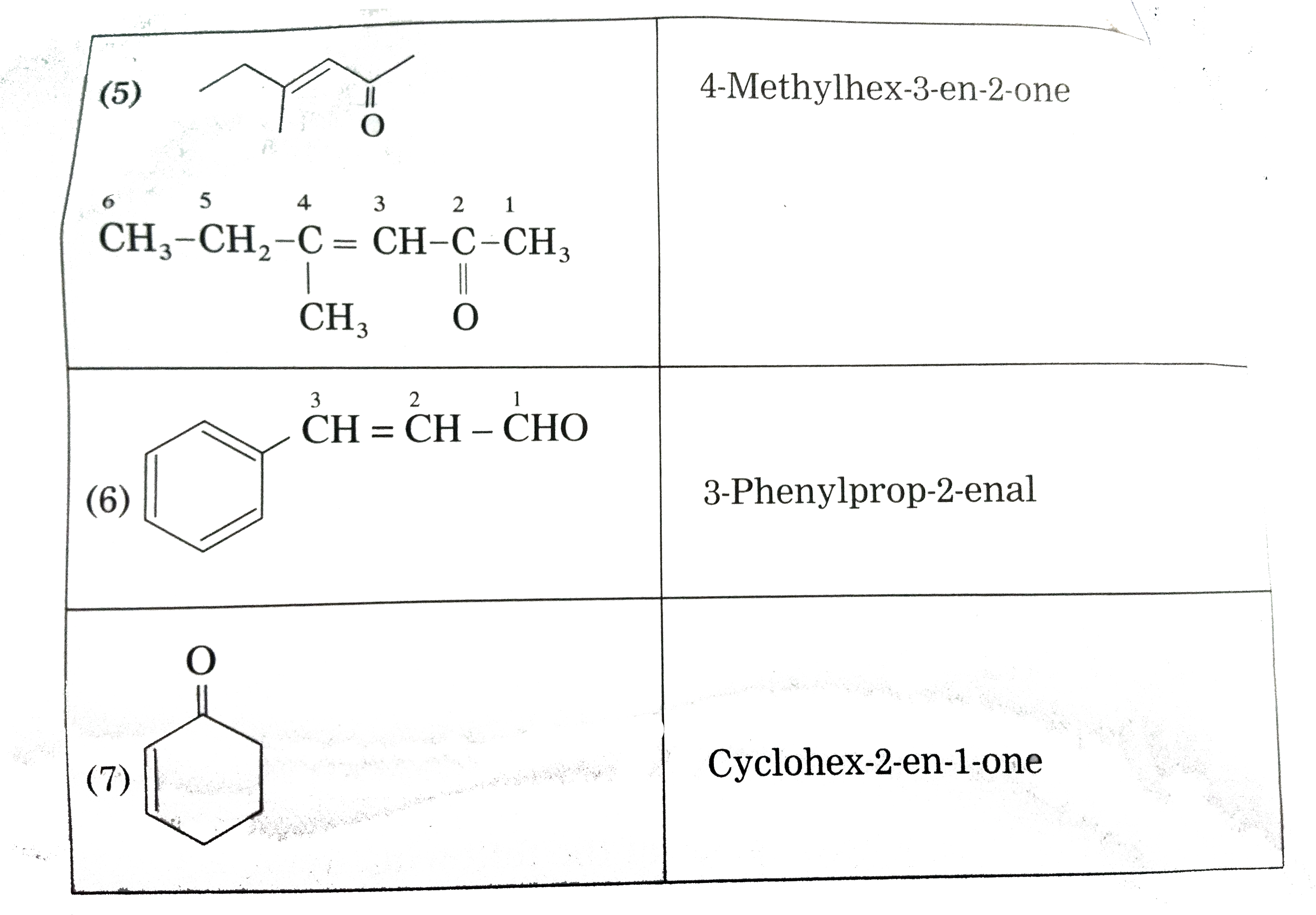
|
|
| 4. |
Given that equilibrium constant for the reaction 2SO_(2)(g) + O_(2)(g)hArr2SO_(3)(g) has a value of 278 at a particular temperature. What is the value of the equilibrium constant for the following reaction at the same temperature ? SO_(3)(g)hArrSO_(2)(g) + (1)/(2)O_(2)(g) |
|
Answer» `1.8 XX 10^(-3)` |
|
| 5. |
Give the IUPAC names of the following: (i) CH_(3)-underset(CO_(2)H)underset(|)(C)H-CH_(2)-CH_(3) (ii) CH_(3)-underset(OH)underset(|)(C)H-CH_(2)-COOH (iii) CH_(3)COCH_(2)COOH (iv) CHO.COOH (v) CH_(3)COCOOH (vi) C_(6)H_(5)-CH=CH-COOH (vii) C_(6)H_(5)CH_(2)CH_(2)COOH (viii) CH_(3)CH_(2)CH(CHO)CH_(2)COOH (ix) CH_(3)CH(Br)CH_(2)CONHCH_(3) |
| Answer» Solution :(i) 2-Methylbutanoic acid, (II) 3-Hydroxybutanoic acid, (III) 3-Oxobutanoic acid, (IV) 2-Oxoethanoic acid, (v) 2-Oxopropanoic acid, (vi) 3-Phenylbut-2-en-1-oic acid, (vii) 3-Phenylpropanoic acid, (viii) 3-Ethyl-4-oxobutanoic acid (IX) 3-Bromo-N-methylbutanamide. | |
| 6. |
Give the IUPAC names of the following: m-CH_3 C_6 NH CH (CH_3)_2 |
| Answer» SOLUTION :N-isopropyl-m-toluenamine | |
| 7. |
Given that the dissociation constant for H_(2)O is K_(w) = 1 xx 10^(-14) "mole"^(2)//"litre"^(2). What is the pH of a 0.001 molar KOH solution |
| Answer» Solution :PH = 14 - POH = 14 - 3 = 11. | |
| 9. |
Given that the abundances of isotopes .^(54)Fe,.^(56)Fe and .^(57)Fe are 5%,90% and 5% respectively, the atomic mass of Fe is: |
|
Answer» 55.85u =55.95amu |
|
| 10. |
Give the IUPAC names of the following. (iii) |
|
Answer» |
|
| 11. |
Given that the abundances of isotopes .^(54)Fe, .^(56)Fe and .^(57)Fe are 5%, 90% and 5% respectively, the atomic mass of Fe is |
|
Answer» 55.85 `.^(56)Fe rarr 90%` `.^(57)Fe rarr 5%` Av. Atomic mass `= x_(1) A_(1) + x_(2) A_(2) + x_(3) A_(3)` `= 54 XX 0.05 + 56 xx 0.9 + 57 xx 0.05 = 55.95` |
|
| 12. |
Give the IUPAC names of the following. (ii) (CH_3)_2=CHCOOH |
|
Answer» |
|
| 13. |
Given that the abundances of isotopes ""^54 Fe, ""^56Fe and ""^57Feare 5%, 90% and 5% respectively, the atomic mass of Fe is |
|
Answer» 55.85 `= (5 xx 54 +90 xx 56 + 5 xx 57)/(100)` ` = (270 + 5040 + 285)/(100)` = 55.95 |
|
| 14. |
Give the IUPAC names of the following. (i) PhCH_2CH_2COOH |
|
Answer» |
|
| 15. |
Given that standard heat enthalpy of CH_4, C_2 H_4 and C_3H_8 are -17.9, 12.5, -24.8 kcal/mol. The triangleH for CH_4+C_2H_4rarrC_3H_8 is: |
|
Answer» `-55.2 KCAL` |
|
| 16. |
Given that O(g) + e^(-) rarr O^(-)(g) Delta H = - 142 kJ mol^(-1) O(g) + 2e^(-) rarr O^(2-)(g) DeltaH =+712kJmol^(-1) The heat change for the reaction O^(-)(g) + e^(-) rarr O^(2-)(g) is : |
|
Answer» `- 570 KJ` (ii) `O(g) + 2e^(-) rarr O^(2-) Delta H = 712 kJ` Subtract eq. (i) from eq.(ii). `O(g) + e^(-) rarr O^(2-) Delta H = 854 kJ` |
|
| 17. |
Give the IUPAC names of the following ethers: C_(2)H_(5)OCH_(2)--overset (CH) underset (CH_(3)) underset (|)---CH_(3) ii.CH_(3)OCH_(2)CH_(2)CI iii. O_(2)N---C_(6)H_(4)---OCH_(3)(p) iv. CH_(3)CH_(2)CH_(2)OCH_(3) v. vi. |
|
Answer» SOLUTION :i.1-Methoxy-2-methoxylpropane II. 2-Choloro-1-methoxyethane III. 4-Nitroanisole iv.1-Methoxypropane v.4-Ethoxy-1,1-dimethylcyclohexane VI. ETHOXYBENZENE vii.2-Ethoxybutane |
|
| 18. |
Given that K_c = 13.7 at 546 K for PCl_3(g)iffPCl_3(g) + Cl_2(g).Calculate what pressure will develop in a 10-litre box at equilibrium at 546 K when 1 mole of PCl_5is introduced into the empty box. |
| Answer» SOLUTION :8.92 ATM | |
| 19. |
Give the IUPAC names of the following compounds : Perfluorobenzene |
Answer» SOLUTION :STRUCTURES of the COMPOUNDS are GIVEN below : 
|
|
| 20. |
Given that K_(a) for acetic acid is 1.8xx10^(-5)and K_(b) for NH_(4)OH is 1.8xx10^(-5)at 25^(@)C. Predict the nature of aqueous solution of ammonium acetate. |
|
Answer» ACIDIC |
|
| 21. |
Give the IUPAC names of the followingcompounds. (i)Na_(2)[Ni(EDTA)(ii)[Co(NH_(3))_(5)Cl]^(2+) |
|
Answer» Solution :`(i)``Na_(2)[Ni(EDTA)]`-Sodium `2,2.,2",2".`-(ethane-`1,2`-diyldinitrilo) tetraacetato nickelate `(II)` `(ii) [[CO(NH_(3))_(5)CL]^(2+)`- Pentaamine chloro cobalt `(III)`ion |
|
| 22. |
Given that K, for acetic acid as 1.8xx 10^(-5)and K_bof NH_4 OH as 1.8xx10^(-5)at 25^@ C, predict the nature of aqueous solution of ammonium acetate. |
|
Answer» ACIDIC |
|
| 23. |
Give the IUPAC names of the following compounds : p-Bromochlorobenzene |
Answer» SOLUTION :STRUCTURES of the COMPOUNDS are GIVEN below : 
|
|
| 24. |
Given that k is the rate constant for some order of any reaction at temp. T then the value of underset(T tooo)limlogk= (where A is the Arrhenius constant) |
|
Answer» A.2,303 if `T to oo,` the `log_ek- log_eA` |
|
| 25. |
Give theIUPAC names of the following compounds: (i) PhCH_2CH_2COOH "" (ii) (CH_3)_(2)C = CHOOCH (##U_LIK_SP_CHE_XII_C12_E01_006_Q01.png" width="80%"> |
| Answer» SOLUTION :(i) (3-Phenylpropanoic acid (ii) 3-Methylbut-2-enoic acid (iii) 2-Methylcyclopentane CARBOXYLIC acid (iv) 2, 4, 6-Trinitrobenzoic acid or 2, 4, 6-Trinitrobenzenecarboxylic acid. | |
| 26. |
Give the IUPAC names of the following compounds: (i)PhCH_2CH_2COOH (ii)(CH_3)_2C = CH COOH |
|
Answer» Solution :(i) 3 - Phenylpropanoic acid (ii) 3 - methylbut - 2 - enoic acid (iii) 2 - METHYLCYCLOHEXANE carboxylic acid (IV) 2,4,6 - Trinitorbenzoic acid or 2,4,6,- TRINITROBENZENE carboxylic acid |
|
| 27. |
Given that K is the rate constant for some order of any reaction at temp T then the value of T^limrarroo^(logK)_____.(where A is the arrhenius constant): |
|
Answer» `A//2.303` |
|
| 28. |
Give the IUPAC names of the following compounds: (i) CH_(3)CH(Cl)CH(Br)CH_(3) (ii) CHF_(2)CBrClF (iii) ClCH_(2)C-=C CH_(2)Br (iv) (C Cl_(3))C Cl (v) CH_(3)C(pClC_(6)H_(4))_(2)CH(Br)CH_(3) (vi) (CH_(3))_(3) C CH=C(Cl)C_(6)H_(4)I-p |
| Answer» SOLUTION :(i) 2-Bromo-3-chlorobutane (II) 1-Bromo-1-chloro-1,2,2-trifluoroethane (iii) 1-Bromo-4-chlorobut-2-yne (IV) 2-(Trichloromethyl)-1,1,1,2,3,3-heptachloropropane (v) 2-Bromo-3-3-B is (4-chlorophenyl)butane (VI) 1-Chloro-1-(4-iodophenyl)-3,3-dimethylbut-1-ene. | |
| 29. |
Given that for a reaction of order n, the integrated from of the rate equation is : k=(1)/(t(n-))[10/(C^(n-1))-(1)/(C_(0)^(n-1))] where C_(0) and C are thevalues of the reactant concentration at the start and after tme t. What is the relationship between t_(3//4) and t_(1//2) where t_(3//4)is the time required for C to become (1)/(4)C_(0)? |
|
Answer» `t_(3//4)=t_(1//2)[2^(n-1)+1]` |
|
| 30. |
Given that for a reaction of nth order, the integrated rate equation is: K=1/(t(n-1))[1/C^(n-1)-1/C_(0)^(n-1)], where C and C_(0) are the concentration of reactant at time t and initially respectively. The t_(3//4) and t_(1//2) are related as t_(3//4) is time required for C to become C_(1//4) : |
|
Answer» `t_((3)/(4))=t_((1)/(2))][2^(n-1)+1]` |
|
| 31. |
Give the IUPAC names of the followingcompounds. (i) [CO(NO_(2))_(3) (NH_(3))_(3)] (ii)K_(3)[Fe(CN)_(5)NO] |
|
Answer» Solution :`(i)` `[CO(NO_(2))_(3) (NH_(3))_(3)]`-Triamminetrinitrioto-KN Cobalt `(III)` `(ii)``K_(3)[FE(CN)_(5)^(NO)]`-Potassiumpentacydonitrosylferrate `(II)` |
|
| 32. |
Given that for a reaction of nth order the integrated rate equation is K=1/(t(n-1))[1/(C^(n-1))-1/(C_(0)^(n-1))] where Cand C_(0) are the concentration of reactant at time to initiallyh respectivley. The t_(3//4) and t_(1//2) are related as (t_(3//4) is time required to C to become C/4) |
|
Answer» `t_(3//4)=t_(1//2)[2^(n-1)+1]` |
|
| 33. |
Give the IUPAC names of the followingcompounds. (i) [PdI_(2)(ONO)_(2)(H_(2)O)_(2)](ii) [Cr(PPh_(3))(CO)_(5)] |
|
Answer» SOLUTION :`(I)``[PdI_(2)(ONO)_(2)(H_(2)O)_(2)]`- Diaquadiiododinitrito-kopalladium `(iv)` `(ii)``[CR(PPh_(3))(CO)_(5)]`-Pentacarbonyltriphenylphosphanechromium (O) |
|
| 34. |
Given that E_(O_(2)//H_(2)O)^(Theta)= +1.23V,E_(S_(2)O_(8)^(2-)//SO_(4)^(2-))^(Theta)=2.05V,E_(Br_(2)//Br^(-))^(Theta)=+1.09V, E_(Au^(3+)//Au^(Theta))=+1.4V The strongest oxidizing agent is : |
|
Answer» `O_(2)` |
|
| 35. |
Give the iUPAC names of the following compounds: (i). CH_(3)CH(Cl)CH(Br)CH_(3) (ii). CHF_(2)CBrCIF (iii). ClCH_(2)C-=C CH_(2)Br (iv). (C Cl_(3))_(3)C Cl (v). CH_(3)C(p-ClC_(6)H_(4))_(2)CH(Br)CH_(3) (vi). (CH_(3))_(3)C CH=C(Cl)C_(6)H_(4)I-p. |
Answer» SOLUTION : 
|
|
| 36. |
Given that Fe^(3+)+e leftrightarrow Fe^(2+), E^@=0.77V Fe^(2+)+2e leftrightarrow Fe, E^@=-0.44V What will be the E^@ value for the following half cell. Fe^(3+)+ 3e leftrightarrow Fe |
| Answer» SOLUTION :`-0.04V` | |
| 37. |
Give the IUPAC names of the followingcompounds. (i) [Ag(NH_(3))_(2)]^(+) (ii) [FeF_(6)]^(4-) |
|
Answer» SOLUTION :`(i) [Ag(NH_(3))_(2)]^(+)`-Diammine silver `(I)` ION `(ii) [FeF_(6)]^(4-)`-Hexa fluoro FERRATE `(II)` ion |
|
| 38. |
Given that E^(@)(Zn) = -0.76V and E^(@)(Cu) = 0.34V. Calculate the emf of the cell with cell reaction |
|
Answer» `-42 V` |
|
| 39. |
Give theIUPAC names of the following compounds : (i) CH_(3)CH(Cl)CH(Br)CH_(3) "" (ii) CHF_(2)CBrClF (iii) ClCH_(2) C -= C CH_(2) Br "" (iv) (C Cl_(3))_(3) C Cl (v) CH_(3)C (p-ClC_(6)H_(4))_(2)CH (Br) CH_(3) "" (vi) (CH_(3))_(3)C CH = ClC_(6)H_(4)I-p |
| Answer» Solution :(i) 2-Bromo -3- chlorobutane (ii) 1-Bromo -1- chloro -1, 2, 2- trifluoroethane , (iii) 1-Bromo -4-chlorobut -2-yne (iv) 2-(Trichloromethyl ) -1,1,1,2,3,3,3-heptachloropropane (V) 2- Bromo -3, 3-Bis (4- chloro - PHENYL )BUTANE (vi) 1-Chloro -1- (4- iodophenyl ) -3, 3- dimethylbut -1- ene. | |
| 40. |
Given that E^(@)(Zn) = -0.76V and E^(@)(Mg|Mg^(2+) )= 2.37V. What will happen when zinc dust is added to MgCl_(2) solution ? |
|
Answer» MAGNESIUM will be precipitated |
|
| 41. |
Give the IUPAC names of the following compounds :ClCH_(2)C-= C CH_(2)Br |
| Answer» SOLUTION :`underset("1-Bromo-4-Chloro but-2-eye")(Cl-overset(4)(C )H_(2)-overset(3)(C )-=overset(2)(C )-overset(1)(C )H_(2)-Br)` | |
| 42. |
Give the IUPAC names of the following compounds: (i) C_(6)H_(5)-CH_(2)-CH_(2)-OH""(ii) CH_(3)-underset(CH_(3))underset(|)overset(CH_(3))overset(|)(C)-CH_(2)-CH_(2)-OH (iii) [(CH_(3))_(2)CH]_(3)COH.""(iv) CH_(3)-underset(OH)underset(|)(CH)-CH_(2)-CH_(2)-O-CH_(2)CH_(3) (v) CH_(3)-CH_(2)-underset(Cl)underset(|)(CH)-underset(CH_(3))underset(|)(CH)-underset(OH)underset(|)overset(CH_(3))overset(|)(C)-CH_(3)""(vi) (vii) (CH_(3))_(3)COH""(viii) CH_(3)-underset(CH_(3))underset(|)(CH)-underset(OH)underset(|)(CH)-CH_(2)-underset(CH_(3))underset(|)(CH)-CH_(3) (ix) {:(""CH_(2)OH),("|"),(CH_(2)-CH_(2)-CH-CH-CH-CH_(3)),("|""|"),(""CH_(2)Cl""CH_(3)):}, (x) {:(CH_(3)-C=C-CH_(2)OH),("|""|"),(""CH_(3)Br):} (xi) CH_(2)=CH-underset(OH)underset(|)(CH)-CH_(2)-CH_(3), (xii) {:(""CH_(2)OH),("|"),(CH_(3)-CH-CH_(2)-CH-CH-CH_(3)),("|""|"),(""CH_(3)""OH):} |
|
Answer» SOLUTION :(i) 2-Phenylethanol, (ii) 3, 3-Dimethylburan -1-ol (III) 2, 4-Dimethy-3 (1- methylenthyl) pentan-3-ol, (iv) 4-Ethoxybutan-2-ol (v) 4-Chloro-2, 3-dimethylhexan-2-ol, (vi) 3-Methyl-3-3 phenylpentan-2-ol (vii) 2-Methylpropan-2-ol, (viii) 2, 5-Dimethylhexan-3-ol (ix) 3-Chloromethyl-2-isopropylpentan-1-ol, (x) 2-Bromo-3- methylbut -2-EN-1 -ol (xi) Pent-1 -en -3-ol, (xii) 2, 5-Dimethylhexan-1, 3-diol |
|
| 43. |
Given that E_(Fe^3+|Fe) and E_(Fe^2|Fe)^@ are -0.36V and-0.439V, respectively.The value of E_(Fe^(3+)\fe^(2+))^@ would be: |
|
Answer» `(-36-0.439)V` |
|
| 44. |
Given that density of water is "1 g mL"^(-1). What is its density in kg m^(-3)? |
| Answer» Solution :`"1 G mL"^(-1)="1 g cm"^(-3)=(1g)/(1CM^(3))=1gxx(1kg)/(1000g)XX(1)/(cm^(3))xx(100CM)/(1m)xx(100cm)/(1m)xx(100cm)/(1m)=1000kgm^(-3)` | |
| 45. |
Give the IUPAC names of the following compounds :CHF_(2)CBrClF |
| Answer» SOLUTION :`underset("1-Bromo-1-Chloro-1,2,2-Triflucoromethane")(F-underset("F")underset("|")(overset(2)(C ))H-overset("F ")overset("| ")underset("Br")underset("| ")("C ")-Cl)` | |
| 46. |
Give the IUPAC names of the following compounds: (a) (CH_(3))_(3)C-CI""(b) CH_(3)-underset(C_(2)H_(5))underset(|)CH-CH_(2)CI (c)H_(2)c=CH-underset(C_(2)H_(5))underset(|)CH-underset(CI)underset(|)C=CH_(2) (d)CH-overset(C_(2)H_(5))overset(|)underset(CI)underset(|)C-CH_(2)-overset(C_(2)H_(5))overset(|)underset(Br)underset(|)C-CH_(3)(e)(CH_(3))_(3)C-CH_(2)-CH_(2)CI(f) (CH_(3))_(3) C-underset(CH_(3))underset(|)CH-underset(I)underset(|)CH-CH_(2)CH_(3)(g) CH_(3)-overset(C_(2)H_(5))overset(|)underset(F)underset(|)C-CH_(2)-overset(C_(2)H_(5))overset(|)underset(CI)underset(|)C-CH_(3) (h) HC-=C-CH_(2)-CH=CHCI(i) BrCH_(2) -CH_(2) -CH_(2) -CH_(2)CI (j) CH_(3) -C -=C-underset(CI)underset(|)CH-CH_(3) (k) (C_(2)H_(5))_(3)C-CI (l)CH_(3)CH_(2)-overset(CH_(3))overset(|)underset(Br)underset(|)C-underset(Br)underset(|)CHCH_(2)CI ""(m) HC-=C-CH_(2)Br |
|
Answer» SOLUTION :(a) 2-Chloro-2-methylpropane (b) 1-Chloro-2-methylbutane (C) 2-Chloro-3-ethylpenta-1,4-diene (d)3-Bromo-5-chloro-3,5-dimethylheptane (e) 1-Chloro-3,3-dimethylbutane (f) 4-Iodo-2,2,3-trimethylhexane (g) 3-Chloro-5-fluoro-3,5-dimethylheptane (h) 1-Chloropent-1-en-4-yne (i)1-Bromo-4-chlorobutane (J)4-Chloro-pent -2-yen (K) 3-Chloro-3-ethylpentane (L)2,3-Dibromo-1-chloro-3-methylpentane (m)3-Bromoprop -1-ene (n)1-Bromobut -2-ene (o) 4-bromopent-2-ene (p)1-Bromo-2-methylbut -2-ene (q)4-Bromo-3-methylpent-2-ene (r) 3-Bromo-2-methylbut-1-ene (s) 3-Bromo-2-methylpropene |
|
| 47. |
Given that dU = T dS - P dV and H = U + PV. Which one of the following relations is true ? |
|
Answer» `d H = T d S + V d P` `delta H = delta E + P delta V + V delta P` `= T delta S - P delta V + P delta V + V delta P` `delta H = T delta S + V delta P` |
|
| 48. |
Give the IUPAC names of the following compounds :CH_(3)C(p-ClC_(6)H_(4))_(2)CH(Br)CH_(3) |
Answer» SOLUTION :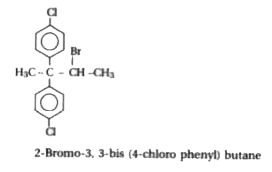
|
|
| 49. |
Given that DeltaH_(f)(H)=218kJ//mol, express the H-H bond energy in kcal/mol |
|
Answer» 52.15 or `H_(2) to 2H,DeltaH,=436kJ//mol` `=(436)/(4.18)=104.3kcal//mol` thus, 104.3 kcal/mol energy is absorbed for breaking of one mole of H-H BONDS. Hence, H-H bond energy is 104.3 kcal/mol. |
|
| 50. |
Give the IUPAC names of the following compounds :(CH_(3))_(3)C CH=C ClC_(6)H_(4)I-p |
Answer» SOLUTION :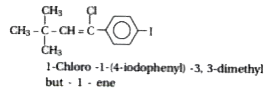
|
|