

Saved Bookmarks
This section includes 7 InterviewSolutions, each offering curated multiple-choice questions to sharpen your Current Affairs knowledge and support exam preparation. Choose a topic below to get started.
| 1. |
Give the formula and describe the structure of a noble gas species which is isostructrural with BrO_3^(-) |
Answer» Solution :`BrO_3^(-)`: The central Br atom has SEVEN electrons. Four of these electrons form two double bonds or coordinate bonds with two oxygen atoms while the fifth ELECTRON forms a single bond with `O^(-)` ion. The remaining two electrons form one lone pair. Thus, in all there are THREE bond pairs and one lone pair around Br atom in `BrO_3^(-)`. Therefore, according to VSEPR theory, `BrO_3^(-)` is pyramidal. Now, BRO, has a total of `26 (7 + 3 xx 6 + 1 = 26)` valence electrons. A noble gas species having 26 valence electrons is `XeO_3 (8 + 3 xx 6 = 26)`. Like `BrO_3^(-), XeO_3` is also pyramidal. 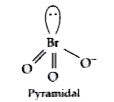
|
|
| 2. |
Given , Cu^(2+) + e^(-) to Cu^(+) E^(@) = 0.15 " volt " , Cu^(+) + e^- to Cu E^(@) = 0.5 volt Calculate potential for Cu^(2+) + 2e^(-) to Cu |
|
Answer» `0.65 V ` |
|
| 3. |
Give the facial (fac) and meridional (mer) isomeric structures of [Co(NH_(3))_(3)(NO_(2))_(3)]. |
Answer» SOLUTION :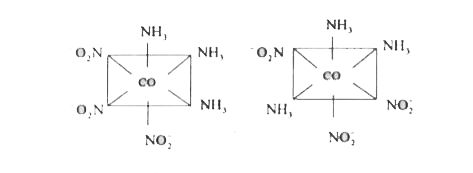
|
|
| 4. |
Given concentration cell Zn//Zn^(2+) (1M) //Zn^(2+) (0.15M) //Z Calculate E cell. As the cell discharges, does the difference in concentrations between the two solutions become smaller or larger? |
|
Answer» SOLUTION :At anode `Zn to Zn^(2+) (I M) +2e` At cathode `Zn^(2+) (0.15M) +2e to Zn` Overall REACTION `Zn^(2+) (0.15M) to Zn^(2+) (I M)` E cell `=E^(@)" cell "(0.059)/(2) log ""(1)//(0.15)` For a concentration cell, `E_("cell")^(@)=0` E cell `=-0.0295 xx 0.825 V=-0.0224` As the cell discharges, the reaction proceeds to the left, that is, the IM zinc ions is used and 0.15M zinc is produced. THUS, the TWO solutions approach each other in concentration. |
|
| 5. |
Give the extraction of iron using Blast furnace. |
|
Answer» Solution :The extraction of iron involves the following steps: (i) Concentration. The ORE is first of all crushed to small pieces of 3-5 cm size and sifted with the help of sifter. In a few CASES ore is washed with water to remove the silicon impurities. In this way we get concentrated ore. (ii) Roasting or Calcination. The concentrated ore is roasted or calcined in shallow kilns in excess of air to (a) remove moisture and carbon dioxide, (b) oxidise arsenic, sulphur, if any: (c) convert ferrous oxide `(FeO)`into ferric oxide `(Fe_2O_3)` and prevent the loss of iron because ferrous oxide forms a slag of ferrous silicate `(FeSiO_3)` with sand. `2Fe_2O_3. 3H_2O to 2Fe_2O_3+ 3H_2O uarr` `FeCO_3 to FeO+ CO_2 uarr` `4FeO+ O_2 to 2Fe_2O_3` In addition to these chemical changes, the entire mass becomes porous which FACILITATES the reduction of the metal oxide to metallic iron. (iii) Smelting. The roasted ore is then smelted (reduced) in a blast furnace (Fig.) in the presence of coke and lime (flux). Blast furnace is a huge structure made of iron plates lined inside with fire bricks. The blast furnace is provided at the top with a cup and cone arrangement for introducing the charge and acts as a SEAL for checking 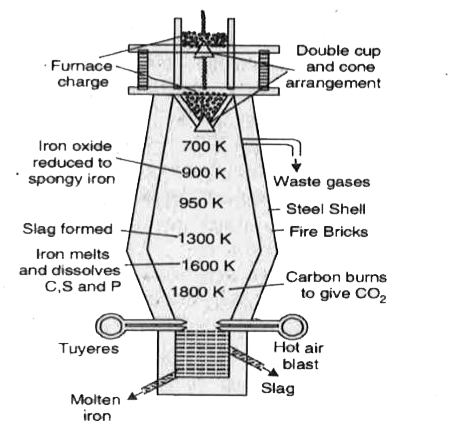 the escape of the flue gases during the charging of the furnace. Near the base, the furnace is provided with pipes called tuyeres for supplying a hot blast of air, atapping hole for molten iron and a slag hole through which slag flows out. There is an outlet near the top of the waste gases. The charge consisting of ore (8 parts), coke (4 parts) and lime stone (1 part) is introduced into the fumace by means of cup and cone arrangement. At the same time, the fumace is lit and a hot blast of air is admitted through the tuyeres. The following reactions take place in the fumace. (i) Zone of combustion. Near the tuyeres, carbon burns to give carbon dioxide producing a lot of heat. `C + O_2 to CO_2 + 405.46 KJ` Here the temperature is about 1800 K. As the hot gases move up and meet the descending charge, the temperature falls gradually. Thus a little above this, temperature is 1600 K, in the middle it is 1300 K and is 700-900 near the top. (ii) Zone of heat absorption. This is the middle part of the furnace. Here carbon dioxide, rising up, is reduced to carbon monoxide. `CO_2 + C to 2CO - 163.02 kJ` (iii) Zone of slag formation. In this zone the temperature is 1170 K to 1300 K. Here lime stone decomposes to give lime and carbon dioxide. The spongy iron falls to this region of zone of limestone decomposition. Lime thus obtained acts as a flux and combines with silica (present as an impurity) to form a fusible slag. `CaCO_3 to CaO + CO_2 uarr` `CaO + SiO_2 to CaSiO_3` (iv) Zone of reduction. It is the upper part of the furnace. Here the charge moving down is reduced to spongy iron by carbon monoxide rising up. The temperature here is 700 - 900 K. `Fe_2O_3 + 3CO to 2Fe + 3CO_2uarr` The reduction actually takes place in successive stages-first to magnetic oxide of iron, then to ferrous oxide and finally to spongy iron - according to the equations : `3Fe_2O_3 + CO to CO_2+ 2Fe_3O_4` `Fe_2O_4 + CO to CO_2 + 3FeO` `FeO + CO to CO_2 + Fe` (v) Zone of fusion. This is the lowest part of the furnace (temperature 1600-1700 K). Here the spong) iron sliding down melts and dissolves some carbon, phosphorus and silica, etc. At the bottom of the furnace, the molten iron collects while above this floats the fusible slag which also protects iron from oxidation. The two layers of molten iron and fusible slag are periodically withdrawn through separate tapping holes. The process is very economical as it is a continuous one. The waste gases containing about 20-25% of carbon monoxide are let out through the outer pipe. These are burnt with air to produce heat which is utilised for preheating the air blast admitted through tuyeres. The iron which is tapped off from the fumace is an impure variety and is known as cast iron or pig iron. |
|
| 6. |
Given : {:(,"Column A","Column B"),((A),"Ionic solid",(I)NaCl),((B),"Metallic solid",(II) Fe),((C),"Covalent solid",(III)C("graphite")),((D),"Molecular solid",(IV)"Dry ice"):} |
|
Answer» A - II, B - I, C - IV, D - III |
|
| 7. |
Give the expression of Freundlich isotherms. |
|
Answer» <P> SOLUTION :`x/m=K P^(1//n)or log ""(x)/(m)=log k +1/nlog P`where m is the mass of the adsorbent and x that of adsorbate, P is the pressure of the GAS and n is an integer. |
|
| 8. |
Give the expression that relates molar conductivity and degree of dissociation. |
| Answer» SOLUTION :`alpha=wedge_(m)/wedge_(m)^(0)` | |
| 9. |
Give the exmaple of a reaction in which order and molecularity are equal. |
|
Answer» SOLUTION :`CH_(3)COOC_(2)H_(5) + NAOH to CH_(3)COONa+ C_(2)H_(5)OH` ORDER of reaction = 2 , MOLECULARITY of reaction = 2 |
|
| 10. |
Given, C(graphite)+O_(2)(g)toCO_(2)(g),Delta_(r)H^(0)=-393.5kJ*mol^(-1) H_(2)(g)+(1)/(2)(g)toH_(2)O(l),Delta_(r)H^(0)=-285.8kJ*mol^(-1) CO_(2)(g)+2H_(2)O(l)toCH_(4)(g)+2O_(2)(g),Delta_(r)DeltaH^(0)=+890.3kJ*mol^(-1) Based on the above thermochemical equations, the value of Delta_(r)H^(0) at 298K for the reaction, C(graphite)+2H_(2)(g)toCH_(4)(g), will be- |
|
Answer» `-74.8kJ*MOL^(-1)` |
|
| 11. |
Given chemical formula and name, which are correctly matched ? |
|
Answer» `K[Pt(NH_(3))Cl_(5)]` - Potassium amminepentachloroplatinate (IV) |
|
| 12. |
Give the expected major product for each reaction, including stereochemistry where applicable. |
Answer» SOLUTION : . .
|
|
| 13. |
Give the examples of first order reactions. |
|
Answer» Solution :FOLLOWING reactions are first order reactions. Hyydrogenation of ethene `C_(2)H_(4(g))toC_(2)H_(6(g))` Rate =`-(d[R])/(dt)=k[C_(2)H_(4)]` All natural & artificial radioactive decay of unstable nuclei take place by first order kinetics. (i)`H_(2)O_(2)+I^(-)H_(2)O+IO^(-)` (ii)`H_(2)O_(2)+IO^(-)toH_(2)O+I^(-)+O_(2)` (i)`N_(2)O_(5)to2NO_(2)+(1)/(2)O_(2(g))` (ii)`2N_(2)O_(5(g))to2N_(2)O_(4(g))+O_(2(g))` (i)`C_(2)H_(5)I_((g))overset("decomposition")toC_(2)H_(4(g))+HCl_((g))` (ii)`C_(2)H_(5)Cl_((g))overset("decomposition")toC_(2)H_(4(g))+HCl_((g))` `SO_(2)Cl_(2(g))toSO_(2(g))+Cl_(2(g))` `UNDERSET("sucrose")(C_(12)H_(22)O_(11))+H_(2)Otounderset("Glucose")(C_(6)H_(12)O_(6))+underset("Fructose")(C_(6)H_(12)O_(6))` |
|
| 14. |
Give the example of zero order reaction. |
|
Answer» Solution :Zero order reaction are relatively uncommon but they occur under special conditions. Some enzyme catalysed REACTIONS and which occur on METAL surfaces are a few examples of zero order reaction. e.g. the decomposition of gaseous ammonia on a hot platinum surface is a zero order reaction at high pressure. `2NH_(3(g))underset(1130K)underset("Pt catalyst)"toN_(2(g))+3H_(2(g))` RATE=`k[NH_(3)]^(0)=k` In this reaction platinum metal acts as a catayst.At high pressure the metal surface gets SATURATED with gas molecules .So,a further CHANGE in reaction condition is unable to alter the amount of ammonia on the surface of the catalyst making rate of the reaction independent of its concentration. e.g The thermal decomposition of HI on gold surface is another example of zero order reaction. |
|
| 15. |
Given C_(("graphite"))+O_(2)(g)toCO_(2)(g), Delta_(r)H^(@)=-393.5kJmol^(-1) H_(2)(g)+1/2O_(2)(g)toH_(2)O(l), Delta_(r)H^(@)=-285.8kJmol^(-1) CO_(2)(g)+2H_(2)O(l)toCH_(4)(g)+2O_(2)(g), Delta_(r)H^(@)=+890.3kJmol^(-1) Based on the above thermochemical equations, the value of Delta_(r)H^(@) at 298 K for the reaction C_(("graphite"))+2H_(2)(g)toCH_(4)(g) will be : |
|
Answer» `+144.0kJmol^(-1)` |
|
| 16. |
Give the example of solution which has liquid as the solute and solid as the solvent. |
| Answer» SOLUTION :HYDRATED SALTS. | |
| 17. |
GivenC_(("graphite"))+O_(2)(g)rarrCO_(2)(g), ""Delta_(r)H^(@)=-393.5 kJ mol^(-1),H_(2)(g)+(1)/(2)O_(2)(g)rarrH_(2)O(l),""Delta_(r)H^(@)=-285.8 kJ mol^(-1),CO_(2)(g)+2H_(2)O(l)rarrCH_(4)(g)+2O_(2)(g),Delta_(r)H^(@)=-890.3 kJ mol^(1),Based on the above thermochemical equations, the value of Delta_(r)H^(@) at 298 K for the reaction C_(("graphite"))+2H_(2)(g)rarrCH_(4)(g) will be |
|
Answer» `+144.0 kJ mol^(1)` `DeltaH_(r)=-393.5kJ//mol=DeltaH_(r)CO_(2)(g)` `H_(2)(g)+(1)/(2)O_(2)(g)rarrH_(2)O(l)` `DeltaH_(r)=-285.8 kJ//mol=DeltaH_(F)H_(2)O(l)` `CO_(2)(g)+2H_(2)O(l)rarrCH_(4)(g)+2O_(2)(g)` `DeltaH_(r)=DeltaH_(f)(CH_(4))-DeltaH_(f)CO_(2)(f)-2DeltaH_(f)H_(2)O(l)=890.3` `IMPLIES DeltaH_(f)CH_(4)+393.5+2xx285.8=890.3` `impliesDeltaH_(f)CH_(4)(g)=-74.8 kJ//mol` |
|
| 18. |
Given: C_(("Graphite"))+O_(2(g))toCO_(2(g)), Delta_rH^@=-393.5 kJ mol^-1 H_(2(g))+1/2 O_(2(g)) to H_2O_((l)), Delta_rH^@=-285.8 kJ mol^-1 CO_(2(g))+2H_2O_((l)) to CH_(4(g))+2O_(2(g)), Delta_r H^@=+890.3 kJ mol^-1 Based on the above thermochemical equations, the value of Delta_r H^@ at 298 K for the reaction C_(("graphite")) + 2H_(2(g)) to CH_(4(g)) will be _________ . |
|
Answer» `+74.8 KJ mol^-1` |
|
| 19. |
Give an example of elimination reaction ? |
|
Answer» Solution :when a simple molecule like H-X, `H_2O` ETC. is ELIMINATED from an ORGANIC compound to form an unsaturated product , then such reaction is called elimination reaction. It is two types :(i) biomolecular nucleophilic elimination reaction: EX: `CH_3-CH_2-Br +KOH_(alc.) rarr underset (ETHENE)(CH_2=CH_2)+KBr +H_2O` (ii) Unimolecular nucleophilic elimination reaction : 
|
|
| 20. |
Given C_("graphite") + O_(2 ) (g) to CO_(2)(g) , Delta _(r) H^(@) = -393.5 kJ mol^(-1) H_(2) (g) + (1)/(2) O_(2) (g) to H_(2) O (l) , Delta_(r) H^(@) = -285.8 kJ mol^(-1) CO_(2) (g)+ 2 H_(2) O (l) to CH_(4) (g) + 2 O_(2) (g) , Delta_(r) H^(@)= + 890 . 3 k J mol^(-1) Based on the above thermochemical equations, the value of Delta_(r)H^(@)at 298 K for the reaction C_("(graphite)") + 2 H_(2) (g) to CH_(4) (g) will be : |
|
Answer» `+ 144.0 KJ MOL^(-1)` |
|
| 21. |
Givethe examplefor a zeroorderreaction. |
|
Answer» Solution :(i)Photochemicalreactionbetween`H_(2)` and `CI_(2)` `H_(2)O_((g))rArr N_(2)+ (1)/(2)O_(2) ` (ii)Decompositionof N20on hotplatinumsurface (iii)lodinationacetonein acidmediumis zeroorderwithrespecttoiodine `CH_(2)COCH_(2)+ I_(2)overset(H^(+))(to)ICH_(2)COCH_(2)+HI` `Rate= k[CH_(2)COCH_(3)] [H^(+)]` |
|
| 22. |
Given : C_(2)H_(6(g))rarr2C_((g))+6H_((g)), DeltaH=712 kcal. The C - C bond energy is 112kcal, what is the C-H bond energy |
|
Answer» 88 KCAL |
|
| 23. |
Given : C_(2)H_(6)(g) rarr 2C(g) + 6H(g) : Delta H = 712 kcal The C - C bond energy is 112 kcal, what is the C - H bond energy ? |
|
Answer» 88 kcal = 712 - 112 = 600 kcal BOND energy of one C-H bond = 100 kcal |
|
| 24. |
Given C(s)+O_2 (g)→CO2 (g)+94.2Kcal,H_2 (g)+ 1/2 O_2 (g)→H_2 O(l)+68.3Kcal,CH_4 (g)+2O_2 (g)→CO_2 (g)+2H_2 O(l)+210.8KcalThe heat of formation of methane in kcal will be: |
|
Answer» 45.9 kcal |
|
| 25. |
Give the equations of reactions for the preparation of phenol from cumene. |
Answer» SOLUTION :
|
|
| 26. |
Give the equation of formation of slag from FeO. |
| Answer» Solution :`{:(FeO +SiO_(2) OVERSET(TRIANGLE)(to) FeSiO_(3)),("(SLAG) "):}`. | |
| 27. |
Given, C+O_2rarrCO_2+94.2 kcal. (i)H_2+1/2O_2rarrH_2O+68.3 kcal (ii)CH_4+2O_2rarrCO_2+2H_2O+210.8 kcal The heat of formation of methane in kcal will be: |
|
Answer» 45.9 |
|
| 28. |
Given, C graphite +(1)/(2)O_(2)=CO, DeltaH = -10.5 kj …(i) …(ii) CO+(1)/(2)O_(2)=CO_(2),DeltaH = 283.2 kj The heat of reaction of C graphite + O_(2) = CO_(2) is |
|
Answer» `+ 172.7 KJ` |
|
| 29. |
Give the equation for the conversion of aniline to 4-Bromo aniline. |
Answer» SOLUTION :
|
|
| 30. |
Given below, catalyst and corresponding process/reaction are matched. The one with mismatch is |
|
Answer» `[RhCl(PPh_(3))_(2)]` : Hydrogenation |
|
| 31. |
Give the empirical relationship between molar conductance and concentration of the electrolyte. |
|
Answer» Solution :Kohlraush deduced the FOLLOWING EMPIRICAL relationship between the MOLAR conductance `(wedge_(m))` and the concentration of the ELECTROLYTE (C). `""wedge_(m)=wedge_(m)^(@)-ksqrt(C)` |
|
| 32. |
Given below, catalyst and corresponding process/reaction are matched. The mismatch is |
|
Answer» `[RhCl (P Ph_(3))_(2)]` : hydrogenation |
|
| 33. |
Give the electronic configuration of the Why is this complex coloured ? Explain on the basis of distribution of electrons in the d-orbitals ? |
| Answer» Solution :On absorption of radiation from the visible region, d-d transition takes place i.e., the electron is EXCITED from `t_(2g)` to `e_(G)` orbital. The transmitted light (violet) is the COLOUR SHOWN by the complex. | |
| 34. |
Give the electronic configuration of the How does the colour change on heating [Ti(H_(2)O)_(6)]^(3+) ion? |
| Answer» Solution :On heating, coordinated water molecules are removed. Crystal field splitting vanishes in the ABSENCE of ligands. Hence, no EXCITATION of ELECTRONS and no COLOUR. | |
| 35. |
Given below are the structures of five organic compounds (1) to (5) which can tautomerise. underset(2)("PhCOCH"_(2)"COCH"_(2)) "" underset(2)("PhCOCH"_(2) CH_(3)), underset(3)("PhCOCH"_(2)"COOC"_(2)H_(5)) Select from the following the incorrect statement regarding the enolization of the above mentioned. |
|
Answer» (5) is EXTENSIVELY enolized compared to (4). |
|
| 36. |
Give the electronic configuration of the following complexes on the basis of Crystal field splitting theory. [CoF_(6)]^(3-),[Fe(CN)_(6)^(4-) and [Cu(NH_(3))_(6)]^(2+) |
|
Answer» Solution :Electronic configuration of the COMPLEXES on the BASIS of CFST are given as under : `[CoF_(6)]^(3-),Co^(3+)(d^(6))t_(2g)^(4),e_(g)^(2)` `[Fe(CN)_(6)]^(4-), Fe^(2+)(d^(6)) t_(2g)^(6), e_(g)^(0)`, `[Cu(NH_(3))_(6)]^(2+),Cu^(2+),Cu^(2+)(d^(9))t_(2g)^(6),e_(g)^(3)` |
|
| 37. |
Given below are the half cell reactions: Mn^(2+)+2e^(-)toMn,""E^(@)=-1.18V 2(Mn^(3+)+e^(-)toMn^(2+)),E^(@)=+1.51V The E^(@) the 3Mn^(2+)toMn+2Mn^(3+) will be |
|
Answer» `-0.33V`, the reaction will occur `MN^(2+)+2e^(-)toMn,E^(@)=-1.18V` `underline(""2MN^(2+)to2Mn^(3+)+2e^(-),E^(@)=-1.51V)` OVERALL reaction: `3Mn^(2+)toMn+2Mn^(3+),E^(@)=-1.18V+(-1.51)` `=-2.69V` As `E_(cell)^(@)` is -ve, reaction will not occur. |
|
| 38. |
Given below are the half-cell reactions ltbr Mn^(2+)+2e^(-)toMn,E^(@)=-1.18V 2(Mn^(3+)+e^(-)toMn^(2+)),E^(@)=+1.51V The E^(@) for 3Mn^(2+)toMn+2Mn^(3+) will be: |
|
Answer» `-2.69V`, the reaction will not occur `therefore` For `Mn^(2+)` disproportionation, `E^(o)=-1.51V-1.18V` `=-2.69V LT 0` Reaction is non-spontaneous. |
|
| 39. |
Give the electronic configuration of the d-orbitals of Ti in [Ti(H_(2)O)_(6)]^(3+) ion in an octahedral crystal field. |
|
Answer» Solution :`TI^(3+)` has the following CONFIGURATION in `[Ti(H_(2)O)_(6)]^(3+)` `3d^(1)4s^(0)` The splitting that takes place Jn octahedral crystal FIELD is SHOWN below : 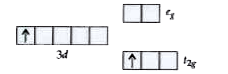
|
|
| 40. |
Give the electronic configuration of the following complexes on the basis of Crystal Field Splitting theory. [CoF_(6)]^(3-),[Fe(CN)_(6)]^(4-) and [Cu(NH_(3))_(6)]^(2+). |
|
Answer» Solution :`[CoF_(6)]^(3-)" has "Co^(3+)(d^(6))"viz".t_(2g)^(4)e_(g)^(2)`, `[Fe(CN)_(6)]^(4-)" has "Fe^(2+)(d^(6))"viz. " t_(2g)^(6)e_(g)^(0)`, `[Cu(NH_(3))_(4)]^(2+)" has "Cu^(2+)(d^(9))" viz. "t_(2g)^(6)e_(g)^(3)`. |
|
| 41. |
Given below are the standard electrode potentials of few half-cells. The correct order of these metals in increasing reducing power will be K^(+)//K=-2.93 V , Ag^+ /Ag=0.80 V, Mg^(2+)/Mg=-2.37 V, Cr^(3+)/Cr =-0.74 V |
|
Answer» K lt MG lt Cr lt AG |
|
| 42. |
Given below are the different temperature reactions and products during extraction of iron in blast furnace. P. 900 K ""1. " "Fe_(2)O_(3) + 3C to 2Fe + 3CO Q. 1200 K ""2." "CaCO_(3) to CaO + CO_(2) R. 1500 K ""3." " 2C + O_(2) to 2CO S. 2000 K ""4. " "Fe_(2)O_(3) +3CO to 2Fe+ 3CO_(2) Find the correct match. |
|
Answer» P-4,Q-2,R-3,S-1 |
|
| 43. |
Give the electronic configuration of the d-orbitals of Ti in [Ti(H_(2)O)_(6)]^(3+) ion and explain why this complex is coloured ? |
|
Answer» Solution :Electronic configuration of d-orbitals of Ti in `[Ti(H_(2)O)_(6)](3+)` is `3d^(1)4s^(0)`. This COMPOUND is coloured DUE to d-d transitions. |
|
| 44. |
Given below are some statements concerning formic acid, which of them is true |
|
Answer» It is a WEAKER acid than ACETIC acid |
|
| 45. |
Give the electronic configuration of d-orbitals of K_(3)[Fe(CN)_(6)] and K_(3)[FeF_(6)] and explain why these complexes give different colours with same solution. |
Answer» Solution :`K_(3)[Fe(CN)_(6)]` : Oxidation state of Fe in the compound is +3. Configuration of `Fe^(3+)` and `Ar3d^(5)` 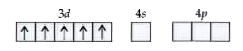 In the PRESENCE of `CN^(-)` ions, pairing of electrons TAKES place under :  These electrons will REMAIN in t2g orbitals and eg orbitals will remain empty. `K_(3)[FeF_(6)]` : Here also the oxidation number of Fe is +3. The configuration of Fe3+ in the presence of `F^(-)` will be  Here due to weak ligand, coupling will not take place. There are 5 unpaired electrons in this case.The COLOUR shown by a coordination compound is due to excitation of electrons within d-d orbitals (from `t_(2g)` to `e_(g)`)- As the distribution of electrons in the two coordination compounds is different, they will show different colours. |
|
| 46. |
Given below are half-cell reactions |
|
Answer» `2.69V`, the REACTION will not OCCUR |
|
| 47. |
DeltaH value for the given reactions at 25^(@)C are- C_(3)H_(8)(g)to3C(s)+4H_(2)(g),DeltaH^(0)=103.8kJ*mol^(-1) 2H_(2)(g)+O_(2)(g) to 2H_(2)O(l),DeltaH^(0)=-571.6kJ*mol^(-1) C_(2)H_(6)(g)+(7)/(2)O_(2)(g)to2CO_(2)(g)+3H_(2)O(l),DeltaH^(0)=-1560kJ*mol^(-1) CH_(4)(g)+2O_(2)(g) to CO_(2)(g)+2H_(2)O(l),DeltaH^(0)=-890kJ*mol^(-1) C(s)+O_(2)(g) to CO_(2)(g),DeltaH^(0)=-393.5kJ*mol^(-1) Calculate DeltaH^(0) for the reaction at 25^(@)C C_(3)H_(8)(g)+H_(2)(g)toC_(2)H_(6)(g)+CH_(4)(g) |
|
Answer» `+98.45kJ` |
|
| 48. |
Given below are few mixtures formed by mixing two components . Which of the following binary mixtures will have same composition in liquid and vapour phase ? (i)Ethanol + Chloroform (ii)Nitric acid + Water (iii) Benzene + Toluene (iv)Ethyl chloride + Ethyl bromide |
|
Answer» (i) and (III) |
|
| 49. |
Give the disproportionation reaction of H_3PO_3. |
|
Answer» Solution :`H_3PO_3` on HEATING undergoes self-oxidation reduction, i.e., disproportionation to form `PH_3` in which is reduced and `H_3PO_4` in which P is oxidised. Oxidation states of P in `H_3PO_3` , `PH_3 and H_3PO_4` are +3, -3 and +5, RESPECTIVELY. `UNDERSET("PHOSPHOROUS acid ")overset(+3)(4H_3PO_3) overset(Delta)to underset("Phosphine")overset(-3)(PH_3) + underset("Orthophosphoric acid ") overset(+5)(3H_3PO_4)` |
|
| 50. |
Given (at 25^(@)C): C (s, graphite)toC(g),DeltaH^(0)=+713.64kJmol^(-1) (1)/(2)H_(2)(g)toH(g),DeltaH^(0)=+218kJ*mol^(-1) 6C(s, graphite)+3H_(2)(g)toC_(6)H_(6)(g),DeltaH^(0)=+82.93kJ*mol^(-1) At 25^(@)C, if the energy of C_H and C-C bonds are 418 and 347 kJ*mol^(-1) respectively, then the C=C bond energy is- |
|
Answer» `+679.8kJ*MOL^(-1)` |
|