

Saved Bookmarks
This section includes 7 InterviewSolutions, each offering curated multiple-choice questions to sharpen your Current Affairs knowledge and support exam preparation. Choose a topic below to get started.
| 1. |
Give the disproportionation reaction of H_(3)PO_(3)? |
|
Answer» SOLUTION :`H_(3)PO_(3)` on HEATING undergoes self - oxidation reduction as : `overset("+3")underset("(phosphorous acid)")(4H_(3)PO_(3))rarrunderset("(phospine)")overset(-3)(PH_(3))underset("(Ortho - phosphoric acid)")overset("+5")(+""3H_(3)PO_(4))` |
|
| 2. |
Given at 25^(@)C [Ag(NH_(3))_(2)]^(+)hArrAg^(+)+2NH_(3) will be |
|
Answer» `10^(-8)` `underline(""AgtoAg^(+)+e^(-),E^(@)=-0.80V)` `[Ag(NH_(3))_(2)]^(+))HARR[Ag^(+)]+2NH_(3),E_(cell)^(@)=-0.78V` `E_(cell)^(@)=(0.0591)/(n)logKtherefore-0.78=(0.0591)/(1)LOGK` or `logK=(-0.78)/(0.0591)=--13.2` K=Antilog`overline(14).8=6.3xx10^(-14)` |
|
| 3. |
Give the disproportionation reaction of H_3PO_3 |
|
Answer» SOLUTION :`H_3PO_3 `DISPROPORTIONATE on HEATING as : `4H_3PO_3 to 3H_3PO_4 + PH_3` |
|
| 4. |
Given (at 25^(@)C): 2FeSO_(4)(s)toFe_(2)O_(3)(s)+SO_(2)(g)+SO_(3)(g),DeltaH^(0)=340.1kJ 2Fe(s)+(3)/(2)O_(2)(g)toFe_(2)O_(3)(s),DeltaH^(0)=-824.2kJ S(s, rhombic)+O_(2)(g)toSO_(2)(g),DeltaH^(0)=-296.8kJ SO_(2)(g)+(1)/(2)O_(2)(g)toSO_(3)(g),DeltaH^(0)=-98.9kJ Heat of formation (in kJ mol^(-1)) of FeSO_(4)(s) at 25^(@)C is- |
|
Answer» `-879.9` |
|
| 5. |
Given are the followingstandardfreeenergies of formation at 293 K. Delta_(f)G^(@) //kJ mol^(-1)""underset(-137.17)(CO(g))""underset(-394.36)(CO_(2)(g))""underset(-228.57)(H_(2)O(g))""underset(-237.13)(H_(2)O(l))""underset("zero")(H_(2)(g))(a)Find Ddelta_(r)G^(@)and the standardequilibriumconstantK_(p)^(0)at 298 K for thereaction""CO(g)+ H_(2)O(g) iffCO_(2)(g) +H_(2)(g) (b) If CO, CO_(2) and H_(2)are mixedso thattheparticalpressureof eachis 101.325 kPaand themixture is broughtinto contactwithexcess of liquidwater,whatwill bethepartialpressure ofgas when equilibrium is attained at 298 K. Thevolumeavailableto the gases is contant . |
|
Answer» `= - 28.62` `= - 2.303 RT logK_(p)` `K_(p)= 1.047 xx 10^(5)` `By ""H_(2)O(L) hArr H_(2)O(g)` `DeltaG^(@) = - 228.57 + 237.13` ` = 8.56 = RT InK_(p)` `K_(p) = 0.0316 "BAR"` `P_(H_(2)O) (g) = 3.16pa` `underset("at eq.pressureX") underset("Initial pressure (101.325)")(CO) + underset(3.16 KPA)underset((3.16 kpa))(H_(2)O(g))""hArr""underset(202.65 kpa)underset((101.325))(CO_(2)) + underset(202 .65 kpa)underset((101.325))(H_(2))` `1.047 xx 10^(5) =(202.65)^(5)/(X xx3.16)` `X = 0.124kPa` |
|
| 6. |
Given are the isomers of C_(8)H_(8)O_(2). Which isomer gives +ve Tollen's test, also reacts with FeCl_(3) ? |
|
Answer» B |
|
| 7. |
Given are the isomers of C_(8)H_(8)O_(2). Which isomer reacts with NaHCO_(3) ? |
|
Answer» c |
|
| 8. |
Give the dispersion medium and dispersed phase of the following : (ii) milk. |
Answer» SOLUTION :
|
|
| 9. |
Given are the isomers of C_(8)H_(8)O_(2). Which isomer on hydrolysis gives 1,4-di hydroxybenzen ? |
|
Answer» a |
|
| 10. |
Give the dispersion medium and dispersed phase of the following : (i) smoke |
Answer» SOLUTION :
|
|
| 11. |
Given are cyclohexanol (I), acetic acid (II), 2, 4, 6 - trinitrophenol (III) and phenol (IV). In these the order of decreasing acidic character will be |
|
Answer» II GT III gt IV gt I |
|
| 12. |
Give the differences between zero order and first order reaction . |
| Answer» Solution :`{:("Zero Order","FIRST order"),("(i) Its .k. has unit"= molL^(-1)s^(-1),"(i) Its .k. has unit =time"^(-1)=SEC^(-1)),("(II) Its " t_(1//2)"is DIRECTLY proportional to initial conc. of reactant ","(ii) Its HALF life is independent of the initial conc. of the reactant."):}` | |
| 13. |
Given are cyclohexanol (I) , acetic acid (II), 2, 4 , 6-trinitrophenol (III) and phenol (IV) . In these the order of decreasing acidic character will be |
|
Answer» `III GT IV gt II gt I` 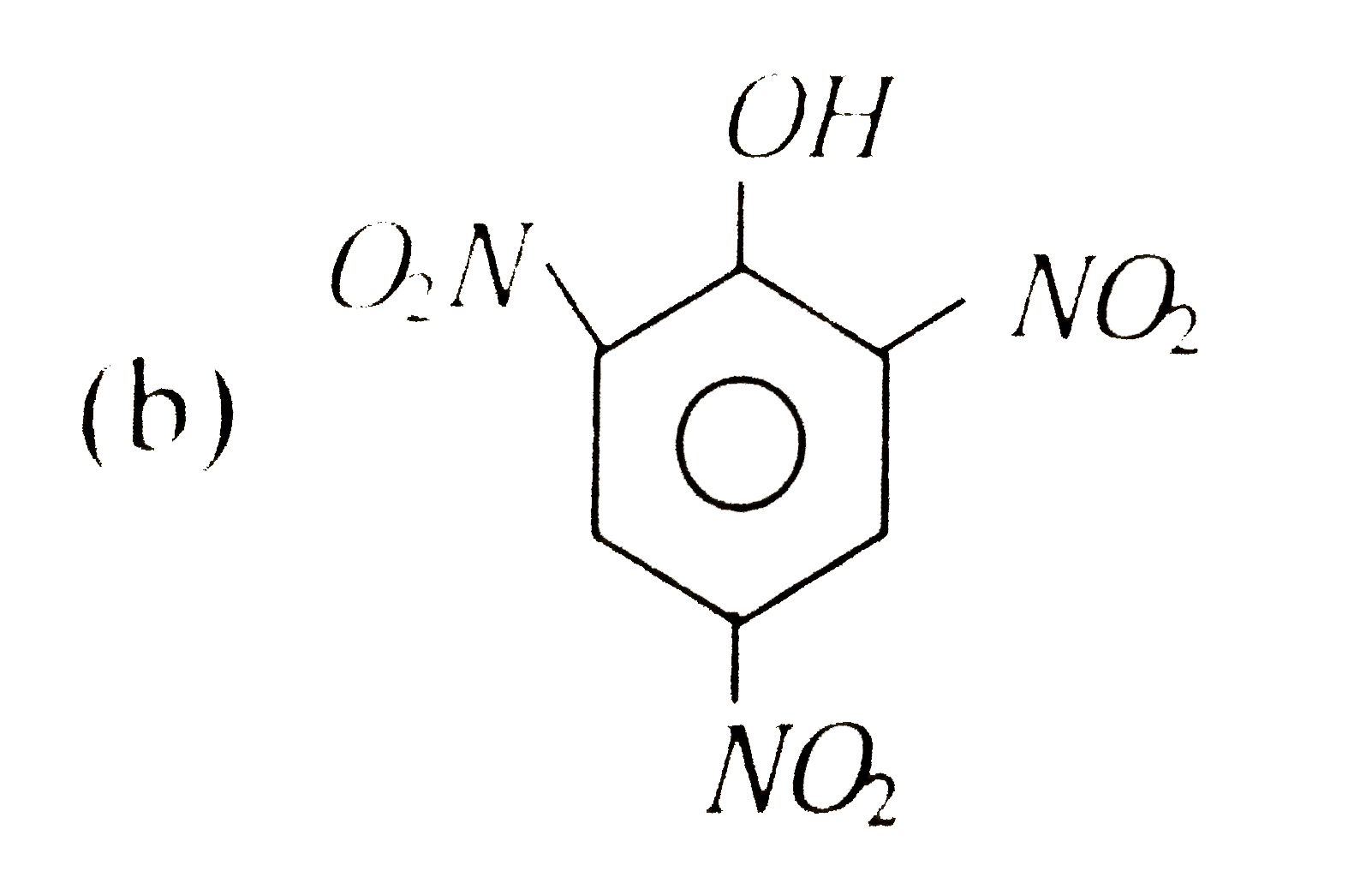
|
|
| 14. |
Given an example of solid solution in which the solute is a gas. |
| Answer» Solution :In case a solid solution is formed between two SUBSTANCE, an interstitial solid solution (SMALLER size particle will OCCUPY interstitial position in solid CRYSTAL) will be formed. For example, a solution of hydrogen in palladium is a solid solution in which the solute is a GAS. | |
| 15. |
Give the differences between primary and secondary structure of proteins |
Answer» SOLUTION :
|
|
| 16. |
Given an example of crown ether. Write the formula and structure |
Answer» 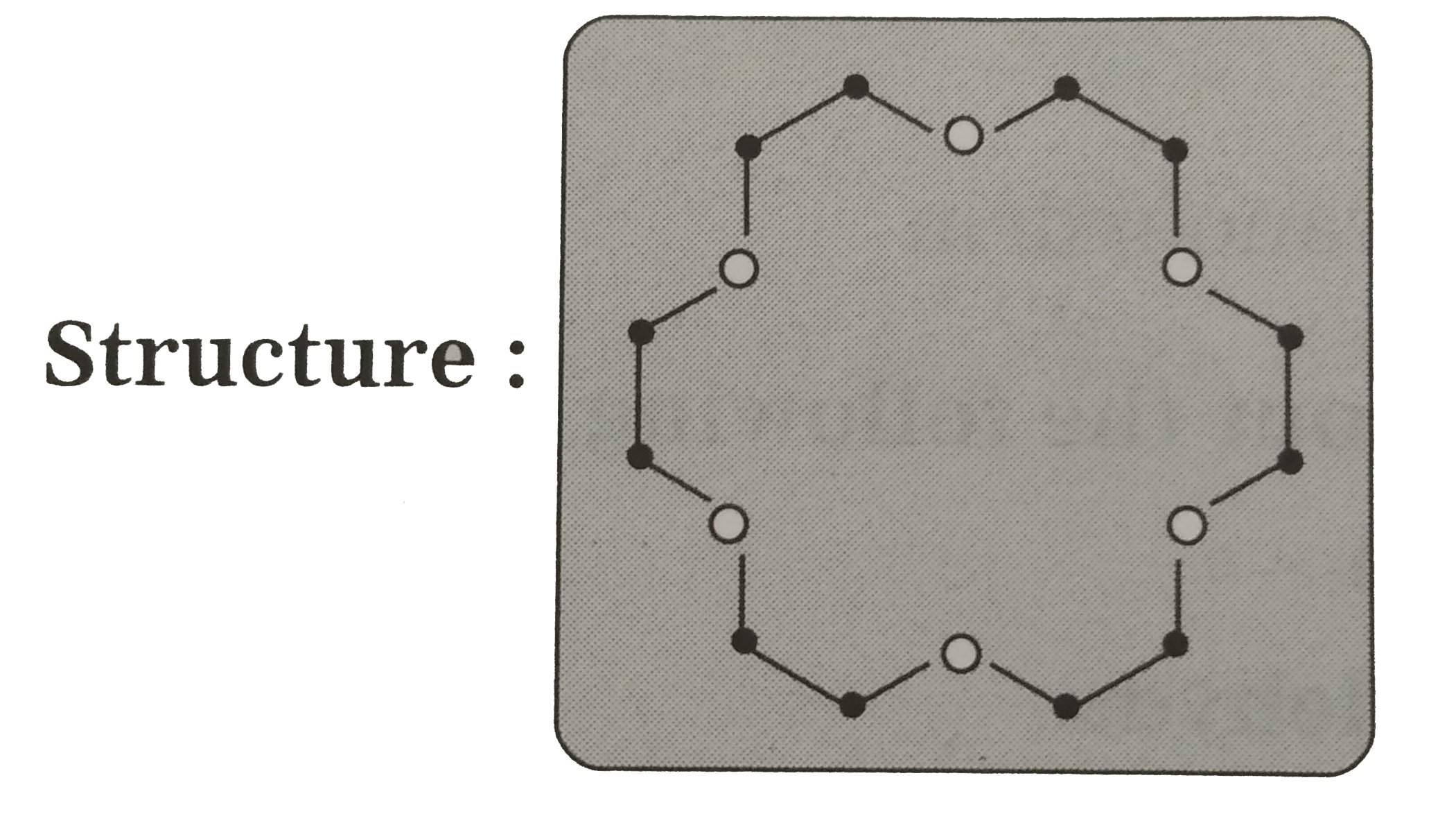
|
|
| 17. |
Give the differences between primaryand secondarystructure of proteins . |
Answer» SOLUTION :
|
|
| 18. |
Given an example of ionization isomerism. |
|
Answer» SOLUTION :Ionisation ISOMERISM : `[Co(NH_3)_5 SO_4 ] Br and [Co(NH_3)_5 Br] SO_4.` |
|
| 19. |
Give the differences between lanthanides and actinides |
Answer» SOLUTION :
|
|
| 20. |
Givenan exampleof a syntheticrubber and mentionits main advantage . |
|
Answer» Solution :An EXAMPLEOF SYNTHETIC rubberis BUNA - S . MAIN advanatge: Itisresistance to theactionof petrol , lubricatingoil and organicsolvents. |
|
| 21. |
Give the differences between DNA and RNA. |
Answer» SOLUTION :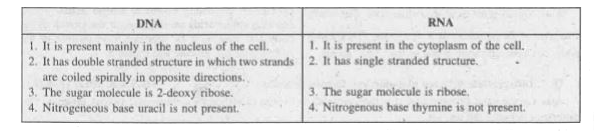
|
|
| 22. |
Illustrate the following with an example : 'Coordination isomerism.' |
|
Answer» SOLUTION :Co-ordination Isomerism : `[CR(NH_3)_6] [Co(CN)_6] and [Co(NH_3)_6][Cr(CN)_6]` |
|
| 23. |
Given an example for each.(a) Artificial sweetening agents. Narcotic analgesics. |
|
Answer» SOLUTION :(a) Ortho-sulphobenzimide (saccharin) or Aspartame or Alitame. (b) MORPHINE or HEROIN or Codein. |
|
| 24. |
Give the difference between double salts and coordination compounds. |
Answer» SOLUTION :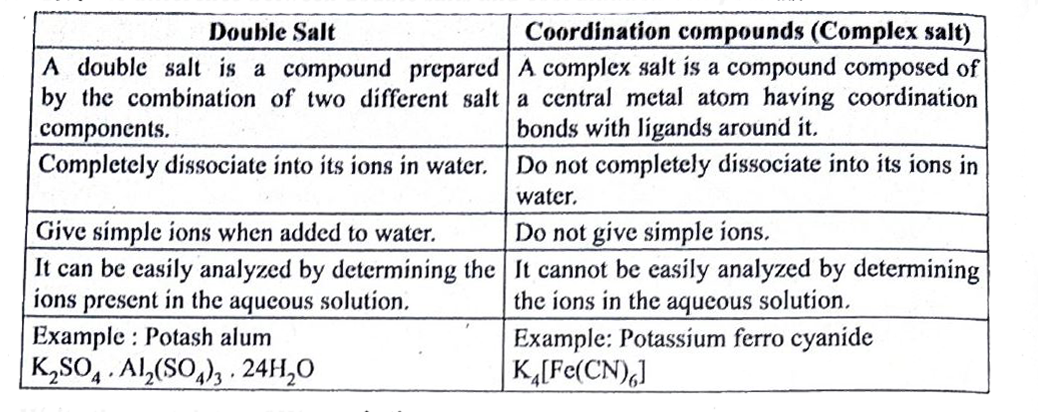
|
|
| 25. |
Given an example for complex of the type [Ma_(2)b_(2)c_(2)] where a,b,c are monodentate ligands and give the possible isomers. |
|
Answer» Solution :The OCTAHEDRAL complexes of `[Ma_(2)b_(2)c_(2)]` type can exist in five geometrical ISOMERS. The five geometrical isomers for the COMPLEX ion `[PtCl_(2)(NH_(3))_(2)(py)_(2)]^(2+)` are shown below. 
|
|
| 26. |
Give the differences between crystalline and amorphous solids with respect to shape and melting point. |
Answer» SOLUTION :
|
|
| 27. |
Given an alloy of Cu, Ag and Au in which Cu atoms constitute the ccp arrangement . If the hypothetical formula of the alloy is Cu_4 Ag_3 Au , the probable locations of Ag and Au atoms are |
|
Answer» Ag- all tetrahedral VOIDS , Au - all octahedral voids |
|
| 28. |
Give the depressing agents used in the forth floatation process and why we use depressing agents in that process? |
| Answer» Solution :Generally sodium cyanide and sodium carbonate are used as an DEPRESSING agents for FORTH floatation process.These reagents are used to selectively prevent other metal sulphides from coming to the forth.For example,When impurities such as ZNS is present in galena (PbS),sodium cyanide(NaCN) is added to depresses the flotation property of ZnS by forming a layer of zinc complex `Na_(2)[Zn(CN)_(4)]` on the SURFACE of zinc sulphide | |
| 29. |
Give the decreasing order of (o+p)/(m) ratio of the reactions or decreasingorder of the reactivitygiven is problem 11.11. |
|
Answer» <P> Solution :Reactivity order of `SE` reactiion or `((o+p)/(m))` ratio (same explanation as in Problem `11.10`)`o-, p-` DIRECTING reactivity and `((o+p)/(m))` ratio order. i.`underset((VIII))(-NH-)overset(O)overset(||)(C-) underset(gt)(gt) underset((I))(-R) (-CHMe_(2) underset(gt)(gt) underset((II))(-CMe_(3))) underset(gt)(gt) underset((VII))(-Ar) underset(gt)(gt) underset((III))(I)` ii. `m-` directing reactivity order: `underset((V))(-CX_(3)) underset(gt)(gt) underset((VI))(-C) -= N underset(gt)(gt) underset((IV)) overset(O)overset(||)(-C-O-R)` But `((o+p)/(m))` ratio order of compounds in Problem 11.11 is: `underset((VIII))(O) underset(gt)(gt) underset((I))(A) underset(gt)(gt) underset((II))(C) underset(gt)(gt) underset((VII))(M) underset(gt)(gt) underset((III))(E) underset(gt)(gt) underset((IV))(G) underset(gt)(gt) underset((VI))(K) underset(gt)(gt) underset((V))(I)` |
|
| 30. |
Given A^(2+)+2e to A_((s)), E^(0)=0.08V B^(+) +e to B_((s)), E^(0)=-0.64 V X_(2(g))+2e to 2X^(-), E^(0)=1.03 V The incorrect statement among the following is: |
|
Answer» `X_(2(g))` will OXIDIZE both A and B |
|
| 31. |
Give the decreasing order of therelative reactivity towards SE reaction of the following compounds. a. I. Benzene, II. Phenol, III. Aniline, IV. Chlorobenzene b. I. Acetannilide, II. Aniline, III. Acetep[jempme, IV. Benzene. c. I. 1,3- Dimryhyl benzene, II. 1,4- Dimenthyl-benzene, III. Tolune, IV. Trimehtyl benzene, V. 1,3,5- Trimethtyl benzene d. I. p- Mehtyl benzoic acid, II. Terephtalic acid, III. p- Xylene, IV. Toluene. e. I. Benzene, II. Toulene, III. p-Nitrotoulene, IV. m- Nitroluence, V. Benzence g. I. Flurobenzene, II. Chlorobenzene, III. Bromobenzene, IV. Iodobenzene h. I. p- Nitrochlorobenze II. Chlorobenzene, III. 2.4- Dintrochlorobenzene |
|
Answer» Solution :a. `(III) gt (II) gt (I) gt (IV) (PhNH_(2) gt PhOH gt PHH gt Ph-Cl)` Reactiving of `- NH_(2) gt -OH gt -H gt -C,` b. `(II) gt (I) gt (IV) gt (III)` 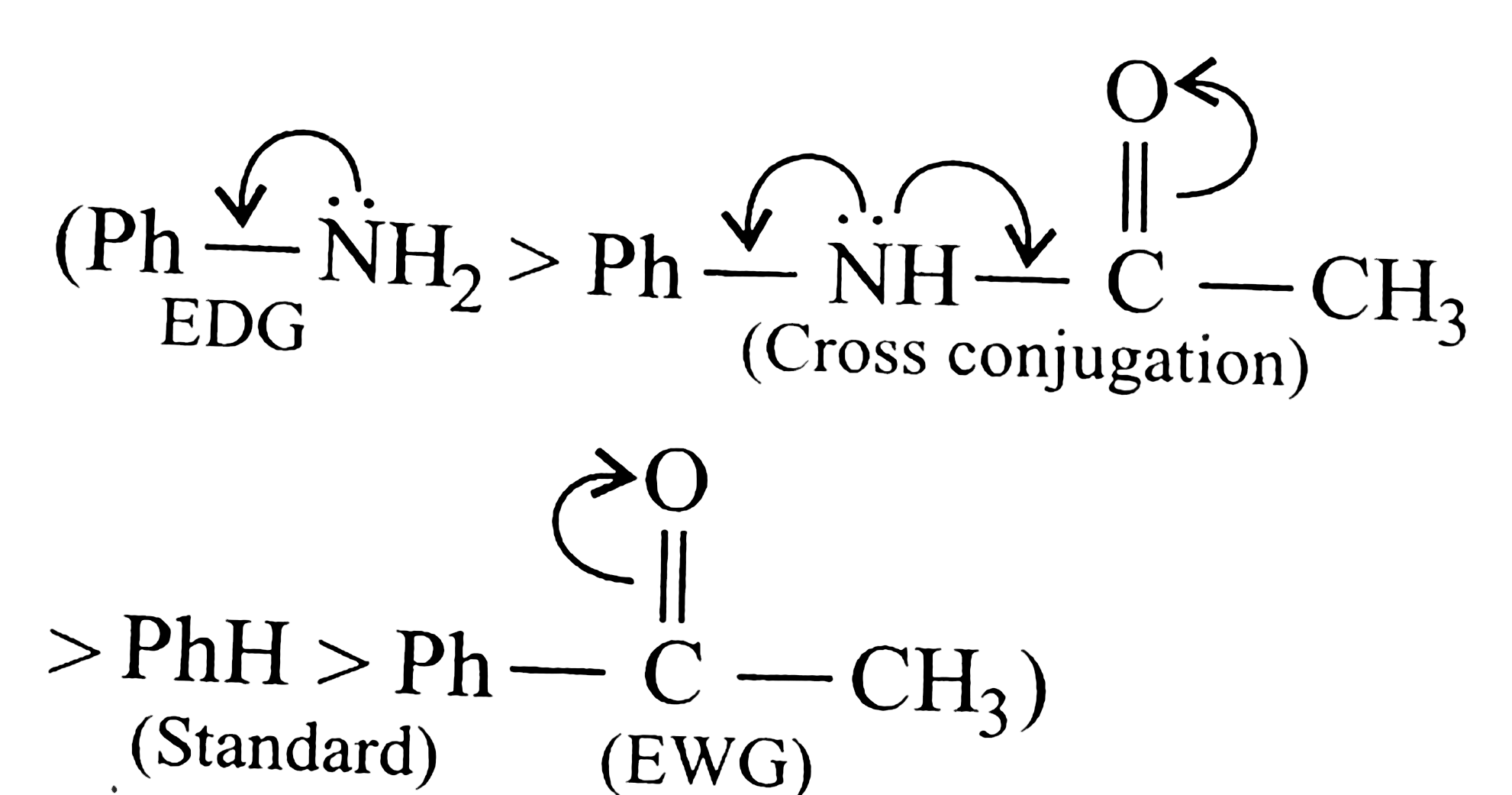 c. `(V) gt (II) gt (I) gt (III) gt (IV)` c. `(V) gt (II) gt (I) gt (III) gt (IV)` 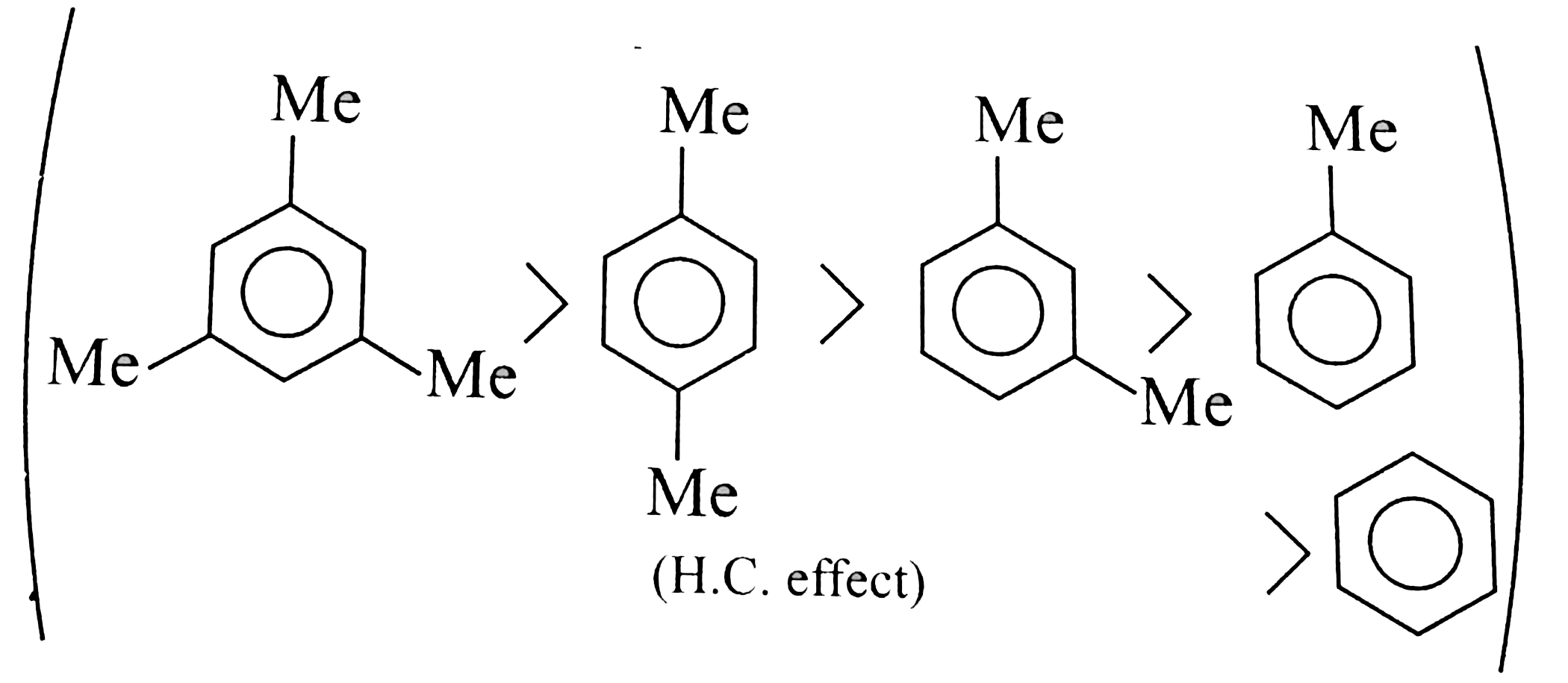 d. `(III) gt (IV) gt (I) gt (II)` 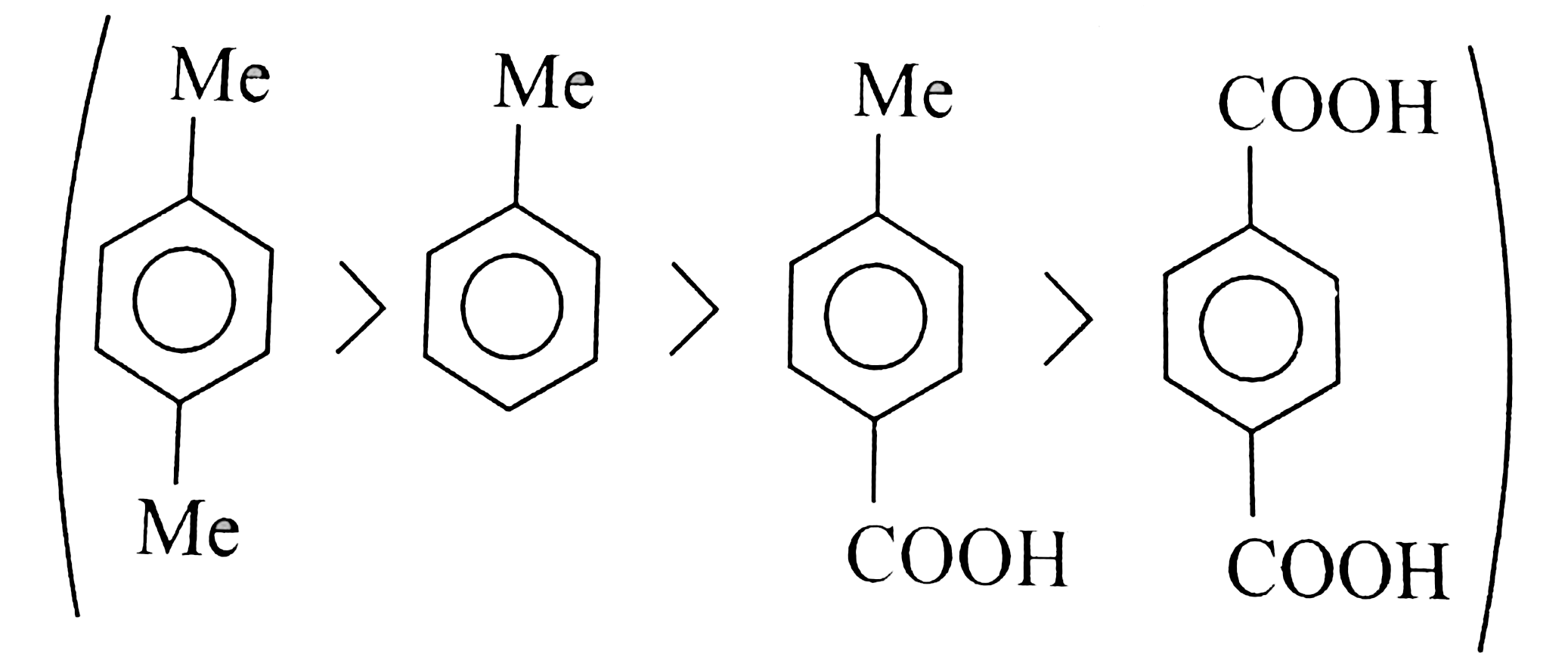 e. `(II) gt (III) gt (IV) gt (V) gt (I)` 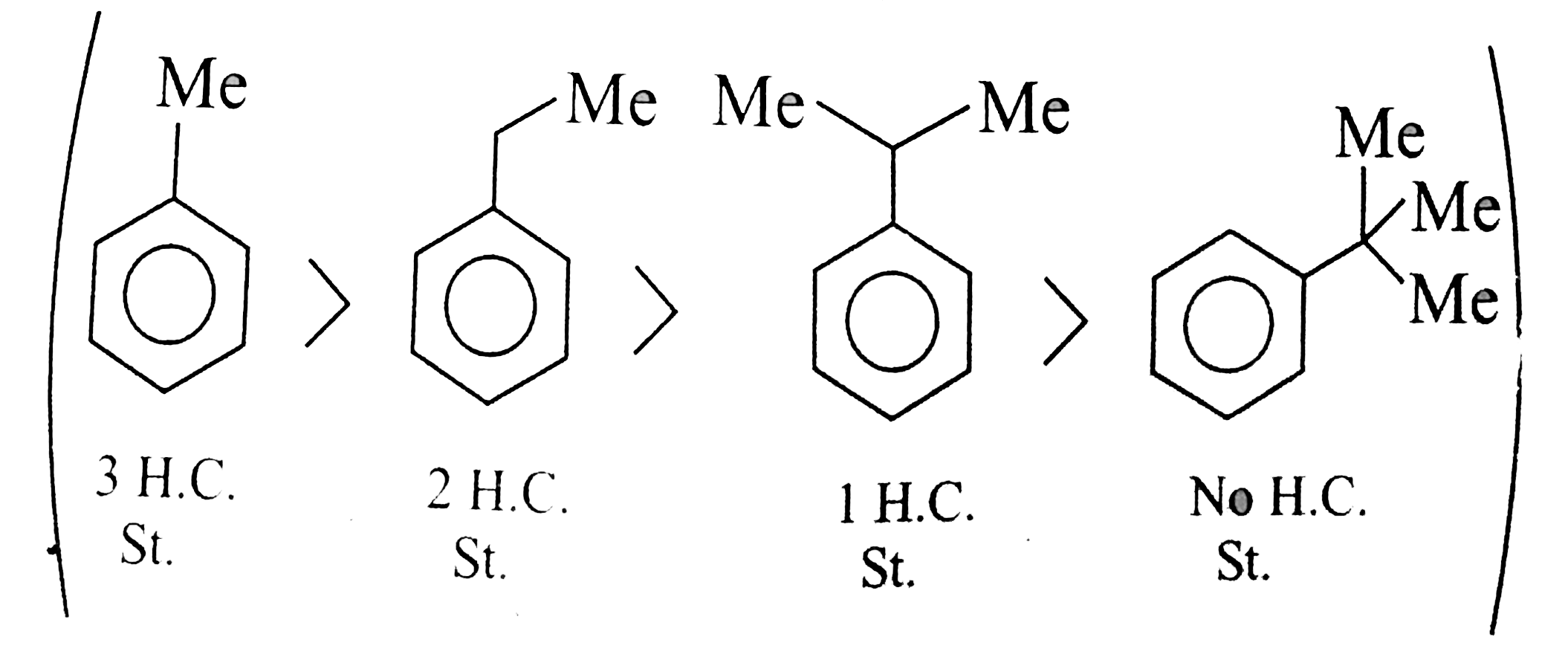 f. `(I) gt (II) gt (V) gt (IV) gt (III)` 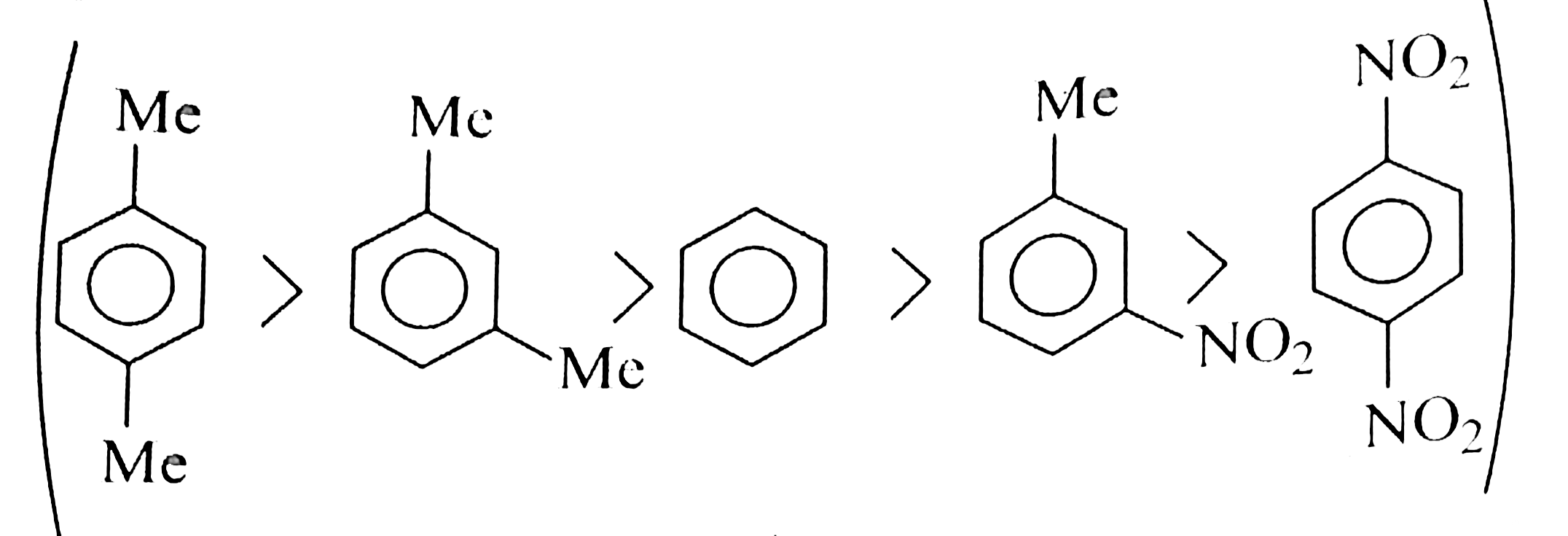 Explanation: Hyperconjugative effect is stronger at `o-` adnd p-` positions than at `m-` position. So, the reactivity of ``(I) gt (II). overline(e)` withdrawingby resonance of `(-NO_(2))` is stronger at `o-` and `p-` positons than at `m-` positon. The deactivating effect is more at `o-` and `p-` positons, so the reactivity of `(IV) gt (III). Explanation: Hyperconjugative effect is stronger at `o-` adnd p-` positions than at `m-` position. So, the reactivity of ``(I) gt (II). overline(e)` withdrawingby resonance of `(-NO_(2))` is stronger at `o-` and `p-` positons than at `m-` positon. The deactivating effect is more at `o-` and `p-` positons, so the reactivity of `(IV) gt (III). g. `(IV) gt (III) gt (II) gt (I) (ph - Br gt PhCl gt Phf)` Reactivity at `I gt Br gt Cl gt F` (both `-I` and `+R` EFFECTS) [ILLUSTRATION `11.18 (f)`]. h.`(II) gt (I) gt (III)` 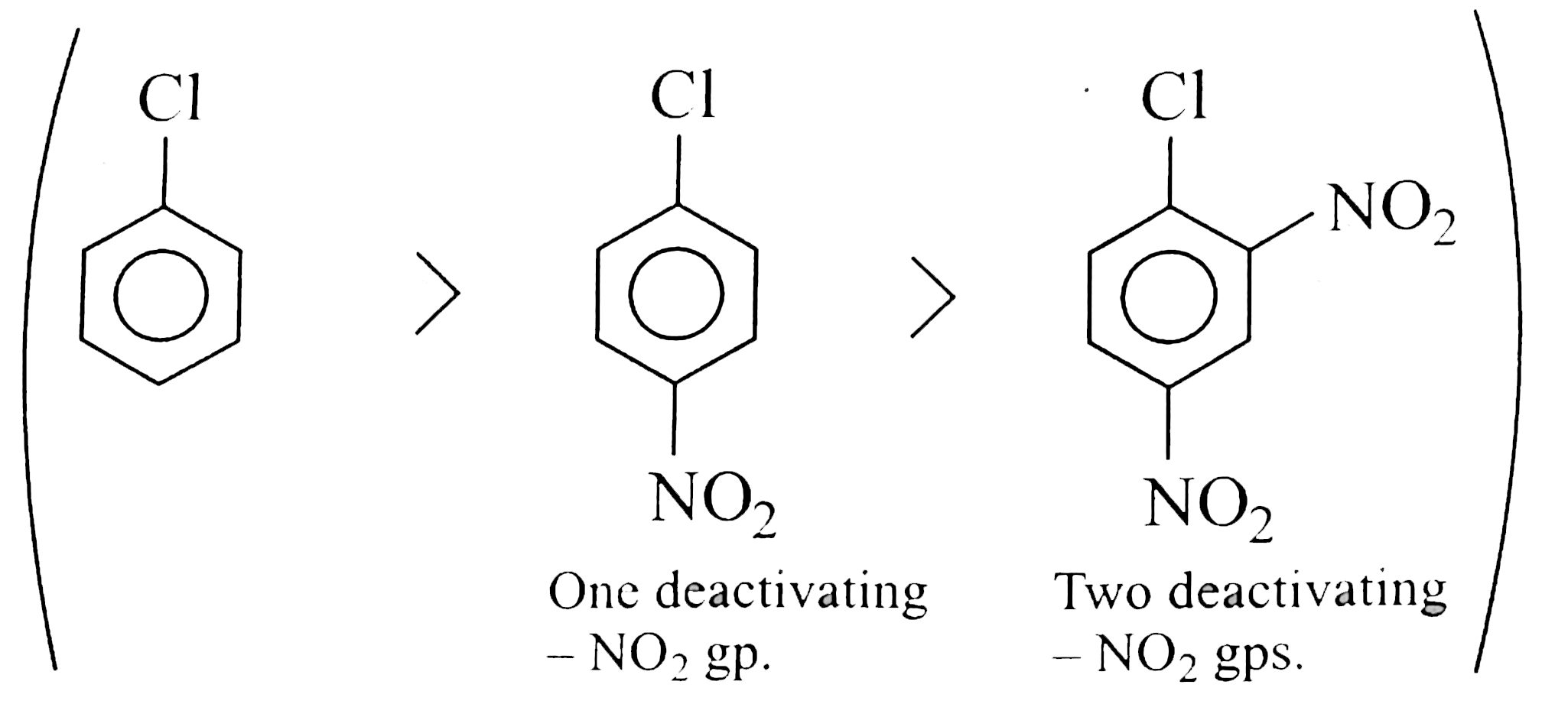
|
|
| 32. |
Given 2Fe_(2)O_(3)(s) to 4Fe(s)+3O_(2)(g),DeltaG^(@)=-1487 "kJ mol"^(-1) 2CO(g)+O_(2)(g) to 2CO_(2)(g),DeltaG^(@)=-514.4"kJ mol"^(-1) Free energy change DeltaG^(@) for the reaction 2Fe_(2)O_(3)(s)+6CO(g) to 4Fe(s)+6CO_(2)(g) will be |
|
Answer» `-168.2 "KJ MOL"^(-1)` |
|
| 33. |
Give the decreasing order of following with their properties as indicated. A. Decreasing basic, mucliophllic and fugacity orders: a. I, H_(2)O, II. CH_(3)OH, III. O overset(o-)(H), IV. CH_(3)O^(o-) b. I. H_(2)O, II. C_(2)H_(5) OH, III. O overset(o+)(H), IV. C_(2)H_(5)O^(o-) c. I. HCO_(3)^(o+), II. F^(o-) III. F_(3) C - COO^(o-), IV. NO_(3)^(o-) B. The decreasing order of ArSN reaction: a. I. PhCl II. p-NO_(2) - C_(6)H_(4) - Cl III. 2,4,6- Trinitro chlorobenze IV. 2.4- Dintro chlorobenzene I. PhF II. p-NO_(3)S - C_(6) H_(4) - F III. p-HOOC - C_(6) H_(4) - F IV. Ip-NO_(2) - C_(6) H_(4) - F C. I. PhCl II. p-NO_(2) - C_(6) H_(4) - Cl III. o-NO_(2) - C_(6) H_(4) - Cl IV. m-NO_(2) - C_(6)H_(4) - Cl C. The decreasing order of SE reaction: a. I. PhCl, II. C_(6) H_(6) III. PhCH_(3), IV. PhOMe b. I. PhCH_(3) II. o-MeO-C_(6) H_(4) - Me III. m-MeOC_*(6) H_(4) - Me IV. p-MeO - C_(6)H_(4) - Me c. I. PhNH_(2), II. PhNHCHOCH_(3) III. PhNHCOPh , IV. PhNHTs d. I. PhNH_(2) II. o-NP_(2) - C_(6) H_(4) - NH_(2) III. m-NUO_(2) - C_(6) H_(4) - NH_(2) IV. p-NO_(2) - C_(6) H_(4) - NH_(2) |
|
Answer» <P> Solution :a. Convert the given bases into acid by adding `H^(o+)`. Find the order of acidic character.Remember `CH_(3)OH` is a slightly acid than `H_(2)O` but other alchois are weaker acidsthan `H_(2)O`. Order of acidic character: `CH_(3) O underset(o+)(H_(2)) gt H_(3) O^(o+) gt CH_(3) OH gt H_(2)O` `pK_(n)` value: `-2.5, 1.74, 15.5, 15.74`. For basic character remove `H^(o+)` ion and reverse the acidic order. Order of basic character: `CH_(3)OH lt GH_(2)O lt CH_(3)O^(o-) lt O^(o+)H` `(II) lt (I) lt (IV) lt (III)` Decreasing order: `(III) gt (IV) gt (I) gt (II)` Nuclephillicity order: (Since the nuclephlic centre is same, teh orders of basicaly and nucleopphilicy are same.) `(III) gt (I) gt (IV) gt (III)` b. Rember `H_(2)O` is a stronger acid than `C_(2) H_(5)OH` Order of acidic cahracter: `H_(3) O^(o+) gt C_(2) H_(5) O^(o+) H_(2) gt H_(2)OOH` Order of basic character: `H_(2)O lt C_(2) H_(5)OH lt OH lt C_(2)H_(5)O` `(I) lt (II) lt (III) lt (IV)` Decreasing order: `(IV) gt (III) gt (II) gt (I)` Nuclephilic order: `(IV)(II) gt (II) gt (I)` Basically and nucleiphilcilty orders are same, due to teh same nucleopphilic centre. Fugacity order (reverse of basic order): `(I) gt (II) gt (III) gt (IV)` C. Order of acidic character: `HNO_(3) gt F_(3)C - COOH gt HF gt H_(2) CO_(3)` `pK_(4)` value: `-1.4, 0.18, 3.2, 3.7` Basic order: `NO_(3)^(o+) lt F_(3)C - COO^(o-) lt F^(o-) lt HCO_(3)^(o-)` `(IV) lt (III) gt (II) lt (I)` Decreasing basicand nucleophillic orders: `(I) gt (II) gt (III) gt (IV)` Nucleophililic order and basic orders are same. Fugacity order (reverser of basic order): `(IV) gt (III) gt (II) gt (I)` B. A. `ArSn` reactions are facoured by `EWG`ART `o-` adbn `p-` positonsmore the`EWG`presentatthesepositons, faster is the `ArSN` reaction. The decreasingorder of `ArSN` reasction: `(III) gt (IV) gt (II) gt (I)` `(III) implies` Three `(NO_(2))` groups at `o-` and `p-` (IV) implies` Two `NO_(2)` groups at `o-` and `p-`, `(II) implies ` One(NO_(2))` groups at `p-`. `(I) implies (Cl)` group` b. The decreasing oreder of `ArSN` reaction: `(II) gt (IV) gt (III) gt (I)` `EW` power by resonance of `(-SO_(3)H) gt (-NO_(2)) gt (-COOH)` in all `F` has to be substitudedby `Nu^(o-)` (althogh `-I` effect of `(-NO_(2)) gt (-SO_(3)H)` (`:'EN` of `NgtS` ) but `-R` effect of `(-SO_(3)H)` gropu than in `(-NO_(2))` and `(-COOH), -R` power is equal but `-I` effect of `(-NO_(2))` froup `o-NO_(2) gt p-NO_(2) gt m- NO_(2)` (at `o-` and `p-` positobns `-R` effect is equal, but `-1` effect at `o-` position`-R` effect is equal. but`-1` effect at `o-0` positonsis slightlygreater than that at `p-` postion and at `m-` positon only `-1` effect is operative). The decreasingorder of `ArSN` reaction: `(III) gt (II) gt (IV) gt (I)` C. `SE` reaction is favoured by `EDG`. More the `EDG` faster is the `SE` reaction. a. `ED` power of `(-OME)` (by `+R` and `-I` effect) `gt (_CH_(3))``(buy `+1` and `H.C`) gt BENZENE `gt (-Cl)` (deactivating by `-1` effect). `:.` decreasing`SE` reaction order: `(IV) gt (III) gt (II) gt (I)` b. `ED` POWEROF `(-OMe) group: `(p - OMe) gt ("orhto", - OMe) gt (-CH_(3)) gt (m 0 OMe)` 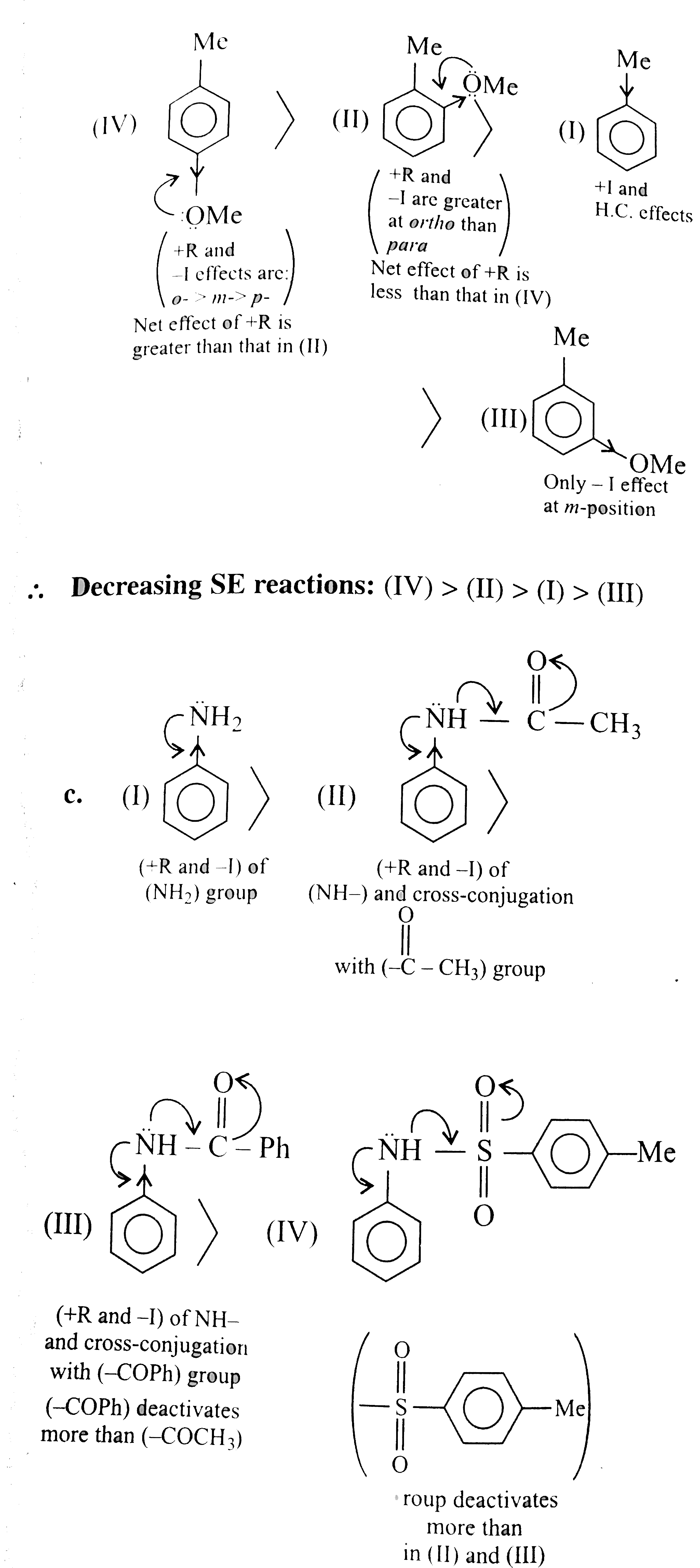 `:.` Dereasing `SE` reaction order: `(I) gt (II) gt (III) gt (IV)` 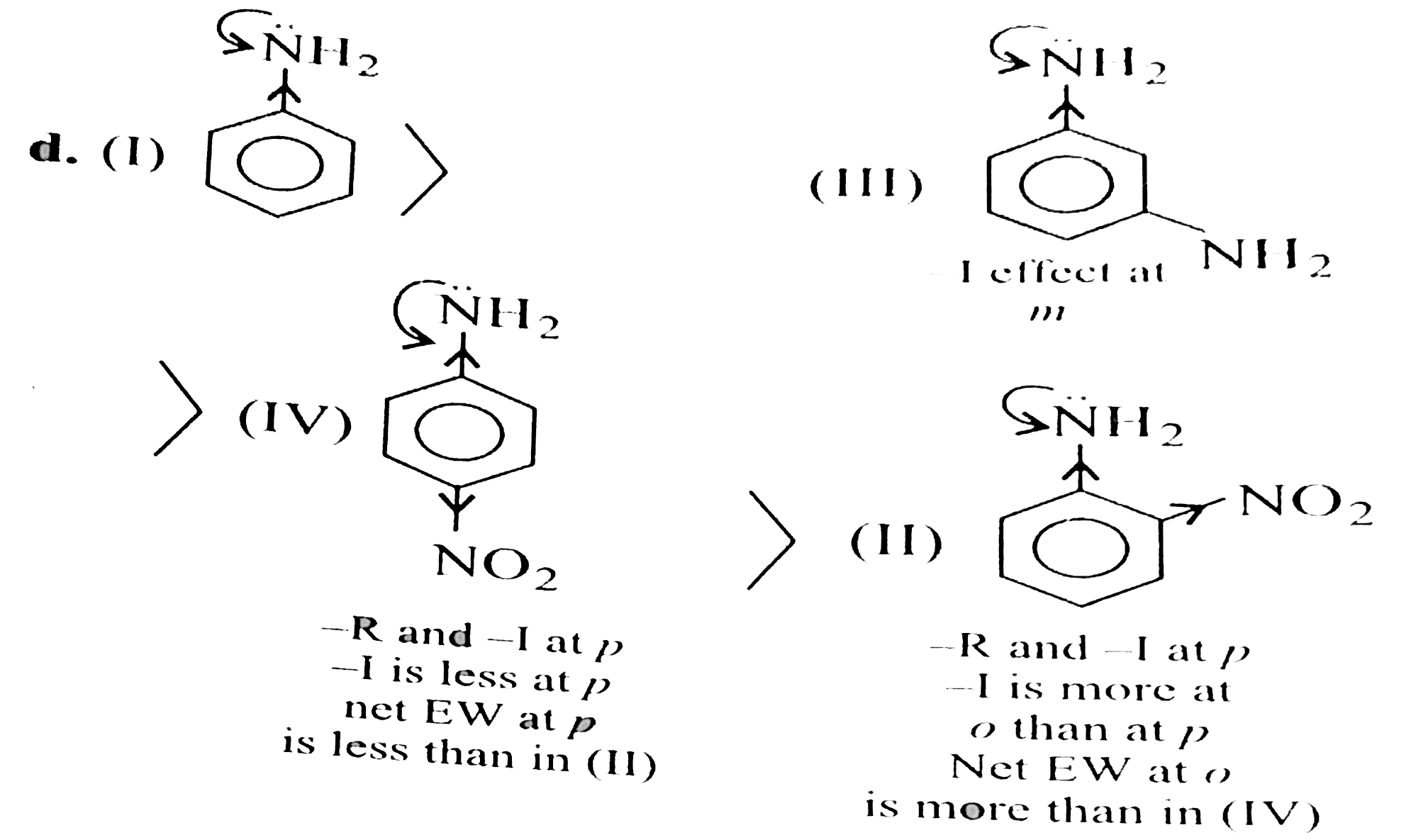
|
|
| 34. |
Given a 0.1 M solution of each of the following. Which solution has the lowest pH |
|
Answer» `NaHSO_(4)` `H^(+) = 10^(-1)`. `pH = -log [H^(+)] = -log[10^(-1)] , pH = 1`. |
|
| 35. |
Give the decreasingorder of ((o + p)/(m)) ratio for the nitration of compounds in Problem 11.9. |
|
Answer» Solution :Greater the reactivity of `o,p-` directing substiuent, more is the `(( o + p)/(m))` ratio. SIMILARLY, greaterthe reativityof `m-` directing substituent, less is the `(( o + p)/(m))` ratio. IN problem`11.9`, the reactivity order of `o-,p` directing substituent and of `m-` directing substituent is: `o-,p-` Directing reactivity and`(( o + p)/(m))` ratio order: `UNDERSET((IV))(-OR) underset(gt)(gt) underset((I))(-OCOR) underset(gt)(gt)underset((VII))(-CH=CH-COOH) underset(gt)(gt) underset((II))(-CH=CH-NO_(2)) underset(gt)(gt) underset((V))(-R)` m-` directing reactivity order: `underset((VI)) overset(O) overset(||) (-C) -R underset(gt)(gt) underset((III))overset(O)overset(||)(C) - NH_(2)` `(o+p)/(m)` ratio: `(III) gt (IV)` HENCE `((o + p)/(m))` ratio order is: `(IV) gt (I) gt (VII) gt (II) gt (V) gt (III) gt (VI)` |
|
| 36. |
Given 1. C("graphite")+O_(2)(g) to CO_(2)(g), DeltaH^(@)=-3935 kJ mol^(-1) 2. H_(2)(g)+(1)/(2)O_(2)(g) to H_(2)O(l),DeltaH^(@)=-285 kJ mol^(-1) 3. CO_(2)(g)+2H_(2)O(l) to CH_(4)(g)+2O_(2)(g),DeltaH^(@)=+890.3kJ mol^(-1) Based on the above thermochemical equations the value of Delta(r)H^(@) at 298 K for the reaction C("graphite")+2H_(2)(g) to CH_(4)(g) will be |
|
Answer» `+78.8 KJ MOL^(-1)` |
|
| 37. |
Given, 2Fe+(3)/(2)O_(2)toFe_(2)O_(3),DeltaH=-193.4kJ,Mg+(1)/(2)O_(2)to MgO,DeltaH=-140.2kJ What is the DeltaH for the following reaction? 3Mg+Fe_(2)O_(3) to 3MgO+2Fe |
|
Answer» `-227.2kJ` `Mg+(1)/(2)O_(2)toMgO,DeltaH=-140.2kJ`. ..(ii) On multiplying Eq. (iI) by (3) and subtracting eq. (i) we GET the FINAL equation, `3Mg+Fe_(2)O_(3)to2Fe+3MgO,` `therefore DeltaH=(-420.6)+(193.4)=-227.2kJ` |
|
| 38. |
Give the decreasing order of ease of decarboxylation of the following acids on heating with sodalime, |
Answer» Solution :CARBOXYLIC acid forms Na or K or calcium carboxylate salts `(RCOO^(-))` which lose `CO_(2)` to form R (carbanion). More STABLE the carbanion formed, more readily the RESPECTIVE compound is formed. EWG [(-) or (-R) stabilises the carbanion. 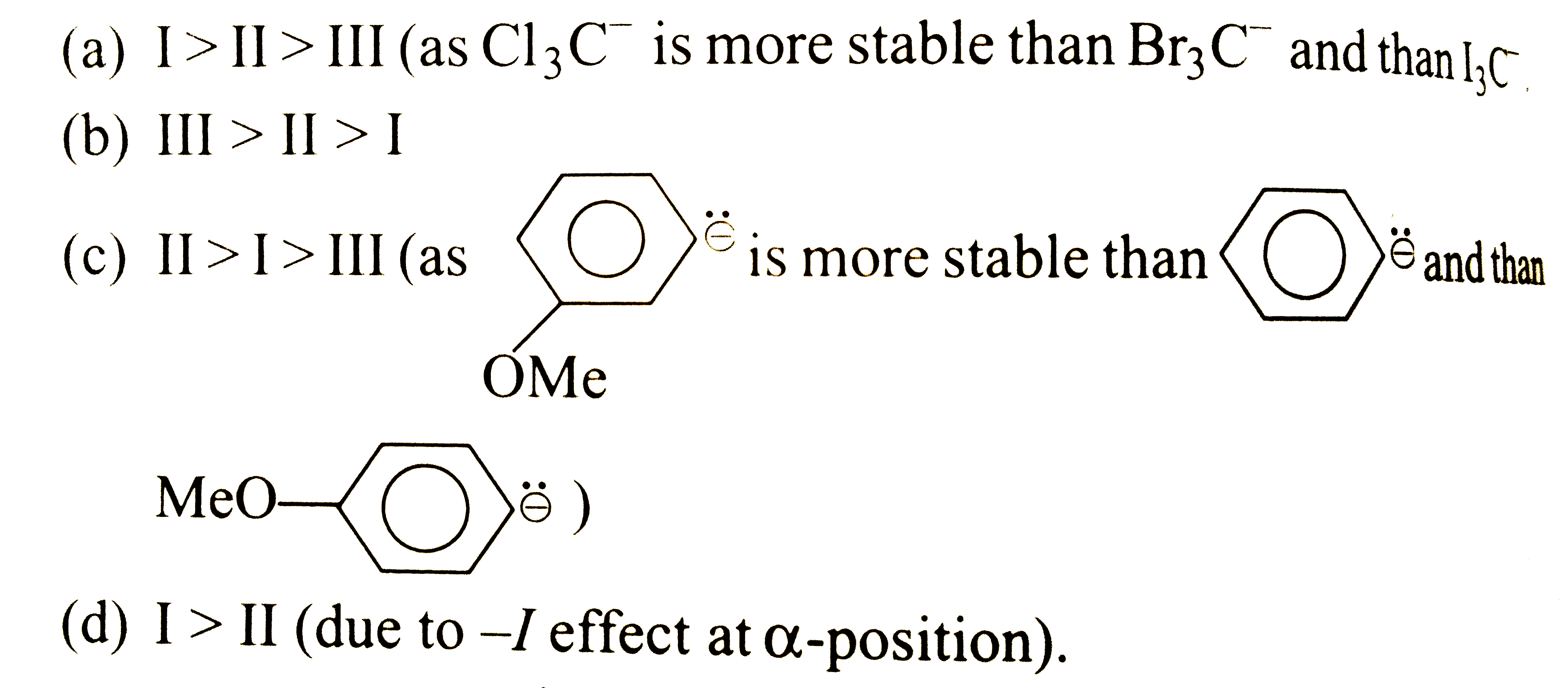
|
|
| 39. |
Given :2Fe+(3)/(2)O_(2)rarrFe_(2)O_(3), DeltaH=-193.4 kJ,Mg+(1)/(2)O_(2)rarrMgO, DeltaH=-140.2 kJWhat is the DeltaH of the reactionMg+Fe_(2)O_(3)rarr3MgO+2Fe |
|
Answer» `-1802 KJ` `MG+(1)/(2)O_(2)rarrMgO, DeltaH=-140.2 kJ "....(ii)"` On MULTIPLYING eq. (ii) by 3 `3Mg+(3)/(2)O_(2)rarr3MgO, DeltaH=-420.6 kJ "....(ii)"` Resulting equation can be obtained by SUBTRACTING eq. (i) from (iii) `3Mg+(3)/(2)O_(2)rarr3MgO, DeltaH=-420.6 kJ` `(2Fe+(3)/(2)O_(2)rarrFe_(2)O_(3), DeltaH=-193.4 kJ)/("Subtraction : ")` `3Mg+Fe_(2)O_(3)rarr2Fe+3MgO, DeltaH=-227.2 kJ` |
|
| 40. |
Give the decreasing boiling points of ortho para and metadichlorobenzens |
|
Answer» ORTHO lt PARA ltmeta |
|
| 41. |
Given: 2C_((s)) + 2O_(2(g)) to 2CO_(2(g)), Delta H_1 =-767 kJ …(i) H_(2(g)) + 1/2 O_(2(g)) to H_2 O_((l)), Delta H_2 =-266 kJ …(ii) C_2 H_(2(g)) + 5/2 O_2 to 2CO_(2(g)) + H_2 O_((l)), Delta H_3 =-1290 kJ ….(iii) Heat of formation of acetylene is _________ . |
|
Answer» 1802 KJ |
|
| 42. |
Give the correct set for the product which can be obtained by the hydrolysis of CaC_2 ? |
|
Answer» (I)(III)(Q) |
|
| 43. |
Give vapour pressure of Benzalehyde is 400torr at 154^(@)C and its normal BP is 179^(@)C. What is its molar entholpy of vaporisation, DeltaH_("vap")? |
|
Answer» `67.9KJ MOL^(-1)` |
|
| 44. |
Give the correct order of the increasing acidic strength of the following compounds : |
|
Answer» `II LT I lt III` |
|
| 45. |
Give the correct order of stability is shown by : (P) [Al(H_(2)O)_(6)]Cl_(3) (Q) [Al(H_(2)O)_(5)Cl]Cl_(2).H_(2)O (R ) [Al(H_(2)O)_(4)Cl_(2)]Cl.2H_(2)O (S) [Al(H_(2)O)_(3)Cl_(3)].3H_(2)O |
|
Answer» `PltQltRltS` `[Al(H_(2)O)_(6)]Cl_(3)overset("water") to [Al(H_(2)O)_(6)]^(3+)+3Cl^(-)` |
|
| 46. |
Give uses of lanthanoids and its compounds |
|
Answer» Solution :Pyrophoric Misch metal that has 50% Ce, 40% La, 7% Fe and 3% other elements such as S, C, Ca and Al is used as reducing agent and as stones in gas lighters. Mixed oxides of lanthanoids are employed as catalyst in PETROLEUM cracking. Gadolinium sulphate is used to produce very low temperature by its magnetic effect. `CeO_(2)` is USEFUL in pigments Ce(IV) compounds are used as OXIDIZING agents and in volumetric analysis Oxides of lanthanoids are used as phosphors in TELEVISION screen adn fluorescing surfaces. Mg based alloy to produce bullets, shell and leighter flint |
|
| 47. |
Give uses of ammonia. |
|
Answer» Solution : Liquid ammonia is used as refrigerant DUE to its large heat of VAPOURISATION. Ammonia is used to PRODUCE various nitrogenous fertilizers (ammonium nitrate, ammonium phosphate and ammonium sulphate) and in the manufacture of some INORGANIC nitrogen compounds, the most important one being nitric ACID. |
|
| 48. |
Give the correct order of intitials T or F for following statements. Use T if statements is true and F if it is false. (I)Sulphide ions reacts with Na_(2)[Fe(CN)_(5)(NO)] to form a purple coloured compound Na_(2)[Fe(CN)_(5)(NOS)]. In the reaction, the oxidation state of iron changes. (II)Pt(IV) compounds are relatively more stable than Ni(IV) compounds (III) The welding of magnesium can be done in the atmosphere of Helium (V) LiAlH_(4) on hydrolysis will give H_(2) |
|
Answer» FFTT |
|
| 49. |
Give two tests for aldehydes. |
|
Answer» Solution :(i) Tollens Reagent Test : Tollens reagent is an ammonical silver solution. When an aldehyde is warmed with Tollens reagent a bright silver mirror is produced due to the formation of silver metal. This reaction is also called silver mirror test for aldehydes. `CH_(3)CHO+2[Ag(NH_(3))_(2)]^(+)+3OH^(-)toCH_(3)COO^(-)+underset("Silver mirror")(4NH_(3)+2Ag+2H_(2)O)` (ii) Fehlings solution Test : (a) Fehlings solution is prepared by mixing EQUAL volumes of Fehlings solution 'A' containing aqueous copper sulphate and Fehlings solution 'B' containing alkaline solution of sodium potassium tartarate (Rochelle salt) (b) When aldehyde is warmed with Fehlings sodium deep blue colour solution is changed to red PRECIPITATE of cuprous oxide. (iii) Schiffs' reagent Test : Dilute solution of aldehydes when added to schiff's reagent (Rosaniline hydrochloride dissolved in water and its red colour decolourised by passing `SO_(2)`) yields its red colour. This is known as Schiff's test for aldehydes. Ketones do not GIVE this test. Acetone however gives a POSITIVE test but slowly. |
|
| 50. |
Give two tests for aldehyde. |
Answer» SOLUTION : Schiff.s REAGENT is a solution of p-resoaniline HYDROCHLORIDE which is decolourised by PASSING `SO_(2)` into it. |
|