

Saved Bookmarks
This section includes 7 InterviewSolutions, each offering curated multiple-choice questions to sharpen your Current Affairs knowledge and support exam preparation. Choose a topic below to get started.
| 1. |
Give the correct order of initials T(true) or F(false) for following statements. (a) Micelles formation takes place only above craft temperature (b)ZSM-5 is a type of zeolites used as a catalyst in petrochemical industries. (c)A micell is an aggregation of surfactants in in aqueous solution, often spherical (d) Lyophilic sols are irreversible sols |
|
Answer» T F F T |
|
| 2. |
Give two requirements for vapour phase refining. |
|
Answer» SOLUTION :The two requirements are : (i) The metal should form a volatile compound with AVAILABLE reagent. (ii) The volatile compound should EASILY DECOMPOSE to recover the metal. |
|
| 3. |
Give the correct order of initials T or F for following statements. Use T iff statement is true and F if it is false. (i) Cu^(+) undergoes disproportionation to Cu and Cu^(2+) in aqueous solution. (ii) Hg_(2)Cl_(2) does not impart chromyl chloride test (iii) Sulphide ions react with sodium nitroprusside to form a purple coloured complex. in this reaction, oxidation state of iron changes. |
|
Answer» TFF (ii) `Hg_(2)Cl_(2)` does ot FURNISH `CL^(-)`, for chromyl chloride test. (iii) `Fe(H_(2)O)_(5)NO]^(2+)` is unstable, as iron is present in +1 oxidation state |
|
| 4. |
Give the correct order of initials T or F for following statements. Use T if statement is true and F ifit is false. X (molecular formula, C_(7)H_(6)O_(2)) is an aromatic which solid which liberates colourles, odourless gas on reacting with NaHoverset(14)(C)O_(3) S_(1): Only three of the five functional isomers of X (including 'X' itself) will gie positive 2, 4-DNP test. S_(2): Theliberated colourless, odourles gas will containng radioactive .^(14)C. S_(3): Except 'X' no other functional isomer will liberate colourles odourless gas with NaHoverset(14)(C)O_(3). S_(4): The DU of higher homolog of 'X' will be four. |
|
Answer» TTTF 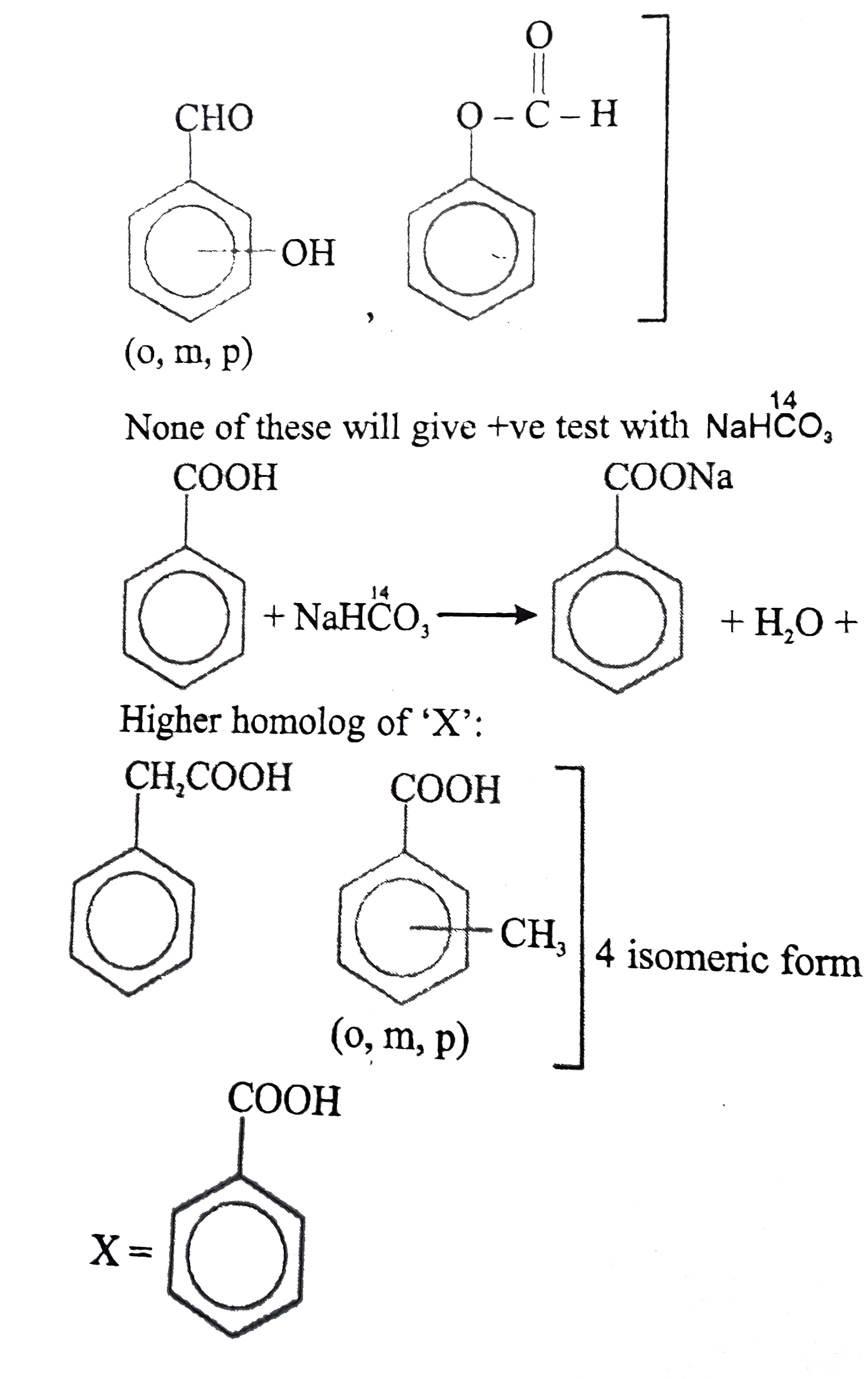
|
|
| 5. |
Give two reasons the chemistry of actinoids is more complicated than Lanthnoids. |
|
Answer» Solution :1. Actinoids are RADIOACTIVE 2. Their HALF life period is very short 3. They can be prepared in nanograms. |
|
| 6. |
Give the correct order of initials T or F for following statements. Use T if statements is true and F if it is false. (i) In gold schmidt thermite process aluminium acts as a reducing agent. (ii) Mg is extracted by electrolysis of aq. solution of MgCl_(2). (iii) Extraction of Pb is possible by carbon reduction method (iv) Red Bauxite is purified by Serpeck's process. |
|
Answer» TTTF |
|
| 7. |
Give the correct order of initials T (true) or F (False) for following statements. I. In an anti-fluorite structure anions form FCC lattice and cations occupy all tetrahedral voids. II. If the radius of cations and anions are 0.2 Å and 0.95 Å then coordinate number of cation in the crystal is 4. III. An atom/ion is transferred from a lattice site to an interstitial position in Frenkel defect. IV. Density of crystal always increases due to substitutinal impurity defect. |
|
Answer» TFFF |
|
| 8. |
Give two reactions that show the acidic nature of phenol. Compare the acidity of phenol with that of ethanol. |
Answer» SOLUTION :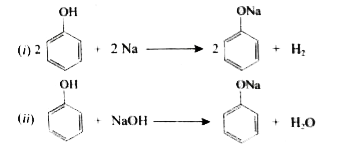
|
|
| 9. |
Give the correct order of coagulation values of given electrolytes for the coagulation of 1 litre As_(2)S_(3) sol. (i) FeCl_(3) (ii) Na_(2)SO_(4) (iii) BaCl_(2) |
|
Answer» (i) LT (III) lt (II) |
|
| 10. |
Give two reactions that show the acidic nature of phenol. Compare its acidity with that of ethanol. |
|
Answer» Solution :The REACTION showing ACIDIC nature of phenol are: (i) Reaction with sodium. Phenol REACTS with ACTIVE metals like sodium to liberate `H_(2)` gas. 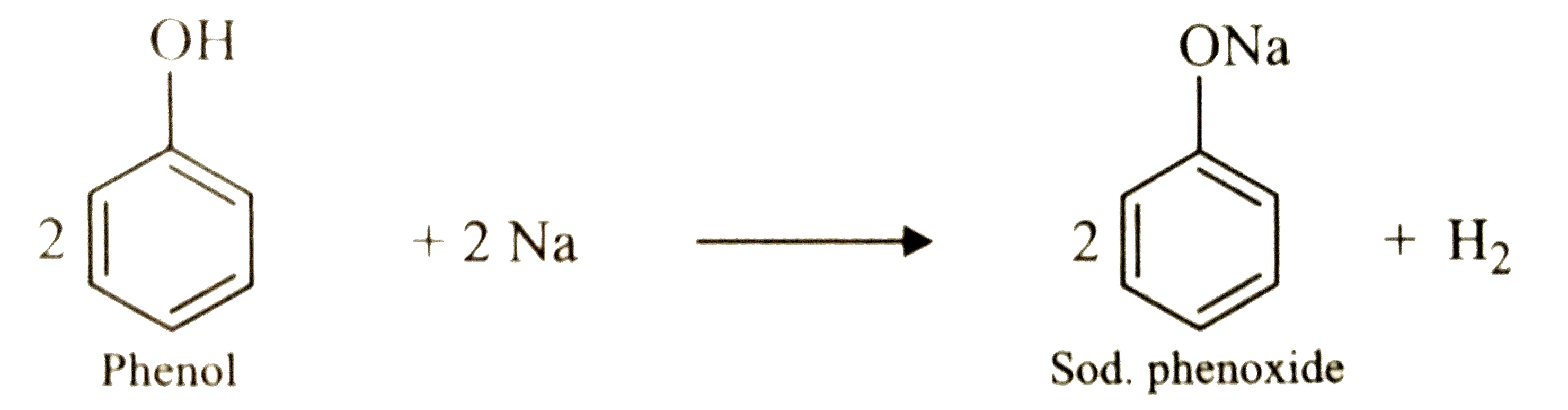 (ii) Reaction with NaOH. Phenol dissolves in NaOH to form sod. phenoxide and water. 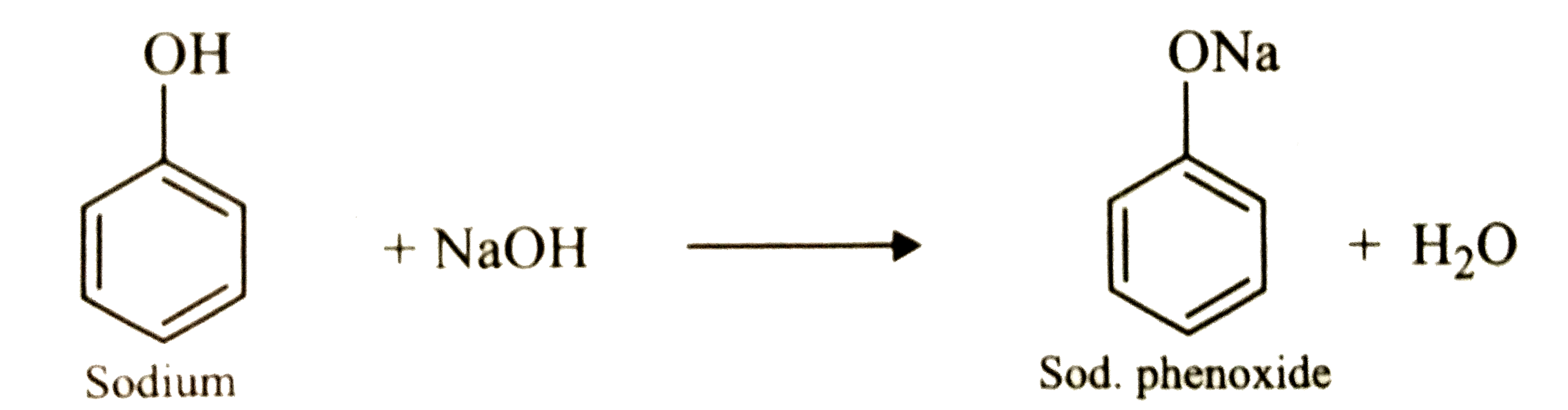 Comparison of acidic character of phenol and ethanol. phenol is more acidic than ethanol. this is due to the reason that phenoxide ion left after the loss of a proton from phenol is STABILIZED by resonance while ethoxide ion is not. |
|
| 11. |
Give two reactions that show the acidic nature of phenol. |
|
Answer» SOLUTION :The reactions showing acidic character of phenol are : (i) REACTION with sodium. Phenol REACTS with sodium to give `H_(2)` GAS  (ii) Reaction with `NaOH`. Phenol dissolves in `NaOH` to give sodium phenoxide and water. 
|
|
| 12. |
Give two reactions in which aliphatic aldehydes differ from aromatic aldehdyes? |
|
Answer» SOLUTION :(i) Aliphatic aldehydes being more reactive REDUCE FEHLING's solution to red ppt. of `Cu_(2)O` while aromatic aldehdyes do not. (ii) Aromatic aldehydes on treatment with an alcoholic solution of KCN undergo benzoin CONDENSATION but aliphatic aldehydes do not. |
|
| 13. |
Give the correct order of initials T and F for for following statements. Use T if stament is true and F it is false. (P) In Gold Schmidt thermite process, aluminium acts as a reducing agent. (Q) Mg is extracted by electrolysis of aq. Solution MgCl_(2). (R) Extraction of Pb is possible by smelting. (S) Red bauxite is purified by Serpeck's process. |
|
Answer» TTTF |
|
| 14. |
Give the correct of initials T or F for following statements. Use T if statements is true and F if it is false. (I) Co(III) is stabilised in presence of weak field ligands, while Co(II) is stabilised in presence of strong field ligand. ((II) Four coordinated complexes of Pd(II) and Pt(II) are diamagnetic and square planar. (III) [Ni(CN)_(4)]^(4-) ion and [Ni(CO)_(4)] are diamagnetic tetrahedral and square planar respectively. (IV) Ni^(2+) ion does not form inner orbital octahedral complexes |
|
Answer» TFTF (II) Because of higher `Z_(e f f)` value on the VALENCE SHELL of `Pd^(2+) and Pt^(2+)` cations they, always from inner orbital complex. (III) `[Ni(CO)_(4)],sp^(3)`, tetrahedral, `mu=0` BM `[Ni(CN)_(4)]^(4-),sp^(3)`, tetrahedral, `mu=0` BM (IV) `Ni^(2+)` in the octahedral field. 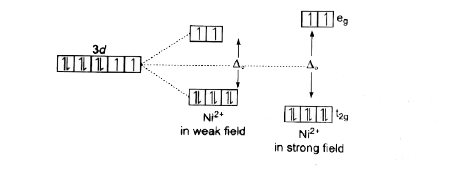 `implies` i.e., electronic distribution remains unaffected. |
|
| 15. |
Give two reaction that show the acidic nature of phenol. Compare acidity of phenol with that of ethanol. |
|
Answer» Solution :The reactions showing acidic nature of phenol are : (i) Phenol reacts with active metals like sodium to liberate `H_(2)` gas.  (ii) Phenol dissolves in `NAOH` to FORM sodium phenoxide and water.  Comparison of acidic character of phenol and ETHANOL : Phenol is more acidic than ethanol. Phenoxide ION left after the loss of a proton from phenol is stabilised by resonance while ethoxide ion (left after loss of a proton from ethanol) is not stabilised. |
|
| 16. |
Give the correct order of bond lengths x, y and z in |
|
Answer» `x=yltz` |
|
| 17. |
Give two properties in which interstitial compounds differ from its elements. |
|
Answer» Solution :(i) They have modified PROPERTIES, e.g., STEEL is harder than iron and does not GET corroded. (ii) They have greater TENSILE strength than the constituent METALS. |
|
| 18. |
Give the correct IUPAC names of the following: (a) 2-Vinylpropae (b) Isoprene (c) Succinic acid (d) Tataric acid (e) Chloropicerin (f) Neopentane (g) Methyl cyanide (h) Dimethyl ether (i) Acetamide (j) Ethyl chloride |
|
Answer» (c) Butane-1 , 4-diolic ACID (d)2, 3 , Dihydroxybutane-1 , 4-dioic acid (e) Trichloronitromethane (f) 2,2-Dimethylpropane (G) Ethanenitrile(h) METHOXYMETHANE (i) Ethanamide (j) Chloroethane . |
|
| 19. |
Give the correct order of acidic strength of the following alcohols. |
|
Answer» 2-methyl propan-2-ol `GT` propan-1-ol `gt` propan-2-ol |
|
| 20. |
Give two name of fuels other than hydrogen used in fuel cell. |
|
Answer» METHANE, CARBON MONOXIDE |
|
| 21. |
Give the correct IUPAC names for the following amines. i. CH_(3)-CH_(2)-CH_(2)-underset(NH_(2))underset(|)(CH)-CH_(3)""ii. CH_(3)-CH_(2)-underset(NHCH_(3))underset(|)(CH)-CH_(3) |
Answer» SOLUTION :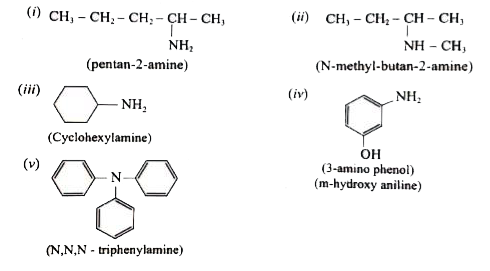
|
|
| 22. |
Give two methods of preparation of ketones and write the chemical reactions. |
|
Answer» Solution :(1) By the dry distillation of CALCIUM salt of a FATTY acid. e.g `(CH_(3)COO)_(2)Ca overset("Dry distillation") to CaCO_(3)+CH_(3)COCH_(3)` (ii) By catalytic dehydrogenations of `2^(@)` alcohols. 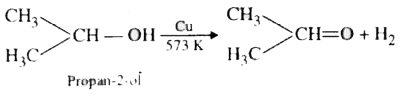
|
|
| 23. |
Give the correct IUPAC name for CH_3CH_2-O-overset(CH_(3))overset(|)CH-CH_2CH_2CH_2CI |
|
Answer» 2-ethoxy-5-chloropentane |
|
| 24. |
Give two important use of NH_3 and chemical reaction of NH_3 with (i) H_2O (ii) HCl " and " (iii) FeCl_3 (aq) . |
|
Answer» SOLUTION :USES of `NH_3` (i) It is used in the manufacturingof NITRIC acid (ii) It is used as a laboratory reagent. Reaction of `NH_3` with (i) `H_2O : NH_3 + H_2O iff NH_(4)^(+) + OH^(-)` (ii) `HCl : NH_3 + HCl to NH_4Cl` (iii) `FeCl_3 (aq)` `FeCl_3 + 3H_2O + 3NH_3 to Fe(OH)_3 DARR + 3NH_4Cl` |
|
| 25. |
Give the correct increasing order of electrical conductivity of aqueous solution of following complex entities : (P)[Pt(NH_(3))_(6)]Cl_(4)""(Q)[Cr(NH_(3))_(6)]Cl_(3) (R ) [Co(NH_(3))_(4)Cl_(2)]Cl""(S)[K_(2)[PtCl_(6)] |
|
Answer» `RltSltQltP` |
|
| 26. |
Give the conect order of initials T(true) or F(false) for following statements [3] I : Lyophobic sols are irreversible sols. II : Micelles fonnation takes place only above krafc temperature III : PO_4^(3-)ions have more coagulation value than SO_4^(2-) 2ions for coagulation ofpositive sols. IV : The volues of the colligativeproperties observed exXperimcntall are ve smallof colloied sols |
|
Answer» F T T F |
|
| 27. |
Give two important uses of formalin. |
|
Answer» SOLUTION :(i) To PRESERVE bilogical SAMPLES. (ii) To PREPARE Bakelite. |
|
| 28. |
Give the correct increasing order of electrical conductivity of aqueous solutions of following complex entities I) [Pt(NH_3)_6]Cl_4II) [Cr(NH_3)_6]Cl_3 III) [Co(NH_3)_4Cl_2]ClIV) K_2 [ PtCl_6] |
|
Answer» `III LT IV lt II lt I` |
|
| 29. |
Give the contribution of the following to the unit cell : (a) An atom at the corner of a unit cell. (b) An atom at the middle of a unit cell. (c) An atom at the centre of face of a unit cell. |
|
Answer» Solution :(a) `"Corner atom has the contribution to the UNIT CELL "=(1)/(8)` (b) `"Atom at the MIDDLE of unit cell has contribution = 1"` (c) `"Face-centred atom has contribution "= (1)/(2)` |
|
| 30. |
Give the conversion of alkenes into alcohols. |
|
Answer» Solution :Alkenes react with WATER in the presence of ACID as catalyst to form alcohols. `UNDERSET("PROPENE")(CH_(2)CH=CH_(2)+H_(2)O) overset(H^(+))Leftrightarrow underset("2-poropanol")(CH_(3)-underset(OH)underset(|)(CH)-CH_(3))` |
|
| 31. |
Give two general characteristics of an ideal solution of two liquids. |
|
Answer» Solution :(a) OBEYS Raoult.s LAW. (b) `DELTA` H of mixing is zero. (c) `Delta`V of mixing is zero. (d) Does not FORMS azeotropic mixtures. (e) (A- B) INTERACTIONS are same as that of (A - A ) or(B - B) interactions. |
|
| 32. |
Give two important characteristics of physisorption. |
|
Answer» Solution :IMPORTANT characteristics of physisorption: i. It is reversible ii. It has low HEAT of adsorption iii. It has weak van der Waals forces of attraction with adsorbent. iv. It increases with increase in PRESSURE. V. It forms multimolecular layer. |
|
| 33. |
Give the composition of Urotropine |
| Answer» SOLUTION :`(CH_2)_6N_4` | |
| 34. |
Give two functions of mitochondria. |
|
Answer» (B) These are the respiratory centres of the cell. |
|
| 35. |
Give the composition of tincture of iodine. |
| Answer» SOLUTION : 2-3% solution of IODINE in alcohol-water MIXTURE. | |
| 36. |
Give two examples Very weak acid (ii) Give two examples Very weak base |
|
Answer» SOLUTION :Very WEAK acid: `HF,CH_3COOH` Very weak BASE: `CL^(-),ClO_4^(-)` |
|
| 38. |
Give the composition of copper matte. |
|
Answer» Solution :`Cu_(2)S and FeS//Cu_(2)S+FeS` `""` OR Coper SULPHIDE + IRON Sulphide |
|
| 39. |
Give the composition of calamine and zincite. |
|
Answer» SOLUTION :Calmine : `ZnCO_(3)`. ZINCITE : ZNO. |
|
| 40. |
Give the composition of bleaching powder. |
| Answer» Solution :`Ca(OCL)_(2).CaCl_(2).Ca(OH)_(2).2H_(2)O` | |
| 41. |
Give two examples of solid alloys in which atoms of one substance displace some atoms of the other substance in the crstal littice. |
| Answer» SOLUTION :BRASS, 22% CARAT GOLD. | |
| 42. |
Give the common names of the following compounds which have been named according to the IUPAC system of nomenclature. (a) Ethanolychloride (b) Methanol (c) Ethanol (d) Ethanoic acid (e) Propane -1,2,3,tri-carboxylic acid (f) 1,2,3,-Propanetriol (g) Butanal (h)Methylethanoate (i) Ethylcarbylamine |
|
Answer» (d) Acetic acid (e) Tricarballylic acid (F) Glycerol (g) Butyraldehyde (h) Methyl ACETATE (i) Ethyl isocyanide. |
|
| 43. |
Give the composition of bauxite and malachite. |
|
Answer» Solution :Bauxite : `AlO_(X)(OH)_(3-2x.)" where "0 LT x lt 1`. MALACHITE : `CuCO_(3).Cu(OH)_(2)`. |
|
| 44. |
Give two examples to show the anomalous behaviour of fluorine. |
|
Answer» Solution :The anomalous behaviour of fluorine is due to its (i) SMALL size, (ii) highest electronegativity, (iii) low F-F bond dissociation enthalpy and (iv) non-availability of d-orbitals in its valence shell. The two examples are : (i) Being the most ELECTRONEGATIVE element KNOWN, fluorine shows an oxidation state of -1. It cannot show an oxidation state of +1 (except in HOF) since there is no element more electronegative than F with which it can share its unpaired electron. Further due to absence of d-orbitalss, it cannot show higher positive oxidation states of +3, +5, and +7. In contrast, all other halogens show positive oxidation states of +1, +3, +5 and +7. besides oxidation state of -1. Since it does not show psoitive oxidation states, therefore, fluorine does not show disproportionation reactions in the alkaline medium while other halogens do. (B) Due to small size and high electronegativily. F forms the STRONGEST H-bonds. As a result, HF is a liquid with a boiling point of 293 K while all other hydrogen halides are gases at room temperature. |
|
| 45. |
Give the common name for cyanocobalamine. |
| Answer» SOLUTION :HAEMOGLOBIN | |
| 46. |
Give two examples of pseudo molecular reactions. |
|
Answer» Solution :(i) Hydrolysis of ETHYL acetate. (II) Inversion of cane SUGAR. |
|
| 47. |
Give the common name of first member of aldehyde series. |
| Answer» SOLUTION :FORMALDEHYDE | |
| 48. |
Give two examples of path-dependent quantities. Are they properties of a system? |
| Answer» Solution :TWO path-dependent QUANTITIES are heat (q) and work (W). These are not the properties of a system. | |