

Saved Bookmarks
This section includes 7 InterviewSolutions, each offering curated multiple-choice questions to sharpen your Current Affairs knowledge and support exam preparation. Choose a topic below to get started.
| 1. |
Give the industrial importance of phenyl isocyanide. |
| Answer» SOLUTION :It is USED in the MANUFACTURE of POLYURETHANE PLASTICS. | |
| 2. |
Given: E_(Cr^(3+)//Cr)^(0)=-0.74V,E_(MnO_(4)^(-)//Mn^(2+))^(0)=1.51V E_(Cr_(2)O_(7)^(2-)//Cr^(3+))^(0)=1.33V,E_(Cl//Cl^(-))^(0)=1.36V Based on the data given above, strongest oxidising agent will be |
|
Answer» `Cl` |
|
| 3. |
Give the Grignard reagent and carbonyl compound that can be used to prepare (a) CH_(3)-CH_(2)-CH_(2)-OH (b) (CH_(3))_(2)C(OH)CH_(2)CH_(2)CH_(3) ( c) C_(6)H_(5)CH_(2)CH(OH) CH_(3) (d) CH_(3)-CH_(2)-overset(C_(6)H_(5))overset(|)underset(C_(6)H_(5))underset(|)C-CH_(3) |
|
Answer» Solution :(a) `underset("ETHYL magnesium BROMIDE")(CH_(3)CH_(2)MgBr) + underset("Formaldehyde")(HCHO)` (b) `underset("PROPYL magnesium bromide")(CH_(3)-CH_(2)-CH_(2)MgBr)+ CH_(3) - underset("ACETONE")(O)underset(||)C-CH_(3)` ( c) `underset("Benzyl magnesium bromide")(C_(6)H_(5)CH_(2)MgBr) + underset("Acetaldehyde")(CH_(3)CHO)` ( d) `underset("Phenyl magnesium bromide")(2C_(6)H_(5)MgBr) + CH_(3)-CH_(2)-underset("2-Butanone")underset(O)underset(||)C-CH_(3)` |
|
| 4. |
Given E_(Cr^(3+)//Cr)^(@)=-0.74V E_(MnO_(4)^(-)//Mn^(2+))^(@)=1.51V E_(CrO_(7)^(2-)//Cr^(3+))^(@)=1.33,E_(Cl//Cl^(-))^(@)=1.36V Based on the data given above, strongest oxidizng agent will be |
|
Answer» `MnO_(4)^(-)` |
|
| 5. |
Give the Howarth projection of D-glucopyranose. |
Answer» SOLUTION :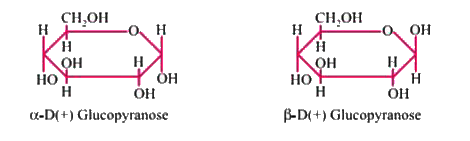
|
|
| 6. |
Given E_(Cr^(3+)//Cr)^(@)=-0.74V,E_(MnO_(4)^(-)//Mn^(2+))^(@) =1.51V E_(Cr_(2)O_(7)^(2-)//Cr^(3+))^(@)=1.33V,E_(Cl//C//l^(-))^(@)=1.36V Based on the data given above , strongest oxidising agent will be : |
|
Answer» `Cl^(-)` |
|
| 7. |
GivetheHaworth'sstructureofSucrose. |
Answer» SOLUTION :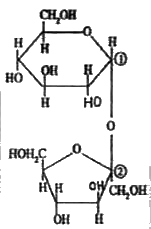
|
|
| 8. |
Give the Haworth structure of lactos. |
Answer» SOLUTION :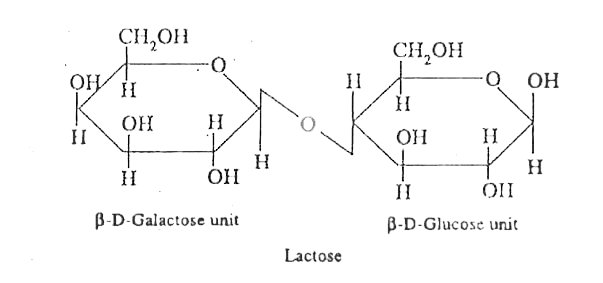
|
|
| 9. |
Given E_(Cr^(3+)//Cr)^(@) = -0.72 V, E_(Fe^(2+)//Fe)^(@) = -0.439 V. The value of standard electrode potential for the change, Fe_(aq.)^(3+) + e^(-) rarr Fe_(aq.)^(2+) will be: |
|
Answer» `-0.072 V` `E_(Fe^(2+)//Fe)^(@) = -0.42 V` `2Cr + 3FE^(2+) rarr 3Fe + 2Cr^(3+)` Six ELECTRONS `(n = 6)` are used in redox CHANGE. `E_(cell) = E_(cell)^(@) - (0.0591)/(n)log'([Cr^(3+)]^(2))/([Fe^(2+)]^(3))` `= (-0.42 + 0.72) - (0.0591)/(6)log'((0.01)^(2))/((0.01)^(3))` `= 0.30 - (0.0591)/(6)log.((0.1)^(2))/((0.01)^(3))` `= 0.30 - (0.0591)/(6)log10^(4)` `E_(cell) = 0.2606 V` |
|
| 10. |
Give the graph of zero order reaction and which informtaion obtained from them? |
|
Answer» Solution :(a)The defential RATE expression of zero order reaction R`to` P is as, Rate =`-(d[R])/(dt)=k` Rate =k and rate is independent of concentration therefore the PLOT of rate of reaction and time is as under.  The rate of reaction is constant with time as the slope of graph is zero .The line is parallel to Z-axis. (B)The intergrated equation form of reaction of zero order is as under and which is straight line y=mx+c  So, the plot of concentration of Reactant [R] against time [t] is as under in which intercept equal to `[R]_(0)` and slope will be negative. So, the plot of concentration of Reactant [R] against time [t] is as under in which intercept equal to `[R]_(0)` and slope will be negative. Slope =-k =Rate constant  (c)The graph of LOG [R] `to` t is same as the above diagram. |
|
| 11. |
Given E_("Cr_(2)O_(7)^(2-)//Cr^(3+))^(@)=1.33V,E_(MnO_(4)^(-)//Mn^(2+))^(@)=1.51V Among the following, the strongest reducing agent is E_(Cr^(3+)//Cr)^(@)=-0.74V^(x),E_(MnO_(4)^(-)//Mn^(2+))^(@)=1.51V E_(Cr_(2)O_(7)^(2-)//Cr^(3+))^(@)=1.33V,E_(Cl//Cl^(-))^(@)=1.36V Based on the data given above strongest oxidising agent will be |
|
Answer» `Cl^(-)` |
|
| 12. |
Give the generals electronic configuration of Actinides. |
| Answer» SOLUTION :`5F^(1-14)6D^(0-1) 7S^(2)` | |
| 13. |
Give the graph for first order reaction and write the information obtained from it. |
Answer» Solution :the integrated rate equation of first order reaction V(A) are as under . and  These equations are in the form of straight line equations y=mx+c .SO ,the plot of both wil be straight line.  Both plots are straight line of negative slope and intercept MADE on Y-axis. (b)On the base of integrated rate equation of first order reaction log `([R]_(0))/([R])=(k)/(2.303)(t)`, the plot of log `([R]_(0))/([R])tot` is as under.  These plot do not form interccept and it is PASS from ORIGINE (0,0) |
|
| 14. |
GivenE_(Cr^(3+)//Cr)^(@)=-0.72 V, E_(Fe ^(2+)//Fe)^(@)=-0.42V. The potential for the cell Cr|Cr^(3l) (0.1M)||Fr ^(2l)(0.01M)|Fe is |
|
Answer» `0.26V` `E_(cell) =(E_(Fe^(@+)//Fe)^(@)-E_(Cr^(3+)//Cr)^(@))-(0.059)/(6) log ""([Cr^(3+)])/([Fe^(2+)]^(3))`[Nernst-Equ.] `=-0.42-(-0.72) -(0.059)/(6) log ""((0.1)^(2))/((0.01)^(3))` `=-0.42 +0.72 -(0.059)/(6) log ""(0.1 xx0.1)/(0.01xx0.01xx0.01)` `=0.3-(0.059)/(6) log ""(10^(-2))/(10^(-6)) =0.3 -(0.059)/(6) xx4` `= 0.30-0.0393 =0.26V` Hence OPTION (d) is CORRECT answer. |
|
| 15. |
Given E_(Cl_(2)//Cl^(-))^(@)=1.36V,E_(Cr^(3+)//Cr)^(@)=-0.74V E_(Cr_(2)O_(7)^(2-)//Cr^(3+))^(@)=1.33V,E_(MnO_(4)^(-)//Mn^(2+))^(@)=1.51V Among the following, the strongest reducing agent is |
|
Answer» `Cr^(3+)` |
|
| 16. |
Give the general representation of alkanes. |
|
Answer» |
|
| 17. |
Given E_(Cl_(2) // Cl^(-))^(@) = 1.36 V , E_( Cr^(3+) // Cr)^(@) = -0.74 V , E_(Cr_(2) O_(7)^(2-) // Cr^(3+)) = 1.33 V, E_(MnO_(4)^(-) // Mn^(2+))^(@) = 1.51 V Among the following, the strongest reducing agent is: |
|
Answer» `MN^(2+)` |
|
| 19. |
Give the general electronic configuration of d-block or transition elements. |
| Answer» SOLUTION :The GENERAL CONFIGURATION is `(n-1) d^(1-10) NS^(1-2)`. | |
| 20. |
Given : E_(Cl_(2)//Cl^(-))^(@)=1.36" V ", E_(Cr^(3+)//Cr)^(@)=0.74V. E_(Cr_(2)O_(7)^(2-)//Cr^(3+))^(@)=1.33" V ", E_(MnO_(4)^(-)//Mn^(2+))^(@)=1.51" V". Among the following, the strongest reducing agent is : |
| Answer» Solution :(c ) More negative the `E_(VALUE)^(@)`, stronger is the reducing AGENT. In this case `E_(Cr^(3+)//Cr)^(@)=-0.74" V"`. Therefore, Cr is the stronger reducing agent. | |
| 21. |
Given E_(Cl_(2)//Cl^(-))^(@)=1.36V,E_(Cr^(3+)//Cr)^(@)=-0.74V E_("Cr_(2)O_(7)^(2-)//Cr^(3+))^(@)=1.33V,E_(MnO_(4)^(-)//Mn^(2+))^(@)=1.51V Among the following, the strongest reducing agent is |
| Answer» Answer :D | |
| 22. |
Give the general electronic configuration of actinoids |
| Answer» SOLUTION :`5F^(1-14) 6D^(0-1)7S^(2)` | |
| 23. |
Give the full form of mer in isomerism. |
| Answer» SOLUTION :MERIDIONAL | |
| 24. |
GivenE_(Ag^(+) // Ag)^(0) = 0.80 V , E_(Mg^(2+) // Mg)^(0) =-2.37 V , E_(Cu^(2+) // Cu)^(0) = 0.34 E_(Hg^(2+) // Hg)^(0) = 0.79 V Which of the following statement is / are correct ? |
|
Answer» `AgNO_3` can be stored in copper vessel |
|
| 25. |
Give the formulae of the following compounds: (a) Potassium trioxalatoaluminate (III) (b) Tetraammineaquachloridocobalt(III) chloride |
|
Answer» Solution :(a) POTASSIUM trioxalatoaluminate (III) `K_(3)[AL(C_(2)O_(4))_(3)]` (b) Tetraammineaquachloridocobalt(III) CHLORIDE `[Co(NH_(3))_(4)*H_(2)O.Cl]Cl_(2)` |
|
| 26. |
Give the formula of each of the following coordination entities : Ni^(2+) ion is bound to two water molecules and two oxalate ions. Write the name and magnetic behaviour of each of the above coordination entities. |
|
Answer» Solution :`Ni^(2+) + 2H_(2)O + 2C_(2)O_(4)^(2-)` `[Ni(H_(2)O)_(2)(Ox)_(2)]^(2-)` Name : Diaquadioxalatonickelate(II) ion Here the LIGANDS are weak and pairing of electrons will not take PLACE. EVEN if pairing of electrons takes place, we cannot get two vacant d-orbitals. Here `sp^(3)d^(2)` hybridisation takes place. Configuration of `Ni^(2+)` ion  Six electron pairs from the ligands are accommodated in `sp^(3)d^(2)` hybrid orbitals giving octahedral shape. As there are two unpaired electrons, the complex ion is paramagnetic. |
|
| 27. |
Given E^(@) values as: Ni^(2+)//Ni=0.25V,Cu^(2+)//Cu=0.34V,Ag^(+)//Ag=0.80V and Zn^(2+)//Zn=-0.76V Which of the following reactions under standard conditions will not take place in the specified directions? |
|
Answer» `Ni^(2+)(aq)+Cu(s)toNi(s)+Cu^(2+)(aq)` |
|
| 28. |
Give the formula of each of the following coordination entities : Co^(3+) ion is bound to one Cl^(-), one NH_(3) molecule and two bidentate ethylene diamine (en) molecules. |
|
Answer» Solution :`Co^(3+)+1Cl^(-) + 1NH_(3) + 2` ETHYLENE diammine `[CoClNH_(3)(H_(2)NCH_(2)CH_(2)NH_(2))_(2)]^(2+)` Name: Amminechloridobis (ethane-1, 2-diammine) cobalt(III) ion. The electronic CONFIGURATION of `Co^(3+)` in 3d ORBITAL is  In the presence of the ligands NH3 and en, pairing of ELECTRONS will take place as under and `d^(2)sp^(3)` hybridisation takes place giving rise to octahedral shape  As there are no unpaired electrons, the complex ion will be diamagnetic. |
|
| 29. |
Given E^@= 0 V for the H^(+)//H_2couple and -0.8281 V for H_2O//H_2, OH^- couple. Determine K_w at 25^@C . |
| Answer» SOLUTION :`1.01 XX 10^(-14)` | |
| 30. |
Give the formula of three ions which are coloured due to charge transfer spectra. |
Answer» SOLUTION :`VO_(2),CrO_(4)^(2-)MnO_(4)^(-)`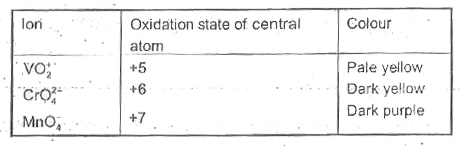
|
|
| 31. |
Given E^0=-0.268V for the Cl^-|PbCl_2|Pb couple and -0.126 V for the Pb^(2+)|Pb couple, determine K_(sp) for PbCl_2 at 25^(@)C |
|
Answer» |
|
| 32. |
Give the formula of (i) EDTA (ii) Triphenyl phosphine |
|
Answer» <P> SOLUTION :`(i)`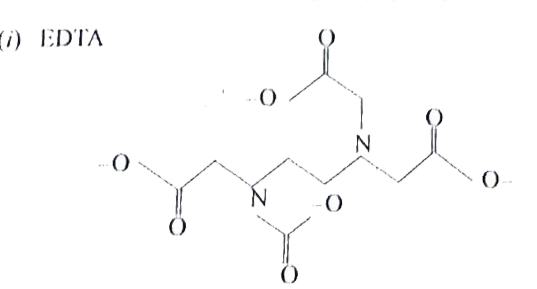 `(II)` TRIPHENYL phosphine `-P(Ph_(3))` |
|
| 33. |
Given E^@ =-0.268 V for the PbCl_2//Pb couple and -0.126 V for Pb^(2+)//Pbcouple. Determine K_(sp) for PbCl_2 at 25^@C . |
|
Answer» SOLUTION :`PbCl_2 + 2E to Pb + 2Cl^(-)` `Pb to Pb^(2+) + 2e` `1.6 XX 10^(-5)` |
|
| 34. |
Give the formula of (a) haematite (b) magnetite. |
| Answer» SOLUTION :(a) `Fe_(2)O_(3)`, (B) `Fe_(3)O_(4)`. | |
| 35. |
Given : Delta_("vap")H" at "373K=40.693kJmol^(-1), C_(p)(H_(2)O,l)=75.312JK^(-1)mol^(-1), C_(p)(H_(2)O,g)=33.305JK^(-1)mol^(-1). Pressure over 1000 ml of a liquid is gradually increases from 1 bar to 1001 bar under adiabatic conditions. If the final volume of the liquid is 990 ml, calculate DeltaUandDeltaH of the process, assuming linear variation of volume with pressure. |
| Answer» SOLUTION :`DeltaU=501J,DeltaH=99.5kJ` | |
| 36. |
Give the formula of A and B: CH_(3)-overset(O)overset(||)C-OH overset(SOCl_(2))to A overset(LiAlH_(4))to B |
| Answer» SOLUTION :`CH_(3)-overset(O)overset(||)C-OH overset(SOCl_(2))to underset((A))(CH_(3)COCL) overset(LiAlH_(4))to underset((B))(CH_(3)CH_(2)OH)` | |
| 37. |
Given Delta_(r)S^(@) =-266 and the listed [S_(m)^(@) value] calculate S^(@) for Fe_(3)O_(4)(s): ""4Fe_(3)O_(4)["……………"] + O_(2)[205] rarr 6Fe_(2)O_(3)(s)[87] |
|
Answer» `+111.1` |
|
| 38. |
Given: Delta_(f)H^(@) (kJ//mol)"" S_(m)^(@)(J//K mol) {:(CCl_(4)(l), -135 A, 215 A),(CCl_(4)(g), -103.0, 308.7):}: What is the boiling point of carbon tetrachloride? |
|
Answer» `8.25^(@)` C `{:(Delta_(F)H^(@), -135A, -103.0, Delta_(r)H^(@) = -103 -(-135.4)=32.4 kJ//mol),(S_(m)^(@), 215.4, 308.7, Delta_(r)S^(@) = 308.7-215.4= 93.3 J//K mol):}` `T_("boiling") =(Delta_(r)H^(@))/(Delta_(r)S^(@)) = (32.4 xx 10^(3))/(93.3) = 347.3 K = 74.3^(@) C` |
|
| 39. |
Give the formula and IUPAC name of the following ligands. (i) OX(ii)en |
Answer» SOLUTION :`(i)` 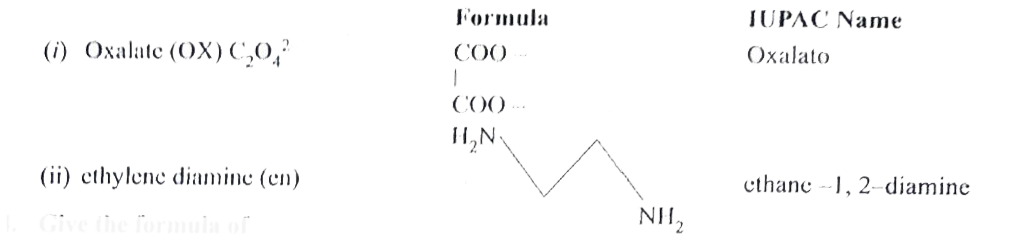
|
|
| 40. |
Given DeltaH_("oxidation") (HCN) = 45.2 kJ "mole"^(-1) & DeltaH_("oxidation") (CH_(3)CO_(2)H) = 2.1 kJ "mole"^(-1), which of the following statement is correct? |
|
Answer» `pKa(HCN) =pKa(CH_(3)CO_(2)H)` |
|
| 41. |
Give the formula and the name of one ammine complex of copper. |
| Answer» Solution :`[Cu(NH_3)_4]SO_4` [ tetraamine COPPER(II) SULPHATE]. | |
| 42. |
Given : {:(Cu^(2+)+e^(-) rarr Cu^(+),,E^(@)=0.15" volt"),(Cu^(+)+e^(-) rarr Cu,,E^(@)=0.5" volt"):} Calculate potential for Cu^(2+)+2e^(-) rarr Cu. |
|
Answer» |
|
| 43. |
Give the formula and IUPAC ligand name for Ethylenediamine. |
Answer» SOLUTION :
|
|
| 44. |
Give the formula and describe the structure of a noble gas which is isostructural with (i). Icl_4^(ɵ) (ii). I Br_2^(ɵ) (iii). BrO_3 |
Answer» Solution :(i) 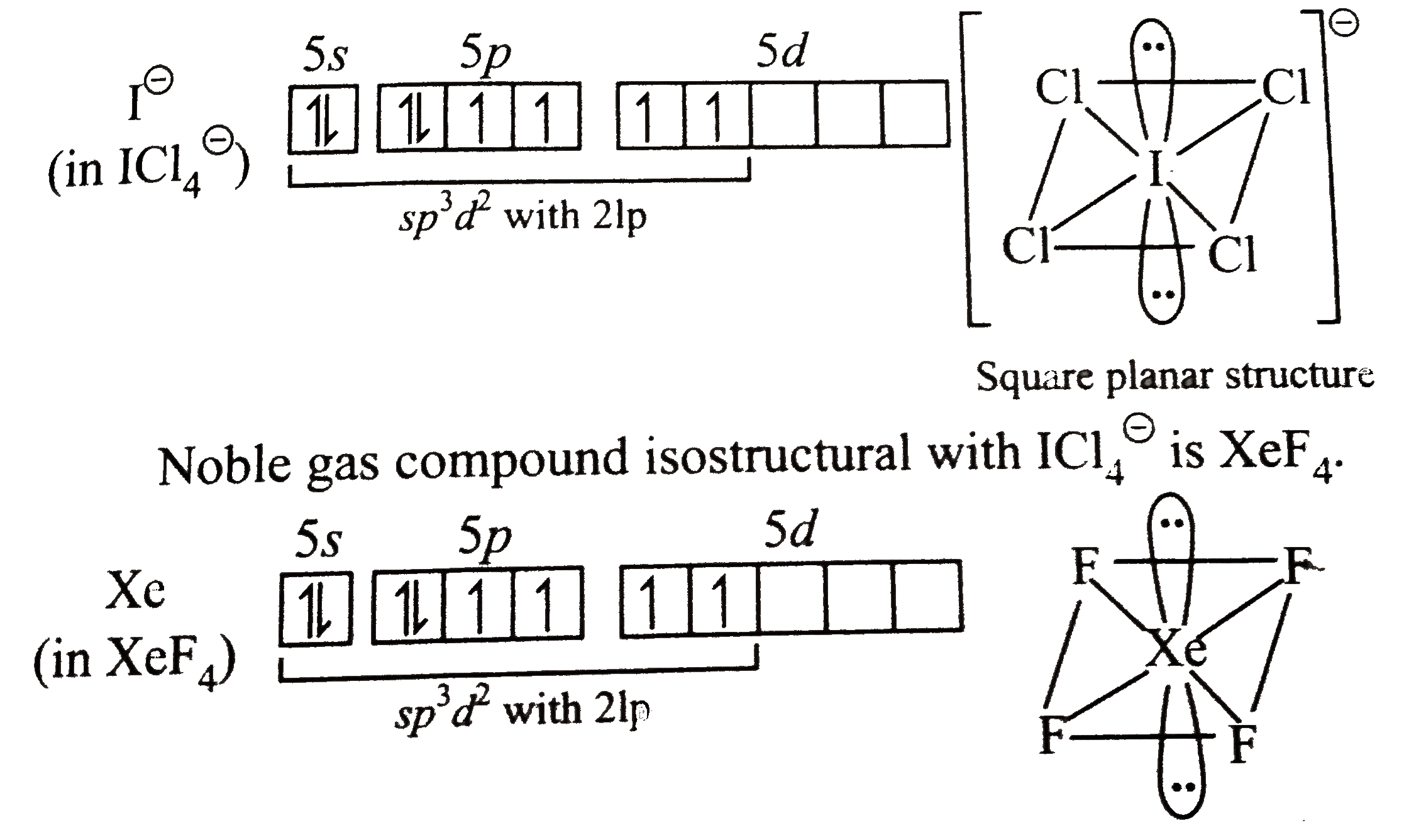 NOBLE gas compound isostructural with `ICl_(4)^(ɵ)` is e` `XeF_(4)`. 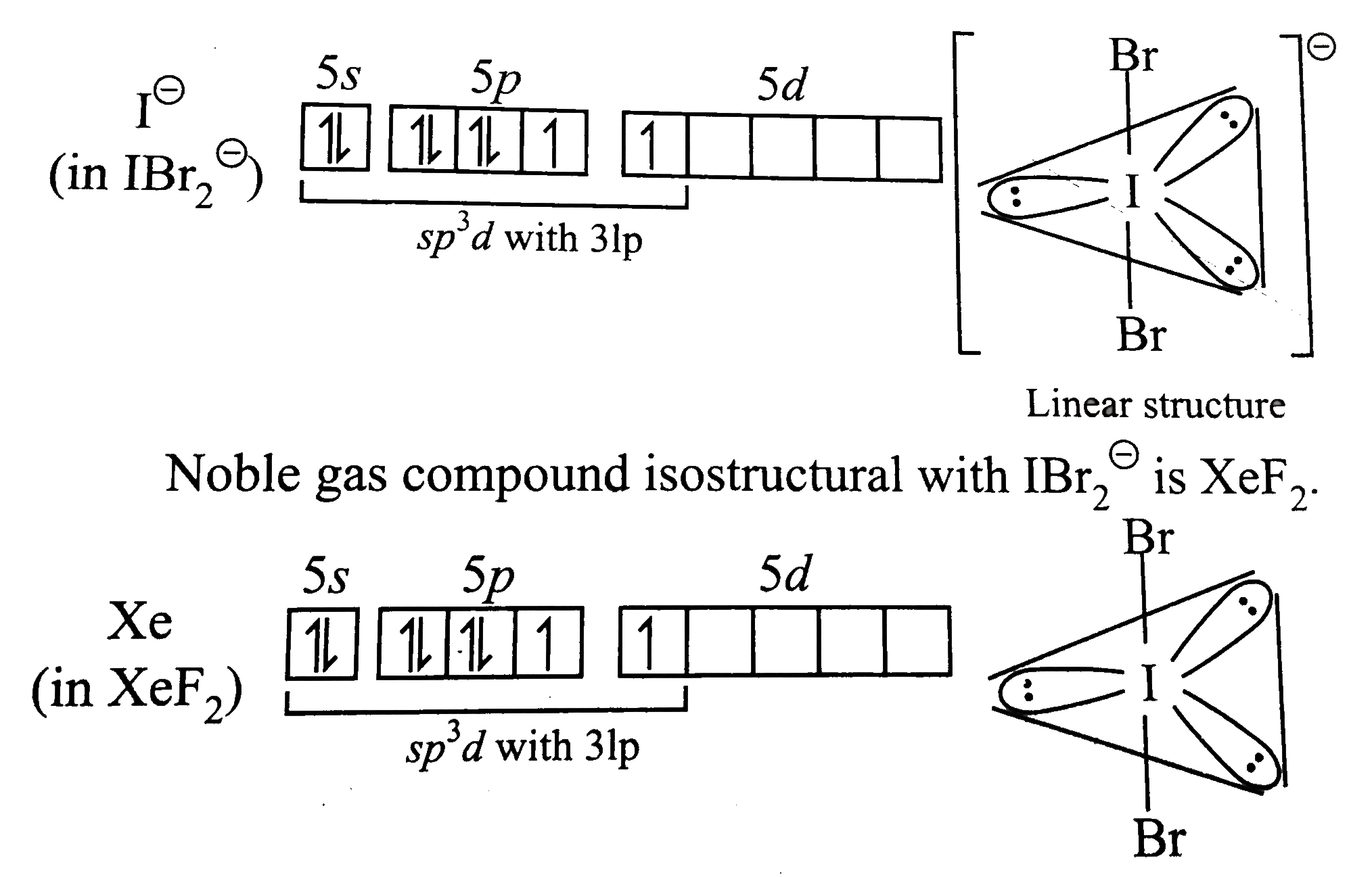 (ii). 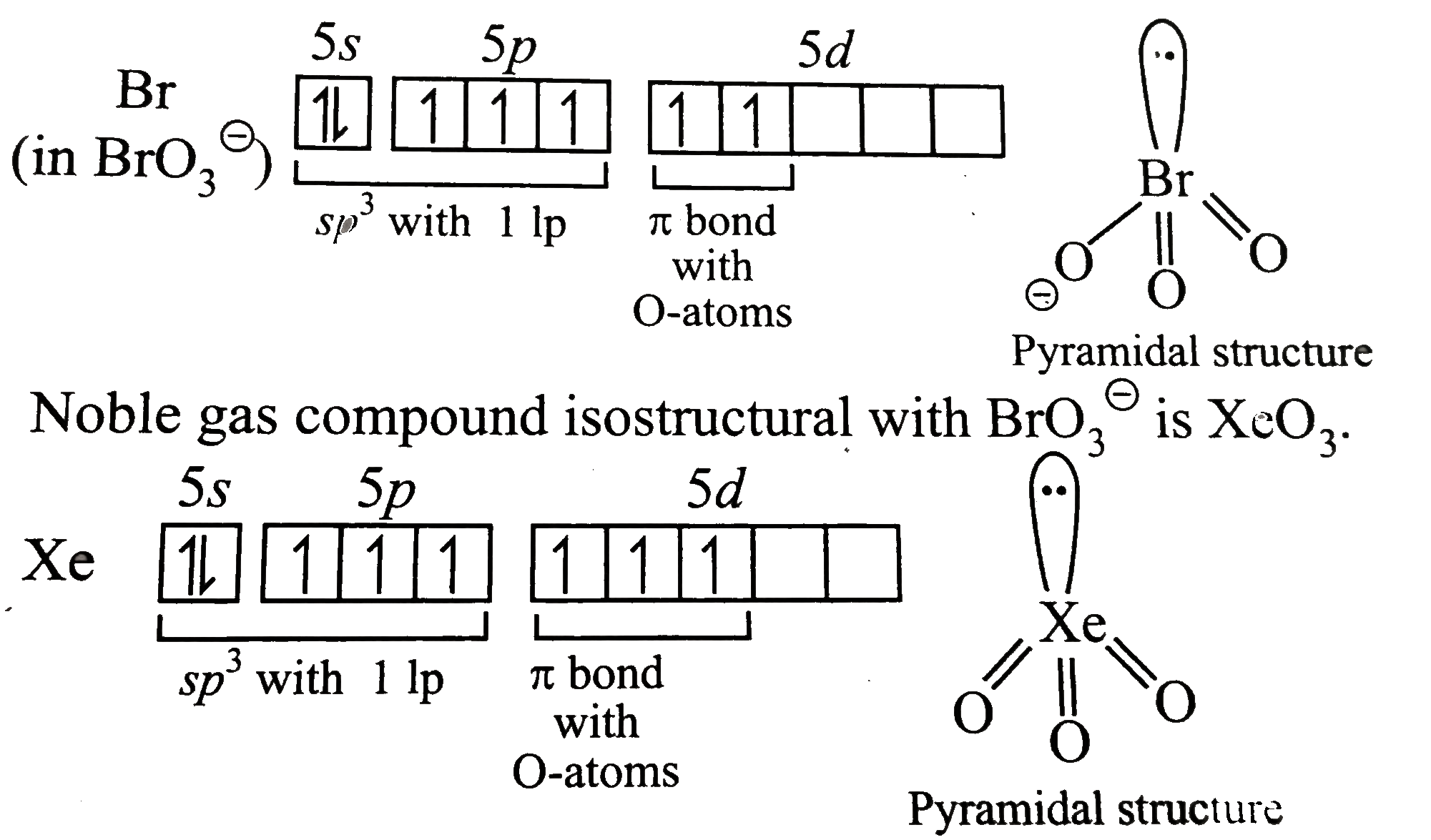 Noble gas compound isostructural with `IBr_(2)^(ɵ)` is `XeF_2`. Noble gas compound which is isostructural with `IBr_(2)^(ɵ)` is (iii).Noble gas compound isostructural with `BrO_(3)^(ɵ)` is `XeO_(3)`. |
|
| 45. |
Give the formula and describe the structure of a noble gas species which is isostructural with: (i)Icl_4 (ii) Ibr_2 (iii) BrO_3^(-) |
|
Answer» SOLUTION :(i) `ICI_4` is iso-structural with `XeF_4`. Both have SQUARE planar STRUCTURE. (II) `Ibr_2` is isostructural and with `XeF_2`. Both have linear shape. (III) `BrO_3` is isostructural with `XeO_3`. Both have trigonal pyramidal structure. |
|
| 46. |
Give the formula and describe the structure of a noble gas species which is isosturctural with : (i) ICl_(4)^(-) (ii) IBr_(2)^(-) (iii) BrO_(3)^(-) |
Answer» Solution :(i) Structure of `ICI_(4)^(-)`.  No. of electrons in the VALENCE shell of the central I ATOM = 7. No. of electrons provided by four Cl atoms = 4 `xx` 1 = 4 Charge on the central atom = 1 `therefore` Total no. of electrons around the central atom = 7 + 4 + 1 = 12 Total no. of electron pairs around the central atom = 12/2 = 6 But the no. of bond pairs = 4 (`because` there are four I-Cl bonds) `therefore` No. of lone pairs = 6 - 4 = 2 Thus, I in `ICl_(4)^(-)` has 4 bond pairs and 2 lone pairs. Therefore, ACCORDING to VSEPR theory, it should be square planar. Now a noble gas compound having 12 electrons in the valence shell of the central atom is `XeF_(4)` ( 8 + 1 `xx` 4 = 12). Like `ICl_(4)^(-)`, it also has 4 bond pairs and 2 lone pairs. Therefore, like `ICl_(4)^(-), XeF_(4)` is also square planar. (II) Structure of `IBr_(2)^(-)`  No. of electrons in the valence shell of the central I atom = 7 No. of electrons provided by two Br atoms = 2 `xx` 1 = 2 Charge on the central I atom = 1 `therefore` Total no. of electrons around the central I atom = 7 + 2 + 1 = 10 Total no. of electron pairs around the central atom = 10/2 = 5 But the no. of bond pairs = 2 (`because` there are two I-Br bonds) `therefore` No. of lone pairs = 5 - 2 = 3 Thus, I in `IBr_(2)^(-)` has two bond pairs and three lone pairs. Therefore, according to VSEPR theory, it should be linear. Now a noble gas compound having 10 electrons in the valence shell of the central atom is `XeF_(2)` (8 + 1 `xx` 2 = 10). Like `IBr_(2)^(-)`, it also has 2 bond pairs and 3 lone pairs. Therefore, like `IBr_(2)^(-), XeF_(2)` is also linear. (iii) Structure of `BrO_(3)^(-)`  In `BrO_(3)^(-)`, since O is more electrnegative than Br, therefore, -ve charge stays on the O atom. Therefore, in `BrO_(3)^(-)`, there are two Br = O bond and one `Br-O^(-)` bond. Now according to VSEPR theory, double bonds do not contribute any electron while single bonds contribute one electron towards the total NUMBER of electrons in the valence shell of the central atom. HOwever, both double and single bonds contribute one bond pair. Thus, total number of electrons is the valence shell of the central Br atom = 7 + 2 `xx` 0 + 1 `xx` 1 = 8 `therefore` No. of electron pairs around Br atoms = 8/2 = 4 But total number of bond pairs = 2 `xx` 1 (Br = O) + 1 `xx` 1 `(Br - O^(-))` = 3 and lone pairs = 4 - 3 = 1. Thus, `BrO_(3)^(-)` has 3 bond pairs and one lone pair. Therefore, according to VSEPR theory, it should be pyramidal. Now a noble gas compound having 8 electrons in the valence shell of the central atom is `XeO_(3)` (8 `xx` 1 + 3 `xx` 0 = 8). Like `BrO_(3)^(-)`, it also has 3 bond pairs and one lone pair. Therefore, like `BrO_(3)^(-), XeO_(3)` is also pyramidal. |
|
| 47. |
Give the formula and describe the structure of a noble gas species which is isostructural with : (i) IC l_(4)^(-) (ii) Ibr_(2)^(-) (iii) BrO_(3)^(-). |
|
Answer» Solution :(i) Structure of `IC l_(4)^(-)`: I in `IC l_(4)^(-)` has four bond pairs and two lone pairs. Therefore, according to VSEPR theory, it should be square planar. `IC l_(4)^(-)`has `(7+4xx7+1)=36` valence electrons. A noble gas SPECIES having 36 valence electrons is `XeF_(4)(8+4xx7=36)`. Therefore, like `IC l_(4)^(-), XeF_(4)` is also square planar. 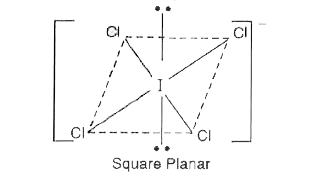 (ii) Structure of `IB r_(2)^(-) : IB r_(2)^(-)` has two bond pairs and three lone pairs. So, according to VSEPR theory, it should be linear. Here, `IBr_(2)^(-)` has `(7+2xx7+1)` valence electrons. A noble gas species having 22 valence electrons is `XeF_(2)(8+2xx7=22)`. Thus, like `IBr_(2)^(-), XeF_(2)` is alos linear. 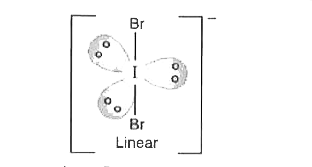 (iii) Structure of `BrO_(3)^(-)` : The central atom Br has seven electrons. Four of these electrons from two double bonds with two OXYGEN atoms while the fifth electron forms a single bond with `O^(-)` ion. The remaining two electrons from one lone pair. Hence, in all, there are three bond pairs and one lone pair aroundBr atom in `BrO_(3)^(-)`. Therefore, according to VSEPR theory, `BrO_(3)^(-)` should be pyramidal. Here, `BrO_(3)^(-)` has `26(7+3xx6+1=26)` valence electrons. A noble gas species having 26 valence electrons is `XeO_(3)(8+3xx6=26)`. Thus, like, `BrO_(3)^(-)XeO_(3)` is also pyramidal. 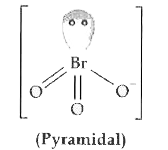
|
|
| 48. |
Give the formula and describe the structure of a noble gas species which is isostructrural with ICl_4^(-) |
|
Answer» Solution :`ICl_4^(-)` : In `ICl_4^(-)`, the central I atom has in all 8 ELECTRONS (7 valence electrons + one due to negative charge). Four of these form single BONDS with four Cl atoms (four bond pairs) while the REMAINING four constitute two lone pairs. Thus, I in `ICl_4^(-)` has four bond pairs and two lone pairs. Therefore, ACCORDING to VSEPR theory, it is SQUARE planar as shown below. Now, `ICl_4^(-)` has a total of `(7 + 4 xx 7 + 1) = 36` valence electrons. A noble gas species having 36 valence electrons is `XeF_4 (8 + 4 xx 7 = 36)`. Like `ICl_4^(-), XeF_4` is also square planar 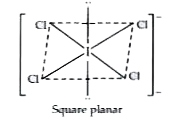
|
|
| 49. |
Give the formula and describe the structure of a noble gas species which is isostructrural with IBr_2^(-) |
|
Answer» Solution : `IBr_2^(-)` : In `IBr_2^(-)` the central I atom has 8 electrons (7 valence electrons + one due to NEGATIVE CHARGE). Two of these form two SINGLE bonds (two bond pairs) with two Br atoms, while the remaining six constitute three lone pairs. Thus, I in `IBr_2^(-)`has two bond pairs and three lone pairs. Therefore, according to VSEPR theory, it is linear. `IBr_2^(-)`has a total of `22 (7 + 2 xx 7 + 1)` valence electrons. A noble gas species having 22 valence electrons is `XeF_2 (8 + 2 xx 7 = 22)`. Like `IBr_2^(-), XeF_2`is also linear 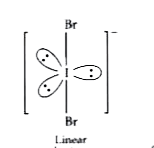
|
|