

Saved Bookmarks
This section includes 7 InterviewSolutions, each offering curated multiple-choice questions to sharpen your Current Affairs knowledge and support exam preparation. Choose a topic below to get started.
| 1. |
Give reasons for the following : (a) Carboxylic acids do not give characteristic reactions of carbonyl group. (b) Treatment of benzaldehyde with HCN gives a mixture of two isomers which cannot be separated even by careful fractional distillation. (c) Sodium bisulphite is used for the purification of aldehydes and ketones. |
Answer» SOLUTION :(a) Due to resonance, the position of carbonyl group is changing.  Hence, carboxylic ACIDS do not give REACTIONS of carbonyl group. (b) It is because we get two optical isomers which have same physical properties. Therefore they cannot be separated by fractional distillation.  (c) Aldehydes and ketones form addition COMPOUNDS with `NaHSO_3` whereas impurities do not. On hydrolysis, we get pure aldehydes and ketones back. `CH_(3)-overset(O)overset(||)C-H + NaHSO_(3) to CH_(3) - overset(OH)overset(|)CH-SO_(3)Na overset((H_(2)O)//H)to CH_(3)-overset(O)overset(||)C-H + NaHSO_(3)` |
|
| 2. |
Give reasons for the following: (a) At higher altitudes, people suffer from a disease called anoxia. In this disease, they becomeweak and cannot think clearly. (b) When mercuric iodide is added to an aqueous solution of KI, the freezing point is raised. |
|
Answer» Solution : (a) At higher altitudes, available oxygen is less, CAUSING anoxia. (b) ` underset("1mol")(HgI_2) + underset("2 mol")(2KI) to underset("potassium tetraiodomercurate (II)")(K_2HgI_4)` Due to the FORMATION of complex compound`K_2HgI_4` , the number of moles of the solute in the solution decreases. Greater the number of moles of the solute in the solution, greater the depressionin FREEZING point. Smaller the number, the REVERSE effect will take place |
|
| 3. |
Give reasons for the following: (a) Ammonia acts as a ligand. (b) Sulphur disappears when boiled with an aqueous solution of sodium sulphite. |
|
Answer» Solution :(a) `NH_3` has lone pair of electrons , therefore , acts as ligand . (B) It is due to FORMATION of SODIUM thiosulphate `Na_2SO_3 + S to underset("Sodium thiosulphate")(Na_2S_2O_3)` `Na_2S_2O_3` is soluble in WATER . |
|
| 4. |
Give reasons for Measurement of osmotic pressure method is preferred for the determination of molarmasses of macromolecules such as proteins and polymers. |
| Answer» Solution :Osmotic pressure method has the advantage over other METHODS as pressure measurementis around the room temperature and molarity of the solution is used INSTEAD of molality. ITSMAGNITUDE is large EVEN for DILUTE solutions. | |
| 5. |
Give reasons for Elevation of boiling point of 1 M KCl solution is nearly double than that of 1 M sugar solution. |
| Answer» Solution : KCl is ionised into `K^+` and `Cl^-`ions. Thus a 1 M KCl solution will contain 1 MOLE of `K^+` ions and 1 mole of `Cl^-` ions. The solution will contain 2 moles of particles (ions). On the other hand, 1 M sucrose solution will contain 1 mole of particles as it does not ionise. Therefore elevation of boiling POINT of 1 M KCl solution is nearly DOUBLE than that of 1 M SUGAR solution. | |
| 6. |
Give reasons for following:- (i) ZnO issued as white paint inspite of the fact that it has less covering power than white lead. (ii) Zn readily liberates H_(2) from cold, dil H_(2)SO_(4) but not from cold, conc. H_(2)SO_(4). |
|
Answer» Solution :(i) White lead pigments are backened after sometime due to the action of `H_(2)S` present in atmosphere where as ZnO pigments are not affected by `H_(2)S` and remains white `4PbO + H_(2)S to PbSO_(4) + H_(2)` (ii) `H_(2)SO_(4)` is a covalent compound which in dilute solution ionises to APPRECIABLE extent to produce `H^(+)` ions and THUS Zn REACTS with dilute `H_(2)SO_(4)` to produce `H_(2)`. `Zn + 2H^(+) to Zn^(+2) + H_(2)` On the other HAND the DISSOCIATION of `H_(2)SO_(4)` in conc. solution is not appreciable. |
|
| 7. |
Give reasons for Aquatic animals are more comfortable in cold water than in warm water. |
| Answer» Solution :Aquatic animals depend upon DISSOLVED oxygen for respiration. Solubility of a gas decreaseswith increase of temperature. With increasing temperature, solubility of oxygen in water DECREASES. Therefore, aquatic animals are more COMFORTABLE in cold water than in WARM water. | |
| 8. |
Give reasons: E^0 value for Mn^(3+)//Mn^(2+) couple is much more positive than that for Fe^(3+)//Fe(2+). |
| Answer» Solution :The COMPARATIVELY high VALUE for Mn Shows that `Mn^(2+) (d)^5` is paricularly stable / MUCH larger third IONISATION ENERGY of Mn (where the required change is from ds to (f) | |
| 9. |
Give reasons: Dioxygen is a gas while Sulphur is a solid at room temperature |
| Answer» Solution : Oxygen has multiple bonding WHEREAS sulphur shows catenation / DUE to pp-pp bonding in oxygen whereas sulphur does not / Oxygen is DIATOMIC therefore held by WEAK intermolecular FORCE while sulphur is polyatomic held by strong intermolecular forces | |
| 10. |
Give reasons (CH_3)_2 NH is more hasic than (CH_3)_3N in an aqueous solution. |
| Answer» SOLUTION :Because of the combined factors of INDUCTIVE EFFECT and solvation or HYDRATION effect | |
| 11. |
Givereasons : C-Cl bond length in chlorobenzene is shorter than C -- Cl bond length in CH_(3) - Cl . |
Answer» SOLUTION : Electrons on Cl in chlorobenzene TAKE part in resonance with the BENZENE ring. This creates a partial double BOND character between C and Cl. This does not happen in methyl chloride. A double bond is shorter than single bond. |
|
| 12. |
Give reasons : Cerium (Ce) exhibits +4 oxidation state |
| Answer» SOLUTION :GETS OCTET CONFIGURATION | |
| 13. |
Give reasons : Actinoids show variable oxidation states |
| Answer» Solution :DUE to comparable energies of Sf, 6D and 7S LEVELS. | |
| 14. |
Give reasons : A silent electric discharge is used in the preparation of ozone. |
| Answer» Solution :The formation of OZONE from oxygen is an ENDOTHERMIC process. So to prevent its decomposition SILENT electrical DISCHARGE is USED. | |
| 15. |
Give reasons : (a) Propanone is less reactive than ethanal towards nucleophilic addition reactions. (b) O_(2)N -CH_(2) -COOH has lower pKa value than CH_(3)COOH ( c) (CH_(3))_(2)CH-CHO undergoes aldol condensation whereas (CH_(3))_(3)C-CHO does not. |
|
Answer» Solution :(a) Propanone is less reactive than ethanal towards nucleophilic addition reaction due to (i) STERIC hindrance (ii) + I effect of two alkyl groups in propanone. (b) - `-NO_(2)`exerts electron withdrawing effect which increases the acidic STRENGTH or decreases the `pK_(a)`VALUE. (c) Aldol condensation reaction is given by substances which have at LEAST one alpha hydrogen atom. `(CH_3)_2CH — CHO` has an a-hydrogen atom but `(CH_3)_3C — CHO` does not have `alpha` -hydrogen atom. |
|
| 16. |
Give reasons : (a) E^(@) value for Mn^(3+)//Mn^(2+) couple is much more positive than that for Fe^(3+)//Fe^(2+). (b) Iron has higher enthalpy of atomisation than that of copper. ( c ) Sc^(3+) is colourless in aqueous solution whereas Ti^(3+) is coloured. |
|
Answer» Solution :(a) `E^(@)` value for `Mn^(3+)//Mn^(2+)` couple is much more positive than that for `Fe^(3+)//Fe^(2+)`. Electronic configurations of `Mn^(3+)` is `-3d^(4)` and that of `Mn^(2+)` is `-3d^(5)`. Thus `Mn^(3+)` has a tendency to gain one electron and change to more STABLE half-filled configuration to give `Mn^(2+)`. Thus it has a HIGHER value of `E^(@)`. Electronic configurations of `Fe^(3+)` is `-3d^(5)` and that of `Fe^(2+)` is `-3d^(6).Fe^(3+)` has a more stable half-filled configuration and has no tendency to gain an electron to change into `Fe^(2+)`. Therefore `E^(@)` value for `Mn^(3+)//Mn^(2+)` couple is much more positive than for `Fe^(3+)//Fe^(2+)`. (b) Iron has higher enthalpy of atomisation than that of copper. Enthalpy of atomisation depends upon the number of electrons in the outermost orbit. Iron has a higher enthalpy of atomisation than that of copper. ( c ) `SC^(3+)` is colourless in aqueous solution whereas `Ti^(3+)` is coloured. Colour of a transition metal compound is due to d-d transition. Configuration of `Sc^(3+)` is [Ar]. There are no d-electrons and therefore there is no possibility of d-d transitions. Hence `Sc^(3+)` is colourless in aqueous solution. Configuration of `Ti^(3+)` is `3d^(1)`. There is a possibility of d-d transition. Hence this is coloured. |
|
| 17. |
Give reasons : (a) Methylamine is a stronger base than ammonia. (b) Reactivity of -NH_(2) groups gets reduced in acetanilide. |
|
Answer» Solution :(a) It is because methyl group is electron releasing and increases electron density on .N.. (B) It is because `CH_(3)-overset(overset(O)(||))(C)-`group is electron WITHDRAWING. The lone pair of ELECTRONS is INVOLVED in conjugation with the carbonyl group, thus decreasing electron densityon nitrogen. 
|
|
| 18. |
Give reason:(a) What is lanthanoid contraction?(b) Which is the general oxidation state shown by actinoids? |
|
Answer» Solution :(a) Steady decrease in the size of lanthanides with INCREASE in atomic number is KNOWN as lanthanoid contraction. (B) +3 |
|
| 19. |
Give reason. Zeolites are good shape-selective catalyst. |
| Answer» SOLUTION :ZEOLITES have HONEYCOMB LIKE STRUCTURES. | |
| 20. |
Give reason: Zeolites are good shape-selective catalyst. |
|
Answer» Solution :Zeolites have honeycomb like STRUCTURES. Zeolites are GOOD shape SELECTIVE CATALYST because of their honeycomb like structure. |
|
| 21. |
Give reason : Why molecular mass of polymer is always expressed as an average ? |
|
Answer» Solution :Polymer properties are closely related to their molecular mass, size and structure. The growth of the polymer chain during their synthesis is dependent upon the availability of the monomers in the reaction MIXTURE. Thus, the polymer sample contains CHAINS of VARYING lengths and hence its molecular mass is ALWAYS expressed as an AVERAGE. The molecular mass of polymers can be determined by chemical and physical methods. |
|
| 22. |
Give reason why a finely divided substance is more effective as an adsorbent. |
|
Answer» Solution :Adsorption arises due to the fact that the surface particles of the adsorbent are not in the same environment as the particles INSIDE the bulk. Inside the adsorbent all the forces acting between the particles are mutually balanced but on the surface the particles are not surrounded by atoms or molecules of their kind on all sides and hence they possess unbalanced or residual attractive forces. These forces of the adsorbent are responsible for attracting the adsorbate particles on its surface. The extent of adsorption INCREASES with the increase of surface area per unit mass of the adsorbent at a given temperature and pressure. Another important factor featuring adsorption is the heat of adsorption. During adsorption, there is always a decrease in residual forces of the surface, i.e. there is decrease in surface energy which appears as heat. Therefore, adsorption is invariably an exothermic process. Thus, adsorption is accompanied by decrease in enthalpy as well decrease in entropy of the system. For a process to be spontaneous, the thermodynamic requirement is that at constant temperature and pressure, `DeltaG` must be negative, i.e. there is a decrease in Gibbs energy. On the basis of equation, `DeltaG = DeltaH - TDeltaS`, if `DeltaH` has sufficiently high negative value, than `DeltaG` can be negative as `-T DeltaS` is positive. Thus, in an adsorption process, which is spontaneous, a combination of these two factors makes AG negative. As the adsorption proceeds, `DeltaH` becomes less and less negative ultimately `DeltaH` becomes equal to `TDeltaS and DeltaG` becomes zero. At this state equilibrium is ATTAINED. |
|
| 23. |
Give reason why a finely divided substance is more effective as an adsorbent ? |
| Answer» SOLUTION :FINELY divided substance has LARGE surface area and HENCE greater ADSORPTION. | |
| 24. |
Give reason why a finely divided substance is more effective as an adsorbent . |
| Answer» SOLUTION :Finely DIVIDED SUBSTANCE has larger surface area and HENCE GREATER adsorption . | |
| 25. |
Give reason 'transition metals generally form coloured compound'. |
| Answer» SOLUTION :When a visible light falls on the metal ion, the unpaired electron of d subshell jumped from lower energy d-orbitals to higher energy d-orbitals by absorbing light of particular wavelength. THEREFORE the unabsorbed light is TRANSMITTED as COMPLIMENTARY colour. | |
| 26. |
Give reason to explain why ClF_3 exists but FCl_3, does not. |
| Answer» SOLUTION : This is because FLUORINE is more ELECTRONEGATIVE COMPARED to CHLORINE. | |
| 27. |
Give reason to explain why ClF_3 exists but FCl_3 does not exist. |
| Answer» Solution :CHLORINE has vacant d-orbitals in its valance SHELL. Hence, it can show (+3) oxidation STATE by promotion of electron in 3d electron. However, fluorine being most electronegative ELEMENT and absence of rf-orbitals in valance shell does not exhibit POSITIVE oxidation states and cannot expand its covalency. | |
| 28. |
Give reason : The monoamino monocarboxylic acids have two p Ka values. |
| Answer» SOLUTION :DUE to ZWITTER ION FORMATION. | |
| 29. |
Give reason : The presence of nitro group (-NO_(2))at o/p positions increases the reactivity of haloarenes towards nucleophilic substitution reactions. |
Answer» Solution :For a nucleophilic reaction to take place, a positive centre should be created where the nucleophile could attach itself. PRESENCE of a nitro GROUP at ortho or para position creates such a positive centre at the carbon where the HALOGEN is attached as shown:  Such a positive centre is not created at the halogen bearing carbon if the nitro group is PRESENT at m-position relative to halogen. INSTEAD it is produced at a position which is of no use. 
|
|
| 30. |
Give reason to explain why CIF_(3) exists but FCl_(3) does not exist. |
|
Answer» Solution :Reasons are : (i) Cl has vacant d-orbitals and hence can show an oxidation STATE of +3 but F has no d-orbitals, therefore, it cannot show positive oxidation states. Further, since F can show only -1 oxidation state, therefore, itcan FORM only ClF and not `FCl_(3)`. (ii) Because of BIGGER size, Cl can ACCOMMODATE three small F atoms around it while F being smaller cannot accommodate three bigger sized Cl atoms around it. |
|
| 31. |
Give reason s for each of the following : (i) Transtion metal fluorides are ionicin nature whereasbromides and chlorides are usually covalent in nature. (ii) Chemistry of all the lanthanoids is quite similar. |
|
Answer» Solution :(i) As electronegativity of halogens decreases in the order `F gt Cl gt BR`, the ionic character of transition metal HALIDES decreases in the order `M- F gt M -Cl gt M-Br` . Hence, fluorides are ionic whereas CHLORIDES and bromides are covalent. (ii) The change in the SIZE of the lanthanoids due in langthanoid contraction is very small as we proceed from`L a( Z =57)` to `Lu ( Z= 71)` . Hence, their chemical propertiesare similar. Moreover, their valence shell configuration remains the same because the electrons are added into the inner 4 f-subshell. Hence, they show similar chemical properties. |
|
| 32. |
Give reason : SC^(3+) ions are colourless whereas V^(3+)ions are coloured. |
| Answer» SOLUTION :`SC^(3+)` ions are colourless, whereas `V^(3+)`ions are coloured because, `V^(3+)`ions CONTAINS partially filled d-orbitals.Therefore they have d-d transition of electrons, which results in imparting color to the ions. | |
| 33. |
Give reason : Racemic mixture is optically inactive. |
| Answer» SOLUTION :Racemic MIXTURE consists of equal amounts of d- and l-forms. Optical activity of one FORM is NEUTRALISED by the other form. Therefore the mixture is optically inactive. | |
| 35. |
Give reason '' Potash alum is used in the clarification of water |
| Answer» Solution :Potash ALUM coagulates MUDDY particles in water. | |
| 36. |
Give reason (one each) for the following : Transition metal are good catalytic agent |
| Answer» SOLUTION :Because they are INCOMPLETELY FILLED d-orbitals. | |
| 37. |
Give reason (one each) for the following : The spin only magnetic moment of Se^(3+) is zero (Z=21) |
| Answer» SOLUTION :Because `SC^(3+)` has no .d. electrons (or) no unpaired ELECTRON. | |
| 38. |
Give reason on one or two sentances for the following: Iodoform is obtained by the reaction of acetone with hypoiodote but not with iodode |
|
Answer» SOLUTION :Hypoiodite acts as an oxidising agent and this reaction is initiated by the replacement of methyl protons by `I^(o+)`. Moreover, hypoiodite ion `(OI^(ɵ))` acts as a base to ABSTRACT methyl proton, while `I^(ɵ)` is a WEAK base (but strong nucleophile) and cannot abstract methyl proton. `Me-CO-CH_(3)+3overset(ɵ)(O)Irarr Me-CO-CI_(3)+3overset(ɵ)(O)H` |
|
| 39. |
Give reason (one each) for the following. a) Transition metals are good catalytic agents. b) Second ionisation Enthalpy of copper is very high. c) The spin only magnetic moment of Sc^(3+) is zero (Z = 21). |
|
Answer» SOLUTION :a) Because of variable OXIDATION state B) Because of completely FILLED 3d-orbital. c) `Sc^(3+)` has no unpaired electrons. |
|
| 40. |
Give reason (one each) for the following : Second ionisation enthalpy of copper is very high. |
| Answer» Solution :Because DUE to DISRUPTION of STABLE `d^(10)` configuration of `CU^+` ion considerable loss of exchange energy. | |
| 41. |
Give reason (one each) for the following: (a) Transition metals are good catalytic agent (b) Second ionisation enthalpy of copper is very high. (c) The spin only magnetic moment of Sc^(3+) is zero (Z = 21). |
|
Answer» SOLUTION :(a) Multiple oxidation state or (i) INCOMPLETELY FILLED d-orbitals (c) `SC^(3+)` has do configuration no .d. electrons `mu = 0` |
|
| 42. |
Give reason : On electrolysis in acidic solution amino acids migrate towards cathode while in alkaline solution these migrate towards anode. |
Answer» SOLUTION :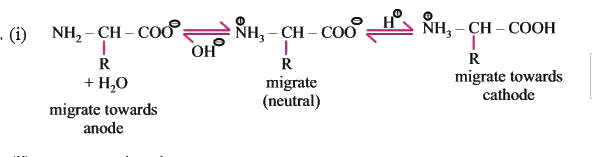
|
|
| 43. |
Give reason : Nitrogen is less reactive at room temperature. |
| Answer» Solution :DUE to HIGH bond DISSOCIATION of enthalpy N=N | |
| 44. |
Give reason : n-Butyl bromide has higher boiling point than t-butyl bromide. |
|
Answer» SOLUTION :`underset("n-Butyl BROMIDE")(CH_(3) - CH_(2) - CH_(2) - CH_(2)- Br ) "" underset("t-Butyl bromide") (CH_(3) - underset(CH_(3))underset(|)overset(CH_(3))overset(|)C - Br ) ` n-Butyl bromide has a greater surface AREA and hence greater van der Waals forces between the molecules. Hence it boils at a higher temperature than l-butyl bromide. |
|
| 45. |
Give Reason. Most of the transition metals have high melting point and boiling point. |
| Answer» SOLUTION :ELECTRONS of (n-1)d orbitals along with NS electrons are also INVOLVED in metallic bonding. | |
| 46. |
Give reason : Most of the reactions of fluorine are exothermic . |
| Answer» Solution :Most of the reactions of fluorine are exothermic : Reactions of fluorine are exothermic. It is due to low bond DISSOCIATION ENERGY and STRONG bond FORMED by it with other elements. FORMATION of strong and stable bonds is accompanied by evolution of heat. | |
| 47. |
Give reason in one or two sentences for the following 'Ammonium chloride is acidic in liquid ammonia solvent'. |
|
Answer» Solution :In solution of NH Cl in LIQUID NH3, the FOLLOWING reaction takes place ` NH_(4)^( +)+ NH_(3)leftrightarrow NH_(3) + NH_(4)` Thus NH.CI gives proton. Hence it is acidic |
|
| 48. |
Inter halogen compounds are more reactive than halogens . Why ? |
| Answer» SOLUTION : Typically, interhalogens are more reactive than halogens, because interhalogen BONDS are weaker thandiatomic halogen bonds except for Fluorine. It is due to their difference in electronegativety for EXAMPLE, ICL is more reactive than Iodine because the electro NEGATIVITY difference polarise the bond between Iodine and Chlorine and therefore breaks more easily than Iodine bond. Thus, Inter halogen compounds are more reactive than halogens since the bond between two dissimilar halogens atoms is weaker than the bondbetween two similar halogen atoms. | |
| 49. |
Give reason in one or two sentence for the following ''The hydroxides of aluminium and iron are insoluble in water. However, NaOH is used to separate one form other. |
| Answer» | |
| 50. |
Give reason. In case of optically active alkyl halides, SN1 reactions areaccompanied by racemisation |
|
Answer» Solution :Since the CARBOCATION is PLANAR or `sp^(2)` hybrid carbocation or NUCLEOPHILE can attack the carbocation from both the sides. The carbocation has `sp^(2)`-hybrid CARBON atoms with planar structure. Thus, nucleophile can attack from both the sides equally to for d and l-isomers in equal proportional. |
|