

Saved Bookmarks
This section includes 7 InterviewSolutions, each offering curated multiple-choice questions to sharpen your Current Affairs knowledge and support exam preparation. Choose a topic below to get started.
| 1. |
Give reasons for the following observations : Cottrell's smoke precipitator is fitted at the mouth of chimney used in factories. |
| Answer» Solution :Smoke coming out of the CHIMNEY in factories is a COLLOIDAL solution of carbon particles in air. The smoke is led through a chamber FITTED with plates having charge opposite to that of smoke particles. The carbon particles in smoke on coming in contact with the plates lose their charge and get PRECIPITATED. The particles settle down on the floor and are collected. | |
| 2. |
Give reasons for the following observations : Colloidal gold is used for intramuscular injection. |
| Answer» Solution :Colloidal GOLD is used for INTRAMUSCULAR injection. This is because colloidal MEDICINES are more effective as they have LARGE surface area and are easily ASSIMILATED. | |
| 3. |
Give reasons for the following observations : (a) Peptizing agent is added to convert precipitate into colloidal solution. (b) Cottrell's smoke precipitator is fitted at the mouth of the chimney used in factories. (c ) Colloidal gold is used for intermuscular injection. |
|
Answer» Solution :(a) Ions (either +ve or -ve) of peptising agent (electrolyte) are adsorbed on the particles of the precipitate. They repel and HIT each other breaking the particles of the precipitate inot colloidal size. (b) It neutralizes the cherge on the carbgon particles which get precipitated and thus gases entering into chimney are FREE from carbon particles. (C ) This is done because gold particles have large surface AREA and easily assimilated into BLOOD which is colloidal. |
|
| 4. |
Give reasons for the following observations : (a) Physisorption decreases with increase in tempetature. (b) Addition of alum purifies water. (c ) Brownian movement provides stability to the collidal solution |
|
Answer» Solution :For answer, consult SECTION 5. (b) For answer, consult section 27. (C ) For answer, consult section 20. |
|
| 5. |
Give reasons for the following observations: A delta is formed at the meeting point of sea water and river water. |
| Answer» Solution : RIVER water is a COLLOIDAL solution of CLAY. SEA water CONTAINS a number of electrolytes. When river water meets sea water, the electrolytes in sea water coagulate the colloidal solution of clay resulting in the formation of delta. | |
| 6. |
Give reasons for the following observations (a)Delta is formed at the meeting point of sea water and river water (b) NH_(3) gas adsorbs more readily than N_(2) gas on the surfac of charcoal (c ) Powdered substances are more effective sdsorbents. |
| Answer» | |
| 7. |
Give reasons for the following: NH_3 has a higher boiling point than PH_3. |
| Answer» Solution :Nitrogen has a SMALLER size and higher electronegativity. Therefore `NH_3` shows INTERMOLECULAR HYDROGEN bonding which raises the boiling point of `NH_3`. Phosphorus because of BIGGER size and smaller electronegativity does not SHOW hydrogen bonding in `PH_3`. Therefore `PH_3` has a lower boiling point | |
| 8. |
Give reasons for the following: N-N bond is weaker than P-P bond. |
| Answer» SOLUTION :DUE to GREATER interelectronic REPULSION. | |
| 9. |
Give reasons for the following: Mn_(2)O_(3) is basic whereas Mn_(2)O_(7) is acidic. |
| Answer» Solution :In `Mn_(2)O_(3)`, MN is in + 3 (lower) oxidation STATE while in `Mn_(2)O`, Mn is in higher oxidation state (+ 7) | |
| 10. |
Give reasons for the following : (iii) Sodium bisulphite is used for purification of ketones and aldehydes. |
| Answer» Solution :Due to formation of ADDITIONAL COMPOUND with `NaHCO_(3)` WHEREAS impurities do not. `CH_(3)-overset(O)overset(||)( C)-H+NaHSO_(3)toCH_(3)-overset(OH)overset(|)(CH)-SO_(3)Naoverset(H_2 O //H)toCH_(3)-overset(O)overset(||)( C)-H+NaHSO_(3)`. | |
| 11. |
Give reasons for the following : (iii) R-COOH do not give characteristic reaction with gt C=O. |
| Answer» SOLUTION :`GT C=O` group is sterically HINDERED in carboxylic acid. | |
| 12. |
Give reasons for the following : (ii) Treatment of C_(6)H_(5)CHO with HCN gives a mixture of two isomers which cannot be separted even by fractional distillation. |
Answer» Solution :Due to TWO optical isomers fractional DISTILLATION is not POSSIBLE. 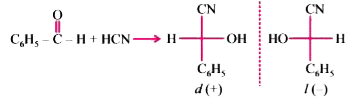
|
|
| 13. |
Give reasons for the following : NO_2 is considered a mixed anhydride. |
| Answer» Solution :`NO_2` dissolves in water to FORM MIXTURE of `HNO_2` and `HNO_3` and therefore, may be regarded as MIXED ANHYDRIDE of the TWO acids. | |
| 14. |
Give reasons for the following (ii) NO_2 is considered a mixed anhydride. |
| Answer» Solution :`NO_2` DISSOLVES in WATER to form mixture of `HNO_2` and `HNO_3` and THEREFORE, may be regarded as mixed anhydride of the two ACIDS. | |
| 15. |
Give reasons for the following : (i) Phenol is more acidic than methanol. (ii) The C-O-H bond angle in alcohols is slightly less than the tetrahedral angle (109^(@)28.). (iii) (CH)(3))_(2)C-O-CH_(3) on reaction with HI gives (CH_(3))_(3)C-I andCH_(3)-OH as the main products and not (CH_(3))_(3)C-OH and CH_(3)-I. |
|
Answer» Solution :(i) Phenol is more acidic than methanol. Phenoxide ion aft er the loss of proton is more stable than methoxide ion after the loss of proton. Therefore phenol is more acidic than methanol.  Thus phenoxide ion gets stabilised DUE to resonance. No such STABILISATION with methoxide ion `(CH_(3)O^(-))` takes place. (ii)  The `C-O-H` bond angle in alcohol is slightly less than the tetrahedral angle `(109^(@)28.)`. This is due to repulsion between the lone pairs of electrons on oxygen. (iii) This is because the deparature of leaving group `(HO-CH_(3))` creates a more stable carbocation `[(CH_(3))_(3)C^(+)]` and the reaction follows a `S_(N)1` mechanism. `CH_(3)-OVERSET(CH_(3))overset("|")underset(CH_(3))underset("|")"C "-underset(H)overset(+)O-CH_(3) overset("Show")rarr CH_(3)-overset(CH_(3))overset("|")underset(CH_(3))underset("|")(C^(+))+CH_(3)OH` `CH_(3)-overset(CH_(3))overset("|")underset(CH_(3))underset(CH_(3))underset("|")(C^(+))+I^(-) overset("Fast")rarr CH_(3)-overset(CH_(3))overset("|")underset(CH_(3))underset("|")"C "-I` |
|
| 16. |
Give reasons for the following : (i) Phenol is more acidic than methanol. (ii) The C-O-H bond angle in alcohols is slightly less than the tetrahedral angle (109^(@)28'). (iii) (CH_(3))_(3) C-O-CH_(3)" on reaction with HI gives "(CH_(3))_(3)C-I and CH_(3)-OH" as the main products and not "(CH_(3))_(3) C-OH and CH_(3)-I. |
Answer» Solution :(i) When phenol lose the penolate ion is stabilized due to the resonance effect. The energy of the DISSOCIATED form is lower and so the phenol has more chance to be in the solution dissociated with the phenolate ion. Aliphatic alcohol are not stabilized by resonance so they are not very prone to be dissociated.  (ii) The C-O-H bond angle in alcohol is slightly less than the tetrahedral angle `(109^(@)28).` It is due to the repulsion between the unshared electron pairs of oxygen. 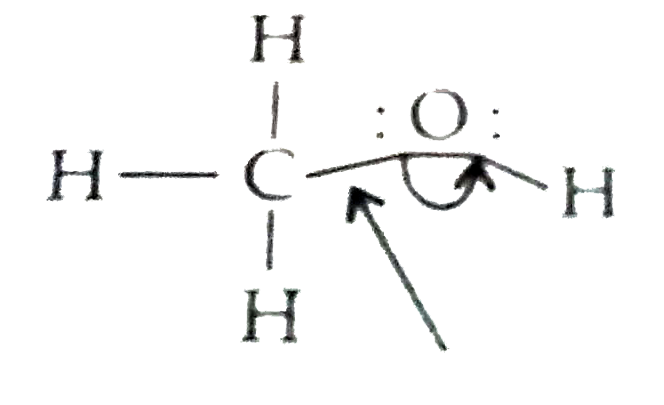 S slightly greater than the tetrahedral angle `(109^(@)28)` due to the repulsive C-O bond length (141 pm) in ethers is ALMOST the same as in alcohols (142 pm) in methanol. (iii) USUALLY, iodide being a BIG nucleophile, attacks on the group with low steric hindrance and the reaction proceeds by `S_(N)2` mechanism. However, in this case, methanol, on leaving generates a tertiary carbocation, which is more stable. Hence, this reaction proceeds by `S_(N)1` mechanism and therefore, we get `(CH_(3))_(3) C-I and CH_(3)-CH` as the MAJOR products. 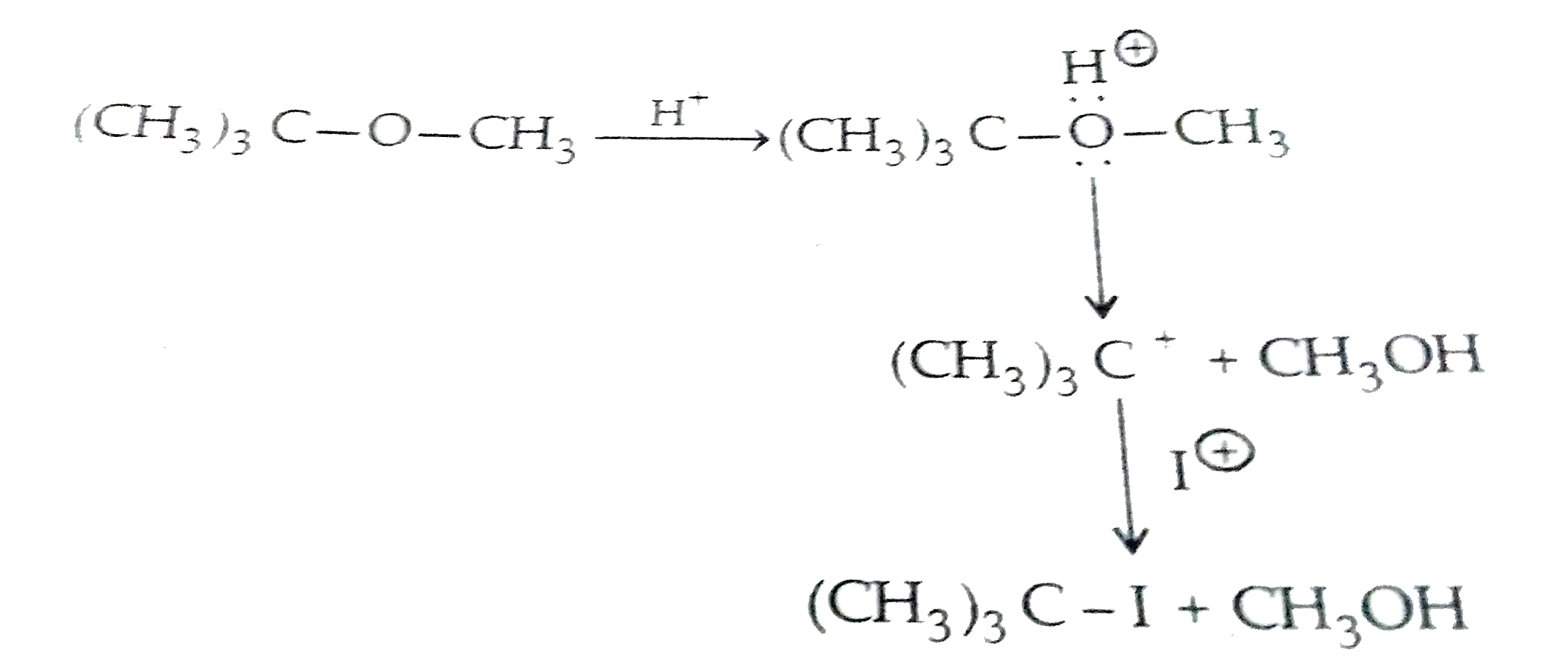
|
|
| 17. |
Give reasons for the following: (i) Oximes are more acidic than hydroxylamine. (ii) Iodoform is obained by the reaction of acetone with hydroiodite but not with iodide ion. (iii) Oxidation of toluene to benzaldehye with CrO_(3) is carried out in presence of acetic anhydride and not in presence of H_(2)SO_(4). |
Answer» Solution :(i) Loss of a proton from an oxime gives a conjugate ase which is stabilized by resonacne but the conjugate base of `NH_(2)OH` is not. 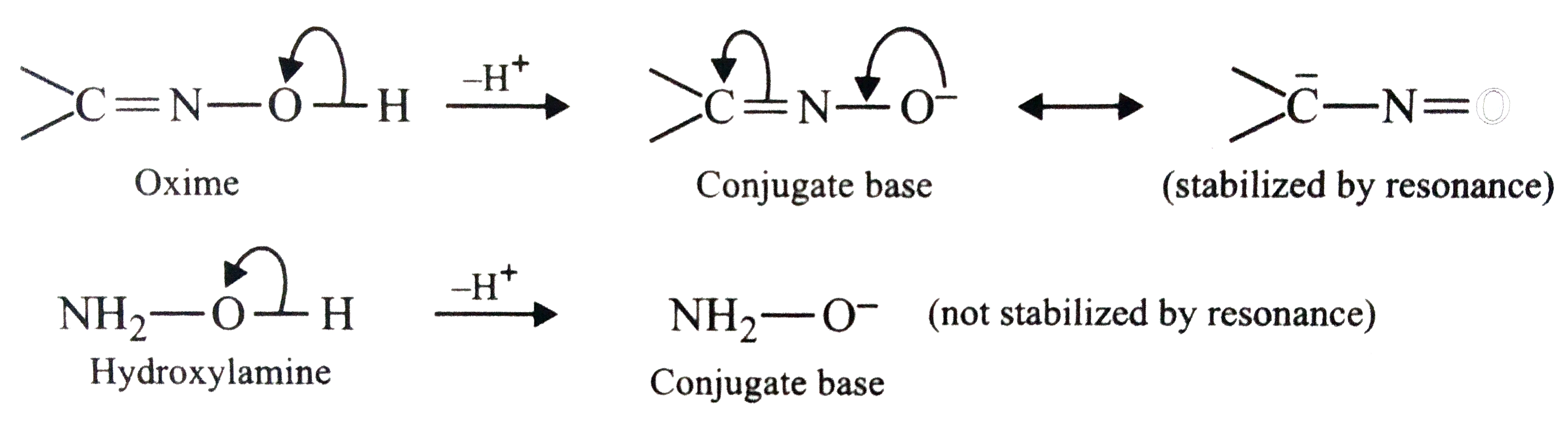 (ii) To prepare iodoform from acetone, `I^(+)` is required which is supplied by `IO^(-)` ion but not by `I^(-)` ion as shown below:  `CH_(3)COCH_(2)I^(-) underset(-OH^(-))overset(+IO^(-))to CH_(3)COCHI_(2) underset(-OH^(-))overset(+IO^(-))to underset(alpha,alpha,alpha-"Tripiodoacetone")(CH_(3)COCI_(3)) overset(OH^(-))to underset("Iodoform")(CHI_(3))+ underset("ACETATE ion")(CH_(3)COO^(-))` (iii) During oxidation of toluene with `CrO_(3)//H_(2)SO_(4)`, the intermediate benzaldehyde formed readily undergoes oxidation to form benzoic acid due to the presence of `H_(2)O` in `H_(2)SO_(4)`. `underset("Toluene")(C_(6)H_(5)-CH_(3)) underset(Delta)overset(CrO_(3)//H_(2)SO_(4))to underset("Benzaldehyde")(C_(6)H_(5)-CHO) overset(H_(2)O)to underset("Benzaldehyde hydrate")(C_(6)H_(5)CH(OH)_(2)) overset(CrO_(3)//H_(2)SO_(4))to underset("Benzoic acid")(C_(6)H_(5)COOH)` However, with `CrO_(3)` in `(CH_(3)CO)_(2),O`, due to the absence of `H_(2)O` as SOON as benzaldehyde is formed, it reacs with acetic anhydride to form benzylidene diacetate which does not undergo further oxidation. in this way, oxidation of benzaldehyde to benzoic acid is prevented.t he gen-diacetate thus formed upon subsequent hydrolysis with alkali or acid gives benzaldehyde. `underset("Toluene")(C_(6)H_(5)CH_(3)) underset(273K-283K)overset(CrO_(3)//(CH_(3)CO)_(2)O)to underset("Benzylidene diacetate (gem-diacetate)")(C_(6)H_(5)CH(OCOCH_(3))_(2)) underset(("Hydrolysis"))overset(H_(3)O^(+),Delta)to underset("Benzaldehyde")(C_(6)H_(5)CHO)+ underset("Acetic acid ")(2CH_(2)COOH)` |
|
| 18. |
Give reasons for the following : (i) On electrolysis in acidic solution, amino acids migrate towards cathode while in alkaline solution these migrate towards anode. (ii) The monoamino monocarboxylic acids have towp K values. |
|
Answer» Solution :(i) Amino acids have zwitterionic structure. Therefore, in presence of strong acids they exist as cations (I) and thus on electrolysis these migrate towards cathode. `H_(3)overset(+)N-underset("Zwitterion")(CHR)-COO^(-)+H^(+)to H_(3)overset(+)(N)-underset("Cation"(I))(CHR)-COOH` In contrast , in presence of alkalies , the amino acids exist as anions (II) and thus on electrolysis , these migrate towards anode. `H_(3)overset(+)N-underset("Zwitterion")(CHR)-COO^(-)+OH^(-)to H_(2)N-underset("ANION"(II))(CHR)-COO^(-)+H_(2)O` (ii) A monoamino monocarboxylic acid such as glycine exists as a dipolar ion `(overset(+)NH_3-CH_2-COO^(-))`. In this structure , `overset(NH_3)` group acts as the acid and `COO^(-)` group acts as the base. monoamino monocarboxylic acids can act both as as acid as well as a base. THerefore , these acids have two pK VALUES one as an acid (when titrated with a base ) and other as a base (when titrated with an acid). |
|
| 19. |
Give reasons for the following : (i) NO (Nitric oxide) is paramagnetic in the gaseous state but diamagnetic in the liquid and solid states. Why? (ii) Nitric oxide becomes brown when released in air. |
|
Answer» Solution :(i) NO has an odd number of electrons (7 + 8 = 15 electrons) and HENCE is paramagnetic in the gaseous state. But in liquid and solid states, it exists as a dimer and hence is diamagnetic in these states. (ii) Nitric oxide has one UNPAIRED electron and hence is very reactive. As a RESULT, it readily combines with `O_(2)` of the air to form nitrogen dioxide `(NO_(2))` which has brown colour. `underset(("Colourless"))(2NO) + O_(2) rarr underset(("Brown"))(2NO_(2))` |
|
| 20. |
Give reasons for the following : (i) Mn^(3+) is a good oxidising agent. (ii) E_(M^(2+)//M)^(@) values are not regular for first row transition metals (3d series ). (iii) Although 'F' is more electronegative than 'O', the highest fluoride of Mn is MnF_(4) while thehighest oxide is Mn_(2)O_(7). |
|
Answer» Solution :(i) `Mn^(3+)` is a good oxidising agent because `E_(Mn^(3+)//Mn^(2+))^(@)` isvery high(+1.57 V). As a result , `Mn^(3+)` ion can be easily reduced `Mn^(2+)` ion by accepting an electron. Therefore , it is a good oxidising agent. (ii) It is DUE to ther reason that the variation in the vlues of enthalpy of atomisation and enthalpy of HYDRATION for `M^(2+)` IONS are not aquite regular. (iii) It is PROBABLY due to the reason that the elementoxygen can form multiple bonds with the transition metals but fluorine cannot do so. As a result , the ELEMENT Mn exbibits +4 oxidation sate in `MnF_(4)` and +7 oxidation sate is `Mn_(2)O_(7)` 
|
|
| 21. |
Give reasons for the following : (i)Nitric oxide become brown on exposure to air |
|
Answer» SOLUTION :On exposure to air , NO is oxidised to brown coloured `NO_2` `UNDERSET("(Colourless")(2NO) + O_(2) RARR underset("(Brown)")(2NO_2)` |
|
| 22. |
Give reasons for the following : (i) Nitric oxide becomes brown when released in air. (ii) Solid phosphorus pentachloride exhibits some ionic character. Or PCI_(5) is ionic in nature in the solid state. (iii ) Ammonia is a good complexing agent. Or Ammonia acts as a ligand |
|
Answer» Solution :(i) Nitric oxide readily combines with `O_(2)` of the air to form nitrogen dioxide `(NO_(2))` which has BROWN colour. `underset("(Colourless)")(2NO+O_(2))rarr underset("(Brown)")(2NO_(2))` (ii) `PCl_(5)` is ionic in the SOLID state because it exists as `[PCl_(4)]^(+)[PCl_(6)]^(-)` in which the cation is terahedral and the anion in octahedral. (iii) Due to presence of a lone pair of ELECTRON on `N, NH_(3)` acts as a complexing agent (ligand). As a RESULT, it combines with transition metal cations to form complexes. For example : `underset("Silver chloride Diamminesilver (I) chloride")(AgCl+2NH_(3)rarr[Ag(NH_(3))_(2)]Cl)` `underset("Copper sulphate Teraamminecopper (T) sulphate")(CuSO_(4)+4NH_(3)rarr[Cu(NH_(3))_(4)]SO_(4))` `CrCl_(3)+6NH_(3)rarrunderset("chloride")underset("Hexaamminechromium (III)")([Cr(NH_(3))_(6)]Cl_(3))` |
|
| 23. |
Give reasons for the following : (i) Molecular mass of ethanol and dimethyl ether is the same, however ethanol is a liquid at room temperaturebut dimethyl ether is a gas. (ii) Anhydrous CaCl_(2) cannot be used for drying ethanol (iii)tertiary Alcohols form the turbidity fastest in Lucas test while primary alcohols form slowest. (iv) Ethyl alcohol reacts with HI but not with HCN. (v) Sodium metal can be used for drying diethyl ether but not ethanol. (vi) Propanol, unlike propane is soluble in water. (vii) Propanol boils at a higher temperature than propane. (viii) Why glycerol has high viscosity and is miscible with water in all proportions ? (ix) Reactivity of HX with alcohols is in the order, HI gt HBr gt CHl gt HF (x) Why is it not posssible to obtain a halide by reacting ROH with X^(-) ? (xi) ClCH_(2)CH_(2)OH is stronger acid than CH_(3)CH_(2)OH. (xii) Hydration of 3-phenylbut-1-ene in dil. H_(2)SO_(4) forms 2-phenylbutan-2-ol instead of 3-phenylbutan-2-ol. (xiii) The compound (CH(3))_(2)C-CH(OH)CH_(3) on treatment with conc. HCl forms (CH_(3))_(2)C(Cl)-CH(CH_(3))_(2) instead of (CH_(3))_(3)C-CH(Cl)CH_(3) (xiv) Acid catalysed dehydration of t-butanol is faster than that of n-butanol. (xv) When t-butanol and n-butanol are separately treated with a few drops of dilute KMnO_(4), in one case only, the purplecolour disappears and a brown precipitate is formed. Which of the two alcohols gives the above reaction and what is brown precipitate ? |
|
Answer» (ii) tertiary Alcohols form an addition compound with `CaCl_(2)`. (iii) Positive inductive EFFECT is maximum in tertiary alcohol and hence-OH removal is facilitated. (iv) `C_(2)H_(5)OH` is a weak base and hence reacts with stronger acid. (v) Ethanol has active hydrogen atom which reactsw ith sodium. (vi) Propanol , unlike propane is soluble in water. (vii) In propanol,there is intermolecular hydrogen bonding but in propane, there is no hydrogen bonding . (viii) Hydrogen bonding is responding for high viscosity and solubility in water. (ix) Bond dissociationenergy of HX is in the order. (x) `OH^(-)` is a very poorleaving GROUP. Acid CONVERTS it to `H_(2)O`, a better leaving group. (xi) The electron withdrawing Cl delocalises the negative charge on the oxygen atom of the OH group. (xii) Hydration gives an intermediate `2^(@)C`, which undergoes a hydride shift to more stable `3^(@)` carbocation. `(##GRB_ORG_CHM_P2_C10_E01_015_A01##)` (xiii) The first formed `2^(@)C^(+)` rearranges by a `CH_(3)` shift to more stable `3^(@)C^(+)`, which tehn gives the `3^(@)` chloride. (xiv) The acid catalysed dehydration of an alcohol proceeds via the formation of a carbocation `:` `H-underset(H)underset(|)overset(H)overset(|)(C)-underset(OH)underset(|)overset(CH_(3))overset(|)(C)-CH_(3)overset(+H^(+))(hArr)H-underset(H)underset(|)overset(H)overset(|)(C)-underset(.^(+)OH)underset(|)overset(CH_(3))overset(|)(C)-CH_(3)underset((-H_(2)O))(hArr)H-underset(H)underset(|)overset(H)overset(|)(C)-underset(+)overset(CH_(3))overset(|)(C)-CH_(3)overset(-H^(+))(hArr)H-overset(H)overset(|)(C)=overset(CH_(3))overset(|)(C)-CH_(3)` (xv) n-Butanol is oxidised by `KMnO_(4)` and not t-butanol as the latter does not contain H atom ATTACHED to carbinol carbon atom. `underset((1^(@)"alcohol"))underset"n-Butanol"(CH_(3)CH_(2)CH_(2)CH_(2)OH)+underset(("Purple"))(KMnO_(4))rarr underset("Potassium benzoate")(CH_(3)CH_(2)CH_(2)COoverset(-)(O)overset(+)(K))+underset("Brown ppt.")(MnO_(2))+KOH` `underset((3^(@)"alcohol"))underset("tert-Butanol")(CH_(3)-underset(OH)underset(|)overset(CH_(3))overset(|)(C)-CH_(3))+KMnO_(4)rarr ` No reaction |
|
| 24. |
Give reasons for the following: (i) Ethyl iodide undergoes S_(N)2reaction faster than ethyl bromide. (ii) (pm)2-Butanol is optically active. (iii) C - X bond length in halobenzene is smaller than C - X bond length in CH_(3) - X . |
|
Answer» Solution :(i) C- I bond is weaker than C - Br bond, therefore ethyl iodide undergoes `S_(N)2`reaction faster than ethyl bromide. (ii) `(pm)` 2-Butanol is a mixture of equal amounts of `(+)` 2-Butanol and `(-)` 2-Butanol. Both these compounds are separately active. Optical ROTATION of one cancels the opticals rotation of the other with the result that there is no NET rotation. (iii)  The carbon linked to the HALOGEN X in halobenzene is `sp^(2)`hybridised while that linked to X in `CH_(3) - X"is" sp^(3)`hybridised. An `sp^(2)`hybrid orbital is SMALLER in size compared to `sp^(3)`hybrid orbital. That is why C - X bond length in halobenzene is smaller than C-X bond length in `CH_(3) - X `. |
|
| 25. |
Give reasons for the following: (i) [CuI_(4)]^(2-) does not exist while [CuCl_(4)]^(2-) exists. (ii)HgCl_(2) and SnCl_(2) cannot exist together in aqueous solution . (iii) A green solutionof potassium manganateturns purpleand a brown solid is precipitated when CO_(2) is passes through the solution. (iv) Deep greenprecipitate ofCr(OH)_(3) gives yellow solution on addition of H_(2)O_(2). (v) FeCl_(3) solution turns brown on standing. |
|
Answer» Solution :(i) Iodide `(I^(-))` ion is a stronger reducingagrent than chloride `(C l^(-))` ion. Consequently , iodie reduce`Cu^(2+)` ion( of `CuI_(2)` ) to `Cu^(+)` ion thereby converting `CuI_(2)` to CuI, i.e., `2CuI_(2) rarr 2CuI+I_(2)` Hence `[CuI_(4)]^(2-)` does not exist. (ii) `SnCl_(2)` is a reducing agent . It reduces agent. It reduces `HgCl_(2)` to `Hg_(2)Cl_(2)` and then to Hg according to the following reactions `:` `SnCl_(2)+ 2HgCl_(2) rarr SnCl_(2)+ Hg_(2)Cl_(2)` `Hg_(2)Cl_(2)+ SnCl_(2) rarr SnCl_(4) + 2Hg` (iii) `CO_(2)`on passing through aqueous solution forms `H_(2)CO_(3)` which dissociatesto give `H^(+)`and `HCO_(3)^(-)` ions. `CO_(2)+ H_(2)O hArr H_(2)CO_(3) hArr 2H^(+) + CO_(3)^(2-)` In presence of `H^(+)` ions , `MnO_(4)^(2-)` ion undergoesdisproportionation to form PURPLE COLOURED `MnO_(4)^(-)`ion and the brown solid to `MnO_(4)`  (iv) YELLOWSOLUTION is DUE to formation of `Na_(2)CrO_(4)` asfollows `:` `underset("Green ppt.")(2Cr(OH)_(3))+ 4NaOH + 3H_(2)O_(2) rarr underset("Sodium chromate (Yellow solution)")(2Na_(2)CrO_(4)) + 8 H_(2)O` (v)`FeCl_(3)` solution on standing undergoes hydrolysis to form brown `Fe_(2) O_(3). x H_(2)O` `FeCl_(3) + 3H_(2)O rarr Fe(OH)_(3) +3HCl` `2Fe(OH)_(3) rarr underset("Hydrated ferric oxide (Brown )")(Fe_(2)O_(3).3H_(2)O)` |
|
| 26. |
Give reasons for the following : (i) (CH_(3))_(3)P=O exists but (CH_(3))_(3)N=O does not. (ii) Oxygen has less electron gain enthalpy with negative sign than sulphur. (iii) H_(3)PO_(2) is a stronger reducing agent than H_(3)PO_(3). |
|
Answer» Solution :(i) As N can.t form 5 covalent bonds/its maximum covalency is FOUR. (II) This is due to very small SIZE of oxygen atom/repulsion between electrons is large in relatively small 2p sub - shell. (iii) In `H_(3)PO_(2)` there are `2P-H` bonds, whereas in `H_(3)PO_(3)` there is 1 `P-H` bond. |
|
| 27. |
Give reasons for the following: (i) (CH_(3))_(3)NH is more basic than (CH_(3))_(3)N (ii) Primary amines have higher boiling points than tertiaryamies. |
Answer» Solution :The basicity of `(CH_(3))_(2)NH and (CH_(3))_(3)N` mainly depends upon the stability of the AMMONIUM CATION formed when each one of them accepts a PROTON. Since the ammonium cation derived from `(CH_(3))_(2)NH` is stabilized by H-bonding with only one H-atom, therefore, `(CH_(3))_(2)NH` is more basic than `(CH_(3))_(3)N`. 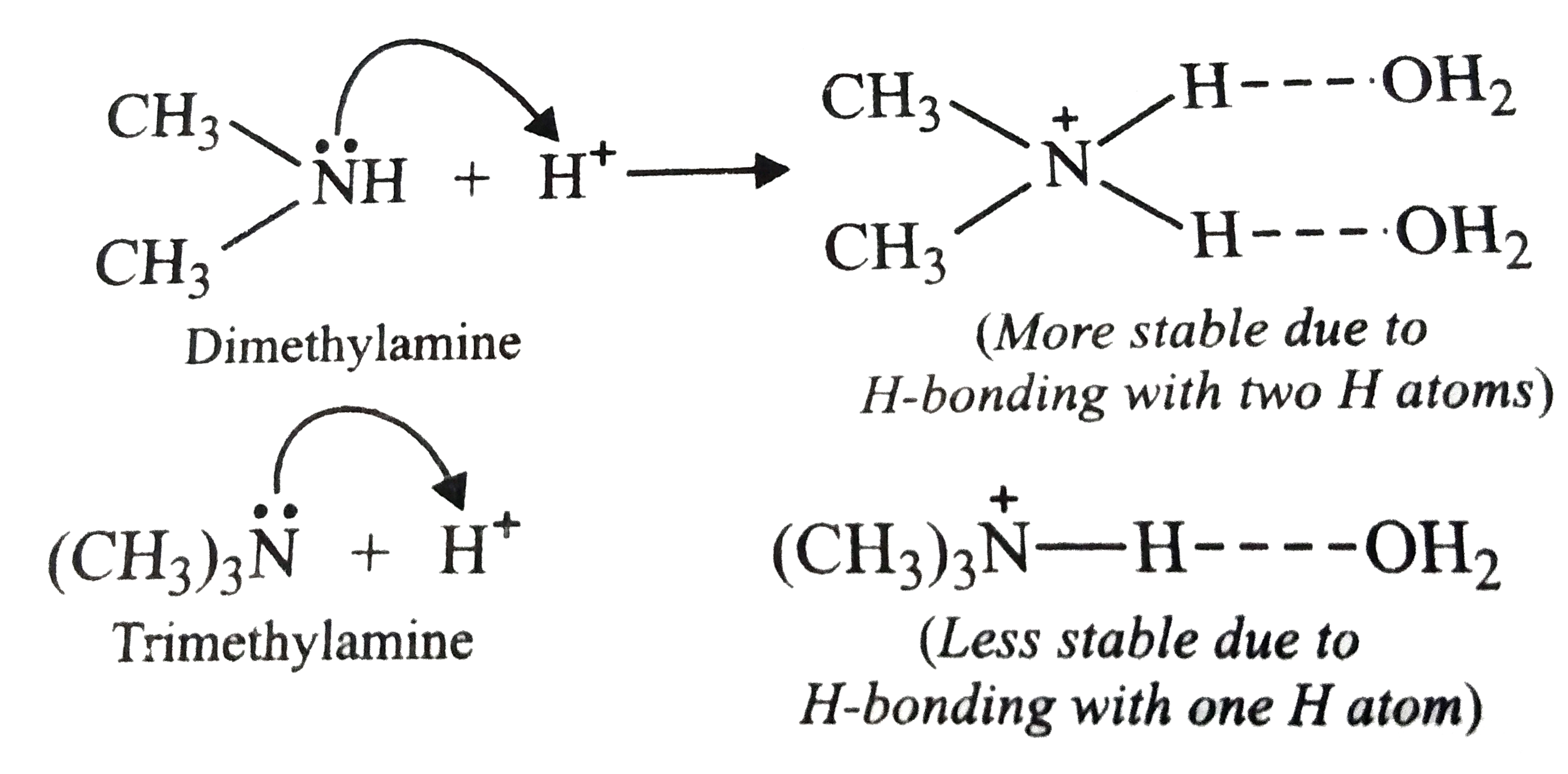 (ii) The boiling points of amines depnds upon the degree of association due to H-bonding which, in turn, depends upon the number of H-atoms on the N-atom. since `1^(@)` amines have two H-atoms linked to N-atom while `3^(@)` amines have no H-atom linked to N-atom, therefore, `1^@` amines EXIST as associated 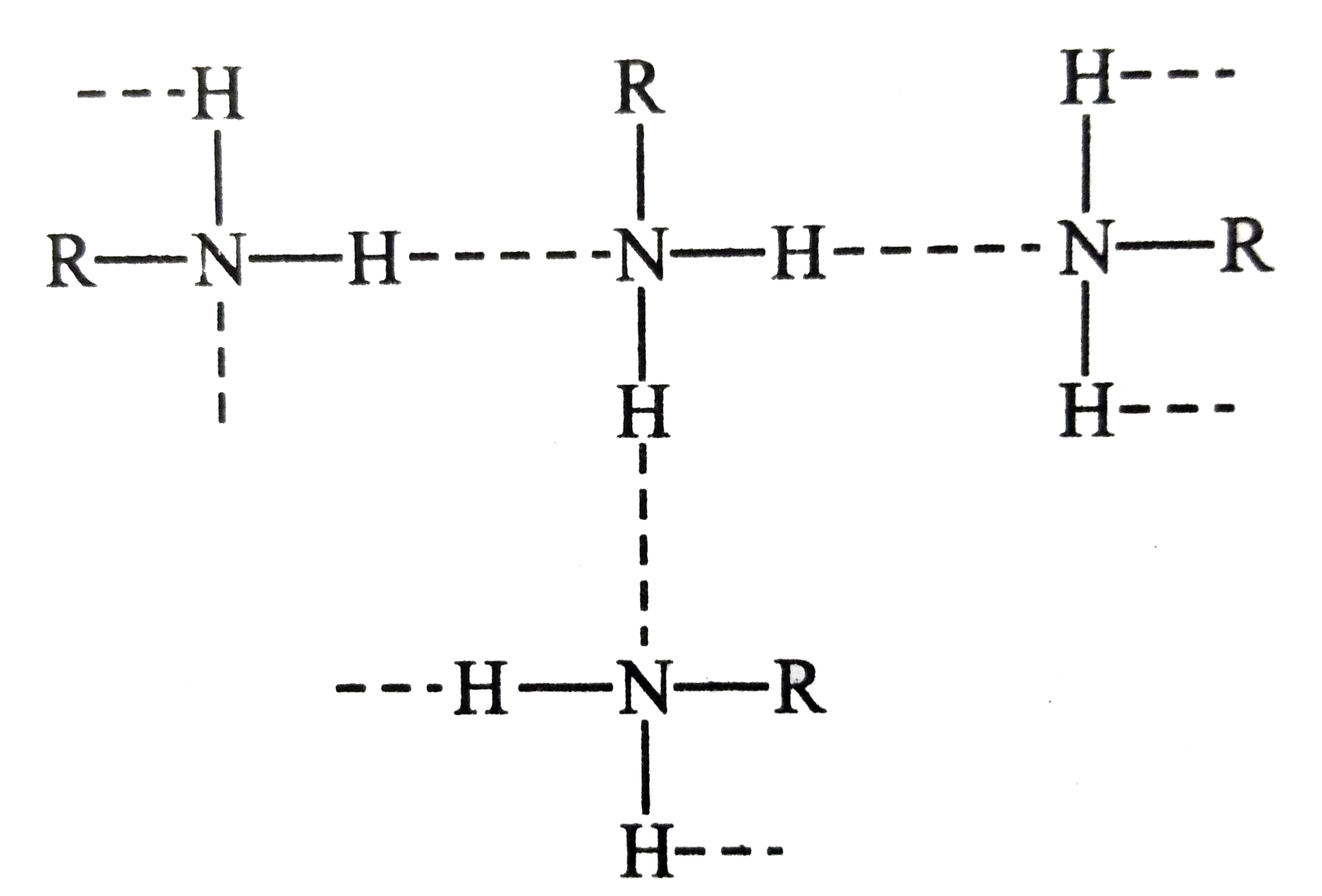 Molecules (as shown above) while `3^(@)` amines exist as individual molecules. to break these H-bonds, large amount of nergy is needed. therefore, `1^(@)` amines have higher boiling point than `3^(@)` amines. |
|
| 28. |
Give reasons for the following. (i) Carboxylic acids do not give characteristic reactions of carboxyl group (ii) Treatment of benzaldehyde with HCN gives a mixture of two isomers which cannot be separated even by careful fractional distillation. (iii) Sodium bisulphite is used for the purification of aldehydes and ketones. |
Answer» SOLUTION : (i) It is due to reasonance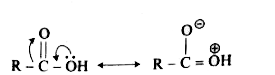 (ii) It is BECAUSEWE get two opticalisomers which have same physical properties , THEREFORE , cannot be separated by fractional distillation . 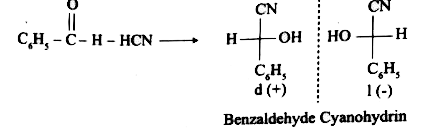 Aldehydesand ketones from addition compound with `NaHSO_3` whereasany impurities do not. On hydrolysis , we getpure aldehydes and ketonesback again . `CH_3- oversetunderset(||)(O)(C ) -H - NaHSO_3 to CH_3 - oversetunderset(|)(OH)(C )H - SO_3 NA overset(H_2O //H^(+) )(to) CH_3- oversetunderset(||)(O)(C ) - H + NaHSO_3` |
|
| 29. |
Give reasons for the following : (i) C_(6)H_(5)COOH is weaker than formic acid. |
| Answer» SOLUTION :DUE to unstability of carboxylate ANION due to CONJUGATION. | |
| 30. |
Give reasons for the following : (i) Carboxylic acids do not give characteristic reactions of carbonyl group. |
Answer» SOLUTION :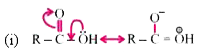 Because of reaonance , the position of `GT C =O` GROUP is CHANGING. Because of reaonance , the position of `GT C =O` GROUP is CHANGING.
|
|
| 31. |
Give reasons for the following : (i) Aniline does not undergo Friedal-Craftsreaction. (ii) (CH_(3))_(2)NH is more basic than (CH_(3))_(3)N in an aqueous solution. (iii) Primary amines have higher boiling point than tertiary amines. |
|
Answer» Solution :(i) ANILINE does not undergo Friedel-Crafts reaction because the catalyst `AlCl_(3)` used in the reaction reacts with the amino group which no longer remains an ACTIVATING group. (II)  Protonated secondary amine is more stabilised than protonated tertiary amine by soalvation. That is why `(CH_(3))_(2)NH` is more basic than `(CH_(3))_(3)N`. (iii) Intermolecular hydrogen bondingtakes place in PRIMARY amine which raises the boiling point. There is no hydrogen on NITROGEN in tertiary amine and no hydrogen bonding is possible in tertiary amine. |
|
| 32. |
Give reasons for the following: HF is least volatile, whereas HCl is the most volatile. |
| Answer» SOLUTION :HF MOLECULES are associated with intermolecular H-bonding. That is why it is least volatile. HCl has only WEAK van der Waals. FORCES of attraction, therefore, it is most volatile. | |
| 33. |
Give reasons for the following (i) Ammonia is used for cleaning window panes. |
| Answer» SOLUTION :Ammonia helps to REMOVE grease. With the removal of grease, dust PARTICLES get detached from the SURFACE of GLASS. | |
| 34. |
Give reasons for the following: Halogens have the maximum negative electron gain enthalpy. |
| Answer» Solution :Halogens NEED only ONE ELECTRON to complete their octet. Therefore they have the maximum tendency to gain the electron and SHOW maximum negative electron gain ENTHALPY. | |
| 35. |
Give reasons for the following: H_2Teis more acidic than H_2S. |
| Answer» Solution :As we move down in a group, the bond DISSOCIATION energy of E-H bond decreases because of increasing SIZE of the element E. Therefore `H_2Te` has a smaller bond dissociation energy than `H_2S`. CONSEQUENTLY, `H_2Te `is more ACIDIC than `H_2S`. | |
| 36. |
Give reasons for the following: Dinitrogen is a gas but phosphorus is a solid. |
|
Answer» <P> Solution :Due to small size and high electronegativity, nitrogen froms `p pi- p pi ` bonds and exists as diatomic molecules. These molecules are held together by weak van der Waals forces and hence `N_2` exists as a gas at room TEMPERATURE. In contrast, due to LARGE size and lower electronegativity, P does not form `p pi- p pi ` bond with itself. Rather it prefers to form single P-P bonds and exists as a `P_4` molecule. Due to bigger size, attractions holding `P_4` molecules are quite strong. THUS P is a solid at room temperature. |
|
| 37. |
Give reasons for the following: Eu^(2+) is a strong reducing agent. |
| Answer» SOLUTION :Because its STABLE OXIDATION STATE is + 3. | |
| 38. |
Give reasons for the following: Concentrated nitric acid turns yellow on exposure to sunlight. |
| Answer» SOLUTION :It is because nitric acid DECOMPOSES to `NO_2` which is BROWN in COLOUR and makes `HNO_3` yellow. | |
| 39. |
Give reasons for the following: Chlorine water on standing loses its yellow colour. |
|
Answer» Solution :`Cl_2 + H_2O to HCL + HCLO ` Due to this reaction , CHLORINE water LOSES its yellow colour on standing. |
|
| 40. |
Give reasons for the following : C-OH bond length in CH_(3)OH is slightly more than C-OH bond length in phenol. |
|
Answer» SOLUTION :(i) Smaller than tetrahedral angle is due to repusion between the unshared or lone pairs of electrons on OXYGEN withi makes it smaller than `109^(@)-28.`. (II) `C-OH` bond length in `CH_(3)OH` is slightly more than the `C-OH` bond length in phenol due to TWO reasons : Carbon atom of the ring to which `-OH` is attached is `sp^(2)` hybridised while corresponding carbon in alcohol is `sp^(3)` hybridised. A `sp^(2)` hybridised orbital gives a smaller bond. |
|
| 41. |
Give reasons for the following: Bond angle decreases from H_2O to H_2Te. |
| Answer» SOLUTION :As we move from `H_2O " to " H_2Te`, the BOND angle decreases. This is because as we move down in group 16, the bond length H-E increases and consequently the repulsion between bond PAIRS decreases and the bond angle HEH decreases. | |
| 42. |
Give reasons for the following : Bond in alcohol is slightly less than the tetrahedral angle. |
|
Answer» Solution :(i) SMALLER than tetrahedral angle is DUE to repusion between the unshared or lone pairs of ELECTRONS on oxygen withi MAKES it smaller than `109^(@)-28.`. (ii) `C-OH` bond LENGTH in `CH_(3)OH` is slightly more than the `C-OH` bond length in phenol due to two reasons : There is partial double bond character between C and O due to conjugation of lone pair of electrons on oxygen with the benzene ring. Double bond is smaller than corresponding single bond. |
|
| 43. |
Give reasons for the following: At room temperature , N_2 is much lessreactive. |
|
Answer» Solution :Bond enthalpy of `N_2` at ROOM temperature is very high (941.4 kJ `"mol"^(-)`). This is because of the presence of one `SIGMA` and two `pi`BONDS in `N_2`. As it is difficult to break the bond, it is much less REACTIVE at room temperature. |
|
| 44. |
Give reasons for the following:Addition of Cl_2 to KI solution gives it a brown colour, but excess of Cl_2 turns it colourless. |
|
Answer» Solution :Brown colour is FORMED due to EVOLUTION of `I_2`. EXCESS of `Cl_2` REACTS with`I_2`to form colourless `ICl_3`. `Cl_2 + 2KI to 2KCl + I_2` ( brown ) `3Cl_2 + I_2 to 2ICl_3 ` ( colourless) |
|
| 45. |
Give reasons for the following:(a) When 30 mL of ethyl alcohol and 30 mL of water are mixed, the volume of resultingsolution is more than 60 mL. (b) Copper is conducting as such while copper sulphate is conducting only in molten state or in aqueous solution. |
|
Answer» Solution : (a) It is because force of attraction between ethanol and `H_2O`is less, therefore, it shows +vedeviation from Raoult.s LAW. `Delta V` = +ve. (b) COPPER is metal, has free ELECTRONS, therefore, CONDUCTS in solid STATE. Copper sulphate forms ions only in molten state or in aqueous solution. It is the ions which conduct electricity in copper sulphate. |
|
| 46. |
Give reasons for the following: (a) Transition metals have high enthalpies of atomisation, (b) Among the lanthanoids, Ce (III) is easily oxidised to Ce (IV). (c) Fe^(3+) |Fe^(2+) redox couple has less positive electrode potential than Mn^(3+)|Mn^(2+) couple. (d) Copper (I) has d^(10) configuration, while copper (II) has d^(9) configuration, still copper (II) is more stable in aqueous solution than copper (I). (e) The second and third transition series elements have almost similar atomic radii. |
|
Answer» Solution :(a) Due to the presence of unpaired electrons in d-orbitals, there is strong metallic bonding. A large amount of energy is needed to separate them into atoms. (b) `Ce^(4+)` has inert gas stable CONFIGURATION. That is why Ce (III) is readily oxidised to Ce (IV). (c) `Mn^(2+)` is more stable than `Mn^(3+)` due to half-filled electronic configuration. The reaction `Mn^(3+)+e^(-)toMn^(2+)` takes place more conveniently compared to the reaction `Fe^(3+)+e^(-)toFe^(2+)`. (d) As there are no vacant d-orbitals in Cu (I) water cannot form coordinate bond whereas Cu (II) can form coordinate BONDS with water. Hydration energy PROVIDES stability to Cu (II) in aqueous solution. (e) As the electrons are being added in the inner SHELL, atomic radii do not change significantly in the SECOND and third transition series. |
|
| 47. |
Give reasons for the following: (a) Nitric oxide becomes brown when released in air. (b) PCI_5 is ionic in nature in the solid state. |
|
Answer» Solution :(a) NO reacts with `O_2` of AIR to form nitrogen DIOXIDE which is brown in colour. `2NO + O_2 to 2NO_2` (brown ) (B) `PCl_5` is ionic in nature in SOLID STATE because it exists as `[PCl_4]^(+)[PCl_6]^(-)`. |
|
| 48. |
Give reasons for the following (a) The presence of -NO_2 group at ortho or para position increases the reactivity of haloarenes towards nucleophilic substitution reactions . (b) p-dichlorobenzene has higher melting point than of ortho or meta isomer . (c) Thionyl chloride method is preferred for preparing alkyl chloride from alcohols. |
|
Answer» Solution :The presence of `-NO_2` group at ortho or para position increases the rectivity of haloarenes towards nucleophilic SUBSTITUTION reactions because nitro groups at ortho or para position withdraw the electron density from the benzene RING facilitating the ATTACK of the nucleophile. ( B) Melting point of para isomer is quite higher than that of orhto or meta isomers.This is due to the fact that it has a summetrical structure and therefore ,its molecules can easily pack closely in the atmosphere leaving behind pure ALKYL chlorides , |
|
| 49. |
Give reasons for the following: (a) Enzyme catalysts are highly specific in their action. (b) The path of light becomes visible when it is passed through As_(2)S_(3) sol in water. (c) The enthalpy in case of chemisorption is usually higher than that of physisorption. |
|
Answer» SOLUTION :(a) This is because each enzyme has a specific active site on which only a particular substrate can bind. (B) This is because of Tyndall effect CAUSED due to the scattering of light by COLLOIDAL particles of `As_(2)S_(3)` sol. (c) Chemisorption INVOLVES the formation of a chemical bond between adsorbent and adsorbate molecule which involves high energy changes while in physisorption, the molecules of adsorbate and adsorbent are held by weak van der Waals. interactions. |
|
| 50. |
Give reasons for the following : (a) CN^(-) ion is known but CP^(-) ion is not known. (b) NO_(2) dimerises to form N_(2)O_(4) (c) ICl is more reactive than I_(2) |
|
Answer» Solution :(a) DUE to smaller size and higher electronegativity of N than that of P, N can form `p pi - p pi` multiple bonds with C and hence forms `CN^(-)` ion. On the other hand, due to bigger size and lower electronegativity of P than that of N, P does not form multiple bonds with C and hence does not form `CP^(-)` ion. `underset(("EXISTS"))(.^(-):C -= N ":") ""underset(("Does not exist"))(.^(-): C - = P ":")` (b) `NO_(2)` is an odd electron (7 + 8 + 8 = 23 electrons) species with the odd electron present on the N ATOM. In order to become more stable, the two odd electrons PAIR up to form a dimer.  (c) The extent of overlapping between orbitals of DIFFERENT halogen atoms is less effective than between orbitals of the same halogen. As a result, I-Cl bond is weaker than Cl-Cl and I-I bonds. In other words, ICl is more reactive than `I_(2)`. |
|