

Saved Bookmarks
This section includes 7 InterviewSolutions, each offering curated multiple-choice questions to sharpen your Current Affairs knowledge and support exam preparation. Choose a topic below to get started.
| 1. |
Give reason: (i) Rusting of iron pipe can be prevented by joining it with a piece of magnesium. (ii) Conductivity of an electrolyte solution decreases with the decrease in concentration. |
|
Answer» Solution :(i) it is DUE to cathodic protection in which MAGNESIUM metal is oxidized in preference to iron and ACTS as the anode. (ii) It is due to the FACT that on dilution, number of ions per UNIT volume decreases. |
|
| 2. |
Give reason : (i) Most of the transition metals have high melting point and boiling point (ii) 2^(nd) ionization enthalpy of Cu is exceptionally high. (iii) atomic size of 4d- and 5d-series elements are almost the same. |
|
Answer» Solution :(i) ELECTRONS of (n - 1) d orbitals along with ns electrons are also involved in metallic bonding (ii) There is loss of exchange energy, DUE to disruption of do configuration of `CU^(+)` ion. (iii) Due to LANTHANOID contraction. |
|
| 3. |
Give reason:(i) ICI is more reactive thanI_2.(ii) Fluroine exhibit only -1 oxidation state.(iii)H-F is liquid but other hydrogen halides are gases. |
| Answer» Solution :(i) Bond dissociation ENTHALPY of I-Cl is LESS than that of I-I bond. HENCE I-CI bond can be broken easily. (ii) due to high ELECTRONEGATIVITY and ABSENCE of d-orbitals. (iii) due to strong hydrogen bonding. | |
| 4. |
Give reason: i) Actinoid contraction is greater from element to element. ii) Actinoids show variable oxidation states. |
|
Answer» Solution :i) Due to poor SHIELDING by 5F ELECTRONS ii) `5f, 4D, 6s` have nearly same ENERGY so actionoids show variable oxidation states. |
|
| 5. |
Give reason for the higher boiling point of ethanol in comparison to methoxymethane |
Answer» Solution :Ethanol UNDERGOES intermolecular H-bonding due to the presence of a hydrogen atom attached to the electronegative oxygen atom. As a RESULT, ethanol exists as assOCiated molecules.  Consequently, a large amount of ENERGY is required to break these hydrogen bonds. T herefore, the boiling POINT of ethanol is higher than that of methoxymethane which does not form H-bonds. |
|
| 6. |
Give reason for the higher boiling point of ethanol in comparison to methoxymethane. |
Answer» Solution :Ethanol undergoes INTERMOLECULAR H-bonding DUE to the presence of a hydrogen attached to the electronegative oxygen atom. As a result, ethanol exists as ASSOCIATED molecules. 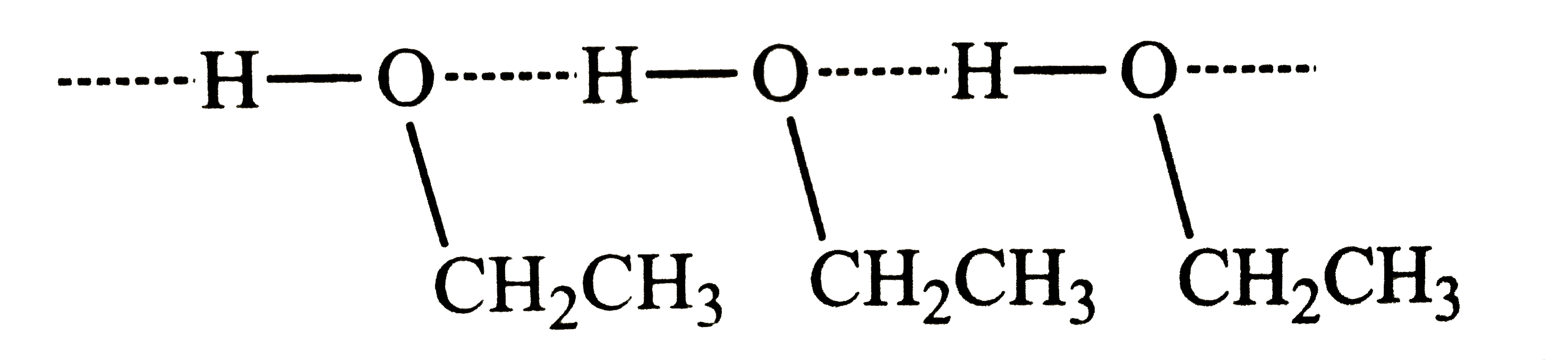 Consequently, a large amount of energy is required to break these hydrogen bonds. therefore, the boiling point of ethanol is higher than that of methoxymethane which does not FORM H-bonds. |
|
| 7. |
Give reason for the higher boiling point of ethanol in comparison the methoxymethane. |
|
Answer» Solution :Ethanol UNDERGOES intermolecular H - bonding due to the presence of a hydrogen attached to the electronegative oxygen ATOM. As a RESULT, ethanol exists as associated molecules. `{:("- - - - -"H-O"- - - - -"H-O"- - - - -"H-O"- - - - -"),("\\\"),(""CH_(2)CH_(3) ""CH_(2)CH_(3)""CH_(2)CH_(3)):}` Consequently, a large amount of energy is REQUIRED to BREAK these hydrogen bonds. Therefore, the boiling point of ethanol is highter than that of methoxymethane which does not from H - bonds. |
|
| 8. |
Give reasonfor the following : Variations in the radii of transition elements are not as pronouced asthose of representative elements. |
| Answer» SOLUTION :As we PROCEED along a transition series,the nuclea charge increase which trends to decrease thesize but the additoin of electrons in the d-subshell increases the SCREENING effect which tend STO counter balance the effect of the increased nuclear charge. | |
| 9. |
Give reason for the following : Sugar gets charred on addition of concentrated sulphuric acid. |
|
Answer» Solution :Conc. `H_2SO_4` is dehydrating agent. Sugar gets DEHYDRATED and sugar charcoal is obtained which is of black colour. `underset("SUCROSE")(C_(12)H_(22)O_(11)) overset( Conc. H_2SO_4) to underset("Sugar charcoal ")(12C) + underset("Water ")(11H_2O)` |
|
| 10. |
Give reason for the following: PH_3 is a weaker base than NH_3 |
| Answer» Solution :Both the molecules are pyramidal in shape and contain a LONE pair of electrons on P and N. Phosphorus being bigger in SIZE, ELECTRON density is SMALLER and, therefore, it is a weaker base than AMMONIA. | |
| 11. |
Give reason for the following : Oxygen has less electron gain enthalpy with negative sign than sulphur. |
| Answer» Solution :DUE to SMALL SIZE and high ELECTRON density, the added electron suffers some repulsion. Therefore, it has less electron gain enthalpy with NEGATIVE sign than sulphur. | |
| 12. |
Give reason for the following : PbCl_(4) is more covalent than PbCl_(2). |
| Answer» Solution :Due to high oxidising power, halogens combine directly with most metals to FORM their corresponding halides . But if the metal exhibit more than one oxidation STATES the halide in higher oxidation state will be more covalent than the one in LOWER oxidation state. Therefore `PbCl_(2)` is more covalent than `PbCl_(2)` because Pb exhibits more than one oxidation states . | |
| 13. |
Give reason for the following Mesasurenent of osinotic pressure method is preferred for thedetermination of molar masses of macmolecules such as proteins and polymers. |
| Answer» Solution :As compared to other colligative properties, its magnitude is large EVEN for very dilute solutions/ macromolecules are generally not stable at higher temperatures and POLYMERS have poor solubility / PRESSURE measurement isaround the ROOM temperature and the molarity of the solution is usedinstead of molality. | |
| 14. |
Give reason for the following : (i) (CH_(3))_(3)C-O-CH_(3)underset("ether")overset('Anhydrous HI")(rarr) CH_(3)I+(CH_(3))_(3)COH (ii) (CH_(3))_(3)C-O-CH_(34)overset(HI(aq.))(rarr)(CH_(3))_(3)Cl+CH_(3)OH (iii) Ethers possess a net dipole moment even if they are symmetrical in structure. (iv) Dimethyl ether is completely miscible with water but diethyl ehter is soluble in water to a small extent. (v) The C-O-C bond angle in ether is higher than H-O-H angle in water though oxygen is sp^(3)- hybridized in both these cases. (vi) Why are ethers relativelyinert compounds ? |
Answer» SOLUTION :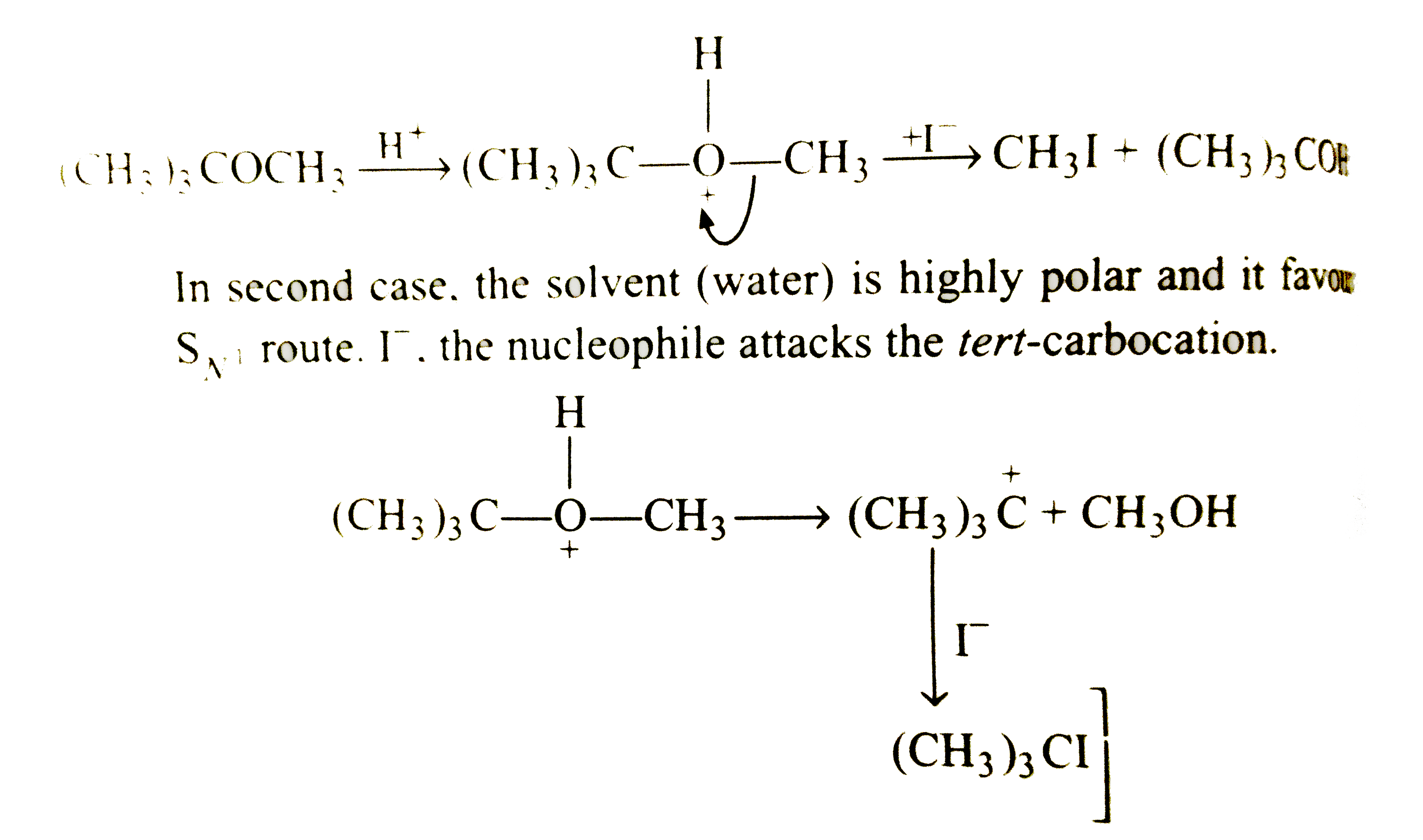
|
|
| 15. |
Give reason for the following in one or two sectences : 'Dimethyl amine is a stronger base than trimethyl amine' |
| Answer» Solution :DUE to steric hindrance in trimethyl AMINE . The availability for DONATION of LINE pair of electrobn by atom decreases . In sptit of more `(+I)` inductive effect of `(- CH_3)` group, | |
| 16. |
Give reason: Why Lanthanoids are less reactive than actinoids. |
| Answer» Solution :Because lanthanoids have LESS SRP (STANDARD Reduction POTENTIAL) value than Actinoids, therefore they areless reactive. | |
| 17. |
Givereason for the following (i) compoundsof transition elementaregenerallycoloured. (ii) MnO isbasicwhile Mn_(2) O_(7) is acidic (iii) Calculatethe magneticmoment adivalention inaqueousmedium if its atomicnumberis 26. |
|
Answer» Solution :(i) The colourof TE transitionelementisdue TOTHE d-d transition (ii) Sincethe oxidationstateandpolarisingpowerof Mn in `Mn_(2)O_(7)`is higher it isacidicin nature `(iii) = mu = sqrt(N(n + 2)) = sqrt( 4(4+2))` `= 4.90 BM` |
|
| 18. |
Give reason for the following: (i) Copper displaces silver from silver nitrate solution. (ii) Iron pipes are usually, coated with zinc. |
|
Answer» SOLUTION :(i) Copper lies above silver in the ELECTROCHEMICAL SERIES, i.e., copper is more active than silver. (ii) This is done to protect iron PIPES from rusting because zinc is more electropositive than iron. |
|
| 19. |
Give reason for the following. Brownian movement of colloidal particles. |
|
Answer» Solution :(i) The reason for the Brownian MOVEMENT of colloidal particles is the collisions of the CONSTANTLY movingdispersion medium particles. During COLLISION, colloidal particles ACQUIRE kinetic energy. Due to larger sizecompared to dispersion medium particles, colloidal particles move slowly in a zig-zag manner. (ii) The reason for the stability of colloids is the presence of equal and similar charges on the colloidal particles. The repulsive forces between charged particles having same charge prevent them from aggregatingwhen they come closer to one another. (III) The movement of colloidal particles towards cathode is due to the presence positive charges on thecolloidal particles. |
|
| 20. |
Give reason for the following : (i) Amino acids have high melting points and are soluble in water. (ii) What is meant by the secondary structure of proteins ? |
|
Answer» Solution :(i) `alpha`-Amino acids contain both an acidic carboxyl group and a BASIC amino group. These two GROUPS neutralize each other. As a result, `alpha`-amino acids largely exist as dipolar ions or zwitterions. `NH_(2)-underset(R)underset(|)CH-COOHhArroverset(+)NH_(3) -underset("Zwitterion")underset(R)underset(|)(CH)-COO^(-)` Due to dipole interactions , the molecules of `alpha`-amino acids are HELD together by STRONG forces of attraction and hence amino acids have hight melting points. Further , due to strong interactions between the `+ve` and `-ve` poles of `alpha`-amino acids with molecules , `alpha`-amino acids are moderately soluble in water. (ii) Secondary structure of proteins refers to the conformation or the shape which the polypeptide chains Assume as a result of H-bonding . there are two types of secondary structures of proteins. These are `alpha`-helix and `beta`-PLEATED sheet structure. |
|
| 21. |
Givereason for thefollowing : (i) A transitionmetalexhibits highestoxidation statein oxidesfluories . (ii) Cu^(2+) is unstablein anaqueoussolution. |
|
Answer» SOLUTION :(i) Thehighestoxidationstatein oxidesandflouridesis DUETO smallsize and highelectronegativityof and O (ii)Many`Cu^(+)` compounds areunstablein aqueoussolutionand undergodisproportionation . `2Cu toCu^(2+)+ Cu` Thissuggestthat in aqueoussolution`Cu^(+) ` convertsinto `Cu^(2+)` . whichis dueto muchmorenegative `Delta _(HYD) H^(-)` of `Cu^(2-)` then `cu^(2+)` whichcompensatesmore forthesecondionisationenthalpyof Cu. |
|
| 22. |
Give reason for the following : F_(2) is more reaction than ClF_(2) but ClF_(3) is more reactive than Cl_(2). |
|
Answer» (II) While Cl-F BOND in `ClF_(3)` is weaker than Cl-Cl bond in `Cl_(2)` therefore, `ClF_(3)` is more reactive than `Cl_(2)`. (iii) So these graphite rods are consumed slowly and need to be REPLACED from time - to - time. |
|
| 23. |
Give reason for the following : H_3PO_2 is a stronger reducing agent than H_3PO_3. |
| Answer» Solution :In `H_3PO_2`, two HYDROGEN atoms are directly LINKED to P and are READILY AVAILABLE for reduction. | |
| 24. |
Give reason for the following : F_(2) is more reactive than CIF_(3) but CIF_(3) is more reactive than Cl_(2). |
| Answer» SOLUTION :Due to the small size of flourine, it has high ELECTRONEGATIVITY and low bond energy so it is more reactive than CIF ,. But `CL - Cl` bond energy is higher than `Cl – F` bond . Therefore `CIF_(3)`is more reactive than `Cl_(2)`. | |
| 25. |
Give reason for the following : (CH_3)_3P=O exists but (CH_3)_3N=O does not. |
| Answer» Solution :N does not possess d-orbitals. The maximum covalency that it can SHOW is three. THUS, it cannot link with three methyl groups along with O to form `(CH_3)_3 N=O`. On the other hand P with the help of d-orbitals can EXPAND its covalency and form `(CH_3)_3P=O`. | |
| 26. |
Give reason for the following: Among the noble gases only xenon is well known to form chemical compounds. |
| Answer» SOLUTION : Xenon has the largest atomic SIZE and the SMALLEST IONISATION enthalpy of all the noble GASES. | |
| 27. |
Give reason for the following Aquatic snimals are comfortable in colt water than in wam water |
| Answer» SOLUTION :Because oxygen is more soluble in cold WATER or at low TEMPERATURE | |
| 28. |
Give reason for the following. Among the noble gases only Xenon is well known to form chemical compounds? |
| Answer» SOLUTION :Xe is LARGEST in size and has the HIGHEST POLARIZING power. | |
| 29. |
Give reason for the following : All five bonds in PCl_5 molecule are not equivalent. |
| Answer» Solution : `dsp^(3)` hybridisation of orbital takes place in `PCl_5`GIVING rise to trigonal bipyramidal shape. All the BONDS are not in same PLANE. Axial bonds are longer than equatorial bonds due to more repulsion in the former. | |
| 30. |
Give reasons: Actinoids show variable oxidation states. |
| Answer» SOLUTION :5f-6d-and 7s-subshells of Actinoids have COMPARABLE energies. As a result one or more electrons from 5fsubshell also PARTICIPATES in bonding. HENCE actinoids shows VARIABLE oxidation state. | |
| 31. |
Give reason for, ''The colour of mercurous chloride, Hg_(2)Cl_(2), changes from white to black when treated with ammonia.'' |
| Answer» | |
| 32. |
Give reason for the difference in the following: Reactivity of nitrogen and phosphorus. |
| Answer» SOLUTION :There is triple bond `(N -= N)` in nitrogen which has high bond DISSOCIATION energy. In PHOSPHORUS, there is a single bond (P-P) in the molecule of `P_4`. It has a lower bond dissociation energy. | |
| 33. |
Give reason for each of the following: (a) Bleaching of flowers by Cl_(2) is permanent while by SO_(2) is temporary. (b) Molten aluminium bromide is a poor conductor of electricity. (c ) Nitric oxide becomes brown when released in air. (d) PCl_(5) is ionic in nature in the solid state. (e ) Ammonia is a good complexing agent. |
|
Answer» Solution :(a) `Cl_(2)` bleaches by oxidation, while `SO_(2)` does it by reduction. The REDUCED product gets oxidise again and the colour is regained back. (b) Aluminium bromide exists as a dimer, `Al_(2)Br_(6)`. In this structure, each aluminium atom forms one coordinate BOND by accepting a lone PAIR of ELECTRONS from the bromine atom of another aluminiumbromide molecule and thus complete the octet of electrons. Due to lack of free electrons, molten aluminium bromide is a poor conductor of electricity. (c ) Nitric oxide reacts with air and oxidised into `NO_(2)` which is brown in colour. `2NO+O_(2)rarr 2NO_(2)` (d) In solid state `PCl_(5)` exists as `[PCl_(4)]^(+)[PCl_(6)]^(-)` and hence it is ionic in nature. Due to its ionic nature, it conducts current on fusion. (e) N atom in ammonia has lone pair of electrons which can coordinate with other atoms or cations required for the stability of electron pair. |
|
| 34. |
Give reason : Extraction of copper directly from sulphide ores is less favourable than that from its oxide ores through reduction. |
|
Answer» Solution :(i) The standard free energy for the formation of `CuFeS_(2)` (copper pyrites) is GREATER than those of `CS_(2)` and `H_(2)S`. (ii) Hence, `CuFeS_(2)` cannot be reduced by carbon or HYDROGEN. (iii) HOWEVER, the free energy of copper OXIDE is less than that of `CO_(2)` . (IV) That is the reason, extraction of copper is easier from its oxide through reduction. |
|
| 35. |
Give reason equimolar solutions of sodium chloride and glucose do not have the same osmotic pressure. |
|
Answer» SOLUTION :The no. of SOLUTE particles are not the same. OR SODIUM CHLORIDE ionizes but GLUCOSE does not. OR Number of solute particles in NaCl solution is greater than that in glucose. |
|
| 36. |
Give reason ''BrF_(5)Is more reactive than Br_(2)'' |
| Answer» SOLUTION :BR - F BOND is WEAKER than Br - Br bond. | |
| 37. |
Give reason : Amylase present in the saliva becomes inactive in the stomach. |
| Answer» SOLUTION :HCI present in STOMACH DECREASE the PH. | |
| 38. |
Give reason: Ammonia is more basic than aniline. |
| Answer» Solution :AMMONIA is more BASIC than ANILINE because in aniline the lone pair of electrons on NITROGEN are partiallywithdrawn by benzene ring and it becomes DIFFICULT for nitrogen to donate electron pair. | |
| 39. |
Give reason : Acetic acid is soluble in water. |
| Answer» SOLUTION :Due to the formation of hydrogen BOND between ACETIC acid and water. | |
| 40. |
Give reason: (a) Why does an alkaline medium inhibit the rusting of iron. ltBrgt (b) Why does a dry cell become dead after a long time even if it has not been sued. (c) Why is zinc better than tin in protecting iron from corrosion? |
|
Answer» Solution :(a) Rusting of iron takes place in presence of `H^(+)` ions. ALKALINE medium NEUTRALIZES the `H^(+)` ions and thereby inhibits rusting. (b) This is because acidic `NH_(4)Cl` CORRODES the zinc container. (c) Zinc protects iron better than tin because reduction potential of zinc is lower than that of iron but that of tin is higher than that of iron. |
|
| 41. |
Give reason : Acetophenone does not react with saturated sodium bisulphite solution. |
| Answer» SOLUTION :DUE to STERIC HINDRANCE. | |
| 42. |
Give reason (a) Why does an alkaline medium inhibit the rusting of iron ? (b) Why does a dry cell become dead after a long time even if it has not been used ? (c) Why is zinc better than tin in protecting iron from corrosion ? |
|
Answer» Solution :(a) Rusting of IRON takes place in the presence of `H^+`. Alkaline medium neutralises `H^+` ions and inhibits the process of rusting. (b) A dry cell becomes dead after a LONG time even if it has not been used. This is because acidic `NH^4Cl` which is a salt of weak base and STRONG acid, corrodes zinc container. (c) Zinc protects iron from corrosion because reduction potential of `Zn^(2+)` is lower than that of `Fe^(2+)`, but that of `SN^(2+)`is higher than that of `Fe^(2+)` . |
|
| 43. |
Give reason : a) Cerium (Ce) exhibits +4 oxidation state. b) Actinoid contraction is greater from element to element than lanthanoid contraction. |
|
Answer» Solution :a) Attaining extra stability of empty f ORBITAL OR `Ce^(+4)` is FAVOURED by its noble CONFIGURATION OR Stable noble gas configuration of Xenon. (b) Poor shielding by 5f ELECTRONS |
|
| 44. |
Give Reason. Second ionisation enthalpy of copper is exceptionally high. |
| Answer» SOLUTION :`Cu^(+)` ion has COMPLETELY filled ORBITALS more energy is needed to remove second ELECTRONS from STABLE configuration. | |
| 45. |
Give reactsin one two sentence for thefollowin g ''Thehydroxideof aluminumandion areinsoluble in waterHowever,NaOHisused to separate one fromother .'' |
|
Answer» Solution :In NaOH, the hydroxide of AI BECOMES solubledue to theformation of sodium meta-aluminum `AI(OH)_(3) + NaOH rarr NaAIO_(2) + 2H_(2)O` Hydroxide of iron does NOTDISSOLVE in NaOH |
|
| 46. |
Give reason : ( a ) Why is Frenkel defect found in AgCl ? ( b ) What is the difference between phosphorus doped and Gallium doped semiconductors ? |
|
Answer» Solution :(a) Frenkel defect is shown by substances where there is a large difference in the size of ions . In the case of AgCl, there is a large difference in the SIZES of Ag and C ions . Hence , AgCl shows Frenkel defect . Here `Ag^(+)` ions are dislocated from the normal position and are located at interstitial sites . (b) In phosphorus doped semiconductors , phosphorus is linked to say FOUR Si atoms by means of four electrons , the FIFTH electron (P has 5 electrons in the valence shell) is AVAILABLE for conducting electrons . It is an n - type semiconductor . In gallium doped semiconductor , gallium occupies one of the lattice positions . Gallium has only three valence electrons . This creates an electron hole at this position. To compensate this , an electron from the neighbouring Si atom migrates to this Ga atom . This in turn creates an electron hole at the position of Si . This process continues on PASSING electricity. The electron hole (positively charged) moves towards the negatively charged plate . Such semiconductors are called p - semiconductors . |
|
| 47. |
Give reactions of aryl halides with metals. |
Answer» Solution :(i) Wurtz - Fitting reaction : A mixture of an ALKYL HALIDE and aryl halide gives an alkylarene when treated with sodium in dry ether.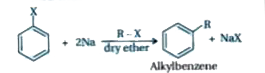 (II) Fitting reaction : Aryl halides also give analogous COMPOUNDS when treated with sodium in dry ether, in which two aryl groups are joined together. 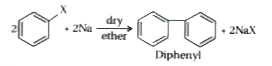 (iii) Grignard reaction : The reaction of aryl halide with magnesium in presence of dry ether gives aryl magnesium halide which is KNOWN as Grignard reagent. 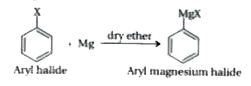
|
|
| 48. |
Give reaction occurred near anode of electrolysis of sulphuric acid in electrolytic cell near inert electrode. |
|
Answer» Solution :* Ionization of `H_(2)SO_(4)` solution : `SO_(4)^(2-)` ions and water are NEAR anode. So, oxidation of either `SO_(4)^(2-)` or `H_(2)O` is possible. `H_(2)SO_(4) to 2H_((aq))^(+)+So_(4(aq))^(2-)` Oxidation of `H_(2)O`: `2H_(2)O_((l)) to O_(2(g))+4H_((aq))^(+)+4E^(-)""E_(cell)^(THETA)=1.23V` * Oxidation of `SO_(4)^(2-)` : Value of `E^(Theta)` of water is less and near anode species with less `E^(Theta)` value get oxidized. so, OXYGEN is produced on oxidation of water near anode. if concentration of `H_(2)SO_(4)` is more than oxidation of `SO_(4)^(2-)` is possible. `2SO_(4(aq))^(2-) to S_(2)O_(8(aq))^(2-)+2e^(-)""E_(cell)^(Theta)=1.96V` |
|
| 49. |
Give R= 8.314 JK^(-1) mol^(-1) the work done duringcombustion of 0.090 kg of ethane(molar mass=30) at 300 K is |
|
Answer» `-18.7 KJ` `DeltaH= n C_(P)DT` `rarr 3W =(0.090)/(30)xx5/2xx8.314xx300` `=18.7 kJ` |
|
| 50. |
Give product in following reactions. |
Answer» SOLUTION : . .
|
|