

Saved Bookmarks
This section includes 7 InterviewSolutions, each offering curated multiple-choice questions to sharpen your Current Affairs knowledge and support exam preparation. Choose a topic below to get started.
| 2. |
give product in following reactions. . |
Answer» SOLUTION :  . .
|
|
| 3. |
Give product in following reaction. . |
Answer» SOLUTION : . .
|
|
| 4. |
Give product in following reaction. . |
Answer» SOLUTION :
|
|
| 5. |
Give uses of Ferric oxide (Fe_2O_3). |
|
Answer» Solution :`Fe_2O_3 + H_2 overset(573K) 2FeO + H_2O` PROPERTIES: (a) It is insoluble in WATER. (b) It is black COLOURED powder. ( c) It is a basic oxide and dissolves in acids to FORM ferrous salts. `FeO(s) + H_2SO_4(AQ) rarr FeSO_4(aq) + H_2O` |
|
| 6. |
Give preparation of potassium permanganate |
|
Answer» Solution :(i) Laboratory preparation: In a laboratory, `KMnO_(4)` can be PREPARED by oxidation of Mn(II) salts by peroxodisulphate `2Mn^(2+) + 5S_(2)O_(8)^(2-) + 8H_(2)O rarr 2MnO_(4)^(-) + 10SO_(4)^(2-) + 16H^(+)` (ii) Commercial preparation: Step-1 Conversion of `MnO_(2)` to potassium manganate. A dark coloured potassium manganate `(K_(2)MnO_(4))` is obtained when `MnO_(2)` is fused with an alkali metal hydroxide in presence of oxidizing agent such as `KnO_(3)`. `2MnO_(2) + 4KOH + O_(2) rarr underset(("Green"))(2K_(2)MnO_(4)) + 2H_(2)O` Step-2 Conversion of `K_(2)MnO_(4) " to " KMnO_(4)` (i) Potassium manganate disproportionates in a neutral or acidic medium to give potassium permanganate `3MnO_(4)^(2-) + 4H^(+) rarr underset(("dark purple"))(2MnO_(4)^(-)) + underset(("Brown ppt"))(MnO_(2) + 2H_(2)O)` The above reaction can also be carried out using a current of `CO_(2), Cl_(2)` OR `O_(3)`. (ii) Electrolytic method: This is the modern method of conversion of potassium manganate to potassium permanganate. It is known as electrolytic oxidation. `MnO_(4)^(-)` is obtained at anode. Anode: `underset(("Green"))(MnO_(4)^(2-)) underset("Oxidation")OVERSET("Electrolytic")rarr underset(("purple"))(MnO_(4)^(-)) + e^(-)` The purple solution of potassium permanganate is evaporated to dryness to get CRYSTALS of potassium permanganate |
|
| 7. |
Give preparation of Phenol from (i) Alkali fusion of Sulphonates and (ii) Cumene. Write its chemical reactions with (i) Acid chloride, (ii) Br_(2)- water and (iii) Methyl chloride. |
Answer» Solution :Preparation of Phenol <BR>  REACTIONS of Phenols with (i) ACID CHLORIDE (ii) `Br_(2)` water  
|
|
| 8. |
Give preparation of phosphine (PH_3). |
|
Answer» Solution :Phosphine is prepared by the reaction of calcium phosphide with water or dilute HCl. `Ca_(3)P_(2) + 6H_(2)O to 3Ca(OH)_(2) + 2PH_(3)` `Ca_(3)P_(2) + 6HCl to 3CaCl_(2) + 2PH_(3)` In laboratory, it is prepared by heating white phosphorous with CONCENTRATED NaOH solution in an inert atmosphere of `CO_(2)` `P_(4) + 3NaOH + 3H_(2)O to UNDERSET("Sodium hypophosphite")(PH_(3) + 3NaH_(2) + PO_(2))` When pure, it is non inflammable but becomes inflammable owing to presence of `P_2H_4` or `P_4` vapours. To purify it from the impurities it is absorbed in HI to form phosphonium iodide (`PH_4I`) which on TREATMENT with KOH gives off phosphine: `PH_(4)I + KOH to Kl + H_(2)O + PH_(3)` |
|
| 9. |
Give preparation of potassium dichromate and state its uses |
|
Answer» Solution :Preparation: The yellow coloured sodium CHROMATE is obtained by FUSION of chromite ore `[FeCr_(2)O_(4)]` with sodium carbonate in free access of air `4FeCr_(2)O_(4) + 8Na_(2)CO_(3) + 7O_(2) rarr 8Na_(2) CrO_(4) + 2Fe_(2)O_(3) + 8CO_(2)` The yellowcoloured solution of sodium chromate is filtered and acidified with sulphuric acid to GIVE a solution from which orange sodium dichromate `Na_(2)Cr_(2)O_(7). 2H_(2)O` ca be crystallized out `2Na_(2)CrO_(4) + 2H^(+) rarr Na_(2)Cr_(2)O_(7) + 2Na^(+) + H_(2)O` Sodium dichromate is more soluble than potassium dichromate. The latter is therefore PREPARED by treating the solution of sodium dichromate with potassium chloride. `Na_(2)Cr_(2)O_(7) + 2KCl rarr K_(2)Cr_(2)O_(7) + 2NaCl` |
|
| 10. |
Give preparation of phenol from chloro benzene |
Answer» Solution :In this method, the chlorobenzene is FUSED with 6-8 % AQUEOUS NAOH solution at 623 K and 320 atmospheric pressure. The product obtain is SODIUM phenoxide acidification of which produces phenol. 
|
|
| 11. |
Give preparation of phenol from benzene sulphonic acid and benzene diazonium chloride. |
Answer» Solution :(i) From benzenesulphonic acid : Benzene is sulphonated with oleum and benzene sulphonic acid so formed is converted to SODIUM phenoxide on heating with molten sodium hydroxide. Acidification of the sodium salt gives phenol.  (ii) From benzene diazonium salt : A diazonium salt is formed by treating an aromatic primary amine with nitrous acid (`NaNO_(2)` + HCl) at 273-278 K. Diazonium salts are HYDROLYSED to phenols by WARMING with water or by treating with dilute acids. 
|
|
| 12. |
Give preparation of Nitric acid. |
|
Answer» Solution :Laboratory preparation : In laboratory, nitric acid is prepared by heating `KNO_3` or `NaNO_(3)` and concentrated `H_2SO_(4)` in a glass retort. `NaNO_(3) + H_(2)SO_(4) to NaHSO_(4) + HNO_(3)` Industrial preparation (Ostwald.s process) : This method is based upon the CATALYTIC oxidation of `NH_3` by atmospheric oxygen. `4NH_(3)(g) + underset("From air") (5O_(2)(g)) overset("Pt//Rh gauge catalyst") underset("500 K, 9 bar") to 4NO_(g) + 6H_(2)O(g)` Nitric oxide THUS formed combines with oxygen giving `NO_(2)` `2NO(g) + O_(2)(g) `3NO_(2)(g) + H_(2)O(l) to 2HNO_(3)(aq) + NO(g)` NO thus formed is recycled and the aqueous HN03 can be concentrated by distillation UPTO 68% by mass. Further concentration to 98% can be ACHIEVED by dehydration with cone. `H_2SO_(4)`. |
|
| 13. |
Give preparation of haloalkanes from hydrocarbons. |
|
Answer» Solution :(i) From alkanes by free radical halogenation : Free radical chlorination or bromination of alkanes gives a complex mixture of isomeric mono - and polyhaloalkanes, which is difficult to separate as pure compounds. Consequently, the yield of any single compound is LOW. `CH_(3)CH_(2)CH_(2)CH_(3)overset(Cl_(2)//Delta)underset(" or UV light ")rarr underset("2-Chlorobutane (55%)")(CH_(3)CHClCH_(2)CH_(3))+underset("1-Chlorobutane (45%)")(CH_(3)CH_(2)CH_(2)CH_(2)Cl)` (ii) From alkenes : Alkyl halides can be prepared from alkenes by addition of hydrogen acids such as HCl, HBr and HI. `underset("ETHENE")(H_(2)C)=CH_(2)+HI to underset("Iodoethane")(CH_(3)CH_(2)I)` In case of unsymmetrical alkenes, the addition takes place by Markovnikov.s RULE. `underset("Prop-1-ene")(CH_(3)CH=CH_(2))overset(+HI)rarr underset("(major)")underset("2-iodopropane")(CH_(3)CHICH_(3))+underset("(minor)")underset("1-iodopropane")(CH_(3)CH_(2)CH_(2)I)` However, if the peroxide `(R_(2)O_(2))` is present, the REACTION takes place contrary to Markovanikov.s rule. This is known as Kharasch effect. `underset("Prop-1-ene")(CH_(3)-CH=CH_(2)+HBr)overset((C_(6)H_(5)CO)_(2)O_(2))rarr underset("1-Bromopropane")(CH_(3)CH_(2)CH_(2)Br)` In the laboratory, addition of BROMINE in `C Cl_(4)` to an alkene resulting in discharge of reddish brown colour of bromine constitutes an important method for detection of double bonds in a molecule. The addition results in the synthesis of (vic -dibromides which are colourless) vicinal dihalides. `underset("Ethene")(H_(2)C)=CH_(2)+Br_(2)overset(C Cl_(4))rarr underset("1,2-dibromoethane")(underset("Br ")underset("|")(CH_(2))-underset("Br ")underset("|")(CH_(2)))` |
|
| 14. |
Give preparation of dinitrogen (N_(2)). |
|
Answer» Solution :(i) Commercial preparation : Commercially DINITROGEN is produced by liquefaction and fractional distillation of air. Liquid dinitrogen (b.p. 77.2K) distills out FIRST leaving behind liquid oxygen (b.p. 90K). (ii) Laboratory preparation : In the laboratory, dinitrogen is prepared by TREATING an aqueous solution of ammonium chloride with SODIUM nitrite. `NH_4Cl(aq) + NaNO_(2)(aq) to NaCl(aq) + N_2(g) + 2H_(2)O`(/) `(NH_(4))_(2)Cr_(2)O_(7) overset(Delta) to N_(2) + 4H_(2)O + Cr_(2)O_(3)` `Ba(N_(3))_(2) overset(Delta)to Ba + 3N_(2)(g)` `2NaN_(3) overset(Delta) to 2Na + 3NH_(2)(g)` From metal azide very pure dinitrogen is obtained. |
|
| 15. |
Give preparation of haloarenes from amine compounds. |
Answer» Solution :(i) Diazotization : When a primary aromatic amine, DISSOLVED or suspended in cold aqueous mineral acid, is treated with SODIUM nitrite, a diazonium salt is formed. The reaction is known as diazotization.<BR>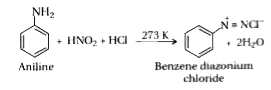 (ii) Sandmeyer.s reaction : Mixing the solution of freshly prepared diazonium salt with cuprous chloride or cuprous bromide results in the replacement of the diazonium group by - Cl or - Br. 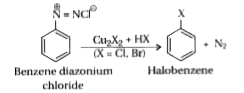 (III) Iodide product : Replacement of the diazonium group by iodine does not required the presence of cuprous halide and is done simply by SHAKING the diazonium salt with potassium iodide. 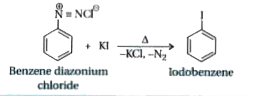
|
|
| 16. |
Give preparation of ethers from alcohols. |
Answer» Solution :In the presence of protic acids such as `H_(2)SO_(4)` or `H_(2)PO_(4)`, the alcohol dehydrates to form either alkene or ether depending upon the reaction CONDITIONS. For example, ethanol is dehydrated to ethene in the presence of sulphuric acid at 443 K and at 413 K, ethoxyethane is obtained.  The formation of ether is a nucleophilic bimolecular substitution reaction (`S_(N)2`) involving the attack of alcohol molecule on a protonated alcohol. The reaction takes place as follows:  Order of dehydration of alcohols to form ethers : `1^(@) gt2^(@) gt3^(@)` `to`Limitations of the method : `to` (i) The method is suitable for the preparation of ethers having primary ALKYL groups only. The alkyl group should be UNHINDERED, and the temperature of the reaction must be low OTHERWISE the alkene will be formed in major proportion. If the alcohol is secondary or tertiary, the elimination favours over substitution and as a result, alkene will be obtained as a major product. `to` (ii) The method is not suitable for the preparation of unsymmetrical ethers (mixed ethers). This is because of combination of two different alcohols that would result in the formation of mixture of three ethers which are not easy to separate. For example, the ethyl methyl ether cannot be prepared by this method. |
|
| 17. |
Give preparation of aryl halides from aromatic hydrocarbons. |
Answer» Solution :Haloarenes are obtained by the electrophilic substitution reactions of arenes. Aryl chlorides and Aryl bromides are prepared by chlorination and bromination respectively in presence of Lewis acid catalysts like iron or iron (III) chloride.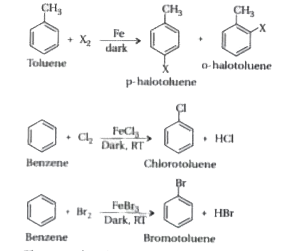 The o - and p - isomers can be easily separated due to large difference in their melting points. Reactions with iodine are REVERSIBLE in nature and required the presence of an oxidiing agent such as `HNO_(3)` or `HIO_(4)` to oxidise the HI formed during iodination. `5HI+HIO_(3)to 3I_(2)+3H_(2)O` 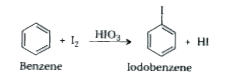 Fluoroarenes are not prepared by this METHOD because of HIGH REACTIVITY of fluorine is difficult to control. |
|
| 18. |
Give preparation of ammonia. |
|
Answer» Solution :Ammonia is present in small quantities in air and soil where it is formed by the decay of NITROGENOUS organic matter e.g. urea. `H_(2)N -underset(O)underset(||)C - NH_(2) + 2H_(2)O to (NH_(4))_(2)CO_(2) `2NH_(4)Cl + Ca(OH)_(2)to 2NH_(3) +2H_(2)O + CaCl_(2)` `(NH_(4))_(2)SO_(4) + 2NaOH to 2NH_(3) + 2H_(2)O + Na_(2)SO_(4)` On large scale, ammonia is manufactured by Haber.s process `N_(2)(g) + 3H_(2)(g) 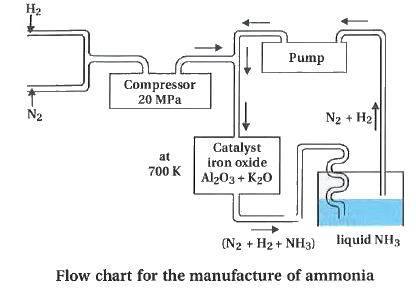 |
|
| 19. |
Give preparation of alcohols from aldehydes and ketones. |
|
Answer» Solution :`to` The alcohols can be prepared from aldehyde and ketones by : `to` (i) REACTION with the Grignard reagent (R - MgX) : By this method, all three types of alcohols i.e., primary, secondary and tertiary alcohols can be prepared. Methanal always produces primary alcohol, aldehyde except methanal produces secondary alcohols whereas ketone always produces tertiary alcohols.  Mechanism of the reaction : The first step of the reaction is the NUCLEOPHILIC addition reaction of Grignard reagent to the carbonyl group to form a tetrahedral intermediate. The hydrolysis of intermediate produces alcohols.  (ii) REDUCTION of aldehydes and ketones : In a PRESENCE of reducing agents such as `LiAlH_(4) //H_(2)O [LAH]` or `NaBH_(4)//H_(2)O` or by addition of `H_(2)` in presence of finely divide metals such as Pt or Pd or Ni (Catalytic hydrogenation), the aldehyde and ketone reduces to alcohols. The reduced product of aldehyde is primary alcohol and that of ketone is a secondary alcohol. `RCHO + H_(2) overset(Pd)to RCH_(2)OH` `RCOR. overset(NaBH_(4))to R -underset(OH)underset(|)CH- R.` |
|
| 20. |
Give possible explanation for the following : (ii) There are two - NH_2 groups is semicarbazide . However, only one is involved in formation of semi carbonzone. |
Answer» Solution :Only one - `NH_2` group attached to `C=O` is INVOLVED in reasonance . As result electron DENSITY on these `NH_2` group decreases and hence does not act as NUCLEOPHILE.  . .
|
|
| 21. |
Give plausiblereasonsforthefollowing: (i) Purealumina isabadconductorof electricity. To makeit conducting, twosubstances (X)and(Y) are added to moltenaluminabeforecarryingoutelectrolysis usingcarbonelectrodes. Why arecarbonelectrodes preferredover metalelectrodes ?(ii) Duringelectrolysis, thesurfaceofthemoltenelectrolyte iscovered witha substance (Z). Identify the substances (X),(Y) and(Z) and explaintheirfunctions. |
|
Answer» SOLUTION :(i) Al hasa verystrongaffinity for oxygen. The ENTHALPY offormationof aluminais-1670 kJ `mol^(-1) ` , higher(more negative) thanpractically all othermetaloxides.Consequently, all the electronsare firmly heldandhenceit isbadconductor ofelectricity. (ii)The TWOSUBSTANCES usually addedto moltenaluminato makeit conductingare:cryolite(X),`Na_3 AlF_ 6`and FLUORSPAR(Y),`Ca F _ 2 `. Boththese subtancesincreasethe conductivity of thesolutionby converting` Al_ 2O _3`into` AlF_ 3`as shownbelow : ` ""Ca F_ 2hArr Ca^(2+)+2 F^(-) ` `"" Na_ 3AlF_6hArr3 Na^(+) +AlF_ 3+3 F^(-) ` At anode.`F^(-)`ionslose electronsto the electrode producingF atoms. Theatomic F thenreactswith`Al_ 2O _ 3`toform` AlF_3 andO _ 2` `""F^(-)toF+e ^(-),2Al_ 2O_ 3+12 F to4AlF_ 3+3O_ 2` The` O _ 2`thusproduced,oxidisescarbonof anode to`CO_ 2` As aresult,consumption oftheanodeoccurs. Becauseof this,theanodeshavetoreplaced fromtime to time.Sincecarbonischeaperthanany metal, THEREFORE,carbonelectrodesare preferred. (iii)Further duringelectrolysis,the surfaceof the electrolyteiscovered withcoke(Z) topreventoxidationand lossofheaddue to radiation. |
|
| 22. |
Give possible explanation for the following : (i) Cyclohexanone forms cyanohydrins in good yield but 2,2,6 trimethyl-cyclohexanone does not . |
Answer» SOLUTION :DUE to steric HINDRANCE for `CN^(-)` at `C=O` and not of 3-methyl groups at `alpha`-position but in case of  . .
|
|
| 23. |
Give plausible explanation for each of the following : Why are aliphatic amines stronger bases than aromatic amines ? |
| Answer» Solution :The electron pair on N in aromatic AMINE is delocalised due to resonance with benzene ring. Electron density on N decreases and consequently the basicity of amine falls. In contrast, alkyl group in ALIPHATIC amine is electron repelling (+I). It increases electron density on N and, THEREFORE, increases the basicity of the amine. In other words, aliphatic amines are STRONGER bases than aromatic amines. | |
| 24. |
Give plausible explanation for each of the following : Why do primary amines have higher boiling points than tertiary amines ? |
Answer» Solution :Due to the presence of two H-atoms on N-atom of PRIMARY amines, they undergo extensive intermolecular H-bonding resulting in ASSOCIATION while tertiary amines due to the absence of a H-atom on the N-atom, do not undergo H-bonding. As a result, primary amines have HIGHER boiling points than tertiary amines of comparable MOLECULAR masses.  `""R-UNDERSET(underset(R)(|))overset(overset(R)(|))(N)"No H-bonding"` |
|
| 25. |
Give plausible explanation for each of the following : Why ae amines less acidic than alcohols of comparable molecular masses ? |
|
Answer» SOLUTION :Loss of a proton from an amine gives an amide ion while loss of a proton from alcohol gives an alkoxide ion as shown below : `""underset("Amine")(R-NH_(2)) rarr underset("Amide ion")(R-NH^(-)+H^(+)` `""R-O-H rarr underset("Alkoxide ion")(R-O^(-)+H^(+))` Since O is more ELECTRONEGATIVE than N, therefore, `RO^(-)` can accomodate the -ve charge more easily than the `RNH^(-)`. In other words, `RO^(-)` is more stable than `RNH^(-)`. Thus, alcohols are more ACIDIC than AMINES. Conversely, amines are less acidic than alcohols. Alternatively :  Oxygen being more electronegative than nitrogen, pulls the electrons with a greater force causing release of protons. |
|
| 26. |
Give plausible explanation for each of the following: (i) Why are amines less acidic than alcohols of comparable molecular masses? (ii) why do primary amines have higher boiling point than than tetiary amines? (iii) Why are aliphatic amines stronger bases than aromatic amines? |
|
Answer» Solution :(i) It is because `C_(2)H_(5)O^(ϴ)` is more stable than `C_(2)H_(5)NH^(ϴ)` because oxygen is more electronegative than nitrogen. (ii) Due to the presence of two H-atioms on N-atom of primary amines, they undergo extensive intermolecular H-bonding while tertiary amines due to the absence of a H-atoms on the N-atom do not undergo H-bonding. As result, primary amines have higher boiling pont tan tertiary amines of camparable molecular MASSES. (iii) It is because there is electron withdrawing `C_(6)H_(5)` GROUP in aromatic amines which makes them less basic than aliphatic amines in whcih ALKYL group is electron releasing. |
|
| 27. |
Give plausible explanation for each of the following: (i) Cyclohexanone forms cyanohydrin in good yield but 2,2,6-trimethylcyclohexanone does not. (ii) there are two -NH_(2) groups in semicarbazide. However, only one is involved in the formation of semicarbazone. (iii) during the preparation of esterns from a carboxylic acid and an alcohol in the presence of an acid catalyst, the water or the ester formed should be removed as soon it is formed. |
Answer» Solution :(i). 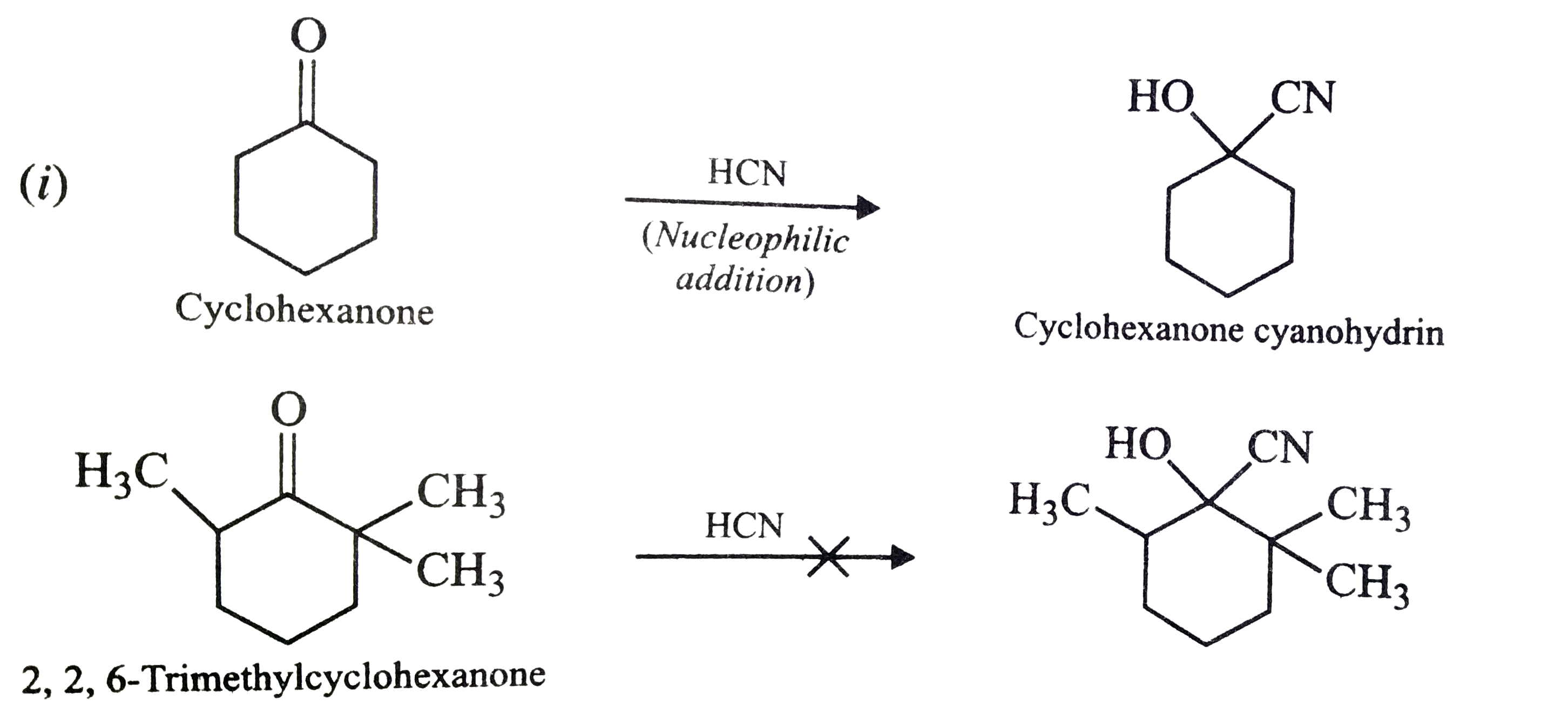 Because of the presence of three methyl groups at `alpha`-positions w.r.t. the C=O groups, the nucleophilic attack by `CN^(-)` ion does not occur due to steric HINDRANCE. Since there is no such steric hindrance in cyclohexanone, therefore, nucleophilic attach by the `CN^(-)` ion occurs readily and hence cyclohexanone CYANOHYDRIN is obtained in good yield. (ii).  Although semicarbazide has two `-NH_(2)` groups but one of them (ie.., which is directly attached to C=O) is involved in resonance as shown above. as a result, electron density on this `NH_(2)` group decreases and hence it does ot act as a nucleophile. in contrast, the lone pair of electrons on the other `NH_(2)` group (i.e., attached to NH) is not involved in resonance and hence is AVAILABLE for nucleophilic attack on the C=O group of aldehydes and ketones. (iii) The FORMATION of esters from a carboxylic acid and an alcohol in presence of an acid catalyst is a reversible reaction. `underset("Carboxylic acid")(RCOOH)+underset("Alcohol")(R'OH) overset(H_(2)SO_(4))hArr underset("Ester")(RCOOR')+H_(2)O` To shift the equilibrium in the forward direction, the water or the ester formed should be removed as fast as it is formed. |
|
| 28. |
Give plausible explanation for each of the following (i) Cyclohexanone forms cyanohydrin in good yield but 2, 2, 6-trimethylcyclohexanone does not. (ii) There are two - NH_3, groups in semicarbazide. However, only one is involved in the formation of semicarbazones. (iii) During the preparation of esters from a carboxylic acid and an alcohol in the presence of an acid catalyst, the water or the ester should be removed as soon as it is formed |
Answer» Solution :(i)  Nucleophilic attack by the `CN^(-)` ion does not occur in reaction II due to steric hindrance. There is no such steric hindrance in cyclohexanone, therefore, nucleophilic attack by the `CN^-` ion occurs readily and hence cyclohexanone cyanohydrin is obtained in good yield. (ii)  Lone pair of electrons on the -NH, group ATTACHED directly to carbonyl group is involved in resonance as SHOWN above. As a result, electron density on this NH group decreases and hence it does not act as a nucleophile. However, the lone pair of electrons on the other NH group (ie, attached to NH) is not involved in resonance and hence is available for nucleophilic attack on the C =0 group. (III) The formation of esters from a carboxylic acid and an alcohol in presence of an acid catalyst is a reversible reaction. `underset("Carboxylic acid")(RCOOH) + underset("Alcohol")(ROH) overset(H_(2)SO_(4)) |
|
| 29. |
Give plausible explanation for each of the following . (i) Why are amines less acidic than alcohols of comparable molecular masses ? (ii) Why have primary amines higher boiling points than tertiary amines. (iii) Why are aliphatic amines stronger bases than aromatic amines ? |
|
Answer» Solution :(i) Loss of proton from amines gives alkyl amide ION whereas loss of a proton from alcohol gives an alkoxide ion. `underset("Amine")(RNH_2) to underset("Alkylamide")(RNH^(-)) + H^(+)` `underset("Alcohol")(ROH) to underset("Alkoxide ion")(RO^(-)) + H^+` Since O is more electronegative than `N_1` therefore , `RO^(-)` can accommodate the -ve CHARGE more easily `RNH^(-)` . Consequently , `RO^(-)` is more stable than `RNH^(-)` . Thus, alcohols are more acidic than amines. (ii) Primary amines `(RNH_2)` have two hydrogen atoms on the N atom and therefore, form INTERMOLECULAR hydrogen bonding.  Tertiary amines `(R_3N)` do not have hyrogen atoms on the N atom and therefore, these do not form hydrogen bonds. As a result of hydrogen bonding in primary amines, they have higher boiling points than tertiary amines of comparable molecular mass. For EXAMPLE, b.p. of n-butylamine is 351 K while that of tert-butylamine is 319 K. (iii) Both arylamines and alkyamines are basic in nature due to the presence of lone pair of N-atom . But arylamines are LESS basic than alkylamines . For example, aniline is less basic than ethylamine as shown by `K_b` values : Ethylamine : `K_b = 4.7xx10^(-4)` Aniline : `K_b = 4.2xx10^(-10)` The less basic character of aniline can be explained on the basic of aromatic ring present in aniline. Aniline can have the following resonating structures :  It is clear from the above resonating strucutures that three of these (III, IV and V) acquire some positive charge on N atom. As a result, the pair of electrons become less avilable for protonation . hence, aniline is less basic than ethyl amine in which there is no such resonance. |
|
| 30. |
Give plausible explanation for each of the following: (i) Why are amines less acidic than alcohols of comparable molecular masses? (ii) Why do primary amines have higher boiling points than tertiary amines? (iii) Why are aliphatic amines stronger bases than aromatic amines? |
|
Answer» Solution :(i) LOSS of a proton from an amine gives an amide ion while loss of a proton from alcohol gives an alkoxide ion as shown below: `underset("Amide")(R-NH_(2))tounderset("Amide ion")(R-NH^(-))+H^(+)` `R-O-H to R-O^(-)+H^(+)` Since O is more electronegative than N, therefore, `RO^(-)` can accommodate the -ve charge more easily than the `RNH^(-)` can accommodate the negative charge. In other WORDS, `RO^(-)` is more stable than `RNH^(-)`. thus, ALCOHOLS are more acidic than amines. conversely, amines are less acidic than alchols. (ii). Due to the PRESENCE of two H-atoms on N-atom of primary amines, they undergo extensive intermolecular H-bonding while tertiary amines due to the absence of a H-atom on the N-atom on the N-atom, do not undergo H-bonding. as a result, primary amines have HIGHER boiling points than tertiary amines of comparable molecular masses. for example, boiling points of n-butylamine (b.p. 351 K) is much higher than that of tert-butylamine (b.p. 319K) 
|
|
| 31. |
Give plausible explanation for each of the followin g: (a) Ortho - nitrophenol is more acidic than ortho - methoxyphenol. (b) Alcohols are easily protonated in comparison to phenols. (c ) The relative ease of dehydration of alcohols is tertiary > secondary > primary. |
Answer» Solution :(a)  Nitro group is electron withdrawing. It drawsthe electron pair between `O-H` towards itself. It helps in the RELEASE `H^(+)` ions. Methoxy group is electron-releasing because of lone pai of electrons on O. It does not help in the release of `H^(+)` ion. Therefore, o - nitrophenol is more acidic than o - methoxyphenol. (B) `R-overset(* *)underset(* *)O-H` (b)  The lone pair of electrons on O in phenol is not readily available for protonation, because these electrons are drawn towards the benzene ring through resonance. No such thing happens in alcohols. Therefore, alcohols are easily protonated in comparison to PHENOLS. (c) The first step in the DEHYDRATION of alcohols is formation of carbocation. A tertiary carbocation is more stable than secondary carbocation which is more stable than primary carbocation. Therefore, the relative ease of dehydration of alcohols is : `"tertiary"gt"secondary"gt"primary"` |
|
| 32. |
Give physical and chemical properties of dinitrogen. |
|
Answer» Solution :Physical PROPERTIES : Dinitrogen is colourless, odourless, tasteless and non-toxic gas. NITROGEN atom has two stable isotopes : `""^(14)N`and `""^(15)N` Water solubility is very low (23.2 `cm^(3)` PER litre of water at 273 K and 1 bar pressure) and low freezing and boiling points. Chemical properties : It is inert at room temperature because of high `overset(..)N -= overset(..)N` enthalpy reactivity increases with rise in temperature. At high temperatures, it directiy combines with some metals to form predominantely ionic nitrides and with non-metals to form covalent nitrides. For example: `6Li + N_(2) overset(Delta) to 2Li_(3)N` `3MG + N_(2) overset(Delta) to Mg_(3)N_(2)` It combines with hydrogen at about 773 K in the presence of catalyst to form ammonia. `N_(2)(g) + 3H_(2)(g) overset(773 K) `N_(2)(g) + O_(2)(g) overset(Delta)to 2NO(g)` |
|
| 33. |
Give oxidation state, d - orbital occupation and coordination number of the central metal ion in the given complexes : (1) K_(3)[Co(C_(2)O_(4))_(3)] (2) cis - [Cr(en)_(2)Cl_(2)]Cl (3) (NH_(4))_(2)[CoF_(4)] (4) [Mn(H_(2)O)_(6)]SO_(4) |
Answer» SOLUTION :
|
|
| 34. |
Give one use of quaternary ammonium salts. |
| Answer» SOLUTION :It is used as detergents, e.g., `[CH_(3)(CH_(2)_(15)N(CH_(3))_(2)]^(+)C1^(-1)`. | |
| 35. |
Give one use of cellulose. |
| Answer» Solution :CELLULOSE ACETATE is used in plastics, for WRAPPING films and in NAIL polishes. | |
| 36. |
Give one use of Ziegler Natta catalyst. |
| Answer» SOLUTION :Heterogeneous CATALYSIS or in high DENSITY POLYMERISATION. | |
| 37. |
Give one use each of (i) niobium (ii) tantalum. |
| Answer» SOLUTION :Niobium : Used in Jet engine PARTS. TANTALUM :Used in MAKING analytical weights. | |
| 39. |
Give one test to distinguish whether the given emulsion is oil in water type or water in oil type. |
| Answer» SOLUTION : It can be identified by dilution test. In this method,the emulsion is DILUTED with water. If the emulsion gets diluted with water, this MEANS that water acts as the dispersion MEDIUM and it is an example of oil in water emulsion. If, it is not diluted then oil acts as dispersion medium, it is an example of water in oil emulsion. | |
| 40. |
Give a chemical test to distinguish between ethyl alcohol and methyl alcohol. |
| Answer» SOLUTION :These are DISTINGUISHED by IODOFROM TEST, where ETHYL alcohol gives potive test. | |
| 41. |
Give one test to differentiate[Co(NH_3)_5Cl]SO_4 and [Co(NH_3) _5 SO_4 ]Cl . |
|
Answer» Solution :(a) `[Co(NH_(3))_(5)Cl]SO_(4)rarr [Co(NH_(3))_(5)Cl]^(+2)+SO_(4)^(2-)` (b) `[Co(NH_(3))_(5)SO_(4)]Clrarr[Co(NH_(3))_(5)]^(-)+Cl^(-)` (i) Aqueous solution of (a) gives sulphate ION. When an addition of `BaCl_(2)` solution (a) gives white PRECIPITATE of `BaSO_(4)`. but (b) does not give any precipitate. (ii) Aqueous solution of (b) gives CHLORIDE ion. When an addition of `AgNO_(3)` Solution (b) gives curdy white precipitate of `AgCl`. But (a) does not give any precipitate. |
|
| 42. |
Give one test each to distinguish between: (i) Aqueous solution of acetaldehyde and acetone. (ii) Aqueous solution of phenol and benzoic acid. (ii) Aqueous solution of formaldehyde and acetaldehyde. |
|
Answer» Solution :(i) Add Tolllens. reagent Acetaldehyde `(CH_(3)CHO)` will give silver mirror whereas ACETONE `(CH_(3)COCH_(3))` will not REACT. (ii) Add neutral `FeCl_(3)` solution. Phenol gives VIOLET colour whereas benzoic ACID gives a BUFF coloured ppt. of ferric benzoate. (iii) Add `I_(2)` and NaOH. Formaldehyde will not react whereas acetaldehye `(CH_(3)CHO)` gives yellow precipatate due to the formation of iodoform. |
|
| 43. |
Give one reason to explain why ClF_(3) exists but FCl_(3) does not exist? |
| Answer» Solution :Because fluorine is more electronegative as compared to CHLORINE and has smaller size. THUS, one large `CL` atom can accommodate three smaller F atoms but reverse is not true. | |
| 44. |
Give one reaction to show that phenol is acidic in character. |
| Answer» Solution :TURNS blue LITMUS red or DISSOLVES in NaOH `(C_(6)H_(5)OH+NaOHtoC_(6)H_(5)ON a+H_(2)O)`. | |
| 45. |
Give one reaction to indicatethe presence of acarbonyl group in gluocse. |
|
Answer» Solution :Glucose REACTS with hydroxyl AMINE to FORM an oxime . OR Glucosereacts with hydrgoen cyanide to from a CYANOHYDRIN. |
|
| 46. |
Give one reaction of D-glucose which cannot be explained by its open chain structure. |
| Answer» Solution : Glucose does not GIVE a precipitate with 2,4-DNP reagent although it contains an aldehyde group. SIMILARLY, it does not FORM the hydrogen SULPHATE addition product with `NaHSO_(3)`. | |
| 47. |
Give one reaction each showing the reducing and oxidising power of sulphur dioxide. |
|
Answer» Solution :(1) `SO_(2)`, as a reducing agent : In moist condition, SULPHUR dioxidereduces `FE^(3+)` to `Fe^(2+)` or `Mn^(7+)` in `KMnO_(4)` to `Mn^(2+)`. (a) `2FeCl_(3) + SO_(2) +2H_(2) O to 2FeCl_(2) + H_(2)SO_(4) +2HCl` (b) `2KMnO_(4) + 2H_(2)O + 5SO_(2) to K_(2)SO_(4) + 2MnSO_(4) + 2H_(2) SO_(4)` (2) `SO_(2)` as an oxidising agent : `SO_(2)` oxidises `H_(2)S(S^(2-))` to `S^(0)` or ferrous choride ,`Fe^(3+) Cl_(2)`to FERRICCHLORIDE , `Fe^(3+)Cl_(3)` . `(a) 2H_(2) S + SO_(2) to 2H_(2)O + 3 Sdarr` `(b) 4FeCl_(2) + 4HCl+ SO_(2) to 4FeCl_(3) + 2H_(2) O + Sdarr` |
|
| 48. |
Give one reaction of alcohol involving cleavage of : (i) C – O bond (ii) O – H bond |
|
Answer» SOLUTION :(i) `CH_(3) CH_(2) OH + PCI_(5) to CH_(3) CH_(2) CI + POCI + HCI` (II) `CH_(3) CH_(2) OH + Na to CH_(3) CH_(2) Ona + H_(2)` |
|
| 49. |
Give one point of defference between the following : Antiseptics and Disinfectants |
|
Answer» Solution :Antiseptics and Disinfectants : Antiseptics are applied to living tissues such as WOUNDS, cuts, ulcers and diseased SKIN surfaces Examples are furacine, soframicine. Disinfectants are applied to inanimate OBJECTS such as floors, drainage system, intruments, ETC. A 0.2 to 0.4 ppm aqueous solution of CHLORINE is an example of disinfectants. |
|
| 50. |
Give one point of defference between the following : Tranuilizers and Analgesics |
|
Answer» Solution :Tranquilizers and ANALGESICS : Tranquilizers are a class of chemical compounds used for treatment of STRESS and mild or EVEN severe mental diseases. Analgesics are CHEMICALS that reduce or abolish pain without causing impairment of CONSCIOUSNESS, mental confusion, incoordination or paralysis. |
|