Saved Bookmarks
This section includes 7 InterviewSolutions, each offering curated multiple-choice questions to sharpen your Current Affairs knowledge and support exam preparation. Choose a topic below to get started.
| 2. |
Give examples and suggest reasons for the following features of the transition metal chemistry : (i) The lowest oxide of transition metal is basic, the highest is amphoteric acidic. (ii) A transition metal exhibits highest oxidation state in oxides and fluorides. (iii) The highest oxidation state is exhibited in oxoanions of a metal. |
|
Answer» Solution :(i) The lower oxide of TRANSITION metal is basic because the metal atom has low oxidation state and still has electrons to donate whereas highest is acidic due to highest oxidation state and not LEFT with free electrons. For example. `overset(II)(MnO)` is basic whereas `overset(VII)(Mn_(2)O_(7))` is acidic. (ii) A transition metal exhibits higher oxidation states in oxides and fluorides. This is because oxygen and fluorine are HIGHLY electronegative elements, small in size (and strongest oxidising agents). For example, osmium shows an oxidation states of +6 in `OsF_(6)` and vanadium shows an oxidation state of +5 in `V_(2)O_(5)`. (iii) Oxometal anions have highest oxidation state, e.g., Cr in `Cr_(2)O_(7)^(2-)` and `CrO_(4)^(2-)` have an oxidation state of +6 whereas Mn in `MnO_(4)^(-)` has an oxidation state of +7. This is again due to the combination of the metal with oxygen, which is highly electronegative and oxidising element. |
|
| 3. |
Give examples for non-ideal solution showing negative deviation from Raoult's law. |
|
Answer» Solution :(i) MIXTURE of PHENOL and aniline. (ii) Mixture of CHLOROFORM and ACETONE. |
|
| 4. |
Give examples and suggest reasons for the following features of the transition metal chemistry: (i) The lowest oxide of transition metal is basic, the highest is amphoteric/acidic. (ii) A transition metal exhibits highest oxidation state in oxides are fluorides. (iii) The highest oxidation state is exhibited in oxoanions of a metal. |
|
Answer» Solution :(i) The LOWEST oxide of transition metal is basic because of their ability to get oxidized to higher oxidation states. The HIGHEST oxides of transition metal is acidic or AMPHOTERIC because of their ability to get reduced to lower oxidation states. Ex. MnO is basic, `MnO_(2)` is amphoteric while `Mn_(2)O_(7)` is acidic. (ii) This is because of high electronegative of oxygen and fluorine, the oxides and fluorides of transition metals are stable in highest oxidation states in highest oxidation state. Ex `V_(2)O_(5), Mn_(2)O_(7), OSF_(6)` etc. (iii) This is because of small size and high electronegativity of oxygen, in ADDITION it also has ability to form multiple bonds with a transition elements. As a result, highest oxidation state is exhibited in oxoanions by the metals Ex. `{:(MnO_(4)^(-),CrO_(4)^(2-),VO_(2)^(+),),((+7),(+6),(+5),):}` etc |
|
| 5. |
Give examples and suggest reasons for the following features of the transition metal chemistry. (i) The lowest oxide of transition metal is basic, the highest is amphoteric / acidic. (ii) A transition metal exhibits highest oxidation state in oxides and fluorides. (iii) The highest oxidation state is exhibited in oxoanions of a metal. |
|
Answer» Solution :(i) Acidic strength of oxides increases with the increase in oxidation state of the element e.g. `MnO(Mn^(2+))` is basic whereas `Mn_2O_(7)(Mn^(7+))` is acidic in nature. (ii) Both oxygen and fluorine being highly electronegative can increase the oxidation state of a PARTICULAR transition metal. In certain oxides, the element oxygen is involved in multiple bonding with the metal and this is responsible for the HIGHER oxidation state of the metal. (III) This is also due to HIGH electronegativity of oxygen e.g., chromium exhibits oxidation STATES of +6 in oxoanion `[CrO_(4)]^(2-)` and manganese shows oxidation state of +7 in oxoanion `[MnO_4]^(-)`. |
|
| 7. |
Give example of epimers. |
Answer» SOLUTION :
|
|
| 8. |
Give example of a material used for making semipermeable membrane for carrying out reverse osmosis. |
| Answer» Solution :Material used for making semipermeable MEMBRANE for carrying out reverse OSMOSIS is - ..a FILM of cellulose ACETATE place over a suitable SUPPORT... | |
| 9. |
Give example for the following. (i) Aldotriose (ii) Ketotriose(iii) Aldotetrose(iv) ketotetrose . |
|
Answer» Solution :(i) Aldotriose - Glyceraldehyde . (II)ketotriose- DIHYDROXY ACETONE. (iii) Aldotetrose- Erythrose . (iv) Ketotetrose- ERYTHRULOSE . |
|
| 10. |
Give examplefor the following. (i) Aldo pentose (ii) Keto pentose (iii) Aldohexose(iv) Ketohexose . |
|
Answer» Solution :(i) ALDO pentose - RIBOSE . (II) Keto pentose- Ribulose . (iii) Aldo hexose - Glucose . (IV) Keto hexose- Fructose . |
|
| 11. |
Give example and suggest reasons for the follwing features of the transition metal chemistry : (i) The lowest oxide of transition metal is basic , the highest is acidic. (ii) A transition metal exhibits higher oxidation states in oxides and fluorides. (iii) The highest oxidation state is exhibited in oxo- anions of a metal. |
|
Answer» Solution :(i) The LOWER oxide of transition metal isbasic because the metal atom has LOW oxidation state whereas highest is acidic due to highest oxidation state. For example , `overset(II) (MnO)`is basic whereas `overset(VII)(Mn_(2)O_(7))` is acidic (Refer in page) . In the low oxidation state of metal, some of the valence ELECTRONS of the metal atom are not involved in bonding. Hence, it can donate electrons and behave as a base. In the higher oxidation state, valence electrons are involved in the bondingand are not AVAILABLE. Instead, effective nuclear charge is high. Hence, it can accept electrons and hence behave as acid. (ii) A transition metal exhibits higher oxidation states in oxides and fluorides because oxygen and fluorine are highly electronegative elements, small in size ( and strongest oxidising agents). For example , osmium shows an oxidation states of `+6` in `OsF_(6)`and vanadium shows an oxidation state of `+5` in `V_(2)O_(5)` (III) Oxometal anions have highest oxidation state, e.g., Cr in `Cr_(2)O_(7)^(2-)` or `CrO_(4)^(2-)` has an oxidation state of `+6` whereas Mn in `MnO_(4)^(-)` has an oxidation state of `+7` . This is again due to the combination of the metal with oxygen , which electronegative and oxidizing element. |
|
| 12. |
Give example: (1) a non - nuclephilic anion (2) a planar carbocation (3) an aromatic carbocation (4) an aromatic carbanion (5) a reagent which acts as source of carbanion (6) a reaction which does not proceed through intermediate (7) an aprotic polar solvent (8) an ambident nucleophile (9) a neutral electrophile (10) a group which stabilises a carbocation (11) a group which stabilies a carbanion (12) an alkyl group whcih does not supply electrons to a double bond by hyperconjugation (13) a carbocation which can be stored for years. |
Answer» SOLUTION :
|
|
| 13. |
Give example and suggest reasons for the following features of the transition metal chemistry. (a) The lowest oxide of transition metal is basic, the highest is acidic. (b) A transition metal exhibits higher oxidation states in oxides and fluorides. (c) The highest oxidation state is exhibited in oxoanions of a metal. |
|
Answer» Solution :(a) In lowest OXIDATION state ionic bonds are formed. As such metals in their lowest oxidation state form ionic oxides which are soluble in water, giving `OH^(-)` ions, thus FORIN basic oxides. While in highest oxidation states, transition metals show non-metallic character. Covalent bonds are formed and oxidcs get hydrolysed by water forming ACIDS. (b) Oxygen and fluorine being SMALL in size are strong oxidizing agents and can provide energy for excitation of electrons. Thus transition metal exhibits higher oxidation states in oxides and fluorides. (c) In oxoanions, the highest oxidation state is exhibited because oxygen is a strong oxidizing agent. For example, highest oxidation state in Mn is +7 in `MnO_(4)^(-)` and that of Cr is +6 in `CrO_(4)^(2-)`. |
|
| 14. |
Give evidence that [Co(NH_(3))_(5)Cl]SO_(4)" and "[Co(NH_(3))_(5)SO_(4)]Cl are ionisation isomers. |
|
Answer» Solution :When they are dissolved in water, they will give DIFFERENT ions in the solutionwhich can be TESTED by ADDING `AgNO_(3)` solution and `BaCl_(2)` solution. When `Cl^(-)` ions are the counter ions, a white precipitate will be obtained with `AgNO_(3)` solution. If `SO_(4)^(2-)` ions are the counter ions, a white precipitate will be obtained with `BaCl_(2)` solution. `[Co(NH_(3))_(5)Cl]SO_(4)(aq)+BaCl_(2)(aq) rarr underset(ppt)(BaSO_(4)(s)darr)` `[Co(NH_(3))_(5)Cl]SO_(4)(aq)+AgNO_(3) rarr "No REACTION"` `[Co(NH_(3))_(5)SO_(4)]Cl(aq)+BaCl_(2)(aq) rarr "No reaction"` `[Co(NH_(3))_(5)SO_(4)]Cl(aq)+AgNO_(3)(aq) rarr underset(ppt)(AgCl(s)darr)` |
|
| 15. |
Give evidence that [Co(NH_(3))_(5)Cl]SO_(4) and [Co(NH_(3))_(5)SO_(4)]Cl are ionisation isomers. |
|
Answer» Solution :When they are dissolved in water, they will give different ions in the solution which can be tested by adding `AgNO_(3)` solution and `BaCl_(2)` solution. When `Cl^(-)` ions are the counter ions, a white precipitate will be OBTAINED with `AgNO_(3)` solution. If `SO_(4)^(2-)` ions are the counter ions, a white precipitate will be obtained with `BaCl_(2)` solution `[Co(NH_(3))_(5)Cl]SO_(4)(AQ)+BaCl_(2)(aq)rarr underset(ppt)(BaSO_(4))(s)darr` `[Co(NH_(3))_(5)Cl]SO_(4)(aq)+AgNO_(3)(aq)rarr` No reaction `[Co(NH_(3))_(5)SO_(4)]Cl(aq)+BaCl_(2)(aq)rarr` No reaction `[Co(NH_(3))_(5)SO_(4)]Cl(aq)+AgNO_(3)(aq)rarrunderset(ppt)(AgCl)(s)darr` |
|
| 16. |
Give evidence that [Co(NH_(3))_(5) CI] SO_(4) Clare ionization isomers |
|
Answer» Solution : `[Co(NH_(3))_(5)CI]SO_(4)(aq)+BaCl_(2)(aq)` to`underset(ppL) BaSO_(4)(S)downarrow` `[CO(NH_(3))_(5)CI] SO_(4)(aq) + AgNO_(3)(aq)`to No reaction `[CO(NH_(3))_(5) SO_(4)]CI (aq) + BaCl_(2)(aq)`to No reaction `[CO(NH_(3))_(5) SO_(4)]CL(aq) + AgNO_(3)(aq)to underset(ppt)(AGCL)(S)` |
|
| 17. |
Give equations of the following reactions : Treating phenol with chloroform in presence of aqueous NaOH. |
Answer» SOLUTION :
|
|
| 18. |
Give equations of the following reactions : Oxidation of propan-1-ol with alkaline KMnO_(4) solution. |
| Answer» Solution :`underset("Propan-1-ol")(CH_(3)- CH_(2)- CH_(2)OH )underset(KMnO_(4))overset("ALK.")to underset("Propanoic acid")(CH_(3)CH_(2)COOH+ H_(2)O)` | |
| 19. |
Give equations of the following reactions : (i) Oxidation of propan -1- ol with alkaline KMnO_(4) solution. (ii) Bromine in CS_(2) with phenol. (iii) Dilute HNO_(3) with phenol. (iv) Treating phenol with chloroform in presence of aqueous NaOH. |
|
Answer» Solution :EQUATIONS for the reactions are given below : (i) `underset("Propan -1 - ol")(CH_(3)CH_(2)CH_(2)OH)+2[O]OVERSET("Alk. "KMnO_(4))underset("Oxidation")rarr underset("PROPANOIC acid")(CH_(3)CH_(2)COOH)+H_(2)O` (ii) 
|
|
| 20. |
Give equations of the following reactions : (i) Oxidation of propan-1-ol with alkaline KMnO_(4) solution. (ii) Bromine in CS_(2) with phenol. (iii) Treating phenol with chloroform in presence of aqueous NaOH. |
Answer» Solution :`CH_(3) - CH_(2) - CH_(2) OH + 2 [O] UNDERSET(KMnO_(4))OVERSET("alkaline")(to) CH_(3) CH_(2) COO^(-) K^(+)` 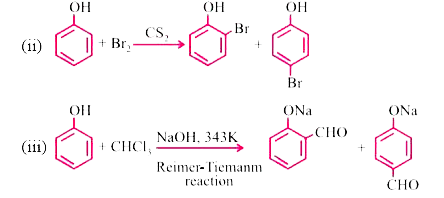
|
|
| 21. |
Give equations of the following reactions: (i) Oxidation of propan-1-ol with alkaline KMnO_(4) solution (ii) Bromine in CS_(2) with phenol (iii) Dilute nitric acid with phenol (iv) Treating phenol with chloroform in presence of aqueous NaOH. |
|
Answer» SOLUTION :(i) `underset("PROPAN")(CH_(3)CH_(2)CH_(2)OH) underset(("Oxidation"))overset("Alk. "KMnO_(4))to CH_(3)CH_(2)COOK underset(("Acidification"))overset(H^(+)//H_(2)O)to underset("Propanoic ACID")(CH_(3)CH_(2)COOH)` (ii) 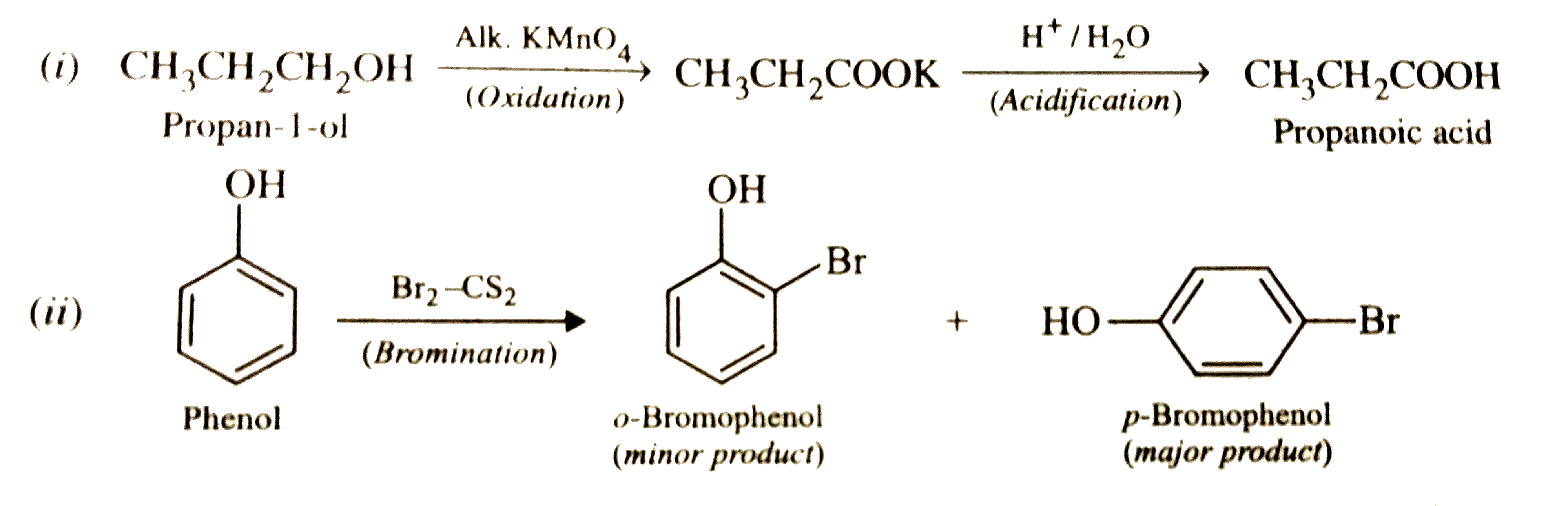 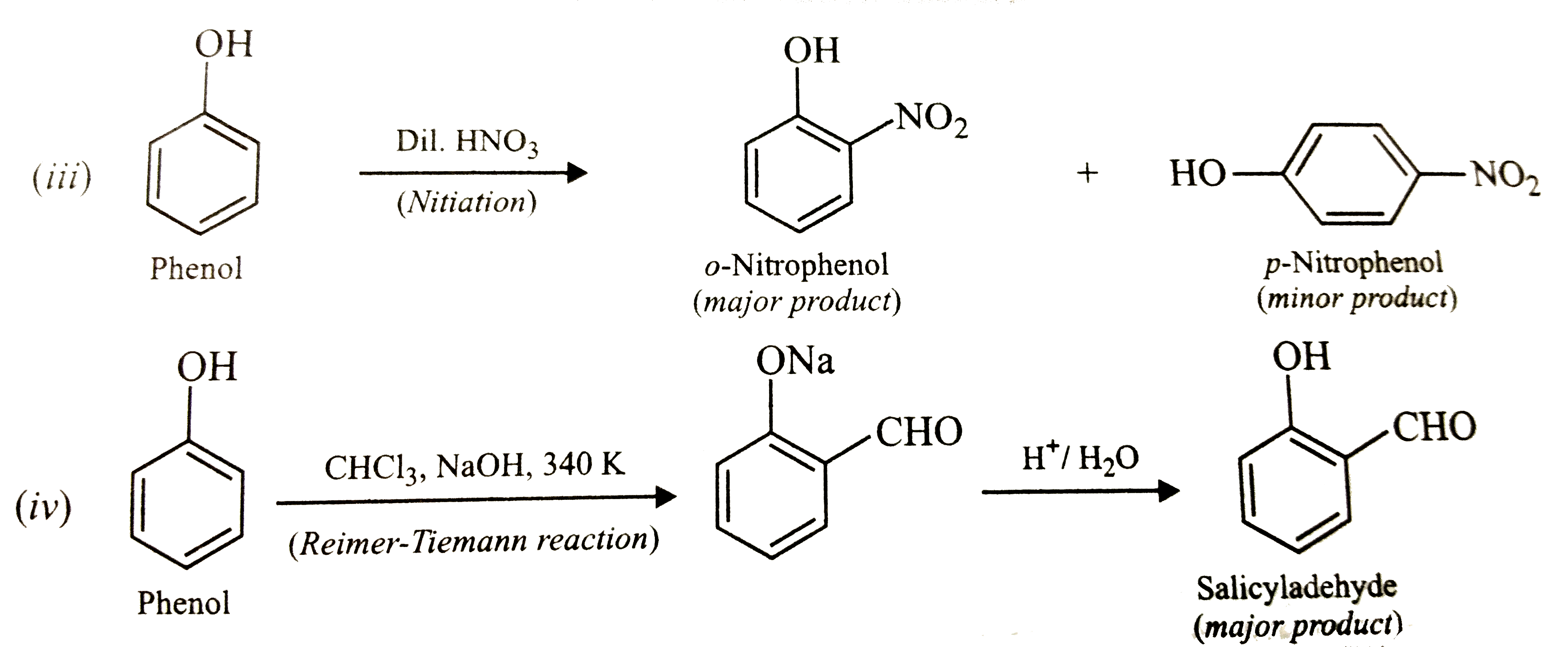
|
|
| 22. |
Give equations of the following reactions : Bromine in CS_(2) with phenol. |
Answer» SOLUTION :
|
|
| 23. |
Give equations of the following reactions : Dilute HNO_(3) with phenol. |
Answer» SOLUTION :
|
|
| 24. |
Give equation to calculate activation energy when rate constants known at two different temperatures. |
Answer» Solution :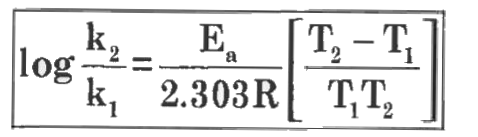 `E_(a)to` ENERGY of activation`K_(1)to` is rate constant at TEMPERATURE `T_(1)` `R to` GAS constant`K_(2)to` is rate constant at temperature `T_(2)` |
|
| 25. |
Write the general equation of Williamson's ether synthesis |
|
Answer» Solution :ALKYL halides on heating with sodium alkoxide ethers are obtained. In this method both SYMMETRICAL and unsymmetrical ether can be PREPARED. `"General Reaction :"underset("Alkyl halide")(R-X)+underset("Sodium alkoxide")(R-O-Na)rarr underset("Ether")(R-O-R)+NaX` `"EXAMPLE :"underset("Chloroethane")(C_(2)H_(5)-Cl)+underset("Sodium ethoxide")(C_(2)H_(5)-O-Na)rarr underset("Ethoxyethane")(C_(2)H_(5)-O-C_(2)H_(5))+NaCl` |
|
| 26. |
Give E_(mn^(+7)|Ma^(+2))^(0) =1.5 and E_(Mn+4|Ma^(+2))^(0) ,then E_(mn^(+7)|Mn^(+4)) is |
|
Answer» 0.1 V 
|
|
| 27. |
Give eletrophilicity order of following carbonyl compounds (I) Benzaldehyde (II) p-Tolualdehyde (III) P-Nitrobenzaldehyde (IV) Acetophenone |
|
Answer» `IgtIVgtIIIgtII` |
|
| 28. |
Give electrolytic reactions of molten NaCl occurrred in inert electrode. |
|
Answer» SOLUTION :* `NaCl to Na^(+) +Cl^(-)` Near CATHODE : `Na^(+) to E^(-)+Na` . . . Reduction `underline("Near anode : "Cl^(-) to (1)/(2)Cl_(2(g))+e^(-) . . ."Oxidation")` Overall REACTION : `NaCl to Na+(1)/(2)Cl_(2(g))`. * Here, not more than ONE ion is present near anode or cathode. |
|
| 29. |
Give electrolytic reaction of aqueous NaCl solution (concentrated) in inert electrode. |
|
Answer» Solution :* Inert electrodes are those electrodes which does not take part in reaction. * Solution is of NaCl, and on IONIZATION of NaCl it gives `Na^(+) and Cl^(-)` ions. In which, `Na^(+)` ions and water are near cathode. Which gives following reactions. `Na_((AQ))^(+)+e^(-) to Na""E_(cell)^(Theta)=-2.71V` or `H^(+)+e^(-) to (1)/(2)H_(2)""E_(cell)^(Theta)=0.0V` * So, reaction with more `E^(Theta)` VALUE gives reduction reaction. so near cathode `H^(+)` of water get reduced `(H_(2)O to H^(+)+OH^(-))` get reduced. (i) `Na^(+) + (H^(+)+OH^(-))+e^(-) to (1)/(2)H_(2(G)) +(Na^(+)+OH^(-))_((aq))` * So, near anode `Cl^(-)` and water, so oxidation reaction is possible. (ii) `Cl^(-)to(1)/(2)Cl_(2)+e^(-)""E_(cell)^(Theta)=1.36V` (iii) `2H_(2)O_((l)) to O_(2(g)) +4H_((aq))^(+) ""E_(cell)^(Theta)=1.23V` * Oxidation reaction is possible with less `E^(Theta)` values, so oxidation reaction of water with less `E^(Theta)` value should occur but oxidation of `Cl^(-)` occurs due to over voltage of oxygen oxidation of `Cl^(-)` is carried out by reaction (ii). * Overall reaction=(i)+(ii) `Na_((aq))^(+)+underset(H_(2)O)ubrace((H^(+)+OH^(-)))+Cl_((aq))^(-) to (1)/(2)Cl_(2(g))+(1)/(2)H_(2(g))+(Na^(+)+OH^(-))_((aq))` * So, near anode `Cl_(2)` gas and near cathode `H_(2)` gas and NaOH is occured. |
|
| 30. |
Give electrode reactions of mercury cell. Give its uses. |
|
Answer» Solution :At anode `Zn(s)+2OH^(-)(aq)toZnO_((s))+H_(2)O_((l))+2e` At CATHODE `HgO_((g))+H_(2)O_((l))+2etoHg_((l))+2OH_(aq)^(-)` Uses. : (i) This CELL GIVES a CONSTANT voltage of 1.35 V. (ii) It is a compact cell. |
|
| 31. |
Given electrode potentials are:Fe^(3+) +e rarrFe^(2+) ,E^@=0.771V I_2 +2e rarr 2I^- ,E^@=0.536V E^@ cell for the cell reaction, 2Fe^(3+) +2I^- rarr2Fe(2+) +I_2is: |
|
Answer» `(2xx0.7710.536)=1.006V` |
|
| 33. |
Give differences between [NiCl_4]^(2-) and [NI(CN)_4]^(2-) with respect to type hybridization, magnetic behaviour and geometry. |
Answer» SOLUTION :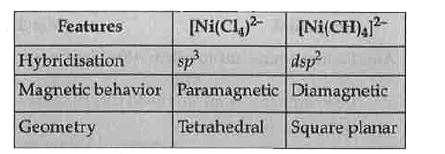
|
|
| 34. |
Give difference between physical adsorption and chemical adsorption. |
Answer» SOLUTION :
|
|
| 35. |
Give common names of noble gases. |
|
Answer» Solution :(i) Helium : Sun (Helious) (ii) Neon : New (III) ARGON : LAZY (IV) Krypton : Hidden (V) Zenon : Strange. |
|
| 36. |
Give common names and IUPAC names of the following compounds. |
|
Answer» Solution :(i) Ethyl m-nitrophenylketone (C.N.) 1-(3-Nitrophenyl) propan-1-one (ii) Crotonaldehyde (C.N). But-2-en-1-al (iii) `alpha`- Methoxycyclobutananecarbaldehyde (C.N.) 2-Methyoxcyclobutanecarbaldehdye (iv) Ethylisopropylketone (C.N.) 2-Methylpentan-3-one (V) SALICYLDEHYDE (C.N.) 2-Hydroxybenzaldehyde (VI) Butan-2,3-dione (vii) Mesityloxide (C.N) 4-Methylpent-3-en-2-one (viii) 3-Oxobutanal (ix) tert-butylmethyl KETONE 3-3-dimethylbutanone (x ) Para-methoxy BENZALDEHYDE 4-Methoxybenzaldehyde (xi) p,p'-dil(hydroxyphenyl) ketone (xii) `beta`-Methylcyclohexanone 3-Methylcyclohexanone (xiii) 2-hydroxy-3-methylcyclohexanecarbaldehyde (xiv) 2-(2-Chlorophenyl)ehtanal (xv) 2-Cyanocylopentanone |
|
| 37. |
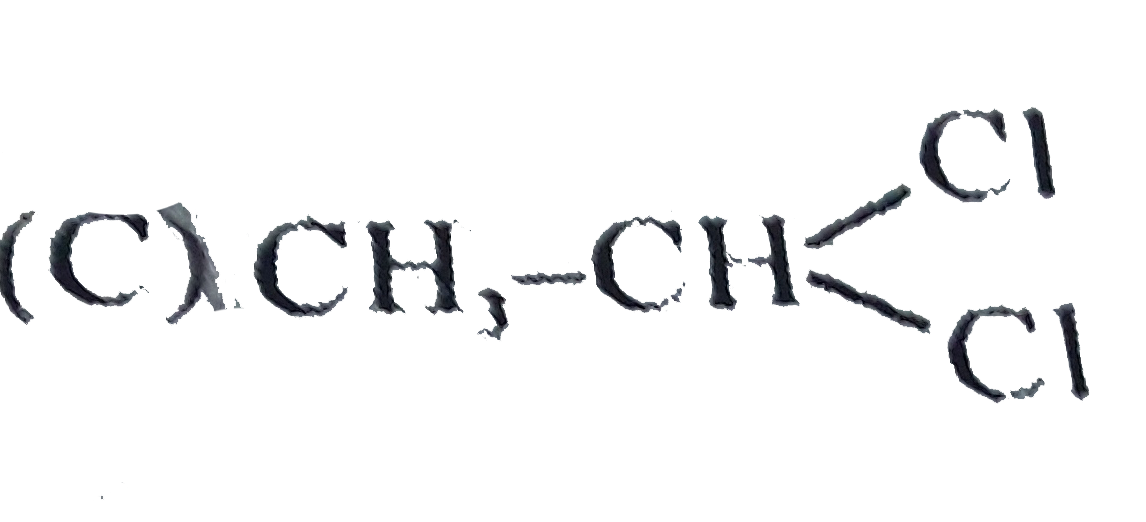
Give common name of following compound : |
|
Answer» `CH_(3)-underset(OH)underset(|)(CH)-CH_(3)` |
|
| 38. |
Give common names and IUPAC names of the following compounds. |
|
Answer» Solution :(i) Ethyl m-nitrophenylketone (C.N.) 1-(3-Nitrophenyl) propan-1-one (ii) CROTONALDEHYDE (C.N.) But-2-en-1-al (iii) `alpha`-Methoxycyclobutanecarbaldehyde (C.N.) 2-Methoxycyclobutanecarbaldehyde (iv) Ethylisopropylketone (C.N.) 2-Methylpentan-3-one (V) Salicyldehyde (C.N.) 2-Hydroxybenzaldehyde (vi) Butane-2, 3-dione (vii) Mesityloxide (C.N.) 4-Methylpent-3-en-2-one (viii) 3-Oxobutanal (ix) tert-butylmethyl KETONE 3,3-dimethylbutanone (x) para-methoxy benzaldehyde 4-Methoxybenzaldehyde (xi) p,p.-di(hydroxyphenyl) ketone Bis(4-hydroxyphenyl) methanone (xii) `BETA`-Methylcyclohexanone 3-Methylcyciohexanone (xiii) 2-hydroxy-3-methylcyclohexaecarbaldehyde (XIV) 2-(2-Chlorophenyl)ethanal (xv) 2-Cyanocyclopentanone |
|
| 39. |
Give commercial preparation of methanol and state its properties and uses. |
|
Answer» Solution :Methanol, `CH_(3)OH` is ALSO known as "wood spirit” was produced by destructive distillation of wood. Today, most of the methanol is produced by the catalytic hydrogenation of carbon monoxide at high pressure and temperature in presence of `ZnO-Cr_(2)O_(3)` CATALYST. `CO+ 2H_(2) underset(573-673 K)(underset("200-300 atm"))overset(ZnO-Cr_(2)O_(3))to CH_(3)OH` `to` Properties and USES of methanol : Methanol is colourless liquid and boils at 337 K. It is highly TOXIC in nature. Ingestion of small amount of methanol can cause blindness and large quantities even death. `to` Methanol is used as solvent in paints, varnishes and chiefly for making formaldehyde. |
|
| 40. |
Give classification of vitamins. |
|
Answer» Solution :Vitamins are classified into two groups depending upon their solubility in WATER or FAT. (i) Fat soluble vitamins : Vitamins which are soluble in fats and oils but insoluble in water are kept in this group. These are vitamins A, D, E and K. They are stored in liver and adipose (fat storing) tissues. (ii) Water soluble vitamins : B group vitamins and Vitamin C are soluble in water, so they are grouped together. Water soluble vitamins must be supplied regularly in diet because they are READILY excreted in urine and cannot be stored (except vitamin `B_(12)`) in our body. |
|
| 41. |
Give commercial preparation of ethanol. State its properties and uses. |
|
Answer» Solution :`to` Ethanol is COMMERCIALLY prepared by the fermentation reaction. The oldest method is from sugars. The sugar in molasses, sugarcane or fruits such as grapes is converted to glucose and FRUCTOSE (both have formula `C_(6)H_(12)O_(6)`), in the presence of enzyme invertase. Glucose and fructose undergo fermentation in the presence of another enzyme, zymase which is found in yeast. `C_(12)H_(22)O_(11) + H_(2)O overset("Invertase")to underset("Glucose")(C_(6)H_(12)O_(6)) + underset("Fructose")(C_(6)H_(12)O_(6))` `C_(6)H_(12)O_(6) overset("Zymase")to 2C_(2)H_(5)OH+ 2CO_(2)` In wine making, grapes are the source of sugars and yeast. As grapes ripen, the quantity of sugar increases the yeast grows on the outer skin. When grapes are crushed, sugar and the enzyme come in contact and fermentation starts. Fermentation takes place in anaerobic conditions (absence of air). Carbon dioxide is released during the fermentation. `to` The action of zymase is inhibited once the percentage of alcohol formed exceeds 14 percent. If air gets into fermentation mixture, the oxygen of the air oxidizes ethanol to ethanoic acid which in turn destroys the taste of alcohol drinks. `to` The commercial alcohol is MADE UNFIT for drinking by addition of copper sulphate (to give it colour) and pyridine (a foul-smelling liquid). It is known as alcohol denaturation. Nowadays, ethanol in large quantities is prepared by hydration of ethene. `to` Properties and uses of ethanol : Ethanol is a colourless liquid with boiling point 351 K. `to` It is used as a solvent in paint industry and in the preparation of a few carbon compounds. |
|
| 42. |
Give classification of oligosaccharides. |
|
Answer» SOLUTION :The oligosaccharides are classified as follows : (i) Disaccharides These carbohydrates produce two monosaccharide units on hydrolysis. For example, sucrose produces glucose unit and fructose unit on hydrolysis, maltose produces two units of glucose and lactose produces one glucose and one GALACTOSE unit on hydrolysis. Thus, sucrose, maltose and lactose are called disaccharides. The general formula of disaccharide is `C_(n)H_(2n-2)O_(n-1)` (ii) Trisaccharides : These carbohydrates produce three units of monosaccharide on hydrolysis. For example, Raffinose `(C_(18)H_(32)O_(16))` is a TRISACCHARIDE. On hydrolysis, raffinose give one unit each of glucose, fructose and galactose. The general formula of trisaccharides is `C_(n)H_(2n-4)4O_(n-2)` (iii) Tetrasaccharides : These carbohydrates produce four units of monosaccharide on hydrolysis. For example, stachyose `C_(24)H_(42)O_(21)` produces two units of galactose, one unit each of glucose and fructose on hydrolysis. The general formula of tetrasaccharide is `C_(n)H_(2n-6)4O_(n-3)`. |
|
| 43. |
Give classification of monohydric alcohols based on -OH group bonded to sp^(3) and sp^(2) carbon. |
|
Answer» Solution :(a) The monohydric alcohols having `SP^(3)` C-OH bond is classified as follows: (i) Primary (`1^(@)`), Secondary (`2^(@)`), Tertiary (`3^(@)`) alcohols : In these three types of alcohols, the OH group is BONDED to primary, secondary and tertiary carbon respectively. `underset("Primary"(1^(@))(-CH_(2)-OH) (##KPK_AIO_CHE_XII_P2_C11_E01_003_S01.png" width="80%"> (ii) Allylic alcohols : The alcohols in which the -OH group is bonded to sp carbon present adjacent to  are called allylic alcohols. These are further classified as primary allylic, secondary allylic and tertiary allylic alcohols. are called allylic alcohols. These are further classified as primary allylic, secondary allylic and tertiary allylic alcohols. `CH_(2)= underset("Primary")(CH- CH_(2)-OH)` `underset("Secondary")(CH_(2)= underset(|)underset(-C-)underset(|)overset(H)overset(|)CH-C-OH) "" underset("Tertiary")(CH_(2)= CH-underset(|)underset(-C-)underset(|)overset(-C-)overset(|) C-OH)` (iii)BENZYLIC alcohols : In these alcohols, the -OH group is bonded to `sp^(3)` carbon next to an aromatic ring. These are further classified as primary benzylic, secondary benzylic and tertiary benzylic alcohols.  (b) Alcohols in which-Oh is bonded to `sp^(2)` carbon: The alcohols in which the -OH group is bonded to `sp^(2)` carbon directly are called vinylic alcohols. 
|
|
| 44. |
Give classification of ethers. |
|
Answer» SOLUTION :`to` The general representation of ether is R-O-R.. Ethers are classified as symmetrical (simple) or unsymmetrical depending on the GROUPS bonded to the oxygen of ether. `to` If the groups bonded to ethers are same (R = R.), the ethers are known as symmetrical and if the groups bonded are different (R = R.), the ethers known as unsymmetrical. `underset("(symmetrical)")(underset("ETHOXYETHANE")(C_(2)H_(5)OC_(2)H_(5))) "" underset("(unsymmetrical)")(underset("Methoxyethane")(C_(2)H_(5)OCH_(3))"" underset("Ethoxybenzene")(C_(2)H_(5)OC_(6)H_(5)))` |
|
| 45. |
Give classification of d-block and f-block elements |
|
Answer» Solution :The d-block elements are classified on the basis of the electrons that get filled in d-orbitals. These elements are classified in to four series: (i) `I^(ST)` series (3 d-series) `rArr ""_(21)Sc" to " ""_(30)Zn` (ii) `II^(nd)` series (4 d-series) `rArr ""_(39)Y" to " ""_(48)Cd` (iii) `III^(rd)` series (5 d-series) `rArr ""_(57)La" to " ""_(72)Hf " to " ""_(80)Hg` (iv) `IV^(th)` series (6 d-series) `rArr ""_(89)Ac" to " ""_(104)Rf " to """_(112)Cn` Each series has 10 elements present, and hence in all there are 40 elements in TOTAL that belongs to a d-block. The f-block elements are categorized in two series on the basis of electrons that get filled in f-orbitals: (i) Lanthanoide series `[""_(58)Ce " to " ""_(71)Lu]`: These elements have similar physical and chemical properties as of Lanthanum. Hence, these elements are called lanthanoids. It is called 4f series (i) Actinoide series `[""_(90)Th " to" ""_(103)Lr]`: These elements have similar physical and chemical properties as of actinoid. Hence, these elements are called actinoids. It is called 5f series. In each series of f-block, there are 14 elements. Hence in all there are 28 elements present in f-block |
|
| 46. |
Give classification of crystalline solids. |
|
Answer» Solution : Most of the solid substances are crystalline in nature. For example metallic elements like iron, copper and silver, non-metallic elements like sulphur, phosphorus and iodine and compounds like SODIUM chloride, zinc sulphide and naphthalene form crystalline SOLIDS. Crystalline solids can be classified on the basis of nature of INTERMOLECULAR forces or bonds that hold the constituent particles together. These are : (i) Ionic bonds (ii) Covalent bonds (iii) VAN der Waal.s forces (iv) Metallic bonds On this basis crystalline solids are classified as : (i) lonic solids Or Electrovalent solids. (ii) Covalent solids Or Network solids. (iii) Molecular solids. (iv) Metallic solids. |
|
| 47. |
Give classification of alcohols and phenols based on number of OH groups. |
|
Answer» Solution :`to` ALCOHOLS and phenols may be classified as mono-, di- TRI- or polyhydric compounds depending on whether they contain one, TWO, THREE or many hydroxyl groups respectively in their structures. `to` Alcohols :  
|
|
| 48. |
Give classification of carbohydrates. |
Answer» Solution :Depending on the behaviour of carbohydrates on hydrolysis, they are classified as follows :  These are simplest carbohydrates that cannot be hydrolysed further to smaller units of polyhydroxy aldehydes of ketones. These includes sugars of three to sevencarbon atoms. Monosaccharides are called aldose if it has aldehyde group and ketose if it has a ketone group. About 20 monosaccharides are known to occur in nature. The common examples are glucose, fructose, galactose, ribose etc.  Oligosaccharides : These carbohydrates produce two to ten units of monosaccharides on hydrolysis (Greek : Oligos = few). Amongst these, the disaccharides are most common. Two monosaccharide units obtained may be same or different when a DISACCHARIDE is hydrolysed. For example, the hydrolysis of sucrose gives one unit of glucose and one unit of fructose on hydrolysis. Polysaccharides : Carbohydrates which yield large numbers (100 to 3000) units of monosaccharides on hydrolysis are called polysaccharides. Some common examples include starch, cellulose, glycogen, GUMS etc. Polysaccharides are not sweet in taste and hence they are called non-sugars. The carbohydrates are also classified as reducing or non-reducing sugars. The carbohydrates that REDUCES Fehling.s and Tollen.s reagent are referred as reducing sugars. All monosaccharides whether aldose or ketose are reducing sugars. |
|
| 49. |
Give chemical teststo distinguish between the following pairs of compounds: (a) Phenol and Benzoic acid (b) Benzaldehyde and Acetophenone. |
|
Answer» Solution :Distinction between pairs of compounds can be made as under: (a. Add neutral ferric chloride. Phenol will GIVE VIOLET colour whereras benzoic acid will not. b. Add `I_(2)` and NAOH. Acetophenone `(C_(6)H_(5)COCH_(3))` gives yellow ppt of iodoform whereas benzaldehyde `(C_(6)H_(5)CHO)` does not. |
|
| 50. |
Give chemical tests to distinguish between the folowing pairs of compounds : (i) Ethanel and propanone . (ii) pentan -2-one and pentan -3-ne . Arrange the folowing compound in incrreasin g order of their aicd strength : Benzonic acid , 4- Nitrfobenzoic acid 3, 4- Dinitrobenzoic acid , 4-Methoxybenzoic aicd . |
Answer» Solution : (i) ETHANAL and PROPANONE can be distinguished ad under : 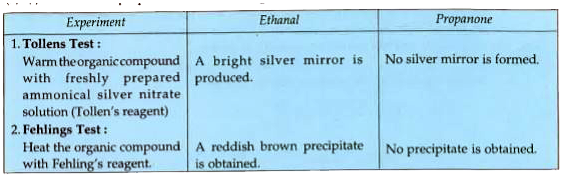 (ii) Pentan -2-ONE and pentan -3- one can be distinguisehd as under :  (b) The acid can be arrangec in INCREASING order of acid STRENGTH as under : 4-Methoxybenzoic acid < Benzoic acid < 4-Nitrobenzoic acid < 3,4-Dinitrobenzoic acid |
|