

Saved Bookmarks
This section includes 7 InterviewSolutions, each offering curated multiple-choice questions to sharpen your Current Affairs knowledge and support exam preparation. Choose a topic below to get started.
| 1. |
Give classification of carbohydrates with examples. |
|
Answer» Solution :On the basis of their hydrolysis products , carbohydrates are CLASSIFIED as : (1) Simple carbohydrates and (2) Comples carbohydrates. (1) Simple carbohydrates : The simple carbohydrates cannot hydrolsed further to simpler compounds . They are the basic units of all carbohydrates , and are called monosaccharides . They are sugars which are crystalline , water soluble and have sweet taste. EXAMPLES : GLUCOSE , fructose , ribose. Monosaccharides are further classified as aldoses, containing an aldehyde group and ketoses , containing keto group . Depending upon number of carbon atoms and the functional groups , monosaccharides are further classified as triose , tetrose ,, pentose , HEXOSE etc. (2) Complex carbohydrates : The complex carbohydrates are further classified as (A) Oligosaccharides and (B) Polysaccharides. (a) Oligosaccharides : An oligosaccharide is a carbohydrates (sugar) which on hydrolysis gives two to ten monosaccharide units. Depending on the number of monosaccharides produced on hydrolysis , oligosaccharides are further classified as : (1) Disaccharides `( C_(12)H_(22)O_(11) )` : Sucrose `overset("Hydrolysis")to ` Glucose + Fructose MALTOSE `overset("Hydrolysis")to ` Glucose +Glucose Lactose `overset("Hydrolysis")to` Glucose + Galactose (2) Trisaccharides `(C_(18)H_(32)O_(16))` : Raffinose `overset("Hydrolysis")to ` Glucose + Fructose + Galactose (3) Tetrasaccharides `(C_(24)H_(42)O_(21))`: Stachyose `overset("Hydrolysis")to` Glucose + Fructose + Galactose + Galactose Oligosaccharide is homogenous . In this , each molecule of oligosaccharide contains the same number of monosaccharide units joines together in the same order as very other molecule of the same oligosaccharide. (b) Polysaccharides : These are carbohydrates which on hydrolysis give a large number of monosaccharides. Polysaccharides are tasteless , amorphous , insoluble in water. They are long chain, naturally occuring polymers of carbohydrates. E.g., cellulose, starch , glycogen. |
|
| 2. |
Give chemical tests to distinguish between the following pairs of compunds : (i) Ethanal and Propanal(ii) Phenol and Benzoic acid |
|
Answer» Solution :(i) ETHANAL and Propanal `:` Ethanal `( CH_(3) CHO ) ` and propanal `( CH_(3)CH_(2)CHO)` can be distinguished by performing iodoform test. Ethanal gives a yellow precipitate of `CHI_(3)` while propanal does not REACT. `CH_(3) CHO OVERSET( NaOH ) ( rarr) HCOONa + CHI_(3)` (ii) Phenol and Benzoic acid `:` Benzoic acid gives an effervescence with a solution of sodium hydrogen carbonate while phenol shows no ACTION. |
|
| 3. |
Give chemical tests to distinguish between the following pairs of compounds: (i)Propanoyl chloride and propanoic acid. (ii) Benzaldehyde and acetophenone. |
|
Answer» Solution :(i) Add `NaHCO_(3)` solution to eac of them. Propanoyl chloride `(CH_(3)CH_(2)Ocl)` will not react whereas propanoic ACID `(CH_(3)CH_(2)COOH)` will give brisk effervescence due to `CO_(2)`. (ii) Add `I_(2)` and NaOH. Acetophenone `(C_(6)H_(5)COCH_(3))` will give yellow ppt. of iodoform whereas benzaldehyde `(C_(6)H_(5)CHO)` will not react. |
|
| 4. |
Give chemical tests to distinguish between the following pairs of compounds : (i) Propanal and propanone (ii) Benzaldehyde and benzoic acid. |
|
Answer» Solution :(i) Add Tollens. REAGENT. Propanal `(CH_(3)CH_(2)CHO)` will GIVE silver mirror WHEREAS propanone `(CH_(3)COCH_(3))` will not react. (ii) Add `NaHCO_(3)` solution, BENZALDEHYDE `(C_(6)H_(5)CHO)` will not react whereas benzoic acid `(C_(6)H_(5)CHO)` will give brisk ettervescence DUE to `CO_(2)`. |
|
| 5. |
Give chemical tests to distinguish between the following pairs of compounds : (i) Benzyl chloride and chlorobenzene (ii) Chloroform and carbon tetrachloride. |
|
Answer» Solution :(i) On adding NaOH and `AgNO_(3)` to both compounds benzyl chlroide form WHITE ppt. but CHLOROBENZENE does not form it. (ii) On heating chloroform and carban tetrachloride with aniline and ethanolic POTASSIUM hydroxide separtely. `CHCl_(3)` forms PUNGENT smelling isocyanide but `CCl_(4)` does not form this compound. |
|
| 6. |
Give chemical tests to distinguish between the following pair of compounds. (i) Propanal and propanone (ii) Benzaldehyde and Benzoic acid |
|
Answer» SOLUTION :(i) On ADDING Tollen.s reagent, propanal will give silver mirror whereas PROPANONE does not react. (II) On adding `NaHCO_2`solution, benzaldehyde will not react whereas benzoic ACID will give brisk effervescence due to the evolution of `CO_2` . |
|
| 7. |
Give chemical tests to distinguish between the following pair of compounds. (i) Propanoyl chloride and propanoic acid (ii) Benzaldehyde and Acetophenone |
|
Answer» Solution : (i) On ADDING `NaHCO_3` , solution to each of them, propanoyl chloride will not react whereas PROPANOIC ACID will give brisk efferevescence DUE to the evolution of `CO_2` . (ii) On adding `I_2`and NaOH, Acetophenone will give YELLOW ppt, of iodoform whereasbenzaldehyde will not react |
|
| 8. |
Give chemical tests to distinguish between the following pairs of compounds : (a) Aniline and Ethylamine (b) Enthylamine and Dimethylamine |
Answer» Solution :(a) Aniline forms diazonium salt with `NaNO_(2)//HCI` which gives ORANGE red dye with `BETA ` napththol. Ethyl amine does not give this test .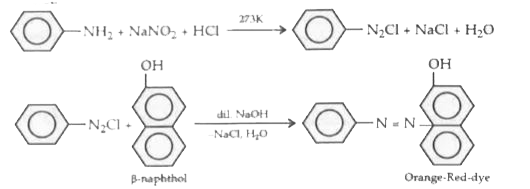 (b) Ethyl amine gives foul smelling ethyl isocyanide on HEATING with chloroform and potassium hydroxide solution. Dimethyl amine does not give this test. `C_(2)H_(5)NH_(2)+CHCI_(3)+3KOH rarr C_(2)H_(5)NC+3KCI+3H_(2)O` |
|
| 9. |
Give chemical tests to distinguish between the following pair of compounds : ""CH_(3)-CH_(2)-NH_(2)" and "(CH_(3))_(2)NH |
|
Answer» |
|
| 10. |
Give chemical tests to distinguish between the following pair of compounds. (i) Phenol and Benzoic acid (ii) Benzaldehyde and Acetophenone |
|
Answer» SOLUTION : (i) By adding ferric chloride, PHENOL will give violet colour whereas benzoic acid will not REACT. (ii) Adding `I_2`and NaOH, ACETOPHENONE will give yellow PPT. of iodoform whereas benzaldehyde will not react. |
|
| 11. |
Give chemical tests to distinguish between the following : (a) Benzoic acid and ethyl benzoate . (b) Benzaldehyde and acetophenone . |
|
Answer» Solution :(a) Benzoic ACID and ethylbenzoate `:` The two compounds can be distinguished by performing sodium bicarbonate test.Benzoic acid gives an effervescence with `NaHCO_(3)` solution while ethyl benzoate does not. `UNDERSET("Benzoic acid")(C_(6) H_(5) COOH) + NaHCO_(3) rarr underset("Sodium benzoate")(C_(6) H_(5) COONa ) + CO_(2) +H_(2) O` `underset("Ethyl benzoate")(C_(6) H_(5) COOC_(2) H_(5)) + NaHCO_(3) rarr ` NO reaction (b) Benzaldehyde and acetophenone `:` The two compounds can be distinguished by performing iodoform test. Acetophenone gives a yellow precipitate of `CHI_(3)` with NaOI or `NaOH//I_(2)` while benzaldehyde does not. `C_(6)h_(5) COCH_(3) OVERSET( NaOH //I_(2))(rarr) underset("Sodium benzoate")(C_(6)H_(5)COONa) + underset("Iodoform")(CHI_(3))` |
|
| 12. |
Give chemical tests to distinguish between the following| pair of compounds: CH_3 -CH_2-NH_2and(CH_3)_2 NH |
| Answer» Solution : Add `CHCl_3` and KOH solution to the compound. ETHYLAMINE will give OFFENSIVE smell of ethyl ISOCYANIDE. Dimethylamine, `(CH_3)_2NH `does not give this REACTION. | |
| 13. |
Give chemical tests to distinguish between propan -2-ol and 2-methyl -propan-2-ol. |
|
Answer» Solution :`underset("2-methylpropan-2-ol")(CH_(3)-overset(CH_(3))overset(|)underset(CH_(3))underset(|)C-OH) + HCL-overset("anydrous")overset(ZnCl_(2)) to underset(CH_(3))underset(|)overset(CH_(3))overset(|)C-CL + H_(2)O` `underset("Propen-2-ol")(CH_(3)-overset(OH)overset(|)CH-CH_(3) + HCl overset("anhydrous")overset(ZnCl_(2)) to underset("2-chloro-2-methylpropane immediate appearnace of TURBIDITY")(CH_(3)-overset(CH_(3))overset(|)underset(CH_(3))underset(|)C-Cl + H_(2)O` `underset("propan-2-ol")(CH_(3)-overset(OH)overset(|)(CH)-CH_(3)) + HCl overset("anhydrous"ZnCl_(2))to underset("2-chloropropane slow appearance of turbidity")(CH_(3)-underset(CH_(3))underset(|)(CH)-Cl + H_(2)O` `underset("propan-2-ol")(CH_(3)-CH_(2)-OH + HCl overset("anydrous")overset(ZnCl_(2)) to` No reaction at room temperature |
|
| 14. |
Give chemical tests to distinguish between : (i) Benzoic acid and phenol (ii) Ethanamide and ethanoic acid. |
|
Answer» |
|
| 15. |
Give chemical tests to distinguish between compounds inthe following pairsof substances ,(i) Ethanal and Propanal (ii) Benzoic acid and Ethyl benzoate(b)An origanic compound contains 69.77%carbon , 11.63%hydrogen and rest oxygen . the molecular mass of the compound is 86. It doesnot reduce tollen 's reagent but forms an addition compound with sodium hydrogen sulphite and gives positive iodoform test. On vigorous oxidation it ethanoic and propanoic acids . Derive the structure of the compound. |
|
Answer» Solution :(a) (i)Distinction between Ethanaland Propanal : Ethanal`(CH_(3)CHO)` and propanal `(CH_(3)CH_(2)CHO)` can be DISTINGUISHED by the iodoform test . Ethanal reacts with `I_(2)//NAOH(orNaOI)`to give yellow ppt . Ofiodoform but propanal does not REACT with `I_(2)//NaOH`. `UNDERSET("Ethanal")(CH_(3)CHO+3I_(2))+4NaOHoverset(Delta)toHCOONa+underset(("Yellow ppt."))(CHI_(3))+3NOI+3H_(2)O` `underset("Propanal")(CH_(3)CH_(2)CHO)overset(I_(2)//NaOH)to` No Yellow ppt. of `CHI_(3)` (ii)Benzoic acid and Ethyl benzoate :These compounds can be distinguished by using`NaHCO_(3)` test . Benzoic acid produces brisk effervescene with `NaHCO_(3)`solution while ethyl benzoate does not . `underset("Benzoic acid")(C_(6)H_(5)COOH)+NaHCO_(3)tounderset("Sod . benzoate")(C_(6)H_(5)COONa+CO_(2)+H_(2)O)` `C_(6)H_(5)COOC_(2)H_(5)overset(NaHCO_(3)"Soln.")to` No effervescence due to evolution of `CO_(2)` GAS. |
|
| 16. |
Give chemical tests to distinguish between : (i) Isopropyl alcohol and n - propyl alcohol (ii) Phenol and alcohol (iii) Methyl ethanoate and ethyl ethanoate. |
|
Answer» Solution :(i) ISOPROPYL ALCOHOL and n - propyl alcohol : On adding `NaOH//I_(2)` or `NaOI` and heating, isopropyl alcohol forms a YELLOW precipitate of iodoform `(CHI_(3))`, n - propyl alcohol forms a yellow precipitate of iodoform `(CHI_(3))`. N - propyl alcohol does not give this test. (ii) Phenol and alcohol : On adding NEUTRAL `FeCl_(3)` solution, phenol forms red - violet complex. Alcohol does not give this test. (iii)Methyl ethanoate and ethyl ethanoate : First of all hydrolysis of the ester is carried out. Methyl ethanoate gives methyl alcohol and acetic acid while ethyl ethanoate gives ethyl alcohol and acetic acid. Out of ethyl alcohol and methyl alcohol, the former gives iodoform test with `NaOH_(2)//I_(2)` and methyl alcohol does not. Thus, on hydrolysis and subsequent isodoform test, if a yellow precipitate is obtained, the ester is ethyl ethanoate. Otherwise, it is methyl ethanoate. |
|
| 17. |
Give chemical tests to distinguish between compounds in each of the following pairs : (i) Phenol and Benzyl alcohol. (ii) Butan-2-ol and 2 - methylpropane -2- ol |
|
Answer» Solution :(i) Phenol gives a violet COLOURED complex with aqueous `FeCl_(3)` while benzyl alcohol does not. (ii) Butan -2- OL `(CH_(3)-UNDERSET(OH)underset("|")"CH"CH_(2)CH_(3))` gives Iodoform TEST (yellow ppt.) with `I_(2)` and `NaOH` whereas `"2 - methylpropan -2- ol, "CH_(3)-overset(OH)overset("|")underset(CH_(3))underset("|")"C "-CH_(3)`, does not. |
|
| 18. |
Give chemical tests to distinguish between (a) Propanal and propanone,(b) Benzaldehyde and acetophenone. |
|
Answer» Solution :Distinction between propanal and propanone `underset("Propanal")(CH_(3) CH_(2) CHO ) ` `underset( "Propanone")(CH_(3) COCH_(3))` The two compounds can be distinguished by the following TESTS `:` Schiff.s reagent test `:` Propanal gives a piink colour with Schiff.s reagent while propanone doe snot Iodofom test `:` Propanone givesa yellow precipitate of `CHI_(3)` when treated with NaOI or `I_(2) //NaOH`, while propanal does not. (b) Distinction between benzaldehyde and acetophenone `:` `underset("Benzaldehyde ")(C_(6)H_(5) CHO ) ` `underset("Acetophenone")(C_(6)H_(6)COCH_(3))` Acetophenone which contains `CH_(3)CO` - group gives a yellow precipitate of `CHI_(3)` on treatment with NaOI or `I_(2) //NaOH` reagent .Benzaldehyde does not GIVE this test. |
|
| 19. |
Give chemical test to distinguish between the following pairs of compounds : CH_3 - CH_2 - NH_2 and (CH_3)_2 NH . |
|
Answer» Solution :CARBYLAMINE TEST. Ethylamine being `1^@` in nature reacts with `CHCl_3` and alc. KOH forming offensive smelling ethylcarbylaminewhereas dimethylamine being `2^@` in nature does not react. `underset("ETHYL amine")(CH_3-CH_2 - NH_2 ) + CHCl_3 + 3KOH ("alc.")to CH_3 - CH_2 - N OVERSET(to)(=) C + 3KCl + 3H_2 O` |
|
| 20. |
Give chemical test to distinguish between C_(6)H_(5)CH_(2)NH_(2)" and "C_(6)H_()NH_(2). |
|
Answer» |
|
| 21. |
Give chemical test to distinguish between methanol and phenol. |
|
Answer» Solution :(i) METHANOL do not have any effect on LITMUS paper whereas phenol turns blue litmus red. (ii) Methanol do not give any colour with neutral `FeCl_(3)` solution, whereas an AQUEOUS solution of phenol GIVES violent colour with neutral `FeCl_(3)` solution. |
|
| 22. |
Give chemical reactions in support of the following observations: Sulphuric acid has low volatility. |
|
Answer» SOLUTION :SULPHURIC acid has hydrogen BONDING in it. It is because of this REASON that it has high boiling point and low volatility. `2MX + H_2SO_4 to 2HX + M_2SO_4 , where =F , CL , NO_3 and M`= Metal |
|
| 23. |
Give chemical reactions showing oxidizing character of KMnO_(4) |
|
Answer» Solution :`KMnO_(4)` act as strong OXIDIZING AGENT in neutral, alkaline and in acidic medium. (a) Oxidizing action in neutral or weak alkaline medium: (i) Oxidation of iodide to iodate `2MnO_(4)^(-) + H_(2)O + I^(-) rarr 2MnO_(2)+ 2OH^(-) + IO_(3)^(-)` (ii) Thiosulphate is oxidized almost quantitatively to sulphate `8MnO_(4)^(-) + 3S_(2)O_(3)^(2-) + H_(2)O rarr 8MnO_(2) + 6SO_(4)^(2-) + 2HO^(-)` (iii) Manganous salt is oxidized to `MnO_(2)`. The reaction is catalysed by ZnO or `ZnSO_(4)`. `2MnO_(4)^(-) + 3Mn^(2+) + 2H_(2)O overset(ZnO)rarr 5MnO_(2) + 4H^(+)` (b) Oxidizing action is acidic medium: (i) Iodine is liberated from potassium iodide `10I^(-) + 2MnO_(4)^(-) + 16H^(+) rarr 2Mn^(2+) + 8H_(2)O 5I_(2)` (ii) `Fe^(2+)` ion (green) is converted to `Fe^(3+)` (yellow) `5Fe^(2+) + MnO_(4)^(-) + 8H^(+) rarr Mn^(2+) + 4H_(2)O + 5Fe^(3+)` (iii) Oxalate ion or OXALIC ACID is oxidized at 333K `5C_(2)O_(4)^(2-) + 2MnO_(4)^(-) + 16H^(+) rarr 2Mn^(2+) + 8H_(2)O + 10CO_(2)` (iv) Hydrogen sulphide is oxidized sulphur is precipitated `H_(2)S rarr 2H^(+) + S^(2-)` `5S^(2-) + 2MnO_(4)^(-) + 16H^(+) rarr 2Mn^(2+) + 5S + 8H_(2)O` (v) Sulphurous acid or sulphite is oxidized to a sulphate or sulphuric acid. `5SO_(3)^(2-) + 2MnO_(4)^(-) + 6H^(+) rarr 2Mn^(2+) + 3H_(2)O + 5SO_(4)^(2-)` (vi) NITRITE is oxidized to nitrate `5NO_(2)^(-) + 2MnO_(4)^(-) + 6H^(+) rarr 2Mn^(2+) + 5NO_(3)^(-) + 3H_(2)O` In permanganate titrations, the HCl is not used because hydrochloric acid is oxidized to chlorine `(Cl_(2)) " by" MnO_(4)^(-)` |
|
| 24. |
Give chemical reactions in support of the following observations: Iodide ions can be oxidised by oxygen in acidic medium. |
| Answer» Solution :`4I^(-) (AQ) + 4H^(+)(aq) + O_2(G) to 2I_2(s) + 2H_2O (l)` | |
| 25. |
Give chemical reaction in support of the statement that all the bonds in PCI_(5) molecule are not equivalent. |
|
Answer» Solution :Due to GREATER BOND pair-bond pair repulsions, the TWO axial P-CI bonds are less stable than the three equatorial P-CI bonds. It is because of this reason that when `PCI_(5)` is heated, the less stable axial bonds are broken to form `PCI_(3) and CI_(2)` `PCI_(5) overset(Delta) rarr PCI_(3) + CI_(2)` |
|
| 26. |
Give chemical reaction in support of the observation that iodide ions can be oxidised by oxygen in the acidic medium. |
| Answer» Solution :`4 I^(-) (AQ) + 4 H^(+) (aq) + O_(2) (g) rarr 2 I_(2) (s) + 2 H_(2)O (l)` | |
| 27. |
Give chemical reaction and its potential by dwaring labelled diagram of Daniell cell. Also give primary information indicating which type of cell it is ? |
Answer» Solution :Daniell cell is a voltaic cell which convert CHEMICAL energy into electrical energy.  Chemical reaction: Daniell cell converts the chemical energy liberated during the redox reaction which is as follows: `Zn_((s))+Cu_((aq))^(2+) to Zn_((aq))^(2+)+Cu_((s))` Cell POTENTIAL: When in a Daniell cell, concentration of `ZN^(2+)` and `CU^(2+)` ions is unity (1 mol `dm^(-3)`), then it has en electrical potential equal to 1.1 V. Such a device is called a GALVANIC or a voltaic cell. |
|
| 28. |
Give chemical evidence for the following: Fluorine is a stronger oxidising agent than chlorine. |
| Answer» SOLUTION :`F_2 + 2KCL to 2KF + Cl_2` | |
| 29. |
Give chemical equation for the preparation of iodoform from acetone. |
| Answer» SOLUTION :`CH_(3)COCH_(3) + 3I_(2) + 2Na_(2)CO_(3) to CHI_(3) +CH_(3)COONA + 3Nal + 2CO_(2) + H_(2)O` | |
| 30. |
Give characteristics tests of Lucas reagent with alcohols. |
|
Answer» Solution :Lucas reagent isa mixture of concentrated HCI and anhydrous ` ZnCI_(2)` . It is used to distinguish between primary , secondary and tertiary alcohols. Alcohol with Lucas reagent forms an alkyl chkloride ,R -CI which is insoluble and gives cloudiness and forms separate layer. The time REQUIRED for cloudiness to appear is based on the type of the alcohol and its reactivity. (1) Primary alcohol : It reacts with the Lucas reagent very slowly and on heating forms alkyl chloride . The separation of a layer takes PLACE after a long time on heating . ` underset(" ETHYL alcohol") (C_(2)H_(5) -OH) + underset("conc.")(HCI) overset(" anhydrous" ZnCl_(2)) underset(Delta) tounderset(" ethyl chloride")(C_(2)H_(5)-CI) + H_(2)O` (2) Secondary alcohol : It reacts with the Lucas reagent much faster to form alkyl chloride. The cloudiness and separtion of layer takes place after five minutes. `CH_(3)-underset("isopropyl alcohol")underset(OH)underset(|)(CH)-CH_(3)+ underset("conc.")("HCI") overset("anhydrous "ZnCl_(2))underset("room TEMP.")to CH_(3)-underset("isopropyl chloride")underset("CI")underset(|)(CH) - CH_(3) + H_(2)O` (3) Tertiary alcohol : It reacts immediately with the Lucas reagent at room temperature to form alkyl chloride. The cloudiness and separation of layer takes place instantaneously . `CH_(3)- underset("tert-butyl alcohol")underset(CH_(3))underset(|)overset(CH_(3))overset(|)C-OH+HCl underset(ZnCl_(2))overset("room temp.")to CH_(3)- underset("tert-butyl chloride")underset(CH_(3))underset(|)overset(CH_(3))overset(|)C-Cl +H_(2)O` |
|
| 31. |
Give cel reaction, expression and formula for copper - Silver galvanic cell. |
|
Answer» SOLUTION :COPPER - Silver cell redox reaction: `Cu_((S))+2Ag_((aq))^(+) to 2Ag_((S))+Cu_((aq))^(2+)`. .(i) Half-cell reaction of galvanic cell is as follows: Cathode (reduction) : `2Ag_((aq))^(2+)+2e^(-)toAg_((S))`. . (ii) Anode (oxidation) : `Cu_((S))toCu_((aq))^(2+)+2e^(-)`. . . (iii) So, the sum of reaction (ii) and (iii) is a TOTAL reaction (i). According to the reaction, silver electrode acts as a cathode and copper electrode acts as an anode. the cell can be represented as: `Cu_((S))|Cu_((aq))^(2+)||Ag_((aq))^(+)|Ag_((S))` and we have `E_(cell)=E_(right)-E_("left")=E_(Ag^(+)|Ag)-E_(Cu^(2+)|Cu)` |
|
| 32. |
Givebriefaccountof natureandstructure of cellulose . |
|
Answer» SOLUTION :(i) Cellulose is themajorconstitunet of PLANTCELL walls. COTTONIS almost purecellulose. Onhydrolysis , celluloseyield D - glucosemolecules . (ii)Celluloseis a straightchainpolysaccharide. The glucosemolecules are linkageby `beta` (1,4) glycosidebond. (iii) STRUCTURE of cellulose: 
|
|
| 33. |
Give bond angle in C-O-C and hybridization of oxygen atom in simple ether. |
|
Answer» `180^(@)` sp |
|
| 34. |
Give below the sketch of a plant for carrying out proces : Name the process occurring in the above plant. To which container does the flow of water take place ? Name one SPM which can be used in this plant. Give one practical use ofthe plant. |
|
Answer» SOLUTION :The peocess is known as revese osmossi. Flow of water TAKES place into the container containing fresh water container. Generally, the semipermeable membrane (SPM) consists of cellulose acetate. The plant is USED for the DESALINATION of sea water i.e. to recover fresh water from sea water. |
|
| 35. |
Give basic information on Battery. |
|
Answer» Solution :(a) What is Battery ? : Any battery or cell that we use as a source for electrical ENERGY is basically a galvanic cell where the chemical energy of the redox reaction is converted into electrical energy. (b) Characteristic of battery : It should be reasonably light, compact and its voltage should not vary APPRECIABLY during its use. (C) Types of battery: There are mainly two types of batteries : (i) primary battery and (ii) secondary battery. (d) EXAMPLES : Dry cell, lead storage cell, Ni-Cd storage cell, hydrogen fuel etc. are wel-known batteries. |
|
| 36. |
Give appropriate reason for each of the following : Addition of chlorine to KI solution gives it a brown colour but excess of Cl_(2) makes it colourless. |
|
Answer» Solution :`2KI + Cl_(2) → 2KCL + I_(2)` `5Cl_(2)("excess")+I_(2)+underset(("COLOURLESS"))(6H_(2)Orarr)2HIO_(3)+10HCl` |
|
| 37. |
Give balanced chemical reactions for the following: i.Sodium iodate is treated with sodium bisulphite solution. ii. Chlorine is passsed through hot NaOH solution. iii.Chlorine is passed through aqueous potassium hydroxide. iv. Chlorine gas is bubbled through a solution of ferrous bromide. v. Iodine reacts with conc. HNO_(3). vi.Chlorine is passed over slaked lime. vii. Sodium chloride is heated with K_(2)Cr_(2)O_(7) and conc. H_(2)SO_(4). viii. Potassium iodide is heated with MnO_(2) and conc. H_(2)SO_(4). ix.Chlorine reacts with Na_(2)SO_(3) solution. x.Iodine is added to stannous chloride solution. xi.Chlorine is passe through a suspension of idine. xii.CI_(2) is passed through a suspension of CaCO_(3). xiii.Chlorine gas is passed through dry and aqueous sulphur dioxide. xiv.Bromine reacts with Na_(2)CO_(3) solution. xv.Potassium reacts is added to bleaching powder containing dilute acetic acid. |
|
Answer» Solution :(i) `2NaIO_(3)+5NaHSO_(3) rarr 3NaHSO_(4)+2Na_(2)SO_(4)+H_(2)O+I_(2)` (ii) `3CL-(2)+6NaOH(CONC.) overset(Hot)(rarr) 5NaCl+NaClO_(3)+3H_(2)O` (iii) `Cl_(2)+2KOH_((aq.)) rarr KCI+KOCl+H_(2)O` (iv) `2FeBr_(2)+3Cl_(2) rarr 2FeCl_(3)+2Br_(3)` (v) `I_(20) +10HNO_(3) rarr 2HIO_(3)+10NO_(2)+4H_(2)O` (vi) `Ca(OH)_(2)+Cl_(2) rarr Ca(OCl)Cl+H_(2)O` (vii) `4NaCl+K_(2)Cr_(2)O_(7)+6H_(2)SO_(4) rarr 2CrO_(2)Cl_(2)+4NaHSO_(4)+2KHSO_(4)+3H_(2)O` (viii) `2KI+MnO_(2)+3H_(2)SO_(4) rarr 2KHSO_(4)+MnSO_(4)+2H_(2)O+I_(2)` (IX) `Cl_(2)+Na_(2)SO_(3)+H_(2)O rarr 2HCL+Na_(2)SO_(4)` (x) `SnCl_(2)+2HCl=I_(2) rarr SnCl_(4)+2HI` (xi) `I_(2)+5Cl_(2)+6H_(2)O rarr 2HIO_(3)+10HCl` (Xii) `2CaCO_(3)+2Cl_(2) rarr CaCl_(2)+Ca(CLO)_(2)+2CO_(2)` (xiii) `ubrace(SO_(2)+Cl_(2))_("Dry") rarr SO_(2)Cl_(2)` `SO_(2)+Cl_(2)+2H_(2)O rarr H_(2)SO_(4)+2HCl` (xiv) `3Br_(2)+underset(("conc. and hot"))(2Na_(2)CO_(3)) rarr 5NaBr+NaBrO_(3)+3CO_(2)` (xv) `CaOCl_(2)+2CH_(3)COOH+2KI rarr (CH_(3)COO)_(2)Ca+2KCl+I_(2)+H_(2)O` . |
|
| 38. |
Give at least one characteristic test which can distinguish between (i) Chlorobenzene (C_(6)H_(5)Cl) and cyclohexyl chloride (C_(6)H_(11)Cl) (ii) Chlorobenzene and benzyl chloride (iii) n-propyl bromide and isopropyl bromide (iv) Chlorobenzene and n-hexyl chloride. (v) CH_(2)=CH-CH_(2)Br and CH_(3)CH_(2)CH_(2)Br. (vi) Ethyl bromide nad bromobenzene (vii) o-Chlorotoluene and benzyl chloride (viii) o-Chlorobenzyl bromide and o-bromobenzyl chloride (ix) Benzyl chloride and benzyl bromide. (x) Bromobenzene and benzyl bromide. 9xi) C_(2)H_(5)Br and C_(2)H_(5)Cl |
| Answer» Solution :MAKE the Lassaigne's extract of `C_(2)H_(5)Br and C_(2)H_(5)Cl` separately. Acidify them with dil `HNO_(3) and ` add `AgNO_(3)` solution. `C_(2)H_(5)Br` gives PALE yellow ppt. of AGBR partially SOLUBLE in ammonia while `C_(2)H_(5)Cl` gives white ppt. of AgCl soluble in ammonia. | |
| 39. |
Give appropriate reason for each of the following : Metal fluorides are more ionic than metal chlorides. |
| Answer» SOLUTION :According to Fajan’s RULE, BIGGER IONS are more polarized than the smaller ions by a particular cation. | |
| 40. |
Give applications of n-type and p-type semiconductors. |
|
Answer» Solution : Diode, that is used as rectifier is a combination of n-type and p-type semiconductors. TRANSISTORS are made by sandwiching a layer of one type of semiconductor between two layers of the other type of semiconductor. NPN and PNP type transistors are used to detect or amplify radio or audio signals. Solar cell used for conversion of light energy to electrical energy is an efficient photo diode. A large variety of solid state materials have been prepared by combination of group-13 and 15 such as InSb, AIP and GaAs and by combination of group-12 and 16 elements such as Zns, Cds, CdSe and HGTE. In this compounds, however bonds are not perfectly covalent and the ionic CHARACTER depends on electronegativities of the two elements. GaAs have very fast response and have revolutionised the design of semiconductor devices. |
|
| 41. |
Give application of d-block elements |
|
Answer» Solution :In PREPARATION of alloys, currency coins, statues, utensils etc. Ex: ..JK.. coins are Cu-Ni alloy. Alloy like Hg -amalgam is used in dentistry. The iron and steels are most important construction materials. Their production is based on the reduction of iron oxides. Mercruy is used in thermometer GOLD and copper alloys is used in preparation of ornaments Transition elements and their compounds are used as catalyst in VARIOUS chemical reactions Ex: Ni in hydrogenation of fats, `PdCl_(2)` in wacker.s process `V_(2)O_(5)` in contact process. `TiCl_(4)` in polymerisation of polythene along with `Al(C_(2)H_(5))_(3)`, Fe in Haber.s process etc. The complexes of Ni is used in polymerisation of alkynes and other organic compounds such as benzene. Zn is used in galvanization `MnO_(2)` is used in dry cell. Ni and Cd are used in BATTERIES AgBr is used in photography DUE to its light sensitive property TiO is used in pigment industry ZnS in preparation of lithophone Pd and Pt are used as electrodes. `Hg_(2)Cl_(2)` is used as reference electrons (calomel electrodes) |
|
| 42. |
Give any two uses of zinc. |
|
Answer» SOLUTION :In the manufacture of batteries (i.e. Dry cells). For galvenising iron to protect against corrosion of iron. As a reducing AGENT in the manufacture of dye stuff, paints ETC. As CONSTITUENT of MANY alloys, examples : brass `(Cu60%+Zn40%)`, german silver `(Cu25-30%,+Zn25-30%,Ni4-50%)`. |
|
| 43. |
Give any two uses of iron. |
|
Answer» Solution :(i) Cast iron is used for casting stores RAILWAY SLEEPERS, gutter pipes, TOYS etc. (ii) It is used in the manufacture of STEEL (utensils, AUTOMOBILES etc.) |
|
| 44. |
Give any two reasons for the formation of large number of complex compounds by transition metals. |
| Answer» Solution :(1) Transition METAL ions absorb a particular electromagnetic radiation of white light and its complementry COLOUR is transmitted. EXAMPLE: C`u^2+` ions absorb RED coloured RADIATIONS for d-d transitions of electrons.Hence it transmits blue colour. | |
| 45. |
Mention any two resons for anomalous behaviour of Fluorine. |
|
Answer» Solution :(i) Ionization enthalpy, electro negativity and ELECTRODE potentials are all higher for fluorine than OTHERS. (ii) Hydrogen fluoride is a liquid DUE to strong hydrogen bonding. Other hydrogenhalides are GASES. |
|
| 46. |
Give any two postulates of Werner's theory. |
|
Answer» SOLUTION :1. In co - ordination compounds central metal atom possess 2 types valencies a. Primary VALENCY b. Secondary valency 2. Primary valency correspond to OXIDATION STATE of central metal atom, Secondary valency corressond to co - ordination number of central metal atom. |
|
| 47. |
Give any two examples of enzme catalysis. |
| Answer» | |
| 48. |
Give two difference between crystalline and amorphous solids. |
|
Answer» Solution :Crystalline solids : 1. Have definite geometical shape 2. Shine in the presence of light 3. ANISOTROPIC 4. Have sharp melting point 5. Have a definite heat of fusion. Amorphous solids : 1. No definite GEOMETRICAL shape 2. Do not shine in the presence of light 3. ISOTROPIC 4. No sharp melting point 5. No definite heat of fusion. |
|
| 49. |
Give two differences between S_(N) - 1 and S_(N) - 2 mechainsm. |
Answer» SOLUTION :
|
|
| 50. |
Give any two chracteristics of chemisorption |
|
Answer» Solution :(i) High specificity: Chemisorption is highly specific and it will only occur when adsorbent and adsorbate MOLECULES can CHEMICALLY react with each other. e.g . oxygen is adsorbed on metals by oxide fomtation. (II) Surface AREA: Chemisorptron increases wilh increase in surface area of the adsorbent |
|