

Saved Bookmarks
This section includes 7 InterviewSolutions, each offering curated multiple-choice questions to sharpen your Current Affairs knowledge and support exam preparation. Choose a topic below to get started.
| 1. |
Give any two differences between Frenkel and Schottky defects . |
Answer» SOLUTION :
|
|
| 2. |
write any two differences between lyophilic and lyophobic colloids . |
Answer» SOLUTION :
|
|
| 3. |
Give any three uses of benzoic acid. |
|
Answer» Solution :(i) Benzoic acid is used as an URINARY antiseptic. (ii) SODIUM benzoate is used as food preservative. (III) Benzoic acid VAPOURS are used to disinfeet BRONCHIAL tube. |
|
| 4. |
Give any three uses of copper. |
|
Answer» Solution :Cu is used making household electrical WIRING. Cu is used for making cooking utensils, BOILERS, kettles, etc. Cu is used for making coins. Cu is not attacked by water hence it is used for making water PIPES. Cu is used for electroplating and for making PRINTED electronic CIRCUIT boards. Cu is used for making alloys such as brass, bronze and german silver. These are used for making decorative articles, attractive coatings, etc. |
|
| 5. |
Give any three methods to prepare carbon monoxide. |
|
Answer» SOLUTION :(i) CARBON monoxide can be prepared by the reaction of carbon with limited amount of oxygen. `2C+O_(2)to2CO` (ii) On industrial scale carbon monoxide is produced by the reaction of carbon with air. `2C+O_(2)//N_(2)("air")tounderset(("PRODUCER gas"))(2CO+N_(2))` (iii) Pure carbon monoxide is prepared by warming methanoic acid with CONCENTRATED sulphuric acid which act as a dehydrating agent. `HCOOH+H_(2)SO_(4)toCO+H_(2)O+H_(2)SO_(4)` |
|
| 6. |
Give any three differencebetween DNAand RNA . |
Answer» SOLUTION :
|
|
| 7. |
Give any three difference between DNA and RNA. |
Answer» SOLUTION :
|
|
| 8. |
Give any three application of adsorption |
| Answer» Solution :(i) Fuller's earth and silica gel are used for refining PROCESS. Sugar prepared from molasses is decolourised to remove coloured impurities by ADDING animal charcoal which acts as decolourising material. (iii) Catalysis is an important branch of SURFACE chemistry which is based on the phenomenon of adsorption of materials on the CATALYST surface. | |
| 9. |
Give any one of the commerical names of PMMA. State its two important uses. |
|
Answer» Solution :Perspex or Lucite. Uses. 1 Lenses. 2 in sign boards and PLASTIC JEWELLERY due to its PROPERTY of ACQUIRING beautiful colours. |
|
| 10. |
Give any three characteristics of ionic crystals. |
|
Answer» Solution :(i) Ionic solids have high melting POINTS. (ii) These solids do not CONDUCT electricity, because the ions are FIXED in their lattice positions. (iii) They do conduct electricity in MOLTEN state (or) when DISSOLVED in waterbecause, the ions are free to move in the moltenstate or solution. |
|
| 11. |
Give any one property of glucose that cannot be explained by the open chain stucture ( b) Compare amylase in terms of constituting stucture . (c )Why do amino acids show amphoteric behaviour ? |
|
Answer» Solution :Glucose doent's undergo 2,4 -DNP test ,shcff 's test .Actually aldehyde give 2,4 -DNP test SCHIFF's test and react with `NaHSO_4` forms hydrogen sulphite addition product . ( b) AMYLOSE is a LONG unbronched chain with 200- 1000 `alpha`- D-(+)glucose unnits held by `Cl-C_4` glycosidic linkage  Amylopection is a bronhed chain of `aplha` - D- glucose units in which the chain is formed by `Cl-C4` glycosidic linkage ,whereas bronching occurs by C1-C6 glycoside linkage . 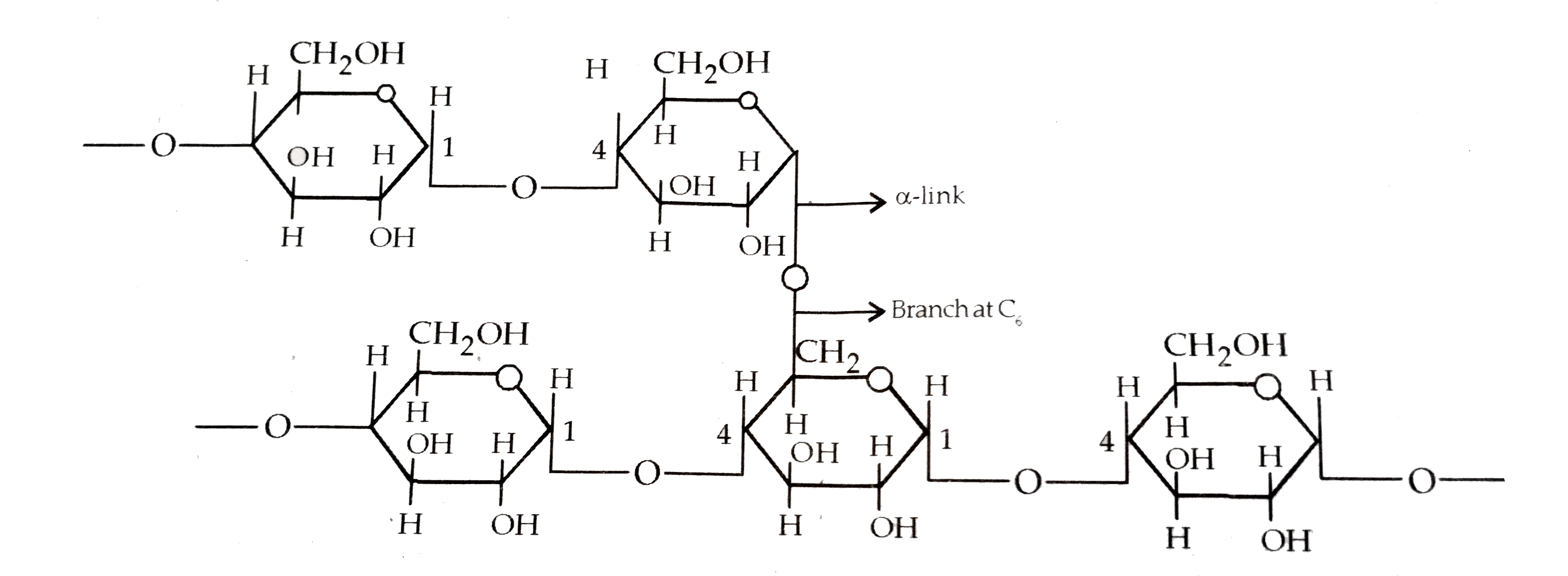 ( c) The amphoteric behaviour of amino acids is explained when it is present in its aqueous state .In an acqueous solution , the carboxyl group of an amino acid can a LOSE a proton and the amino group can accept a proton. |
|
| 12. |
Give any four points of differences between physical and chemical adsorption . |
Answer» SOLUTION :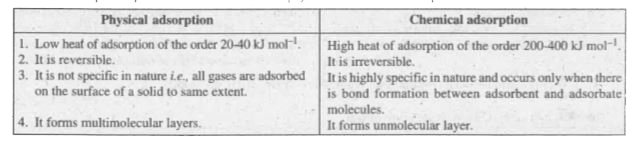
|
|
| 13. |
Give any fourdifferencesbetween DNAand RNA |
Answer» SOLUTION :
|
|
| 14. |
Give any four characteristics of a non-ideal solution showing positive deviations. |
|
Answer» Solution :Positive deviations from Raoult.s law : Here the PARTIAL PRESSURE component .A. in the mixture of .A. and .B. is more than that CALCULATED from Raoult.s law. Similarly, the partial vapour pressure of component .B. can be higher than calculated from Raoult.s law. For example, water and ethanol, chloroform and water, benzene and methanol, acetic acid and toluence, acetone and ethanol, methanol and `H_2O `. In other words, force of attraction between`A HARR B lt A harr A and B harr B.` For positive deviation, `Delta H_("Mixing") = + ve and Delta V _("(mix)")= + v e` Negative deviations from Raoult.s law : (Here the partial vapour pressure of component .A. is found to be less than calculated from Raoult.s law on adding the second component .B.. When .A. is added to .B., the partial vapour pressure of solution is less than that of IDEAL solution of same composition. For example, chloroform and acetone, chloroform and methyl acetate, `H_2Oand HCI, H_2 O and HNO_3` etc. 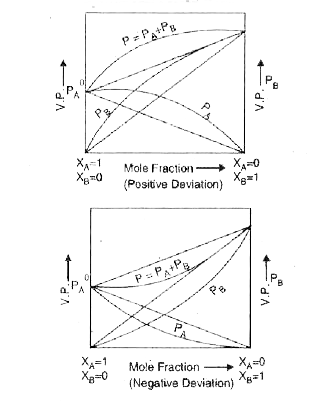
|
|
| 15. |
Give any five chemical differences between aromatic ether and an aliphatic ether. |
Answer» SOLUTION :
|
|
| 16. |
Give any 4 properties of group -18 elements. |
|
Answer» Solution :(i) Electronic configuration `- ns^(2)np^(6)` except helium `(1s^(2))` (II) Atomic radii increase down the GROUP. (iii) They have HIGH ionization enthalpy values. (iv) They have zero electron gain ethalpy values. (V) They have low melting and boiling points due to weak VAN der Waals. forces. Helium has lowest boiling points. (4.2 K) |
|
| 17. |
Give any 2 general characteristics of actinoids. |
|
Answer» SOLUTION :(i) All of them are radioactive. (ii) They are paramagnetic in nature. (iii) The element after URANIUM `(Z = 92)` are CALLED transuranium elements and they are SYNTHETIC elements or MAN made elements. |
|
| 18. |
Give and explain the reaction used to estimation of ozone. |
|
Answer» Solution :Ozone OXIDISES POTASSIUM iodide to iodine. `O_(3)+2KI+H_(2)Orarr 2KOH +O_(2)+I_(2)` This reaction is quantitative and can be USED for estimation of ozone. |
|
| 19. |
Give and explain reducing behaviour of sulphur dioxide. |
|
Answer» Solution :As Sulphur dioxide can readily be oxidised, it acts as a reducing agent. It reduces CHLORINE into hydrochloric acid. `SO_(2)+2H_(2)O+Cl_(2)rarr H_(2)SO_(4)+2HCl` It also reduces potassium permanganate and dichromate to `Mn^(2+) and CR^(3+)` respectively. `2KMnO_(4)+5SO_(2)+2H_(2)Orarr K_(2)SO_(4)+2MnSO_(4)+2H_(2)SO_(4)` `K_(2)Cr_(2)O_(7)+3SO_(2)+H_(2)SO_(4)rarr K_(2)SO_(4)+Cr_(2)(SO_(4))_(3)+H_(2)O` |
|
| 20. |
Give an illustration of Reimer - Tiemann reaction. |
Answer» Solution :When phenol REACTS with `CHCl_(3)` and `KOH` at `60^(@)C`, salicylaldehyde is formed. 
|
|
| 21. |
Give an expression to find out rate of a reaction according to collision theory. |
|
Answer» Solution :Rate ` = PZ_(AE). E^(-(EA)/(RT))`, Where P is probability factor `Z_(AB)` COLLISION frequency of reactants A and B `e^(-(Ea)/(RT))` FRACTION of molecules with energies EQUAL to or greater than `E_(a)`. |
|
| 22. |
Give an example where physisorption charges to chemisorption with rise in temperatue. Explain the reason for the change. |
| Answer» Solution :Adsorrption of `H_(2)` on finely DIVIDED NICKEL at room temperature is due to PHYSISORPTION. As temperature is INCREASED, `H_(2)` dissociates into atoms which are HELD on the surface of nikel by chemisorption. | |
| 23. |
Give an expression for Freundlich adsorption isotherm. |
| Answer» SOLUTION :`(X)/(m)=KPP^(1//n)(NGT1)`. | |
| 24. |
Give an example where physisorption changes to chemisorption with rise in temperature. Explain the reason for the change. |
| Answer» Solution :Physisorption of HYDROGEN on finely DIVIDED NICKEL involves weak van der Waal.s forces. With rise of temperature, hydrogen molecules dissociate into hydrogen atoms which are held on to the SURFACE by CHEMICAL bonds. i.e., chemisorption takes place. | |
| 25. |
Give an example where physisorption changes to chemisorption with rise in temperature. Explain the reason for change. |
| Answer» Solution :The adsorption of hydrogen on finely DIVIDED nickel is due to weak VAN der Waals. forces. Thus, it is an example of physisorption. However, when the temperature is RAISED, the H, molecules breaks into H-atoms which are held by chemical adsorption on the SURFACE of the nickel. | |
| 26. |
Gelatin is generally addid to ice creams. Why? |
| Answer» Solution :Ice cream is an emulsion of milk or cream in WTER, i.e., oil-in-water TYPE. Celatin is added to ACT as an EMULSIFIER, i.r., it HELPS to stabilized the emulsion. | |
| 27. |
Give an example to show the effect of concentration of nitric acid on the formation of oxidation product. |
|
Answer» Solution : Dilute and concentrated nitric acid gives DIFFERENT oxidation PRODUCTS on reaction with copper METAL. `3Cu + 8HNO_3(DIL.)to 3Cu(NO_3)_2 + 2NO+ 4H_2O` `Cu+ 4HNO_3( conc. ) to Cu(NO_3)_2 + 2NO_2 + 2H_2O` NO and `NO_2` are the oxidation products OBTAINED with dil. `HNO_3 ` and conc. `HNO_3` respectively. |
|
| 28. |
Gelatin acts as a protective colloid. Explain. |
| Answer» Solution :Gold sol is a lyophobic colloid which are READILY precipitates with SMALL amount of electrolytes. But they can be stabilised by the ADDITION of small amount of lyophillic colloid like GELATIN. Thus gelatin acts as a PROTECTIVE colloid for gold sol. | |
| 29. |
Give an example to show the effect of concentration of nitric acid on the formation of oxidation product ? |
|
Answer» Solution :Depending upon the concentration, `HNO_(3)` REACTS with METALS to give DIFFERENT oxidation products. With dil. `HNO_(3)`, NO is formed while with conc. `HNO_(3), NO_(2)` is formed. For example, `{:(3Cu + 8 HNO_(3)(dil.)RARR 3 Cu (NO_(3))_(2) + 2NO + 4 H_(2)O),(Cu + 4 HNO_(3)(conc.)rarr Cu (NO_(3))_(2) + 2 NO_(2) + 2 H_(2)O):}` |
|
| 30. |
Give anexample ofzonerefiningof metals. |
| Answer» SOLUTION :Highlypurifiedmetals likegermaniumneededfor makinsemiconductorsis preparedbyzonerefining . Thepurifiedmetalcontainsas littleas 7- 10ppm ofimpurities. | |
| 31. |
Gel is: |
|
Answer» LIQUID DISPERSED in gas |
|
| 32. |
Give an example for a zero order reaction. |
| Answer» Solution :`2NH_(3)overset("Mo, heat")UNDERSET("high pressure")rarr N_(2)+3H_(2)"rate "=K[NH_(3)]^(0)` | |
| 33. |
Gebriel phthalimide synthesis is preferred for the preparation of aliphatic primary amines. Explain. |
| Answer» Solution :In aromatic amines, the lone pair of ELECTRONS on the N-atom is delocalized over the benzene ring. As a result electron density on THENITROGEN atom decreases. Whereas in aliphatic primary amines, due to `+I` effect of alkyl GROUP, electron density on NITROGEN atom increases. As the `pK_(b)` VALUE of aliphatic amines is less than that of aromatic amines, aromatic amines are less basic than primary aliphatic amines. Hence, Gabriel phthalimide synthesis is preferred for the preparation of aliphatic amines. | |
| 34. |
Ge(II) compounds are powerful reducing agents whereas Pb(IV) compounds are strong oxidants. It is because |
|
Answer» Pb is more electropositive than Ge |
|
| 35. |
Give an example of sulpha drugs. |
| Answer» Solution :SULPHAPYRIDINE is used for treatment of PNEUMONIA and sulphaguanidine is used for treatment of severe BACILLARY DYSENTERY. | |
| 36. |
Geiger and Marsden's experiment, which established the nuclear model of the atom, used a beam of : |
|
Answer» `BETA-`particles, which impinged on a metal foil and got absorbed |
|
| 37. |
Gd^(+3) ions has electronic configuration |
|
Answer» `4f^(0) , 5D ^(0), 6S^(0) ` |
|
| 38. |
Gay-Lussac's law of combining volume is applicable for those gases which on mixing: |
|
Answer» Do not react |
|
| 39. |
Gattermann reactionismodifiedformof |
|
Answer» diazotizations REACTION |
|
| 40. |
Give an example of sulfa drug. |
| Answer» SOLUTION :SULFADIAZINE or sulfapyridine. | |
| 41. |
Gattermannreactionconvertbenzenediazoniumchloride to(1)Chlordobenezene(2)bromobenzene (3) toluene(4) nitrobenzene |
|
Answer» 1,4 |
|
| 42. |
Gauche form in less stable than anti form in |
|
Answer» ETHYLENE GLYCOL 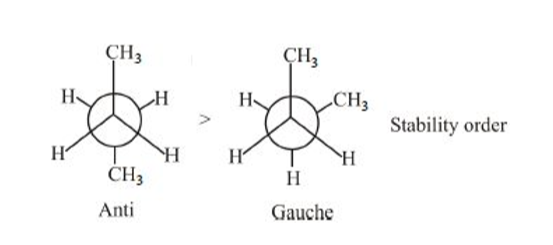
|
|
| 43. |
Gastric juice contains about 3.0 g of HCl per litre. If a person produces about 2.5 litre of gastric juice per day, how may antacid tablets each containing 400 mg of Al(OH)_(3) are needed to neutralize all the HCl produced in one day. |
|
Answer» Solution :HCl is neutralized by `Al(OH)_(3)` according to the EQUATION, `UNDERSET(27+3xx17=78g)(Al(OH)_(3))+underset(3xx36.5=109.5g)(3HCl)rarrAlCl_(3)+3H_(2)O` HCl produced from 2.5 litre of gastric juice `=3.0xx2.5=7.5g` 109.5 g HCl is neutralized by `Al(OH)_(3)=78g` `THEREFORE"7.5 g HCl will be neutralized by "Al(OH)_(3)=(78)/(109.5)xx7.5g=5.342g=5342mg` `therefore"Number of tablets required "=(5342)/(400)=13.35, " i.e., 14 tablets."` |
|
| 45. |
Gastric juices contain: |
|
Answer» HCI |
|
| 47. |
Gasessuchas CO_(2) and NH_(4) are moresolublein waterthan N_(2)because_________. |
|
Answer» bothhace lowboilingpoints |
|
| 48. |
Gasoline is the name of |
|
Answer» Crude oil |
|