

Saved Bookmarks
This section includes 7 InterviewSolutions, each offering curated multiple-choice questions to sharpen your Current Affairs knowledge and support exam preparation. Choose a topic below to get started.
| 1. |
Give IUPAC names of the following: (a) CH_(3)OCH_(2)-underset(CH_(3)) underset(|)(CH)-CH_(3) "" (b) CH_(3)OCH_(2)CH_(2)Cl "" (c) (##MOD_SPJ_CHE_XII_P2_C11_SLV_015_Q01.png" width="80%"> (d) CH_(3)CH_(2)CH_(2)OCH_(2) "" (e) CH_(3)- underset(CH_(3)) underset(|)(CH)-O-CH_(2)CH_(3) "" (f) (##MOD_SPJ_CHE_XII_P2_C11_SLV_015_Q02.png" width="80%"> |
|
Answer» Solution :IPUAC names: `UNDERSET("1-Methoxy-2-methylopropane")(CH_(3)overset(1)(OCH) underset(CH_(3)) underset(|)overset(2)(CH)-overset(3)(CH_(3))) "" (B) underset("2-Chloro-1-methoxyethane")(CH_(2)overset(1)(OCH_(2))overset(2)(CH_(5)CL))` (c)  (d) `underset("1-Methoxypropane")(overset(2)(CH_(3))overset(2)CH_(2)overset(1)(CH_(2))OCH_(2))``underset("2-Ethoxypropane")(overset(1)(CH_(3))-underset(CH_(3))underset(""^(3)|) overset(2)(CH)-OH-)CH_(2)CH_(3)` (F) 
|
|
| 2. |
Give IUPAC names of the following compounds : |
|
Answer» SOLUTION :(a) CHLOROPHENYLMETHANE (b) 1-Bromo-3- phenylpropane (c) 1,1-Dichloro-2-phenylethane (d) 3-Chlorotoluene (e) Trichlorophenylmethane (F) 1-Bromo-3-chlorobenzen (g) 2-Chloro-2-phenylbutane (h) 1,4-Dichlorobenzene (i) 4-Bromo-1,1-dibromo-1-phenylmethane (J) 3-Bromo-1-phenylpropene |
|
| 3. |
Give IUPAC names of the followingCH_3 - undersetoverset(|)(Cl)(CH) - undersetoverset(|)(Cl)(C )H - undersetoverset(|)(CH_3)(C) H - CH_2 OH |
| Answer» SOLUTION :4 - Chloro-2, 3-dimethylpentan - L - OL | |
| 4. |
Give IUPAC names of the CH_(3)-underset(CH_(3))underset(|)CH-O-CH_(2)CH_(3) |
| Answer» SOLUTION : 2 - ETHOXYPROPANE | |
| 5. |
Give IUPAC names of following compounds. |
|
Answer» SOLUTION :(i) 2-Hydroxybutanedioic ACID (II) 3-Ethylcyclohexanecarboxylic acid (iii) Benzene-1,4-dicarboxylic acid (IV) 4-Oxocyclohexanecarboxylic acid (v) 2-Aminobenzoic acid (vi) 2,4,6-Tribromobenzoic acid (VII) 5,5-Dimethylhex-2-enoic acid (viii) 4-Hydroxy-2-nitrocyclopentanecarboxylic acid |
|
| 6. |
Give IUPAC names of the following |
| Answer» SOLUTION :2,6 - Dimethylphenol | |
| 7. |
Give IUPAC name of the ionisation isomer of [Pt(NO_(2))(H_(2)O)(NH_(3))_(2)]Br. |
| Answer» SOLUTION :Ionisation ISOMER of the given compound is `[PT(Br)(II_(2)O)(NII_(3) )_(2)]NO_(2)`. Its NAME is diammineaquabromidoplatinum(II) nitrite. | |
| 8. |
Give IUPAC name of the following organic compound : CH_(3)CH = underset(CH_(3))underset(|)C - underset(Br) underset(|)CH - CH_(3) |
| Answer» SOLUTION :4-Bromo -3- methylpent -2- ENE. | |
| 9. |
Give IUPAC name of the following compound : (CH_(3))_(2)C-CH_(2)-overset(O)overset(||)C-CH(CH_(3))_(2) |
| Answer» SOLUTION :2, 5 - Dimethylhexane - 3-one. | |
| 10. |
Give IUPAC name of the following compound. (i) CH_(3)CH(CI)CH(Br)CH_(3) CICH_(2)C=CCH_(2)Br |
|
Answer» SOLUTION :3-Bromo, 2-methyl PROPENE. `CH_(2)=underset(CH_(3))underset(|)(C)-CH_(3)Br` |
|
| 11. |
Give IUPAC name of the ionisation isomer of [(NH_(3))_(3)PtNO_(2)]Cl. |
| Answer» SOLUTION :Ionisation isomer of the given compound is `[(NH_(3))_(3)PTCL]NO_(2)`. Its name is triamminechloridoplatinum(II) nitrite. | |
| 12. |
Give IUPAC name of the compound given below. CH_(3)-underset(Cl)underset(|)(C)H-CH_(2)-CH_(2)-underset(OH)underset(|)(C)H-CH_(3) |
|
Answer» 2-Chloro-5-hydroxyhexane |
|
| 13. |
Give IUPAC name of the compound given below : CH_(3)-underset(Cl)underset("|")"CH"-CH_(2)-CH_(2)-underset(OH)underset("|")"CH"-CH_(3) |
|
Answer» 2 - Chloro-5-hydroyhexane |
|
| 14. |
Give IUPAC name of : (i) [Mn(H_(2)O)_(6)]SO_(4) (ii) [Co(en)_(3)]Cl_(3) |
| Answer» SOLUTION :(i) hexaaquamanganese (II) sulphate (ii) TRIS (ethane-1, 2-diamine) COBALT (III) CHLORIDE. | |
| 15. |
Give IUPAC name of linkage isomer of [(NH_(3))Pt(NO_(2))]Cl. |
|
Answer» SOLUTION :IUPAC NAME of linkage isomer of the given COMPOUND is : Triamminenitrito-O-platinum(II) chloride. |
|
| 16. |
Give IUPAC name of ionization isomer of [Ni(NH_3)_3 NO_3] Cl. |
| Answer» SOLUTION :Tetramminechloro NICKEL (II) NITRATE. | |
| 17. |
Give IUPAC name of : |
| Answer» SOLUTION :3-chloro-2-methylpentane | |
| 18. |
Give IUPA names of the possible functional isomers of formula C_(3)H_(6)O. |
|
Answer» Solution :The following are the functional ISOMERS of formula. `C_3H_6O`. (i) `CH_3CH_2CHO ""`(Propanal) (ii) `CH_3COCH_3""`(Propanone) (iii) `CH_2=CHCH_(2) OH ""` (PROP- 2- EN - 1 - ol) (iv) `CH_(2) = UNDERSET(OH)underset(|)(C) - CH_(3) ""` (Proen - 2-ol) (V) `underset(OH)underset(|)(CH)= CH-CH_3""` (Prop - 1- en - 1 - ol) (vi) `CH_2 = CH - O-CH_3` (Methoxythene ) 
|
|
| 19. |
Give information about the utillity of catalysts in industries. |
Answer» SOLUTION :
|
|
| 20. |
Give information about the type of adsorption. |
|
Answer» Solution :There are mainly two types of adsorption of gases on solids. If accumulation of gas on the surface of a solid occurs on account of weak van der Waals. forces, the adsorption is termed as physical adsorption or PHYSISORPTION. When the gas molecules or ATOMS are held to the solid surface by chemical bonds the adsorption is termed as chemical adsorption or chemisorption. The chemical bonds may be covalent or ionic in nature. Chemisorption involves a high energy of ACTIVATION and is ALSO often referred to as activated adsorption. Sometimes these two processes occurs simultaneously and it is not easy to ascertain the type of adsorption. A physical adsorption at low temperature may pass into chemisorption as the temperature is INCREASED. For example, dihydrogen is first adsorbed on nickel by van der Waals. forces. Molecules of hydrogen then dissociate to form hydrogen atoms which are held on the surface by chemisorption. |
|
| 21. |
Give information about important features of solid catalysts. |
|
Answer» Solution :The IMPORTANT features of SOLID catalysts are as below : (a) Activity : The activity of a catalyst depends upon the strength of chemisorption to a large extent. Theeactants must get adsorbed reasonably strongly on to the catalyst to become active. However, they must not get adsorbed so strongly that they are immobilised and other reactants are left with no space on the catalyst.s surface for adsorption. `2H_(2(g))+O_(2(g))overset(Pt)rarr2H_(2)O_((l))` (b) Selectivity: The selectivity of a catalyst is its ability to direct a reaction to yield a particular PRODUCT selectively, when under the same reaction conditions many products are possible. Selectivity of different catalyst for same reactants is different. For example starting with H, and CO and using different catalysts, we get different products. (i) `CO_((g))+3H_(2(g))overset(Ni)rarrCH_(4(g))+H_(2)O_((g))` (ii) `CO_((g))+2H_(2(g))overset(Cu//ZnO-Cr_(2)O_(3))rarr CH_(3)OH_((g))` (iii) `CO_((g))+H_(2(g))overset(Cu)rarr HCHO_((g))` Thus, it can be inferred that the action of a catalyst is HIGHLY selective in nature. As a result, a substance which ACTS as a catalyst in one reaction may fail to catalyse another reaction. |
|
| 22. |
Give information about the charge on colloidal particles. |
Answer» Solution :Colloidal particles always carry an electrical charge. The nature of this charge is thesame on all the particles in a given colloidal solution and may be either positive or negative. A list of some common sols with the nature of charge on their particles is given below:  The presence of equal and similar charges on colloidal particles is largely responsible in providing stability to the colloidal solution because the repulsive forces between charged particles having same charge prevent them from coalescing or aggregating when they come closer to one another. The charge on the sol particles is due to one or more reasons. viz., due to electron capture by sol particles during electrodispersion of metals, due to preferential adsorption of ions from solution and due to formulation of electrical double layer. Development of charge on sole particles by preferential adsorption of ions is described below. The sole particles acquire positive or negative charge by preferential adsorption of positive or negative ions. When two or more ions are present in the dispersion medium, preferential adsorption of the ion common to the colloidal particles usually takes place. This can be explained by taking the following examples. (a) When highly diluted solution of silver NITRATE is ADDED to highly diluted potassium iodide solution the precipitated silver iodide adsorbs iodide ions from the dispersion medium and negatively charged colloidal sol results. However when Kl solution is added to `AgNO_(3)` solution, positively charged sol result due to adsorption of Ag+ ions from dispersion medium. `underset("Negatively charged")(AgI//I^(-))""underset("Positively charged")(AgI//Ag^(+))` (b) If `FeCl_(2)`is added to the excess of hot water, a positively charged sol of hydrated ferric oxide is formed due to adsorption of `Fe^(+3)` ions. However, when ferric chloride is added to NaOH solution a negatively charged sol is obtained with adsorption of `OH^(-)`ions. `underset("Positively charged")(Fe_(2)O_(3).xH_(2)O //Fe^(3+))""underset("Negatively charged")(Fe_(2).O_(3).xH_(2)O //OH^(-))` Positively charged Negatively charged Having acquired a positive or a negative charge by selective adsorption on the surface of a colloidal particle as stated above this layer attract counter ions from the medium forming a second layer as shown below. `AgI//I^(-)K^(+)""AgI//Ag^(+)I^(-)` The combination of the two layers of opposite charges around the colloidal particles is called Helmholtz electrical double layer. According to modern views, the first layer of ions is firmly held and is termed fixed layer while the second layer is mobile which is termed diffused layer. Below FIGURE depicts the formation of double layer.  Diffused layer Separation of charge is a seat of potential the charges of opposite signs on the fixed and diffused PARTS of the double layer results in a difference in potential between these layers in the same manner as potential difference is developed in a capacitor. This potential difference between the fixed layer and the diffused layer of opposite charges is called the electrokinetic potential or zeta potential. If two particles of an insoluble material (precipitate) do not have double layers they can come close enough and attractive van der Waals. forces pull them together. When particles possess double layer as shown in fig. the overall effect is that particles repel each other at large distance of separation. This repulsion prevents their close approach. They remain dispersed and colloid is stabilised. The addition of more electrolytes to sol suppresses the diffused double layer and reduce the zita potential. This decreases the electrostatic repulsion between particles to a large EXTENT and colloid precipitates. That is why colloid is particularly sensitive to oppositely charged ions. |
|
| 23. |
Give information about lyophilic colloids and lyophobic colloids. |
|
Answer» Solution :(i) Lyophilic colloids : The word .lyophilic. means liquid having colloidal sols directly formed by mixing substances LIKE gum, gelatine, starch, rubber etc. with a suitable liquid (the dispersion medium) are CALLED lyophilic sols. An important characteristic of these sol is that if the dispersion medium is separated from the dispersed phase the sol can be reconstituted by simply remixing with the dispersion medium. That is why these sols are also called reversible sols. Furthermore, these sols are quite stable and cannot be easily COAGULATED as discussed later. (ii) Lyophobic colloids : The word .lyophobic. means liquid hating. Substance like metals, their sulphides etc., when simply mixed with the dispersion medium do not form the colloid sol. Their colloidal sols can be prepared only by special METHODS. Such sols are called lyophobic sols. These sols are readily precipitated on the addition of small amounts of electrolytes, by heating or by shaking and hence are not stable. Further once precipitated they do not give back the colloidal sol by simple addition of the dispersion medium. Hence, these sols are also called irreversible sols. Lyophobic sols need stabilising agents for their preservation. |
|
| 24. |
Give information about Homogeneous catalysis and Heterogeneous catalysis. |
|
Answer» Solution :Homogeneous Catalysis : When the REACTANTS products and the catalyst are in the same phase, the process is said to be homogeneous catalysis. The following are some of the examples of homogeneous catalysis : (i) OXIDATION of sulphur dioxide into sulphur trioxide with dioxygen in the PRESENCE of oxides of nitrogen as the catalyst in the lead chamber process. `2SO_(2(g))+O_(2(g))overset(NO_((g)))rarr 2SO_(3(g))` The reactants, sulphur dioxide and oxygen, and the catalyst nitric oxide are all in the same phase. (ii) Hydrolysis of methyl acetate is catalysed by `H^(+)` ions furnished by hydrochloric ACID. `CH_(3)COOCH_(3())+H_(2)O_((l))overset(HCl_((l)))rarr CH_(3)COOH_((aq))+CH_(3)OH_((aq))` Both the reactants and the catalyst are in the same phase. (iii) Hydrolysis of sugar is catalysed by `H^(+)` ions furnished by sulphuric acid.  Both the reactants and the catalyst are in the same phase. Heterogeneous catalysis : The catalytic process in which the reactants and the catalyst are in different PHASES is known as heterogeneous catalysis. Some of the examples of heterogeneous catalysis are given below: (i) Oxidation of sulphur dioxide into sulphur trioxide in the presence of Pt. `2SO(2(g))+O_(2(g))overset(Pt_((s)))rarr 2SO_(3(g))` The reactant is in gaseous state while the catalyst is in the solid state. (ii) Combination between dinitrogen and dihydrogen to form ammonia in the presence of finely divided iron in Haber.s process. `N_(2(g))+3H_(2(g))overset(Fe_((s)))rarr2NH_(3(g))` The reactants are in gaseous state while the catalyst is in the solid state. (iii) Oxidation of ammonia into nitric oxide in the presence of platinum gauze in Ostwald.s process. `4NH_(3(g))+SO_(2(g))overset(Pt_((s)))rarr 4NO_((g))+6H_(2)O_((g))` The reactants are in gaseous state while the catalyst is in the solid state. (iv) Hydrogenation of vegetable oils in the presence of finely divided nickel as catalyst. `"Vegetable oils"_((l))+H(2(g))overset(Ni_((s)))rarr"Vegetable ghees"_((s))` One of the reactants is in liquid state and the other in gaseous state while the catalyst is in the solid state. |
|
| 25. |
Give information about Freundlich adsorption isotherm. |
|
Answer» Solution :Freundlich, in 1909 gave an empirical relationship between the quantity of gas adsorbed by unit mass of solid ADSORBENT and pressure at a particular temperature. The relationship can be expressed by the following equation. Where x is the mass of gas adsorbed on mass m of the adsorbcnt at pressure p. k and n are constants which depends on the nature of the adsorbent and the gas at a particular temperature. The relationship is generally represented in the form of a curve where mass of gas adsorbed per gram of the adsorbent is plotted against pressure. These curves indicates that at a fixed pressure, there is a decrease in physical adsorption with increase in temperature. These curves always seem to approach saturation at high pressure.  Taking logarithm of eq. (1) `log""(x)/(m)=logk+(1)/(n)logp"....(2)"` The validity of Freundlich isotherm can be verified by plotting `log""(x)/(m)` on Y - axis (ordinate) and log p on X - axis (abscissa). If it comes to be a straight line, the Freundlich isotherm is valid, otherwise not. The slope of the straight line gives the value of `(1)/(n)`. Theintercept on the Y - axis gives the value of `logk`.  Freundlich isotherm explains the behaviour of adsorption in an approximate MANNER. The factor `(1)/(n)` can have VALUES between 0 and 1 (probable range 0.1 to 0.5). Thus, equation (2) holds good over a limited range of pressure. When `(1)/(n)=0, (x)/(m)=` constant, the adsorption isindependent of pressure. When `(1)/(n)=1, (x)/(m)=k,p` i.e. `(x)/(m) prop p`, the adsorption varies directly with pressure. Both the CONDITIONS are supported by experimental RESULTS. The experimental isotherms always seem to approach saturation at high pressure. This cannot be explained by Freundlich isotherm. Thus, it fails at high pressure. |
|
| 26. |
Give information about Emulsion. |
|
Answer» Solution :These are liquid-liquid colloidal systems, i.e., the dispersion of finely divided droplets in another liquid. If a mixture of two immiscible or partially miscible liquid is shaken, a coarse dispersion of one liquid in the other is obtained which is called emulsion. Generally, one of the two liquids is water. There are two types of emulsions. (i) Oil dispersed in water (o/w type) (ii) Water dispersed in oil (w/o type) In the first system, water act as dispersion medium. Example of this type of emulsion are milk and vanishing cream. In milk, liquid FAT is dispersed in water. In the second system, oil acts as dispersion medium. Common examples of this type are butter and cream.  Emulsion of oil in water are unstable and sometimes they separate into two layers on standing. For STABILISATION of an emulsion a third component called emulsifying agent is usually added. The emulsifying agent forms an interfacial film between suspended particles and the medium. The principal emulsifying agent for o/w emulsions are proteins, GUMS, natural and synthetic soaps, etc. and for w/o heavy metal salts of fatty acids, long chain alcohol, LAMPBLACK etc. Emulsion can be diluted with any amount of the dispersion medium. On the other hand the dispersed liquid when mixed, forms a separate layer. The droplets in emulsions are often negatively charged and can be precipitated by electrolytes. They also show Brownian movement and Tyndall effect. Emulsion can be broken into constituent liquids by heating, freezing, CENTRIFUGING etc. |
|
| 27. |
Give information about examples of colloids. |
|
Answer» Solution :Examples of colloids are as below : (i) Blue colour of the sky: Dust particles ALONG with WATER suspended in air scatter blue light which reaches our eyes and the sky LOOKS blue to us. (ii) Fog, mist and rain : When a LARGE mass of air containing dust particles is cooled below its dewpoint the moisture from the air condense on the surfaces of these particles forming fine droplets. These droplets being colloidal in nature continue to float in air in the form of mist or fog, Clouds are aerosols having small droplets of water suspended in air. On account of condensation in the upper atmosphere, the colloidal divplets of water grow bigger and bigger in size, till they come down in the form of rain. Sometimes, the rainfall occurs when two oppositely charged clouds meet. It is possible to cause artificial rain by throwing electrified SAND or spraying a sol carrying charge opposite to the one on clouds from an aeroplane. (iii) Food articles : Milk, butter, halwa, ice-cream, fruit juices etc. are all colloids in one form or the other. (iv) Blood: It is a colloidal solution of an albuminoid substance. The styptic action of alum and ferric chloride solution is due to coagulation of blood forming a clot which stops further bleeding. (v) Soils : Fertile soils are colloidal in nature in which humus acts as a protective colloid. On account of colloidal nature, soils absorbs moisture and nourishing materials. (vi) Formation of delta : River water is a colloidal solution of clay. Sea water contains a number of electrolytes. When river water meets the sea water, the electrolytes present in sea water coagulate the colloidal solution of clay resulting in its deposition with the formation of delta. |
|
| 28. |
Give information about colloids. |
|
Answer» Solution :We know that solutions are homogeneous systems. We ALSO know that sand in water when STIRRED gives a suspension, which slowly settle down with time. Between the two extremes of suspensions and solution we come across a large group of systems called colloidal dispersions or simply colloids. A colloid is a heterogeneous system in which one substance is dispersed as very fine particles in another substance called DISPERSION medium. The essential difference between a solution and a colloid is that of particle size. In a solution, the constituent particles are IONS or small molecules. In colloid the dispersed phase may consist of particles of a single molecules. (Such as protein or synthetic polymer) or an aggregate of many atoms, ions or molecules. Colloidal particles are larger than simple molecules but small enough to remain suspended. Their range of diameters is between 1 to 1000 nm. `(10^(-9)” to “10^(-6) m)`. |
|
| 29. |
Give information about colligative properties and colour of colloidal solutions. |
| Answer» SOLUTION :Colligative Properties : Colloidal particles being bigger aggregates the NUMBER of particles in a colloidal solution is comparatively small as compared to a true solution. Hence, the VALUES of colligative properties (osmotic pressure, lowering in vapour pressure, depression in freezing POINT and elevation in boiling point) are of small order as compared to values shown by true SOLUTIONS at same concentration. | |
| 30. |
Give information about Brownian movement. |
|
Answer» Solution :When colloidal solution are viewed under a powerful ultramicroscope the colloidal particles appear to be in a STATE of continuous zig-zag motion all over the field of view. This motion was FIRST OBSERVED by the British botanist ROBERT Brown and thus it is known as Brownian MOVEMENT.  This motion is independent of the nature of the colloid but depends on the size of the particles and viscosity of the solution. Smaller the size and lesser the viscosity, faster is the motion. The Brownian movement has been explained to be due to the unbalanced bombardment of the particles by the molecules of the dispersion medium. This motion is independent of the nature of the colloid but depends on the size of the particles and viscosity of the solution. Smaller the size and lesser the viscosity, faster is the motion. The Brownian movement has been explained to be due to the unbalanced bombardment of the particles by the molecules of the dispersion medium. The Brownian movement has a stirring effect which does not permit the particles to settle and thus is responsible for the stability of sols. |
|
| 31. |
Give information about coagulation or precipitation. |
|
Answer» Solution :The stability of the lyophobic sol is due to the presence of charge on colloidal particles. If somehow, the charge is removed, the particles will come nearer to each other to form aggregates (or coagulate) and SETTLE down under the force of gravity. The process of SETTLING of colloidal particles is called coagulation or precipitation of the sol. The coagulation of the lyophobic sols can be carried out in the following ways: (i) By electrophoresis : The colloidal particles move towards oppositely charged electrodes get discharged and precipitated. (ii) By mixing TWO oppositely charged sol : Oppositely charged sols when mixed in almost equal proportions, neutralise their charge and get partially or completely precipitated. Mixing of hydrated ferric oxide (`+ve` sol) and arsenious sulphide (`-ve` sol) bring them in the precipitated forms. This type of coagulation is called mutual coagulation. (III) By boiling : When a sol is boiled the adsorbed layer is disturbed due to increased collisions with the molecules of dispersion medium. This reduce the charge on the particles and ultimately leads to settling down in the form of a precipitate. (iv) By persistent dialysis : On prolonged dialysis, traces of the electrolyte present in the sol are removed almost completely and the colloids become unstable and ultimately coagulate. (v) By addition of electrolytes : When excess of an electrolyte is added the colloidal particles are precipitated. The reason is that colloids interact with ions carrying charge OPPOSITE to that present on themselves. This causes neutralisation leading to their coagulation. The ion responsible for neutralisation of charge on the particles is called the coagulating ion. A negative ion cause the precipitation of positively charged sols and vice versa. It has been observed that generally the greater the valence of the flocculating ion added, the greater is its power to cause precipitation. This is known as Hardy-Schulze rule. In the coagulation of a negative sol the flocculating power is in the order : `Al^(3+) gt Ba^(2+) gt Na^(+)` similarly in the coagulation of a positive sole the flocculating power is in the order : `[Fe(CN)_(6)]^(-4)gt PO_(4)^(-3) gt SO_(4)^(-2) gt Cl^(-)` The minimum concentration of an electrolyte is millimoles per liter required to cause precipitation of a sol in two hours is called coagulating value. The smaller the quantity needed, the higher will be the coagulating power of an ion. |
|
| 32. |
Give information about catalysis and explain about promoters. |
|
Answer» Solution :Potassium CHLORATE, when heated strongly decomposes slowly giving dioxygen. The decomposition occurs in the temperature range of 653-873 K. `2KClO_(3)rarr 2KCl+3O_(2)` However, when a little of manganese dioxide is added, THC decomposition takes place at a considerably lower temperature range, i.e. `473-633 K` and also at a much accelerated rate. The added manganese dioxide remains unchanged with respect to its mass and composition. In a similar manner the rates of a number of chemical reaction can be altered by the mere presence of foreign substance. The systematic study of the effect of various foreign substances on the rates of chemical reactions was first made by Berzelius in 1835. He suggested the term catalyst for such substances. Substances, which ACCELERATE the rate of a chemical reaction and themselves remain chemically and quantitativel unchanged after the reaction are known as catalysts and the phenomenon is known as catalysis. Promoters and poisons : Promoters are substance that enhance the activity of a catalyst while poisons decrease the activity of a catalyst. For EXAMPLE, in Haber.s process for manufacture of ammonia, molybdenum acts as a promoter for iron which is used as a catalyst. `N_(2(g))+3H_(2(g))OVERSET(Fe_((s)))underset(Mo_((s)))rarr2NH_(3(g))` |
|
| 33. |
Give information about applications of colloids. |
|
Answer» Solution :Colloids are widely used in the industry. Following are some examples : (i) Electrical precipitation of SMOKE : Smoke is a colloidal solution of solid particles such as carbon, arsenic compounds, dust etc. in air. The smoke, before it comes out from the chimney is led through a chamber containing plates having a charge opposite to that carried by smoke particles. The particles on coming in contact with these plates lose their charge and get PRECIPITATED. The particles thus settle down on the floor of the chamber. The precipitator is called cottrell precipitator.  (ii) Purification of drinking water : The water obtained from natural sources often contains suspended impurities. Alum is added to such water to coagulate the suspended impurities and make water fit for drinking purpose. (iii) Medicines : Most of the medicines are colloidal in nature. For example, argyrol is a silver sol used as an eye lotion. Colloidal antimony is used in curing kalaazar. Colloidal gold is used for intramuscular injection. Milk of magnesia an emulsion is used for stomach disorder. Colloidal medicine are more effective because they have large surface area and are therefore easily assimilated. (iv) Tanning : Animal hides are colloidal in nature. When a hide, which has positively charged particles is soaked in tannin, which contains negatively charged colloidal particles, mutual coagulation takes place. This RESULTS in the hardening of leather. This process is termed as tanning. Chromium salts are also used in place of tannin. (v) Cleansing action of soaps and detergent : This has already been DESCRIBE in section 5.4.3. (vi) Photographic plates and films : Photographic plates or films are prepared by coating an emulsion of the light sensitive silver bromide in gelatin over glass plates or celluloid films. (VII) Rubber industry : Latex is a colloidal solution of rubber particles which are negatively charged. Rubber is obtained by coagulation of latex. (viii) Industrial products : Paints, inks, synthetic plastics, rubber, graphite lubricants, cement etc. are all colloidal solution. |
|
| 34. |
Give important differences between lanthanides and actinides |
Answer» SOLUTION :
|
|
| 35. |
Give graph of Lamda_(m) to c^(1//2) of aqueous solution strong and weak electrolyte, clarify their difference and uses. |
Answer» SOLUTION :* Graph of `Lamda_(m) to C^(1//2)` aqueous solution of STRONG and WEAK electrolyte is as follows:  
|
|
| 36. |
Give Friedel craft reaction of chlorobenzene (equation only). |
Answer» SOLUTION :
|
|
| 37. |
Give four uses of emulsions. |
|
Answer» SOLUTION :(i) The cleansing action of SOAP is due to emulsions. (ii) It is used in the preparation of vanishing cream. (iii) It is used in the preparation of cod liver oil. (IV) It is used in the preparation of butter, cream ETC. |
|
| 38. |
Give four industrial applications of enzymes along with their names. |
| Answer» | |
| 39. |
Give four examples of natural polymers. |
|
Answer» Solution :(i) RUBBER (II) CELLULOSE (iii) Starch (IV) WOOL (v) Silk |
|
| 40. |
Give four examples of heterogeneous catalysis. |
|
Answer» Solution :Examples of HETEROGENEOUS CATALYSIS : (i) `N_2(G) + 3H_2(g) overst(Fe) to 2NH_3(g)` (ii) `CO(g) + 2H_2(g) OVERSET(ZnO /Cr_2O_3)to CH_3OH` (iii) `CH_2=CH_2+ H_2 underset(573K) overset(Ni) to CH_3-CH_3` 
|
|
| 41. |
Give an example of natural polymer. |
|
Answer» Solution :(i) RUBBER (ii) Cellulose (iii) Starch (IV) Wool (V) SILK |
|
| 42. |
Give four example of carbonyl compounds? |
| Answer» Solution :`{:((i) H-UNDERSET(O)underset(||)C-H,"Formaldehyde"),((ii) CH_3-underset(O)underset(||)C-H,"Acetaldehyd"),((III) CH_3-underset(O)underset(||)C-CH_3,"Acetone"),((iv) C_6H_5-underset(O)underset(||)C-CH_3,"Acetophenone"):}` | |
| 43. |
Give four differences between an electrochemical cell and an electrolytic cell. |
Answer» SOLUTION :DIFFERENCES between ELECTROCHEMICAL CELL and eletrolytic cell.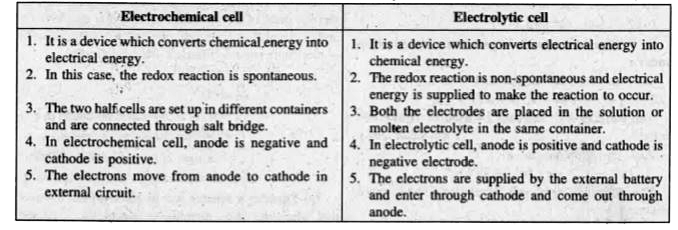
|
|
| 44. |
Give following reaction of aryl halides :(i) Halogenation(ii) Nitration(iii) Sulphonation(iv) Friedel - crafts reaction |
Answer» SOLUTION :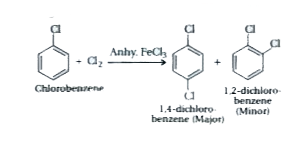 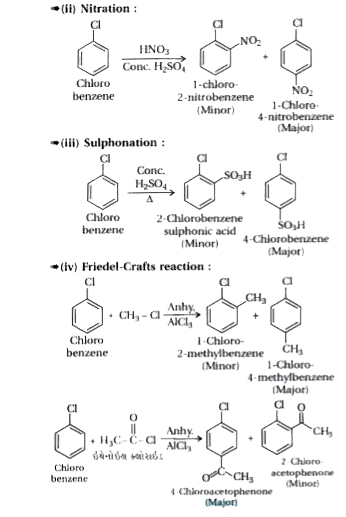
|
|
| 45. |
Give Faraday law and its uses. |
|
Answer» Solution :* Micheal Faraday was the firswt scientist who described the quantitative aspects of electrolysis. * After his extensive investigations on electrolysis of solutions and melts of electrolytes, Faraday published his results during 1833-34 in the form of the FOLLWING well known Faraday.s two laws of electrolysis: (i) First LAW : The amount of chemical reaction which occurs at any electrode during electrolysis by a current is proportional to the quantity of electricity passed through the electrolyte (solution or melt). (ii) Second Law : The AMOUNTS of different substances liberated by the same quantity of electricity passing through the ELECTROLYTIC solution are proportional to their chemical equivalent weights (Atomic Mass of Metal`:-` Number of electrons required to reduce the CATION). |
|
| 46. |
Give Fischer'sopenringstructureandHaworth'sring structureoffructose. |
Answer» SOLUTION :FISCHER's openstructure 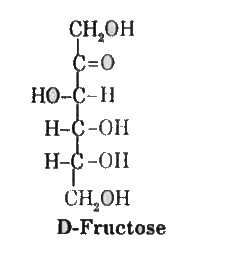 Fischer's ringstructures 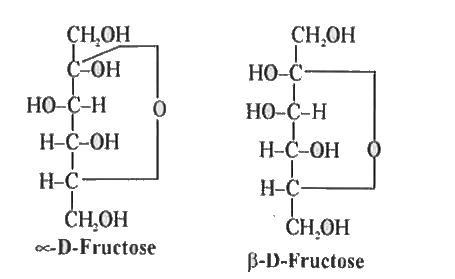 Haworth'sStructureofFructose 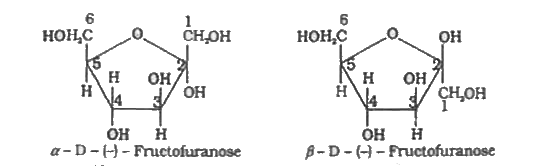
|
|
| 47. |
Give explanation on application of adsorption. |
|
Answer» Solution :The phenomenon of adsorption finds a number of applications. Important ones are listed here : (i) Production of HIGH vacuum : The remaining traces of air can be adsorbed by charcoal from a vessel evacuated by a vacuum pump to give a very high vacuum. (ii) Gas masks : Gas mask (a device which consists of activated charcoal or mixture of adsorbents) is usually used for breathing in coal mines to adsorb poisonous gases. (iii) Control of humidity : Silica and aluminium gels are used as adsorbents for removing moisture are controlling humidity. (iv) Removal of colouring matter from solutions : Animal charcoal removes colours of solution by adsorbing coloured impurities. (v) Heterogeneous catalysis : Adsorption of reactants on the solid surface of the catalyts increases the rate of reaction. There are many gaseous reactions of industrial importance involving solid catalysts. Manufacture of ammonia using iron as a catalysts, manufacture of `H_(2)SO_(4)` by contact process and use of finely divided nickel in the hydrogenation of oils are excellent examples of heterogeneous catalysis. (vi) Separation of inert gases : Due to the difference in degree of adsorption of gases by charcoal, a mixture of noble gases can be separated by adsorption on coconut charcoal at different temperatures. (vii) In curing diseases : A number of drugs are used to kill germs by getting adsorbed on them. (viii) Froth floatation process: A low grade sulphide ore is concentrated by separation it from silica and other earthy matter by this method using pine oil and frothing agent. (ix) Adsorption indicators : Surfaces of CERTAIN precipitate such as silver halides have the property of adsorbing some dyes like eosin, fluorescein, etc. and thereby producing a characteristic COLOUR at the end point. (x) Chromatographic analysis : Chromato graphic analysis BASED on the phenomenon of adsorption finds a number of applications in analytical and industrial fields. |
|
| 48. |
Give examples to show that alkyl halides undergoes nucleophilic substitution reactions. |
Answer» SOLUTION :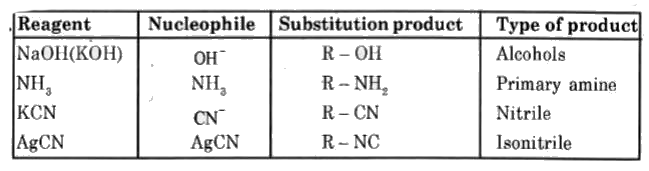
|
|
| 49. |
Give examples of two coordination number . |
|
Answer» Solution :(i)`[CO(NH_3)_6][CR(CN)_6]` (II)`[Cr(NH_3)_6][Co(CN)_6]` |
|