Saved Bookmarks
This section includes 7 InterviewSolutions, each offering curated multiple-choice questions to sharpen your Current Affairs knowledge and support exam preparation. Choose a topic below to get started.
| 1. |
Give one example each of (i) an acidic oxide (ii) a basic oxide (iii) an amphoteric oxide. |
| Answer» SOLUTION :`(i) SO_2 (II) Na_2O (III)ZNO` | |
| 2. |
Giveone exampleeach of(i)addition polymers(ii) condensationpolymers , (iii) copolymers . |
|
Answer» Solution :(i) Addition polymers `underset("Polythene")(-(CH_(2) - CH_(2))-_(n))` (ii) Condensation polymers `underset("Nylon")([-NH(CH_(2))_(6)NHCO(CH_(2))_(4)CO-]_(n))` (iii) Copolymers 
|
|
| 3. |
Give one example each of hormones from the categories of steroids and amino acid derivative. |
|
Answer» Solution :STEROID : Estrogen Amino ACID DERIVATIVE : EPINEPHRINE |
|
| 4. |
Give one example each of essential and non - essential amino acids. |
|
Answer» Solution :ESSENTIAL AMINO acid - VALINE or phenylalanine Non -essential amino acid - GLYCINE or ALANINE. |
|
| 5. |
Give one example each for the following: (i) Antifertility drugs (ii) Narcotic analgesics. |
|
Answer» SOLUTION :(i) NORETHINDRONE or Ethynylestradiol [Novestrol]. (ii) Morphine, Heroin or CODEINE. |
|
| 6. |
Give one example each for synthetic and semi-synthetic polymers. |
| Answer» Solution :Examples of SYNTHETIC POLYMERS: NEOPRENE,Buna-s,Buna-N Examples of SEMI synthetic polymers: cellulose rayon ,cellulose NITRATE. | |
| 7. |
Give one example each for linear and branched chain polymers. |
|
Answer» Solution :1) Linear polymers : These contains long and straight chains. E.g. :PVC ,polythene (HIGH DENSITY) etc. 2) Branched chains polymers : These contains linear chains having some branches. E.g.: LOW density polythene . |
|
| 8. |
Give one example each for essential and non-essential amino acids. |
|
Answer» SOLUTION :ESSENTIAL AMINO ACID — Valine Non-essential amino acid - Glycine |
|
| 9. |
Give one chemical tet to distinguish between the following pairs of compounds: (i) Methylamine and dimethylamine. (ii) Secondary and tertiary aniline. (iii) Ethylamine and aniline. (iv) Aniline and benzylamine. (v) Aniline and N-methylaniline. |
|
Answer» Solution :(i) These can be distinguished by the carbylamine test. Methylamine is a PRIMARY amine, THEREFORE, it gives carbylamine test, i.e., when heated with an alcoholic solution of KOH and `CHCl_(3)`, it gives offensive smell of methyl isocyanide. In constrast, dimethylamine is a secondary amine and hence does not give this test. `underset("Methylamine "(1^(@)" Amine"))(CH_(3)NH_(2))+CHCl_(2)+ underset((alc))(3KOH)overset(Delta)to underset("Methyl isocyanide (offensive smell)")(CH_(3)N overset(to)(=)C+3KCl +3H_(2)O` `underset("Dimethylamine "(2^(@)" Amine"))((CH_(3))_(2)NH) underset(Delta)overset(CHCl_(3)//KOH(alc))to ` No REACTION. (II) These can be distinguished by Liebermann nitrosoaine test since `2^(@)` amines give Liebermann nitrosoaine test while `3^(@)` amines do not. `2^(@)` amines on treatment with `HNO_(2)` (generated in situ by the action of dol. HCl on `NaNO_(2)`) gives yellow coloured oily N-nitrosoamines. for example, `underset("Diethylamine")((CH_(3)CH_(2))_(2)NH)+HO-N=O to underset("N-Nitrosodiethylamine (Yellow colour)")((CH_(3)CH_(2))_(2)N-N=O)+H_(2)O` N-Nitrosodiethylamine on warming with a crystal of phenol and conc. `H_(2)SO_(4)`, gives a gree solution which when made alkaline with aqueous, NaOH turns deep blue and then red on dilution. Tertiary amines, on th other hand, do not give this test. |
|
| 10. |
Give one difference between homogenous catalysis and heterogeneous catalysis. |
| Answer» | |
| 11. |
Give one example cach for (a) Tranquilizer (b) Antiseptic. |
| Answer» SOLUTION :(a) EQUANIL, NORADRENALINE.(B) DETTOL, Terpineol | |
| 12. |
Give one chemical test to distinguish between the following pairs of compounds : Secondary and tertiary amines |
|
Answer» Solution :There can be distinguished by Liebermann nitrosoamine test. Secondary amines give Libebermann nitrosoamine test while tertiary amines do not. `2^(@)` Amines on treatment with `HNO_(2)` gives yellow coloured oily N-nitrosoamines. `underset("Diethylamine")((CH_(3)CH_(2))_(2)NH)+underset("Nitrous acid")(HO-N=O) rarr underset(underset("(yellow colour)")(N-Nitrosodiethylamine))((CH_(3)CH_(2))_(2)N-N=O)+H_(2)O` N-Nitrosodiethylamine on warmingwith a crystal of phenol and conc. `H_(2)SO_(4)`, gives a GREEN solution which when made ALKALINE with AQUEOUS NaOH turns deep blue and then red on dilution. Tertiary amines do not give this test. |
|
| 13. |
Give one chemical test to distinguish between the following pairs of compounds : Methylamine and dimethylamine |
|
Answer» Solution :Carbylamine test : Methylamine is a primary amine, therefore, it gives carbylamine test. When heated with an alcoholic solution of KOH and `CHCl_(3)`, it gives offensive smell of methyl isocyanide. DIMETHYLAMINE is a secondary amine and hence does not give this test. `underset(underset((1^(@)"Amine"))("Methylamine"))(CH_(3)NH_(2))+CHCl_(3)+underset((alc.))(3KOH) overset(Delta)(RARR)underset(underset(("offensive smell"))("Methyl isocyanide"))(CH_(3)NC)+3KCl+3H_(2)O+underset(underset((2^(@)"Amine"))("Dimethylamine"))((CH_(3))_(2)NH)underset(Delta)overset(CHCl_(3)//KOH(alc.))(rarr)"No reaction"` |
|
| 14. |
Give one chemical test to distinguish between the following pairs of compounds : Aniline and N-methylaniline |
|
Answer» Solution :Aniline `(C_(6)H_(5)NH_(2))` is a primary amine while N-methylamiline `(C_(6)H_(5)NHCH_(3))` is a secondary amine. These may be distinguished by the following tests. 1. Carbylamine TEST : Aniline on heating with an alcoholic solution of KOH and `CHCl_(3)` gives an offensive smell of phenyl ISOCYANIDE. `underset("Aniline")(C_(6)H_(5)NH_(2))+CHCl_(3)+underset(ALC.)(3KOH) rarr underset(underset(underset("(offensive smell)")("isocyanide"))("Phenyl"))(C(6)H_(5)NC)+_3KCl+3H_(2)O` N-methylamine does not give carbylamine test. 2. Azo dye test : Aniline gives azo dye test on treatment with `HNO_(2)(NaNO_(2)+dil.HCl)` at 273 - 278 K, followed by treatment with ALKALINE solution of b-napthol. An orange dye is obtained. For chemical reaction, see (iii) above. N-Methylaniline gives an oily yellow coloured N-methyl-N-nitroaniline as shown by the following EQUATION : `underset(underset(underset("N-Methylaniline")(CH_(3)))(|))(C_(6)H_(5)-NH+HO)-N=O rarr underset(underset(underset(underset("(Yellow oil)")("N-methyl-N-nitrosoaniline"))(CH_(3)))(|))(C_(6)H_(5)-N-N=O)+H_(2)O` N-methyl-N-nitrosoaniline on warming with a crystal of phenol and conc. `H_(2)SO_(4)` gives a green solution which when made alkaline with aqueous NaOH turns deep blue and then red on dilution. This is known as Liebermann.s nitrosoamine reaction. |
|
| 15. |
Give one chemical test to distinguish between the following pairs of compounds : Ethylamine and aniline |
|
Answer» Solution :Ethylamine `(CH_(3)CH_(2)NH_(2))` is a primary aliphatic amine while aniline `(C_(6)H_(5)NH_(2))` is a primary aromatic amine. Action of nitrous acid `(HNO_(2))`: Ethylamine gives a brisk effervescence of `N_(2)` gas with the formation of alcohol. `UNDERSET("Ethylamine")(CH_(3)CH_(2)NH_(2))+HONO underset(dil.HCl(273-278K))overset(NaNO_(2))(rarr)underset("Ethanol")(CH_(3)CH_(2)OH)+N_(2)uarr+H_(2)O` Aniline reacts with `HNO_(2)` under the above conditions to form benzenediazonium chloride which on treatment with alkaline solution of b-naphthol (2-naphthol) gives an orange dye (Azo dye TEST). 
|
|
| 16. |
Give one chemical test to distinguish between the following pairs of compounds : Aniline and benzylamine |
|
Answer» Solution :Aniline `(C_(6)H_(5)NH_(2))` and benzylamine `(C_(6)H_(5)CH_(2)NH_(2))`. Action of nitrous acid `(HNO_(2))`: BENZYL amine gives a brisk effervescenc of `N_(2)` gas with the FORMATION of alcohol. `underset("Benzyl alcohol")(C_(6)H_(5)CH_(2)NH)+HONO underset(273-278K)overset(NaNO_(2)//HCl)(rarr)underset("Benzyl alcohol")(C_(6)H_(5)CH_(2)OH)+N_(2)uarr+H_(2)O` Aniline REACTS with `HNO_(2)` under the above conditions to form benzenediazonium chloride which on treatment with alkaline solution of b-naphthol gives an orange dye (Azodye TEST). For reactions, SEE (iii) above. |
|
| 17. |
Give one chemical test to distinguish between C_(2)H_(5)Br and C_(2)H_(5)CI. |
|
Answer» Solution :`C_(2)H_(5)Cl+ KOH_("(aq)") to C_(2)H_(5)OH+ Kcl underset("Dil". HNO_(3))overset(AgNO_(3))to "White ppt. of" AgCl` `C_(2)H_(5)Br+ KOH_("(aq)") to C_(2)H_(5)OH+ KBr underset("Dil." HNO_(3))overset(AgNO_(3))to "Pale yellow ppt, of" AGBR`. |
|
| 18. |
Give one chemical test to distinguish between chlorobenzene and benzyl chloride ? |
|
Answer» |
|
| 19. |
Give one chemical test to distinguish between CH_(3)CH_(2)NH_(2) and C_(6)H_(5)NH_(2) . |
| Answer» Solution :Azo dye test : Dissolve the COMPOUND in cone. HCI and ice-cold solution of `HNO_(2) (NaNO_(2)` + DIL. HCI) and then treat it with an allcaJine solution of 2-naphthol. Appearance of brilliant ORANGE or RED dye indicates ANILINE. Ethyl amine does not give dye test. | |
| 20. |
Give one chemical test to distinguish between acetaldehyde and benzaldehyde. |
| Answer» Solution :ADD a solution of `I_(2)//NaOH` to sample. The sample which GIVES a YELLOW precipitate of iodoform `(CHI_(3))` is acetaldehyde. BENZALDEHYDE does not give this test. | |
| 21. |
Give one chemical method for the preparation of flourine. |
|
Answer» Solution :`F_(2)` can be prepared by the action of the Lewis acid antimony pentafluoride on potassium hexafluoromanganate (IV), `K_(2)MnF_(6)`. In this reaction, first the stronger Lewis acid `SbF_(5)` displaces the weaker acid `MnF_(4)` from its salt `(K_(2)MnF_(6))`. `MnF_(4)` being unstable, readil decomposes to give `MnF_(3) and F_(2)` `{:(2K_(2)MnF_(6)+4SbF_(5) rarr 4KSbF_(6) + 2 MnF_(4)),(""2 MnF_(4) rarr 2 MnF_(3) + F_(2)),(bar(2K_(2)MnF_(6)+4SbF_(5) rarr 4 KSbF_(6) + 2 MnF_(3) + F_(2))):}` |
|
| 22. |
Give one application of aromatic amines. |
| Answer» Solution :AROMATIC amines are used in the MANUFACTURE of DYES and drugs. | |
| 23. |
Give number of the products including stereoisomer formed in the following reaction: |
|
Answer» 5 |
|
| 24. |
Give nucleophilic addition reaction of acetaldehyde with (a) NaHSO_(3), and (b) LiAlH_(4). |
|
Answer» SOLUTION :ADDITION reaction with `NaHSO_(3)` : In the addition of sodium bisulphite to give bisulphite compound - `OSO_(2)Na` ANION is the nucleophile. 
|
|
| 25. |
Give Nerst equation to calculate electrode potential for any concentration of ions for the following electrochemical cell. |
|
Answer» Solution :`Ni(s)|Ni^(2+)(aq)|AG(aq)|Ag^(+)`. The cell reaction is `Ni+2Ag^(+)(aq) to Ni^(2+) (aq)+2Ag` `E_("cell")=E_("cell")^(0)-(2.303RT)/(NF)LOG""([Ni^(2+)])/([Ag^(+)]^(2))` |
|
| 26. |
Give Nernst equation for following reaction M_((aq))^(n+)+n e^(-)to M_((S)) |
|
Answer» Solution :* It is assumed that the concentration of all the species involved in the electrode reaction is unity. This need not be ALWAYS true. * Nernst showed that for the electrode reaction: `M_((aq))^(n+)+n E^(-) to M_((S))` * The electrode potential at any concentration MEASURED with respect to STANDARD hydrogen electrode can be represented by: `E_(("M^(n+)|M))=E_((M^(n+)|M))^(Theta)-(RT)/(nF)LN([M])/([M^(n+)])` * But concentration of solid M is taken as unity and we have `E_((M^(n+)|M))=E_((M^(n+)|M))^(Theta)-(RT)/(nF)ln([1])/([M^(n+)])` Where, n=number of electrons taking part in the reaction . `E_((M^(n+)|M))`=potential of electrode at non standard concentration. `E_((M^(n+)|M))^(Theta)`=standard reduction potential of electrode. R=Gas constant=`8.314KJ^(-1)" "mol^(-1)` F=Feraday constant=96487 and T=TemperatureinKelvin `[M^(n+)]`=Concentration of species `M^(n+)` in molarity. |
|
| 27. |
Give names of the reagents to bring about the following transformations: (i) Pentan-1-ol to pentanal, (ii) Ethannitrile to ethanal, (iii) Allyl alcohol to propenal, (iv) But -2-ene to ethanal and (v) But-1-yne to butanone |
|
Answer» Solution :(i) Pyridiniumchlorochromate, `C_(5)H_(5)NH^(+)CrO_(3)Cl^(-)` (PCC) (ii) (Diisobutyl) aluminium HYDRIDE (DIBAL-H) (iii) Pyridinium chlorochromate (PCC) (iv) OZONE, water and zinc dust (v) 40% dilute `H_(2)SO_(4)` and 1% `HgSO_(4)` |
|
| 28. |
Give names of the reagents to bring about the following transformations : (i) Pentan - 1 - ol to pentanal, (ii) Allyl alcohol to propenal, (iii) But -2- ene to ethanal and (iv) But - 1 - yne to butanone . |
|
Answer» SOLUTION :(i) Pyridiniumchlorochromate, `C_(5)H_(5)NH^(+)CrO_(3)Cl^(-)(PC C)` (ii) Pyridinium chlorochromate (PCC) (iii) Ozone, water and ZINC dust (IV) 40% `H_(2)SO_(4)` and 1% `HgSO_(4)` |
|
| 29. |
Give names of the reagents to bring about the following transformations. (i) Hexan-1-ol to hexanal, (ii) cyclohexanol to ethanal, (iii) p-Flurotoluene to p-flurobenzaldehyde, (iv) Ethanenitrile to ethanal, (v) Allyl alcohl to propenal, and (vi) But-2-ene to ethanal. |
|
Answer» SOLUTION :`underset("Hexan-1-ol")(CH_(3)CH_(2)CH_(2)CH_(2)CH_(2)CH_(2)OH underset(CH_(2)Cl_(2))overset(C_(5)H_(5)overset(+)(N)HCrO_(3)Cl^(-))tounderset("HEXANAL")(CH_(3)CH_(2)CH_(2)CH_(2)CH_(2)CHO` (ii) 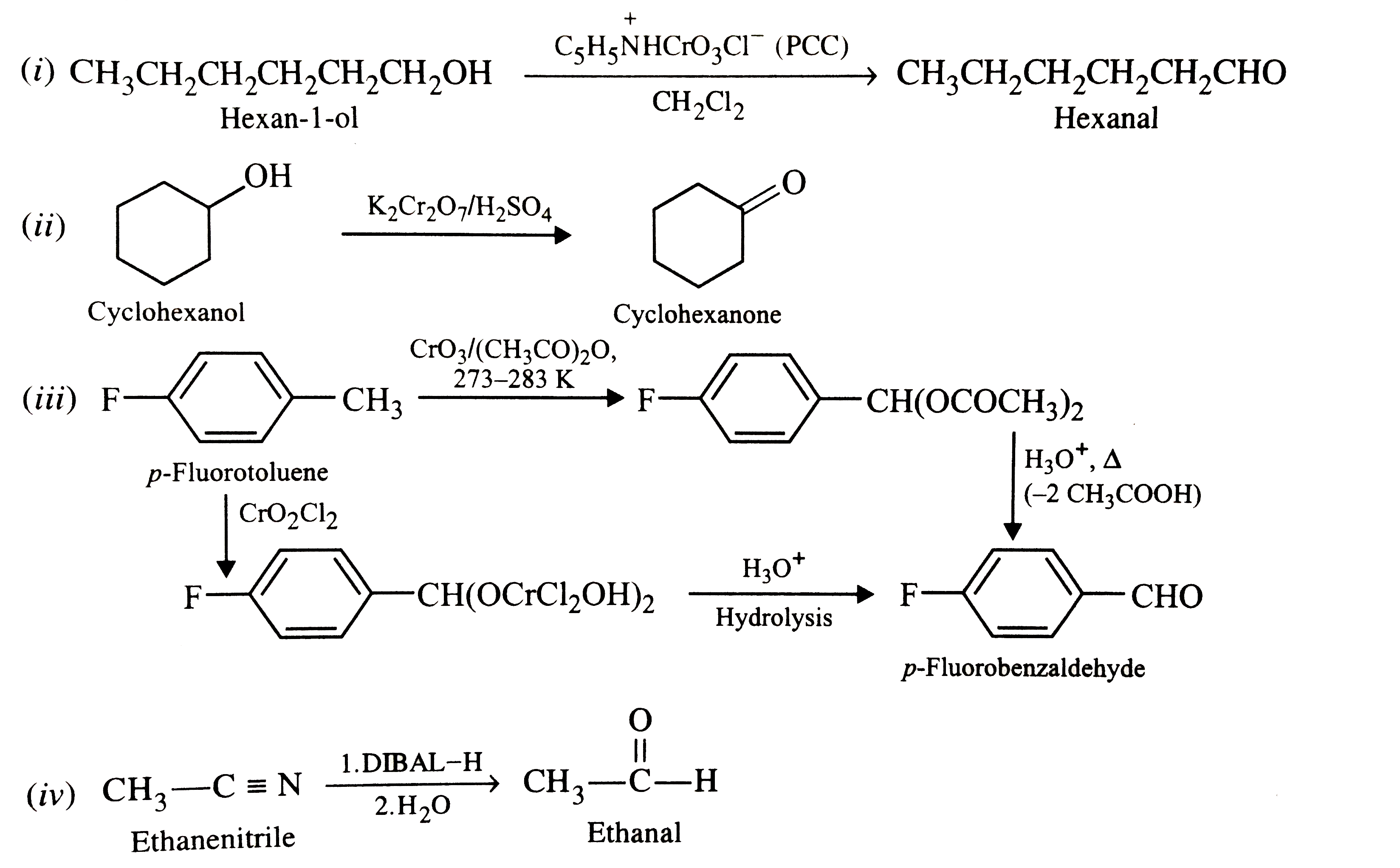 (iv). `underset("Ethanenitrile")(CH_(3)-C-=N) underset(2.H_(2)O)overset(1."DIBAL-H")to underset("ETHANAL")(CH_(3)-overset(O)overset(||)(C)-H)` (v) `underset("Allyl alcohol")(CH_(2)=CHCH_(2)OH) underset(CH_(2)Cl_(2))overset(C_(2)H_(5)overset(+)(N)HCrO_(3)Cl^(-)(PC C))to underset("Prop-2-enal")(CH_(2)=CH-CHO)` (vi). `underset("But-2-ene")(CH_(3)CH=CHCH_(3)) underset(2.Zn" dust"//H_(2)O)overset(1.O_(3)//CH_(2)Cl_(2),196K)to underset("Ethanal")(2CH_(3)-CHO)` |
|
| 30. |
Give names of the reagents to bring about the following transformations: (i) Hexan-1-ol to hexanal (ii) Cyclohexanol to cyclohexanone (iii) p-Fluorotoluene to (iv) Ethanenitrile to ethanal p-fluorobenzaldehyde (v) Allyl alcohol to propenal (vi) But-2-ene to ethanal |
|
Answer» Solution :(i) `C_(5)H_(5)NH^(+)CrO_(3)CL^(-)` (PCC) (ii) `K_(20Cr_(2)O_(7)` in acidic medium (III) `CrO_(3)` in the presence of acetic anhydride/ 1. `CrO_(2)Cl_(2)`, 2. HOH (iv) (diisobutyl) aluminium hydride (DIBAL - H)/`H_(2)O` (V) PCC |
|
| 31. |
Give name and structure of monomer of polyvinyl chloride (PVC). |
| Answer» SOLUTION :VINYL CHLORIDE, `H_2C = CHCL` | |
| 32. |
Give monomers used and partial structure of Terylene (Dacron) |
|
Answer» SOLUTION :Terylene (DACRON): Monomers : Ethylene glycol `HOH_(2)C-CH_(2)OH` Terephtalic acid 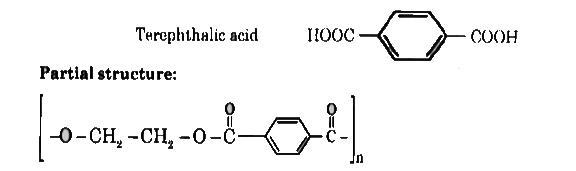
|
|
| 33. |
Give monomers used and partial structure of Nylon -6,6 |
|
Answer» SOLUTION :Nylon-6,6, Monomers: Adipic acid `HOOC (CH_(2)) COOH` Hexamethylenediamine `H_(2)N(CH_(2))_(6)NH_(2)` Partial structure `[-HN(CH_(2))_(6)NH-OC(CH_(2))_(4) CO-]_(n)` |
|
| 35. |
Give monomers used and partial structure of Nylon -6 |
|
Answer» SOLUTION :Nylon -6, MONOMER : Caprolactam PARTIAL STRUCTURE `[-HN(CH_(2))_(5)CO]_(n)` |
|
| 36. |
Give monomers used and partial structure of Melamine formaldehyde polymer. |
|
Answer» Solution :MELAMINE- formaldehyde: Monomersl 1. Melamine2. Formaldehyde PARTIAL STRUCTURE : 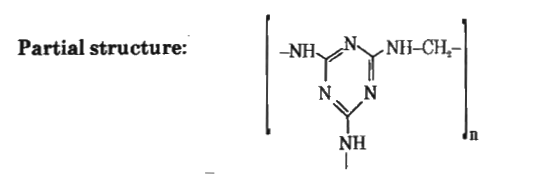
|
|
| 37. |
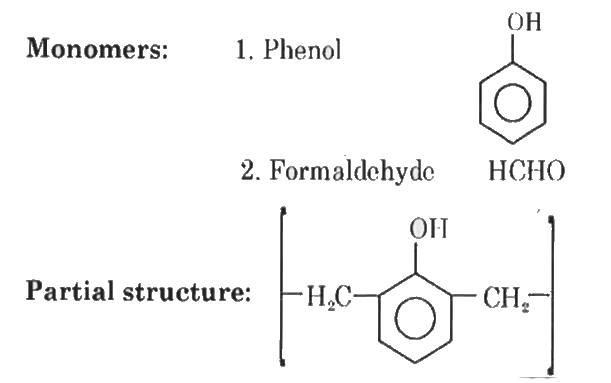
Give monomers used and partial structure of Bakelite |
|
Answer» SOLUTION :Bakelite : MONOMERS: Phenol, Formaldehyde PARTIAL structure: 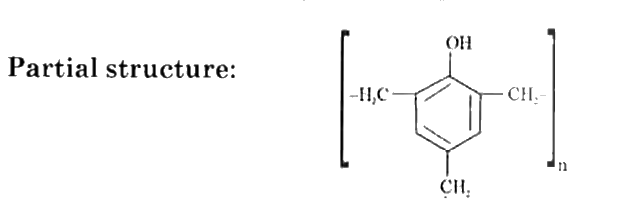
|
|
| 38. |
Give mole fraction of solute present in 1.00 m aqueous solution. |
|
Answer» `0.177` |
|
| 39. |
Give IUPAC substitutive names for the following alcohols: |
Answer» Solution :The longest chain to which the hydroxyl GROUP is attached gives US the base name. The ending is -ol. We then number the longest chain from the end that gives the carbon bearing the hydroxyl group the lower number. Thus, the NAMES, in both of the accepted IUPAC for MATS, are 
|
|
| 40. |
Give IUPAC substitutive names for the following alcohols: |
Answer» Solution :The longest chain to which the hydroxyl group is ATTACHED gives US the base NAME. The ending is -ol. We then number the longest chain from the END that gives the carbon bearing the hydroxyl group the lower number. Thus, the NAMES, in both of the accepted IUPAC for mats, are 
|
|
| 41. |
Give IUPAC names of the following ethers : (i) C_(2)H_(5)OCH_(2)-underset(CH_(3))underset("|")"CH"-CH_(3) (ii) CH_(3)OCH_(2)CH_(2)Cl (iii) O_(2)N-C_(6)H_(4)-OCH_(3)(p) (iv) CH_(3)CH_(2)CH_(2)OCH_(3) |
| Answer» SOLUTION :`{:("(i) 1 - Methoxy -2- methylpropane","(ii) 2 - CHLORO -1- methoxyethane"),("(III) 4 - Nitroanisole","(iv) 1-Methoxypropane"),("(v) 4-Ethoxy-1, 1- DIMETHYLCYCLOHEXANE","(vi) ETHOXYBENZENE"):}` | |
| 42. |
Give IUPAC substitutive names for the following alcohols: |
Answer» SOLUTION :The longest chain to which the hydroxyl group is attached gives US the base NAME. The ENDING is -ol. We then NUMBER the longest chain from the end that gives the carbon bearing the hydroxyl group the lower number. Thus, the names, in both of the accepted IUPAC for mats, are 
|
|
| 43. |
Give IUPAC names of the following ethers : O_(2)N- C_(6)H_(4)- OCH_(3)(p) |
| Answer» SOLUTION : 4-Nitroanisole | |
| 44. |
Give IUPAC names of the following compounds: (a) CH_(3)-underset(OH)underset(|)CH-CH_(2)-underset(OH)underset(|)CH-underset(C_(2)H_(5))underset(|)CH-CH_(2)CH_(3) (b) CH_(3)-underset(OH)underset(|)CH-underset(OH)underset(|)CH-CH_(3) (c)CH_(3)underset(OH)underset(|)CHCH_(2)underset(CH_(3))underset(|)CHCH_(2)CH_(2)CH_(2)CH_(3) (d) CH_(3)underset(CH_(3))underset(|)CH-underset(OH)underset(|)CH-underset(CH_(3))underset(|)overset(CH_(3))overset(|)C-CH_(3) (e) CH_(3)underset(OH)underset(|)CHunderset(OH)underset(|)CHCH_(2)OH (f) C_(6)H_(5)CH_(2)OH (g) CH_(3)CH_(2)CHCH_(4)OH (h) CH_(3)CH_(2)CH_(2)underset(C_(6)H_(5))underset(|)overset(OH)overset(|)C CH_(2)CH_(3) (i) CH_(3)overset(OH)overset(|)CHCH_(2)overset(OH)overset(|)CHunderset(CH_(3))underset(|)CH-CH_(3) (j) |
|
Answer» Solution :(a) 5-Ethylheptane-2, 4-diol (B) Butane-2, 3-diol (c)4-Methyloctane-2-ol (d) 2,2, 4-Trimethylpentan-3-ol (e) Butane-1, 2,-3-triol (f) Phenylmethanol (g) 2-(CHLOROMETHYL) butan-1-ol (h) 3-Phenylhexan-3-ol (i) 5-Methylhexane-2,4-diol (J) 5-Chloro-2, 4-dihydroxybenzaldehyde. |
|
| 45. |
Give IUPAC names of the following ethers : CH_(3)OCH_(2)CH_(2)Cl |
| Answer» SOLUTION :2-Chloro-1-methoxyethane | |
| 46. |
Give IUPAC names of the following ethers : CH_(3)CH_(2)CH_(2)OCH_(3) |
| Answer» SOLUTION :1-Methoxypropane | |
| 47. |
Give IUPAC names of the following ethers : C_(2)H_(5)OCH_(2)- underset(CH_(3))underset(|)CH- CH_(3) |
| Answer» SOLUTION :1-Ethoxy-2-methylpropane | |
| 48. |
Give IUPAC names of the following compounds : CH_(3)-underset(Cl)underset(|)CH-underset(CH_(3))underset(|)CH- underset(CH_(3))underset(|)CH- CH_(2)OH |
| Answer» SOLUTION :4- Chloro-2,3 dimethylpentan-1ol | |
| 49. |
Give IUPAC names of the following compounds: (ii) CH_(3)-CH_(2)-underset(O)underset(||)(C)-CH_(2)-CHO (iii) CH_(3)CH=CH-CHO |
|
Answer» SOLUTION :(i) 3-phenylprop-2-enal (II) 3-oxopentanal (III) But -2-enal |
|
| 50. |
Give IUPAC names of the following compounds : CH_(3)-underset(CH_(3))underset(|)CH-O- CH_(2)CH_(3) |
| Answer» SOLUTION :2-Ethoxypropane | |