

Saved Bookmarks
This section includes 7 InterviewSolutions, each offering curated multiple-choice questions to sharpen your Current Affairs knowledge and support exam preparation. Choose a topic below to get started.
| 1. |
Freshly prepared precipitate sometimes gets conveted to colloidal solution by………… |
|
Answer» COAGULATION |
|
| 2. |
Freshly prepared precipitate sometimes gets converted to colloidal solution by........ |
|
Answer» coagulation |
|
| 3. |
Freshly prepared precipitate sometimes gets converted to colloidal solution by |
|
Answer» coagulation |
|
| 4. |
Freshly prepared precipitate sometimes gets converted to colloidal solution by ……. . |
|
Answer» coagulation |
|
| 5. |
Freshly prepared precipitate sometimes gets converted to colloidal solution by_________ . |
|
Answer» coagulation |
|
| 6. |
Freshly prepared ammonical silver nitrate solution is known as |
|
Answer» TOLLEN's reagent |
|
| 7. |
Fresh tomatoes are a better source of vitamin C than those present in tomatoes which have been stored for some time. |
| Answer» SOLUTION :On prolonged exposure to AIR, VITAMIN .C. PRESENT in stored tomatoes is destroyed due to its aerial oxidation. | |
| 8. |
Fresh tomatoes are a better source of vitamin C than those which have been stored for some time. Explain. |
| Answer» Solution :On prolonged EXPOSURE to air , VITAMIN C present in TOMATOES in DESTROYED due to aerial oxidation. | |
| 9. |
Frequently a species can react in different ways to give a variety of products For example toluene can be nitrated at the ortho meta or para positions we shall consider the simplest case, that of two competing irreversible first- order reactions: A overset(k_(1)) rarr C and A overset (k_(2)) rarr D where the stoichimetric coefficients are taken as unity for simplicity. THe rate law is ((d[A])/(dt))=-k_(1)[A] -k_(2)[A] =-(k_(1)+k_(2))[A] Rightarrow [A] = [A]_(0)e^-(k_(1)+k_(2))t For C, we have ((d[C])/(dt))=k_(1)[A] =k_(1)[A]_(0)e^-(k_(1)+k_(2))t Multiplication by dt and integration from time 0(where [C]_(0)=0 to an arbitary time t gives [C] =(k_(1)[A]_(0))/(k_(1)+k_(2))(1-e^-(k_(1)+k_(2))t) Similarly integration of ((d[D])/(dt)) gives [D] = (k_(2)[A]_(0))/(k_(1)+k_(2))(1-e^-(k_(1)+k_(2))t) The sum of the rate constants k_(1)+k_(2) appears in the exponentials for both [C] and [D] At any time, we also have, [C]/[D] = k_(1)/k_(2) At high temperature, acetic acid decomposition into CO_(2) and CH_(4) and simultaneously into CH_(2)CO (ketene) and H_(2)O (i) CH_(3)COOH overset (k_(1)=3s^(-1)rarr CH_(4)+CO_(2) (ii) CH_(3)COOH overset(k_(2)=4s^(-1)rarr CH_(2)CO+H_(2)O What is the fraction of acetic acid is reacting as per reaction(i)? |
|
Answer» `3/4` |
|
| 10. |
Frequently, preparation of a colloid such as a protein can be made more stabe of the colloid is dialyzed. Why is this so ? |
| Answer» SOLUTION :This is because dialysis HELPS in REMOVING undersirable ions from a colloidal preparation which tend to DESTABILIZE the colloid. | |
| 11. |
Frequent occurrence of water blooms in a lake indicates |
|
Answer» NUTRIENT deficiency |
|
| 12. |
Frequency of matter waves may be expressed as |
|
Answer» 2(K.E. )/H |
|
| 13. |
Freons, i.e., chlorofluorocarbons (CFC) have been widely used as refrigerants and as propellants in aerosols and foams. But theiir persistent use has depleted the ozone layer which has led to global warming. Consequently, use of freons as refrigerants and propellants in aerosols has beenn banned in USA and many other countries. during the past few years, search for effective substitutues for freons have been successful. Now answer the following questions: (i). What is freon-12? How is it prepared? (ii) How does freon-12 deplete ozone layer? |
|
Answer» Solution :(i) Freon-12 is dichlorodifluoromethane `(C Cl_(2)F_(2))`. It is prepared from carbon tetrachloride by Swarts reaction. `3 C Cl_(4)+2SbF_(3) overset(SbCl_(5))to underset("Freon-12")(3C Cl_(2)F_(2))+2SbCl_(3)` (ii) SINCE freons are non-biodegradable. they diffuse into the STRATOSPHERE. there, above the protective ozone layer, the highly energetic UV rays cleave one of the C-Cl bonds and initiates a SERIES of reactions. STEP 1: `C Cl_(2)F_(2)overset(hv)to*C ClF_(2)+Cl*` ltBrgt Step 2: `Cl*+O_(3)to*ClO+O_(2)` Step 3: `*ClO+Oto*Cl+O_(2)` The formation of ANOTHER chlorine radical in step (3) can decompose another molecule of `O_(3)`. the steps (2) and (3) are repated mahy times. as a result, decomposition of one `C Cl_(2)F_(2)(CFC)` molecule can bring about the destruction of thounsands of molecules of ozone. |
|
| 14. |
Freons are: |
|
Answer» `CCl_2F_2` |
|
| 16. |
Freons. |
|
Answer» Solution :(1) Freons are widely used as propelants in AEROSOL, products of food, cosmetics and pharmaceutical INDUSTRIES. (2) Freons containing BROMINE in their molecules are used as fire extinguishers. (3) They are used in aerosol insecticdes, solvent for CLEANING clothes and metallic suraces. It is used as foaming agents in the preparation of foamed plastics and in production of certain fluorocarbons. (4) It is used as REFRIGERANTS and air conditioning purposes. |
|
| 17. |
Freon is used as : |
|
Answer» Refrigerant |
|
| 19. |
Freon-12 is commonly used as : |
|
Answer» an INSECTICIDE |
|
| 20. |
Freon - 12 is |
|
Answer» `CF_3Cl` |
|
| 22. |
Frenkel defect is noticed in: |
|
Answer» AgBr |
|
| 24. |
Freezing point of urea solution is -0.6^(@)C. How much urea (M.W. = 60 g/mole) is required to dissolve in 3 kg water (K_(f) = 1.5^(@)Ckg mol^(-1)) |
|
Answer» 3.6 g [where `W_(A)` = WEIGHT of SOLUTE, `W_(B)` = weight of solvent, `M_(A)` = molecular weight of solute] or, `0-(-0.6)=(1.5xx1000xxW_(A))/(60xx3000)` or, `W_(A)=(60xx3000xx0.6)/(1.5xx1000)=72g` If we consider the mass of water given to 300 gram `0.6^(@)C=(1000g kg^(-1)xx1.5^(@)Ckg mol^(-1)xx " weight of urea")/(60g mol^(-1)xx300 g)` `therefore` Weight of urea = 7.2 g. |
|
| 25. |
Frenkel defect is also known as …….. |
|
Answer» stoichiometric defect |
|
| 26. |
Frenkel defect in the structure of ionic solid is due to..... |
|
Answer» Charge of the ion. |
|
| 27. |
Frenkel defect and shottky defects are two stoichiometric defects in solids. What are stoichiometric defects? |
| Answer» Solution :DEFECTS that do not AFFECT the STOICHIOMETRIC composition of SOLIDS are CALLED stoichiometric defects. | |
| 28. |
Freezing point of urea solution is -0.6^(0)C. How much urea is required to be dissolved in 3 kg water ?[M("urea")=60 g mol^(-1), K_(f)=1.5^(0)"C Kg mol"^(-1)] |
|
Answer» 2.4 G |
|
| 29. |
Freezing point of benzene is 278.4K and heat of fusion of benzene is 10.042 KJ/mol. Acetic acid exists partly as dimer in benzene solution. The freezing point of 0.02mol fraction of acetic acid in benzene is 277.4K. The degree of dimerisation of acetic acid in benzene is |
|
Answer» 0.24 |
|
| 30. |
Freezing point of benzene is 278.4K and heat of fusion of benzene is 10.042 KJ/mol. Acetic acid exists partly as dimer in benzene solution. The freezing point of 0.02mol fraction of acetic acid in benzene is 277.4K. The equilibrium constant for dimerisation of acetic acid in benzene is |
|
Answer» 2.4 |
|
| 31. |
Freezing point of benzene is 278.4K and heat of fusion of benzene is 10.042 KJ/mol. Acetic acid exists partly as dimer in benzene solution. The freezing point of 0.02mol fraction of acetic acid in benzene is 277.4K. The molal cryoscopic constant of benzene in K "molality"^(-1) is |
|
Answer» `4.0` |
|
| 32. |
Freezing point of an aqueous solution is -0.186^(@)C. Elevation of boiling point of the same solution is ……..if K_(b)=0.512 K "molality"^(-1)and K_(f)=1.86K "molality"^(-1) : |
|
Answer» `0.186^(@)C` `DeltaT_(b)=((0.512^(@)C))/((1.86^(@)C))XX(0.186^(@)C)` `=0.0512^(@)C` |
|
| 33. |
Freezing point of 0.2 M KCN solution is -0.7^(@)C. On adding 0.1 mole ofHg(CN)_(2) to one litre of the 0.2 M KCN solution, the freezing point of the solution becomes -0.53^(@)Cdue to the reaction Hg(CN)_(2)+mcN^(-)toHg(CN)_(m+2)^(m-) . What is the value of m assuming molality = molarity? |
|
Answer» Solution :`0.7=2xxK_(F)xx0.2=K_(f)=0.7/0.4=7/4` `HG(CN)_(2)+mCN^(-)toHg(CN)_(m+2)^(m-)` `0.1""0.2""0` `0""(0.2-0.1m)""0.1` Now, Molarity of `K^(+)=0.2M` Molarity of `CN^(-)=(0.2-0.1m)M` Molarity of complex `=0.1M` `0.53=K_(f)(0.2+0.2-0.1m+0.1)=K_(f)(0.5-0.1m)` `implies0.53=7/4(0.5-0.1m)implies2.1=3.5-0.7m` `implies0.7m=1.4impliesm=2` |
|
| 34. |
How will you show that depression in freezing point is a colligative property? |
| Answer» | |
| 35. |
Freezing point of a solvent containing a non volatile solute |
|
Answer» is depressed |
|
| 36. |
Freezing point. |
| Answer» SOLUTION :The freezing point of a liquid is DEFINED as the temperature at which the solid coexists in the equilibrium with the liquid and the vapour PRESSURE of the liquid and the solid are EQUAL. | |
| 37. |
Freezing of food articles can be done using |
|
Answer» SOLID `N_2` at 77K |
|
| 38. |
Free radical polymerization of stryene gives a product in which groups are on alternate carbon atoms rather than on adjacent carbon atoms. Exlpain. |
Answer» SOLUTION :During free radical polymerization , the ADDITION of free radicals to monomer molecules occurs in accrodance with Markovnikov's rule so as to give more stable free radical. For example , addition of R. (obtained from radical initiator) to styrene GIVES more stable BENZYLIC radical (I) rather than less stable radical (II). 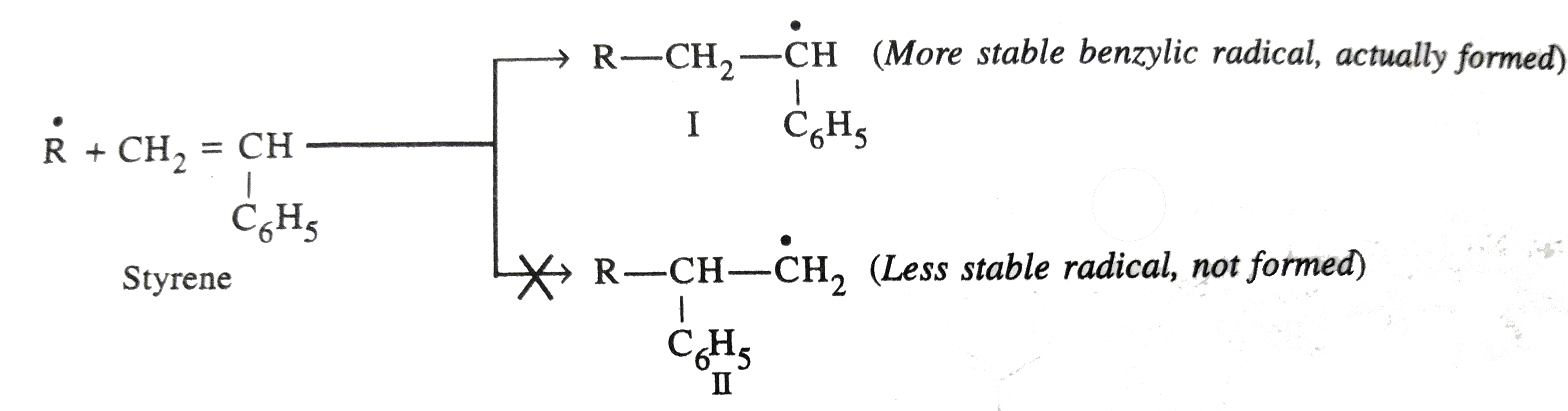 The free radical (I) then adds to another monomer molecule again giving a more stable free radical (III) rather than the less stable free radical (IV). This process continues to give ultimately polystyrene (V) in whicyh the `C_6H_5` groups are on alternate carbon atoms rather than the product (VI) in which the `C_6H_5` groups are on adjacent carbon atoms. 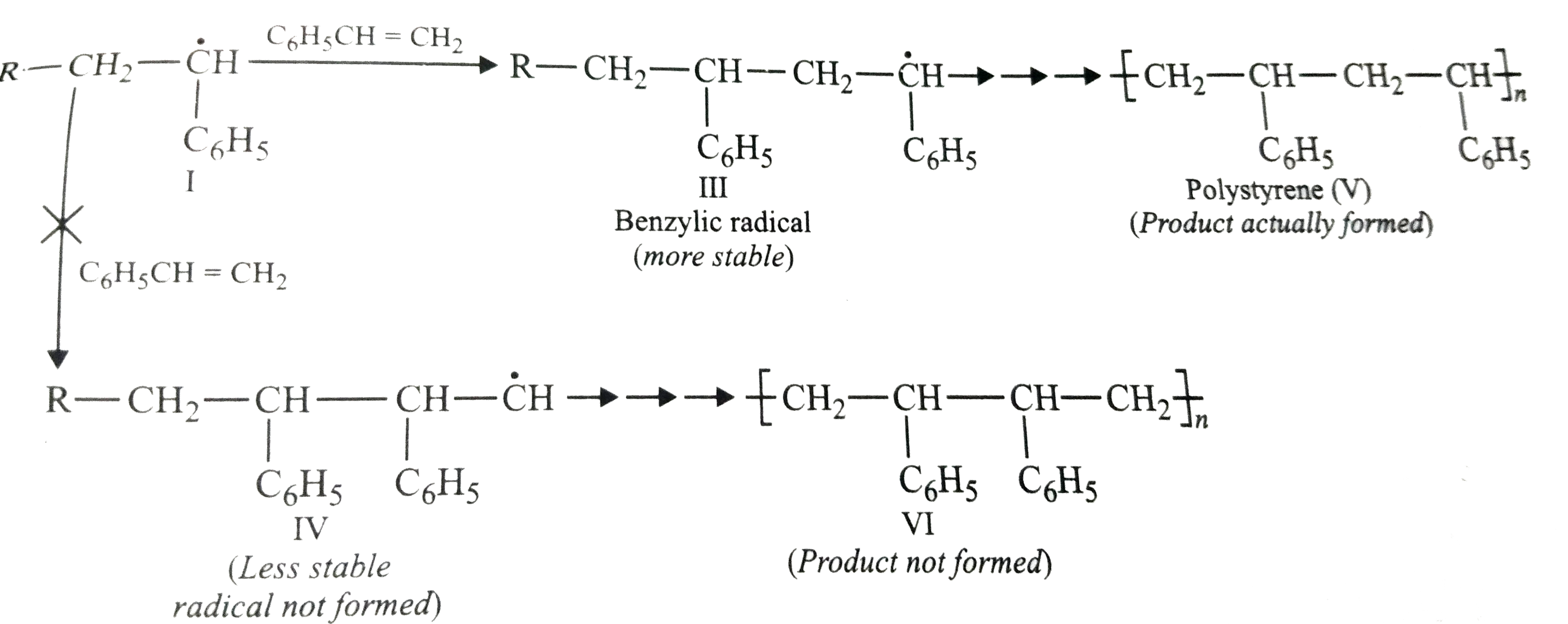
|
|
| 39. |
Free radical halogenation takes place in the presence of light or at high temperature (abov 773K.) Formation of halogen free radical intermediate takes place in first step called chain initiation step. CI_(2)overset(hv)(to)2CI This reaction is mainly given by those compound which have atleast one hydrogen atom present at sp^(3)-hybrid carbon. Reactivity of sp^(3)-hybrid carbon depends on the reactivity of reaction intermediate. The relative rate of formation of alkylradicals by a chlorine radical is : underset((5))("Tertiary") gt underset((3.8))("Secondary") gt underset((1))("Primary") " Percentage yield of the prodcut "=("Relative amount"xx100)/("Sum of relative amounts") Relativeamount = Number of hydrogen atoms on the respective carbon xx relative reactivity. NBS (N-bromo succinimide) is used for bromination at allylic andbenzylic carbon, whereas Br_(2)//hv gives brominationat benzylic allylic and alkyl carbon. Chlorinating agent for free radical chlorination may be taken as : |
| Answer» Solution :N//A | |
| 40. |
Free radical polymerisation requires a free radical initior.The most commonly used free radical initiator is: |
|
Answer» `Ph-CO-O-O-COPh` , benzoylperoxide |
|
| 41. |
Free radical polymerisation may be important for the polymerisation of : (A)HC -= CH, (B)H_2C =CH_2 and ©H_2C =CH -CH = CH_2 |
|
Answer» A and B |
|
| 42. |
Free iodine is titrated against standard reducing agent usuallywith sodium thiosulphate , i.e. K_(2)Cr_(2)O_(7) + 6Kl + 7H_(2)SO_(4) to Cr_(2)(SO_(4))_(3) + 4K_(2) SO_(4) + 7H_(2)O+l_(2) 2CuSO_(4) + 4Kl to Cu_(2)l_(2) + 2K_(2)SO_(4) + l_(2) l_(2) + Na_(2)S_(2)O_(3) to 2Nal + Na_(2)S_(4)O_(6) In iodometric titration, starch solution is used as an indicator. Starch solution gives blue or violet colour with free iodine .At the end point , blue or violet colour disappears when iodine is completely changed to iodide. 50 ml of an aqueous solution of H_(2)O_(2) was treated with excess of Kl in dil. H_(2)SO_(4) . The liberated iodine required 20 ml of 0.1 NNa_(2)S_(2)O_(3) for complete reaction. The concentration of H_(2)O_(2) is |
|
Answer» `0.34` |
|
| 43. |
Free radical bromination of n-butane yields 2-bromobutane as the major product. Why? |
|
Answer» SOLUTION :`CH_3CH_2CH_2CH_3 underset("light")overset(Br_2)(rarr)CH_3CH_2(BR)CH_2CH_3 ("major") + CH_3CH_2CH_2CH_2Br` (MINOR) Free radical bromination of n-butane yields 2-bromobutane as the major product because it is formed via more stable secondary free radical as INTERMEDIATE. The more stable intermediate is formed at faster rate, resulting in the formation of more amount of the subsequent product.1-Bromobutane is formed via less stable primary free radical. |
|
| 44. |
Free iodine is titrated against standard reducing agent usuallywith sodium thiosulphate , i.e. K_(2)Cr_(2)O_(7) + 6Kl + 7H_(2)SO_(4) to Cr_(2)(SO_(4))_(3) + 4K_(2) SO_(4) + 7H_(2)O+l_(2) 2CuSO_(4) + 4Kl to Cu_(2)l_(2) + 2K_(2)SO_(4) + l_(2) l_(2) + Na_(2)S_(2)O_(3) to 2Nal + Na_(2)S_(4)O_(6) In iodometric titration, starch solution is used as an indicator. Starch solution gives blue or violet colour with free iodine .At the end point , blue or violet colour disappears when iodine is completely changed to iodide. A1.1 g sample of copper ore is dissolved and Cu^(2+) (aq). is treated withKl . l_(2) liberated required 12.12" ml of " 0.1 MNa_(2)S_(2)O_(3) solution for titration . The % of Cu in the ore is |
|
Answer» `2.5%` |
|
| 45. |
Free iodine is titrated against standard reducing agent usuallywith sodium thiosulphate , i.e. K_(2)Cr_(2)O_(7) + 6Kl + 7H_(2)SO_(4) to Cr_(2)(SO_(4))_(3) + 4K_(2) SO_(4) + 7H_(2)O+l_(2) 2CuSO_(4) + 4Kl to Cu_(2)l_(2) + 2K_(2)SO_(4) + l_(2) l_(2) + Na_(2)S_(2)O_(3) to 2Nal + Na_(2)S_(4)O_(6) In iodometric titration, starch solution is used as an indicator. Starch solution gives blue or violet colour with free iodine .At the end point , blue or violet colour disappears when iodine is completely changed to iodide. 25 ml of N K_(2)Cr_(2)O_(7) acidified solution will liberate ............ iodine from Kl Solution : |
|
Answer» `0.3175` G |
|
| 46. |
Free iodine is titrated against standard reducing agent usuallywith sodium thiosulphate , i.e. K_(2)Cr_(2)O_(7) + 6Kl + 7H_(2)SO_(4) to Cr_(2)(SO_(4))_(3) + 4K_(2) SO_(4) + 7H_(2)O+l_(2) 2CuSO_(4) + 4Kl to Cu_(2)l_(2) + 2K_(2)SO_(4) + l_(2) l_(2) + Na_(2)S_(2)O_(3) to 2Nal + Na_(2)S_(4)O_(6) In iodometric titration, starch solution is used as an indicator. Starch solution gives blue or violet colour with free iodine .At the end point , blue or violet colour disappears when iodine is completely changed to iodide. What volume of 0.40 M Na_(2)S_(2)O_(3) would be required toreact with l_(2) liberated by adding 0.04 mole of Kl to 50 ml of 0.20 M CuSO_(4) solution ? |
|
Answer» `12.5` ML |
|
| 47. |
Free radical addition polymerisation is initiated by: |
|
Answer» Benzoquinone |
|
| 48. |
Free energy, G=H-TS, is a state function that includes whether a reaction is spontaneous or non-spontaneous. If you think of TS as the part of the system's energy that is disordered already, then (H-TS) is the part of the system's energy that is still ordered and therefore free to cause spontaneous change by becoming disordered. Also, DeltaG=DeltaH-TDeltaS To see what this equation for free energy change has to do with spontaneity let us return to relationship. DeltaS_("total")=DeltaS_("sys")+DeltaS_("surr") = DeltaS + DeltaS_("surr") (It is generally understood that symbols without subscript refer to the system not the surroundings.) DeltaS_("surr")=-(DeltaH)/T, where DeltaH is the heat gained by then system at constant pressure. DeltaS_("total") = DeltaS -(DeltaH)/T rArr TDeltaH_("total")=DeltaH-TDeltaS rArr -TDeltaS_("total") =DeltaH-TDeltaS i.e. DeltaG=-TDeltaS_("total") From second law of thermodynamics, a reaction is spontaneous if DeltaS_("total") is positive, non-spontanous if DeltaS_("total") is negative and at equilibrium if DeltaS_("total") is zero. Since, -TDeltaS=DeltaG and since DeltaG and DeltaS have opposite signs, we can restate the thermodynamic criterion for the spontaneity of a reaction carried out at constant temperature and pressure. If DeltaG lt 0, the reaction is spontaneous. If DeltaG gt 0, the reaction is non-spontanous. If DeltaG=0, the reaction is at equilibrium. In the equation, DeltaG=DeltaH-TDeltaS, temperature is a weighting factor that determine the relative importance of enthalpy contribution to DeltaG. Read the above paragraph carefully and answer the following questions based on above comprehension: Which of the following is true for the reaction? H_(2)O(l) |
|
Answer» `DeltaS=0` HENCE, `0= DeltaH - TDeltaS` or `DeltaH = TDeltaS` |
|
| 49. |
Free energy, G=H-TS, is a state function that includes whether a reaction is spontaneous or non-spontaneous. If you think of TS as the part of the system's energy that is disordered already, then (H-TS) is the part of the system's energy that is still ordered and therefore free to cause spontaneous change by becoming disordered. Also, DeltaG=DeltaH-TDeltaS To see what this equation for free energy change has to do with spontaneity let us return to relationship. DeltaS_("total")=DeltaS_("sys")+DeltaS_("surr") = DeltaS + DeltaS_("surr") (It is generally understood that symbols without subscript refer to the system not the surroundings.) DeltaS_("surr")=-(DeltaH)/T, where DeltaH is the heat gained by then system at constant pressure. DeltaS_("total") = DeltaS -(DeltaH)/T rArr TDeltaH_("total")=DeltaH-TDeltaS rArr -TDeltaS_("total") =DeltaH-TDeltaS i.e. DeltaG=-TDeltaS_("total") From second law of thermodynamics, a reaction is spontaneous if DeltaS_("total") is positive, non-spontanous if DeltaS_("total") is negative and at equilibrium if DeltaS_("total") is zero. Since, -TDeltaS=DeltaG and since DeltaG and DeltaS have opposite signs, we can restate the thermodynamic criterion for the spontaneity of a reaction carried out at constant temperature and pressure. If DeltaG lt 0, the reaction is spontaneous. If DeltaG gt 0, the reaction is non-spontanous. If DeltaG=0, the reaction is at equilibrium. In the equation, DeltaG=DeltaH-TDeltaS, temperature is a weighting factor that determine the relative importance of enthalpy contribution to DeltaG. Read the above paragraph carefully and answer the following questions based on above comprehension: One mole of ice is converted to liquid at 273 K, H_(2)O(s) and H_(2)O(l) have entropies 38.20 and 60.03 J "mol"^(-1) dg^(-1). Enthalpy change in the conversion will be: |
|
Answer» 59.59 J/mol |
|
| 50. |
Free energy, G=H-TS, is a state function that includes whether a reaction is spontaneous or non-spontaneous. If you think of TS as the part of the system's energy that is disordered already, then (H-TS) is the part of the system's energy that is still ordered and therefore free to cause spontaneous change by becoming disordered. Also, DeltaG=DeltaH-TDeltaS To see what this equation for free energy change has to do with spontaneity let us return to relationship. DeltaS_("total")=DeltaS_("sys")+DeltaS_("surr") = DeltaS + DeltaS_("surr") (It is generally understood that symbols without subscript refer to the system not the surroundings.) DeltaS_("surr")=-(DeltaH)/T, where DeltaH is the heat gained by then system at constant pressure. DeltaS_("total") = DeltaS -(DeltaH)/T rArr TDeltaH_("total")=DeltaH-TDeltaS rArr -TDeltaS_("total") =DeltaH-TDeltaS i.e. DeltaG=-TDeltaS_("total") From second law of thermodynamics, a reaction is spontaneous if DeltaS_("total") is positive, non-spontanous if DeltaS_("total") is negative and at equilibrium if DeltaS_("total") is zero. Since, -TDeltaS=DeltaG and since DeltaG and DeltaS have opposite signs, we can restate the thermodynamic criterion for the spontaneity of a reaction carried out at constant temperature and pressure. If DeltaG lt 0, the reaction is spontaneous. If DeltaG gt 0, the reaction is non-spontanous. If DeltaG=0, the reaction is at equilibrium. In the equation, DeltaG=DeltaH-TDeltaS, temperature is a weighting factor that determine the relative importance of enthalpy contribution to DeltaG. Read the above paragraph carefully and answer the following questions based on above comprehension: A particular reaction has a negative value for the free energy change. Then at ordinary temperature. |
|
Answer» It has a large `-ve` value for the entropy change |
|