

Saved Bookmarks
This section includes 7 InterviewSolutions, each offering curated multiple-choice questions to sharpen your Current Affairs knowledge and support exam preparation. Choose a topic below to get started.
| 1. |
Free energy, G=H-TS, is a state function that includes whether a reaction is spontaneous or non-spontaneous. If you think of TS as the part of the system's energy that is disordered already, then (H-TS) is the part of the system's energy that is still ordered and therefore free to cause spontaneous change by becoming disordered. Also, DeltaG=DeltaH-TDeltaS To see what this equation for free energy change has to do with spontaneity let us return to relationship. DeltaS_("total")=DeltaS_("sys")+DeltaS_("surr") = DeltaS + DeltaS_("surr") (It is generally understood that symbols without subscript refer to the system not the surroundings.) DeltaS_("surr")=-(DeltaH)/T, where DeltaH is the heat gained by then system at constant pressure. DeltaS_("total") = DeltaS -(DeltaH)/T rArr TDeltaH_("total")=DeltaH-TDeltaS rArr -TDeltaS_("total") =DeltaH-TDeltaS i.e. DeltaG=-TDeltaS_("total") From second law of thermodynamics, a reaction is spontaneous if DeltaS_("total") is positive, non-spontanous if DeltaS_("total") is negative and at equilibrium if DeltaS_("total") is zero. Since, -TDeltaS=DeltaG and since DeltaG and DeltaS have opposite signs, we can restate the thermodynamic criterion for the spontaneity of a reaction carried out at constant temperature and pressure. If DeltaG lt 0, the reaction is spontaneous. If DeltaG gt 0, the reaction is non-spontanous. If DeltaG=0, the reaction is at equilibrium. In the equation, DeltaG=DeltaH-TDeltaS, temperature is a weighting factor that determine the relative importance of enthalpy contribution to DeltaG. Read the above paragraph carefully and answer the following questions based on above comprehension: For the spontaneity of a reaction, which statement is true? |
|
Answer» `DELTAG =+ve, DELTAH=+ve` |
|
| 2. |
Free energy is related to enthalpy and entropy changes as : |
|
Answer» `DELTA G = Delta H - T Delta S` |
|
| 3. |
Free energy change of reversible reaction at equilibrium is- |
|
Answer» Infinite |
|
| 4. |
Free energies of formation (triangle_(f)G)" of "MgO(s) " and "CO (g) at 1273 K and 2273 K are given below : {:(triangle_(f)GMgO (s) = -941 kJ"/mol at "1273K),(triangle_(f)GMgO (s) = -314 kJ"/mol at "2273K),(triangle_(f)G CO (g) = -439 kJ"/mol at "1273K),(triangle_(f)GCO (g) = -6287 kJ"/mol at "2273K):} On the basis of above data, predict the temperature at which carbon can be used as a reducing agent for MgO (s). |
|
Answer» SOLUTION :`MGO(s)+C (s) to Mg (s) +CO (G)`. `triangle_(f)G = triangle_(f)G [CO (g)] - triangle_(f)G [MgO(s)]` At 1273 K Substituting the `triangle_(f)G` values at 1273 K, we get `triangle_(f)G = -439- (-941) KJ"/"mol = +502 kJ"/"mol` As `triangle_(f)G` is positive at 1273K, reduction is not possible at 1273K. At 2273 K Substituting the values at 2273 K, we get `triangle_(f)G = -628 - (-314) kJ"/"mol = -314 kJ"/"mol` As `triangle_(f)G` is negative at 2273K, reduction is possible at 2273K. |
|
| 5. |
Free energies of formation (Delta_(f)G) of MgO(s) and Co(g) at 1273 K and 2273 K are given below : Delta_(f)G^(@) (MgO(s))=-941 kJ//"mol at" 1273 K Delta_(f)G^(@) (MgO(s))=-344 kJ//"mol at" 2273 K Delta_(f)G^(@) (CO (g)) =- 439 kJ//"mol at" 1273 K Delta_(f)G^(@) (CO(g))=-628 kJ//"mol at" 2273 K On the basis of the above data, predict the temperature at which carbon can be used as reducing agent for MgO(s). |
|
Answer» Solution :The redox reaction for MgO (s) is : `MgO(s) +C(s) to Mg(s) +CO(g)` In order that it MAY proceed, `DeltaG^(@)` must be negative. According to GIBBS Helmholtz EQUATION. `DeltaG^(@)=Delta_(f)G^(@)("products")-Delta_(f)G^(@) ("reactants")` At 1273 K, `DeltaG^(@)=Delta_(f)G^(@)CO(g)-Delta_(f)G^(@)MgO (s)` `=(-439)-(-941)=502 " kJ mol"^(-1)` The reaction will not be feasible as `DeltaG^(@)` is positive. At 2273 K , `DeltaG^(@)=Delta_(f)G^(@)CO(g)-Delta_(f)G^(@)MgO(s)` `=(-628)-(-344)=-284 " kJ mol"^(-1)` The reaction is feasible which means that MgO can be reduced by coke at 2273 K. |
|
| 6. |
Fraw the structures of the following XeF_4 |
Answer» SOLUTION :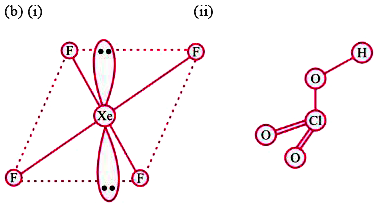
|
|
| 7. |
Fractional distillation is used when |
|
Answer» there is a large difference in the boiling points of liquids |
|
| 8. |
Fractional distillation is used to separate liquids which differ in their in boiling point by : |
|
Answer» `5^@C` |
|
| 9. |
Fraction of the total volume occupied by atoms in a simple cube is : |
|
Answer» `(PI)/2` |
|
| 10. |
Fraction of reactant consumed in a first order reaction after time t in terms of rate constant k is ________ |
|
Answer» `(1-E^(-KT))` |
|
| 11. |
Fourth-floatation method is sussecfufl in separating impurities from oes because |
|
Answer» The PURE ORE is lighter than water containing ADDITIVES LIKE PINE oil, cresylic acid etc |
|
| 12. |
Four suvvessive members of the first series of the transition metals are listed below. For which one of them the standard potential (E_(M^(2+)//M)^(@)) value has a positive sign |
| Answer» Solution :`E_(Cu^(+2)//Cu)^(o)=0.34`volt, other has `-veE_(R.P.)^(o)` | |
| 13. |
Four sucessive members of the first two transition elements are listed below with their atomic numbers. Which one of them is expected to have highest third ionisation enthalpy ? |
|
Answer» Vanadium (Z = 23) `V : 3d^(3) : Cr : 3d^(4) : Mn : 3d^(5) , Fe : 3d^(6)` So Mn has STABLE configuration due to HALF FILLD d-subshell. |
|
| 14. |
Four successive membersof the first series of the transition metals are listed below.For which one of them, the standardpotential E_(M^(2+) //M)^(@)value has a positive sign ? |
|
Answer» `Cu(Z= 29)` |
|
| 15. |
Four successive members of the first series of the transition metals are listed below. For which one of them the standard potential (E_(M)^(0)2 + // m)value has a positive sign? |
|
Answer» CO (Z = 27) |
|
| 16. |
Four successivemembers of the first row transition elementsare listedbelow with atomic numbers. Which one of themis expected to have the highest E_(M^(3+) //M^(2+))^(@)value ? |
|
Answer» `CO(Z= 27)` `(E_(Cr^(3+)//Cr^(2+))^(@)= -0.41V, E_(Mn^(3+ ) //Mn^(2+))^(@)= + 1.57V,E_(Fe^(3+) //Fe^(2+))^(@)= + 0.77V, E_(Co^(3+) //Co^(2+))^(@)=1.97V)` |
|
| 17. |
Four successive members of the first series of the transition metals are listed below. For which one of them the standard potential (E_(M^(2+)//M)^(@)) value has a positive sign? |
|
Answer» `CO(Z=27)` other has `-veE_(E.R.)^(@)` `E_(Co^(2+)//Co)^(@)=-0.28V` `E_(Ni^(2+)//Ni)^(@)=-0.25`V `E_(Fe^(2+)//Fe)^(@)=-0.44V` |
|
| 18. |
Four successive members of the first row transition elements are listed below with atomic numbers. Which one of them is expected to have the highest E_(M^(3+)//M^(2+))^(0) value |
|
Answer» `Cr(Z=24)` `E_(Fe^(3+)//Fe^(2+))^(@)=+0.77V, E_(Co^(3+)//Co^(2+))^(@)=+1.97VSRP` VALUE normally increases from left to right in the period of d-block ELEMENTS. Some SRP vlaue are EXCEPTIONALLY higher due to stability of PRODUCT ion. For e.g. `E_(Mn^(3+)//Mn^(2+))^(@)=+1.57V, E_(Co^(3+)//Co^(2+))^(@)=+1.97V`. |
|
| 19. |
Four successive members of the first row transition elements are listed below with their atomic number. Which one of them is expected to have the highest third ionisation enthalpy ? |
|
Answer» Vanadium (Z - 23) |
|
| 20. |
Four successive members of the first row transition elements are listed ahead with atomic numbers. Which one of them is expected to have the highest E_((M^(3+)|M^(2+)))^(@) value? |
|
Answer» CO(Z=27) |
|
| 21. |
Four successive member of the first row tran sition elements are listed below with their atomic numbers. Which one of them is expected to have the highest third ionisation enthalpy? |
|
Answer» Vanadium (Z = 23) |
|
| 22. |
Four statements for the following reaction given below [CoCl_(2)(NH_(3))_(4)]^(+) to [CoCl_(3)(NH_(3))_(3)]+NH_(3) (P) Only one isomer is produced if the ractant complex ion is a trans isomer (Q) Three isomers are produced if the reactant complex ion is a cis isomer (R ) Two isomers are produced if the reactant complex ion is trans isomer (S) Two isomers are produced if the reactant complex is cis isomer The correct statements are : |
|
Answer» P and Q 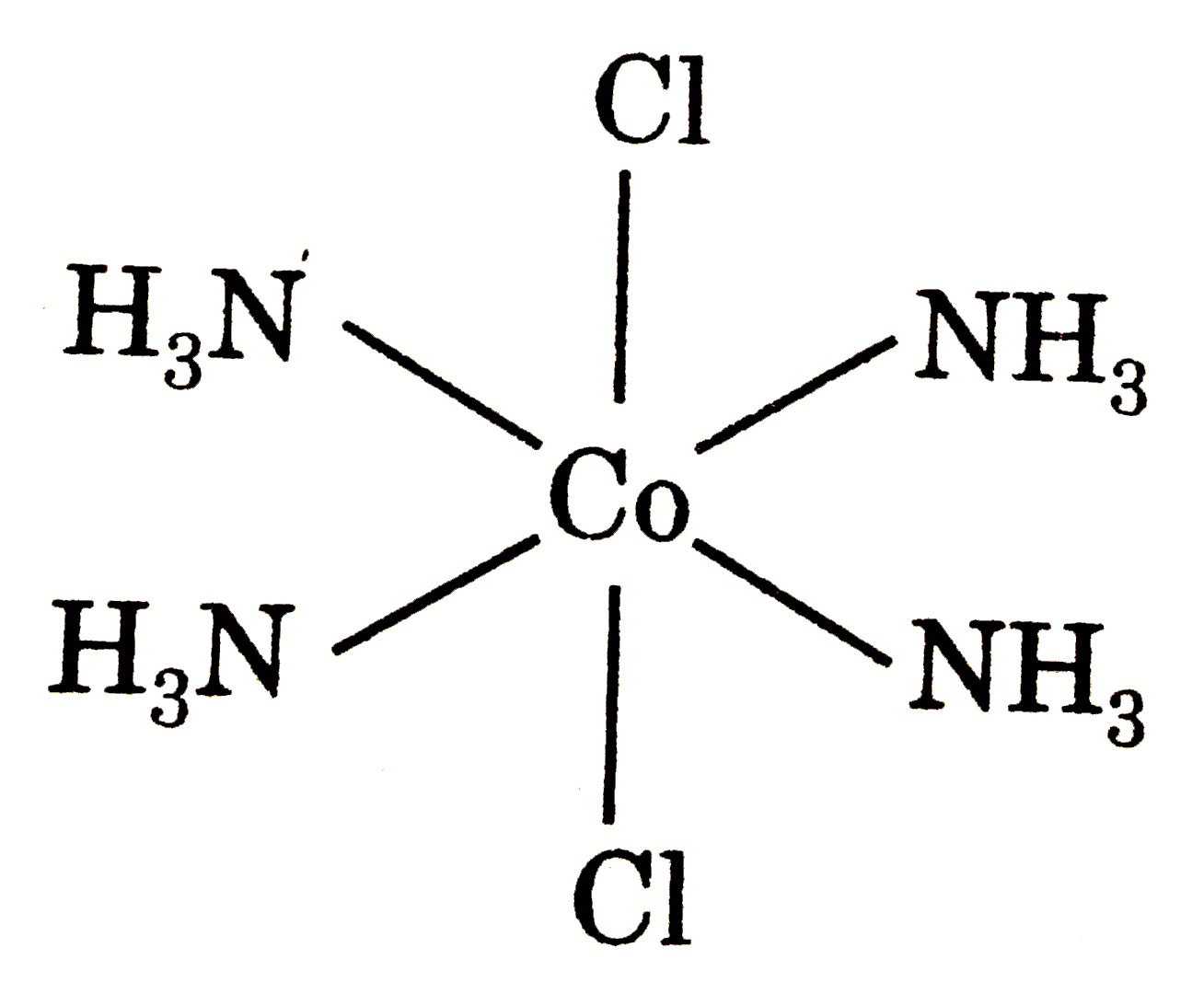 All four positions are equivalent. All four positions are equivalent.  Only two ISOMERS (FAC, MER) are possible. Only two ISOMERS (FAC, MER) are possible.
|
|
| 23. |
Four statements are given below: (P) B_(2) solid does not exist, boron have basic buildingB_(12)icosahedral units made up of polyhedron having 20faces nad 12 corners. (Q) In alum each metal ion is surrounded by six water molecules. ( R) Graphite is used as dry lubricant in machines running at high temperature in place of oil. (S) Fullerene contains twenty, six-membered rings and twelve, five-membered rings. The correct statements are: |
| Answer» Answer :C | |
| 24. |
Four species are listed below (i) HCO_(3)^(-)(ii) H_(3)O^(+) (iii) HSO_(4)^(-)(iv) HSO_(3)F Which one of the following is the correct sequence of their acid strength |
|
Answer» `II LT III lt i lt IV` |
|
| 25. |
Four species are listed below : i. HCO_(3)^(-) "" ii. H_(3)O^(+) "" iii. HSO_(4)^(-) "" iv. HSO_(3)F Which one of the following is the correct sequence of their acid strength ? |
|
Answer» `IV LT ii lt III lt i` `underset(iv)(HSO_(3)F) gt underset(ii)(H_(3)O^(+)) gt underset(iii)(HSO_(4)^(-)) gt underset(i)(HCO_(3)^(-))` or `(i) lt (iii) lt (ii) lt (iv)` It corresponds to choice(c) which is correct answer |
|
| 26. |
Four solutions of K_(2)SO_(4) with the concentrations 0.1m, 0.01 m, 0.001 m and 0.0001 m a. available. The maximum value of van't Hoff factor, i, corresponds to |
|
Answer» 0.0001 m solution |
|
| 27. |
Four solution of K_(2)SO_(4) possess concentration of 0.1 m, 0.001 m and 0.0001 m respectively. So among which solution has highest van't hoff factor ? |
|
Answer» 0.0001 m |
|
| 28. |
Four pure water, degree of dissociation is 1.9xx10^(-9),lambda_(m)^(0)=350 Scm^(2)"mol"^(-1) and lambda_(m)^(0)=200S cm^(2) "mol"^(-1). Hence molar conductance of water is |
|
Answer» `1.045xx10^(-6)S cm^(2) "mol"^(-1)` `alpha=(lambda_(m)^(0))/(lambda_(m)^(0))` `lambd a_(m)^(0)=alphaxx lambda_(m)^(0)` `=1.9xx10^(-9)(350+200)` `=1.9xx550xx10^(-9)` `=1.045xx10^(-6)S cm^(2) "mol"^(-1)` |
|
| 29. |
Four rubber tubes are respectively filled with H_2, O_2, N_2 and he. The tube which will be reinflated forst is : |
|
Answer» `H_2` FILLED TUBE |
|
| 30. |
Four particles have speed 2, 3, 4 and 5 cm//s respectively.Then their rms speed (cm/s) will be |
|
Answer» 27 |
|
| 31. |
Four particals have speed 2,3,4 and 5 cm/s respectively .Their rms speed is : |
| Answer» Answer :D | |
| 32. |
Four organic compound have functional group as shown below : A:-underset(|)overset(|)C-OH,B:-CH_2OH,C:-underset(|)overset(|)CHOH,D:C_6H_5-OH The purple colouration of neutral FeCl_3 will be given by ______. |
|
Answer» A and B |
|
| 33. |
Four one-litre flasks are separately filled with the gases hydrogen, helium, oxygen and ozone at the same room temperature and pressure. The ratio of total number of atoms of these gases present in the different flasks would be |
|
Answer» `1:1:1:1` |
|
| 34. |
Four one litre flasks are separately filled with the gases CO_2, F_2, NH_3 and He at same room temperature and pressure. The ratio of total number of atoms of these gases present in the different flasks would be |
|
Answer» `1 : 1 : 1 : 1` |
|
| 35. |
Four moles of KMnO_(4) reacts with excess of hypo solution to produce - moles of Na_(2)SO_(4) |
| Answer» Answer :A | |
| 36. |
Four moles of electrons were transferred from anode to cathode in an experiment on electrolysis of water. The total volume of the two gases (dry and at STP) produced will be approximately (in litres) |
|
Answer» 22.4 |
|
| 37. |
Four methylene groups are present in |
|
Answer» `OMEGA`-AMINO caproc acid |
|
| 38. |
Four metals and their methods of refinement are given (i) Ni, Cu,Zr,Ga (ii) electrolysis, van Arkel process, zone refining , Mond's process Choosethe right method for each. |
|
Answer» Ni :ELECTROLYSIS, Cu : van Arkel process, |
|
| 39. |
Four metals A, B, C and D are having standard reduction potential as -3.06, -1.66, -0.40 and 0.80 volt respectively. The most reactive metal is |
|
Answer» D |
|
| 40. |
Four isomeric optically active compounds overset (NaHCO_3) rarr CO_2 (g) (A, B , C, D) (C_4 H_8 O_3) Compound (A) overset (LAH) rarr ( E) (Archiral compound) Compound (B) overset (KMnO_4) underset (or CrO_3) rarr Inert to oxidation. Compound ( C) underset (NaOI//H_3 O^(oplus)) rarr CHI_3 (Yellow ppt.) + Compound (F). Compound (D) is : |
|
Answer» `(I)` 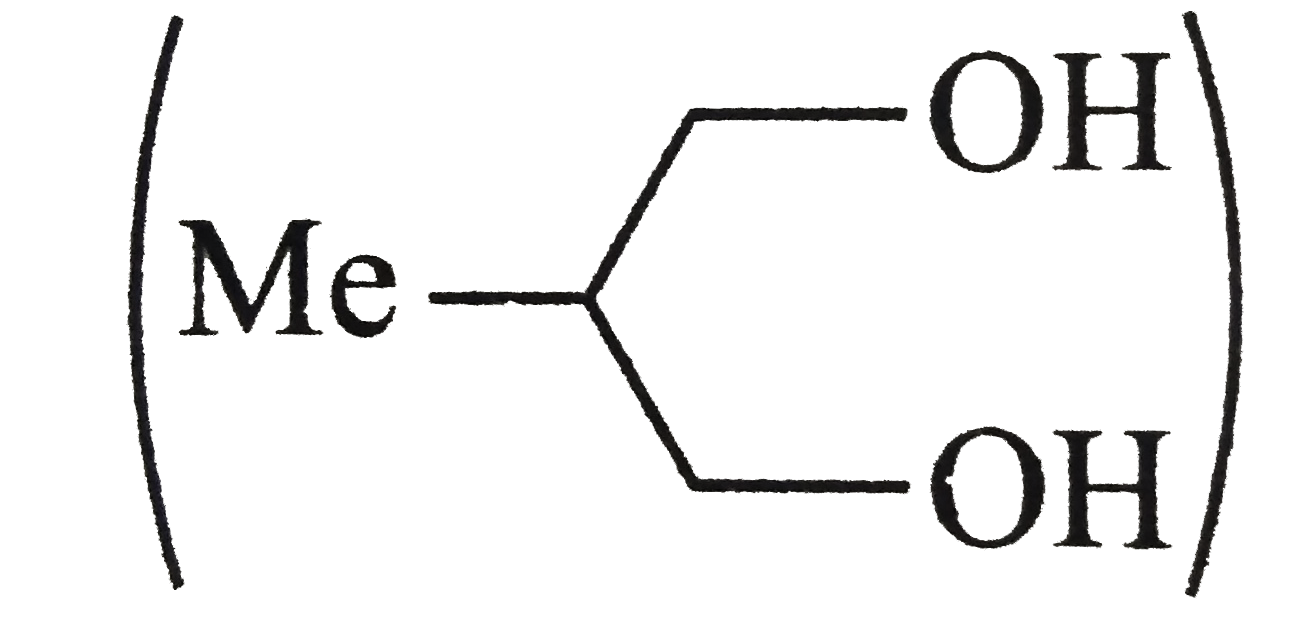 (ii) `(B)` id `(IV)`, since ETHERS are inert to OXIDATION. (iii) Iosoform test is SHOWN by `(II)`, so `(C)` is `(II)`. (iv)  . .
|
|
| 41. |
Four isomeric para-disubstituted aromatic compounds A to D with molecular formula C_(8)H_(8)O_(2) were given for identification. Based on the following observations, give structures of the compounds. |
|
Answer» Both `A` and `B` form a SILVER mirror with TOLLEN's reagent, also `B` give a positive test with `FeCl_(3)` solution. (ii) `-COCH_(3)` gives iodoform test. `NaHCO_(3)` is the test for acidity. |
|
| 42. |
Four membered heterocyclic secondary amines possible for C_(5)H_(11)N |
Answer» 
|
|
| 43. |
Four grams of sodium hydroxide have been added to 10^(3)Ltank of water. The pH of resulting solution is : |
|
Answer» 10 |
|
| 44. |
Four grams of NaOH solid are dissolved in just enough water to make 1 litre of solution. What is the [H^(+)]of the solution ? |
|
Answer» `10^(-2)` moles/litre |
|
| 45. |
Four grams of graphite is burnt in a bomb calorimeter of heat capacity 30 kJ K^(-1) in excess of oxygen at 1 atmospheric pressure. The temperature rises from 300 to 304 K. What is the enthalpy of combustion of graphite (in kJ mol^(-1)) |
|
Answer» Solution :`DeltaE=CxxDeltatxx(M)/(m)=30xx4xx(12)/(4)=360` `DeltaE=-360 KJ mol^(-1)` |
|
| 46. |
Four grams of helium is expanded from 1 atm to one-tenth of its origiinal pressure at 30^(@)C. Change in entropy (assuming ideal gas behaviour) is : |
|
Answer» `38.3 JK^(-1)` `DELTA S=nR "in" (P_(1))/(P_(2))` `n= (4.0)/(4) = 1.0` mol, R= 8.314 `p_(1) =1` atm `p_(2) = 1//10` atm `Delta S= (1.0) xx(8.314) "log" (1)/(1//10)` `=19.15JK^(-1)` |
|
| 47. |
Four grams of graphite is burnt in a bomb calorimeter of heat capacity 30 kJ K^(-1) in excess of oxygen at 1 atmospheric pressure. The temperature rises from 300 to 304 K. What is the enthalpy of combustion of graphite (in kJ mol^(1)) ? |
|
Answer» Solution :`Delta E = C xx Delta t xx (M)/(m)` `= 30 kJ K^(-1) xx 4 xx (12)/(4)` `= 360 kJ mol^(-1)` `Delta E = -360 kJ mol^(-1)` |
|
| 48. |
Four gases P,Q,R and S have almost same values of b but their a values (a,b are van der Waals constants) are in the order QltRltsltP. At a particular temperature, among the four gases the most easily liquefiable is |
|
Answer» P |
|
| 49. |
Four gases PQ,R and S have almost same values of 'b' but their 'a' values (a and b are van der Waals'constant) are in the order QltRltSltP. At a particular temperature, among the four gases, the most easily liquefiable one is |
|
Answer» P |
|