

Saved Bookmarks
This section includes 7 InterviewSolutions, each offering curated multiple-choice questions to sharpen your Current Affairs knowledge and support exam preparation. Choose a topic below to get started.
| 1. |
Give the chemistry of silver mirror test or Tollen's test |
|
Answer» |
|
| 2. |
Formic acid contains ________ group/s |
|
Answer» aldehyde |
|
| 3. |
Formic acid contains both _______ and ________ groups. |
|
Answer» `-CHOandOH` |
|
| 4. |
Formic acid cannot be halogenated with chlorine in presence of red P, but acetic acid can be halogenated in the same way ,because: |
|
Answer» FORMIC ACID is weaker than acetic acid |
|
| 5. |
Formic acid can reduce:Tollen's reagent,Mercuric chloride,Potassium permanganate,All. |
|
Answer» TOLLEN's reagent |
|
| 6. |
Formic acid can be distinguished from acetic acid by reaction with |
|
Answer» `NaHCO_(3)` |
|
| 7. |
Formic acid can be detected with how many of the followings tests ? {:(,(a),"Idoform test",(b),"Tollen's test"),(,(c),"Litmus test",(d),"fehling test"),(,(e),NaHCO_(3) "test",(f),"Benedicts test"),(,(g),"Brady's test",(h),H^(oplus)KMnO_(4)"test"),(,(i),H^(oplus)K_(2)Cr_(2)O_(7) "test",(j),"Hinsberg test"):} |
|
Answer» |
|
| 8. |
Formic acid can be distinguish from acetic acid because formic acid |
|
Answer» RELEASE `H_(2)` with sodium |
|
| 9. |
Formic acid and formaldehyde can be distinguised by : |
|
Answer» Tollen's Test `H-CO_(2)Hoverset(NaHCO_(3))rarrH-CO_(2).^(-)NA^(+)+H_(2)O+CO_(2)uarr` |
|
| 10. |
Formic acid and acetic acid may be distinguished by reaction with : |
|
Answer» SODIUM |
|
| 11. |
Formic acid and acetic acid differ in |
|
Answer» Turning blue LITMUS RED |
|
| 12. |
Formic acid and acetic acid may be distinguished by the reaction with : |
|
Answer» Sodium metal |
|
| 13. |
Formic acid and acetic acid may bedistin guished by the action with : |
|
Answer» 2, 4- Dinitrophenyl hydrazine |
|
| 14. |
Formic acid and acetic acid can be distinguished by the action of: |
|
Answer» conc. `H_(2)SO_(4)` |
|
| 15. |
Formic acid and acetic acid can be distinguished by |
|
Answer» Tollen's reagent  it can be oxidized by Tollons reagent, FEHLINGS reagent and `KMnO_(4)`. But not ACETIC acid. it can be oxidized by Tollons reagent, FEHLINGS reagent and `KMnO_(4)`. But not ACETIC acid.
|
|
| 16. |
Formic acid act as reducing agent. Prove this statement. |
Answer» Solution : (i) Formic ACID contains both an aldehyde as well as an acid group. Hence, like other aldehydes, formic acid can easily be oxidised and THEREFORE acts as a strong reducing agent. 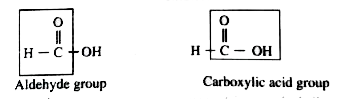 (ii) Formic acid reduces Tollen.s reagent ( ammonical SILVER nitrate solution ) to metallic silver . `HCOO^(-) + UNDERSET("(Tollen.s reagent)")(2Ag^(+)) + 3OH^(-) to underset("Silver mirror")(2Ag) + CO_(3)^(2-) + 2H_2O` (ii) Formic acidreduces Fehling.s solution . It reduces blue coloured cupric IONS to red coloured cuprous ions . `HCOO^(-) + underset("(Fehling solution) ( Blue)")(2Cu^(2+))+5OH^(-) to underset("Red precipitate")(Cu_2O darr) + CO_(3)^(2-) + 3H_2O` |
|
| 17. |
Formic acid acetic acid can be distinguished with |
|
Answer» sodium |
|
| 18. |
Formic acid |
|
Answer» is IMMISCIBLE with water |
|
| 19. |
Formic acid: |
|
Answer» Is immiscible with water |
|
| 20. |
formed by P & Q can be differentiated by : |
|
Answer» 2,4-DNP |
|
| 21. |
Formation of which of the sulphides is most spontaneous? |
| Answer» Answer :c | |
| 22. |
Formation ofLondon smog takes place in |
|
Answer» winter during DAY time |
|
| 23. |
Formation of which of the following compound confirms the unsaturation character of benzene : |
|
Answer» Cyclohexane is in 'boat' form |
|
| 24. |
Formation of which compound given below from 1 -butanol needs an oxidising agent? |
|
Answer» `CH_(3)-CH_(2)-CH_(2)CH_(2)-Br` |
|
| 25. |
Formation of waterfrom its elements is spontaneous, butis slow. Comment . |
| Answer» Solution :Free energy decreases during the FORMATION of water from its elemnts. Hence, thermodynamically the reaction is SPONTANEOUS. Criterion of spontanity should not be correlated with time. Spontaneous reaction means that it will take place but how long it will take, thermodynamics does not tell. At ROOM temperature, without using a CATALYST, about `1%` of the reaction is complete in one YEAR. The reaction is slow. It is kinetically non-spontaneous. | |
| 26. |
Formation of SO_(3) takes place according to the reaction 2SO_(2)+O_(2)hArr2SO_(3),DeltaH=-45.2 kcal Which of the following factors favours the formation of SO_(3) |
|
Answer» Increase in TEMPERATUE |
|
| 27. |
Formation of soap involves : |
|
Answer» Hydrolysis |
|
| 28. |
Formation of Salicylic acid from phenol (Kolbe's reaction) is an example of |
|
Answer» ELECTROPHILIC ADDITION reaction |
|
| 29. |
Formation of polyethylene from calcium carbide takes place as follows CaC_(2)+2 H_(2)O rarr Ca(OH)_(2)+C_(2)H_(2) C_(2)H_(2)+H_(2) rarr C_(2)H_(2) N(C_(2)H_(4)) rarr (-CH_(2)-CH_(2)-)_(n) The amount of polyethylene obtained from 64.1 kgCaC_(2)is |
|
Answer» 7 kg `:.` From the balanced chemical equations, moles of `C_(2)H_(2)=` moles of `C_(2)H_(4)` =moles of `CaC_(2)=1 xx 10^(3)` `:.` moles of polythene `=(1)/(n)xx 1 xx 10^(3)` `:.`weightof polythene `=(1)/(n) xx 1 xx 28n` kg=28kg |
|
| 30. |
Formation of purple colour on the addition of sodium nitroprusside to sodium carbonate extract indicates the presence of |
|
Answer» `PO_(4)^(3-)` |
|
| 31. |
Formation of RBC is because of |
| Answer» Answer :B | |
| 32. |
Formation of polyethylene from calcium carbide takes place as follows CaC_2+2H_2O to Ca(OH)_2 +C_2H_2 C_2H_2 +H_2 to C_2H_4 n(C_2H_4) to (-CH_2-CH_2-)_n The amount of polyethylene obtained from 64.1 kg CaC_2 is |
|
Answer» 7 kg `C_2H_2+H_2 to underset"28 g"(C_2H_4)` 64g of `CaC_2` GIVES 28 g of ethylene `therefore` 64 kg of `CaC_2` will give 28 kg of polyethylene |
|
| 33. |
Formation of phenol from chlorobenzene is an example of_____aromatic substitution occurring through____mechanism. |
| Answer» SOLUTION :NUCLEOPHILIC, BENZYNE | |
| 34. |
Formation of phenol from chlorobenzene is an example of_____aromatic substitution and occurs through____intermediate. |
Answer» SOLUTION :
|
|
| 35. |
Formation of ozone in the upper atmosphere from oxygen takes place by the action of |
|
Answer» nitTogen oxides |
|
| 36. |
Formation of ozonide is: |
|
Answer» ADDITION reaction |
|
| 37. |
Formation of ozone hole is maximum over |
|
Answer» Europe |
|
| 38. |
Formation of oxonium salts shows that ethers are : |
|
Answer» ACIDIC in nature |
|
| 39. |
Formation of oxonium saltshow thatethers are |
|
Answer» A) Basic in NATURE |
|
| 40. |
Formation of nylons and polyestersare called step growth polymerisation because |
|
Answer» the POLYMERS are formed by ADDING a monomer step by step |
|
| 41. |
Formation of nucleus from its nucleons is accompanied by |
|
Answer» DECREASE in MASS |
|
| 42. |
Formation of volatile Ni(CO)_(4) and then its subsquent decomposition into Ni and CO makes basis of Mond's process: Ni+4CO overset(T_(1))to Ni(CO)_(4) overset(T_(2))to Ni 4CO_(3) T_(1) and T_(2) are: |
|
Answer» `100^(@)C, 50^(@)C` |
|
| 43. |
Formation of methyl tertiary butyl ether by the reaction of sodium tertiary butoxide and methyl bromide involves |
|
Answer» Elimination reaction |
|
| 44. |
Formation of metallie copper from the sulphide ore in the normal thermo-metallurgical process essentially involves which one of the following reaction? |
|
Answer» `CuS+(3)/(2)O_(2) to CuO+SO_(2), CuS+C to Cu+CO` `(a) CuS+(3)/(2) O_(2) to CuO+SO_(2)` (Roasting) (b) `2Cu++CuS to 3Cu+5SO_(2)` (Auto REDUCTION) |
|
| 45. |
Formation of metallic copper from the sulphide ore in the normal thermo-metallurgical process essentially involves which one of the following reaction ? |
|
Answer» `{:(CuS + (3)/(2)O_(2) rarr CuO + SO_(2),),(CuO + C rarr Cu + CO):}` |
|
| 46. |
Formation of metallic copper from sulphide ore in te normal thermometallurgical process essentially involves which of the following reactions |
|
Answer» `CuS+3/2O_2rarrCuO+SO_2,` |
|
| 47. |
Formation of metallic copper from the sulphide ore in the normal thermo-metallur-gical process essentially involves which one of the following reaction ? |
|
Answer» `CuS + (3)/(2) O_(2) to CuO + SO_(2),` |
|
| 48. |
Formation of intertitial compounds make the transition metal : |
|
Answer» More SOFT |
|
| 49. |
Formation of hemiketal in fructose between gtC-O group and OH group of C-5 atom, which carbon atom become chiral |
|
Answer» C-1 |
|
| 50. |
Formation of interstitial compounds makes the transition metal |
|
Answer» more soft |
|