

Saved Bookmarks
This section includes 7 InterviewSolutions, each offering curated multiple-choice questions to sharpen your Current Affairs knowledge and support exam preparation. Choose a topic below to get started.
| 1. |
Four flask of 1 litre capacity each are separately filled with gasesH_2,He,O_2 and O_3. At the same temperature and pressure, the ratio of the number of atoms of these gases present in different flask would be : |
| Answer» Solution :`H_(2):He:O_(2):O_(3)=2:1:2:3`. | |
| 2. |
Four equations are given below. Decide if they are correctly balanced or not. (T for true and F for false) (i) M_(x)O_(y) + YC to x M + YCO (ii) 2Al_2O_3 + 3C to 4Al + 3CO_2 (iii) FeO + SiO_2 to FeSiO_3 (iv) Cu_2S + 2Cu_2O to 6Cu + SO_2 |
|
Answer» T T T T |
|
| 3. |
Four elements A, B ,C and D have standard oxidation potential values as : 2.87V , +2.71V, 1.67V and -2.87V. The strongest reducing agent will be |
|
Answer» A |
|
| 4. |
Four complexes are given : (P) [CoCl(NH_(3))_(5)]^(2+)""(Q) [Co(NH_(3))_(5)(H_(2)O)]^(3+) (R ) [Co(NH_(3))_(6)]^(3+)""(S) [Co(CN)_(6)]^(3-) All of them exhibit at least one of the following 4 colours viz, violet, red, yellow orange, pale yellow. One of them absorbs light in the U.V. region. Choose the correct statement(s). |
|
Answer» Order of wavelength of light absorbed : `PgtQgtRgtS` 
|
|
| 5. |
Four containers of 2L capacity contains dinitrogen as described below. Which one contains maximum number of molecules? |
|
Answer» `2*5` G-molecule of `N_(2)` |
|
| 6. |
Four colourless salt solutions are placed in separate test tubes and a strip of copper is placed in each. Which solution finally turns blue: |
|
Answer» `Pb(NO_3)_2` |
|
| 7. |
Four colourless salt solutions are placed in separate test tubes and a strip of copper is placed ineach. Which solution finally turns blue? |
|
Answer» `PB(NO_3)_2` ` Pb^(+2)//Pb , Cu^(+2)//Cu` `Ag^(+)//Ag , m + 2AgNO_3 to Cu(NO_3)_2 + 2AG^(OPLUS)` |
|
| 8. |
Four colourless salt solutions are placed in separate test-tubes and a strip of copper is placed in each . Which solution finally turns blue |
|
Answer» `CD(NO_(3))_(2)` |
|
| 9. |
Foul smell in the water of tanks, ponds etc. is due to |
|
Answer» Anaerobiosis |
|
| 10. |
Fot the reaction A + B to produts, it is found that orders of the reaction in A and B are 1 and 2 respectively. When the conc. ofA is halved and that of B is doubled, the rate increases by a factor : |
|
Answer» 2 `(dx)/(dt)=r_1=k[A][B]^2`… (i) `r_2 = k[1/2][2B]^2`…(ii) `or r_2= 1/2xx2^2k[A][B]^2`…(iii) Dividing (iii) by (i) `(r_(2))/(r_(1)) = (2 k [A][B]^(2))/(k[A][B]^(2)) = 2 therefore r_(2) = 2r_(1)` |
|
| 11. |
Four alkali metals A,B,C and D are having respectively standard electrode potential as -3.05, -1.66, -0.40 and 0.80. Which one will be the most reactive. |
|
Answer» A |
|
| 12. |
Fortbcclcctrochcmical cell, M |M^(+)||X^(-)|X,E ^(@)_(M^(4)//M)=0.44and E ^(@)_(X//X)=0.33V. From this data one can deduce that |
|
Answer» `M +Xto M ^(+)+X` is the SPONTANEOUS REACTION is positive, hence reaction is spontaneous. |
|
| 13. |
Formulate the galvanic cell in which the following reaction takes place: Zn(s)+2Ag^(+)(aq)toZn^(2+)(aq)+2Ag(s) State (i) Which one of the electrodes is negatively charged? (ii) The reaction taking place at each of its electrode. ltBrgt (iii) The carriers of current within this cell. |
|
Answer» Solution :The cell reaction is : `Zn(s)+2AG^(+)(aq)TOZN^(2+)(aq)+2Ag(s)` The cell is represented as: `Az(s)|Zn^(2+)(aq)||Ag^(+)(aq)+Ag(s)` (i) ANODE i.e., zinc electrode is negatively charged. (ii) At anode: `Zn(s)toZn^(2+)(aq)+2e^(-)` At cathode: `Ag^(+)(aq)+e^(-)toAg(s)` (III) Within the cell, the current is carried by the cations and the anions through the salt bridge. In the external circuit, electrons FLOW from zinc to silver andhence conventional current flows from silver to zinc. |
|
| 14. |
Formulate the compound tetraammineaquachloridocobalt (III) chloride |
|
Answer» Solution :Anion (simple ion) `=Cl^(-)` for the COORDINATION ENTITY, writing FIRST the symbol for metal atom and then the ligands in the alphabetical order, we have Cation (complex ion) `=[Co(NH_(3))_(4)(H_(2)O)Cl]^(x)` where x is the charge on the complex ion. x = oxidation state to cobalt + charge on the ligands x=+3+0+0+(-1)=+2 (`H_(2)O` and `NH_(3)` are neutral group and carry no charge. Only chlorido group carries charge = - 1) Charge on one anion = - 1 Charge on complex cation = + 2 Clearly, two anions will NEUTRALISE the charge of the cation. Hence, formula of the given compound is `[Co(NH_(3))_(4)(H_(2)O)Cl]Cl_(2)`. |
|
| 15. |
Formulae for ortho-, pyro-, chain-, and double chain silicates are respectively: |
|
Answer» `[SiO_(4)]^(4-), [Si_2O_7]^(6-),[Si_2O_3]^(2-),[SiO_11]^(6-)` |
|
| 16. |
Formula of tris(ethane-1,2-diamine)iron(II)phosphate |
|
Answer» `[FE(CH_(3)-CH(NH_(2))_(2))_(3)](PO_(4))_(3)` |
|
| 17. |
Formula of thiosulphate, manganate and arsenate respectively are |
|
Answer» `S_(4)O_(6)^(2-),MnO_(4)^(2-),AsO_(3)^(3-)` |
|
| 18. |
Formula of the compound in which the element Y forms CCP lattice and atoms of Xoccupy 1/3rd of THV :- |
|
Answer» `XY_3` `X to 8 xx 1/3=8/3` `X_2Y_3` |
|
| 19. |
Formula of tris (ethane 1,2-diamine ) iron (II) phosphate |
|
Answer» ` [FE(CH_3-CH(NH_2)_2)_3 (PO_4) _3` |
|
| 20. |
Formula of Silicate is ? |
|
Answer» `Si_6O_20^(-12)` 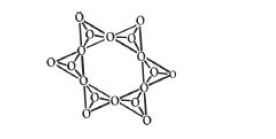
|
|
| 21. |
Formula of Rust is : |
|
Answer» `Fe_(2)O_(3)` |
|
| 22. |
Formula of rhombic sulphur is |
|
Answer» `S_2` |
|
| 23. |
Formula of peroxodisulphuric acid(Marshall"s acid) is |
|
Answer» `H_2SO_5` |
|
| 24. |
Formula of nylon -66 is |
|
Answer» `[OC(CH_2)_6CONH(CH_2)_4NH]_n` |
|
| 26. |
Formula of Hexamethylenediamine is _____. |
| Answer» SOLUTION :`NH_2 \\ (-CH_2)_6-NH_2` | |
| 27. |
Formula of hexa-aquamangnnese (II) phosphate is |
|
Answer» `[MN(H_(2)O)_(6)][PO_(4))` |
|
| 28. |
Formula of hexaaquamanganese (II) phosphate is |
|
Answer» `[Mn(H_(2)O)_(6)](PO_(4))` |
|
| 29. |
Formula of ferrocene is : |
|
Answer» `[Fe(CN)_(4)]^(4-)` |
|
| 30. |
Formula of Feldspar is |
|
Answer» `K_(2) O. Al_(2)O_(3). 6 SiO_(2)` |
|
| 31. |
Formula of diacetone alcohol is: |
|
Answer» `(CH_2)C(OH)CH_2COCH_2` |
|
| 32. |
Formula of calcium chlorite is: |
|
Answer» `CaClO_ 2` |
|
| 33. |
Formonitrile is reduced by SnCl_(2) + HCl and product on acid hydrolysis gives |
|
Answer» FORMIC ACID |
|
| 35. |
Formic and acetic acid may be distinguished by the reaction with |
|
Answer» SODIUM METAL |
|
| 36. |
Formic and acetic acid can be distinguished by |
|
Answer» With AMMONIACAL `AgNO_3` |
|
| 37. |
Formic acid reduces_____but acetic acid does not. |
| Answer» SOLUTION :TOLLENS' REAGENT or FEHLING's solution. | |
| 38. |
Formic acid reduces Tollen's reagent, but acetic acid does not-Give reasons. |
|
Answer» Solution :(i) Formic acid (HCOOH) is unique because it contains both an aldehyde group and carboxyl group also. (ii) Hence it can act as a reducing agent. It REDUCES Fehling's solution Tollen's reagent and decolourises pink coloured `KMnO_(4)` solution. (iii) Whereas in acetic acid, there is no aldehyde group and it cannot act as reducing agent. (iv) Formic acid reduces ammoniacal SILVER nitrate solution (Tollen's reagent) to metallic silver. `HCOOH+Ag_(2)OtoH_(2)O+CO_(2)+2Agdarr` (metallic silver) (v) Formic acid reduces Fehling's solution. It reduces BLUE coloured cupric ions to red coloured cuprous ions. `HCOO^(-)+underset("(blue)")(2CU^(2+))+5OH^(-)toCO_(3)^(2-)+underset("(red)")(Cu_(2)O)+3H_(2)O` |
|
| 39. |
Formic acid reduces ammoniacal AgNO_3 solution and Fehling.s solutionbecause: |
|
Answer» All organic acids do so |
|
| 41. |
Formic acid reacts with conc . H_(2)SO_(4) to give : |
|
Answer» OXALIC acid |
|
| 42. |
Formic acid is obtained when : |
|
Answer» CALCIUM formate is heated with calcium acetate |
|
| 43. |
Formic acid is more stronger than acetic acid. Justify this statement. |
|
Answer» Solution :The ELECTRON releasing groups (+I groups) increase the relative charge on the carboxylate ion and destabilise it and hence the LOSS of proton BECOMES difficult. + I groups are `CH_3 - C_2H_5, - C_3H_7` `underset("FORMIC acid")(H-oversetunderset(||)(O)(C ) -OH) gt underset("acetic acid ")(CH_3 - oversetunderset(||)(O)(C ) -OH ) gt underset("propionic acid")(CH_3 - CH_2 - COOH) ` |
|
| 44. |
Formic acid is obtained when: |
|
Answer» `(CH_3COO)_2Ca` is HEATED with conc.`H_2SO_4` |
|
| 45. |
Formic acid is not a representative member of the carboxylic acids because : |
|
Answer» It is the first member of the series |
|
| 46. |
Formic acid is manufactured on large scale by treating X with sodium hydroxide under a pressure of a 1 atm and 473 K. X is , |
| Answer» Answer :C | |
| 47. |
Formic acid is a stronger acid than acetic acid . This is due to the fact that |
|
Answer» formic acid is reducing AGENT |
|
| 48. |
Formic acid is a stronger acid than acetic acid.This can be explained using |
|
Answer» `+M EFFECT` This can be EXPLAINED using+I effect. Acetic acid showing+I effect decreases the acid STENGTH as it increases the -ve charge on the carboxylate ion which HOLDS the hydrogen FIRMLY. |
|
| 49. |
Formic acid is 4.6% dissociated in a 0.1 N solution at 20^@C . The ionisation constant of formic acid is : |
|
Answer» `21xx10^(-4)` |
|