

Saved Bookmarks
This section includes 7 InterviewSolutions, each offering curated multiple-choice questions to sharpen your Current Affairs knowledge and support exam preparation. Choose a topic below to get started.
| 1. |
For the reaction C(s)+ CO_2(g) hArr 2CO(g) the partial pressure of CO_2 and CO are 4 and 8 atm respectively K_p For the reaction is : |
|
Answer» 16 atm |
|
| 2. |
For the reaction C_((s))+CO_(2(g)) hArr 2CO_((g)) the partial pressures fo CO_2" and CO are 2.0 and 4.0 atm respectively at equilibrium. Kp for the reaction is |
|
Answer» `0.5` |
|
| 3. |
For the reaction CrO_(4)^(2-)+?rarrCr_(2)O_(7)^(-2)the missing ion is |
|
Answer» `OH^(-)` |
|
| 4. |
For the reaction: CO_((g))+Cl_(2(g))iffCOCl_(2(g)),K_(p)//K_(c) equal to |
|
Answer» `1//RT` `K_(p)=K_(c)(RT)^(Deltan)=K_(c)(RT)^(-1)=K_(c)//RT` or, `K_(p)//K_(c)=1//RT` The given reaction is endothermic. So on increasing TEMPERATURE, it will SHIFT in the forward direction. |
|
| 5. |
For the reaction CO_((g))+H_(2)OhArrCO_(2(g))+H_(2(g)) at a given temperature, the equlibrium amount of CO_(2(g))can be increased by |
|
Answer» Adding a suitable catalyst |
|
| 6. |
For the reaction, CO(g)+H_(2)O(g)hArrCO_(2)(g)+H_(2)(g), at a given temperature, the equilibrium amount of CO_(2)(g) can be increased by |
|
Answer» ADDING a suitable catalyst |
|
| 7. |
For the reaction,CO_((g))+Cl_(2(g))hArrCOCl_(2(g))the K_(p)//K_(c) is equal to |
|
Answer» `sqrt(RT)` `Deltan=1-2=-1` `K_(p)=K_(C)[RT]^(Deltan), therefore(K_(p))/(K_(c))=[RT]^(-1)=(1)/(RT)` |
|
| 9. |
For the reaction CO_((g))+2H_(2(g))hArrCH_(3)OH_((g)), true condition is |
|
Answer» `K_(p)=K_(C)` |
|
| 10. |
For the reaction :CO(g)+Cl_(2)(g)hArr COCl_(2)(g)the K_(p)//K_(c )is equal to : |
|
Answer» SOLUTION :`K_(p)=K_(C )(RT)^(Delta n_(G))` `Delta n_(g)=1-(1+1)=-1` `(K_(p))/(K_(c ))=(RT)^(-1)=(1)/(RT)` |
|
| 11. |
For the reaction CO_((g))+(1)/(2)O_(2(g))rarrCO_(2(g)),DeltaH and DeltaS " are "-283 kJ and -87 JK^(-1).Respectively. It was intended to carry out this reaction at 1000, 1500, 3000 and 3500 K. At which of these temperature would this reaction be thermodynamically spontaneous |
|
Answer» 1500 and 3500 K For SPONTANEOUS reaction `DeltaG` should be negative When T=1000 K, `DeltaG`=(-283 -1000 `xx` 0.087) kJ =-370 kJ When `T=1500 K, DeltaG=(-283-1500xx0.087) kJ =-413.5 kJ` `T=3000 K, DeltaG=(-283-3000xx0.087) kJ=-544kJ` When `T=3500 K, DeltaG=(-283-3500xx0.087) kJ=+21.5kJ` Hence at 3500 K, reaction will be non-spontaneous. |
|
| 12. |
For the reaction CO (g) + (1)/(2) O_(2) (g) rarr CO_(2) (g) Delta H and Delta S are -283 kJ and -87 J K^(-1), respectively. It was intended to carry out this reaction at 1000,1500,3000, and 3500 K. At which of these temperatures would this reaction be thermodynamically spontaneous? |
|
Answer» 1500 and 3500K For a spontaneous reaction `DeltaG` should be negative `DeltaH=-234kJ,DeltaS=-87JK^(-1)` Hence reaction will be spontaneous when `DeltaHgtT.DeltaS`. THEREFORE at 1000, 1500 and 3000 K the reaction would be spontaneous. |
|
| 13. |
For the reaction :CO(g)+2H_(2)(g)hArr CH_(3)OH(g) |
|
Answer» <P>`K_(p)=K_(c )` `K_(p)=K_(c )(RT)^(-2)` `therefore K_(p)lt K_(c )` |
|
| 14. |
For the reaction CO_((g))+1/2O_(2(g))hArrCO_(2(g)),(K_(p))/(K_(c)) is equivalent to |
|
Answer» 1 `K_(p)=K_(C)(RT)^(1-1(1)/(2))=K_(c)(RT)^(-1/2),(K_(p))/(K_(c))=sqrt((1)/(RT))` |
|
| 15. |
For the reaction CO(g)+1/2 O_(2) (g) rarr CO_(2)(g) using data given in table find out incorrect statement(s) among the following. {:(,DeltaH_(f)^(@)"(kJ/mole)",S^(@)"(J/Kmole)"),(CO(g),-110,+197),(O_(2)(g),0,+205),(CO_(2)(g),-395,+213):} Assume vibration modes of motion do not contribute to heat capacity at low temperature. |
|
Answer» <P>`DeltaH^(@) gt DeltaU^(@)` for the reaction at 298 K. since `Deltan_(g)=-ve` `rArr DeltaH^(@)-DeltaU^(@) le 0` `DeltaH^(@)=-ve` `DeltaS^(@)=-ve"",""C_(p)=3/2R+R"",""=5/2 R"",""Delta_(r)C_(p)=-ve` |
|
| 16. |
For the reaction CO(g)+(1//2)O_(2)(g)=CO_(2)(g),K_(p)//k_(e ) is |
|
Answer» <P>RT `Delta n=1-(1+(1)/(2))=1-(3)/(2)=-(1)/(2) THEREFORE (K_(p))/(K_(e ))=(RT)^(-1//2)` |
|
| 17. |
For the reaction :CO(g)+1//2O_(2)(g)hArr CO_(2)(g)the partial pressures are :p(O_(2))=0.24atm, p(CO)=0.4 atm and p(CO)=0.04 atm.The equilibrium constant K_(p)is : |
|
Answer» <P>`0.3` `=(0.24)/(0.4xx(0.04)^(1//2))=3.0` |
|
| 18. |
For the reaction CO (g) + (1)/(2) O_(2) (g) rarr CO_(2) (g) using data given in table find out incorrect statement (s) among the following {:(,Delta H_(f)^(@) (kJ//"mole"),S^(@) (J//K"mole"),),(CO (g),-110,+197,),(O_(2) (g),0,+205,),(CO_(2) (g),-395,+213,):} Assume vibration modes of motion do not contribute to heat capacity at low temperature. |
|
Answer» `Delta H^(@) GT Delta U^(@)` for the reaction at 298 K since `Deltan_(g)=-ve` `rArr DeltaH^(@)-DeltaU^(@) lt 0` `DeltaH^(@)=-ve` `DeltaS^(@)=-ve"",""C_(p)=3/2 R+R" ",""=5/2 R` `Delta_(r)C_(p)=-ve` |
|
| 19. |
For the reaction CO_2(g) +H_2 hArr CO(g) +H_2O(g) The K_p for the reaction is 0.11 if the reaction was started with 0.45 moles of CO_2 and 0.45 moles of H_2 at 700k ,the concentration of CO_2 when 0.34 mole of CO_2 and 0.34 mole of H_2 are added when the first equilibrium is attained is |
|
Answer» 0.52 M |
|
| 20. |
For the reaction : Cl_(2(g))rarr2Cl_((g)) |
|
Answer» `DELTA H` is POSITIVE, `Delta S` is positive |
|
| 21. |
For the reaction: Cl_(2)(g) + 2NO(g) to 2NO_(2)F(g) The following mechanism is suggested. i) NO_(2) + F_(2) to NO_(2)+F (slow) ii) NO_(2) + F to NO_(2)F+F (fast) What is the predicted rate law? |
| Answer» SOLUTION :ORDER of REACTION =3 | |
| 22. |
For the reaction Cl_(2)(g)+2NO(g) to 2NOCl (g), the rate law is expressed as : rate =k[Cl_(2)][NO]^(2). What is the overall order of this reaction? |
| Answer» SOLUTION :ORDER = 3. | |
| 23. |
For the reaction : Cl_(2)(g) to 2Cl_(g) |
|
Answer» `DELTAH` is POSITIVE, `DELTAS` is positive. |
|
| 24. |
For the reaction Cl_(2)+2I^(-)toI_(2)+2CI^(-), the initial concentration of I^(-) was 0.20 mol "lit"^(-1) and the concentration after 20 min was 0.18 mol "lit"^(-1). If the rate of formation of I_(2) in mol "lit"^(-1) "min"^(-1) is x xx 10^(-4) then the value of x is |
|
Answer» |
|
| 25. |
For the reaction CH_(4(g))+2O_(2(g))hArrCO_(2(g))+2H_(2)O_((1)), ""DeltaH=-170.8kJmol^(-1) Which of the following statements is not true |
|
Answer» Adoeon of `CH_(4(g))on O_(2(g))` at equlibrium will cause a shift to the right |
|
| 26. |
For the reaction CH_3COCH_3+I_2 overset(H^+)to products. The rate equation is,(dx)/(dt) =k[CH_3COCH_3][H^+]. The order of the reaction with respect to iodine is |
|
Answer» ONE |
|
| 27. |
For the reaction (CH_(3))_(2)CH-CH=CH_(2)+C_(2)H_(5)OH to Product the catayst that can be used is |
|
Answer» DILUTE `H_(2)SO_(4)` 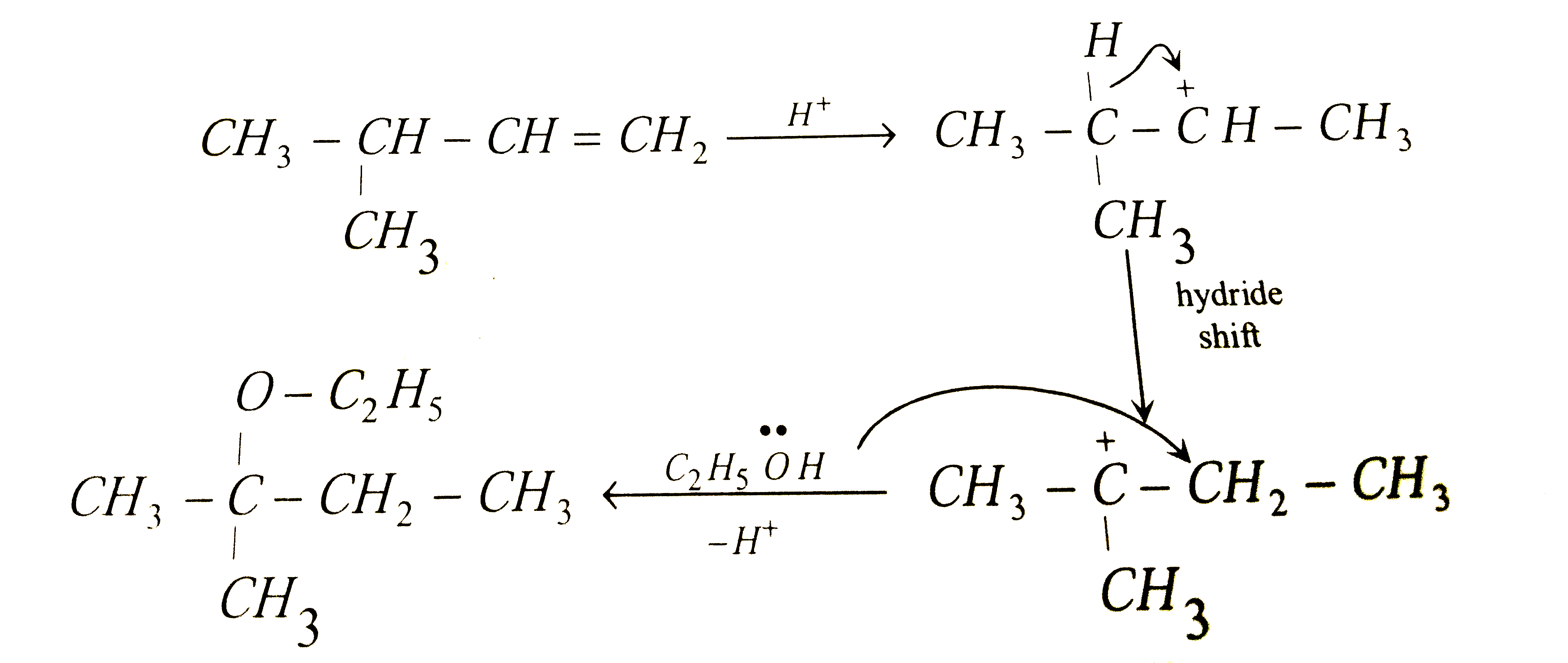
|
|
| 28. |
For the reaction CH_(2)=CH_(2)+HXtoCH_(3)CH_(2)X the orther of reactivity of HX is , |
|
Answer» `HIgtHClgtHBr` |
|
| 29. |
For the reaction, C_("graphite")+(1)/(2)O_(2)(g)=CO(g) at 298 K and 1 atm, DeltaH=-26416 cal. If the molar volume of graphite is 0.0053 litre, calculate DeltaH. |
|
Answer» |
|
| 30. |
For the reaction, CaCO_(3)(s) iff CaO(s)+CO_(2)(g)partial pressure of CO_(2) at 1000 K is 0.003 atm. DeltaG^(@)=27.2 kcal. Calculate the value of DelaG |
|
Answer» 12.6 kcal `K_(p)=P_(CO_(2))=0.003 atm` `DeltaG=DeltaG^(@)+2.303 RT LOG K_(p)` `=27.2+2.303xx2xx1000xxlog 0.003` `=15.6 kcal (R=2 cal mol^(-1)K^(-1))`. |
|
| 31. |
For the reaction CaCO_3(s) hArr CaO(s) +CO_2(g), the pressure of CO_2 depends on |
|
Answer» the MASS of `CaCO_3(s)` |
|
| 32. |
For the reaction, CaCO_3(s)rarrCaO(s)+CO_2(g) |
|
Answer» `TRIANGLEH=TRIANGLEU` |
|
| 33. |
For the reaction C_(6)H_(12)(l)+9O_(2)(g) rarr 6H_(2)O(L)+6CO_(2)(g) DeltaH_(298)=936kcal which of the following is true |
|
Answer» `-936.9 =Delta E -(2 xx 10^(-3)xx298 xx 3)KCAL` |
|
| 34. |
For the reaction, CaCO_3 (s) to CaO(s) +CO_2(g) , which is correct representation ? |
|
Answer» <P>`K_p =(P_(CO))_2` |
|
| 35. |
For the reaction. C_(3)H_(8)(g) + 5O_(2)(g) rarr3CO_(2)(g)+4H_(2)O(l) at constant temperature, DeltaH - DeltaE is |
|
Answer» SOLUTION :`DeltaH-DeltaE=DeltanRT,Deltan=-3` `"so, "DeltaH-DeltaE=-3RT` |
|
| 36. |
For the reaction : C_(3)H_(8)(g) + 5O_(2) rarr 3CO_(2)(g) + 4H_(2)O(l) a constant temperature, Delta H - Delta U is |
|
Answer» `+ RT` `Delta H = Delta U + Delta n_(g) RT` `Delta H - Delta U = - 3RT` |
|
| 37. |
For the reaction : C_2H_4(g)+5O_2(g)→3CO_2(g)+4H_2O(l)at constanttemperature. triangle H - triangleU is: |
|
Answer» RT |
|
| 38. |
For the reaction C_2H_5OH + HX overset(ZnX_2)to C_2H_5X. The order of reactivity is |
|
Answer» HBR GT HI gt HCL |
|
| 39. |
For the reaction, C_(2)H_(5)OH + HX overset(ZnCl_(2))to C_(2)H_(5)X+ H_(2)O, where HX is a halogen acid. The order of reactivity of halogen acids for their reaction is : |
|
Answer» `HCL GT HBR gt HI` |
|
| 40. |
For the reaction, C_2H_4(g)+3O_2(g)rarr2CO_2(g)+2H_2O(l), triangleU=-1414kJ. Then triangleH at 27^@C is: |
|
Answer» `-1410 KJ` |
|
| 41. |
For the reaction : C_(2)H_(4)(g) + 3 O_(2)(g) rarr 2 CO_(2)(g) + 2 H_(2)O(l) at 298 K, Delta U = - 1415 kJ. If R = 0.0084 kJ K^(-1). Then Delta H is equal to |
|
Answer» `- 1400 kJ` `Delta n_(g) = 2 -1 -3 = -2` `Delta H = - 1415 - 2 xx 0.0084 xx 298` `= - 1420 kJ` |
|
| 42. |
For the reaction, C_2H_5OH+HX overset(ZnX_2)rarrC_2H_5X,the order of reactivity is: |
|
Answer» `HI GT HCL gt HBr` |
|
| 43. |
For the reaction, C_(2) H_(4) (g) + 3O(2) (g) to 2 CO_(2) (g) + 2H_(2) O(I), Delta E = -1415 KJ. then Delta H at 27^(@) C is |
|
Answer» `+ 140 KJ` |
|
| 44. |
For the reaction: C_(12) H_(22)O_(11) +H_(2)O overset(H^(+))to C_(6)H_(12)O_(6)+C_(6)H_(12)O_(6) write: (i) rate of reaction expression. (ii) rate law equation. (iii) molecularity. (iv) order of reaction. |
|
Answer» Solution :(i) RATE `=(-d[C_(12)H_(22)O_(11)])/(dt)= -(d[H_(2)O])/(dt)= (d[C_(6)H_(12)O_(6)])/(dt)= (d[C_(6)H_(12)O_(6)])/(dt)` (ii) Rate `=k[C_(12)H_(22)O_(11)]` (iii) Two (iv) The reaction is of first ORDER because `H_(2)O` is taken in such large EXCESS that its concentration does not change with time. |
|
| 45. |
For the reaction, bondenergies are given as under – (i) C—C, 346 kJ/mol (ii) C—H, 413 kJ/mol (iii) H—H, 437 kJ/mol and (iv) C = C, 611 kJ/mol What will be the value of Delta H at 25^(@) C for the above reaction ? |
|
Answer» `-289 kJ mol^(-1)` |
|
| 46. |
for the reactionC+ O_(2) to CO_(2) |
|
Answer» `DeltaH gt DELTAE` `DeltaH=DeltaE` |
|
| 47. |
For the reaction between CO_(2) and graphite CO_(2)(g)+C(s)to2CO(g) DeltaH=+170.0kJandDeltaS=170JK^(-1). The reaction is spontaneous at - |
|
Answer» 298 K |
|
| 48. |
For the reaction between CO_2and graphite,CO_2(g) +C(s) to 2CO(g) , DeltaH = 170 kJ " and " Delta S = 179 JK^(-1)At equilibrium, the reaction will be non-spontaneous at |
|
Answer» 300K ` T = (Delta H)/(Delta S) = (170 xx 10^3)/(170) = 1000 K` The reaction would be non-spontaneous at TEMPERATURE less than 1000 K, so as to have `Delta G`positive. 5 |
|
| 49. |
For the reaction between A andB,the relationship between the concentration of A and B and rate is given by the reaction is |
|
Answer» first order with RESPECT to A |
|
| 50. |
For the reaction below, the product is Q. The compound Q is |
|
Answer»

|
|


