

Saved Bookmarks
This section includes 7 InterviewSolutions, each offering curated multiple-choice questions to sharpen your Current Affairs knowledge and support exam preparation. Choose a topic below to get started.
| 1. |
For the preparation t-butylmethlether Williamson.s method the correct choice of reagents is : |
|
Answer» METHOXIDE and t-butylbromide |
|
| 2. |
For the preparation of p nitroiodobenzene from p-nitroaniline the best method is |
|
Answer» `NaNO_(2)//HCl` followed by KL 
|
|
| 3. |
For the preparationof isopropyl acetate from esterification. The compounds used as , |
|
Answer» |
|
| 4. |
For the preparation of ethyl propionate from ethyl bromide, the other reactant required is |
|
Answer» SILVER ACETATE |
|
| 5. |
For the preparation of alpha,beta unsaturated ketonde, the only CORRECT combination is : |
|
Answer» <P>(II),(ii)(R) 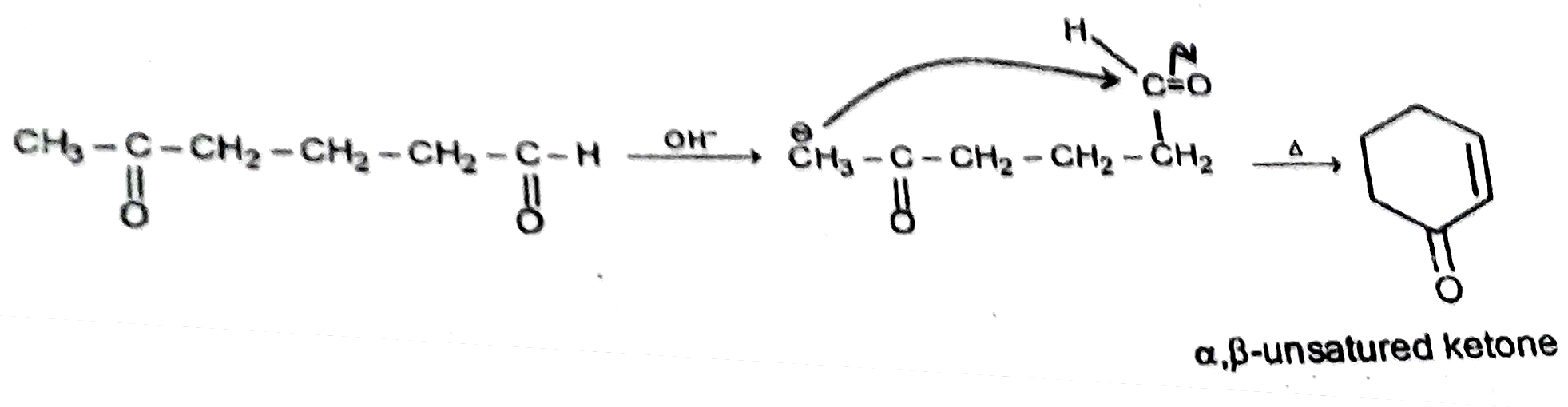
|
|
| 6. |
Forthepreparationof alkanes,asaturatedsolutionsodiumorpotassiumsaltofcarboxylicacidissubjected to : |
|
Answer» HYDROLYSIS |
|
| 7. |
For the preparation of Alkanes, aqueous solution of sodium or potassium salt of carboxylic acid ist subjected to |
|
Answer» Hydrolysis `RCOO NA = overset("Electrolysis")underset(underset(NaOH)(CO))rarr "Alkanes"` `or RCOO^(-)K^(**)` |
|
| 8. |
For the preoarations of alkyl chlorides from alcohols, thionyl chloride (SOCl_2) preferred.Given reason. |
| Answer» SOLUTION :`ROH + SOCl_2 RARR RCL + SO_2 + HCL` | |
| 9. |
For the precipiyation of AgCl by Ag^+ ions and HCl: |
|
Answer» `triangleH=0` |
|
| 10. |
For the precipitation group IV metal ions as their insoluble carbonates, a saturated (NH_(4))_(2)CO_(3) solution is added as a group reagent. But Na_(2)CO_(3) or K_(2)CO_(3) should not be used as the group reagent because |
|
Answer» They will prevent the precipitation of group IV metal CARBONATES by forming soluble complex salts. |
|
| 11. |
For the Paschen series the values of n_(1) and n_(2) in the expression DeltaE=R_(H).c(1/(n_(1)^(2))-1/(n_(2)^(2))) |
|
Answer» `n_(1)=1,n_(2)=2,3,4` … |
|
| 12. |
For the overall reaction between A and B to yield C and D, two mechanisms are proposed: I. A+BtoAB*toC+D,k_(1)=1xx10^(-5)M^(-1)s^(-1) II. AtoA"*"toE,k_(1)=1xx10^(-4)s^(-1), E+BtoC+d,k_(2)=1xx10^(10)M^(-1)s^(-1) (species with * are short lived) AT what concetration of B, rates of two mechanism are equal? |
|
Answer» 1M |
|
| 13. |
For the overall reaction between A and B to yield C and D, two mechanisms are proposed: I. A+BtoAB*toC+D,k_(1)=1xx10^(-5)M^(-1)s^(-1) II. AtoA"*"toE,k_(1)=1xx10^(-4)s^(-1), E+BtoC+d,k_(2)=1xx10^(10)M^(-1)s^(-1) (species with * are short lived) Rate of reaction for mechanism II when concentrationof eacn 1 M is |
|
Answer» `1XX10^(-4)Ms^(-1)` |
|
| 14. |
For the overall reaction between A and B to yield C and D, two mechanisms are proposed: I. A+BtoAB*toC+D,k_(1)=1xx10^(-5)M^(-1)s^(-1) II. AtoA"*"toE,k_(1)=1xx10^(-4)s^(-1), E+BtoC+d,k_(2)=1xx10^(10)M^(-1)s^(-1) (species with * are short lived) Rate of reaction for mechanism I when concentration of each is 0.1 M, is |
|
Answer» `1xx10^(-7)MS^(-1)` |
|
| 15. |
For the order thermal decomposition reaction, the following data were obtained : C_(2)H_(5)Cl(g)rarrC_(2)H_(4)(g)+HCl (g){:("Time/Sec","Total pressure /atm"),(0,""0.30),(300,""0.50):} Calculate the rate constant. (Given: log2 = 0.301, log3 = 0.4771 and log4 = 0.6021) |
|
Answer» <P> Solution :Suppose , the initial pressure of the reactant is P and its pressure reduces to x at a later time t , after the REACTION has started . So, at time t , the partial pressures of different components in the reaction mixture will be as follows:`""C_(2)H_(5)Cl(g)rarrC_(2)C_(4)(g)+HCl(g)` `{:("At " t = 0,P,,),("At "t = t,P-x,""x,""x):}` Total pressure of the mixture at t, `P_(t)=P-x+x+x=P+x` This gives`x=P_(t)-P` Therefore, at time t, the partial pressure of the reactant, `P_(i)=P-x=P-P_(t)+P=2P-P_(t)` As the reaction follows first order kinetics , its integrated rate law is - `k=(2.303)/(t)log.([A]_(0))/([A])` Substituting partial pressures for concentrations , we have, `k=(2.303)/(t)log.(P)/(P_(i))=(2.303)/(t)log.(P)/(2P-P_(t))` Given that `P = 0.30 "atm" and P_(t) = 0.50 "atm at " t = 300s` Substituting these values into the equation of k , we GET, `k=(2.303)/(300)log.(0.3)/(2xx0.3-0.5)=3.662xx10^(-3)s^(-1)` |
|
| 16. |
For the octahedral complexes of Fe^(3+) in SCN^(-)(thiocyanato-S) and in CN^(-) ligands environment, the difference between the spin-only magnetic moments in Bohr magnetons (when approximated to the nearest integer) is : [Atomic number of Fe=26] |
|
Answer» |
|
| 17. |
For the orthorhombic crystal system |
|
Answer» no two sides are EQUAL i.e. `a!=b!=C` |
|
| 18. |
For the octahedral complex of Fe^(3+) in SCN^(-) (thiocyanato-S) and in CN^(-) ligand environments, the difference between the spin only magnetic moments in Bohr magnetons (when approximated to the nearest integer is [Atomic number of Fe = 26] |
|
Answer» In `[Fe(CN)_(6)]^(3-), CN^(-)` is a strong field ligand which causes pairing of electrons  `mu=sqrt(n(n+2))=sqrt(1(1+2))=sqrt(3)=1.732` BM In `[Fe(SCN)_(6)]^(3-), SCN^(-)`being a weak field ligand does not cause pairing of electrons  `mu=sqrt(n(n+2))=sqrt(5(5+2))=sqrt(35)=5.916` BM DIFFERENCE = 5.916 - 1.732 = 4.184 `-=` 4 BM |
|
| 19. |
For the nonequilibrium process A + B toProducts, the rate is first-order w.r.t. A and second-order w.r.t. B. If one mole each of A and B were introduced into a 1-litre vessel, and the initial rate were 1 xx 10^(-2)mol/litre s, calculate the rate when half the reactants have been turned into products. |
| Answer» SOLUTION :`1.2 XX 10^(-3) `mol/L s | |
| 20. |
For the nuclear reaction, ._(Z)^(A)X to ._(Z-4)^(A-8)Y,"" t_(1//2=1600yrs. If initial activity was 10^(7) dps, how many alpha-"particles" will be emitted per second after 4800yrs? |
|
Answer» `1.25xx10^(6)s^(-1)` |
|
| 21. |
For the non equlibrium process, A + B rarr products , the rate is first order with respect to A and second orders with respect to B. If 1.0 mole each of A and B are introduced into 1 litre vessel and initial rat was 1.0 xx 10^(-2) mol // lit sec. The rate ( in m o l^(-1) lit^(-1) )) when (1)/(2) of the reactants have been used : |
|
Answer» `1.2 XX 10^(-3)` |
|
| 22. |
For the non-stoichiometric reaction: 2A + B to C +D, the following kinetic data were obtained in three separate experiments, all 298 K The rate law for the formation of C is: |
|
Answer» `(dC)/(dt) = K[A]` Rate of reaction, `-1/2(d[A])/(dt) = (-d[B])/(dt) = (d[C])/(dt) = (d[D])/(dt)` Now, rate of reaction, `(d[C])/(dt) = k[A]^(X)[B]^(y)` From table, `1.2 xx 10^(-3)= k(0.1)^(x)(0.1)^(y)`…………(i) `1.2 xx 10^(-3)=k(0.1)^(x)(0.2)^(y)`..........(ii) `2.4 xx 10^(-3)=k(0.2)^(x)(0.1)^(y)`............(III) On dividing equation i) by ii), we GET `(1.2xx10^(-3))/(1.2xx10^(-3)) = (k(0.1)^(x)(0.1)^(y))/(k(0.1)^(x)(0.2)^(y))` `1=(1/2)^(y)` or `(1)^(@) = (1/2)^(Y)`therefore y=0 On dividing equation (i) by (ii), we get `(1.2 xx 10^(-3))/(2.4 xx 10^(-3)) = (k(0.1)^(x)(0.1)^(y))/(k(0.2)^(x)(0.1)^(y))` `(1/2)^(1) = (1/2)^(x)` or x=1 Hence, `(d[C])/(dt) = k[A]^(1)[B]^(0)=k[A]` |
|
| 23. |
For the non -stoichiometric reaction : 2A+B rarr C+D the following data were obtained in three separate experiments experiments all at 298 K The rate law for the formation of C is |
|
Answer» `(dC)/(DT) = k[A][B]` `1.2xx10^(-3) = k(0.1)^(x) (0.1)^(y)` `1.2xx10^(-3)=k(0.1)^(x) (0.2)^(y)` `2.4xx10^(3)= k(0.2)^(x)(0.1)^(y)` DIVIDING EQ (ii) by (i) `(1.2xx10^(-3))/(1.2xx10^(-3)) = ((2)/(1)^(y))` or `1=2^(y) :. y=0` Dividing eq (III ) by (i) `(2.4xx10^(-3))/(1.2xx10^(-3))=2^(x)` `2=2^(x):. y=1 ` `:. ` Rate = k [A] |
|
| 24. |
For the non-equilibrium process, A + Brarr products, the rate is first order with respect to A and second order with respect to B. If 1.0 mol each of A and B are introduced into a 1 litre vessel,and the initial rate were 1.0xx10^-2 mol/litre sec.The rate (in mol litre^-1 sec^-1) when half of the reactants have been used: |
|
Answer» `1.2xx10^-3` |
|
| 25. |
For the non-equilibrium process, A + B rarr products, the rate is first-order w.r.t. A and second-order w.r.t. B. If 1.0 mole each of A and B indroduced into a 1.0 L vessel and the initial rate was 1.0xx10^(-2) mol L^(-1)s^(-1) , rate when half reactants have been turned into products is : |
|
Answer» `1.25xx10^(-3)` MOL `L^(-1)s^(-1)` |
|
| 26. |
For the mixture of liquid "A" (P^(0)=40mmof Hg) and liquid "B" (P^(0)=72mm of Hg), the vapour pressure is found to be 56mm of Hg. Assuming ideal behaviour of the solution |
|
Answer» MOLE fraction of "A" in liquid PHASE is 0.5 |
|
| 27. |
For the Mg-Ag cell, how many times the difference between the EMF of the cell and its standard EMF will change if concentration of Mg^(2+) ions is changed from 0.1 M to 0.01 M and that of Ag^(+) ions is chagned from 0.5 M to 0.25 M? |
|
Answer» or `E_(cell)^(@)-E_(cell)=(0.0591)/(n)"log'([Mg^(2+)])/([Ag^(+)]^(2))` `therefore` In 1st CASE, `E_(cell)^(@)-E_(cell)=(0.0591)/(2)"log"(0.1)/((0.5)^(2))` In 2nd case, `E_(cell)^(@)-E_(cell)=(0.0591)/(2)"log"(0.01)/((0.25)^(2))` `=(0.0591)/(2)"log((0.1)^(2))/([(0.5)^(2)]^(2))` `=(0.0591)/(2)xx2log(0.1)/((0.05)^(2))=2` TIMES |
|
| 28. |
For the metallurgical process of which of the ores,calcined ore can be reduced by carbon ? |
|
Answer» HAEMATITE |
|
| 29. |
For the mechanism Step1: A+Bunderset(E_(a-1))overset(E_(a-1))hArrC+D Step2: 2Coverset(E_(a,2)) to G+H Step 2is rate -determining Given the activation energies E_(a.1)=120KJ//mol,E_(a,-1)=96KJ//mol and E_(a,2=196KJ//mol Find E_(a) for the overall reaction. [2A+2Bto2D+G+H] |
|
Answer» 154 |
|
| 30. |
For the metallurgical process of which of the ores calcined ore can be reduced by carbon ? |
|
Answer» HAEMATITE |
|
| 31. |
For themetallurgicalprocesofwhich oftheorescalcinedorecanbereducedbycarbon ? |
|
Answer» haematite |
|
| 32. |
For the measurement of the solubility product of AgCl the following cell is constructed : Ag|AgCl||KCl (0.1 M)||AgNO_(3) (0.1 M)|Ag The emf of the cell is 0.45 volt. In the cell, KCl is dissociated to the extent of 83% and AgNO_(3) is dissociated to the extent of 86%. Calculate the solubility product of AgCl at 298 K. |
|
Answer» |
|
| 33. |
For the manufacture of Ammonia by Haber's process, write the equation and optimum conditions for maximum yield of ammonia. |
|
Answer» Solution :In large SCALE Ammonia is manufactured by Haber.s process. It involves the direct combination of NITROGEN and hydrogen to FORM ammonia. `N_(2)(g)+3H_(2)(g)hArr 2NH_(3)(g), Delta=-"46.1 kJ mol"^(-1)` This reaction is reversible and exothermic. ACCORDING to Le Chatelier.s PRINCIPLE, the formation of ammonia is favoured by i) High pressure of about 200 atm. ii) A moderate temperature of 773K iii) Iron oxide is used as catalyst with small amounts of `K_(2)O` and `Al_(2)O_(3)` as a promoters to increase the rate of attainment of equilibrium. |
|
| 34. |
For the line water test , if the observation are positionfor the unknown sample , then which of the followingconclassion (s) is /areincorrect? |
|
Answer» sample has only `NO_(2)` |
|
| 35. |
In the manufacture of ammonia by Haber's process. Write the flow chart and chemical equations with optimum conditions. |
Answer» SOLUTION :(i) Haber.s PROCESS flow chart 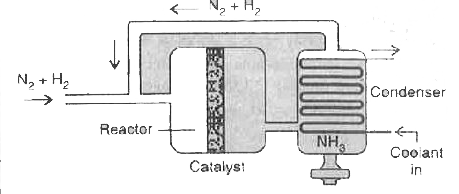 (ii) `N_(2)(g)+3H_(2)(g)rarr 2NH_(3)(g)` (III) Catalyst - Iron. |
|
| 36. |
For the manufacture of Ammonia by Haber’s process, write the flow chart and chemical equation with suitable conditions. |
|
Answer» Solution :AMMONIA is manufactured by Haber’s process by the direct combination of NITROGEN andhydrogen. `N_(2)(g) + 3H_(2)(g) to2NH_(3)(g)` According to Le-chatelier’s principle yield of ammonia is INCREASED by (i) High pressure of 200 atm. (ii) Optimum temperature of 700 K. (iii) Use of catalyst like iron oxide with `K_(2)O and Al_(2)O_(3)` 
|
|
| 37. |
For the isothermal explanation if an ideal gas |
|
Answer» E and H INCREASES |
|
| 38. |
for the identification of beta-naphthol using dye test, it is necessary to use |
|
Answer» DICHLOROMETHANE SOLUTION of `BETA`-naphthol |
|
| 39. |
For the hydrolysis of methyl acetate in aqueous solution, the following results were obtained : (a) Show that it follows pseudo first order reaction, as the concentration of water remains constant. (b) Calculate the average rate of reaction between the time interval 10 to 20 seconds. (Given : log 2 = 0.3010, log 4 = 0.6021) |
|
Answer» SOLUTION :(a) `K'(2.303)/(t)log""([A_(0)])/([A])"in which "[A_(0)]=0.10` `t=10 S,` `K'=(2.303)/(10)log ""([0.10])/([0.05)=(2.303)/(10)log (2)` `=(2.303)/(10)xx0.3010=0.06932=6.932xx10^(-2)S^(-1)` `t=20 S, K'=(2.303)/(20)log""([0.10])/([0.025])` `=(2.303)/(20)log(2)^(2)=(2.303)/(20)xx0.3010xx2=6.93xx10^(-2)S^(-1)` (b) Average rate during the interval 10-20 seconds `=(C_(2)-C_(1))/(t_(2)-t_(1))=((0.025-0.05))/(20-10)` `=(0.025)/(10)=0.0025=2.5xx10^(-3) MOL L^(-1) S^(-1)` |
|
| 40. |
For the hydrolysis of methyl acetate in aqueous solution, the following results were obtained, a) Shat that it follows pseudo first order reaction, as the concentration of water remains constant. b) Calcualte the average rate of reaction between the time interval 30 to 60 seconds. |
|
Answer» Solution :a) The chemical equation for the hydrolysis reaction is: `CH_(3)COOCH_(3) + H_(2)O OVERSET(H^(+))tounderset("Excess")(CH_(3)COOH) + CH_(3)OH` Let us substitute the values in the rate equation for first order reaction and calculate the value of rate constant. Case I. `k=2.303/tlog(a/(a-x))=(2.303)/(30s)LOG([0.60M])/([0.30M])=2.303/(30S)log2=2.303/(30s) xx 0.3010 = 0.0231s^(-1)` Case II. `k= 2.303/tlog(a/(a-x)) = (2.303)/(60S)log([0.60]M)/([0.15M])=2.303/(60 MIN) log4=(2.303)/(60s) xx 0.6021 = 0.0231s^(-1)` As the value of k in both the case in the same, this show that the reaction is pseudo first order reaction. b) Average reaction between time interval 30-60 sec is: Average rate = `(0.15-0.30M)/(60-30)s = (0.15M)/(30s) = 0.15 mol L^(-1)s^(-1)` |
|
| 41. |
For the hydrolysis of esters in alkaline mediumrate expression is : -(d[ester])/do=K[Ester][Alkali] In case alkali used is in excess, then the overall order of the reaction is: |
|
Answer» Zero |
|
| 42. |
For the hydrolysis of esters in alkaline medium rate expression is, -(d["Ester"])/(dt)=k[ Ester][Alkali]. Inspace alkali used is in excess, then the overall order of the reaction is |
|
Answer» ZERO |
|
| 43. |
For the hydrolysis of esters in alkaline mediumrate expression is : -(d[ester])/(dt)=K[Ester][Alkali] In case alkali used is in excess, then the overall order of the reaction is: |
|
Answer» Zero |
|
| 44. |
For the homogenous reaction xA+yB iff 1Y + mZ DeltaH^(@) = -30kJ mol^(-1) and DeltaS=-100JK mol^(-1) At what temperature the reaction is at equilibrium |
|
Answer» `50^(@)C` |
|
| 45. |
For the hydrolysis of a salt of weak acid and weak base, the hydrolysis constant is : |
|
Answer» `K_(OMEGA)//K_(B)` |
|
| 46. |
for the homogeneous gaseous reaction A(g) +2B(g) hArr C(g) at 300K. the value of K_c=0.1 When 2 mol of each of A and B are mixed then what will be the approx equilibrium pressure if 30% of A is converted to C? [given that(3.18)^1/2 = 1.78] |
|
Answer» 90 ATM |
|
| 47. |
For the homogeneous gas reaction at 600 K 4NH_(3_(g))+5O_(2_(g))hArr4NO_((g))+6H_(2)O_((g)) the equilibrium constant K_(c) has the unit |
|
Answer» `("MOL DM"^(-3))^(-1)` |
|
| 48. |
For the half life period of a first order reaction which one of the following statements is generally false ? |
|
Answer» It is independent of initial concentration . |
|
| 49. |
For the half-life period of a first order reaction, which one of the following statements is generally false? |
|
Answer» It is INDEPENDENT of initial concentration |
|
| 50. |
For the half-life period of a first order reaction, which of the following statements is false? |
|
Answer» It is INDEPENDENT of initial concentration. `t_(1//2)=(0.693)/(k)` therefore `t_(1//2)` depends upon k and hence it depends on temperature because RATE constant k is a function of temperature. |
|