Saved Bookmarks
This section includes 7 InterviewSolutions, each offering curated multiple-choice questions to sharpen your Current Affairs knowledge and support exam preparation. Choose a topic below to get started.
| 1. |
For the half-cell raction, 2H_(2)O+2e^(-)toH_(2)+2OH^(-),E^(@)=-0.8277V at 298K. Autoprotolysis constant of water calculted from this value will be |
|
Answer» `1xx10^(-10)` Redn. Half reaction: `2H_(2)O+2e^(-)toH_(2)+2OH^(-),E^(@)=-0.8277V` `underset("Ox. Half reaction:"H_(2)to2H^(+)+2e^(-),E^(@)=0.0)` Cell reaction: `2H_(2)OhArr2H^(+)+2OH^(-),E^(@)=-0.8277V` `E=E^(@)-(0.0591)/(2)"log"[H^(+)]^(2)[OH^(-)]^(2)` At EQUILIBRIUM, E=0. Hence, `E^(@)=(0.0591)/(2)log[H^(+)]^(2)[OH^(-)]^(2)` `therefore-0.8277=0.0591log[H^(+)][OH^(-)]^(2)` `=0.0591logK_(w)` or `logK_(w)=14` or `K_(w)=10^(-14)`. |
|
| 2. |
For the half cell, +2H^(+)2e^(-).E^(0)= 1.30 V. At pH = 2, electrode potential of the given quinhydrone half cell is : |
|
Answer» `1.36V` |
|
| 3. |
for the graph below, select correct order of temperture ? |
|
Answer» `T_(1)gtT_(2)GT T_(3)` |
|
| 4. |
For the given set of complexes : (P) [Co(CN)_(6)]^(3-)" and "[Co(H_(2)O)_(6)]^(3+) (Q) [Co(H_(2)O)_(6)]^(3+)" and "[Rh(H_(2)O)_(6)]^(3+) (R ) [Co(H_(2)O)_(6)]^(2+)" and "[CoF_(6)]^(3-) (S) [Co(NH_(3))_(6)]^(3+)" and "[CoF_(6)]^(3-) Select the correct order for Delta_(0): |
|
Answer» `[Co(CN)_(6)]^(3-)"GT "[Co(H_(2)O)_(6)]^(3+)` `Delta_(0)" of "CN^(-) gt NH_(3) gt H_(2)O gt F^(-)` complexes |
|
| 5. |
For the graph below, select correct order of temperature? |
|
Answer» `T_(1)gtT_(2)gtT_(3)` |
|
| 6. |
For the following three reaction 1, 2 and 3, equilibrium constants are given: (1) CO_((g)) + H_(2)O_((g))hArrCO_(2(g)) + H_(2(g)), K_(1) (2) CH_(4(g)) + H_(2)O_((g))hArrCO_((g)) + 3H_(2(g)), K_(2) (3) CH_(4(g)) + 2H_(2)O_((g))hArrCO_(2(g)) + 4H_(2(g)), K_(3) Which of the following relations is correct ? |
|
Answer» `K_(2)K_(3)=K_(1)` |
|
| 7. |
For the given reactions: (a) C_(x)H_(y) +(x+(y)/(4))O_(2) rarr xCO_(2)+(y)/(2)[R] (b) N_(2)+3H_(2) underset(200 " atm " 500^(@)C) overset( Fe+Mo) rarr [S]_("gas") (c ) P_(4) +NaOH +H_(2)O overset ("boil")rarr[T]_(gas) The % ratio of valence electron of central atom vs total valence shell electrons is 62.5% is [S} and 27.77% in[T] and central atom of [S] and [T] belongs to same group then what is the correct order of increasing bond angle of [R]=1, [S]=2 and [T]=3? ,brgt [If your answer is 1 lt 2 lt 3 then write 0123.] |
|
Answer» |
|
| 8. |
For the given reactions, which of the following statements are true? underset("(excess)")(KI +K_3 ) [Fe (CN)_6]underset(H_2 SO_4 ) overset("dilute ") tounderset("darrZn SO_4)(" Brownishyellowsolution ") whiteprecipitate+{:(ubrace("Brownish yellow filtrate")),(""darr Na_2 S_2 O_4),("colourlesssolution"):} |
|
Answer» The first reaction is a redox reaction. ` I_2+ KIto KI_3` ` K_4 [Fe (CN) _6] + 2 ZnSO_4toZn_2 [Fe (CN) _6 ] +2K_2 SO_4 ` `UNDERSET("Brownishyellow filtrate ") ( KI_3+ 2Na_2 S_2O_3tounderset("COLOURLESSSOLUTION ") (Na_2S_4O_6+ 2KI+KI` `Zn_2[Fe(CN)_6 ]+8NaOHto2Na_2underset("Soluble ")([Zn (OH)_4] )+Na_4 [Fe (CN)+6 ]` |
|
| 9. |
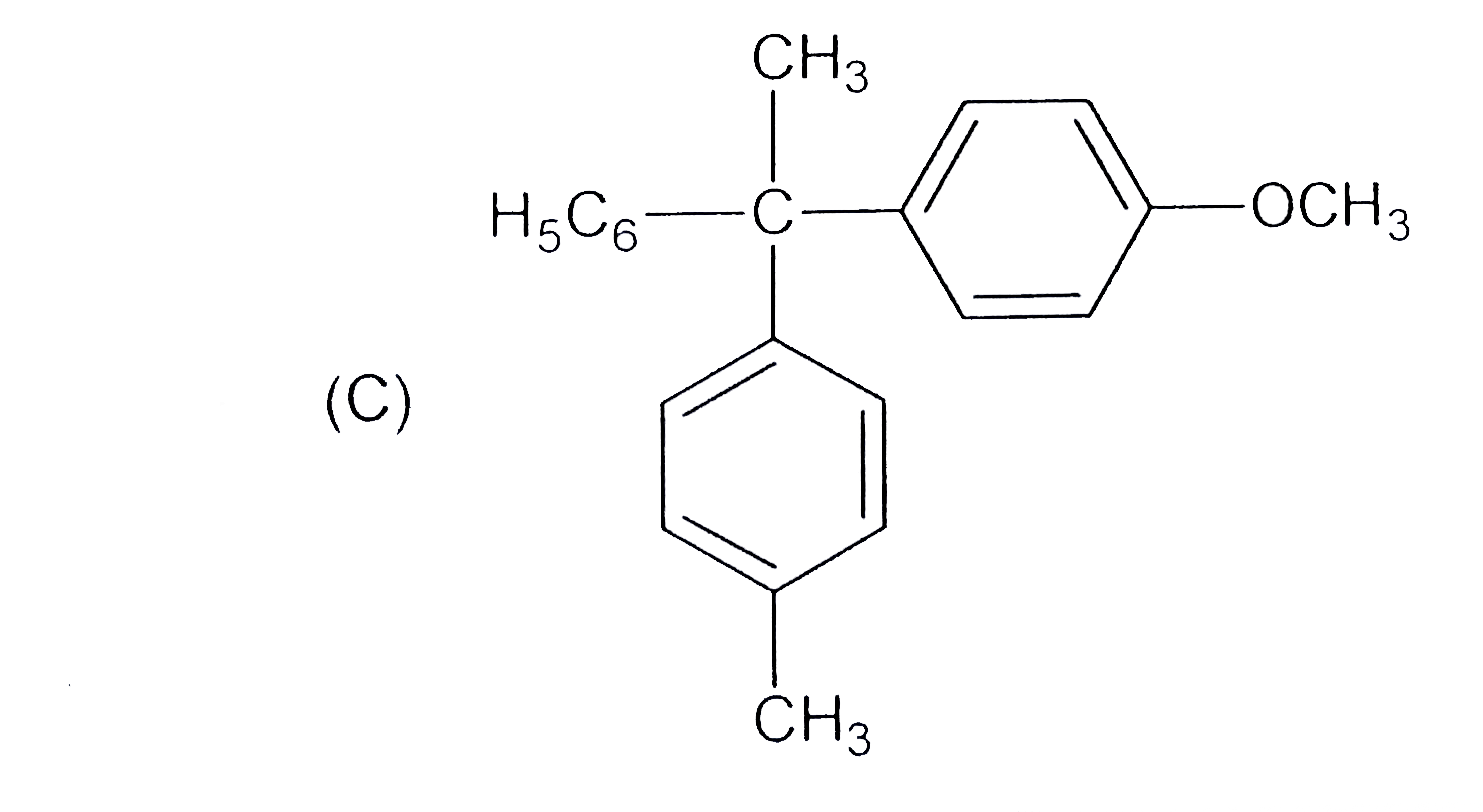
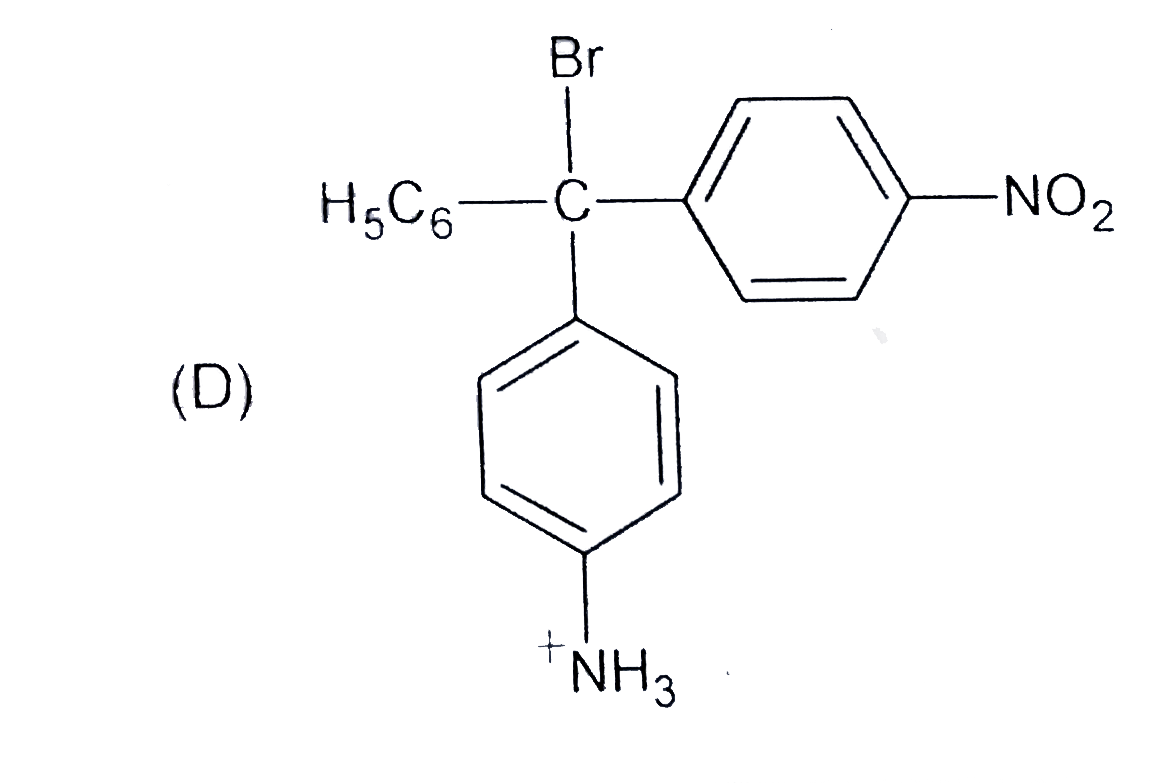
For the given reaction, the major product obtained is (AAK_MCP_35_NEET_CHE_E35_019_Q01) |
|
Answer»
|
|
| 10. |
For the given reaction, R-underset(R_(2))underset(|)overset(R_(1))overset(|)(C )-x overset(HOH)(rarr) R-underset(R_(2))underset(|)overset(R_(1))overset(|)(C )-OH Which substrate will give maximum racemisation? |
|
Answer» `H_(5)C_(6)- underset(C_(2)H_(5))underset(|)overset(CH_(3))overset(|)C-Br` |
|
| 11. |
For the given reaction ,find the order of the reaction with respect to [H^(+)] 5Br_((aq))^(-)+BrO_(3(aq))^(-)hArr3Br_(2(aq))+3H_(2)O_(l) |
|
Answer» 3 |
|
| 12. |
For the given plot, match the most appropriate graph for respective gases: (Among H_(2),He, CO, CH_(4)) |
|
Answer» <P>`{:(P,Q,R,S),(H_(2),He,CO,CH_(4)):}` |
|
| 13. |
For the given reaction |
|
Answer» `CH_(3)-underset(CH_(3)) underset(|) OVERSET (CH_(3)) overset(|) (C)-Br//AlBr_(3)` 
|
|
| 14. |
For the given orbital in column 1, the only correct combination for any hydrogen like species is |
| Answer» Answer :A | |
| 15. |
For the given graph which of the following is correct : (n = mole of gas and P = Pressure) |
|
Answer» `P_(2) gt P_(1)` with n is CONSTANT For or PV = NRT P will ALSO increase, `P_(2) gt P_(1)` (n = constant) |
|
| 16. |
For the given equlibrium : 2SO_(2)+O_(2)hArr2SO_(3)+ heat the equlibrium reaction proceeds in forward direction when |
|
Answer» OXYGEN is removed |
|
| 17. |
For the given graph of real gas:What should be the pathto change a gas into a liquid or vice-versa in which always a single phase is present ? |
|
Answer» `A RARR F` VERTICALLY then `F rarr G` (isothermally) then `G rarr D` |
|
| 18. |
For the given endothermic reaction, A(g) hArr 2B(g) The variation in concentration due to different changes is plotted. Neglect the slope of change in concentration. Changes are carried out very fast. Given the correct order of initials T (true) of F (false) for following statements. (P) Effect-I is decrease in temperature at constant volume (Q) Effect-II is decrease in total equilibrium pressure by changing volume. (R) Effect-III is addition of B only at constant volume |
|
Answer» FTT |
|
| 19. |
For the given compounds in column (I), the only combination for any terminal alkyne is |
|
Answer» (I)(iv)(Q) |
|
| 20. |
For the given conversion : Me-overset(O)overset(||)C-OH rarrMe-overset(O)overset(||)C-H Suitable options are : |
|
Answer» Reduction by `LiAIH_(4)` |
|
| 21. |
For the given compound X, the total number of optically active stereoisomers is…….. |
|
Answer» |
|
| 22. |
For the given compound CH_(3)-underset(overset(|)(OH))(CH)-CH=CH-CH_(3). (i) Total number of stereoisomers. (ii) Number of opticallly active stereoisomers. (iii) Total number of fractions on fractional distillation of all stereoisomers. |
|
Answer» Number of STEREOCENTRES = 2 so TOTAL number of stereoisomers = `2^(2)` = 4 (II) All 4 isomers are optically active.(III) Total enantiomeric pairs are 2, hence number of FRACTION will be 2. |
|
| 23. |
For the given complex [CoCl_(2)(en)(NH_(3))_(2)]^(+), the number of geometrical isomers, the number of optical isomers and total number of isomers of all type possible respectively are |
|
Answer» 2, 2 and 4 |
|
| 24. |
For the given complex [Co(NH_(3))_(5)Br]SO_(4), write the IUPAC name and its ionisation isomer. |
| Answer» Solution :Pentaamminebromido cobalt (III) SULPHATE `[CO(NH_3)_5 SO_4] BR.` | |
| 25. |
For the given cell, Mg|Mg^(2+)||Cu^(2+)|Cu |
|
Answer» MG is cathode |
|
| 26. |
For the given complex [CoCl_(2)(en) (NH_(3))_(2)]^(+), the number of geometrical isomers, the number of optical isomers and total number of isomers of all type possible respectively are : |
| Answer» Answer :A | |
| 27. |
For the given cell, Mg | Mg^(2+) || Cu^(2+) | Cu |
|
Answer» Mg is cathode |
|
| 28. |
For the given cell Cr_((s))abs(Cr_((aq))^(3+))abs(Cu_((aq))^(2+))Cu_((s)) which is correct? |
|
Answer» Cr is the anode |
|
| 29. |
For the given cel, Mg|Mg^(2+)||Cu^(2+)|Cu _____ |
|
Answer» Mg is cathode Oxidation : `Mg_((S)) to Mg^(2+)+2E^(-)`. .(i) So, Option (A) is not right. In this cell, cathode of `Cu^(2+)|Cu` is on right side, where reduction reaction occur. Reduction : `Cu^(2+)+2e^(-) to Cu` . . .(ii) Total reaction in cell (iii)=(i)+(ii) (iii) Redox reaction :  So, option (C) is right. * In this reaction oxidation of Mg and reduction of `Cu^(2+)` occur. So `Cu^(2+)` is oxidizing and Cu is not Oxidizing. So option (D) is wrong. |
|
| 30. |
For the given aqueous reaction which of the statement(s) is (are) true? |
|
Answer» The first reaction is a redox reaction 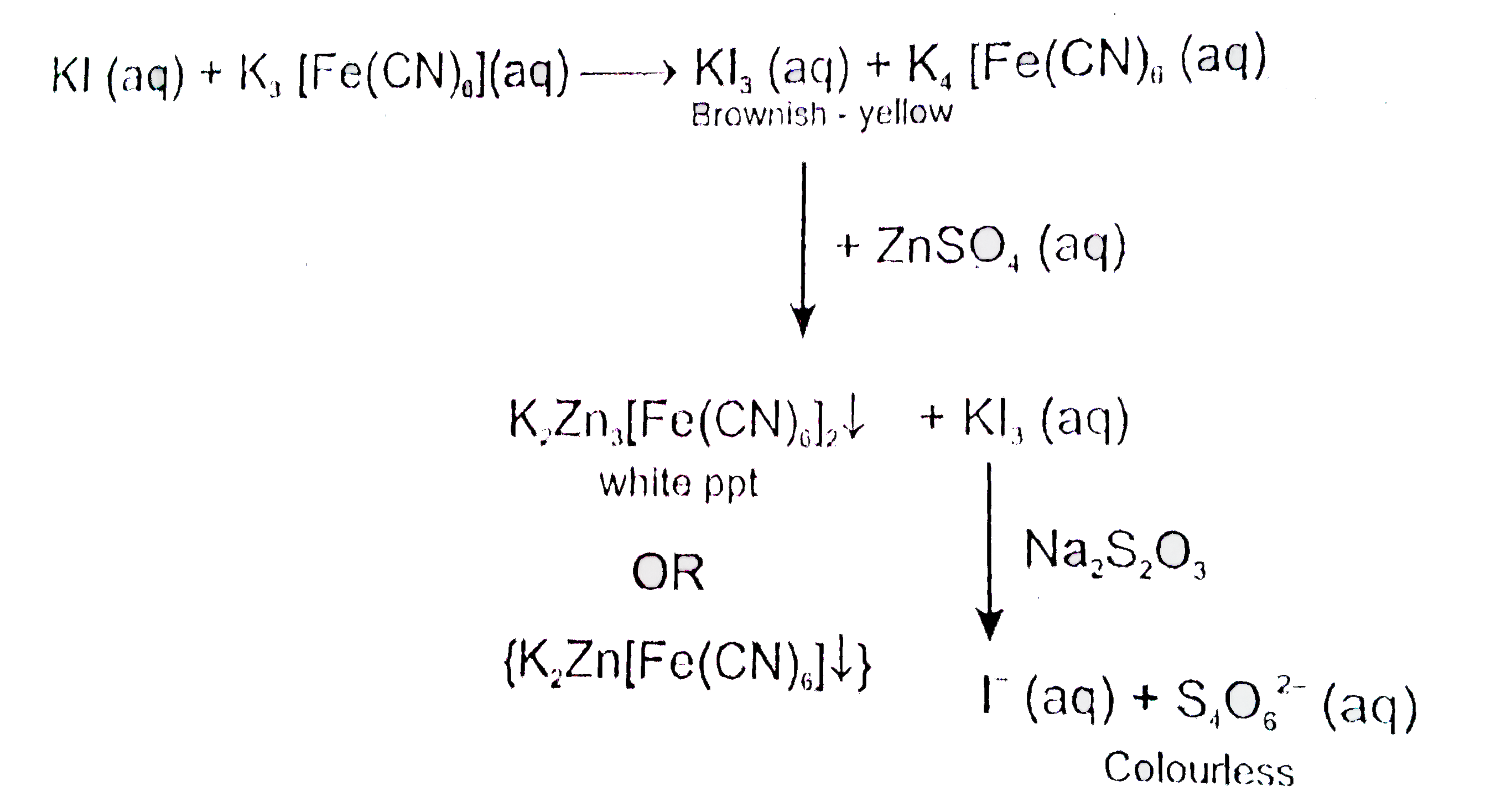 `(D)` with `NaOH` `K_(2)Zn[Fe(CN)_(6)] + NaOH to [Zn(OH)_(4)]^(2-)(aq)+[Fe(CN)_(6)]^(4-)(aq)` |
|
| 31. |
For the given aqueous reactions, which of the statement(s) is (are) true ? |
|
Answer» The first reaction is a REDOX reaction `2KI+2K_(3)underset((Fe^(3+)))([Fe(CN)_(6)]) underset(H_(2)SO_(4))overset(dil.) to 2K_(4) underset((Fe^(2+))([Fe(CN)_(6)])+I_(2)` `I_(2)+ underset("(Excess)")(KI to KI_(3))` |
|
| 32. |
For the given aqueous reaction, which of the statement(s) is (are) true ? |
|
Answer» The FIRST reaction is a redox reaction `I_(2)+KI hArr KI_(3)` (brown -yellow sol)' `{:(Zn^(2+)+K_(4)[Fe(CN)_(6)] rarr K_(2)Zn_(3)[Fe(CN)_(6)]_(2)+K^(+)),("(white ppt)"),("or"),(""Zn_(2)[Fe(CN)_(6)]+K^(+)),("(white ppt)"):}` |
|
| 33. |
For the given aqaction , whichof the statement (s) is (are) true? |
|
Answer» The first reaction is a redoxreaction 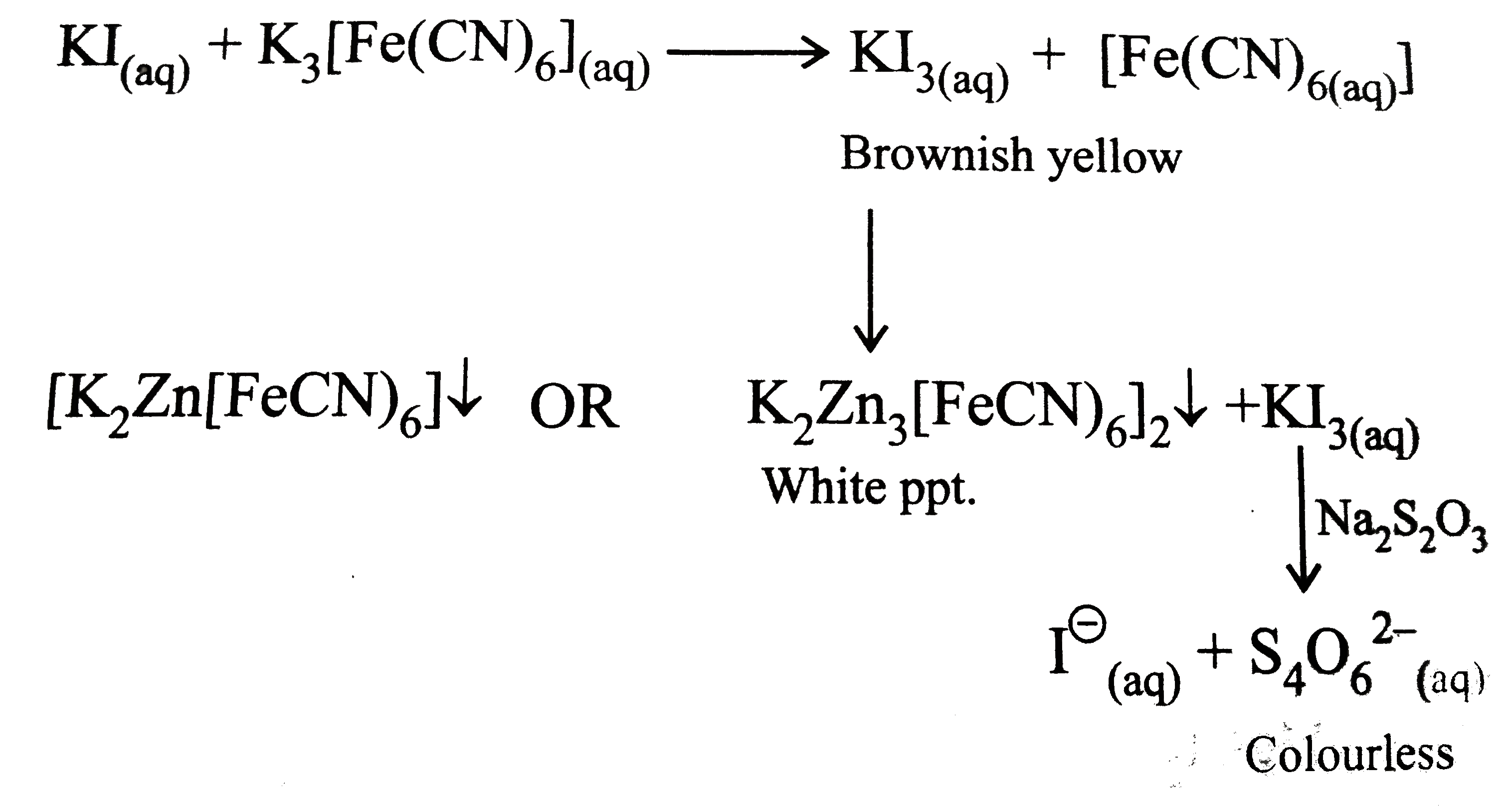
|
|
| 34. |
For the gaseous reaction, say, A toproduct, the rate is often described in terms of d(P_A)//dt instead of d[A]//dt or d(n_A)//dt . What is the relation among these three expressions? |
| Answer» SOLUTION :`(d(P_A))/(DT) = (RT)/(V) (d(n_A))/(dt) = RT (d[A])/(dt)` | |
| 35. |
For the gaseous reaction :N_(2)+3H_(2)hArr 2NH_(3)the partial pressure of H_(2) and N_(2) are 0.4and0.8 atm respectively.The total pressure of the entire system is 2.8 atm.What will be the value of K_(p)if all concentrations are given in atmospheres ? |
| Answer» ANSWER :A | |
| 36. |
For the given complex [Co(NH_3)_5 Br]SO_4,write the IUPAC name and its ionisation isomer. |
| Answer» SOLUTION :`(CO(NH_3)_5SO]BR` Pentaaminiesulphito COBALT (IH) bromide | |
| 37. |
For the gaseous reaction, N_(2)O_(4) rarr 2NO_(2) |
|
Answer» `DELTAH lt DeltaE` For this reaction `Deltan_(g)=2-1=1` `Deltan_(g)` is positive is i.e., there is an INCREASE in the number of gaseous moles then `DeltaH gt DeltaE`. |
|
| 38. |
For the gaseous reaction :A(g)to Products, the rate may be expressed as MethodI: -(1)/(V).(dn_(A))/(dt)-k_(1).C_(a)"^(n) Method II: -(dp_(A))/(dt)=k_(2).P_(A)"^(n) Wehre C_(A)=(n_(A))/(V)=molar concentration of A and P_(A) is the partial pressure of A at time 't' and 'n' is the order of reaction. The reaction is occurring at constant temperature, T=300 K Assume ideal behaviour of gas. Select the correct statement (s). |
|
Answer» `k_(1)=K_(2)` for any VALUE of `'n'` |
|
| 39. |
For the gaseous reaction, H_(2)+Cl_(2) to 2HCl. If 40 ml of hydrogen completely reacts with chlorine then find out the the required volume of chlorine and volume of produced of HCl? |
|
Answer» Solution :According to GAY Lussac's Law: `H_(2)+Cl_(2) to 2HCl` `therefore` 1 ML of `H_(2)` will react will 1 ml of `Cl_(2)` and 2 ml of HCl will produce. `therefore` 40 ml of `H_(2)` will react with 40 ml of `Cl_(2)` and 80 ml of HCl will produce REQUIRED vol. of `Cl_(2)=40` ml , produced vol. of HCl=80 ml |
|
| 40. |
For the gaseous phase reacton 2NOhArrN_(2)+O_(2)DeltaH^(@)=+43.5"kcal mol"^(-1) Which statement is correct |
|
Answer» K VAIRES with addition of NO `DeltaH=+ve` for the REACTION |
|
| 41. |
For the gaseous phase reaction, 2NO ⇌ N_2 + O_2 , DeltaH^o = -43.5 Kcal mol^(-1) , Which statement is corrct for, N_2 (g) + O_2 (g) ⇌2NO(g): |
|
Answer» K is INDEPENDENT of TEMPERATURE |
|
| 42. |
For the gas phase reaction 2NO(g)hArrN_(2)(g) + O_(2)(g) , DeltaH = -43.5 kcal,which one of the following is true for N_(2)(g) + O_(2)(g)2NO(g) |
|
Answer» K is INDEPENDENT of T |
|
| 43. |
For the gas phase reaction, C_(2)H_(4)+H_(2)hArrC_(2)H_(6)(Deltah=-32.7kcal) carried out in a vessel, the equlibrium concentration of C_(2)H_(4) can be increased by |
|
Answer» Increasing the TEMPERATURE |
|
| 44. |
For the gas phase reaction 2NO(g) hArr N_2(g) +O_2(g) ,DeltaH=-43.5 kcal, which one of the following is true for N_2(g) +O_2(g) hArr 2NO(g) |
|
Answer» K is independent of T |
|
| 45. |
For the gas phase reaction, C_2H_4 +H_2 hArr C_2H_6,DeltaH=-136.8 kJmol^(-1) carried out in vessel the equilibrium concentration of C_2H_4 can be increases by |
|
Answer» INCREASING the temperature |
|
| 46. |
For the gas phase exothermic reaction, A(g) + 2B(g) |
|
Answer» DECREASING the temperature |
|
| 47. |
For the gas equation P = ( RT )/( V - b) - ( a)/( TV^(2)) , following conclusions are found true ( 1) lim ( RT - PV ) = 0, P rarr alpha, T rarr beta ( 2) lim (V) /( T ) = ( R )/( P ) , T rarr gamma Which is the correct set of the vlaues of alpha, betaand gamma? |
|
Answer» `OO, 0 ,oo` |
|
| 48. |
For the gas - phase decomposition , PCI_(5)(g)overset(Delta)hArr PCI_(3)(g) + CI_(2)(g): |
|
Answer» `DeltaH LT 0, DeltaS lt 0` |
|
| 49. |
For the galvanic cell: Zn(s) | Zn^(2+)(aq) (1.0 M) || Ni^(2+)(aq) (1.0 M) | Ni(s), E_cell^o will be [Given E_((Zn^(2+)) /(Zn))^0 = -0.76 V, [E_((Ni^(2+))/(Ni))^0= -0.25V] |
|
Answer» `-0.51V` |
|