Saved Bookmarks
This section includes 7 InterviewSolutions, each offering curated multiple-choice questions to sharpen your Current Affairs knowledge and support exam preparation. Choose a topic below to get started.
| 1. |
For hydrolysis of the following functional groups,the decreasing orderof reactivity is: |
|
Answer» `RCOOR GT RCOCl gt RCONH_2` |
|
| 2. |
For hydrolysis of the following functional groups, the decreasing orderof reactivity is: |
|
Answer» `RCOOR GT RCOCL gt RCONH_2` |
|
| 3. |
For hydrolysis of the following functional groups, the decreasing order of reactivity |
|
Answer» `RCOOR GT RCOCL gt RCONH_2` |
|
| 4. |
For hydrogen gas C_p - C_v = a, and for oxygen gas C_p - C_v = b , so the relation between a and b is : |
|
Answer» a = 16b |
|
| 5. |
For hydrogen - oxygen fuel cell at one atm and 298 KH_(2(g)) + (1)/(2)O_(2(g))to H_2O_((l)), DeltaG^(@) = -240 kJ E^(@) for the cell approximately , (Given F = 96,500 C ) |
|
Answer» 2.48 V `-240000=-2xx96,500 XX E^(@)` `E^(@)=1.24V` |
|
| 6. |
For his 18th birthday in February Peter plants to turn a hut in the garden of his parents into a swimming pool with an artifical beach. In order to estimate the consts for heating the water and the house , peter obtains the data for the natural gas combustion and its price. What is the total energy (in MJ) needed for Peter's"winter swimming pool" calculated in 1.3 and 1.4? How much natural gas will he need, if the gas heater has an efficiency of 90.0% ? What are the different costs for the use of either natural gas or electricity ? Use the values given by PUC for your calculations and assume 100% efficiency forthe electric heater. Table 1: Composition of natural gas {:("Chemical substance","mol fraction x",D_(1)H^(@)(KJ mol^(-1))^(-1),S^(@)(J mol^(-1)K^(-1))^(-1),C_(p)^(@)(J mol^(-1)K^(-1))^(-1)),(CO_(2(g)),0.0024,-393.5,213.6,37.1),(N_(2(g)) ,0.0134,0.0,191.6,29.1),(CH_(2(g)),0.9732,-74.6,186.3,35.7),(C_(2)H_(3 (g)),0.0110,-84.0,229.2,52.2),(H_(2)O_(g),-,-285.8,70.0,75.3),(H_(2)O_(g),-,-241.8,188.8,33.6),(H_(2)O_(g),-,0.0,205.2,29.4):} Equation J=E(A.Deltat)^(-1) =!! lambda "wall" . DeltaT. d^(-1), where J= energy flow E along a temperature gradient (wall direction Z) par area A and time Deltat, d-wall thickness , lambdawall -heat conductivity , DeltaT - difference in temperature between the inside and the outside of the house. |
|
Answer» |
|
| 7. |
For hydrogen atom, the only correct combination is |
| Answer» Answer :D | |
| 8. |
For his 18th birthday in February Peter plants to turn a hut in the garden of his parents into a swimming pool with an artifical beach. In order to estimate the consts for heating the water and the house , peter obtains the data for the natural gas combustion and its price. Calculate the energy (in MJ) which is needed to maintain the temperature inside the house at 30.0^(@)C during the party (12 hours) . 1.00 m^(3)of natural gas as delivered by PUC costs 0.40 € and 1.00 k Wh of electricity costs 0.137 € . The rent for the equipment for gas heating will cost him about 150.00 € while the corresponding electrical heaters will only cost 100.00 €. |
|
Answer» |
|
| 9. |
For how many metals of 10^(th)12 th and 14^(th) groups in periodic chart, Extraction is possible by self - reduction mrthod ? |
|
Answer» |
|
| 10. |
For his 18th birthday in February Peter plants to turn a hut in the garden of his parents into a swimming pool with an artifical beach. In order to estimate the consts for heating the water and the house , peter obtains the data for the natural gas combustion and its price. Calculate the energy (in MJ) which is requried of heat the water in the pool to 22.0^(@)C and the energy which is required of heat the initial amount of air (21.0% of O_(2), 79% of N_(2)) to 30.0^(@)Cat a pressure of 1.013 xx 10^(5) Pa. In February , the outside temperature is about 5^(@) C in Northern Germany. Since the concrete walls and the cost of the house are relatively thin (20.0cm) there will be a loss of energy . This energy is released to the surroundings (heat loss released to water and/or ground should be neglected ). The heat conductivity of the wall and the roof is 1.00 WK^(-1)M^(-1) |
|
Answer» |
|
| 11. |
For He^(+) and Li^(2+), the energies are related to the guantum number, n, through an expression E_(n)= - (Z^(2)B)/(n^(2)),where Z is the atomic number of species and B=2.179 xx 10^(-18)J What is the energy of the lowest level (n=1) of a He^(-) ion? |
| Answer» SOLUTION :`8.716 XX 10^(-18)J` | |
| 12. |
For his 18th birthday in February Peter plants to turn a hut in the garden of his parents into a swimming pool with an artifical beach. In order to estimate the consts for heating the water and the house , peter obtains the data for the natural gas combustion and its price. The desity of natural gas is 0.740 g L^(-1) (1.013 xx 10^(5)Pa, 25^(@)C)specified by PUC , the public utility company. (a) Calculate the amount of methane and ethane (in moles) in 1.00m^(3) of natural gas (natural gas, methane and ethane are not ideal gases). (b) Calculate the combustion energy which is released as thermal energy during the buring of 1.00 m^(3) of natural gas under standard conditions assuming that all products are gaseous .(if you do not have the amount from 1.2 a) assume that 1.00 m^(3) natural gas corresponds to 40.00 mol natural gas) According to the PUC the combustion energy will be 9.981K Wh per m^(3) of natural gas if all products are gaseous . How large is the deviation (in percent) from the value you obtainedin b? The swimming pool inside the house is 3.00 m wide ,5.00 m long and 1.50 m deep (below the floor) . The tap water temperature is 8.00^(@)C and the air temperature in the house(dimensions given in the figure) is 10.0^(@)C. Assuming a water density of rho=1.00 Kg L^(-1) and air behaving like an ideal gas. |
|
Answer» |
|
| 13. |
For his 18th birthday in February Peter plants to turn a hut in the garden of his parents into a swimming pool with an artifical beach. In order to estimate the consts for heating the water and the house , peter obtains the data for the natural gas combustion and its price. Write down the chemical equations for the complete conbustion of the main components of natural gas, methane and ethane , given intable-1. Assume tht nitrogen is inert under the chosen conditions. Calculate the reaction enthalpy , the reaction entropy , and the Gibbs energy under standard conditons (1.013 xx 10^(5) Pa , 25.0^(@)C) for the combustion of methane and ethane according to the equations above assuming that all products are gaseous . The thermodynamic properties and the composition of natural gas can be found in table 1. |
|
Answer» |
|
| 14. |
For He^(+) and Li^(2+), the energies are related to the guantum number, n, through an expression E_(n)= - (Z^(2)B)/(n^(2)),where Z is the atomic number of species and B=2.179 xx 10^(-18)J What is the energy of the level n=3 of a Li^(2+) ion? |
| Answer» SOLUTION :`2.179 XX 10^(-18)J` | |
| 15. |
For HCl molecule, mu = 1.03D and bond length is 1.27 Å . The fraction of charge carried by Cl is : |
|
Answer» `-0.50` |
|
| 16. |
For H_(3)PO_(3) and H_(3)PO_(4) the correct choice is |
|
Answer» `H_(3)PO_(3)` is DIBASIC and reducing |
|
| 17. |
For H_(3)PO_(3) and H_(3)PO_(4), the correct choice is |
|
Answer» `H_(3)PO_(3)` is dibasic and REDUCING |
|
| 18. |
For H_(2)S, K_(a_(1))=10^(-7), K_(a_(2))=10^(-14),CoS=4xx10^(-21), Ag_(2)S=6.3xx10^(-50) Calculate difference in PH for precipitation of MnS and CoS. |
|
Answer» |
|
| 19. |
For H_2(g)+I_2(g)⇌2HI(g), triangle H=12.4 K cal. The enthalpy of formation of HI is: |
|
Answer» 12.4 K cal |
|
| 20. |
For H_(2) gas, the compressibility factor, Z = pV //nRT is : |
|
Answer» 1.equal to 1 |
|
| 21. |
For H_(2)+Cl_(2)overset(x)(to)2HCl rate law is given R=K. Then X is |
|
Answer» Pt |
|
| 22. |
For H_2 + Cl_2overset(hv)(to) 2HCl ,rate of reaction at t=0 is given by rate= - (d)/(dt) [H_2] = 6 xx 10^(-3) M-"min"^(-1) then rate of the reaction at t = 30 min is |
|
Answer» `(-d)/(dt)[Cl_(2)]=2XX10^(-4)M-"min"^(-1)` |
|
| 23. |
For H^(+) and Na^(+) the values of lambda^(@) are 349.8 and 50.11 respectively. Calculate the mobilities of these ions and their velocities if they are in a cell in which the electrodes are 5 cm apart and to which a potential of 2 volt is applied. |
|
Answer» Solution :We have `U_(H^(+))^(@) = (lambda_(H^(+))^(@))/(F) = (349.8)/(96500)` `= 3.62 xx 10^(-3) CM^(2) "volt"^(-1)s^(-1)` `U_(Na^(+))^(@) = (lambda_(Na^(+))^(@))/(F) = (50.11)/(96500)` `= 5.20 xx 10^(-4) cm^(2) "volt"^(-1)s^(-1)` Further, we KNOW that `U^(@) = ("ionic velocity (cm/s)")/("pot. diff. (volt)/distance between the electrodes (cm)")` `THEREFORE` velocity of `H^(+) = 3.62 xx 10^(-3) xx (2)/(5)` `= 1.45 xx 10^(-3) cm s^(-1)` Velocity of `Na^(+) = 5.20 xx 10^(-4) xx (2)/(5)` `= 2.08 xx 10^(-4) cm s^(-1)`. |
|
| 24. |
For H^(+) , lambda^(0) = 349.8 S cm^(2) mol^(-1) . Calculatethe velocity of H^(+) electrodes are 5 cm apart to which 1 volt of potential is applied. If the answer is 7.0 xx 10^(-x)cm/s then x is - |
|
Answer» ` = ((^^_M^(0))/(F)) xx (("VOLTAGE")/("distance")) = (349.8 S - cm^(2) - " MOLE"^(-1))/(96500) xx (1" volt")/(5 cm ) = 7.249 xx 10^(-4) cm//sec` |
|
| 25. |
For given simultaneous reaction : X(s)hArrA(g)+B(s)+C(g) K_(P_(1))=500 atm Y(s)hArrD(g)+A(g)+E(s) K_(P_(2))=2000 atm If total pressure =x , then write your answer after dividing by 25. |
|
Answer» `(p_1+p_2)p_1=500`..(i) `(p_1+p_2)p_2=2000`..(ii) eq.`(i)/(ii)` `p_1/p_2=1/4" " implies p_2=4p_1` `p_T=(p_1+p_2)+p_1+p_2=10+40+10+40=100 atm implies p_(T)/25=100/25=4` atm |
|
| 26. |
For gold plating, the electrolyte used is |
|
Answer» `AuCl_(3)` |
|
| 27. |
For given reaction select incorrect option P_4+SOCl_2rarrPCl_3+ Oxide of S + Chloride of S |
|
Answer» Oxidation of S in both the product ar + 4 and + 1 respectively. |
|
| 28. |
For given processes, choose the correct order of purity of silicon obtained. I.SiO_(2)+2C to Si + 2CO II.Si("pure")+2Cl_(2) to Si +MgCl_(2) III.Na_(2)[SiF_(6)]+4Na to 6NaF + Si to Zone refined Si |
|
Answer» `I GT II gt III` |
|
| 29. |
For given, E_(Cl_(2)//Cl^(-))^(@)=1.36V,E_(Cr^(3+)//Cr)^(@)=-0.74V E_(Cr_(2)O_(7)^(2-)//Cr^(3+))^(@)=1.33V,E_(MnO_(4)^(-)//Mn^(2+))^(@)=1.51V then which of the following is strongest reducing agent ? |
|
Answer» Cr So, `E_(Cr^(3)//Cr)^(@)=0.74V` When `E_(Mn^(2+)//MnO_(4)^(-))^(@)=-1.51V` `E_(Cr^(+3)//Cr_(2)O_(7)^(-2))^(@)=-1.33V` `E_(Cl^(-)//Cl_(2))^(@)=-1.36V`. |
|
| 30. |
For given oxidation number in Column-I, the only correct combination for any oxyacid of nirogen is : |
|
Answer» <P>(II)(iii)(Q) Combination: (I)(i)(P) (II)(N.A)(P) (III)(N.A)(Q) (III)(ii)(Q) |
|
| 31. |
For given mass of an ideal gas at constant temperature |
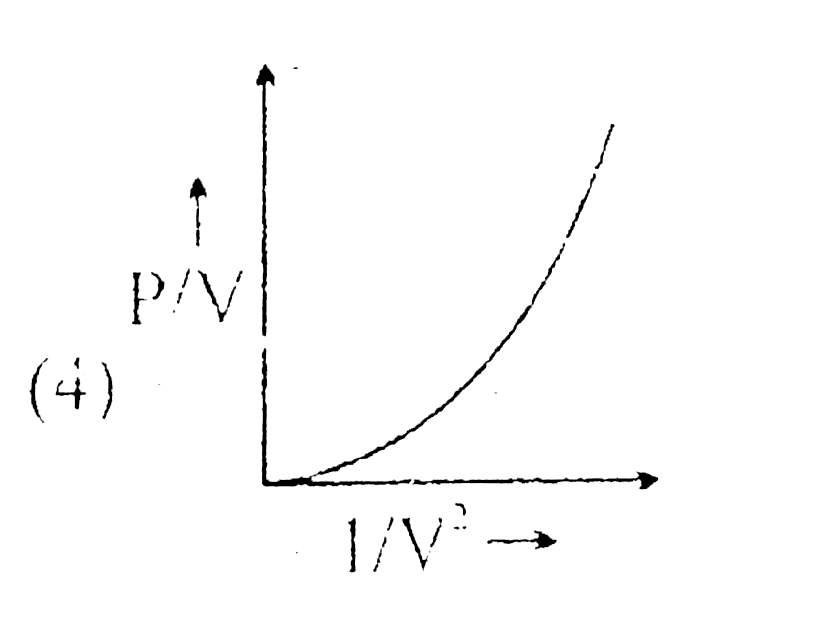
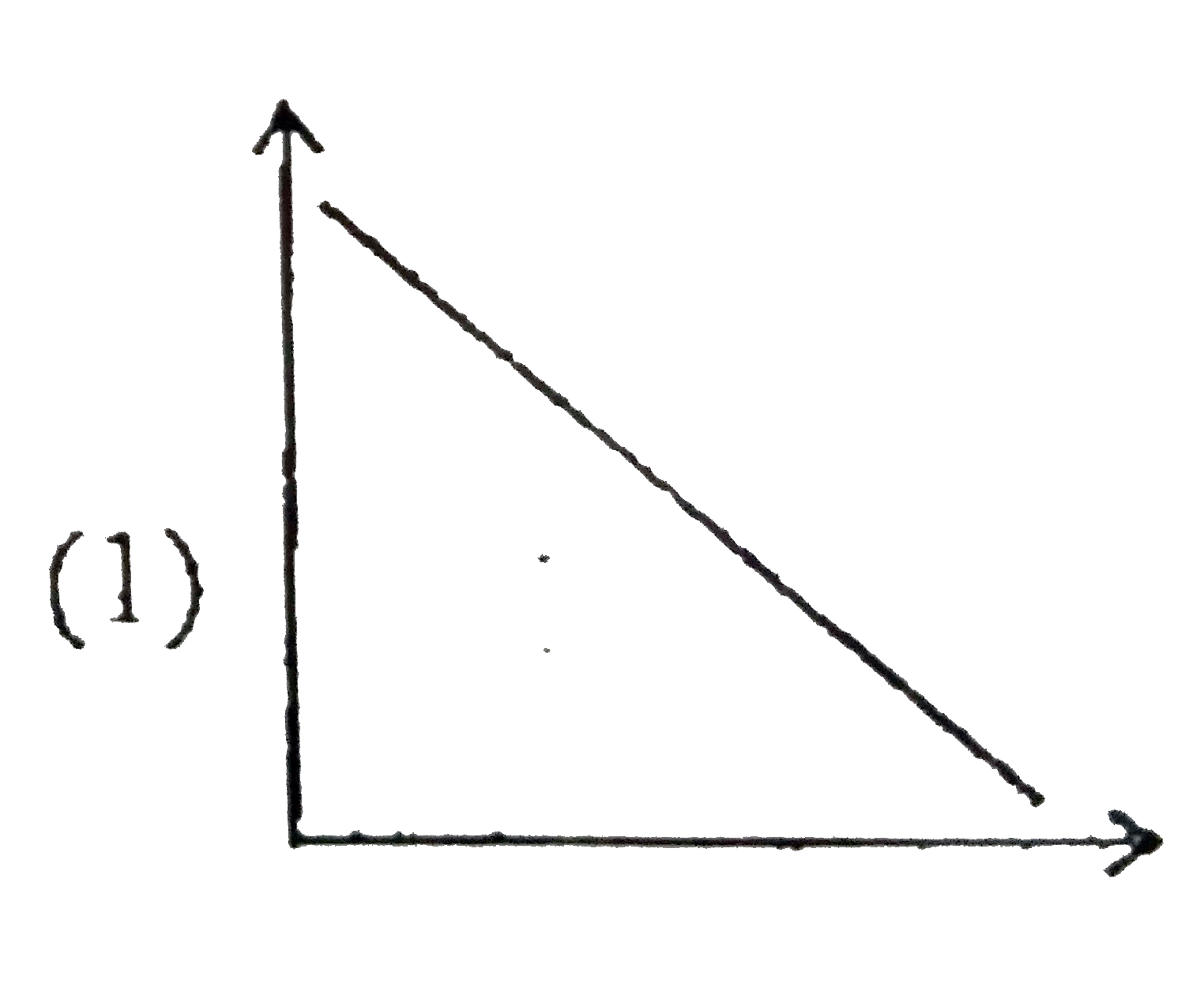
|
Answer» P vs V graph is a straight line PASSING through origin |
|
| 32. |
For given electrochemical cell if E_"cell" = 0.90 V Al_"(s)"|Al^(3+)(xM)||Zn^(2+)(0.01 M)|Znoverset(o+)((s)) x=.........E_(Al|Al^(3+))^@=1.66V,E_(Zn|Zn^(2+))^@=0.76V |
| Answer» Answer :A | |
| 33. |
For getting accurate value of molar mass of a solute by osmotic pressure measurement |
|
Answer» The solute MUST be volatile |
|
| 34. |
For given hypothetical elementary parallel reaction, Intially only 2 moles of A are present. The total no. of moles of A, B and C at the end of 75% reaction are: |
|
Answer» 2 |
|
| 35. |
For general redox reaction: aA+bB overset(n e^(-)) to cC=dD. Derive nernst equation. |
|
Answer» Solution :* If `E_(cell)`=cell POTENTIAL and `E_(cell)^(THETA)=`standard cell potential and [A], [B], [C] and [D] are the CONCENTRATION of A,B,C and D respectively, then the NERNST equation is as follows: `E_(cell)=E_(cell)^(Theta)-(RT)/(nF)lnQ` `therefore E_(cell)=E_(cell)^(Theta)-(RT)/(nF)ln([C]^(c)[D]^(d))/([A]^(a)[B]^(b))` This formula can be written as under, `E_(cell)=E_(cell)^(Theta)-(0.591)/(n)"log"_(10)([C]^(c)[D]^(d))/([A]^(a)[B]^(b))` and `E_(cell)=E_(cell)^(Theta)-(2.303RT)/(nF)"log"_(10)([C]^(c)[D]^(d))/([A]^(a)[B]^(b))` |
|
| 36. |
For geometric isomers of 3–hexene : |
|
Answer» <P>M.P. is high and DIPOLE moment high for TRANS 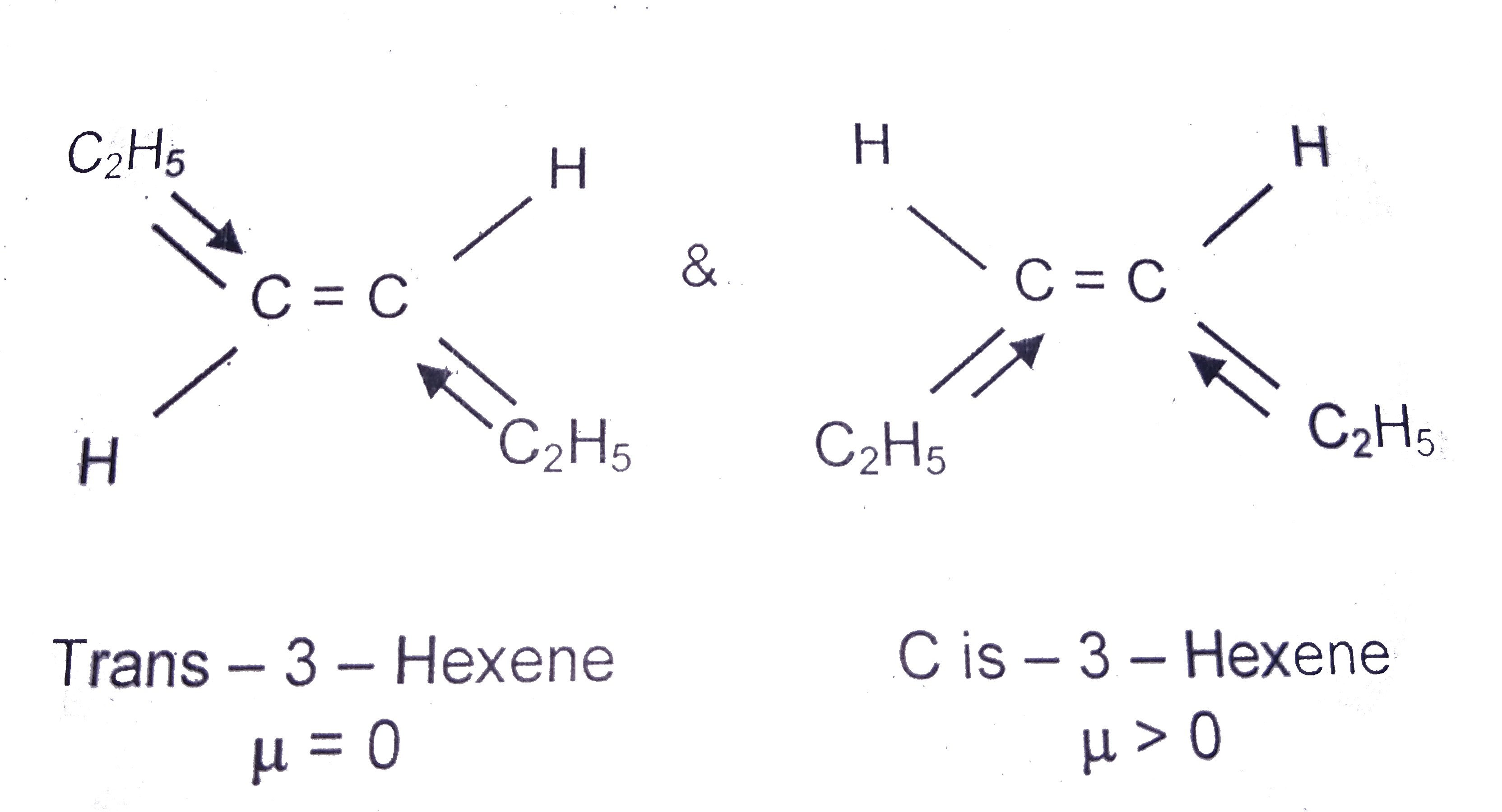 `{:("Trans-3-Hexene","C is -3-Hexene"),(mu=0,mugt0):}` M. P. of Trans ISOMER High than ci'sIsomer. |
|
| 37. |
For gases, the standard emf depends on _______. |
|
Answer» 1 ATM pressure |
|
| 39. |
For gaseous substances having rate of reaction is k[A][BN].If volume of container become (1)/(4) than rate becomes …….times of initial rate. |
|
Answer» <P>`(4)/(1)` If rate BECOMES `(1)/(4)` ,then pressure will be 4 TIME `THEREFORE` New pressure will be be `4p_(A)` and `4p_(B)`. So,rate `r_(2)=k(4p_(A))(4p_(B))=16k(p_(A))(p_(B))` So, `(r_(2))/(r_(1))=(16k(p_(A))(p_(B)))/(k(p_(A))(p_(B)))=16` |
|
| 40. |
For gaseous Ni(CO)_(x), what is value of x if under identical condition CH_(4) effuses sqrt(10.5) times faster than Ni(CO)_(x) |
|
Answer» SOLUTION :`sqrt(10.5)=(r_(CH_(4)))/(r_(Ni(CO)_(3)))=sqrt((M_(Ni(CO)_(X)))/(16))=M.Wt.` `Ni(CO)_(x)=168` `28x=112` x=4 |
|
| 41. |
For gaseous reaction, A(g)+3B(g)to3C(g)+3D(g) DeltaE is 17 kcal at 27^(@)C. Assuming R=2" cal K"^(-1),"mol"^(-1), the value of DeltaH for the above reaction will be |
|
Answer» 20.0 KCAL |
|
| 42. |
For gaseous state, if most probable speed is denoted by C^(**), average speed by bar( C ) and mean square speed by C, then for a large number of molecules the ratios of these speeds are : |
|
Answer» `C^(**): bar ( C ) : C = 1.225 : 1. 128:1` `C^(**) : bar( C ) : C = 1: 1 .128: 1.225` |
|
| 43. |
For Freundlich isotherm a graph of log x/mis plotted against log p. The slope of the line and its y - axis intercept respectively corresponds to |
|
Answer» 1/n , K |
|
| 44. |
Forfreudlich isotherm a graph of log""(x)/(m) is plottedagaintslog P. The slope of the line and itsy-axisintercept respectively corresponds to ............... |
|
Answer» <P>`1/n, k ` `(x)/m= k.p^(1/n)` `implieslog""((x)/(m))= log k + (1)/(n) log p` `y+ C+ mx "" m=(1)/(n) and c= log k` |
|
| 45. |
For Freundilich isotherm a graph of log""(x)/(m) is plotted against log P. The slope m of the line and its y-axis intercept, respectively corresponds to |
|
Answer» `(1)/(N), K` 
|
|
| 46. |
For freundlich isotherm a graph of "log"(x)/(m) is plotted against log P. The slope of the line and its y-axis intercept respectively corresponds to ……………….. . |
|
Answer» <P>(a) `1//n,k` `rArr log((x)/(m))=log k+(1)/(n)log p` `y=c+mx"" m=(1)/(n) and c=logk` |
|
| 47. |
For following decomposition: N_(2)O_(4)(g)rarr2NO_(2)(g) Calculate vapour density of mixture at a time when 20% of N_(2)O_(4) has been dissociated. (Assume initially only N_(2)O_(4) were present) |
|
Answer» 110 `a_(0)-a_(0)alpha 2a_(0)alpha` `n_(avg)=(a_(0)xx92)/(a_(0)(1+alpha))=(92)/(1.2)=76.67` V.D. `=(M_("av"))/(2)=(76.67)/(2)=38.33` |
|
| 48. |
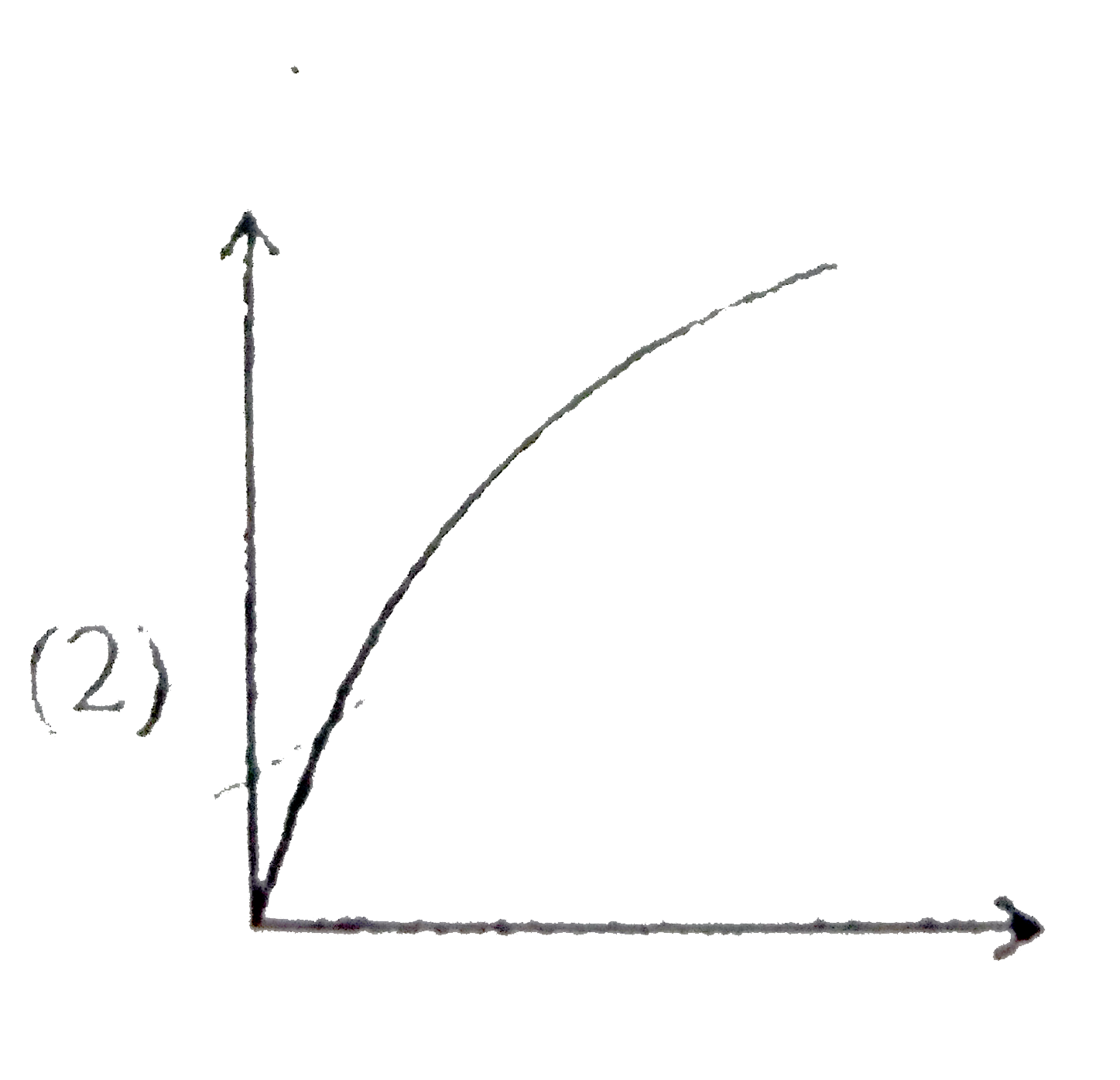
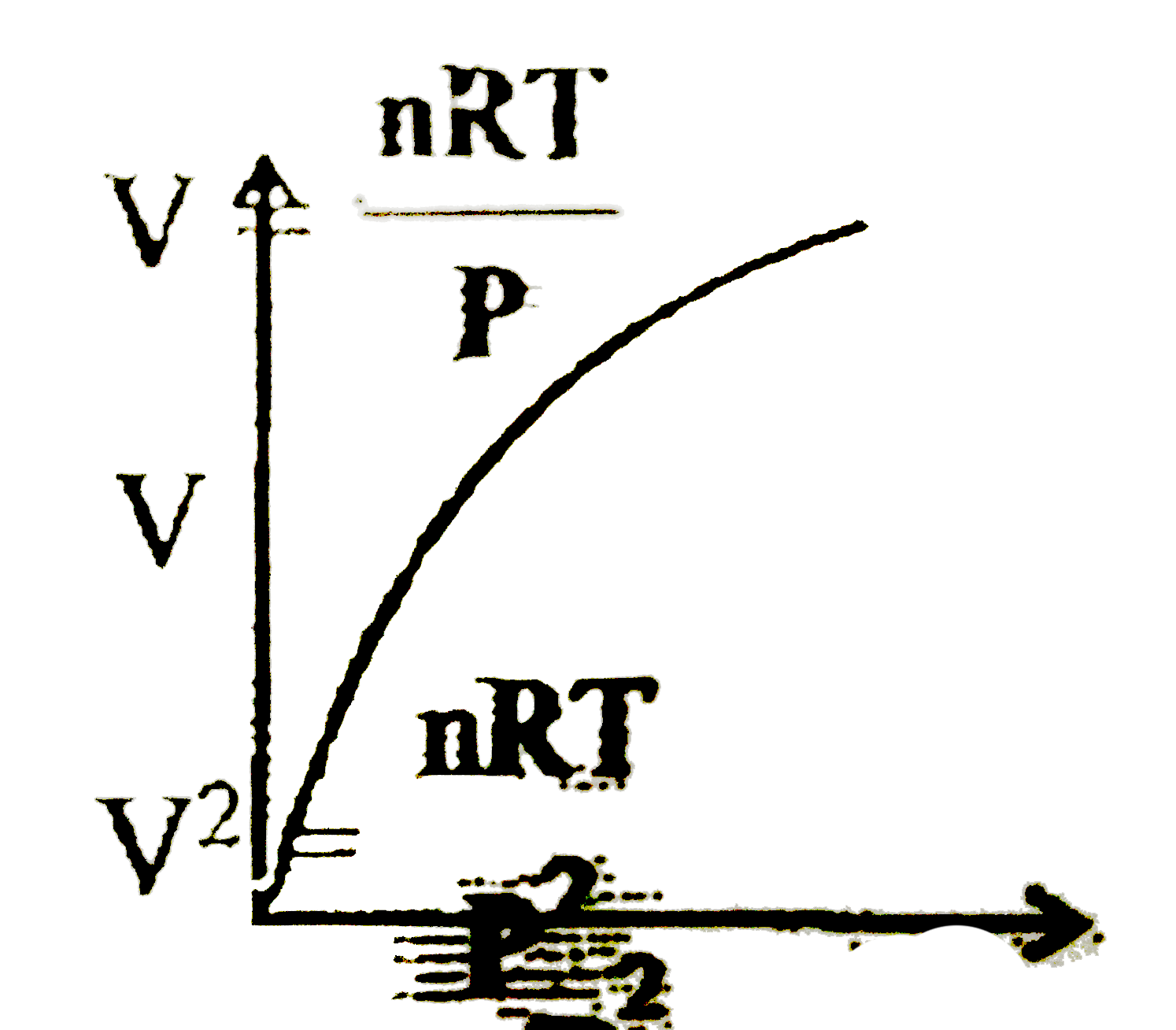
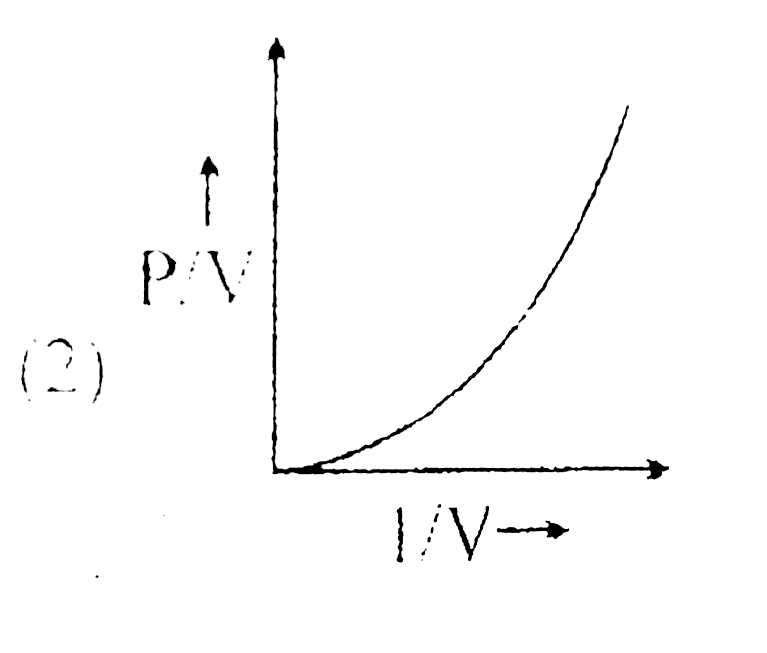
For fixed mass of an ideal gas a constant temperature. Which is correct graph ? |
|
Answer»
|
|
| 49. |
For following given compounds identify correct statement(s) |
|
Answer» All are basic W.DG `uarr` b.c `darr` `CH_(3)-overset(CH_(3))overset(|)underset(CH_(3))underset(|)C-CH_(2)-overset(O)overset(||)C-OH overset(SOCl_(2))toCH_(3)-overset(CH_(3))overset(|)underset(CH_(3))underset(|)C-CH_(2)COCL overset((CH_(3))_(2)NH)to` |
|


 WIDTH="