Saved Bookmarks
This section includes 7 InterviewSolutions, each offering curated multiple-choice questions to sharpen your Current Affairs knowledge and support exam preparation. Choose a topic below to get started.
| 1. |
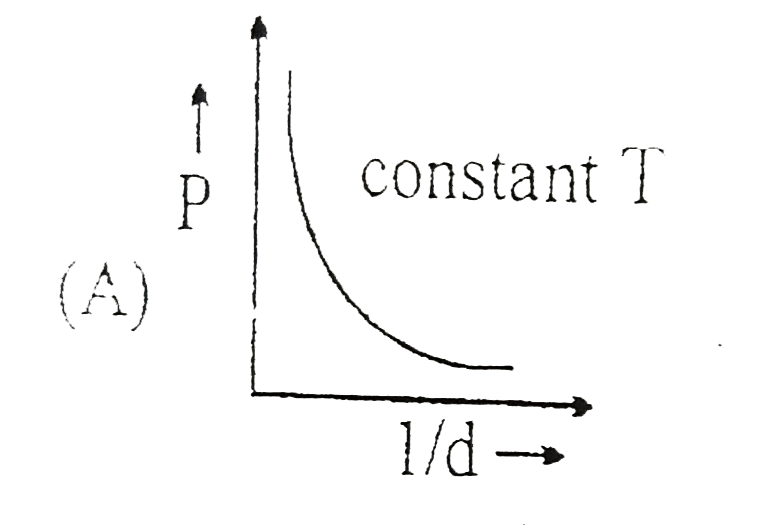
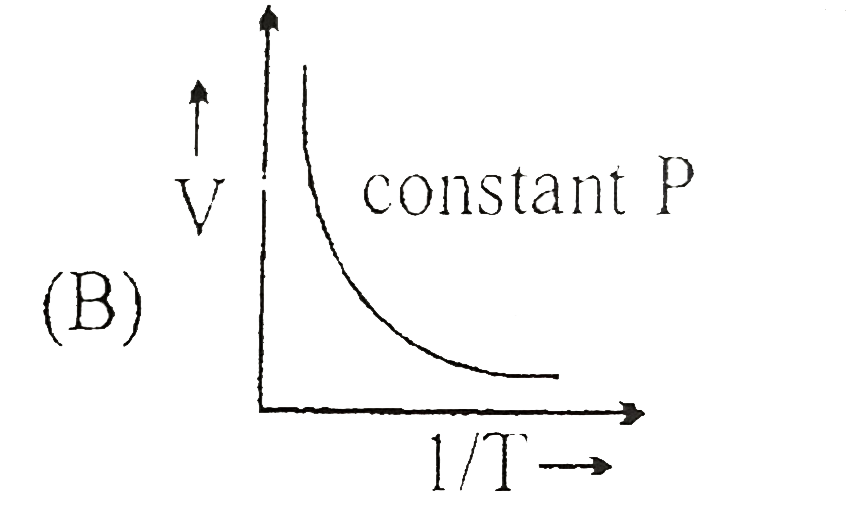
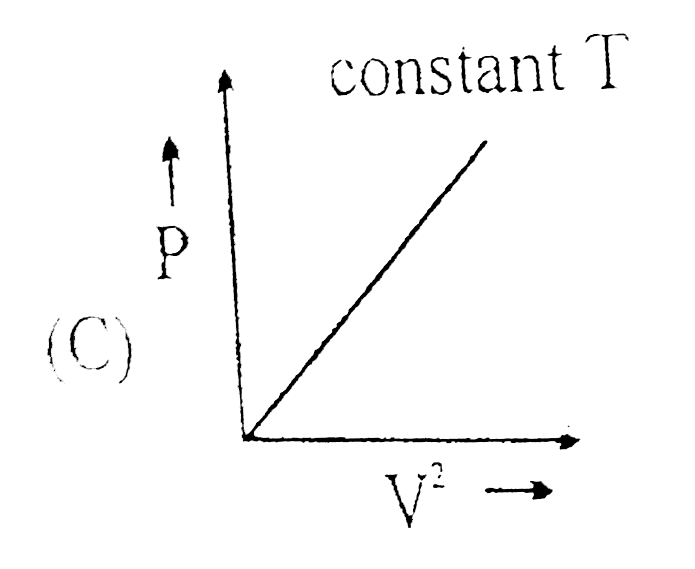
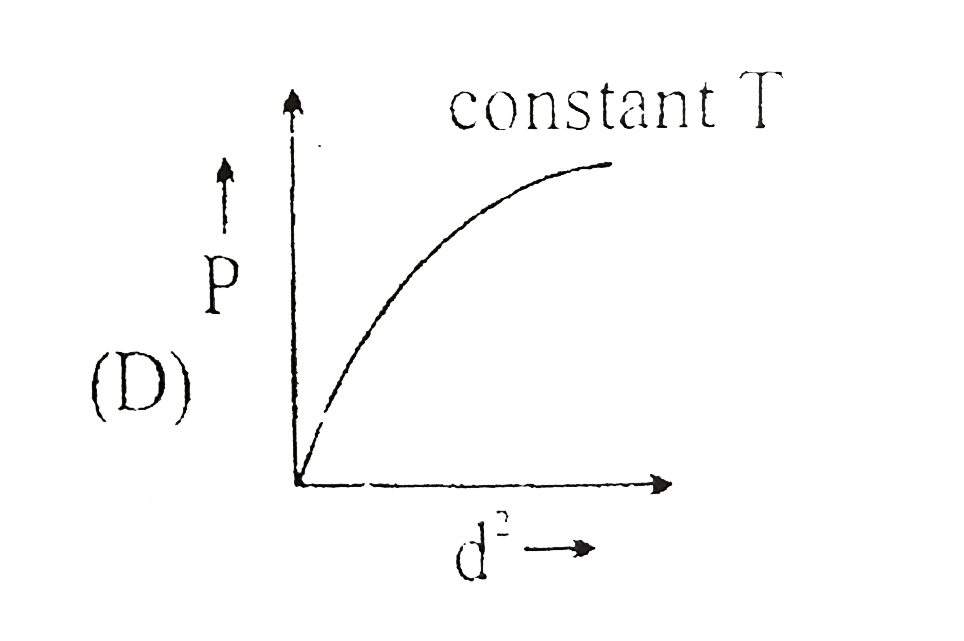
For fixed mass of an ideal gas. |
|
Answer» `(P)/(d) = (R )/(M) XX T ((P)/(d) = y, T = X)` (R ) `PV = nRT =` constant `PV = K` `P = K (1)/(V) (P = y, (1)/(V) = x)` `y = mx` (S) `P = (RT)/(M) xx d` `Pd = (RT)/(M) xx d^(2) (Pd = y, d = x)` |
|
| 3. |
For first order raction, the concentration of ractant |
|
Answer» is independent of time |
|
| 4. |
For first order reation the ratio of t_(0.75)" to "t_(0.25) would be |
| Answer» Answer :C | |
| 5. |
For first order reaction, rate constant : |
|
Answer» is DIRECTLY proportional to concentration of the REACTANT |
|
| 6. |
For first order parallel reactions k_(1) and k_(2)are 4and 2min(-1) respectively at 300 K. If the activation energies for the formation of B and C are respectively 30,00 and 38,314 joule/ mol respectively, the temperature at which B and C will be obtained in equimolar ratio is : |
|
Answer» 757.48 k |
|
| 7. |
For first order parallel reactionK_(1) and K_(2) are 4 and 2"min"^(-1) respectively at 300K. If the activation energies for the formation of B and C are respectively 30,000 and 38,314 Joul/mol respectively. The temperature at which B and C will be obtained in equimolar ratio is 47x. Hence x is _____________ |
|
Answer» `Aoverset(K)(to)C` `y_(B)=(K_(1))/(K_(1)+K_(2))=y_(C)=(K_(2))/((K_(1)+K_(2)))`…….1 , `K_(1)=AE^(-epsilon)//RT`…….2 `K_(2)=Ae^(-epsilona_(2)//RT)`…….3, `K=Ae^(-epsilone//RT)`………………..4 If `T_(1)=300K,T_(2)=376K` |
|
| 8. |
For [FeF_(6)]^(3-)" and "[CoF_(6)]^(3-), the statement that is correct is : |
|
Answer» both are COLOURED |
|
| 9. |
For [Fe(CN)_(6)]^(4-).[Ni(CN)_(4)]^(2-)and[Ni(CO)_(4)]. Correct statement |
|
Answer» all have IDENTICAL geometry |
|
| 10. |
For extraction of sodium from NaCl, the electrolytic mixture NaCl + KCl + CaCl_2is used. During extraction process, only sodium is deposited on cathode but K and Ca do not because : |
|
Answer» Na is more REACTIVE than K and Ca |
|
| 11. |
For extraction of sodium from NaCI, the electrolytic mixture NaCI + Na_(3)AIF_(6) +CaCI_(2) is used. During extraction process, only sodium is deposited on cathode but K and Ca do not because |
|
Answer» NA is more reactive than K and Ca |
|
| 12. |
For every 10^@C rise in temperature the rate of reaction increases nearly |
|
Answer» 10 times |
|
| 13. |
For estimating ozone in the air, a certain volume of air is passed through an . Alkaline Kl solution when O_(2)is evolved and iodide is oxidized to iodine . When such a solution is acidified , free iodine is evolved which can be titrated with standard Na_(2)S_(2)O_(3) . Solution : in an experiment, 10 L ari at 1 atm and 27^(@) C were passed through an alkaline Kl solution , and at the end, the iodine was entrapped in a solution which on titration as above required 1.5 ml of 0.01 N Na_(2)S_(2)O_(3) solution. Calculate volume percentage of ozone in the sample. |
|
Answer» Solution :The chemical REACTION is , `H_(2)O +Kl + O_(3) tol_(2) + O_(2) + KOH ` Milliequivalents of iodine = Milliequivalents of Kl = MILLI equivalents of `O_(3)` reacted Milliequivalnets of `Na_(2)S_(2)O_(3) = 1.5 xx 0.01 = 1.5 xx 10^(-2)` Millimoles of iodine ` = (1.5 xx 10^(-2))/2 = 7.5 xx 10^(-3)"" [ :." n-factor for iodine " =2]` Millimoles of ozone ` = 7.5 xx 10^(-3)` Volume of ozone ` = (nRT)/P = (7.5 xx 10^(-6) xx 0.0821 xx 300)/1 = 184.725 xx 10^(-6) ` litre Volume PER cent of ozone ` = (184 .725 xx 10^(-6))/10 xx 100 = 1.847 xx 10^(-3)` |
|
| 14. |
For equilibrium AB(g) iff A(g) + B(g), K_pis equal to four times the total pressure.Calculate the number of moles of B formed. |
| Answer» SOLUTION :`2//sqrt5` TIMES INITIAL MOL of AB | |
| 15. |
For emission of alpha-particle from uranium nucleus: ._(92)U^(235) - ._(2)He^(4) rarr ._(90)Th^(231) Shortage of two electrons in thorium is due to |
|
Answer» CONVERSION of ELECTRON to positron |
|
| 16. |
For effusion of equal volume, a gas takes twice the time as taken by methane under similar conditions. The molar mass of the gas is |
|
Answer» 32 g/mol |
|
| 17. |
For each value of l, the number of m value is |
|
Answer» 2L |
|
| 18. |
For each of the following pharmaceutical compounds, identify all stereogenic (i.e., all asymmetric carbon atoms) and lable the configuration of each as being either (R ) or (S). |
|
Answer» |
|
| 19. |
For each of the following processes, tell whether the entropy of the system increases, decreases or remains constant. (a) Melting one mole of ice to water at 0^(@)C (b) Freezing one mole of water of ice at 0^(@)C (c ) Freezing one mole of water to ice at -10^(@)C (d) Freezing one mole of water to ice at 0^(@)C and then cooling it to -10^(@)C |
|
Answer» |
|
| 20. |
For each of the following orders as listed in Column-I pick the correct observation listed in Colomn-II. {:("Column-I","Column-II"),((A)"CgtN",(p)"More favourable (exothermic)electron affinity"),((B)"SegtBr",(q)"The higher first ionization energy "),((C )"MggtK",(r)"The larger size"),((D)"FgtCl",(s)"The higher electronegativity"),(,(t)"The higher number of valence electrons"):} |
|
Answer» `C=ns^2 np^2, N=ns^2 np^3` (B)`Delta_(eg)H, Se= - 198 KJmol^(-1)` , Br = -`325 kJ mol^(-1)` `Delta_(IE1)`,Se=941 kJ `mol^(-1)` , Br=1142 `kJ mol^(-1)` Covalent radius/PM, Se=117, Br = 114 Electronegativity, Se=2.48 , Br = 3.0 Se=[Noble gas] `ns^2 np^4` , Br=[Noble gas] `ns^2 np^5` (C )`Delta_(eg)`H, K=-48 kJ `mol^(-1)`, `MG~~O`(stable configuration `ns^2`) `Delta_(IE1), K 419 kJ mol^(-1)`, Mn`=737 kJ mol^(-1)` Metallic radius /pm K=227, Mg=160 Electronegativity , K=0.8 , Mg=1.2 K =[Noble gas ] `ns^1` , Mg=[Noble gas]`ns^2` (D)`Delta_(IE1)`,F=1680 kJ `mol^(-1)` , Cl = `1256 kJ mol^(-1)` Covalent radius / pm , F=64 , Cl=99 Electronegativity , F=4.0 , Cl=3.2 Have same number of valence electrons because both belong to same group i.e. halogen |
|
| 21. |
For each of the following cells :(a) Write the equation for cell process. (b)Find E^@ for each cell. (c) Expiain the significance of any negative answers in part (b). 1. Fe//Fe(NO_3)_2 (1.0 M) | | Zn^(2+) (1.0 M)/Zn 2. Pt//Cl_2(g)/KCl | | Hg_2Cl_2(s)/Hg 3. Cd//Cd^(2+) (1.0M) | | AgNO_3//Ag E^@ (Fe) = 0.41V , E^@ (Cd) = 0.40 V ,E^@ (Zn) = 0.76 V E^@ (Cl– / Cl_2) = – 1.36 V , E^@ (Ag) = – 0.80V ,E^@ (Hg//Hg_2Cl_2) = – 0.27 V |
|
Answer» |
|
| 22. |
For each of the following complexes, draw a crystal field energy-level diagram, assign the electrons to orbitals, and predict the number of unpaired electrons: (a) [CrF_(6)]^(3-)"" (b) [V(H_(2)O)_(6)]^(3+) "" ( c)[Fe(CN)_(6)]^(3-) (d) [Cu(en)_(3)^(2+) "" ( e) [FeF_(6)]^(3-) |
Answer» SOLUTION :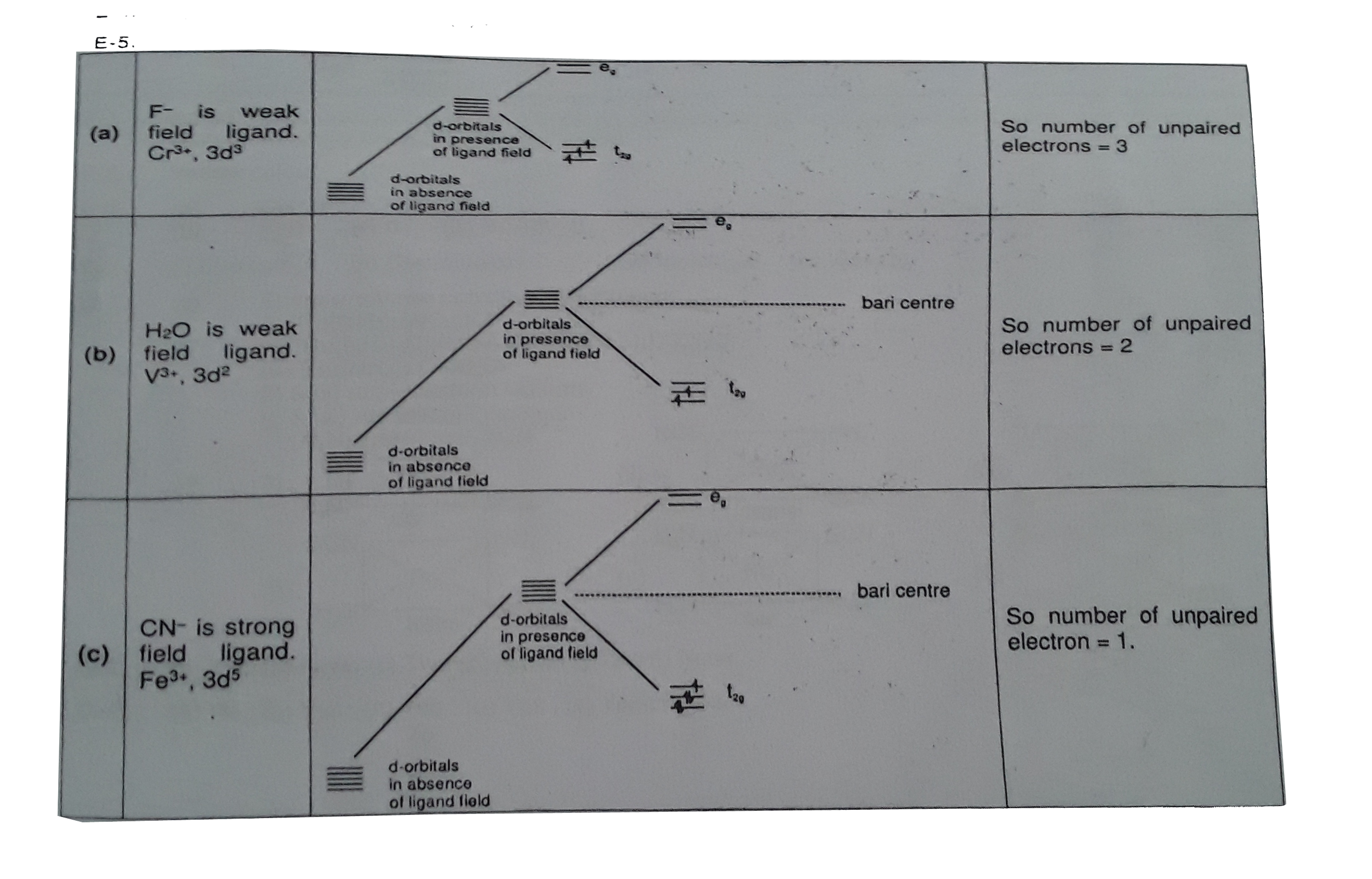 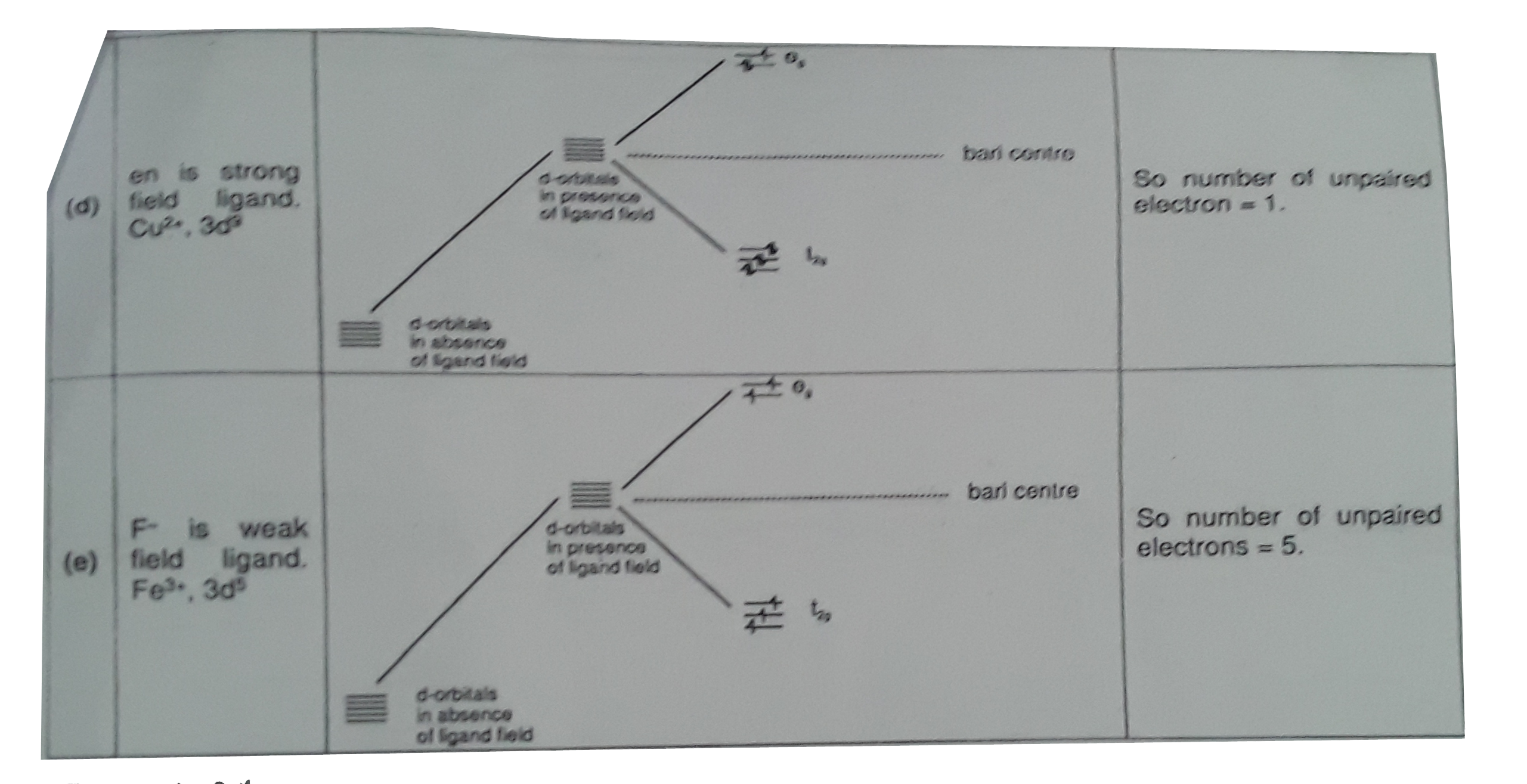
|
|
| 23. |
For dry cleaning of clothes instead of tetra chloroethane which is carcinogen in nature, which of the following solvents can be used ? |
|
Answer» LIQUID `CO_(2)` |
|
| 24. |
For drying ether sodium metal can be used, but it cannot be used for drying ethyl alcohol because: |
|
Answer» NA is very reactive |
|
| 25. |
For dofferemt reactions of H_(2)SO_(4) with(i) HNO_(3) and (ii) HClO_(4), a. Write the equactions for therecactionsand identify the conjugate acids and bases: b. Expain the differentbehaviours of H_(2)SO_(4) II. Nitrobenze can be prepared from benzeneby usinga mixtureof conc. HNO_(3) and conc. H_(2)SO_(4) In the nitratingmixture, HNO_(3) acrs are: a. Base, b. Acid c. Reducingagent, d. Catayst III. Among the following statements on the nitraction of aromatic compounds, the false one is: a. The rateof nitration of benzene is almost the sameas that of hexadeucterobenzene. b. The rate of nitration of touene is grater than that of benzene. c. The rate of nitration of benzene is greater than that of hexadeuterobenze. c. The rate of nitration of benzene is greater than that of hexadeuterobenezene. d. Nitration is an electrophillic subsitution reaction. IV. Select the correct alternatice(s). The following reaction occurs in a mixture of conc. HNO_(3) and cnc. H_(2)SO_(4) as: HNO_(3) + 2H_(2)SO_(4) rarr NO_(2)^(o+) + 2HSO_(4)^(o+) + H_(3)^(o+) Which of the following statements about this reaction is correctgt a. Nitric acid acts as a base. b. Sulphuric acid acts as a base. Sulphureacid acts as a dehydrating agent. d. Addition of H_(2)O will reduce the NO_(2)^(o+) concentration. e. HNO_(3) and NO_(2)^(o+) are conjugate acid-base pair. |
Answer» Solution :a. i. 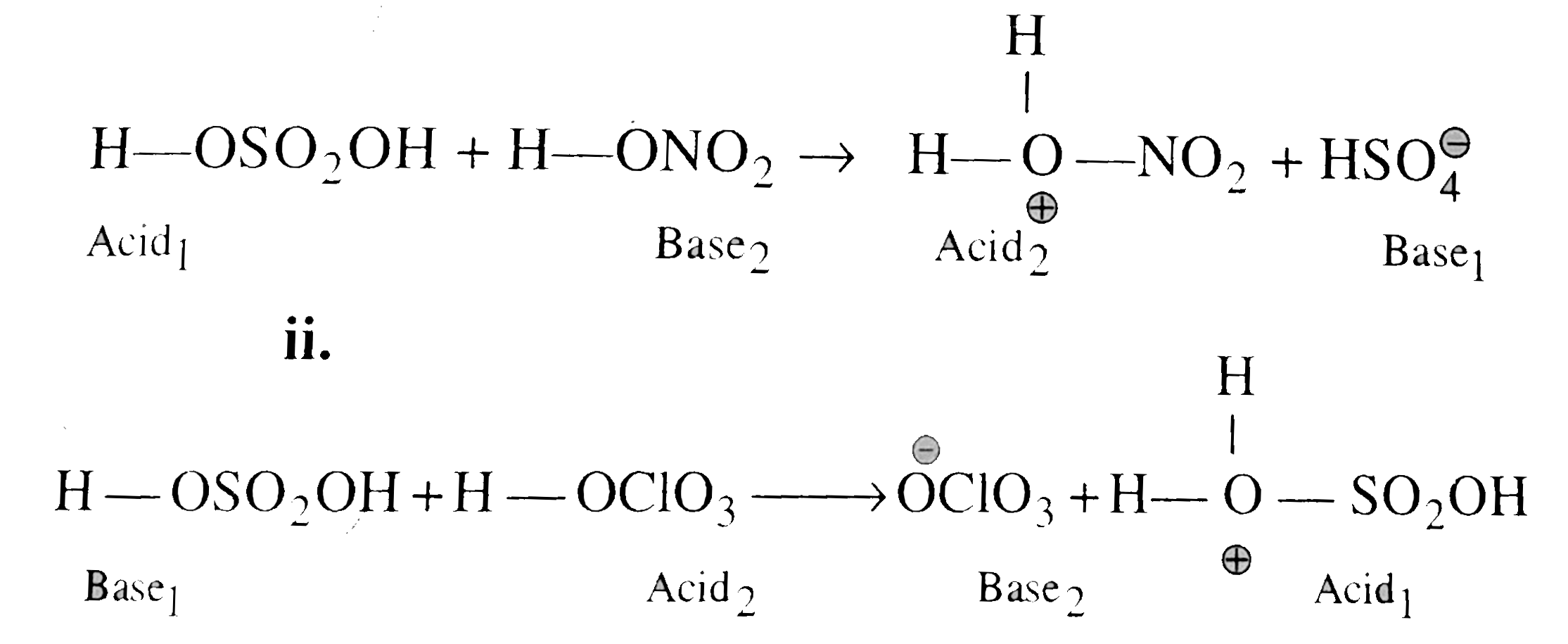 i. `H_(2)SO_(4)` a STRONGER acid, GIVESA proton to `HNO_(3)`, a weaker acid now acting as a base. II. `H_(2)SO_(4)` is the weakeracid and acts as the base to accept a proton from `HclO_(4)` II. a. III. c. IV. a and d. |
|
| 26. |
For dissolution of a solid in a liquid, Delta S is generally |
|
Answer» `+ve` |
|
| 27. |
For dissolution of an ionic solid in water Delta_("sol") H^((Theta)) = |
|
Answer» `Delta_("lattice")H^(Theta)+Delta_(f)H^(Theta)` (For dissolution of an IONIC solid in WATER) |
|
| 28. |
For dilution of H_2SO_4, why water should not be added to concentrated H_2SO_4 ? |
| Answer» Solution :On adding water to `H_2SO_4` a LARGE amount of HEAT is evolved. This LEADS to spontaneous change of water into steam. This may lead to splashing of the LIQUID CAUSING burns, etc | |
| 29. |
For dibasic acid correct order is |
|
Answer» `K_(a1) lt K_(a2)` `H_(2)X hArr H^(**) ** HX^(**) K_(3_(1))` `HX^(**) hArr H^(**) ** X^(@**) K_(a_(2))` |
|
| 30. |
For diamond, state the element present at the lattice sites, the number of nearest neighbours for each atom and the type of cell. State the hybridization of the carbon atom in diamond. |
| Answer» Solution :Carbon is PRESENT at the lattice SITES, one carbon atom is linked with four other carbon atoms forming a network crystal. It has TETRAHEDRAL UNITS and `sp^3` hybridization. | |
| 31. |
For detection of sulphur in an arganic compound, sodium nitroprusside is added to the sodium extract. A violet colour is obtained due to the formation of: |
| Answer» Answer :C | |
| 32. |
For denaturation of ethanol |
|
Answer» Copper SULPHATE is ADDED to give colour and pyridine for FOUL smell |
|
| 33. |
For dehyetohalogenation, the order of reactivity of alkyl halides considering E1 mechanism is |
|
Answer» `1° GT 2° gt 3°` |
|
| 34. |
For dehydration and also purification of gases like CO_(2), N_(2), Cl_(2), O_(2)and He, ........... and ........ are employed. |
| Answer» SOLUTION :ALUMINA , SILICA | |
| 35. |
For decolouration of 1 mole of KMnO_4, the moles of H_2 O_2 required is |
|
Answer» `1//2` |
|
| 36. |
For cyclohexane, which of the following factors does not make the boat conformation less stable than the chair conformation |
|
Answer» 1,3-diaxial interactions |
|
| 37. |
For [CrCl_(3) xNH_(3)] , elevation in boiling point of one molal solution is double of one molal urea solution . Hence , the value of x (assuming complete dissociation ) is ____ |
|
Answer» |
|
| 38. |
For d-electrons the orbital angular momentum is |
|
Answer» `sqrt(6)h/(2PI)` For d l=2 `:.` Orbital angular momentum `=sqrt(2(2+1))h/(2pi)=sqrt(6)h/(2pi)` |
|
| 39. |
For Cyclooctatetraene following is correct ? |
|
Answer» There are two TYPES of C-C bond 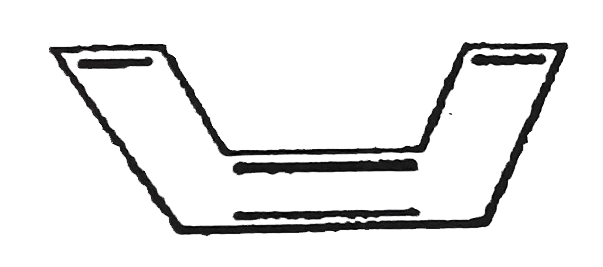 (non planar) so there is no resonance . Hence , 4 bonds are C-C (SINGLE ) and 4 bonds are C=C (double bond) |
|
| 40. |
For CuSO_(4)*5H_(2)O, which is the correct mole relationship? |
|
Answer» 9 `XX` mole of CU = mole of O |
|
| 41. |
For Cr_(2)O_(7)^(2-)(aq)+14H^(+)(aq)+6e^(-) to 2Cr^(3+)(aq)+7H_(2)O(aq) E^(@)=1.33" V". At [Cr_(2)O_(7)^(2-)]=4.5" millimole" , [Cr^(3+)]=15" millimole", E is1.067" V". The pH of the solution is : |
|
Answer» SOLUTION :`-E_(cell)=-((772xx1000" CV "mol^(-1)))/((4)xx(96500" C " mol^(-1)))=2V` ltbr? For the given reaction : `Cr_(2)O_(7)^(2-)(aq)+14H^(+)(aq)+6e^(-) to 2Cr^(3+)(aq)+7H_(2)O(aq)` `1.067=1.33-(0.0591)/(6)"log"([Cr^(3+)]^(2)[H_(2)O]^(7))/([Cr_(2)O_(7)^(2-)][H^(+)]^(14))` `1.067=1.33-9.85xx10^(-3)"log"((15xx10^(-3))^(2)xx(1)^(7))/((4.5xx10^(-3))[H^(+)]^(14))` `2 log[15xx10^(-3)]-log[4.5xx10^(-3)]-14" log "[H^(+)]=(0.263)/(9.85xx10^(-3))` `2xx(-1.82)+2.34+14 pH=26.7`B `14 pH=26.7+1.3=28` `pH=(28)/(14)=2`. |
|
| 42. |
For Cr_(2)O_(7)^(2-)+14H^(+)+6e^(-)to2Cr^(3+)+7H_(2)O,E^(@)=1.33V At [Cr_(2)O_(7)^(2-)]=4.5 millimole, [Cr^(3+)]=15 millimole, E is 1.067V. Calculate the pH of the solution. |
|
Answer» Solution :For the GIVEN reaction, `Cr_(2)O_(7)^(2-)+14H^(+)+6e^(-)to2Cr^(3+)+7H_(2)O` `E=E^(@)=-(0.0591)/(6)"log"([Cr^(3+)]^(2)[H_(2)O]^(7))/([Cr_(2)O_(7)^(2-)][H^(+)]^(14))` `1.067=1.33-9.85xx10^(-3)"log"([15xx10^(-3)]^(2)[1]^(7))/([4.5xx10^(-3)][H^(+)]^(14))` `(-0.263)/(-9.85xx10^(-3))=2LOG(15xx10^(-3))-log(4.5xx10^(-3))-14log(H^(+))` `26.7=2(-1.82)+2.34+14pH` or `pH=(28)/(14)=2`. |
|
| 43. |
For Cr_2O_7^(2-) + 14 H^(+) + 6e^(-) to 2Cr^(+3) + 7H_2O, E^(@) = 1.33 V " At" [ Cr_2O_7^(2-)]=4.5 millimoles , [Cr^(+3)]=15 millimole , E is 1.067V. The pH of the solution is nearly equal to |
|
Answer» 2 `Cr_(2)O_(7)^(2-)+14H^(+)+6e^(-) rarr 2Cr^(3+)+7H_(2)O` `E=E^(@)-(2.303RT)/(nF)log. ("[Products]")/("[Reactants]")` `1.067=1.33-(0.0591)/(6)log. ([Cr^(3+)]^(2)[H_(2)O]^(7))/([Cr_(2)O_(7)^(2-)][H^(+)]^(14))` `1.067=1.33-9.85xx10^(-3)log. ([15xx10^(-3)]^(2)[1]^(7))/([4.5xx10^(-3)][H^(+)]^(14))` `(-0.263)/(-9.85xx10^(-3))=2 log[15xx10^(-3)]-log[4.5xx10^(-3)]-14log[H^(+)]` `26.7=2xx-1.82+2.34+14`pH `26.7= - 3.64+ 2.34+14 ` pH `14pH=26.7+3.64-2.34` `pH=(28)/(14)=2` |
|
| 44. |
For copper half cell, the graph between reduction potential (Y-axis) and log[Cu^(2+)]is a straight line with the Y -intercept + 0.34V. Reduction potential of copper electrode with 0.01 M CuSO_4solution is |
|
Answer» +0.40V |
|
| 45. |
For converting aniline into chlorobenzene which of the following reagents is not used? |
| Answer» ANSWER :A | |
| 46. |
For converting aniline into chlorobenzene which of the following reagents is not used ? |
|
Answer» `Cl_(2)` |
|
| 47. |
For complex ion/compound formation reactions (I) Co^(3+) (aq) + EDTA^(4-) to P (II) Ni^(2+) (aq) + "dmg (excess)" overset(NH_4 OH)to Q (III) Zn^(2+) (aq) + "gly (excess)" to R (IV) Pt^(4+)aq + en (excess to S Which of the following complex ion/compound does not exhibit optical activity ? |
|
Answer» P |
|
| 48. |
Forcomplete oxidationof 4 litres of CO at NTP , therequiredvolume of O_(2)at NTPis |
|
Answer» 4 LITRES |
|
| 49. |
For converting a solution if 100 ml KCl of 0.4 M concentration into a solution of KCl 0.05 M concentration. The quantity of water added is |
|
Answer» Solution :We know that, `M_(1)V_(1)= M_(2)V_(2)` `0.05xx V_(1)=0.4xx100` `therefore V_(1)=(0.4xx100)/(0.05)=800` `V_(2)-V_(1)=800-100 RARR 700 ml`. |
|
| 50. |
For conversion C(graphite) rarr C(diamond) the DeltaS is |
|
Answer» Zero |
|