

Saved Bookmarks
This section includes 7 InterviewSolutions, each offering curated multiple-choice questions to sharpen your Current Affairs knowledge and support exam preparation. Choose a topic below to get started.
| 1. |
For nuclide ""_(Z)^(A) X , which of the following changes take place in respectively decay ? |
|
Answer» Both A and Z DECREASES in `alpha`- DECAY |
|
| 2. |
For nuclear fusion reactions , the fusion temperature is of the order of |
|
Answer» `10^(5) K` |
|
| 3. |
For non-zero value of force of attraction between gas molecules gas equation Will be |
|
Answer» <P>`PV =NRT -(n^(2)a)/(V)` |
|
| 4. |
For NH_4HS(s) hArr NH_3 (g) + H_2S , The observed pressure for reaction mixture in equillibrium is 1.12 atm at 160^Oc. Calculate the value of K_p for the reaction: |
|
Answer» 3.136 `atm^2` |
|
| 5. |
For naturally occurring fructose, the configuration and sign of specific rotation respectively |
|
Answer» D,- |
|
| 7. |
For N^(3-) gt O^(2-) gt F^(-) and Na^(+), the order in which their ionic radii varies is |
|
Answer» `N^(3) gt O^(2) gt F gt Na^(+)` `N^(3-) gt O^(2-) gt F^(-) gt Na^(+)` |
|
| 8. |
For natural polymers PDI is generally |
|
Answer» 1 |
|
| 9. |
For N_(2)O_(5)("in CCl"_(4))to2NO_(2)+1/2O_(2), K=6xx10^(-4)s^(-1) at 350 K and K=1.2xx10^(-3)s^(-1) at 360 K. Then, when temperature is changed to 380 K, value of K ("in s"^(-1)) |
|
Answer» `1.2xx10^(-3)` |
|
| 10. |
For N_(2)O_(5) (In "CC"l_(4))to2NO_(2)+1/2O_(2),K=6xx10^(-4)s^(-1) at 350 K and K=1.2xx10^(-3)s^(-1) at 360 K. Then when temperature is changed to 380 K, value of K (in s^(-1)) |
|
Answer» `1.2xx10^(-3)` |
|
| 11. |
For the reaction N_(2)O_(5)to2NO_(2)+1/2O_(2), Given (-d[N_(2)O_(5)])/(dt)=K_(1)[N_(2)O_(5)], (d[NO_(2)])/(dt)=K_(2)[N_(2)O_(5)] and (d[O_(2)])/(dt)=K_(3)[N_(2)O_(4)]. The relation in between K_(1),K_(2) and K_(3) is |
|
Answer» `k_(1)=2k_(2)=3k_(3)` |
|
| 12. |
For N_2O_5 to 2NO_2 + 1//2O_2, it is found that (-d)/(dt) [N_2O_5] = k_1[N_2O_5], (d)/(dt) [NO_2] = k_2[N_2O_5], (d)/(dt) [O_2] = k_3[N_2O_5] , then |
|
Answer» `k_1 = 2k_2 = 3k_3` |
|
| 13. |
For N_2O_4(g) to 2NO_2(g) ,pressure is found to be increased from 700 mm to 800 mm in 10 min. Then(-Delta [P])/(Delta t)with respect to N_2O_4 is |
| Answer» Answer :A | |
| 14. |
For N_(2)+3H_(2)hArr2NH_(3)+ heat |
|
Answer» `K_(p)=K_(C)(RT)` |
|
| 15. |
For N_(2)+3H_(2)hArr2NH_(3) equlibrium constant is k then equlibrium constant for 2N_(2)6H_(2)hArr4NH_(3) is |
|
Answer» `sqrtk` |
|
| 16. |
For N_2 + O_2 to 2NO,initially N_2 & O_2are at pressures 500mm & 700 mm at t = 0. If the pressure of N_2 is 480 mm at t = 20 min average rate of reaction is |
| Answer» Answer :B | |
| 17. |
N_(2) + 3H_(2) to 2NH_(3). The rateof disappearanceof nitrogen is 0.02 mol L^(-1)s^(-1). Whatis the rate ofapperance of ammonia ? |
| Answer» Answer :C | |
| 18. |
For N_(2)+3H_(2)to2NH_(3) rates of disappearance of N_(2) and H_(2) and rate of appearance of NH_(3) respectively, are a,b and c then |
|
Answer» `-0.02 "MOL"` |
|
| 19. |
For N_2 + 3H_2 hArr 2NH_3 DeltaH = -VE then : |
|
Answer» `K_P = K_C` |
|
| 20. |
For mu isomerism is associated with which one of the following complex ? (M = central metal) |
|
Answer» `[M(A A)_(2)]` |
|
| 21. |
For metal complexes (i) [PtCl_(3)(C_(2)H_(4))]^(-) and (ii) [PtCl_(3)(C_(2)F_(4))]^(-) the correct statement is/ are that: |
|
Answer» Carbon-carbon BOND length is SAE both in (i) and (ii) 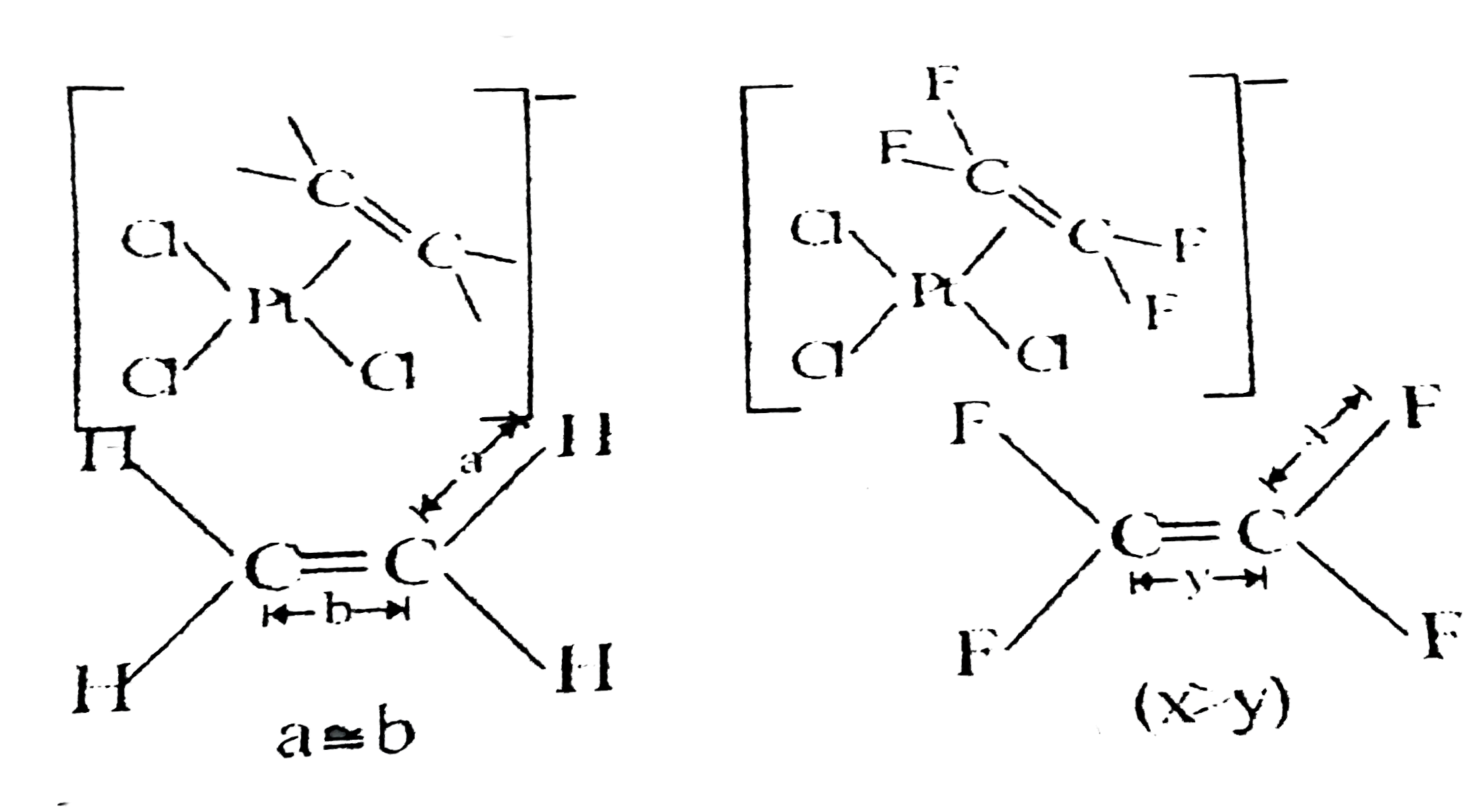 The hybrid orbital to which F is ATTACH contains more p-character than other hybrid ORBITALS. [bent's rule] so`C-F` bond length increases and other bond length DECREASES in the same molecule. |
|
| 22. |
For melting of 3 moles of water at 0^(@)C the DeltaG^(@) is |
|
Answer» ZERO |
|
| 23. |
For measuring the conductivity of an electrolyte its solution should be prepared in |
|
Answer» TAP water |
|
| 24. |
For measuring conductivity of an electrolyte, its solution should be prepared in |
|
Answer» TAP WATER |
|
| 25. |
For manufacture of tyre rubber jthe percentages is sulphur is |
|
Answer» 20-30 % |
|
| 26. |
For making distinction between 2 pentanone and 3 pentanone the reagent to be employed is |
|
Answer» `K_(2)Cr_(2)O_(7)//H_(2)SO_(4)` 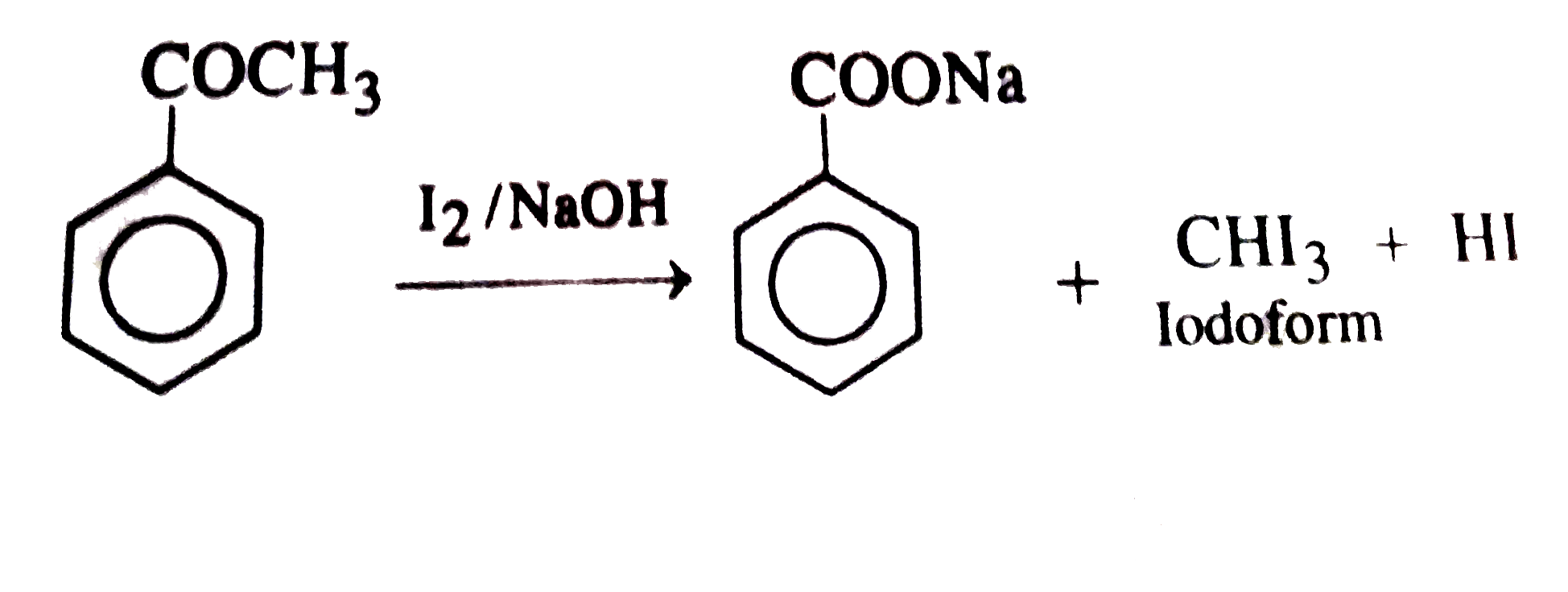
|
|
| 27. |
For making good quality mirrors, plates of float glass are used. These are obtained by floating molten glass overliquid metal which does not solidify before glass. The metal used can be |
|
Answer» tin |
|
| 28. |
For M^(2+)//M and M^(3+)//M^(2+) systems, the E^(@) values for some metals are as follows : {:(Cr^(2+)//Cr,,=-0.9V,,Cr^(3+)//Cr^(2+),,=-0.4V),(Mn^(2+)//Mn,,=-1.2V,,Mn^(3+)//Mn^(2+),,=+1.5V),(Fe^(2+)//Fe,,=-0.4V,,Fe^(3+)//Fe^(2+),,=+0.8V):} Use this data to comment upon : (a) the stability of Fe^(3+) in acid solution as compared to that of Cr^(3+) or Mu^(3+) and (b) the ease with which iron can be oxidised as compared to the similar process for either chromium or manganese metals. |
|
Answer» SOLUTION :(a) `CR^(3+)//Cr^(2+)` has a negative reduction potential. Hence, `Cr^(3+)` cannot be reduced to `Cr^(2+)`, i.e., `Cr^(3+)` is most stable. `Mn^(3+)//Mn^(2+)` has large POSITIVE `E^(@)` value. Hence, `Mn^(3+)` can be easily reduced to `Mn^(2+)`, i.e., `Mn^(3+)` is LEAST stable. `E^(@)` value for `Fe^(3+)//Fe^(2+)` is positive but small. Hence, `Fe^(3+)` is more stable than `Mn^(3+)` but less stable than `Cr^(3+)`. Thus, the stability follows the order : `Cr^(3)gt Fr^(3+)gt Mn^(3+)` (b) Oxidation potentials for the given pairs will be `+0.9V,+1.2V` and `+0.4" V"`. Thus, the order of GETTING oxidised will be : `Mn gt Cr gt Fe` |
|
| 29. |
For making distinction between 2-pentanone and 3-pentanone the reagent to be employed is |
|
Answer» `K_(2)Cr_(2)O_(7)//H_(2)SO_(4)` |
|
| 30. |
For making Ag and AgNO_(3), which of the following is used |
|
Answer» `pH_(3)` `UNDERSET("silver nitrate")(6AgNO_(3))+underset("PHOSPHENE")(2PH_(3)) to 6Ag+underset("phosphorous acid")(2H_(3)PO_(3))+6NO_(2)` |
|
| 31. |
For (M^(2+))/(M) and (M^(3+))/(M^(2+)) systems the E^(ɵ) values for some metals are as follows. (Cr^(2+))/(Cr) -0.9V, (Cr^(3+))/(Cr^(2+)) -0.4V (Mn^(2+))/(Mn)-1.2V,(Mn^(3+))/(Mn^(2+)) +1.5V (Fe^(2+))/(Fe) -0.4, (Fe^(3+))/(Fe^(2+)) +0.8V Use this data comment upon: (i). The stability of Fe^(3+) in acid solutio as compared to that of Cr^(3+) or Mn^(3+) and ltbtgt (ii). The case with which iron can be oxidised as compared to a similar process for either chromium or manganese metal. |
|
Answer» Solution :(i). `((Cr^(3+))/(Cr^(2+)))` has a negative reduction potential. HENCE, `Cr^(3+)` cannot be reduced to `Cr^(2+)`, i.E., `Cr^(3+)` is most stable. `((Mn^(3+))/(Mn^(2+)))` has LARGE positive `E^(ɵ)` value for `((FE^(3+))/(Fe^(2+)))` is positive but small. Hence, `Fe^(3+)` is more stable than `Mn^(3+)` but less stable than `Cr^(3+)`. (ii). Oxidation potential for the given pairs will be `+0.9V,+1.2V` and `+0.4volt`. Thus, the order of their getting oxidised will be in the order `MngtCrgtFe`. |
|
| 32. |
For M^(2+)//M and M^(3+)//M^(2+) systemsthe E^(@) values for some metals are as follows: {:(Cr^(2+)//Cr,-0.9V,Cr^(3)//Cr^(2+),-0.4V),(Mn^(2+)//Mn,-1.2V,Mn^(3+)//Mn^(2+),+1.5V),(Fe^(2+)//Fe,-0.4V,Fe^(3+)//Fe^(2+),+0.8V):} Use this data to comment upon: (i) the stability of Fe^(3+) in acid solution as compared to that of Cr^(3+) or Mn^(3+) and (ii) the ease with which iron can be oxidised as compared to a similar process for either chrmoium or magnganess metal. |
|
Answer» SOLUTION :(i) The `M^(3+)|M^(2+)` values suggest that `Fe^(3+)` ions in acidic medium is more STABLE than `Mn^(3+)` ions and LESS stable than `Cr^(3+)` because of higher reduction potential. (ii) `M^(2+)|M` is most negative for Mn and hence Mn will be most easily oxidized. The ease wiht which OXIDATION occurs will be `Mn gt Cr gt Fe` |
|
| 33. |
For M^(2+)//M and M^(3+)//M^(2+) systems the E_0 values for some metals are as follows: {:(Cr^(2+)//Cr,-0.9 V, Cr^3//Cr^(2+),-0.4V),(Mn^(2+)//Mn, -1.2 V, Mn^(3+)//Mn, +1.5V),(Fe^(2+)//Fe, -0.4V. Fe^(3+)//Fe^(2+),+0.8V):} Use this data to comment upon : (i) The stability of Fe^(3+ ) in acid solution as compared to that of Cr^(3+) or MnO^(3+), and (ii) The case with which iron can be oxidised as compared to similar process for either chromium or manganese metal. |
|
Answer» Solution :(i) Higher the reduction potential of a species, greater is the tendency for its reduction to take place. Therefore, `MN^(3+)` with highest reduction potential would be READILY reduced to `Mn^(2+)` and hence is the least stable. THUS, from the values of reduction potential, it is clear that stability of `Fe^(3+)` in acidic solution is more stable Mn + but less stable than that of `CR^(3+)`. (ii) Lower the reduction potential or higher the oxidation potential of a species, greater the ease with which its oxidation will take place. Thus, order of tendency to undergo oxidation is Fe < Cr Mn. |
|
| 34. |
For M^(2+) //M and M^(3+) //M^(2+)system, E^(@) values for some metals are as follows , Cr^(2) //Cr= - 0.9 V l, Cr^(3+) //Cr^(2) = - 0.4 V, Mn^(2+) //Mn = - 1.2 V, Mn^(3+) //Mn^(2+) = + 1.5 V, Fe^(2+) //e= - 0.4 V, Fe^(3+) //Fe^(2+) = + 0.8 V Use this data to comment upon (i) the stability of Fe^(3+) in acid solution as compared to that of Cr^(3+) and Mn^(3+) (ii)the case with which iron can be oxidized as compared to the similar process for either Cr or Mn metals. |
|
Answer» Solution :(i) `Cr^(3+) //Cr^(2+)` has a negative reduction POTENTIAL. Hence, `Cr^(3+)` cannotbe reduced to `Cr^(2+) ` ,i.E, `Cr^(3+)` is most stable . `MN^(3+) //Mn^(2+)` has largepositive `E^(@)` value. Hence, `Mn^(3+)` can be easily reduced to `Mn^(2+)` , i.e., `Mn^(3+)` is least stable. `E^(@)` value for`Fe^(3+)//Fe^(2+)` is positivebut SMALL. Hence, `Fe^(3+) ` si more stable than `Mn^(3+)` but lessstable than `Cr^(3+)` (ii) Oxidation potentials for the givenpairs will be `+ 0.9 V , + 1.2 V` and `+ 0.4 ` volt . Thus, the ORDER of their getting oxidized will be in the order `Mn gt Crgt Fe` |
|
| 35. |
For KMnO_(4) in strong basic medium correct combination is - |
|
Answer» (I) (ii)(R) |
|
| 36. |
For I^(st) order decomposition of SO_2Cl_2(g), SO_2Cl_2(g)toSO_2(g)+Cl_2(g) a graph of log (a-x) v//s t is shown in figure answer the following using above information. What is rate of reaction at t=10 min [ in "mole"//Lit.//sec] |
|
Answer» `0.2xx10^(-3)` at t=10 MIN `implies log (a-x)=-3` so, (a-x)`=10^(-3)` Rate `=(7.7xx10^(-3)xx10^(-3))` `=7.7xx10^(-6)` |
|
| 37. |
For KMnO_(4) in neutral medium correct combination is - |
|
Answer» (I) (III) (Q) |
|
| 38. |
For I^(st) order decomposition of SO_2Cl_2(g), SO_2Cl_2(g)toSO_2(g)+Cl_2(g) a graph of log (a-x) v//s t is shown in figure answer the following using above information. What is the rate constant (in sec^(-1)) ? |
|
Answer» 0.2 `K=2.303/t "LOG" (a/(a-x))` `log (a-x)=[-K/2.303]t+log a` SLOPE=`-K/2.303=-2/10` `K=2/10xx2.303/60sec^(-1)` `=7.7xx10^(-3) sec^(-1)` |
|
| 39. |
For isothermal expansion of an ideal gas, the correct combination of the thermodynamic parameters will be |
|
Answer» `DELTA U =0, Q = 0 , w ne 0` and ` Delta H ne 0` ` THEREFORE Delta U = nC_v Delta T= 0` ` DeltaH = nC_p Delta T = 0` From first LAW of thermodynamics ` Delta U = Q + w` As ` Delta U = 0` ` therefore Q = w ne 0` |
|
| 40. |
For 'invert sugar', the total number of correct statement(s) is(are) (Given : specific rotations of (+) -sucrose, (+)-maltose, L-(-)-glucose and L-(+) fructose in aqueous solution are + 66°, + 140°, -52° and +92^(@) respectively) (I) ‘invert sugar’ is prepared by acid catalyzed hydrolysis of maltose. (II) ‘invert sugar’ is an equimolar mixture of D-(+)~giucose and D-(-)-fruetose. (III) specific rotation of‘invert sugar’ is -20°. (IV) on reaction with Br_2 water, ‘invert sugar’ forms saccharic acid as one of the products. |
|
Answer» `underset(+"sucrose")(C_(12)H_(22)O_(11)) + H_(2)O overset(H^(+)) to underset("invert sugar")(C_(6)H_(12)O_(6) + O_(2) overset(+)to C_(6)H_(12)O_(6))` Specific rotation of invert sugar = `(-92^(@)+52^(@))/2 = -20^(@)` D-glucose on oxidation with `Br_(2-)` WATER produces gluconic ACID and not saccharic acid. |
|
| 41. |
For 'invert sugar' the correct statement(s) is (are) . Give : specific rotations of (+) -sucrose , (+)- maltose , L-(-) glucose and L-(+) -fructose in aqueous solution are +66^@, +140^@,-52^@ and 92^@, respectively. |
|
Answer» invert SUGAR' is prepared by acid catalyzed hydrolysis of maltose `therefore` Specific rotation of invert sugar `=0.5xx[alpha] of D-(+)`-glucose `+0.5xx[alpha_(D)] of D-(-)`-fructose `=0.5(+52)+0.5(-92)=-20^@`. |
|
| 42. |
For 'invert sugar' the correct statement is (Given : specific rotations of (+)-sucrose, (+)-maltose, L-(-)-glucose and L-(+)-fructose in aqueous solution are +66^(@),+140^(@), -52^(@)" and "+92^(@), respectively) |
|
Answer» invert SUGAR' is prepared by acid catalyzed HYDROLYSIS of maltose |
|
| 43. |
For intromethane movecule , write structures (s) (i) showing signifcant resonance stabilisation (ii) indicationg tautomerism . |
Answer» SOLUTION :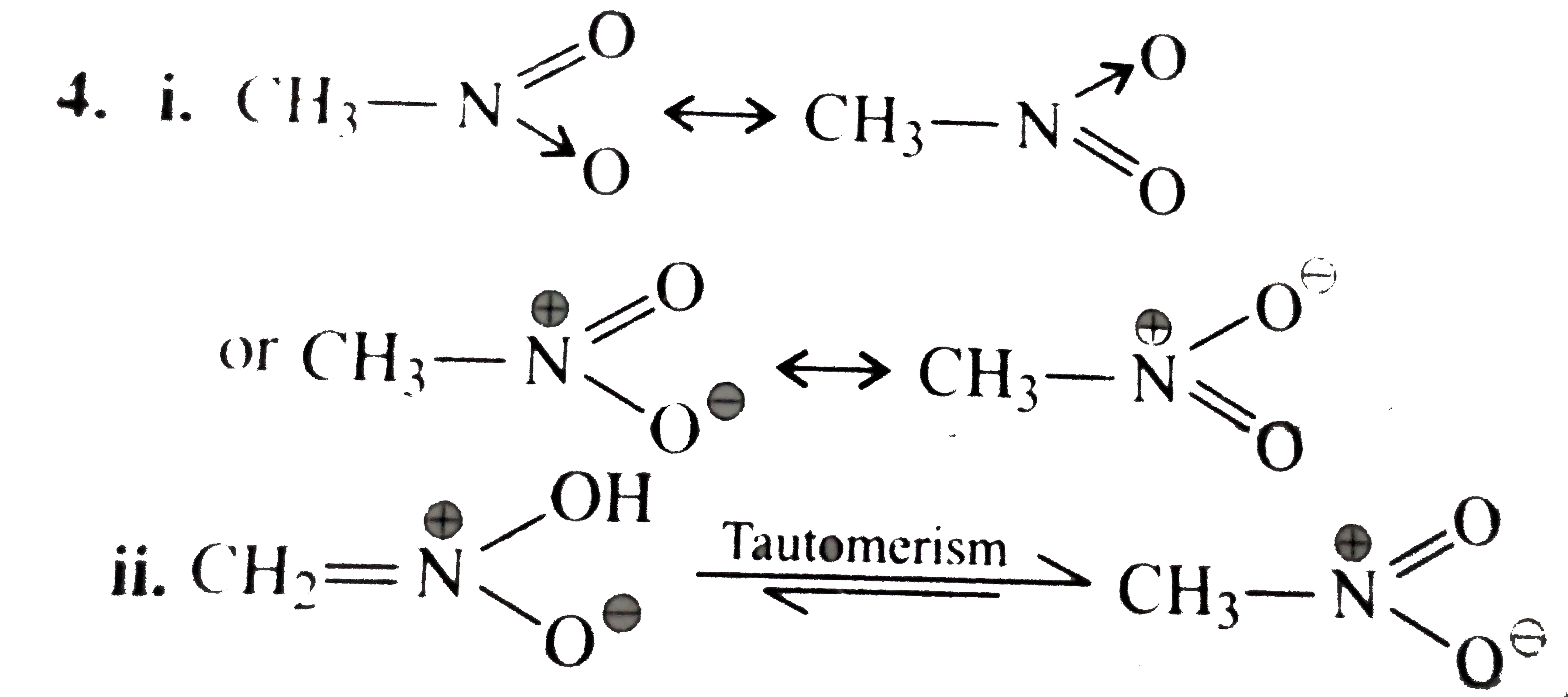
|
|
| 44. |
For ideal gases pV // nRTis : |
|
Answer» 1. EQUAL to 0 |
|
| 46. |
For ideal binary solution, p=x_(A)*p_(A)^(0)+x_(B)*p_(B)^(0) This equation reflects |
|
Answer» BOYLE's LAW |
|
| 47. |
For hypothetical reactions, the equlibrium constnat (k) vlues are given AhArrB,K_(1)=2.0 BhArrC,K_(2)=4.0 ChArrD,K_(3)=3.0 The equlibrium constnat for reaction AhArrD is |
|
Answer» 48 For the reaction `A hArrD` `K=([D])/([A])=([D])/([C])xx([C])/([B])xx([B])/([A])=K_(1)xxK_(2)xxK_(3)=3xx4xx2=24` |
|
| 48. |
For hypothetical reaction - A(g)+B(g)toC(g)+D(g) Which of the following statements is correct - |
|
Answer» `DeltaH=DeltaE` |
|
| 49. |
For I_2 + 2e to 2I^(-) , standard reduction potential = + 0.54 volt. For2Br^(-) to Br_2 + 2e^(-) . Standard oxidation potential = - 1.09 volt. For Fe to Fe^(2+) + 2e^(-) , standard oxidation potential = + 0.44 volt. Which of the following reaction is non-spontaneous ? |
|
Answer» `Br_(2) +2I^(-) RARR 2Br^(-) +I_(2)`<BR>`FE+Br_(2) rarr Fe^(2+) + 2Br^(-)` |
|