Saved Bookmarks
This section includes 7 InterviewSolutions, each offering curated multiple-choice questions to sharpen your Current Affairs knowledge and support exam preparation. Choose a topic below to get started.
| 1. |
Finely divided Nickel is a better adsorbent than Nickel crystal. |
|
Answer» Solution :As the ADSORPTION is a SURFACE PHENOMENON it depends on the surface area of adsorbent. i.e., higher the surface area, higher is the amount adsorbed. Finely DIVIDED Nickel has LONGER surface area and it is a better adsorbent than Nickel crystal. |
|
| 2. |
Finely divided iron is used as a catalyst in an industrial process. The name of the process is |
|
Answer» CONTACT PROCESS. |
|
| 3. |
Finelydivided iron combines with CO to give : |
|
Answer» `Fe(CO)_4` |
|
| 4. |
Finely divided iron combines with CO to give _________. |
| Answer» Answer :A | |
| 5. |
Find Z_(eff) (using Slater's Rule) on 3d electron of Cu(29) |
|
Answer» 8.3 `sigma=9xx0.35+18xx1` `Z_(EFF)=Z-sigma=29-9xx0.35-18` `Z_(eff)=11-3.15=7.85` |
|
| 6. |
Finely divided catalyst is more effective because____________. |
|
Answer» it INCREASES activation energy |
|
| 7. |
Fire extinguishers contain H_2SO_4 and, |
|
Answer» `NaHCO_3 `and `Na_2CO_3` |
|
| 8. |
Find wrong statement |
|
Answer» `CuCl_(2)` is used as catalyst in Deacon's process. (d) `I_(2)` SHOWS bleaching property `CaoCl_(2) + 2KI + HCl rarr 2CaCl_(2) + KCl + H_(2) O + I_(2)` |
|
| 9. |
Find trelationship between given pair : |
|
Answer» |
|
| 10. |
Find total planes in CH_(4) containing maximum no. of atoms :- |
| Answer» SOLUTION :`N//A` | |
| 11. |
Find total number of species in which Zn metal is soluble under oridnary condition (R.T.). H_(2)O,"dil".H_(2)SO_(4),"conc". H_(2)SO_(4),"dil".HNO_(3),"conc".HNO_(3),"dil". HCl,NaOH(aq),AgNO_(3)(aq.),CuSO_(4)(aq.) |
|
Answer» `Zn+"CONC".H_(2)SO_(4)rarrZnSO_(4)(aq)+SO_(2)uarr` `Zn+"dil". HNO_(3)rarrZn(NO_(3))_(2)(aq)+N_(2)Ouarr` `Zn+"conc."HNO_(3)rarrZn(NO_(3))_(2)(aq)+NO_(2)uarr` `Zn+"dil". HClrarrZnCl_(2)(aq)+H_(2)RARR` `Zn+NaOHrarrNa_(2)Zn(OH)_(4)(aq)+H_(2)uarr` `Zn+AgNO_(3)rarrZn(NO_(3))_(2)+Agdarr` `Zn+CuSO_(4)rarrZnSO_(4)+Cudarr` |
|
| 12. |
Find total number of stereoisomers for each compound given below : |
|
Answer» (2) `(1) 2^(2) rArr4,` (3) `(1) 2^(4) =16 ("n=4 stereogenic centre")` (4)`(1) 2^(2)rArr4 ("molecule unsymmetrical"),` (5) `(1) 2^(2)rArr4` (6) `(1) 2^(2)rArr4 ("molecule unsymmetrical"),` (7) `(1) 2^(2)rArr4` (8) `S.LrArr3 ("molecule SYMMETRICAL")` (9) 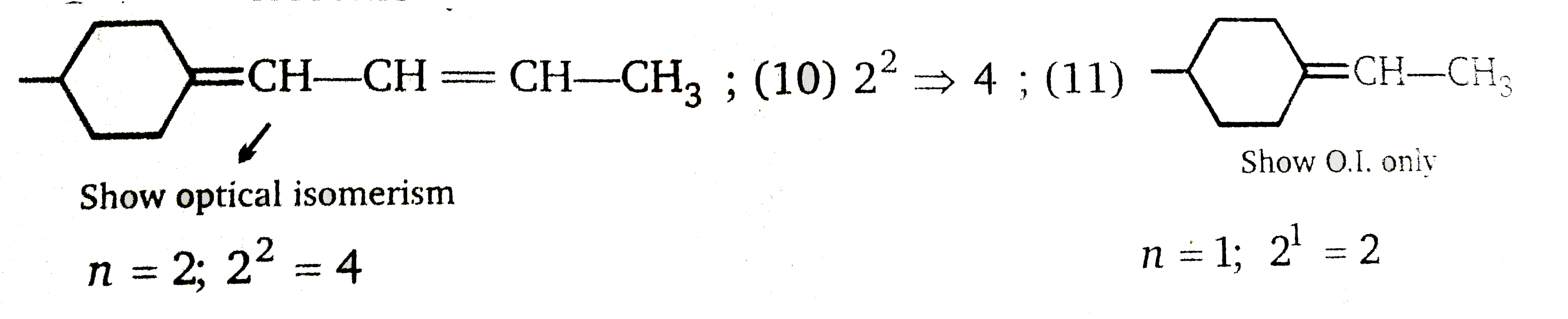
|
|
| 13. |
Find total number of orbital which can overlap colaterally, (if inter nuclear axis is z): s, p_(x), p_(y), p_(z), d_(xy), d_(yz), d_(xz), d_(z), d_(x^(2)-y^(2)) |
|
Answer» <P> |
|
| 14. |
Findthe workdonewhen one mole of thegas isexpandedreversibly po and isothermallyfrom5 atmto 1e atm at 25^(@) C. |
|
Answer» |
|
| 15. |
Find the work done when one mole of the gas is expanded reversibly and isothermally from 5 atm to 1 atm at 25^(@)C |
| Answer» SOLUTION :`w=-3.988kJ` | |
| 16. |
Find the work done when 1 mole of hydrogen expands isothermally from 15 to 50 litres against a constant pressure of 1 atm at 25^(@)C. |
|
Answer» |
|
| 17. |
Find thework done in each case :(a)Whenone moleof ideal gas in 10 liter container aat 1 atm,is allowed to enter a vaccuated bulb of capacity 100 liter. (b)When1 moleof gas expands from1 liter to 5 liter a against constant stamospherice pressue . |
|
Answer» |
|
| 18. |
Find the volume of CO_(2) obtained at S.T.P. on heating 200 gm of 50% pure CaCO_(3) - |
|
Answer» 11.2 litre |
|
| 19. |
Find the velocity of an electron emitted by a metal whose threshold frequency is 2.25 xx 10^(14) sec^(-1) . When exposed to visible light of wavelength 5.0 xx 10^(-7) m. |
|
Answer» Solution :`phi = hv_(0)` `= 6.6 xx 10^(-34) xx 2.25 xx 10^(14) = 0.928 eV` Total ENERGY given by the visible light `= ( h C)/(lambda)` ` = ( 6.6 xx 10^(-34) xx 3 xx 10^(8))/( 5.0 xx 10^(-7)) = 2.47 eV ` K.E. = Total energy `E - phi = 2.45 - 0.928 = 1.547 eV ` K.E. = `( 1)/(2) mv^(2)` `1.547 xx 1.6 xx 10^(-14) = ( 1)/( 2) xx 9 xx 10^(-31) xx v^(2)` `v = sqrt(( 1.547 xx 1.6 xx 10^(-19) xx 2 )/( 9 xx 10^(-31))) 7.4 xx 10^(5) m//`SEC |
|
| 20. |
Find the values of A,B and C in the following table for the reaction X + Y to Z. The reaction is of first order w.r.t X and zero order w.r.t. Y. {:("Exp",[X](mol L^(-1)),[Y](mol L^(-1)),"Initial rate (mol L^(-1) s^(-1))),(1,0.1,0.1,2xx10^(-2)),(2,A,0.2,4 xx 10^(-2)),(3,0.4,0.4,B),(4,C,0.2,2 xx 10^(-2)):} |
|
Answer» `A = 0.2 MOL L^(-1), B = 8 xx 10^(-2) mol L^(-1) s^(-1), C = 0.1 mol L^(-1)` Rate is INDEPENDENT of the conc. Of Y and it depends only on the conc.of X and it is the first ORDER reaction. From exp. (1), `2 xx 10^(-2) = k (0.1)` From exp, (2) `4 xx 10^(-2) = k(A)` Dividing (ii) and (i) , `(4 xx 10^(-2))/(2 xx 10^(-2)) = (k(A))/(k(0.1)) = (A)/(0.1)` `IMPLIES 2 xx 0.1 = A` `implies A = 0.2 mol L^(-1)` From exp. (3), `B = k(0.4)` Dividing (iii) and (i), `(B)/(2 xx 10^(-2)) - (k(0.4))/(k(0.1)) = 4` `implies B = 4 xx 2 xx 10^(2) = 8 xx 10^(-2) mol L^(-1) s^(-1)` From exp. (4), `2 xx 10^(2) = k (C )` dividing (iv) and (i), `(2 xx 10^(-2))/(2 xx 10^(-2)) = (k(C ))/(k(0.1)) = (C )/(0.1)` `implies C = 0.1 mol L^(-1)` |
|
| 21. |
Find the values of the rate constant of a first order reaction having half life of 50 minutes. |
| Answer» SOLUTION :Rate CONSTANT(k) = `(0.693)/t_(1//2) = 0.693/(50 "min") = 0.0139 min^(-1)` | |
| 22. |
Find the value (x+y)/(2)(include sterio isomers) |
|
Answer» |
|
| 24. |
Find the value of m+n in the anionic species [Ti(CO)mp^(n-), if it follows E.A.N. rule and complex is octahedral ? |
|
Answer» 22+n+12=36 `implies` n=2 |
|
| 26. |
Find the value of expression |x-| for following compounds. where, x=total number of water insoluble salts. y=total number of salts, which can liberate non-olar acidic gas during their complete thermal decomposition. BaCO_(3),""PbSO_(4),""AgNO_(3),""CaC_(2)O_(4),""CsHCO_(3),""Na_(3)PO_(4),""CH_(3)COOAg,""Mg(OH)_(2),""Pb(NO_(3))_(2) |
|
Answer» `y=5(BaCO_(3),PbSO_(4),CaC_(2)O_(4),CsHCO_(3),CH_(3)COOAg)` |
|
| 27. |
Find the value of AG^(@) at 25^(@)C for the following electrochemical cell. Cu|Cu^(2+)(1M)||Ag^(+)(1M)|Ag [Ec_(u)=+0.34V, E_(Ag)^(@)=+0.8V] F=96487C |
|
Answer» SOLUTION :`E_("CELL")^(@)=E_("cell")-E_("anode")=0.8-0.34=0.46V` `DELTAG^(@)=-nFE_("cell")^(@)=-2xx96500xx0.46=-88780J` |
|
| 28. |
Find the total stereoisomes for : (a) [Cr(C_(2)O_(4))_(3)]^(3-)=x (b) [PtCl_(2)(en)_(2)]^(2+)=y (c ) [Cr(NH_(3))_(2)Cl_(2)(en)]^(+)=z Hence write the value of x+y+z |
|
Answer» |
|
| 29. |
Find the two third life (t_(2//3)) of a first order reaction in which k=5.48xx10^(-14)sec^(-1), (log3=0.4771,log2=0.3010) |
|
Answer» |
|
| 30. |
Find the total pressure exerted by 1.6 g of methane and 2.2 g of CO_(2) contained in a four-litre flask at 27^(@)C. |
|
Answer» |
|
| 31. |
Find the total numberof isomers of C_(7)H_(14) (only 5-membered ring.) |
Answer» 
|
|
| 32. |
Find the total number of stereoisomers of [M(gly)_(3)] [Where M is any metal capable of forming such complexes.] |
|
Answer» |
|
| 33. |
Find the total number of molecule / ions in which d orbitals is / are not in hybridisation PCl_(6)^(-), PCl_(4)^(+), IF_(4)^(-), IF_(5), XeO_(3), F_(2), I Cl_(2)^(+), SF_(2), SF_(6), As F_(4)^(+), SiF_(4) |
|
Answer» 3 |
|
| 34. |
Find the total number of monohalogenated products including stereoisomers for R. |
Answer»  `THEREFORE""8` `THEREFORE""8`
|
|
| 35. |
Find the total number of stereoisomer for each compound : |
|
Answer» (2) `2^(2)=4` (3) `2^(n-1)+2^((n//2-1))+2^(2//1)+2^((2//2-1)=2^(1)+2^(@)=2^(1)+1=3` (4) 4 (5) `2^(3)rArr8` 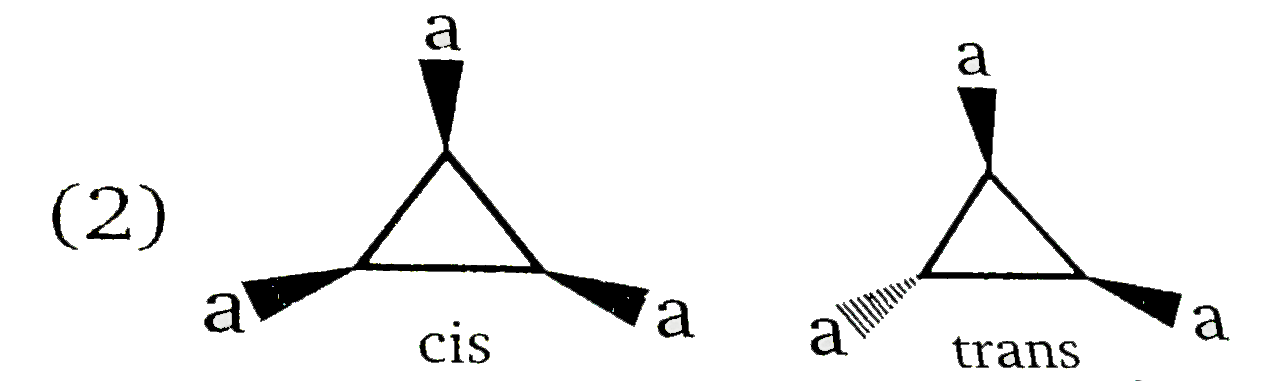
|
|
| 36. |
Find the total number of optically active compounds in [Zn(bm)(en)]Cl_(2). |
Answer» 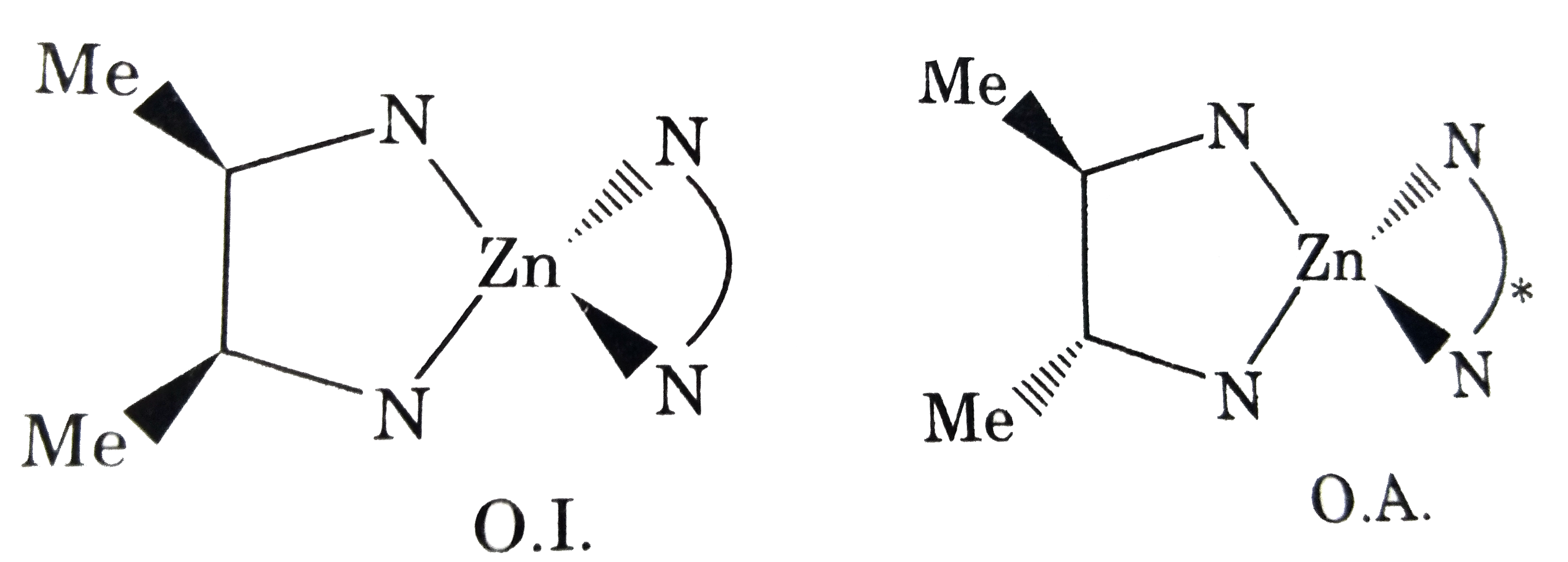
|
|
| 37. |
Find the total numberof ions which form paramagnetic complex irrespective of nature of ligand in octahedral geometry. (C.N. = 6) Sc^(+3), Ti^(3=), Cr^(+3), Pt^(+4), Ni^(+2), Co^(+3), Fe^(+3) |
|
Answer» |
|
| 38. |
Find the total number of lone pair in compound Z which is formed as follows: CH_(3)CH_(2) CH_(2)Br overset(aq. NaOH) to X overset(Al_(2)O_(3)) to Y overset(Cl_(2)//H_(2)O) to Z |
Answer»  Hence, the LONE pair of electron in Z is 5. |
|
| 39. |
Find the total number of ligands which act as pi-acceptor. O^(2), F^(-), CO, CH_(3)NC, CN^(-), CH_(3)O^(-), OH^(-), CH_(2)=CH_(2), NO^(+), PF_(3), AsF_(3) [If your answer is 2, write your answer is 2, write it as 0002.] |
|
Answer» |
|
| 40. |
Find the total number of geometrical iosmers of [M(AB)(CD)(EF)]^(n+) |
Answer» 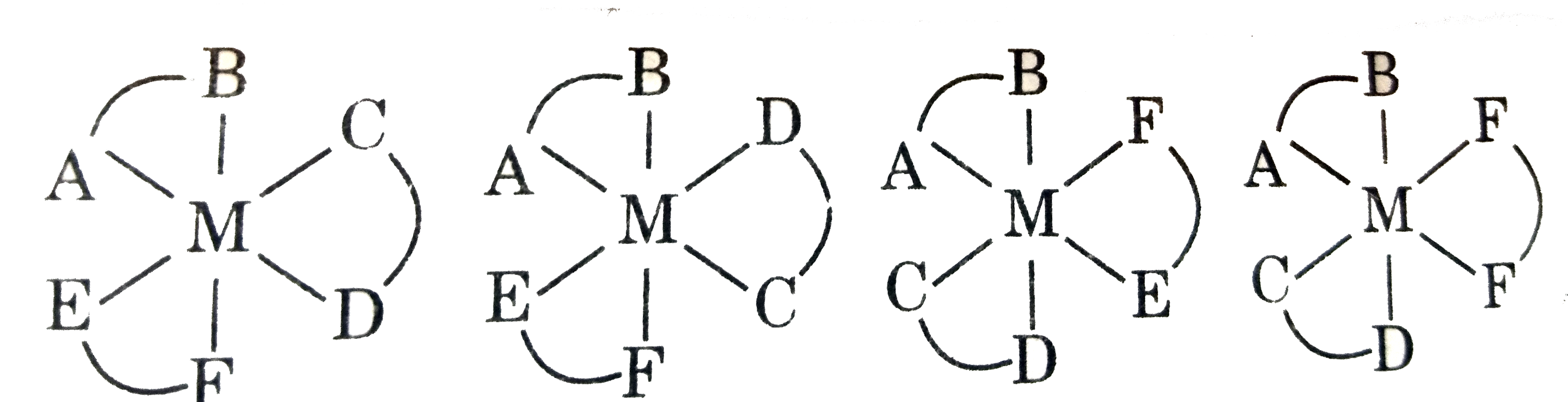
|
|
| 41. |
Find the total number of feasible products (including stereoisomers) in the following reaction. (No carboncation rearrangements is observed) |
|
Answer» |
|
| 42. |
Find the total number of elements which have higher ionisation energy than their both adjacentelements (either in a period or in a group in the long from of periodic table). Be, B, N, P, Ga, S, Mg |
|
Answer» `C lt N gt O` `Si lt P gt S` `AL lt GA gt In` `Na lt Mg gt Al` |
|
| 43. |
Find the total number of elements which have higher ionisation energy than their both adjacent elements (either in a period or in a group in the long from of periodic table). Be, B, N, P, Ga, S, Mg |
|
Answer» |
|
| 44. |
Find the total number of Fe-Fe bonds in Fe_(3)(CO)_(12) if it follows EAN rule. |
Answer» 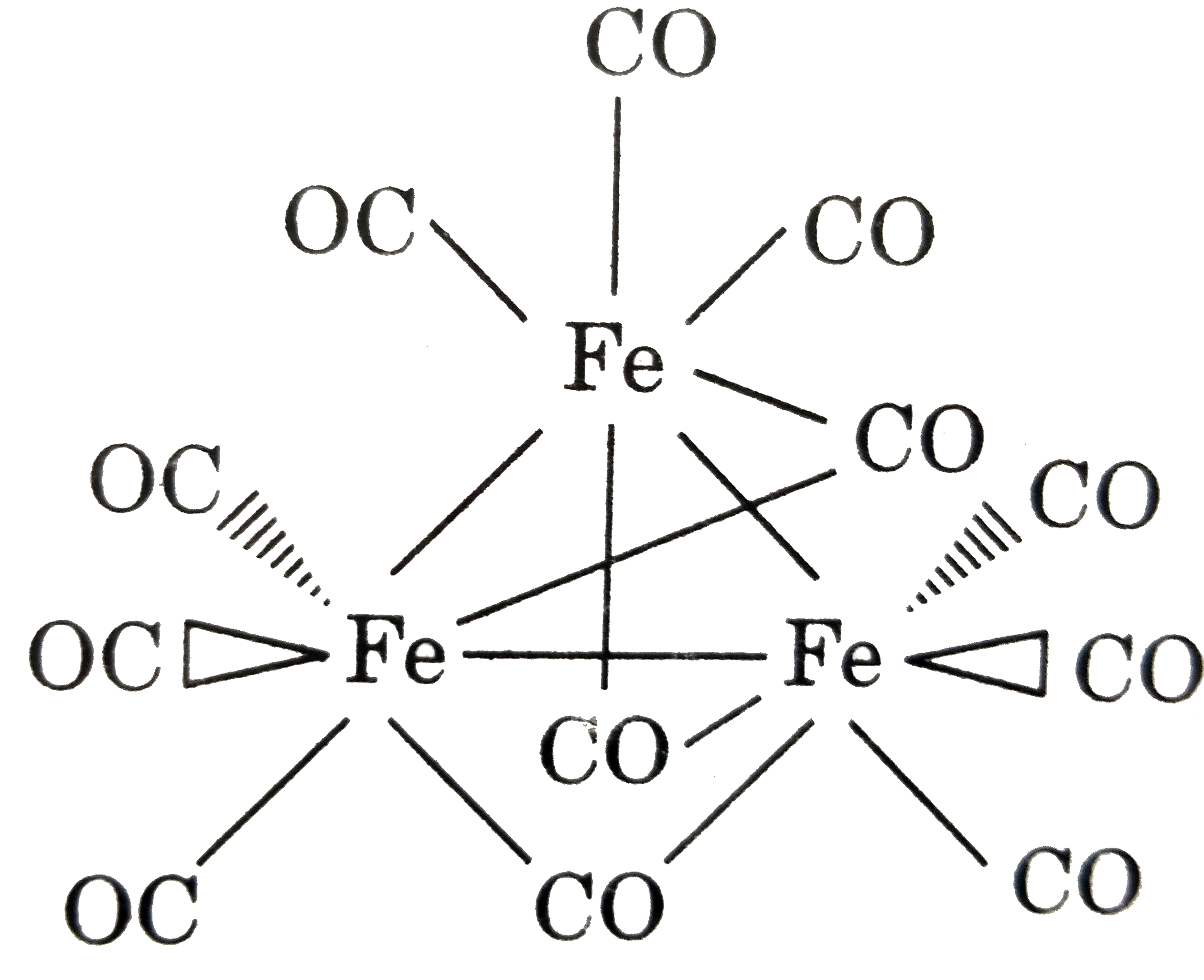
|
|
| 45. |
Find the total number of diamagnetic complexes. K_(3)[Fe(CN)_(6)],[Co(NH_(3))_(6)]Cl_(3), Na_(3)[Co(Ox)_(3)], [Ni(H_(2)O)_(6)]Cl_(2), K_(2)[Pt(CN)_(4)], [Zn(H_(2)O)_(6)](NO_(3))_(2), K_(2)[NiCl_(4)],[Pt(NH_(3))_(2)Cl_(2)], [Ni(CO)_(4)] |
|
Answer» |
|
| 46. |
Find the total number of diastereomers of the complex M_(a_(2)b_(2)c_(2)) where M is the central metal atom/ion and a, b, c are monodentate achiral ligands. |
|
Answer» (AB)(ab)(cc) `cancel O.I.=1` (ac) (bb)(cc) `cancel O.I.=1` (aa)(bc)(bc) `cancel O.I.=1` (ab)(ac)(bc) RIGHT O.A.=2 `:.` Diastereomers=5 |
|
| 47. |
Find the total number of compounds or ions having O-O bond longer than that in free O_(2) molecule. (a) Na_(2)O_(2),""(b) KO_(2), (c ) [overset(v)Cr(O_(2))_(4)]^(3-),""(d) [overset(VI)CrO(O_(2))_(2)(H_(2)O)], (e ) [CrO_(5)(Py)],""(f) [overset(III)Cr(O_(2))(CN)_(5)]^(3-), (g) Na_(2)ZnO_(2) |
|
Answer» |
|
| 48. |
Find the total number of complexes / species which are paramagnetic. (a) [Co(NH_(3))_(6)]^(3+),""(b) [Co(H_(2)O)_(6)]^(3+), (c ) [Cr(NH_(3))_(6)]^(2+),""(d) [CoF_(6)]^(3-), (e ) K_(3)[PtCl_(3)(C_(2)H_(4))],""(f) [Mn(NH_(3))_(6)]^(2+), (g) [Fe(NH_(3))_(6)]^(2+),""(h) NO_(2), (i) ClO_(2),""(j) [Pt(NH_(3))_(2)Cl_(2) |
|
Answer» (c )`[CR(NH_(3))_(6)]^(2+),Cr^(2+),3d^(4),SP^(3)d^(2)` hybridisation, complex (d) `[CoF_(6)]^(3-) Co^(3+),3d^(6),sp^(3)d^(2)` hy7bridisation, there will be FOUR unpaired electrons (e )`K_(3)[PtCl_(3)(C_(2)H_(4))]` diamagnetic (f) `[Mn(NH_(3))_(6)]^(2+) 3d^(5)`,5unpaired electrons, (paramagnetic). 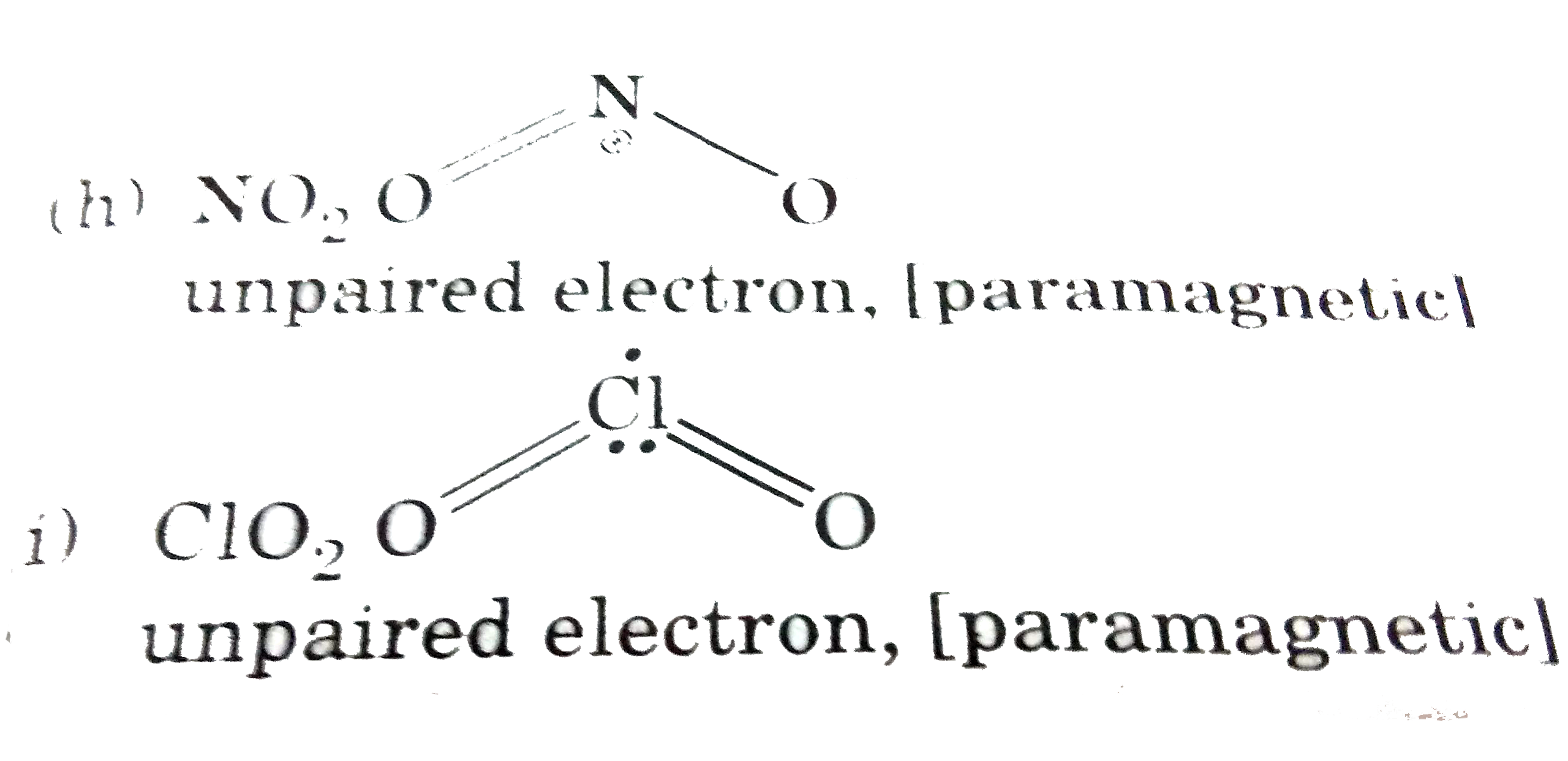 (g) `[Fe(NH_(3))_(6)]^(2+)` paramagnetic (4 unpaired electrons) |
|
| 49. |
Find the total number of compounds/ions having linear shape. [Ag(CN)_(2)]^(-), HgCl_(2), SnCl_(2), NO_(2)^(+1), ClO_(2)^(+), AuCl_(2)^(-), Hg_(2)Cl_(2) |
|
Answer» |
|