Saved Bookmarks
This section includes 7 InterviewSolutions, each offering curated multiple-choice questions to sharpen your Current Affairs knowledge and support exam preparation. Choose a topic below to get started.
| 1. |
Flourine is highly reactive because |
|
Answer» F-F BOND ENERGY is high |
|
| 2. |
Flocculation value is expressed in terms of - |
|
Answer» Millimole/litre |
|
| 3. |
Flocculation value of BaCl_(2) is much less than that of KCl for sol A and flocculation value of Na_(2)SO_(4) is much less than that of NaBr for sol B. The correct statement among the following is: |
|
Answer» Both the sols A and B are NEGATIVELY charged In second case the given compounds have SIMILAR cation but differentcharge. Hence, they will precipitate positively charged sol i.e., B. |
|
| 4. |
Flint glass is obtained from which of the following ? |
|
Answer» Zinc and barium borosilicate |
|
| 5. |
Flash bulbs contain wire or foil of Mg packed in an atmosphere of: |
|
Answer» `SO_3` |
|
| 6. |
Flase statement is |
|
Answer» rate of zero order RACTION is INDEPENDENT of INITIAL CONCENTRATION of ration is inversely concentration of the reactant |
|
| 7. |
Flame test is not gives by |
|
Answer» `Mg^(2+)` IONS |
|
| 9. |
Flagpole intersection is present in: |
|
Answer» BOAT FORM of cyclohexane |
|
| 10. |
Fixed mass of a gas is subjected to the changes as shown is diagram, calculate T_(3),T_(4),P_(1),P_(2) and V_(1) as shown is diagram .Considering gas obeys PV = nRT equation. |
|
Answer» |
|
| 11. |
Flag - pole interaction is present in |
|
Answer» BOAT form of CYCLOHEXANE |
|
| 12. |
Fixedamount of an ideal gas contained ina sealed rigidvessl(V=24.6 litre) at 1.0baris heatedreversiblyfrom 27^(@)to 127^(@) C. Determine charge in G ibb's energy (|DeltaG|in Joule)if entropys=10+10^(+2)T(J//K) |
|
Answer» <P> SOLUTION :`dG= V.dP - S.DT"","at CONST. volume"``DeltaG = V.DeltaP- int(10+10^(-2)T).dT""(P_(1))/(T_(1))=(P_(2))/(T_(2)) rArrP_(2) = 1 xx 400//300` `DeltaG=24.6xx((4)/(3)-1) xx 100 -[10xx100+10^(2)xx((T_(2)^(2))/(2)-(T_(1)^(2))/(2))]` `DeltaG=24.6xx(1)/(3)xx 100 -[1000+10^(2)xx((160000)/(2)-(90000)/(2))]` ` = 24.6 xx(1)/(3)xx100-1000-350=-530 J` |
|
| 13. |
Five valence electrons of .^(15)P re labelled asIf the spin quantum numbers of B and Z is+(1)/(2), the group of electron with three of the quantum number (n,l,m) same are . |
| Answer» Answer :2 | |
| 14. |
Fixation of nitrogen means: |
|
Answer» Reaction of nitrogen with oxygen |
|
| 15. |
Five thousand with three significant figures is written as: |
|
Answer» 5000 |
|
| 16. |
Five moles of an ideal gas undergoes reversible expansion from 1 L to 4 L at 27^oC. The work done and enthalpy change for the process respectively are |
|
Answer» `- 12.5 KJ and - 18.2 kJ` |
|
| 17. |
Five most abundant elements in the living cell are |
|
Answer» `C,H,O,N,Fe` |
|
| 18. |
Five isomeric para- disubtitutedaromaticcompounds (A) to (E) withmolecularformulaC_(6)H_(6)O_(2)were givefor identification . Basedon the followingobservations findstructureof thecompounds. (i)Both (A) and (B) form a silvermirrorwithTollen'sregent, also(B) givesa positivetest withFeCl_(3)solution . (ii) (C) givespositiveiodoform test .(iii)(D)isreadily extractedin aqueousNaHCO_(3) solution. (iv) (E) on acid hydrolysis gives 1,4- dihydroxybenzene. |
Answer» SOLUTION :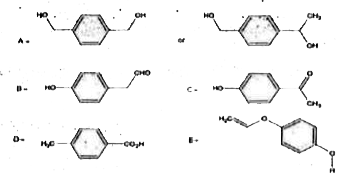
|
|
| 19. |
Five moles of an ideal gas at300 K, expandedisothermallyfroman intinalpressueof4 atmto a final pressureof 1 atm againsta cont. extpressureof 1 atm . Calculate q ,w, DeltaU & DeltaH. Calculatethe correspondingof allif theaboveprocessis carriedoutreversibly . |
|
Answer» ` =- P_("ext") xx nRT [1-(1)/(4)]` `= 9353.25 J` `W_("rev") =- 2.303 nRT log .(P_(1))/(P_(2)) = -17288. 47J` `DeltaU = 0,""DeltaH = 0` |
|
| 20. |
Five hypothetical gases having name A,B,X,Y and Z are having boiling point in the range of 4.9 K to 6.9 K. Gases A and B are reacting to produce gases X,Y and Z as per the following stoichiometric equation in a container of volume 0.9 L pressure 1 atmosphere and at temperature 8.513K ( at equilibrium ) . A_((g)) + B_((g)) rarr X_((g)) + Y _((g)) + 2Z_((g)) At the condition of equilibrium, which of the following statement is correct ? |
|
Answer» `K_(P) = K_(C )` |
|
| 21. |
Fittig reaction. |
|
Answer» Solution :Fittig reaction : ARYL halides give analogus compounds when treated with SODIUM in dry ether, in which TWO aryl groups undergocouplng reaction to form diphenyl is called Fittig reaction. 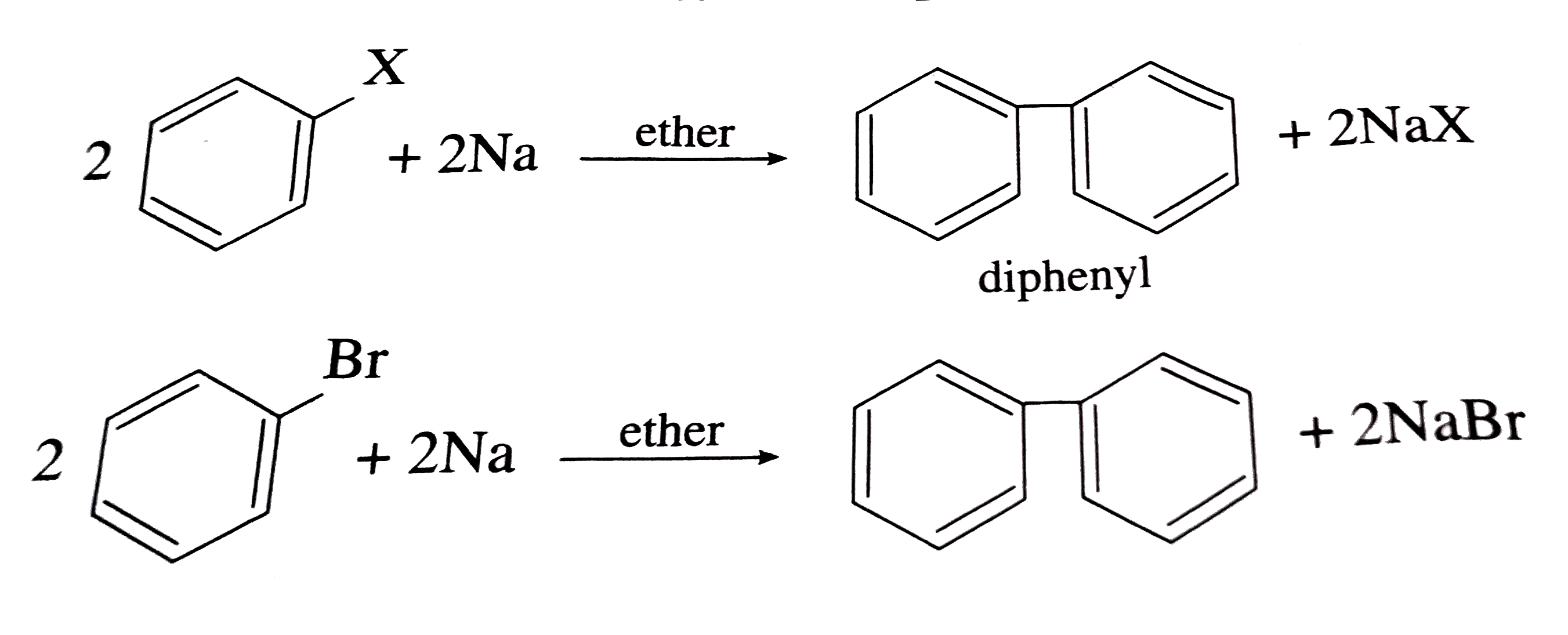
|
|
| 22. |
Five amine synthesis are outlined below. In each reactions box enter a single letter designating the best reagent and conditions selected from the list at the bottom of the page. a) i) LiAlH_(4) in ether, ii) H_(2)O & base b) C_(2)H_(5)NH_(2)(cat. H^(+)) c) NaCN in alcohol d) H_(2) & Ni catalyst or H_(2) & Pd catalyst e) NaN_(3) in alcohol f) (CH_(3)CO)_(2) & pyridine g) C_(2)H_(5)Br h) (i) 2CH_(3)I & pyridine j) KOH in H_(2)O |
Answer» 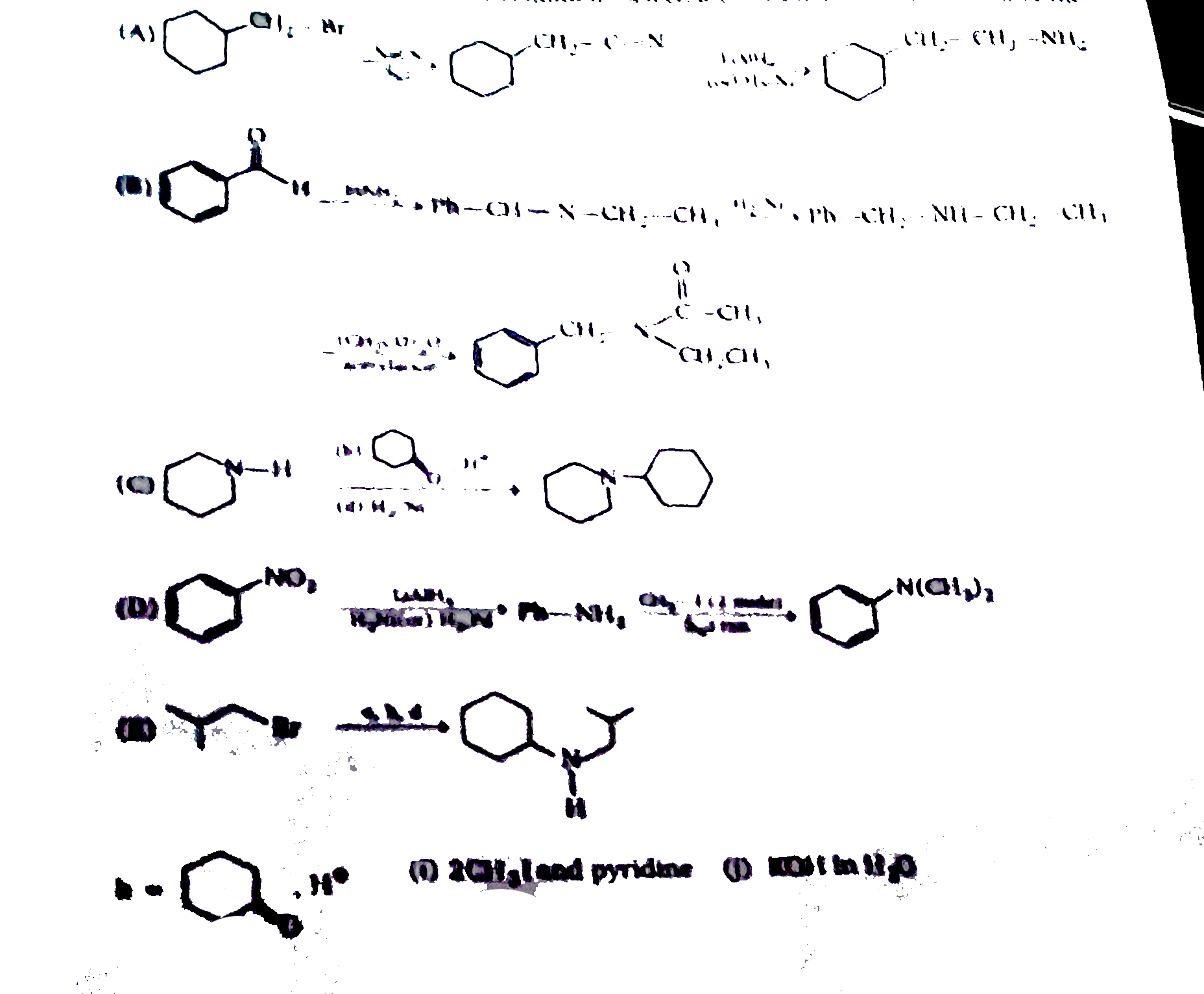
|
|
| 24. |
Fishes die by sewage because |
|
Answer» Of its bad smell |
|
| 25. |
Fishes die in water bodies polluted by sewage due to : |
|
Answer» pathogens |
|
| 26. |
Fisher- Tropschprocessis usedin themanfactureof : |
|
Answer» ETHANE |
|
| 27. |
Fish do not grow in warm water as in cold water, why ? |
| Answer» SOLUTION :The AMOUNT of dissolved oxygen in WARM water is less than in COLD water . | |
| 28. |
Fischer Tropsch process is used for the manufacture of |
|
Answer» SYNTHETIC petrol |
|
| 29. |
First three ionisation energies (in kJ/mol) of three representative elements are given below: {:("Element",IE_(1),IE_(2),IE_(3)),(P,495.8,4582,6910),(Q,737.7,1451,7733),(R,577.5,1817.2745):} then incorrect option is: |
|
Answer» Q: alkaline earth metal |
|
| 31. |
Fischer projection indicates: |
|
Answer» HORIZONTAL SUBSTITUENTS above the plane |
|
| 32. |
First theory to explain the formation of complexes was proposed by |
| Answer» Answer :A | |
| 33. |
First stable compound of inert gas was prepared by: |
|
Answer» RAYLEIGH and Ramsay |
|
| 34. |
First order reaction complete 50% in 16 minutes .How much time require to complete 87.5%? |
| Answer» SOLUTION :165.58 MINUTES | |
| 35. |
First I.P. of Mg is …… than Al |
| Answer» Solution :More because of STABLE CONFIGURATION of MG. | |
| 36. |
First group of basic radicals (cation) involve analysis of presence of Pb^(2+), Ag^(+)and Hg_(2)^(+2)ions in the salt. The chloride salts of these metal ions are sparingly soluble in water and their K_(sp) values are as follows. K_(sp) [PbCl_(2)] = 10^(-12), K_(sp)[AgCl] = 10^(-10), K_(sp)[Hg_(2)Cl_(2)] = 10^(-18) Then sequence of precipitation of these salts on adding dilute HCl to the equimolar mixture of these metal ions will be : |
|
Answer» `PbCl_(2), AgCl` and then `Hg_(2)Cl_(2)` HENCE SEQUENCE of ppt. will follow this order. |
|
| 37. |
First, fourth and fifth periods of the long form the periodic table consist of elements respectively: |
|
Answer» 1.2,8,8 |
|
| 38. |
First chlorinated insecticide is |
|
Answer» DDT |
|
| 39. |
First chemotherapeutic agent is |
|
Answer» analgin |
|
| 40. |
First and second ionisation energies of Mg (g) are 740 and 1450kJ mol ^(-1). Calculate percentage of Mg^(+)(g)and Mg ^(2+) (g),if 1 g of Mg(g) absorbs 50 kJ of energy. |
|
Answer» SOLUTION :Number of MOLES of 1G of `Mg = 1/24 = 0.0417` Energy required to convert mg(g) to `Mg ^(+)(g) =0.0417 x 740 =30.83kJ` Remaining energy `= 50 -30.83 =19.17 kJ` Number of moles of `Mg ^(2+)` formed `= (19.17)/(1450) =0.0132` Thus, remaining `Mg ^(+)` will be = `0.0417 - 0.0132=0.0285` `%Mg ^(+) = (0.0285)/(0.0417) xx 100= 68.35%` `%Mg ^(+2) =100 -68.35 =31. 65%` |
|
| 41. |
First and second electron gain enthalpies of oxygen are -141 and + 702 kJ mol^(-1) How is large number of oxides accounted for ? |
|
Answer» SOLUTION :`O(g)+e^(-)rarrO^(-)(g),DeltaH=-141kJmol^(-1),O^(-)(g)+e^(-)rarrO^(2-)(g),DeltaH=+702kJ mol^(-1)`. Formation of `O^(-)` is EXOTHERMIC and `O^(2-)` is endothermic. However, oxygen is divalent and forms OXIDE with stable `ns^(2)np^(6)` configuration. Further, the lattice ENERGIES of oxides are very HIGH on account of greater electrostatic forces of attraction. |
|
| 42. |
Fire extinguishers contain H_2 SO_4 and |
|
Answer» `CaCO_(3)` |
|
| 43. |
Fire which results from the combustion of alkali metals can be extinguished by |
|
Answer» `C Cl_4` |
|
| 45. |
Fire extinguisher Pyrene is : |
|
Answer» `CO_(2)` |
|
| 46. |
Fire extinguiser contains:- |
|
Answer» `CaCO_(3)` |
|
| 48. |
Finkelstein reaction is used to prepare |
|
Answer» ALKYL chlorides |
|
| 49. |
Finkelstein reaction. |
|
Answer» Solution :Finkelstein reaction : When ALKYL chloride of bromide is treated with SODIUM iodide in the presence of dry acetone, alkyl iodide is obtained. This reaction is knownn as Finkelstein reaction. `{:(R-Cl, + NaI underset("acetone")overset("dry")(rarr),RI,+NaCl),("alkyl chloride",,"alky iodide",):}` `{:(R-Br, + NaI underset("acetone")overset("dry")(rarr),RI,+NaBr),("alkyl bromide",,"alky iodide",):}` In the presence of dry acetone, sodium chloride of sodium bromide gets precipitated. `{:(C_(2)H_(5)Br, + NaI underset("acetone")overset("dry")(rarr),C_(2)H_(5)I,+NaBr),("ethyl bromide",,"ethyl iodide",):}` `{:(C_(2)H_(5)Br, + NaI overset("dry acetone")(rarr),C_(2)H_(5)I,+NaBr),("ethyl chloride",,"ethyl chloride",):}` |
|