

Saved Bookmarks
This section includes 7 InterviewSolutions, each offering curated multiple-choice questions to sharpen your Current Affairs knowledge and support exam preparation. Choose a topic below to get started.
| 1. |
Fluorine oxidizes HSO_4^(-) to …… |
|
Answer» `S_2O_3^(2-)` `2HSO_4^(-) +F_2 to S_2O_8^(2-) + 2HF` `F_2`also oxidises chlorates to perchlorates and `CR^(3+)` SALTS to dichromates |
|
| 2. |
The conjugate base of HSO_(4)^(-) ion is …….. |
|
Answer» `S_(2) O_(3)^(2-)` |
|
| 3. |
Fluorine is usually obtained from: |
|
Answer» Fluorspar |
|
| 4. |
Fluorine is the most reactive of all four common halogens. |
|
Answer» Solution :`F_(2)` is most reactive of all the FOUR common halogens (`F_(2), Cl_(2), Br_(2) and I_(2)`) because of the following reasons : (i) `F_(2)` has the LOWEST bond dissociation enthalpy. (ii) The bonds formed between F and most of the elements are much stronger than those formed by other halogens. (iii) `F_(2)` has the highest electrode potential (+ 2.8+N397 V) of the four halogens, therefore, `F_(2)` is the STRONGEST oxidising AGENT and hence can be reduced more readily as compared to `Cl_(2), Br_(2) and I_(2)`. |
|
| 5. |
Fluorine is stronger oxidizing agent than chlorine in aqueous solution. This can be stributed to the property |
|
Answer» HEAT of DISSOCIATION |
|
| 6. |
Fluorine is stronger oxidising agent. This is attributed to many factors except |
|
Answer» HEAT of DISSOCIATION |
|
| 7. |
Fluorine is prepared by |
|
Answer» OXIDATION of `HF` `KFrarrK^(+)+F^(-)` At cathode: `K^(+)+e^(-)rarrK` `2K+2HFrarr2KF+H_(2)` At anode:`F^(-)rarrF+e^(-)` `F+FrarrF_(2)` |
|
| 8. |
Fluorine is present in a small quantities in |
|
Answer» Kidney |
|
| 9. |
Fluorine is obtained by the interaction of K_2MnF_6 with Lewis acid SbF_5 because of the : |
|
Answer» ACIDOLYSIS of `MnF_4` |
|
| 10. |
Fluorine is more electronegative than chlorine even then p-fluorobenzoic acid is a weaker aci than p-chlorobenzoic acid. Explan. |
Answer» Solution :Since halogens are more ELECTRONEGATIVE than carbon and also POSSESS lone pairs of ELECTRONS, therefore, they exert both -I- and +R- EFFECTS. Now in F, the lone pairs of electrons are present in 2p-orbitals but in Cl, they are present in 3p-orbitals. since 2p-orbitals of F and C are of almost equal size, therefore, the effect is more pronoiunced in p-fluorobenzoic acid than in p-chlorobenzoic acid. 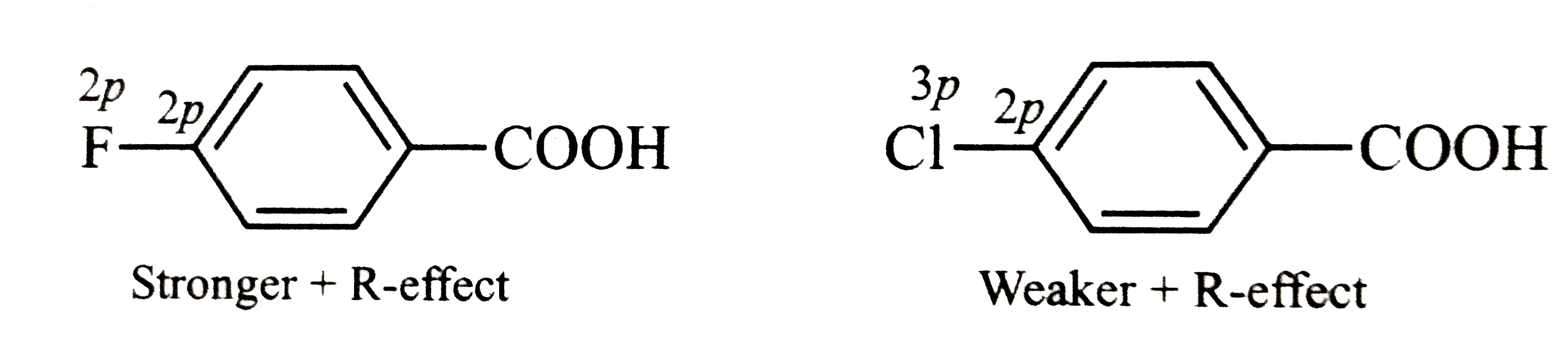 Thus, in p-fluorobenzoic acid, +R-effect outweighs the -I-effect but is p-chlorobenzoic acid, it is the -I- effect which outweighs the +R-effect. consequently, p-fluorobenzoic acid is a WEAKER acid than p-chlorobenzoic acid. |
|
| 11. |
Fluorine is a very strong oxidising agent: |
|
Answer» It has several isotopes |
|
| 12. |
Fluorine is highly reactive due to |
|
Answer» its high electronegativity |
|
| 13. |
Fluorine is highly reactive because of: |
|
Answer» Highest electronegativity |
|
| 14. |
Fluorine is a stronger oxidising agent than chlorine in aqueous solution. This is attributed to many factors except: |
|
Answer» HEAT of dissociation |
|
| 15. |
Fluorine is a stronger oxidising agent than chlorine in aqueous solution . This is attributed to many factors except |
|
Answer» Heat of dissociation |
|
| 16. |
Fluorine is a strong oxidising agent because : |
|
Answer» It has several isotopes |
|
| 17. |
Fluorine is a powerful oxidising agent. Why? |
| Answer» SOLUTION :Fluorine has the smallest SIZE and highest electronegativity among halogens, HENCE it is a powerful oxidising AGENT. | |
| 18. |
Fluorine is a constituent of each of the following except : |
|
Answer» Teflon |
|
| 21. |
Fluorine exhibits only-1 oxidation state whereas other halogens exhibit +1, +3, +5 and +7 oxidation states also. Explain. |
| Answer» Solution :Fluorine is the most electronegative element and cannot exhibit any positive oxidation STATE. Other halogens have d-orbitals and THEREFORE, can expand their octets and show (+1), (+3), (+5) and (+7) oxidation STATES also. | |
| 22. |
Fluorine exhibits only-1 oxidation state, while iodine exhibits oxidation states of -1,+1,+3,+5 and+7. This is due to : |
|
Answer» FLUORINE being a gas |
|
| 23. |
Fluorine exhibits only -1 oxidation state whereas other halogens exhibit +1, +3, +5 and +7 oxidation states. Explain. |
|
Answer» Solution :Fluorine, like other halogens, has seven electrons in the valence shell and thus accepts one more ELECTRON to acquire the stable electronic configuration of the nearest noble gas. Therefore, like other halogens, it also exhibits and oxidation state of -1. Further, since fluorine is the most electronegative element known, it cannot share its unpaired electron with an element more electronegative than itself and hence cannot show an oxidation state of +1 (except in HOF). However, other halogens (Cl, Br, I) can share their respective unpaired electron with more electronegative ELEMENTS such as F and O and hence can show positive oxidation state of +1. Further, fluorine does not have d-orbitals in its valence shell. Therefore, it cannot expand its valence shell and hence does not show higher positive oxidation states of +3, +5 and +7. On the other hand, other halogens have VACANT d-orbitals and, therefore, can expand their octets by EXCITING one, two or even three electrons form ns and np orbitals to nd-orbitals. As a result, 3, 5 and 7 half-filled orbitals are made available for bond formation and hence, Cl, Br and I also show higher positive oxidation states of +3, +5 and +7. Thus, form the above discussion, it follows that fluorine SHOWS only -1 oxidation state while other halogens show positive oxidation states of +1, +3, +5 and +7. |
|
| 24. |
Fluorine exhibits only - 1 oxidation state , whereas other halogens exhibit +1,+3,+5and +7 oxidation states . Explain. |
| Answer» SOLUTION :FLUORINE has no d - orbital for EXCITATION of electrons and it is most electronegative element. Hence it shows OXIDATION STATE of -1 only. | |
| 25. |
Fluorine does not show variable oxidation state due to : |
|
Answer» SMALL size of its atoms |
|
| 26. |
Fluorine does not show positive oxidation states because: |
|
Answer» It is most electronegative element |
|
| 27. |
Fluorine does not exhibit any positive oxidation states. Explain. |
| Answer» Solution :The electron configuration of F is `1s^(2)2s^(2)2p_(x)^(2)2p_(y)^(2)2p_(z)^(1)`. It has ONE unpaired electron. Since F is the most electronegative element KNOWN, THEREFORE, the possibility of sharing its unpaired electron with an element more electronegative than itself does not arise and hence it cannot show an OXIDATION state of +I. Further, F does not have d-orbitals in its valence shell. Therefore, it cannot expand its valence shell and hence does not show higher positive oxidation states of +3, +5 and +7. Thus, in nutshell, F cannot show any positive oxidation states. | |
| 28. |
Fluorine does not show positive oxidation states becaouse |
|
Answer» It is most electronegative element |
|
| 29. |
Explain the following observations : (i) Fluorine does not exhibit any positive oxidation state. (ii) The majority of known noble gas compounds are those of Xenon. (iii) Phosphorus is much more reactive than nitrogen. |
| Answer» Solution :FLUORINE being the most ELECTRONEGATIVE element, does not exhibit any oxidation STATE. | |
| 30. |
Fluorine does not show positive oxidation due to the absence of: |
|
Answer» p-orbitals |
|
| 31. |
Fluorine does not exhibit any positive oxidation state. Why? |
| Answer» Solution :Fluorine is a strongly electronegative ELEMENT. It has no TENDENCY to give electrons. Therefore, it does not EXHIBIT any POSITIVE OXIDATION state. | |
| 32. |
Fluorine can not be obtained from fluoride by chemical methods. Why ? |
|
Answer» Solution :OXIDATION of fluoride is shown as `2F^(-) RARR 2e^(-) + F_(2)` The above oxidation can not be performed using a chemical substance, because FLUORINE itself is the best OXIDANT. |
|
| 33. |
Fluorine, chlroine, bromine and iodine are placed in the same group (17) of the periodic table, because |
|
Answer» They are non-metals |
|
| 34. |
Fluorine cannot be prepared by chemical oxidation of F^(-) ion-explain. |
| Answer» Solution :Fluorine is the smallest halogen with the HIGHEST electronegativity and so `F^(-)` is very stable. Hence, it is impossible for any oxidising AGENT to REMOVE an ELECTRON from `F^(-)` ion and liberate F-atom (or `F_(2)` MOLECULE). Therefore, `F_(2)` cannot be prepared by chemical oxidation of `F^(-)` ion. | |
| 35. |
Fluorine can be prepared by each of the following methods except |
|
Answer» Whytlaw-Gray's METHOD |
|
| 36. |
Fluorine can be prepared by heating NaF and MnO_2 with conc. sulfuric acid. |
| Answer» SOLUTION : Fluorine cannot be PREPARED by heating NAF and `MnO_2`, with conc. SULFURIC acid. | |
| 37. |
Fluorine as compared to air is |
|
Answer» lighter |
|
| 38. |
Fluorine can be freed from HF by passing the mixture through: |
|
Answer» `H_2O` |
|
| 39. |
Fluorine - 18 is a radioactive isotope that decays by positron emission to form oxygen - 18 with a half-life of 100 min. Physicians use ^(18)F for the study of brain by injecting a quantity of fluoro substituted glucose into the blood of a patient The glucose accummulates in the region where the brain is active and needs nourishment. If a sample of glucose that contains .^(18)F is injected into the blood what percentange will remain after 5 hours? |
|
Answer» `12.5` |
|
| 40. |
Fluorine - 18 is a radioactive isotope that decays by positron emission to form oxygen - 18 with a half-life of 100 min. Physicians use ^(18)F for the study of brain by injecting a quantity of fluoro substituted glucose into the blood of a patient The glucose accummulates in the region where the brain is active and needs nourishment. How long does it take for 99.9% decay of .^(18)F ? |
|
Answer» INFINITE TIME |
|
| 41. |
Fluorine absorbs….portion of light and appears yellow: |
|
Answer» Yellow |
|
| 42. |
Fluorine - 18 is a radioactive isotope that decays by positron emission to form oxygen - 18 with a half-life of 100 min. Physicians use ^(18)F for the study of brain by injecting a quantity of fluoro substituted glucose into the blood of a patient The glucose accummulates in the region where the brain is active and needs nourishment. What is the average life for decomposition of 18_(F)? |
| Answer» Answer :D | |
| 43. |
Fluoride ion has higher hydration enthalpy than chloride ion. Give reasons. |
| Answer» Solution :Due to smaller size of F over CI, the electron DENSITY on the F atom is HIGHER than on CI atom. Therefore, F attracts H of `H_(2)O` molecule more strongly than CI does and hence hydratio energy of F is higher than that of CI. | |
| 44. |
Fluoride ion differs from fluorine atom in the number of: |
|
Answer» Protons |
|
| 45. |
Fluorides and iodides of hydrocarbons are best prepared by ______________ method. |
|
Answer» |
|
| 46. |
Fluorescin, a well known dye is obtained by the reactions of |
|
Answer» Phthalic ANHYDRIDE and phenol |
|
| 47. |
Flourine reacts with uranium to produce uranium hexaflouride , UF_(6), as represented by this equation U(s) + 3F_(2)(g) to UF_(6)(g) How many fluorine molecules are required to produce 7.04 mg of uranium hexafluoride , UF_(6) , from an excess of uranium? The molar mass of UF_(6) is 352 gm/mol (N_(A)=6xx10^(23)) |
|
Answer» |
|
| 48. |
Fluorapatite is a mineral of: |
|
Answer» `F_2` |
|
| 49. |
Flouro benzene cannot be prepared by direct flourination since |
|
Answer» `F_2` is HIGHLY REACTIVE |
|
| 50. |
Flourine is prepared by electrolysis. What is the liquid used and electrodes ? |
| Answer» SOLUTION :ELECTROLYTE is FUSED `KHF_2` and ELECTRODES are GRAPHITE. | |