

Saved Bookmarks
This section includes 7 InterviewSolutions, each offering curated multiple-choice questions to sharpen your Current Affairs knowledge and support exam preparation. Choose a topic below to get started.
| 1. |
Find the total number of acidic radical which produce volatile product with dil HCl : (i) SO_(4)^(2-) "" (ii) I^(-) "" (iii) NO_(2)^(-) "" (iv) NO_(3)^(-) (v) SO_(3)^(2-) "" (vi) HCO_(3)^(-) |
|
Answer» |
|
| 2. |
Find the total number of acidic radical which prodce with dil HCl SO_(4)^(2-),I^(-),NO_(2)^(-),SO_(3)^(2-),HCO_(3)^(-) |
|
Answer» |
|
| 3. |
Find the total no. of unpaired e~ present in the following complexes. (i) [Fe(CO)_(5)], (ii) [Cr(CO)_(6)] (iii) [Fe(CN)_(6)]^(4-), (iv) [Mn(CN)_(6)]^(4-) |
|
Answer» `[Mn(CN)_(6)]^(4-)`  Complexes (I, II, III) are diamagnetic HENCE they have no unpaired electrons. |
|
| 4. |
Find the the number of ions having S-S bond from the following S_(2)O_(4)^(-2), S_(2)O_(6)^(-2), S_(2)O_(2)^(-2), S_(2)O_(3)^(-2), S_(2)O_(7)^(-2) |
Answer» 
|
|
| 5. |
Find the total no. of alkynes that on catalytic reduction gives 3-ethyl-4 methylheptane. |
|
Answer» (ii) `CH=C-CH_(2) -underset(CH_(3))underset(|)CH-underset(CH_(2)CH_(3))underset(|)CH-CH-CH_(2)CH_(3)` (iii) `CH_(3)-C=C-underset(CH_(3))underset(|)C-underset(CH_(2)CH_(3))underset(|)CH-CH_(2)CH_(3)` Alkynes (i), (ii) and (iii) PRODUCES 3-ethyl-4-methyl HEPTANE on catalytic reduction. |
|
| 6. |
Find the total charge in coulmb on one gram ion of nitride. |
|
Answer» Solution :Charge on each NITRIDE `(N^(3-))` ION `=3xx1.602xx10^(-19)=4.806xx10^(-19)` coulomb. Number of IONS in a gram ion of nitride `=6.023xx10^(23)` Total charge on ONE gram ion ofnitride `=6.023xx10^(23)xx4.806xx10^(-19)` `=2.895xx10^(5)` coulomb. |
|
| 7. |
Find the the correct answer.(a) Electron affinity of F is less than that of CI (b) Number of lone paris at central chlorien atoms of ClF_(4) is 2 (c)Iodine absorbs radiaton of viloet colour and appear in yellow colur. (d) F_(2) oxidizes all other ionic halies to halogens find the correct answer. |
| Answer» Solution :Conceptual | |
| 8. |
Find the sum of optically active isomers of both [Pt(gly)_(2)Cl_(2)]" and "[Co(en)_(2)Cl_(2)]. |
Answer» 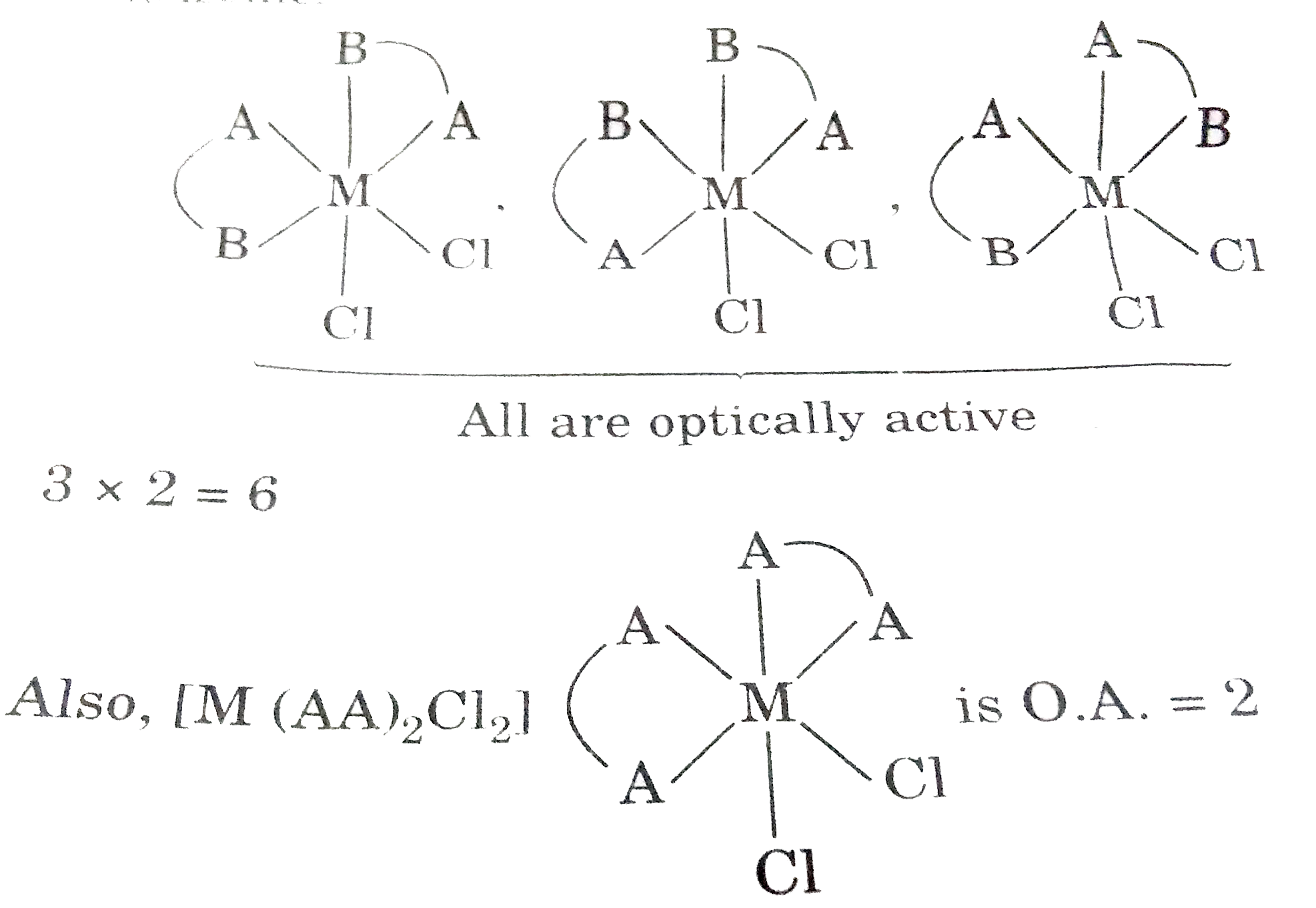 TOTAL =6+2=8. |
|
| 9. |
Find the sum of number of stereoismomers and stereocentres for the given compound. CH_3-CH=CH-undersetunderset(Cl)(|)CH-CH=CH-CH_3 |
|
Answer» So total =7 |
|
| 10. |
Find the sum to the proper number of significant figures : 12.90 + 0.0068 + 0.082 + 1.1 |
|
Answer» 14.0888 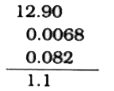 14.088 CORRECT answer upto ONE DECIMAL PLACE (as in 1.1) in 14.1 |
|
| 11. |
Find the sum of all the stereocenters that are present in below compouns : |
|
Answer» 8 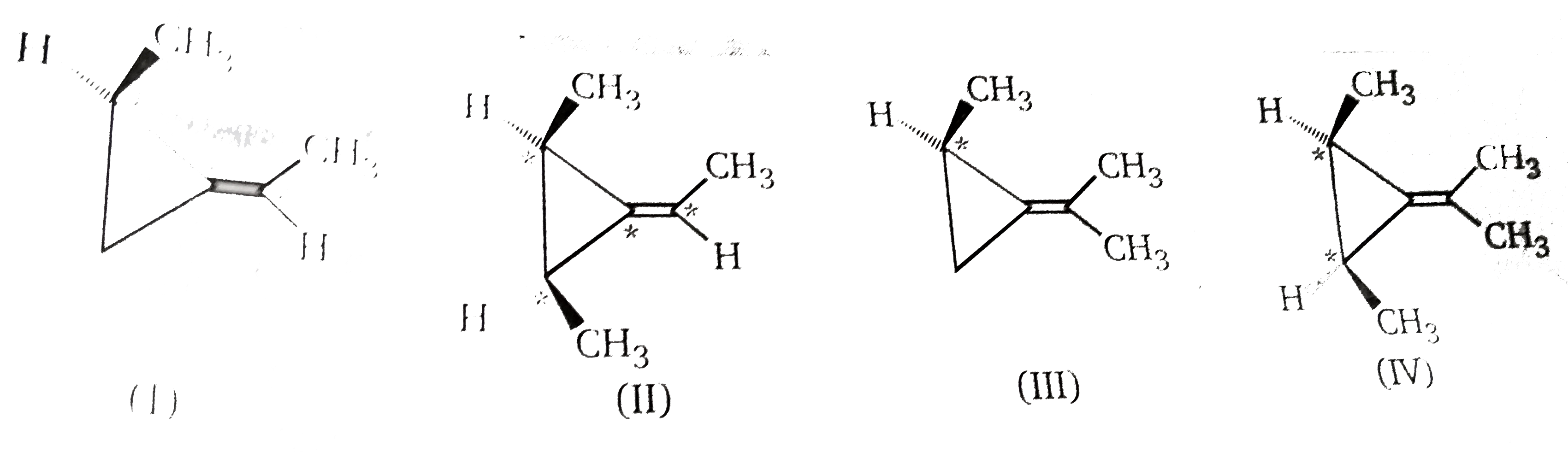 STEREOCENTERS are MARKED with asterisck `(**).` |
|
| 12. |
Find the sum of bond order between same bonded atoms in Q and R compounds. |
|
Answer» |
|
| 13. |
Find the structure formula and molecular weight of 'P'. |
Answer» 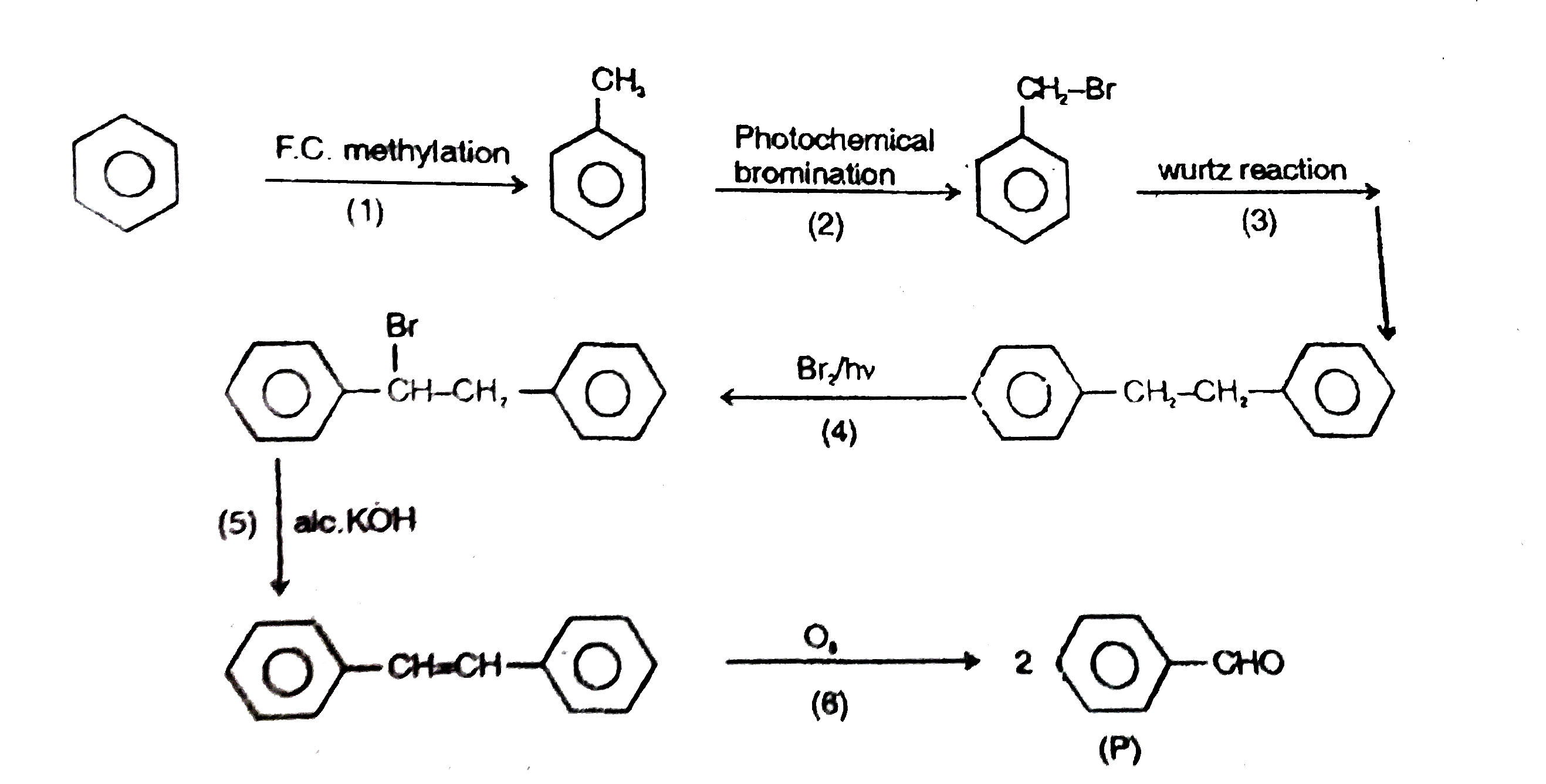
|
|
| 14. |
Find the solution product of Ag_(2)CrO_(4) in water at 298 K if the e.m.f. of the cell Ag//Ag^(+) (saturated Ag_(2)CrO_(4)soln.)||Ag^(+)(0.1M)//Ag" is "0.164V" at "298K. |
|
Answer» Solution :The cell is `Ag|Ag^(+)(c_(1))||Ag^(+)(0.1M)|Ag` `E_(cell)=(0.0591)/(N)"LOG"(c_(2))/(c_(1))` (for concentration cell) `0.164=(0.0591)/(1)"log"(0.1)/(c_(1))` or log`(0.1)/(c_(1))=2.7750` or `0.1//c_(1)=5.957xx10^(2)` o `c_(1)=1.679xx10^(-4)` i.e., `[Ag^(+)]` in saturated `Ag_(2)CrO_(4)` sol.=`1.679xx10^(-4)M` `Ag_(2)CrO_(4)hArr2Ag^(+)+CrO_(4)^(2-)` `[Ag^(+)]=1.679xx10^(-4)M,[CrO_(4)^(2-)]=([Ag^(+)])/(2)=(1.679xx10^(-4))/(2)M` `K_(sp)=[Ag^(+)]^(2)[CrO_(4)^(2-)]=(1.679xx10^(-4))^(2)XX((1.679xx10^(-4))/(2))=2.37xx10^(-12)`. |
|
| 15. |
Find the statement which is not correct with respect to transition metals |
|
Answer» Most transition METALS, should on thermodynamic consideration liberate hydrogen from acids. |
|
| 16. |
Find the standard Gibbs free energy (DeltaG^(@)) for the given reaction : Zn+Cu^(2+)toZn^(2+)+Cu. Give E_("cell")^(@)=1.10V |
|
Answer» SOLUTION :`DeltaG^(@)=-NFE^(@)` CELL n=2 `F=96,500 C` `E_("cell")^(@)=1.10V` `DeltaG^(@)=-2xx96500xx1.10` `=-212300J` `DeltaG^(@)=-212.300kJ` |
|
| 17. |
Find the solubility product of a saturated solution product of a saturated of Ag_(2)CrO_(4) in water at 298K if the emf of the cell. |
|
Answer» |
|
| 18. |
Find the solubility product of a saturated solution of Ag_2 CrO_4in water at 298 K if the emf of the cellAg| Ag^+(satd. Ag_2CrO_4 soln.) || Ag^+ (0.1 M)| Ag is 0.164 V at 298 K. |
| Answer» SOLUTION :`2.4 XX 10^(-12)` | |
| 19. |
Find the size of largest sphere that will fit in octahedral void in an ideal FCC crystal as a function of atomic radius 'r'. The insertion of this sphere into void does not distort the FCC lattice. Calculate the packing fraction of FCC lattice when all the octahedral voids are filled by this sphere. |
|
Answer» Solution : If RADIUS of shpere is r Radius of LARGEST sphere that will fit in the octahedral void is 0.414 r 2[r + 0.414 r] = a 2.828 r = a Volume of spheres `=4XX(4)/(3)PIR^(3)+3xx(4)/(3)pi(0.414r)^(3)` `(16)/(3)pir^(3) [1+0.071]` Volume of unit cell=`a^(3)=(2sqrt(2)r)^(3)=16sqrt(2)r^(3) phi` `((16)/(3)pir^(3)xx1.071)/(16sqrt(2)r^(3))=(pixx1.071)/(3xx1.414)=0.793implies79.3%` |
|
| 20. |
Find the simplest formula of a solid whose cubic unit cell has an 'x' atom at eachcorner, a 'y' atom at each face centre, and a 'z' atom at the body centre. |
|
Answer» `x_2yz` |
|
| 21. |
Find the relative acid strengths in the following groups: (a) phenol, m-chlorophenol, m-nitrophenol, m-cresol (b) phenol, benzoic acid, p-nitrophenol, carbonic acid (c ) phenol, p-chlorophenol, p-nitrophenol, p-cresol (d) phenol, o-nitrophenol, m-nitrophenol, p-nitrophenol (e) phenol, p-chlorophenol, 2,4,6-trichlorophenol, 2,4-dichlorophenol (f) phenol, benzyl alcohol, benzenesulphonic acid, benzoic acid |
Answer» Solution :(a) m-chlorophenol `LT` m-nitrophenol `lt` m-cresol `lt` phenol  Nitro GROUP has + on N, it has a greater electron - withdrawing inductive effect than has Cl. The decreasing order of relative acid strengths Benzoic acid `gt` CARBONIC acid `gt` p-nitrophenol `gt` phenol (b) The decreasing order of relative acid strengths Benzoic acid `gt` carbonic acid `gt` p-nitrophenol `gt` phenol (c ) The resonance effect of `p-NO_(2)` exceeds the inductive effect of `p-Cl. p-CH_(3)` is electron releasing. The decreasing order of relative acid strengths p-nitrophenol `gt` p-chlorophenol `gt` phenol `gt` p-cresol (d) Intramolecular H-bonding makes the o-isomer weaker than the p-isomer. The increasing order of relative acids strengths p-nitrophenol `gt` o - nitrophenol `gt` m - nitrophenol `gt` phenol (e) The decreasing order of relative acids strengths 2,4,6 - trichlorophenol `gt` 2,4 - dischlorophenol `gt` p-chlorophenol `gt` phenol (f) Benzyl alcohol `lt` phenol `lt` benzoic acid `lt` benzene sulphonic acid The decreasing order of relative acid strengths Benzene sulphonic acid `gt` benzoic acid `gt` phenol `gt` benzyl alcohol |
|
| 22. |
Find therelation betweenthe givencompounds . |
|
Answer» ` C-C-C-C-C-C ` `c, d to" chainisomers""" d,e to" POSITION isomers "` Monochlorination `to ` Replace one H by C1 |
|
| 23. |
Find the ratio of the time period of 2^(nd) Bohr orbit of He^(+) and 4^(th) Bohr orbit of Li^(2+) |
|
Answer» |
|
| 24. |
Find the ratio of the number of atoms present in 16 g of O_2 and 32 g of O_3. |
| Answer» Answer :D | |
| 25. |
Find the ratio of the mass needed to generate 1 muCiof ""_88^236Ra (t_(1//2) = 1622 yr) to that for 1 muCiof ""_86^232Rn (t_(1//2) = 3.825 d). |
| Answer» SOLUTION :`1.58 XX 10^5` | |
| 26. |
Find the ratio of electrochemical equivalents of silver and aluminium . |
|
Answer» |
|
| 27. |
Find the rate of law of the given reaction 2NO+2H_2rarrN_2+2H_2O |
| Answer» SOLUTION :`dx/dt=[NO]^2[H_2]^2` | |
| 28. |
Find the rate of reactionof the given reaction 2NO+2H_2rarrN_2+2H_2O |
| Answer» SOLUTION :`dx/dt=[NO]^2[H_2]^2` | |
| 29. |
Find the rate law of the reaction 2H+ Ar to H_2 + Arwhich is elementary. |
| Answer» SOLUTION :`R = K[H^2][AR]` | |
| 30. |
Find the product of uncertainty in position and velocity for an electron of mass 9.10 xx 10^(-31) kg. (h= 6.62 xx 10^(-34) J.s, " i.e., " kg m^(2) s^(-1)) |
|
Answer» <P> Solution :We have, `Delta x. Delta p= (H)/(4pi)``Delta x.(m xx Delta v) = (h)/(4pi)` or `Deltax. Detla v= (h)/(4pi m)` `=(6.62 xx 10^(-34) (kg.m^(2).s^(-1)))/(4 xx 3.14 xx 9.10 xx 10^(-31) (kg))` `=5.8 xx 10^(-5) m^(2) s^(-1)` |
|
| 31. |
Find the product for CH_(3)CH_(2)-O-CH_(2)-CH_(2)-O-CH_(2)-C_(6)H_(5)+HI(exess) |
|
Answer» `HO-CH_(2)CH_(2)OH, C_(6)H_(5)CH_(2)-I, CH_(3)CH_(2)-I` So formation of produce is controlled by the stablity of the carbocation resulting in the cleavage of C-O bond in protonated ether. Thus the PRODUCT for GIVEN equation are `C_(6)H_(5)CH_(2)I, CH_(3)CH_(2)I, HOCH_(2)-CH_(2)OH` |
|
| 32. |
Find the PH of saturated solution of Mg(OH)_2 [K_p of Mg(OH_2)=8.9xx 10^(-12)] |
|
Answer» 10.4168 |
|
| 33. |
Find the pH of a buffer solution containing 0.20 mole per litre sodium acetate and 0.18 mole per litre acetic acid, K_a for acetic acid is 1.8 times 10^-5. |
|
Answer» Solution :`ph=Pk_a+LOG([salt])/([acid])` GIVEN that `K_a=1.8 TIMES 10^-5` `THEREFORE pK_a=-log(1.8 times 10^-5)` `=5-log 1.8` `=5-0.26=4.74` `therefore pH=4.74+log (0.20)/(0.18)` `=4.74+log 10/9` `=4.74 +log 10/9` `4.74+1-0.95` `=5.74-0.95` `=4.79` |
|
| 34. |
Find the pH of a 0.01 M solution of acetic acid having degree of dissociation 12.5%. |
|
Answer» 4.509 |
|
| 35. |
Find the pH of a buffer solution containing 0.20 mole per litre CH_(3)COONa and 0.15 mole per litre CH_(3)COOH, K_(a) for acetic acid is 1.8xx10^(-5) |
|
Answer» Solution :`K_(a)=1.8xx10^(-5)` `pK_(a)=-log(1.8xx10^(-5))=4.7447` `pH=pK_(a)+log""(["Salt"])/(["ACID"])` `……….."... HENDERSON - Hasselbalch EQUATION"` `=4.7447+log""(0.20)/(0.15)` `pH=4.7447+log""(4)/(3)` `=4.7447+0.6021-0.4771=4.8697` |
|
| 36. |
Find the pH at equivalence points when a soluiton of 0.1M acetic acid is titrated with a solution of 0.3M NaOH K_(a) for acetic acid =7.5xx10^(-6) |
|
Answer» Solution :AT equivalence point `CH_(3)COONa` will be formed. `M_("base")V_("base")=M_("acid")V_("acid")rArr V_("acid")=(0.3)/(0.1)V_("base")=3V_("base")` `[CH_(3)COONa]_("Equivalent point")=("Total moles")/("Total volume")=(0.3xxV_("base"))/(V_("acid")+V_("base"))=(0.3V_("base"))/(4V_("base"))=0.075` `[OH^(-)]=sqrt((K_(W))/(K_(a))XXC)=sqrt((10^(-14))/(7.5xx10^(-6))xx0.075)xx10^(-5)rArrpOH=5 :.pH=9` |
|
| 37. |
Find the percentage of nitrogen in an organic compound analysed by Kjeldahl method. 1.61g of the compound produced NH_(3) which was absorbed in 250 mL of (N)/(2) H_(2)SO_(4) solution. The remaining acid was then diluted to one litre, 25mL of which required 25.5mL of N/10 NaOH for exact neutralization. |
|
Answer» |
|
| 38. |
Find the percentage decrese in vapour pressure with respectt to solution when saturated solution of Ag_(3)PO_(4) is prepared. Given : K_(sp) of Ag_(3)PO_(4)=((3)/(16))^(3)xx10^(-12) Report your answer by divideng 10^(-4) |
|
Answer» |
|
| 39. |
Find the percentage composition of iron and magnesium 5.0g which can dissolved in acid, gave 2.81 litre of H_(2) at NTP. |
|
Answer» |
|
| 40. |
Find the percentage composition of potassium chlorate (KClO_(3)) |
|
Answer» `%" of K"=(39)/(122.5)XX100,%" of Cl"=(35.5)/(122.5)xx100, %" of O"=(48)/(122.5)xx100` |
|
| 41. |
Find the oxidation states of halogens in the following : (a) Cl_2O (b) KBrO_3 (c) NaClO_4 (d) ClO_2 |
|
Answer» Solution :As all the molecules are neutral, sum of the oxidation numbers in each molecule is zero. Assuming the value x for the unknown element, we get <BR> (a) `ul(Cl_2)O` `2x-2 =0` `2x=2` `x= +1` (b) `K ul(Br)O_3` `+1 + x -6 =0` ` x= +5` (c) `NA ul(Cl)O_4` `1 + x -8 =0` `x=+7` (d) `ul(Cl)O_2` `x-4=0` `x=+4` |
|
| 42. |
Find the pair of compounds in which both show geometrical as well as optical isomerism : |
|
Answer» `M(A A)_(3)" and "M(AB)_(3)` |
|
| 43. |
Find the oxidation state of the halogens in the following compounds. (a) Cl_(2)O (b) ClO_(2) (c) KBrO_(3) |
|
Answer» SOLUTION :(a) `Cl_(2)O,+1` (b) `ClO_(2),+4` (c) `KBrO_(3),+5` |
|
| 44. |
Find the oxidation state of Fe in Fe_(4)[Fe(CN)_(6)]_(3). |
|
Answer» |
|
| 45. |
Find the oxidation number of sulfur in peroxomono-sulfuric acid. |
|
Answer» Solution :Peroxomonosulfuric acid `(H_2SO_5)` is REPRESENTED as : `H -O-O - overset(O)overset(||)underset(O)underset(||)S-O-H` In this structure, S is attached to TWO oxygen atoms by double bonds (O.N. = 2), ONE - OH group (O.N. = -1) and one -0-0-H group (O.N. =-1). Therefore, oxidation number of S is 1(-1)+2 (-2) +1 (-1)=0 or X = + 6. |
|
| 46. |
Find the overall order for the following reactions: i) A + 3B to C, rate = k[A]^(1//2)[B]^(3//2) ii) 2H_(2)(g) + 2NO (g) to 2H_(2)O (g) + N_(2)(g), rate =k[H_(2)][NO]^(2) What are the dimensions of rate constant in each case? |
|
Answer» ORDER of reaction =`1//2 + 3//2=2` Rate `=k[H_(2)][NO]^(2)` Order of reaction = `1+1=3` |
|
| 47. |
Find the order of the reaction in which a gas is formed at the surface of tungsten due to adsorption. |
|
Answer» |
|
| 48. |
Find the osmotic pressure M/20 solution of urea at 27^(@)C (S = 0.0821 lit atm K^(-1) mol^(-1)) |
|
Answer» `T=27^(@)C=27+273=300K` `"Osmotic pressure "(pi)=CRT` `=(0.05"mol L"^(-1))XX(0.0821" L atm K"^(-1)mol^(-1))xx(300K)=1.2315 atm.` |
|
| 49. |
Find the odd one out . Soda water, Butter, Starch solution, Cheese, Cream. |
| Answer» Solution :STARCH solution. It is a SUSPENSION whereas others are COLLOIDS. | |