

Saved Bookmarks
This section includes 7 InterviewSolutions, each offering curated multiple-choice questions to sharpen your Current Affairs knowledge and support exam preparation. Choose a topic below to get started.
| 1. |
Explain with an example how impurity defect develops in NaCl crystal. |
| Answer» Solution :`SrCl_(2)` is added to molten `NaCl` and crystallised. Some `Na^(+)` sites will be OCCUPIED by `Sr^(2+)`. Each `Sr^(2+)` REPLACES two `Na^(+)` ions and THUS cationic vacancy is PRODUCED for EVERY `Sr^(2+)` ion added. | |
| 2. |
Explain the giving reasons : Cause of Bromian movement. |
| Answer» Solution :Brownian movement is due to bombardment of colloidal particles by the MOLECULES of the dispersion medium with UNEQUAL forces from different direction. As a RESULT, there is a resultant force acting on it causing the particle to MOVE. | |
| 3. |
Explain with a suitable diagram and appropriate examples why some non-ideal solutions show postive deviation from ideal behaviour. |
|
Answer» |
|
| 4. |
Explain with an example, Clemmensen's reduction. |
|
Answer» SOLUTION :When KETONE is TREATED with Zn-Hg/Conc. HCl a hydrocarbon is obtained. `CH_(3)COCH_(3)+4[H]UNDERSET(HCl)overset(Zn-Hg)(to)CH_(3)-CH_(2)-CH_(3)+H_(2)O` |
|
| 5. |
Explain the given basicity order in aqueous medium: (CH_(3))_(2)overset(* *)(N)H(2^(@))gtCH_(3)overset(* *)(N)H_(2)(1^(@))gt(CH_(3))_(3)overset(* * )(N)(3^(@)) |
|
Answer» Solution :Basic strenght of amines in aqueous MEDIUM depends on TWO factors: (1) Increased electron density on the N + atom MAKES an amine moer basic. So considering the +I effect of differect number of alkyl groups on the N - atom, the basic strenght of amines should follow the order:  (2) Again, basicity of an amine increases as stabilisationof the conjugate acid, through solvation, increases. The conjugate acid of primary amine attains maximum stability through intermolecular H - bond formation with three molecules of water, while the conjugate base of teriary amine attains minimum stablisation through such H - bond formation with only one molecule of water.  Thus on the BASIS of stability of the conjugate acids, the basic strenght of amins should follow the order: `CH_(3)-NH_(2)gt(CH_(3))_(2)NHgt(CH_(3))_(3)N` As a consequence of these two opposite orders of basicty practically we FIND the given sequence of basicity in aqueous medium : `(CH_(3))_(2)overset(* *)(N)H(2^(@))gtCH_(3)overset(* *)(N)H_(2)gt(CH_(3))_(3)overset(* *)(N)H(3^(@))` |
|
| 6. |
Explain Williamson's reaction. Write the general equation. |
|
Answer» Solution :Alkyl halide is allowed to react with sodium alkoxide to GET ETHER. `R - X + R - ONa RIGHTARROW ROR + NaX` |
|
| 7. |
Explain the geometry and magnetic nature of the following complex ions on the basis nof valence bond theory(Cr(NH_(3))_(6)]^(3+)(ii) [Fe(CN)_(6))]^(4) (iii) [FeF_(5)]^(3-)(iv) [MnCl_(4))]^(2) (V) [Mncl(4)]^(2-)(vi) [Cu(NH_(3)_(4)]^(2) |
|
Answer» Solution :Octahedral, paramagnetic (ii) octahedral, DIAMAGNETIC (III) octahedral, paramagnetic (iv) tetrahedral, paramagnetic (V) square PLANAR, diamagnetic (vi) square planar, paramagnetic |
|
| 8. |
Explain why Zn shown only +2 oxidation state. |
| Answer» SOLUTION :E.C. of Zn `Zn = [Ar]^(18) 3d^(10) 4s^(2)` . After loss of `2e^(-)` of FORM `Zn^(2+)` , it acquires stable electronic configuration of `3d^(10)` ( fully -filled). Hence, it shows oxidation STATE of `+2` only. | |
| 9. |
Explain why Zn on reaction with dil. H_(2)SO_(4) liberated hydrogen, whereas copper cannot? |
|
Answer» Solution :(i) Any metal above hydrogen in the electrochemical SERIES is a weaker reducing agent than hydrogen and will not CONVERT `H^(+) " to " H_(2)`. (ii) This EXPLAINS why Zn lying below hydrogen reacts with DIL. `H_(2)SO_(4)` to liberate `H_(2)`, while Cu lying above hydrogen does not react. `Zn+2H^(+)(dil.H_(2)SO_(4)) rarr Zn^(2+)+H_(2) uarr Cu+2H^(+)(dil.H_(2)SO_(4))Cu^(2+)+H_(2)` |
|
| 10. |
Explain why vinylidene chloride (CH_2=C CI_2) does not polymerise is isotactic , syndiotactic and atactic forms. |
| Answer» Solution :Poly(ethylidene CHLORIDE) does not have chiral carbon atoms , therefore , this POLYMER does not have ISOTACTIC, syndiotactic or atactic FORMS for DEFINITIONS of isotactic , syndiotactic and atactic. | |
| 11. |
Explain the function of permutit in the softening of hard water. |
|
Answer» Solution :(i) Permutit is EMPLOYED for softening of hard water. It adsorbs `Ca^(2+) and Mg^(2+)`ions in its surface, there is an ION exchange as shown below it occurs on the surface. `underset("Permutit")(Na_2Al_2Si_4O_(12))+CaCl_2 to CaAl_2 Si_4O_(12) + 2NaCl` (ii) EXHAUSTED permutit is GENERATED by adding a solution of commonsalt. `underset("Permutit")(CaAl_2Si_4O_(12))+ 2NaCl to Na_2Al_2Si_4O_(12)+CaCl_2` |
|
| 12. |
Explain why vinyl chloride is unreactive in nucleophillic substitution reaction? |
Answer» Solution :VINYL chloride is unreactive in nucleophillic substitution REACTION because of DOUBLE bond CHARACTER between C–Cl bond which is difficult to BREAK 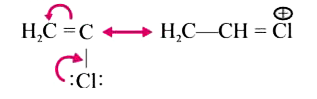
|
|
| 13. |
Explain why thionyl chloride method is preferred for preparation alkyl chlorides from alcohols? |
| Answer» SOLUTION :Because the by products of the REACTION, i.e., `SO_(2)` and HCl being gases escape into the atmosphere leaving BEHIND ALKYL chlorides in almost pure state. | |
| 14. |
Explain the function of H_(2)-O_(2) fuel cell. |
|
Answer» Solution :Fuel cell : (i) The galvanic cell in which the energy of combustion of fuels is directly converted into electrical energy is called the fuel cell. (ii) It requires a continuous supply of reactant to keep functioning. (iii) The general representation of a fuel cell is follows Fuel | Electrode | Electrolyte | Electrode | Oxidant (iv) Let us understand the function of fuel cell by considering hydrogen - oxygen fuel cell. (v) In this case, hydrogen act as a fuel and oxygen as an oxidant and the electrolyte is aqueous KOH maintained at `200^(@)C` and 20 - 40 atm. (vi) Porous graphite electrode containing NI and NIO serves as the inert electrodes. (vii) Hydrogen and oxygen gases are bubbled through the anode and cathode, respectively. Oxidation OCCURS at the anode: `2H_(2(g))+4OH_((AQ))^(-) rarr 4H_(2)O(L)+4e^(-)` Reduction occurs at the cathode `O_(2(g))+2H_(2)O(l)+4e^(-) rarr 4OH_((aq))^(-)` The overall reaction is `2H_(2(g))+O_(2(g)) rarr 2H_(2)O(l)` |
|
| 15. |
Explain why transition elements have many irregularities in their electronic configuration. |
| Answer» Solution :In the transition elements, the `( n-1)` d subshell and NS subshell have verysmall difference in ENERGY incoming electron may enter into ns or ( n-1) d subshell . HENCE, they SHOW IRREGULARITIES in their electrons configurations. | |
| 16. |
Explain why the stability of oxoacids of chlorine increases in the order given below : HClO lt HClO_2 lt HClO_3 lt HClO_4 |
|
Answer» Solution :Oxygen is more electronegative than CHLORINE. Therefore, dispersal of negative charge PRESENT on chlorine increases from `ClO^(-)` to `ClO_4^(-)` ion because the number of oxygen atoms attached to chlorine is increasing . Therefore stability of ions will INCREASE in the order. `ClO^(-) LT ClO_2^(-) lt ClO_3^(-) lt ClO_4^(-)` . Hence the acidic STRENGTH of the acids will increase in the same order. |
|
| 17. |
Explain the functions of lead accumulator. |
|
Answer» |
|
| 18. |
Explain why the stability of oxoacids of chlorine increases in the order given below :HClO lt HClO_(2) lt HClO_(3) lt HClO_(4) |
|
Answer» Solution :The ACIDIC strength of OXOACIDS depends on : (i) Electronegativity of CENTRAL atom (II) Presence of electronegative atoms AROUND the central atom (iii) Size of central atom |
|
| 19. |
Explain the function of a salt bridge in an electrochemical cell. |
|
Answer» Solution :The main functions of the salt bridge are (i) To COMPLETE the ELECTRICAL circuit by the allowing only ions to flow from one solution to other without mixing the two solutions. (ii) To MAINTAIN electrical NEUTRALITY of the solution in the two half cells. |
|
| 20. |
Explain why the rate of the following S_(N)2 reaction increases on increasing the polarity of the solvent: R_(3)N:+R-XrarrR_(3)overset(o+)(N)-RX^(Theta). |
Answer» Solution :Since the reactants are neutral, therefore, the transition state of this reaction is relatively more POLAR than the reactants.  When the polarity of the solvent increases, the transition state become relatively more STABLE as compared to the reactants. As a RESULT, the activation energy of the reaction `(E_a)` decreases and the reaction RATE increases. |
|
| 22. |
Explain why the reaction -rate does not proceed at a uniform rate during the course of a reaction. |
| Answer» Solution :Except for zero order reactions, the rates of most chemical reactions very directly with CONCENTRATION of the reactants Since the concentration of a REACTANT during the COURSE of the reaction decreases with time , the reaction -rate ALSO decreases. Therefore, a reaction cannot proceed at a uniform speed. | |
| 23. |
Explain the formation of water with copper catalyst by intermediate compound formation theory. |
|
Answer» Solution :(i) Formation of WATER due to the reaction of `H_(2) and O_(2)` in the presence of Cu can be given as (ii) `underset("Catalyst")(2CU) + underset("Reactant")(1/2O_2 ) to underset("INTERMEDIATE compound")(Cu_2O)` (iii) `Cu_2O + underset("Reactant")(H_2) to underset("Product")(H_2O) + underset("Catalyst")(2Cu)` |
|
| 24. |
Explain why the path of light becomes visible when it is passed through colloidal solution. |
| Answer» | |
| 25. |
Explain why the -OH group in phenols more strongly held as compared to -OH group in alcohols? |
| Answer» Solution :`to` In phenol, the oxygen of the -OH group is BONDED to `sp^(2)` carbon of the benzene ring. Due to resonance, the C-O bond acquires the partial double bond character and hence the bond between the ring and -OH group becomes shorter and stronger than C-OH bond in ALCOHOL. | |
| 26. |
Explain why the nucleophilic substitution reactions are not very common in phenol ? |
| Answer» Solution :`to` In phenols, the oxygen atom of -OH group delocalise the lone pair of ELECTRONS over the benzene ring and as a RESULT, the electron density on the benzene ring increases which MAKES difficult for the nucleophiles to attack DUE to repulsions. | |
| 27. |
Expain the formation of the two products in the following reaction : CH_3 CH=CHCH_2 Cl+H_2 O toCH_3 -CH =CHCH_2 OH+CH_3 CH (OH) CH=CH_2 |
|
Answer» Solution :Hydrolysis of 1-chloro-2-butene takes place through `S_(N^(1))` mechanism involving the FORMATION of allylic carbocation as INTERMEDIATE which is stabilised by RESONANCE. `CH_(3)-CH= CH-CH_(2)Cl overset(OH^(-))rarr [CH_(3)-CH=CH-overset(+)(C )H_(2) harr CH_(3) - overset(+)(C )H- CH= CH_(2)]` The positive charge is equally DISTRIBUTED over C-1 and C-3. THe nucleophile can attack on C-1 or C-3 resulting in the formation of two products. 
|
|
| 28. |
Explain why the given names in the following are wrong Give a correct name in each case: (a) 1-methylpentane (b) 2-ethylbutane (c) 2,3-dichloropropane (d) 1,1,,3-trimethylpropane (e) 3-bromo-2-methylpropane (f) i-chloro-1-methylpropan-2-ol (g) 3-propyl-4-methylbutan-1-oic acid (h) 4,4-dimethylbut-2-en-1ol (i) 1,1,2,2-tetramethylethane (j) 1,4-dihydroxybut -2-yne (k)2-keto-pentan-5-oic acid (l) 1-aminobutan-3-one. |
|
Answer» (b) The longest cahin consists of five carbon atoms. The correct name is 3-methylpentane. (c) The NUMBERING has been DONE wrongly. The correct name is 1,2-dichloroprogane. (d) The length chain consists of five carbon atoms. the correct name is 2-methylpentane. (e) The numbering has been done wrongly the correct name is 1-bromo-2-methylpropane. (f) The longest chain has not been selected properly the correct name is 3-chlorobutan-2-ol. (G) The longest chain consists of 6-carbon atoms. the correct name is 3-ethylhexanoic acid (h) The longest chain consits of five carbon atoms. the correct name is 4-methylpent-2-en-1-ol (j) The longest chain consists of four carbon atoms. the correct name is 2,3-dimethylbutane. (j) -OH is a primary FUNCTIONAL group and not substituated. the c orrect name is but -2-yne-1,4-diol. (k) Carboxylic group is a principal functional group and numbering should be done from this end. the correct name of the compound is 4-0ketopentanoic acid. (l) Keto is a principal functional group and lowestnumber should be given to it. the correct name of the compound is 4-aminobutan-2-one. |
|
| 29. |
Explain why the members of the actinoid series exhibit a large number of oxidation states than the corresponding members of the lanthanoid series. |
| Answer» SOLUTION :Duue to the comparable eneries of 5f, 6d and 7s levels MEMBERS of actinoid series exhibit a large NUMBER of OXIDATION states. | |
| 30. |
Explain the formation of delta. |
| Answer» SOLUTION :(i) RIVER water is colloidal solution of clay. Sea water contains a number of electrolytes. (ii) When river water meets the sea water, the electrolytes present in sea water COAGULATE the colloidal solution of clay which get deposited with the formation of delta. | |
| 31. |
Explain why the lower members of carbonyl compounds are soluble in water ? |
| Answer» Solution :LOWER members of CARBONYL compounds are SOLUBLE in water due to H-bonding but solubility DECREASES with increase in MOLECULAR mass. | |
| 32. |
Explain why the following general reaction takes place readily in the presence of small amount of NaI. R-Cl+R'-I overset(Na) rarr ROR'+NaCl. |
|
Answer» Solution :Although `R'O^(-)` is a GOOD NUCLEOPHILE, the given `S_(N)2` reaction occurs at a slower rate as `Cl^(Theta)` is not a good leaving group. In presence of `I^(Theta)`, the reaction actually takes place in two steps: ` RCI+I^(color(red)Theta)underset(("fast"))OVERSET(S_N2)(rarr)RI+CLl^(color(red)Theta), RI+R'O^(color(red)Theta)underset(("fast"))overset(S_(N)2)(rarr)ROR'+I^(color(red)Theta)` `I^(color (red) Theta)` is a stronger nucleouphile (more polarisable) than `R'O^(Theta)`. It readily displaces `Cl^(Theta)` from RCl. `I^(Theta)` is ALSO a good leaving group (weaker base and weaker C-I bond). So, it is readily displaced by `RO^(Theta)` and once again reacts in the first step. Thus, in presence of `I^(Theta)` as a catalyst the overall reaction occurs readily (THis is an EXAMPLE of a nucleophillic catalysis). |
|
| 33. |
Explain the formation of coloured ions by lanthanoids |
|
Answer» Solution :Many TRIVALENT ions `(M^(3+))` in lanthanoids show colour in both SOLID as well as in aqueous state. The formation of colour can be explained by `f- f` transition. However, absorption bands are narrow. The tripositive lanthanoid ion having `4f^(n)` configuration has same colour as tripositive lanthanoid ion having `4f^(14-n)` configuration. Ex: `ND^(3+) (4f^(3)) and Er^(3+ )4f^(11))` both show red colour. `LA^(3+), GD^(3+) and Lu^(3+)` are colourless because of `f^(0), f^(7) and f^(14)` configurations respectively. |
|
| 34. |
Explain why the ethers and alcohols of comparable molecular mass have different boiling points ? |
| Answer» Solution :`to` Alcohols FORM intermolecular H-bond due to presence of polar -OH group WHEREAS ETHER molecule does not form H-bond. Thus, the boiling points of ethers are lower than alcohols. | |
| 35. |
Explain why the electron withdrawing groups such as -NO_(2) show its effect only at o - position and p - position and not at m - positions. |
Answer» Solution :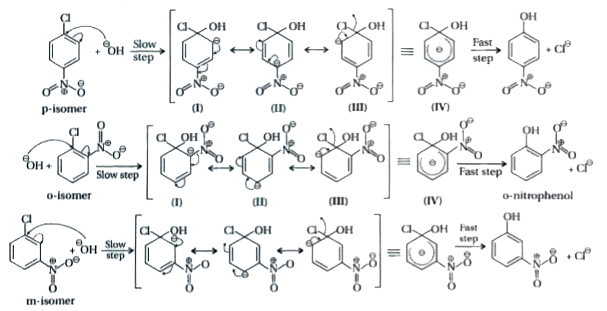 As shown in figure, the presence `- NO_(2)` electron withdrawing GROUP at ortho - and para - positions withdraws the electron density from the benzene ring and thus facilitates the attack of the nucleophile on haloarene. The carbanion thus FORMED is stabilised through resonance. At ortho - and para - positions with respect to the halogen substituent, the negative charge appeared is stabilised by `- NO_(2)`, whereas in CASE of meta - nitrobenzene, NONE of the resonating structures bear the negative charge on CARBON bearing the `- NO_(2)` group. Therefore, the presence of nitro group at metaposition does not stabilise the negative charge and no effect on reactivity is observed by the presence of `-NO_(2)` group at meta - position. |
|
| 36. |
Explain the formation H_(2) molecule on the basis of Valence Bond theory. |
|
Answer» SOLUTION :This theory explains the shapes of covalent molecules as well as the directions of the bonds in them. Important postulates : 1) Covalent bond is formed by the OVERLAP of two ATOMIC orbitals. 2) The overlapping orbitals contain unpaired electrons with opposite spins. 3) Each of the bonded atoms retains its own atomic orbitals. But the electron pair in the overlapping orbitals is shared by both the atoms. 4) The greater the extent of overlap of orbitals, the stronger is the covalent bond formed. 5) Except 's' orbitals, the remaining all atomic orbitals are directional. So the bonds formed due to their overlap are ALSO directional. This determines the shape of the molecule. 6) When the atomic orbitals of the two atoms overlap, then electron density increases on their internuclear axis. This binds the two atoms, firmly. Thus the molecule is stabilised. Ex : Formation of Hydrogen molecule (s - s overlap) : Hydrogen molecule is formed due to overlap of 1 s - orbitals of two hydrogen atoms. The bond formed between the two H - atoms is called `sigma_(s-s)` bond and the type of overlapping is s - s overlap. 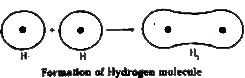
|
|
| 37. |
Explain why the chain initiating step in thermal chlorination of CH_(4) is Cl_(2)overset(Delta)rarroverset(.)(C)l and not CH_(4)overset(Delta)rarroverset(.)(C)H_(3)+overset(.)H |
Answer» Solution :Because `E_("ACT")" of "Cl_(2)` is less than `E_("act")" of "CH_(4)` 
|
|
| 38. |
Explain why :The dipole moment of chlorobenzene is lower than that of cyclohexyl chloride ? |
| Answer» Solution :In CHLOROBENZENE, the electron withdrawing inductive EFFECT of - Cl is oppsosed by electron releasing resonance effect. THEREFORE it has relatively lower DIPOLE moment. In case of cyclohexyl Chloride there is only electron withdrawing inductive effect of Cl atom due to which it has higher dipole moment. | |
| 39. |
Why are the compound of transition elements coloured? |
|
Answer» Solution :(i) Transition metal ions absorb a particular electromagnetic RADIATION of white light and its complementary COLOUR is transmitted. Example : `Cu^(2+)` ions absorb red colour and transmit blue colour. (ii) The unpaired ELECTRONS present in the d-orbitals of transition metal ions undergo d-d transition by absorbing the ENERGY of CERTAIN electromagnetic radiation. Example : `Cu^(2+)`ion in water absorb red coloured radiation for d-d transitions of electrons. Hence it transmits blue colour. |
|
| 40. |
Explain why the carbonyl oxygen atom of a carboxylic acid is more basic than hydroxyl oxygen. |
Answer» Solution :Protonation at the hydroxyl OXYGEN of a carboxylic acid GIVES structure (I) but protonation at the carbonyl oxygen gives structure (II) which can be regarded as a resonance HYBRID of two structure (II and III). Thus, structure (II) is more stable than structure (I) and HENCE carbonyl oxygen atom of a carboxylic acid is more basic than hydroxyl oxygen. 
|
|
| 41. |
Explain why the amino group in aniline acts as a powerful activator and o- and p- director towards electrophilic substitution reaction. |
|
Answer» <P> Solution :`-NH_(2)` group has a LONE PAIR of electrons. It is delocalised by resonance with benzene ring creating negative charges at o- and p- positions in RESONATING structures. It increases electron density at o- and p- and that is why electrophilic substitution takes place at o- and p- positions. |
|
| 42. |
Explain the folowing : (i) Electrodialysis (ii) Phase of a colloidal solution. |
| Answer» | |
| 43. |
Explain why sometimes foaming is seen in river water near the place where sewage water is poured after treatment. |
| Answer» SOLUTION :DETERGENTS REMAIN unaffected by treatment and THEREFORE foaming is observed. | |
| 44. |
Explain the followinng in one or two sentences (i) Displacement of cyanide and amide ion is never observed in nucleophilic substitution reaction. (ii) RCl is hydrolysed to ROH slowly but the reaction is rapid if a catalytic amount of KI is added to the reaction mixture. |
|
Answer» Solution :(i) HCN `(pK_(a)10) and NH_(3)(pK_(a)11.25)` are very weak acids. Therefore, their conjugate bases, i.e., `CN^(-)` ion and `NH_(2)^(-)` are very strong bases. Since strong bases are bad leaving groups, their DISPLACEMENT in nucleophilic substitution reactions is never observed. (ii) Iodide ion is a powerful nucleophile and hence reacts rapidly with RCl to form RI.  Further because `I^(-)` ion is a better leaving group than `Cl^(-)` ion, therefore, RI is more rapidly hydrolysed than RCl to form ROH,  . . The `I^(-)` ion thus regenerated recycles in the above reaction thereby explaining its catalytic effect. |
|
| 45. |
Explain why some times foaming is seen in river water near the place where sewage water is poured after treatment ? |
|
Answer» Solution :DETERGENTS have long hydrocarbonchains. If their hydrocarbon chain is highly branched. Then bacteria cannot degrade this easily. Such detergents are non-biodegradable. SLOW degradationof detergents leads to their accournlation. These non-biodegradable detergents persist in water even after treatement and cause foarming in rivers, ponds and their wate get polluted. In order to overcome this issue BRANCHING of the hydrocarbon chain is K controlled and keptto minimum. |
|
| 46. |
Explain the following with suitable examples : (i) Ferromagnetism (ii) Paramagnetism (iii) Ferrimagnetism (iv) Antiferromagnetism (v) 12-16 and 13-15 group compounds. |
|
Answer» Solution :For (i) to (iv) refer to Point Number 18 of "Chapter At A Glance". (V) (a) 12-16 compound : A semiconductor formed by combination of GROUP 12 and group 16 elements is CALLED 12-16 compound. For example, `ZnS. Cds, and HGTE`. (b) 13-15 compound : A semiconductor formed by the combination of group 13 and group 15 elements is called 13-15 compound. For example, AlP, InSb and GAAS. |
|
| 47. |
Explain why si orthonitrophenol ? |
Answer» Solution :Nitro `(NO_(2))` GROUP is an electron withdrawing group while methoxy `(OCH_(3))` group is electron releasing in nature. The release of `H^(+)` ion is therefore, easier from o-nitrophenol while it is quite difficult from o-methoxyphenol. Apart form that, o-nitrophenoxide ion is stabilised due to resonance (for the resonating structures refer to Q. No. 8,. On the contary, o-methoxyphenoxide is destabilised SINCE the electron density on the negatively charged oxygen tends to increase due to the electron releasing tendency of the methoxy `(OCH_(3))` group.  In the light of the above disscussion, we may conclude that o-nitrophenol is a stronger ACID `(pK_(a)=7.23)` than o-methoxyphenol `(pK_(a) = 9.98)`. |
|
| 48. |
Explain the following with suitable examples : (i) Tranquilizers(ii) Anaesthetics |
|
Answer» Solution :(i) Tranquilizers . These are substances USED to relieve mental diseases. They reduce tension and anxiety. They ACT on higher centres of nervous system. These are the constituents of sleeping pills. The common examples are: Derivatives of barbituric ACID, equanil, luminal, dizapam, methadrine etc. (ii) ANAESTHETICS. These are substances which produce general or local insensibility to pains and other sensations. Cocaine, inovacaine are local anaesthetics, Chloroform, diethyl and VINYL ethers, etc. are general anaesthetics. |
|
| 49. |
Explain why river mouths have to periodically dredged to keep it navigable. |
| Answer» Solution :RIVER WATER being colloidal solution carrying NEGATIVE charge, clay gets coagulated at the MOUTH of river, by electrolytes present in sea water. | |
| 50. |
Explain the following with suitable examples : 12-16 and 13-15 group compounds. |
|
Answer» Solution :When SOLID state materials are produced by the combination of group-12 and group-16 elements, the compounds THUS obtained are called group 12-16 compounds. Ex.: ZNS, Cds etc. The group 13-15 compounds are obtained by combination of elements of group-13 and group-15. Ex. : InP, GaAs, INSB etc. |
|