

Saved Bookmarks
This section includes 7 InterviewSolutions, each offering curated multiple-choice questions to sharpen your Current Affairs knowledge and support exam preparation. Choose a topic below to get started.
| 1. |
Express the following in scientific notation: (i) 0.0048""(ii)234,000""(iii) 8008""(iv) 500.0""(v) 6.0012 |
| Answer» Solution :`(i)4.8xx10^(-3)""(II)2.34xx10^(5)""(iii) 8.008xx10^(3)""(IV) 5.000xx10^(2)""(V)6.0012xx10^(@)` | |
| 2. |
Explain the kinetic property of colloids. |
| Answer» Solution :The CONTINUOUS RAPID, zig-zag, chaotic, random and ceaseless movement EXECUTED by a colloidal PARTICLE in the dispersion medium is called Brownian movement of colloidal particles. | |
| 3. |
Express the equilibrium constant K_p of the reaction H_2 +0.5O_2 = H_2O(v)in terms of total pressure p and degree of dissociation a of water vapour. |
|
Answer» <P> SOLUTION :`K_p = ((1- ALPHA)(alpha + 2)^(1//2))/(p^(1//2) alpha^(3//2))` |
|
| 4. |
Explain the isomerism exhibited by carboxylic acids. |
|
Answer» Solution :(i) Chain isomerism : This arises due to the DIFFERENCE in the carbon chain of alkyl group attached to CARBOXYL group. `C_(5)H_(10)O_(2)` `underset("Pentanoic ACID")(CH_(3)-CH_(2)-CH_(2)-CH_(2)-COOH)andunderset("3-methyl butanoic acid")(CH_(3)-overset(CH_(3))overset(|)(CH)-CH_(2)-COOH)` (ii) Functional isomerism : CARBOXYLIC acids are functional isomers of esters. `C_(3)H_(6)O_(2)` `underset("Propanoic acid")(CH_(3)-CH_(2)-COOH)andunderset("Methyl acetate")(CH_(3)COOCH_(3))" "underset("Ethyl formate")(HCOOC_(2)H_(5))` |
|
| 5. |
Express Kohlraush's law for molar conductance of a uni - univalent electrolyte NaCl. |
|
Answer» SOLUTION :For a uni - UNIVALENT electrolyte such as NaCl, the Kohlraush.s law is expressed as `""(wedge_(m)^(0))_(NaCl)=(lambda_(m)^(0))_(Na^(+))+(lambda_(m)^(0))_(Cl^(-))` |
|
| 6. |
Explain the interprocess of receptors as drug targets. |
|
Answer» Solution :Receptors are proteins that are crucial to body.s communication process. Receptor proteins are embedded in the cell membrane in such a way that their small part possessing active site PROJECTS out of the SURFACE of the membrane and opens on the outside region of the cell membrane.  In the body, message between two neurons and that between neurons to muscles is communicated through certain chemicals. These chemicals, known as chemical messengers are received at the binding sites of receptor proteins. To accommodate a messenger, shape of the receptor site CHANGES. This brings about the transfer of message into the cell. Thus, chemical messenger gives message to the cell without entering the cell.  There are a large number of DIFFERENT receptors in the body that interact with different chemical messengers. These receptors show selectivity for one chemical messenger over the other because their binding sites have different shape, structure and amino acid composition. Drugs that bind to the receptor site and inhibit its natural FUNCTION are called antagonists. These are useful when blocking of message is required. There are other types of drugs that mimic the natural messenger by switching on the receptor, these are called agonists. These are useful when there is lack of natural chemical messenger. |
|
| 7. |
Express kinetic molecular theory equation int (P=(2)/(3)E), where E is the kinetic energy per unit volume. |
| Answer» SOLUTION :`U = sqrt((3P)/(D))=sqrt((3 hdg)/(D))=1.838xx10^(3)ms^(-1)` | |
| 8. |
Explain the intermolecular dehydration of alcohols. State the limitations of this method. |
Answer» Solution :In the presence of protic acids such as `H_(2)SO_(4)` or `H_(2)PO_(4)`, the alcohol dehydrates to form either alkene or ether depending upon the reaction conditions. For example, ethanol is dehydrated to ethene in the presence of sulphuric acid at 443 K and at 413 K, ethoxyethane is obtained.  The formation of ether is a NUCLEOPHILIC bimolecular substitution reaction (`S_(N)2`) involving the attack of alcohol molecule on a protonated alcohol. The reaction takes place as follows:  Order of dehydration of alcohols to form ethers : `1^(@) gt2^(@) gt3^(@)` `to`Limitations of the method : `to` (i) The method is suitable for the preparation of ethers having primary alkyl groups only. The alkyl group should be unhindered, and the temperature of the reaction must be low otherwise the alkene will be formed in MAJOR proportion. If the alcohol is secondary or tertiary, the elimination FAVOURS over substitution and as a RESULT, alkene will be obtained as a major product. `to` (ii) The method is not suitable for the preparation of unsymmetrical ethers (mixed ethers). This is because of combination of two different alcohols that would result in the formation of mixture of three ethers which are not easy to separate. For example, the ethyl methyl ether cannot be prepared by this method. |
|
| 9. |
Express decimal equivalent of 1/60 to three significant figures. |
|
Answer» 0.0167 |
|
| 10. |
Explain the interaction of drugs with target molecules. |
|
Answer» Solution :Drugs interact with biomolecules (macro-molecules) such as carbohydrates, proteins, nucleic acids and LIPIDS present in the CELL. The macro-molecules such as proteins perform various function the body. (1) The proteins perform the role of biological CATALYSTS in the boa are called enzymes. (2) The proteins which are CRUCIAL to communication system in the body are called receptors. (3) The proteins which carry molecules across the cell membranes are called carrier proteins. (4) Nucleic acids have coded genetic information for the cell while carbohydrates are the structural materials for the cell membrane. |
|
| 11. |
Express 4.2 L h^(-2) to mL s^(-2) |
|
Answer» `4.2 xx 10^(-3) MLS^(-2)` `1L = 1000 mL` UNIT factor 1` = (1000 mL)/(1L)` 1h = 3600 s Unit factor` = (1h)/(3600 s)` `(4.2L)/(h^2) = 4.2 xx( (1000 mL)/(1L)) xx ((1h)/(3600 s))^2` ` = 3.24 xx 10^(-4) mL s^(-2)` |
|
| 12. |
Explain the (i) acid medium reduction (ii) Neutral medium reduction of Nitromethane. |
Answer» SOLUTION :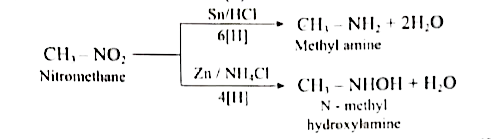
|
|
| 13. |
Exposure of sunlight help to synthesise which vitamin in our body? |
|
Answer» A |
|
| 14. |
Explain the hydrolysis reaction of the following with equation? (i) (CH_3CO)_2 O (ii) (C_6H_5CO)_2O |
Answer» SOLUTION :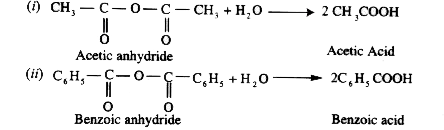
|
|
| 15. |
Express 0.006006 into scientific notation in three significant digits: |
|
Answer» `6.01xx10^(-3)` |
|
| 16. |
Explain the hybridisation, geometry and magnetic property of [CoF_(6)]^(3-) based on VBT. |
Answer» Solution :ELECTRONIC Configuration of `[CoF_(5)]^(3-)`  The complex has octahedral geometry. This complex is PARAMAGNETIC because of the presence of unpaired electrons. |
|
| 17. |
Exposure of an organism to UV system cause |
|
Answer» PHOTODYNAMIC action |
|
| 19. |
Explaub photosynthesis . |
|
Answer» Solution :Carbohydrates are synthesised by greenleavesduringphotosynthesis , a complexprocess in whichsunlightprovides the energyto convertcarbondioxideand waterintoglucose ANDOXYGEN. Glucose is then convertedintoothercarbohydratesand is consumed by animals. `6 CO_(2) + 6H_(2) O OVERSET("Sunlight")to C_(6)H_(12)O_(6) + 6O_(2) uarr` |
|
| 20. |
Explan the action of Pt (or) Sn/HCl with nitrobenzene. |
| Answer» SOLUTION :`underset("Nitrobenzene")(C_(6)H_(5)NO_(2))underset(("or")Sn//HCl)overset(3H_(2)//PT, 680K)(to)underset("Aniline")(C_(6)H_(5)NH_(2)+2H_(2)O` | |
| 21. |
Explain the hybridisation, geometry, magentic property and magnetic moment of [COF_(6)]^(3-) |
Answer» SOLUTION :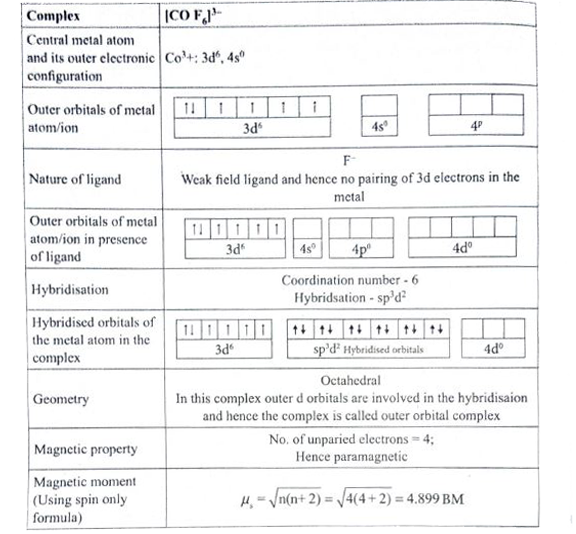
|
|
| 22. |
Explain:The catalyst increase the rate of reaction: |
|
Answer» Solution :The catalyst increase the rate of reaction.The ACTION of the catalyst can be explained by intermediate complex theory. According to this theory ,a catalyst participates in a chemical reaction by forming TEMPORARY bonds with the reactants resulting in an intermediate complex . This has a TRANSITORY existence and DECOMPOSES to yield PRODUCTS and the catalyst. It is believed that the catalyst provide an alternate pathway on reaction mechanism by reducing the activation energy between reactant and products and hence lowering the potential energy barrier as shown in figure . 
|
|
| 23. |
Explainthe alkylation reaction of methylamine with equation. |
Answer» SOLUTION :ALKYLATION: Primary amines reacts with alkyl halides to GIVE SUCCESSIVELY `2^(@)` and `3^(@)` amines and quaternary ammonium salts. 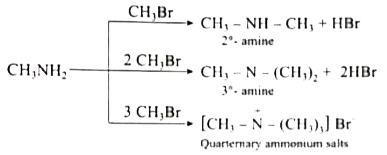
|
|
| 24. |
Explains the following |
Answer» SOLUTION :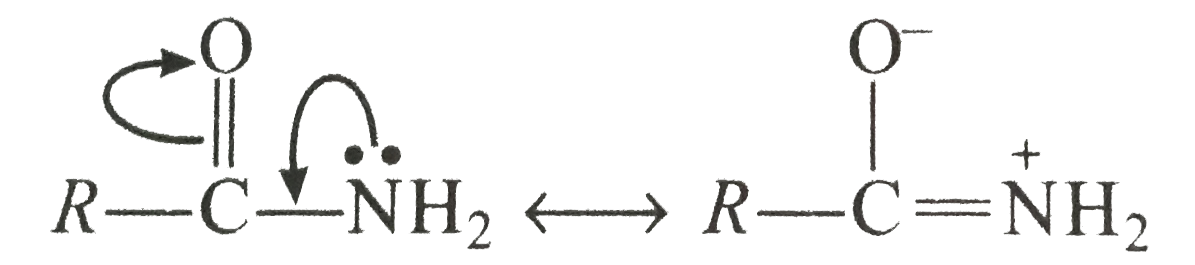
|
|
| 25. |
Explain zone refining process with an example using the Elligham diagram fiven below. |
|
Answer» Solution :(i)Zone refining method is based on the principles of FRACTIONAL crystallisation.When an impure metal is melted and allowed to solidify,the impurities will prefer to be in the molten region.i.e impurities are more soluble in the melt than in the solid state metal. (II)In this PROCESS,the impure metal is taken in the form of a rod.One end of the rod is heated using a mobile induction heater which in melting of the metal on that portion of the rod. (iii)When the heater is slowly moved to the other end the pure metal crystallises while the impurities will move on to the adjacent molten xone formed due to the movement of the heater.As the heater moves further away,the molten zone containing impurities also moves ALONG with it. (iv)The process is repeated several times by moving the heater in the same direction again and again to achieve the desired purity level. (v)This process is carried out in an inert gas atmosphere to prevent the oxidation to metals (vi)Element such as germanium (Ge),SILICON (Si) and galium (Ga)that are used as semiconductor are refined using this process. |
|
| 26. |
Explain the estimation of phosphorus and sulphur present in the organic compound |
|
Answer» Solution :Estimation of sulphur: A known mass of the ORGANIC compound is heated with sodium peroxide in a Carius tube. Then S is oxidised to `H_(2)SO_(4)`. The acid is precipitated as `BaSO_(4)` by adding excess of `BaCl_(2)` aq. Solution. The ppt. is filtered, wahed, dried and weighed. Calculations: Mass of organic compound =ag Mass of barium sulphate =bg Molecular weight of `BaSO_(4)=233` 1 mole of `BaSO_(4) or 233 G of BaSO_(4)` contains 32g of sulphur `THEREFORE b g" of "BaSO_(4)` contains ........? `=(32 xx b)/(233)` g of sulphur a g of organic compound contains `(32 xx b)/(233)" g of sulphur"` 100 g organic compounds ..........? `=(100 xx 32 xx b)/(a xx 233)" g of sulphur (% of S)"` Estimation of phosphorus : A known mass of organic compound is heated with funning nitric acid in a Carius tube. Then phosphorus is oxidised to phosphoric acid. The acid is precipitated as AMMONIUM phosphomolybdate by adding AMMONIA and ammonium molybdate solutions. Calculation: Mass of organic compound=a.g. Mass of ammonium phosphomolydate =bg Molecular weight of ammonium phosphomolybdate =1877 1877g of ammonium phosphomolybdate conatains 31 g of phosphorus b'g of ..............? `=(31 xx b)/(1877)` g of phosphorus. 'a g of organic compound contains `(31 xx b)/(1877)` g of phosphorus `=(100 xx 31 xx b)/(a xx 1877)" g of P(% of P)"` |
|
| 27. |
Explain zone refining with a diagram |
Answer» Solution :Zone refining. This method is used for metal which are required in very high purity. For example, extremely pure silicon, germanium, boron, gallium and indium are refined by this method. This method is based on the principle that the impurities are more soluble in the metal than in the solid state of the metal. Therefore, an impure metal on solidification will deposit crystals of pure metals and the impurities will remain behind in the MOLTEN part of the metal. In this method, the impure metal is cast into a thin bar. A circular mobile heater is fixed at one end of the ROD of impure metal. One zone of the bar is melted by a circular mobile heater in the atmosphere of a noble gas like argon. At the heated zone, the metal as shown in FIGURE. As the heater moves 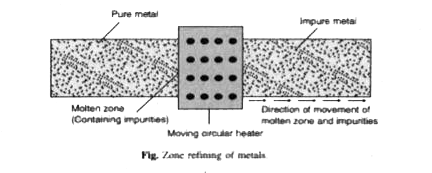 slowly, the impurities also move into the adjacent molten part. In this way, the impurities are made to move into one end which is finally cut off and discarded. The molten metal present at the colder region solidifies in the mean time SINCE it is away from a heater. Thus, we get completely pure metal by this method. This method is specially useful for producing semiconductors of very high purity, Germanium, for example, purified by this method contains impurities only UPTO 7-10 ppm. |
|
| 28. |
Explain:How the value of activation energy is dermine on the base of Aeehenius equation? |
|
Answer» Solution :Method-1:Calculation of `E_(a)` :The Arrhenius equation :`T_(1)` and `T_(2)` The Arrhenius equation :k=A.`e^(-(E_(a))/(RT))` and In k=`-(E_(a))/(RT)` + In A Of the value of the rate constant at temperature `T_(1)` and `T_(2)` are `K_(1)` and `k_(2)` respectively then we have two following equations. In `k_(1)=(E_(a))/(RT_(1))+In A`.........(i) In `K_(2)=-(E_(a))/(RT_(2))+In A` .......(ii) Substracting equation (ii)from equation (i) In `k_(2)-In K_(1)=-(E_(a))/(RT_(2))-((E_(a))/(RT_(1)))`+In A-In A `therefore In (k_(2))/(k_(1))=+(E_(a))/(R)((T_(1)-T_(1))/(T_(1)xxT_(2)))` Taking log on both side log `(k_(2))/(k_(1))=(E_(a))/(2.303R)((T_(2)-T_(1))/(T_(1)T_(2)))` By using this formula we can calculate the activated energy `E_(a)` method-2: To draw plot of in `kto(1)/(T)` or log `kto(1)/(T)` Measuring the slope of the LINE,the value of `E_(a)`can be CALCULATED . In K`to(1)/(T),=-(E_(a))/(R)` log `kto(1)/(T),=-(E_(a))/(2.303R)` |
|
| 29. |
Explain the hybridisation, mgnetic property, geometry, magnetic moment of [Ni(CO)_(4)] using valence bondy theory. |
Answer» SOLUTION :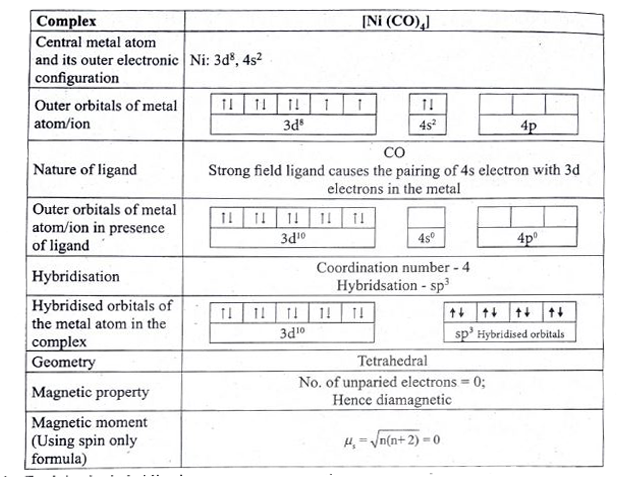
|
|
| 30. |
Explain zone refining process. |
Answer» Solution :Principle : Difference in the SOLUBILITY of impurities in molten and solid state of the metal. As shown in figure, a mobile heater SURROUNDING the rod of impure metal is fixed at its one end. The molten ZONE moves along with the heater which is moved forward. As the heater moves forward, the pure metal crystallises out of the melt left behind and the impurities pass on into the ADJACENT new molten zone created by movement of heaters. The process is repeated several times and the heater is moved in the same direction again and again. Impurities get concentrated at one end & this end is cut off. This method is very useful for producing semiconductor and other metals of very high PURITY, e.g., germanium, silicon, boron, gallium and indium. |
|
| 31. |
Explain Wurtz-Fitting reaction with equation. |
Answer» Solution :WURTZ fittign REACTION - When aryl halides and ALKYL halides are TREATED sodium in dry either gives Alkylarene is called wartz FITTING reaction. 
|
|
| 32. |
Explain the hybridisation, geometry, magentic property and magnetic moment of [Ni(CN)_(4)]^(2-) using valence bondy theory. |
Answer» SOLUTION :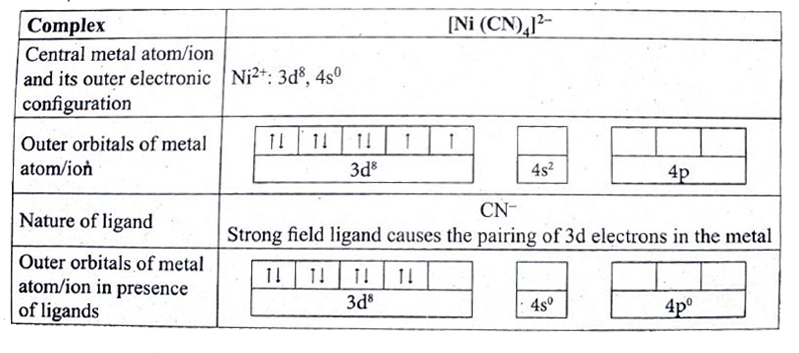 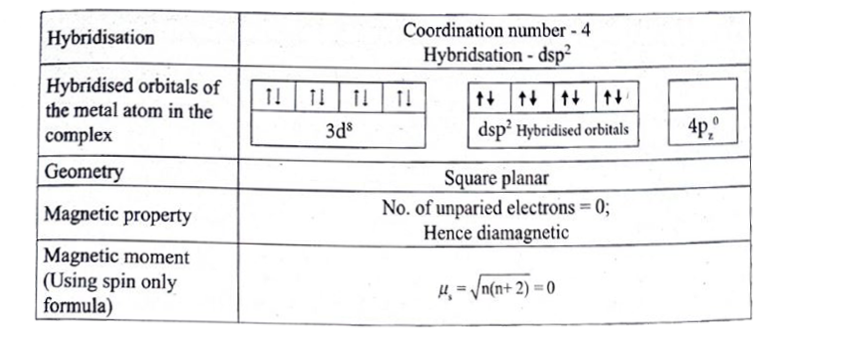
|
|
| 33. |
Explain the hybridization, geometry and magnetic property of [Co(NH_3)_6]^(3+)ion on the basis of Valance Bond Theory (VBT). [Atomic number of Co= 27]. |
Answer» Solution :(i) Orbitals of N`i^(+2)` ion  (ii) In presence of strong ligand CN’ spin pairing takes place and `dsp^(2)` hybridisation takes place. `dsp_(2)` hybridised ORBITAL of `Co_(3)`.  (iii) Four pairs of ELECTRONS, one from each CN“ occupy the four hybrid orbitals. Thus the complex has square planar geometry and DIAMAGNETIC because of the absence of unpaired electrons.  `[Ni(CN)J^(2)]` Complex orbitals For `[Ni(CN)_(4)J^(2)]` Complex, (i) Type of hybridisation : `dsp^(2)` (ii) Geometry : Square planar (iii) Magnetic property : Diamagnetic. |
|
| 34. |
Explain Wolf Kishner reduction with suitable example. |
|
Answer» Solution :Wolf Kishner reduction: `UNDERSET("propanone")(CH_3 - undersetoverset(|||)(O)(C ) - CH_3 + 4 [H]) underset(C_2H_5O Na)OVERSET(NH_2 -NH_2)(to) underset("propane")(CH_3-CH_2-Ch_3+H_2O + N_2 UARR)` |
|
| 35. |
Explain wurtz-Fitting's reaction |
|
Answer» Solution :Explanation Equation `C_(6)H_(5)-X+2Na+R-X overset("Ethar")to C_(6)H_(5)-R+NaX` Detailed Answer: A mixture of alkyl halide and aryl halide UNDERGO reaction with sodium metal in dry ether to FORM Alkylbenzene. This reaction is called Wurt.s Fittig reaction. Ex: A mixture of chloromethane CHLOROBENZENE undergo reaction with sodium in dry ether to form methylbenzene. `CH_(3)-Cl+2Na +Cl-C_(6)H_(5) overset("ether") to CH_(3)-C_(6)H_(5)+2NaCl`. |
|
| 36. |
(a) Explain SN^(1) mechanism by taking tertiary butyl bromide as an example. (b) What is Wurtz Fitting's reaction? Give an example. |
| Answer» Solution :When alkyl halied is heated with ARYL halide with sodium in dry ETHER alkyl BENZENE (ARENE) is OBTAINED. | |
| 37. |
Explain with two examples each of the following coordination entity, ligand, coordination number, coordination polyhedron, homoleptic and heteroleptic. |
|
Answer» Solution :(i). COORDINATION entity . (II). Ligand. (iii). Coordination number. (iv). Coordination POLYHEDRON. (v). Homoleptic and HETEROLEPTIC. |
|
| 38. |
On the basis of VBT explain the hybridization, geometrical shape and magnetic property of [CoF_(6)]^(3-), hexafluorido cobaltate (III) ion. |
|
Answer» Solution :In `[CoF_(6)]^(3-)`, the oxidation state of `Co` is `+3`. The electronic configuration `Co` in `+3` oxidation state is `C_(o)^(3+)-[Ar]3d^(6)4S^(@)`  Since `F^(-)` ion provides a weak field ligand, there fore pairing doesnot takes place. One 4s, three 4p and two 4d - orbitals hydridised to YIELD six `sp^(3)d^(2)` hybrid orbitals pointing toward the six corer of an octahedron. These six hybrid orbitals overlaps with orbitals of six `F^(-)` ligands.  Geometry - Octahedran HYBRIDISATION - `Sp^(3)d^(2)` Magnetic property - paramagnetic |
|
| 39. |
Explain with the help of potential energy barrier how does a catalyst increase the speed of a reaction ? |
|
Answer» Solution :(1) A catalyst is a substance, when added to the reactants, increases the rate of the reaction without veing consumed. (2) The catalyst provides alternaative and lower energy PATH or mechanism for the reaction. (3) In the presence of the catalyst, the activation energy of the reaction is lowered. The HEIGHT of activation energy barrier is less than that in the uncatalysed reaction. (4) Due to lowering of energy of activaion, `(E_(a))` the number of molecules possessing `E_(a)` increases, hence the rate of the reaction increases. (5) The rate CONSTANT `=k=Axxe^(-E_(a)//RT)` where A is a frequency factor and hence the rates of the catalysed reaction are higher than those of uncatalysed reactions. (6) The catalyst does not change the extent of the reaction but hastens the reaction. 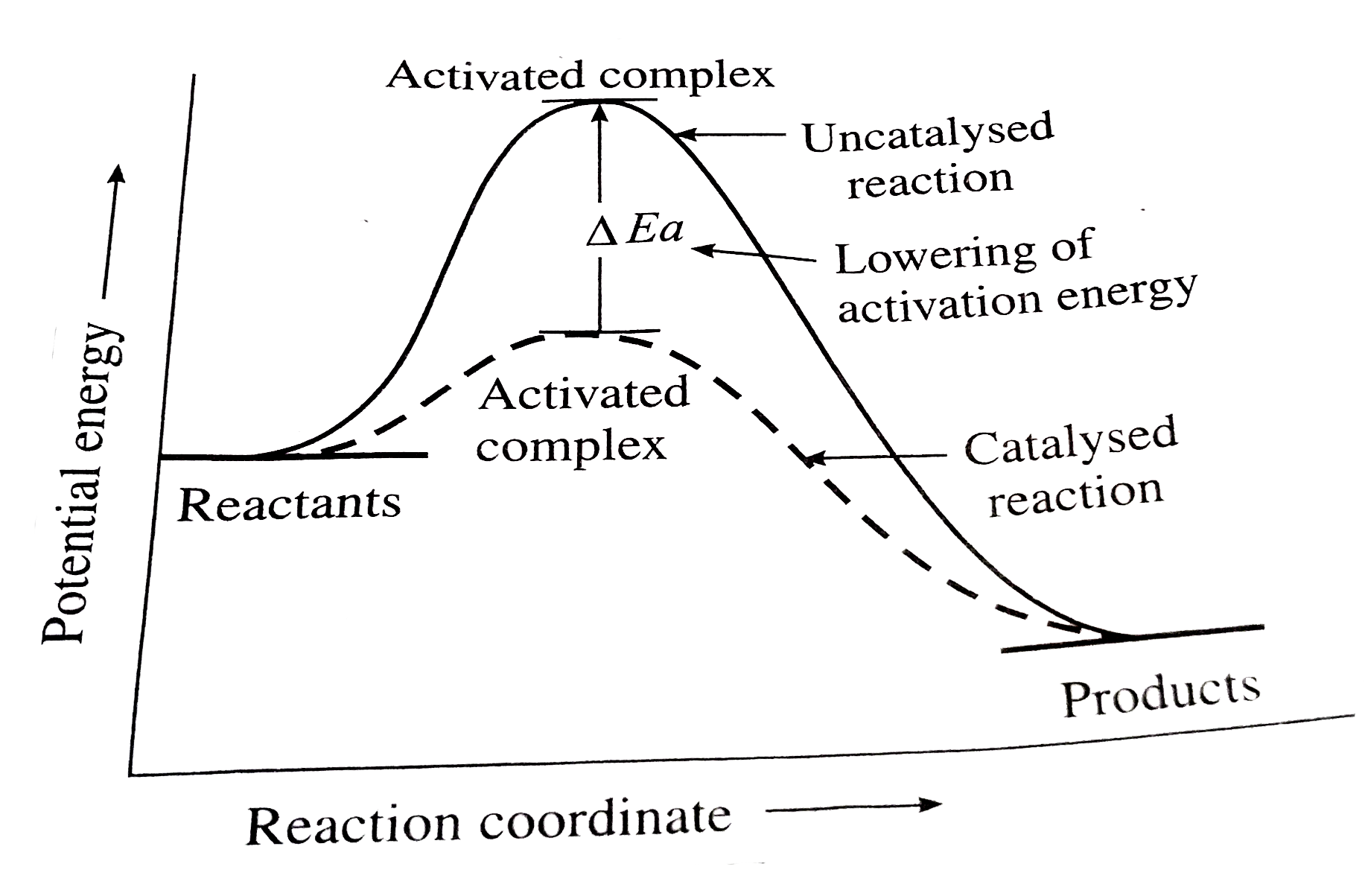
|
|
| 40. |
Explain with the help of an example the meaning of Anti-Congressism. |
|
Answer» Solution :Non-congress-ism is a term that is USED to describe the anti-congress waves started by non-congress parties with RIGHTIST and leftist leanings Parties felt Congress rule to be the root cause of various problems faced by our country such as food problems, economic crisis, corruption and DEPENDENCE on foreign countries. This not only resulted in the defeat of many Congress stalwarts but also led to many internal revolts in the party. The coinage of this term can be rightfully traced back to the ELECTIONS of 1967. Aproposal by Ram ManoharLohia in the early 60s that there was a viable alternative to the congress Party and that all it needed was for the OPPOSITION to unite. |
|
| 41. |
Explain the HVZ reaction. |
|
Answer» `(##ANE_PKE_CHE_XII_C12_E02_086_S01##)` |
|
| 42. |
Explain with equation Van-Arkel method for refining of zircnium. |
|
Answer» Solution :The CRUDE metal is heated in an EVACUATED VESSEL with IODINE. The metal iodide being more covalent, volatizes. `Zr+2I_(2)rarrZrI_(4)` The metal iodide is decomposed on a tungsten FILAMENT, electrically heated to about 1800K. The pure metal is thus deposited on the filament. `ZrI_(4)rarrZr+2I_(2)` |
|
| 43. |
Explain with equations, the react ion of sulphuric acid with ethyl alcohol under different conditions. |
|
Answer» Solution :Equations for reaction of sulphuric acid with ethyl alcohol at different temperatures are given below : (i) `C_(2)H_(5)OH overset("conc. "H_(2)SO_(4))UNDERSET("ROOM temp.")rarr underset("sulphate")underset("Ethyl hydrogen")(C_(2)H_(5)HSO_(4))+H_(2)O` (ii) `2C_(2)H_(5)OH overset("conc. "H_(2)SO_(4))underset(383K)rarr underset("Diethyl sulphate")((C_(2)H_(5))_(2)SO_(4))+2H_(2)O` (iii) `2C_(2)H_(5)OH overset("conc. "H_(2)SO_(4))underset(413K)rarr underset("Ethoxyethane")(C_(2)H_(5)OC_(2)H_(5))+H_(2)O` (iv) `C_(2)H_(5)OH overset("conc. "H_(2)SO_(4))underset(443K)rarr underset("ETHENE")(CH_(2)=CH_(2))+H_(2)O` |
|
| 44. |
Explain the Hoffmann's bromamide reaction. |
|
Answer» Solution :Hoffmann.s Bromamide reaction : When an acid AMIDE is heated with bromine and POTASSIUM HYDROXIDE solution a PRIMARY AMINE is obtained. `R-CONH_2+Br_2+4KOHoverset(/_\)toR-NH_2+K_2CO_3+2KBr+2H_2O` and `R=CH_3` |
|
| 45. |
Explain with equations how to convert: (i) Aldehyde containign no alpha- hydrogen to a mixture of sodium salt of the carboxylic acid and alcohol. (ii) Ketone intohydrocarbon. |
Answer» SOLUTION :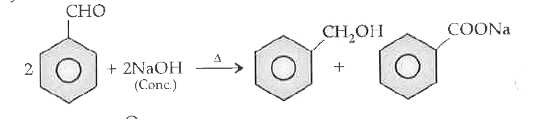 (ii) `CH_(3)-overset(O)overset(||)(C)-CH_(3)-4[H]overset(Zn-Hg//HCl)(to)CH_(3)-CH_(2)-CH_(3)-H_(2)O` |
|
| 46. |
Explain with diagram the construction, cell reactions and symbolic representation of the Daniel cell. |
|
Answer» SOLUTION :Daniel cell is a electrochemical cell It consistsof TWO half cells or two ELECTODE SYSTEMS. Zinc rod dipped in 1M `ZuSO_(4)` forms Anode. In this electrode, Zin: rod is -vely charged with respect to the solution and zinc undergoes oxidation. Copper red dropped in1M `CuSO_(4)` forms Cathode. In the electode, copper rod is +vely charged with respect lo the solution and copper ions undergoes reduction. The metallie rods in the vessel are connected through ammeter by means of insulated wire. The SOLUTIONS in the two beakers are connected by means of Salt bridge. 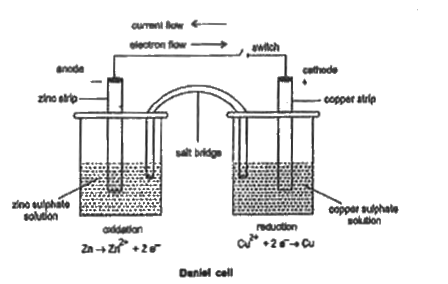 whenthe circuitiscompletedelectronsflowszincrod(anode )to copperrod( cathode )in theexternalcircuit, therefore , curtent flowsfromcoppertozinc 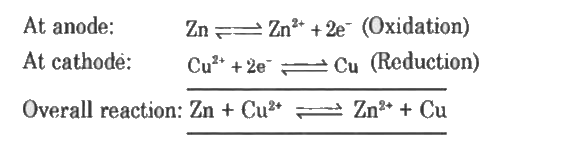
|
|
| 47. |
Explain the giving reasons : Rate of physical adsorption decreases with rise of temperature. |
|
Answer» SOLUTION :Physical adsoroption is an exothermic process in equilibeium Gas (Adsorbate ) + Solid (ADSORBENT) `hArr` Gas adsorbed on Solid + Heat As the TEMPERATURE is increased, by Le Chatelier's principle, EQULIBRIUM shigts in the backward direction, i.e., adsorption decreases. |
|
| 48. |
Explain with an example, what is a pseudo first order raction ? The graphs (A and B) given below are plots of rate of reaction Vs concentration of the reactant. Predict the order from the graphs. |
Answer» SOLUTION :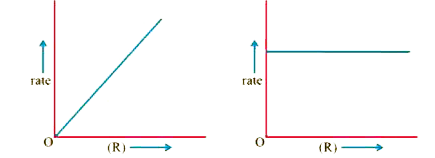
|
|
| 49. |
Explain the giving reasons : Colloidal particles scatter light. |
| Answer» SOLUTION :This is DUE to the disirabel SIZE of the COLLOIDAL PARTICLES `(10Å-10000Å).` | |
| 50. |
Explain with chemical reactions three oxidising properties of KMnO_(4) in acidic medium. |
|
Answer» SOLUTION :(i) `2KMnO_(4)+ 8H_(2)SO_(4)+ 10FeSO_(4) to K_(2)SO_(4)+ 2MnSO_(4)+ 8H_(2)O+ 5Fe_(2)(SO_(4))_(3)` (ii) `2KMnO_(4)+ 5SO_(2)+2H_(2)O to K_(2)SO_(4)+ 2MnSO_(4)+ 2H_(2)SO_(4)` (iii) `2KMnO_(4)+ 3H_(2)SO_(4) + 5H_(2)C_(2)O_(4) to K_(2)SO_(4) +2MnSO_(4)+ 10CO_(2)+ 8H_(2)O` (iv) `2KMnO_(4)+ 8H_(2)SO_(4)+ 10KI to 6K_(2)SO_(4)+ 2MnSO_(4)+ 5I_(2)+ 8H_(2)O` (v)`2KMnO_(4)+ 3H_(2)SO_(4)+ 5H_(2)O to K_(2)SO_(4)+ 2M_(4)SO_(4)+ 8H_(2)O+ 5O_(2)` |
|