

Saved Bookmarks
This section includes 7 InterviewSolutions, each offering curated multiple-choice questions to sharpen your Current Affairs knowledge and support exam preparation. Choose a topic below to get started.
| 1. |
Explainthe mechanism of enzyme action? |
|
Answer» Solution :(i) Enzymes are bio catalysts that catalysea speific bio chemicalreaction. They generallyactivates the reactionby reducingthe activationenergy by stabilisingthe transition state. (II) In a TYPICAL reaction , enzymeE bindswith the substratemolecule leversitytoproduceand the ENZYME becomes free and is readyto bind toanothersubstratemolecule . (ii) `underset("Enzyme")E + underset("SUBSTRATE")S to underset("Enzyme-substrate complex")([ES])` `[ES] to underset("PRODUCT" )P + underset("Enzyme")(E)` |
|
| 2. |
Extent of physisorption of a gas increases with……….. |
|
Answer» INCREASE in temperature |
|
| 3. |
Explain the mechanism of enzyme catalysis. |
|
Answer» Solution :Step 1 : There are a number of active centres on the surface of the enzyme. The MOLECULES of the reactant (substrate) which have complementory shape to the enzyme fit into active centres LIKE a key fits into a LOCK and FOMS an activated complex. `E + S rarr RS^(**)` Step II : Decomposition of activated complex gives the products. `ES^(**) rarr E + P` |
|
| 4. |
Extent of physisorption of a gas increases with_____. |
|
Answer» INCREASE in TEMPERATURE |
|
| 5. |
Explain the mechanism of cleansing action of soaps and detergents. Mechanism of cleansing action of soaps and detergents: |
|
Answer» Solution : (i) The cleansing action of both soaps and detergents from their ability to lower the surface tension of water, to emulsify oil or grease and to hold them in a suspension in water. (ii) This ability is due to the structure of soaps and detergents. (iii) In water a sodium soap dissolves to form soap anions and sodium cations. For example, the following chemical equation shows the ionisation of sodium palmitate. `underset("(Soap)")underset("(Sodium palmitate)")(CH_3(CH_2)_(14)COO^(-)Na^(+)) to underset("(Soapanion)")underset("Palmitate")(CH_3(CH_2)_(14)COO^(-))+underset("(Sodium ion)")(Na^(+))` (iv) A soap anion consists of a long hydrocarbon chain with a carboxylate group on one end. The hydrocarbon chain, which is hydrophobic, is soluble in oils or grease. The ionic part is the carboxylate group which is hydrophilic, is soluble in water.  (v) In water, detergent dissolves to form detergent anions and sodium cations. For example the following chemical equations show the ionisation of sodium alkyl sulphate and sodium alkyl benzene sulphate.  (vi) The following explains the cleansing action of a soap or detergent on a piece of cloth with a greasy stain: `implies`A soap or detergent anion consists of a hydrophobic part and a hydrophilic part. `implies`Soap or detergent reduces the surface tension of water. Therefore the surface of the cloth is wetted thoroughly. `implies`The hydrophobic PARTS of the soap or detergents anions are soluble in grease. `implies`The hydrophilic parts of the anions are soluble in water. `implies ` Scrubbing or mechanical agitation helps to PULL the grease away from the cloth and the grease is BROKEN into smaller droplets. `implies`REPULSION between the droplets causes the droplets to be suspended in water, forming an emulsion. `implies`Thus the droplets do not coagulate or redeposit on the cloth. Rinsing washes away the droplets. |
|
| 6. |
Extent of Physisorption of a gas increases with …… |
|
Answer» increase in temperature |
|
| 7. |
Explain the mechanism of cleansing action of soaps and detergents. |
|
Answer» Solution :(b) Mechanism of cleansing action of soaps and detergents. 1. The cleansing action of both soaps and detergents from their ability to LOWER the surface tension of water, to emulsify oil or grease and to hold them in a suspension in water. 2. This ability is due to the structure of soaps and detergents. 3. In water a sodium soap dissolves to form soap anions and sodium cations. For example, the following chemical equation shows the ionisation of sodium PALMITATE. `underset("Sodium palmitate soap")(CH_(3)(CH_(2))_(14)COO^(-) NA^(+) to underset("Palmitate soapanion")(CH_(3)(CH_(2))_(14)COO^(-) + underset("Sodium ion")(Na^(+))` 4.A soap anion consists of a long hydrocarbon chain with a carboxylate group on one end. The hydrocarbon chain, which is hydrophobic, is soluble in OILS or grease. The ionic part is the carboxylate group which is hydrophilic, is soluble in water.  5. In water, detergent dissolves to form detergent anions and sodium cations. For example the following chemical EQUATIONS show the ionisation of sodium alkyl sulphate and sodium alkyl benzene sulphate. 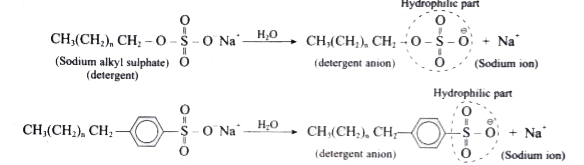 6.The following explains the cleansing action of a soap or detergent on a piece of cloth with a greasy stain: a) A soap or detergent anion consists of a hydrophobic part and a hydrophilic part. (b) Soap or detergent reduces the surface tension of water. Therefore the surface of the cloth is wetted thoroughly. ( c) The hydrophobic parts of the soap or detergents anions are soluble in grease. (d) The hydrophilic parts of the anions are soluble in water. ( e) Scrubbing or mechanical agitation helps to pull the grease away from the cloth and the grease is broken into smaller droplets. (f) Repulsion between the droplets causes the droplets to be suspended in water, forming an emulsion. (g) Thus the droplets do not coagulate or redeposit on the cloth. Rinsing washes away the droplets. |
|
| 8. |
Extent of physisorption of a gas increases with _________ |
|
Answer» INCREASE in temperature. |
|
| 9. |
Explain , themechanismof alkalinehydrolysis (reactionwithaqueous KOH)of tert-butyl bromide (2-Bromo-2- methyl - propane ) with energyprofile diagram. |
Answer» Solution : (i) Consider alkaline hydrolysis of tert-butyl bromide (2-Bromo-2- methylpropane) with aqueous NaOH or KOH <BR> 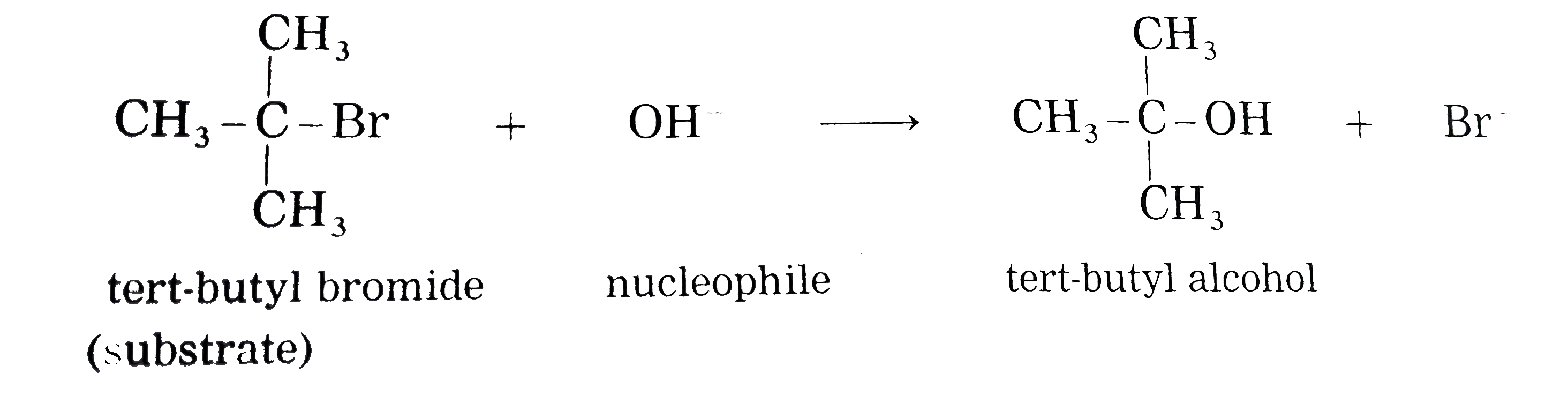 (ii) Kineticof thereaction: Due to steric hindranceof volumethree methly grouparoundcarbon , nucleophile`OH^(-)`cannotattack carbon atom directly. Hence, the reaction TAKES place in towsteps. Step I : Thisinvolves heterolytic fission of C- Br covalent bond in the substrate forming carbonium ion or carbocation and `Br^(-)` Thie process is a slow process. 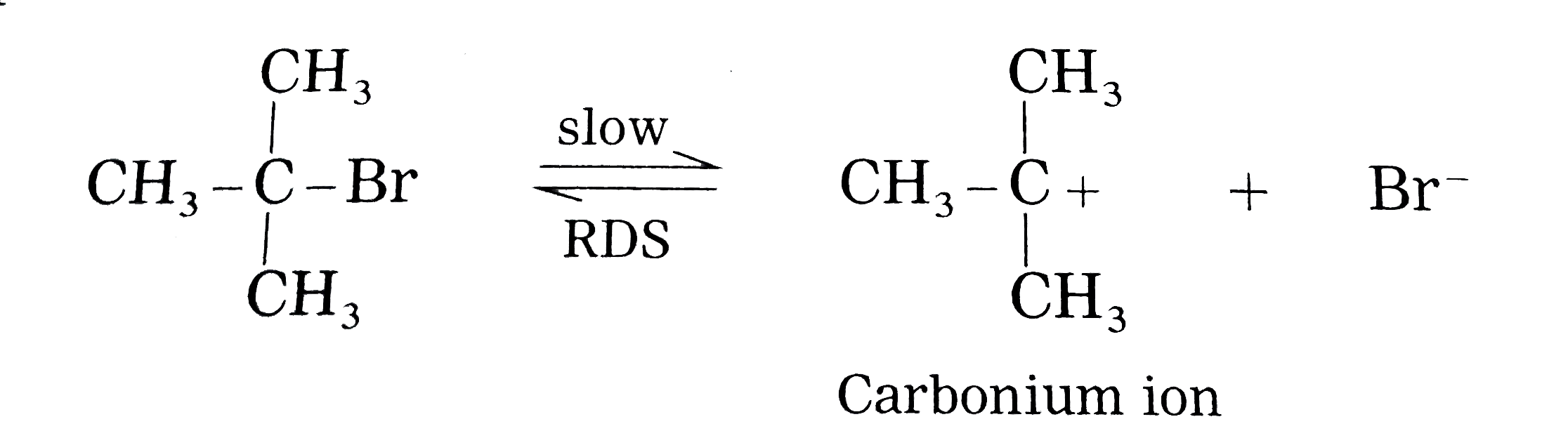 StepII : This step involves attack of nucleophile `OH^(-)` or carbocation forming C- OH bondand product tert - butylalchohol. Sinceit involvesionicchargeneutralisation it isa fast step. 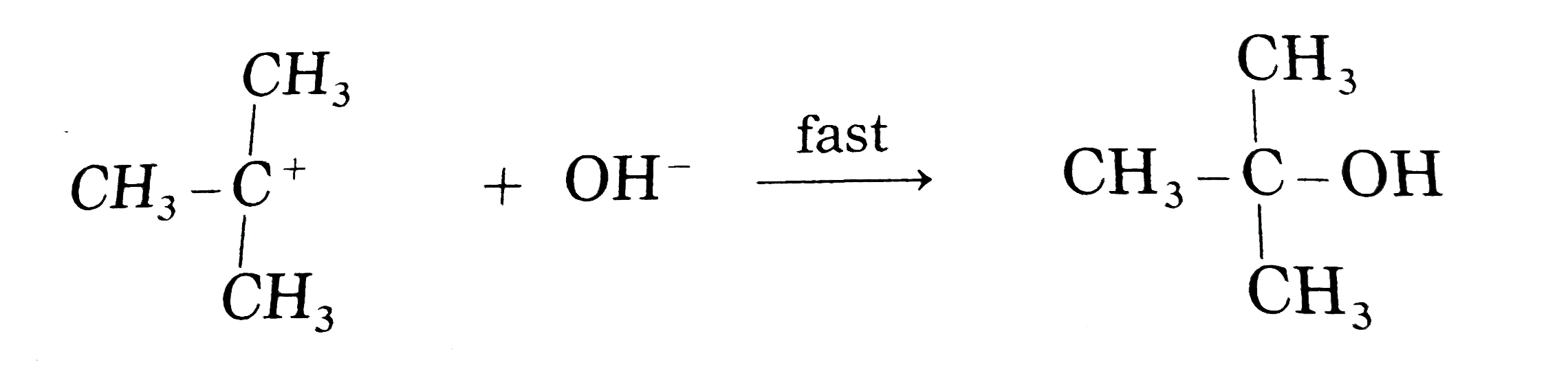 Rate Determining Step (R.D.S.) : Since the first step is a slow step, it is R.D.S., and therefore the rate of the reaction depends on the concentration of only one reactant, `(CH(3))_(3)C- Br`. Rate = R = `k [(CH_(3))_(3)C - Br]` where k isa rate constant of thereaction `SN^(-1)`reaction : The rate of this reaction depends only on theconcentration of one substance (tert-butyl bromide) and is independent of concentration of alkali added. This is first (1st) order Nucleophilie Substitution reaction denoted as `SN^(1)` reaction. STEREOCHEMISTRY and mechanisim of thereaction: The reaction takes placein two steps and both the steps involveformation of transition state (T.S.). 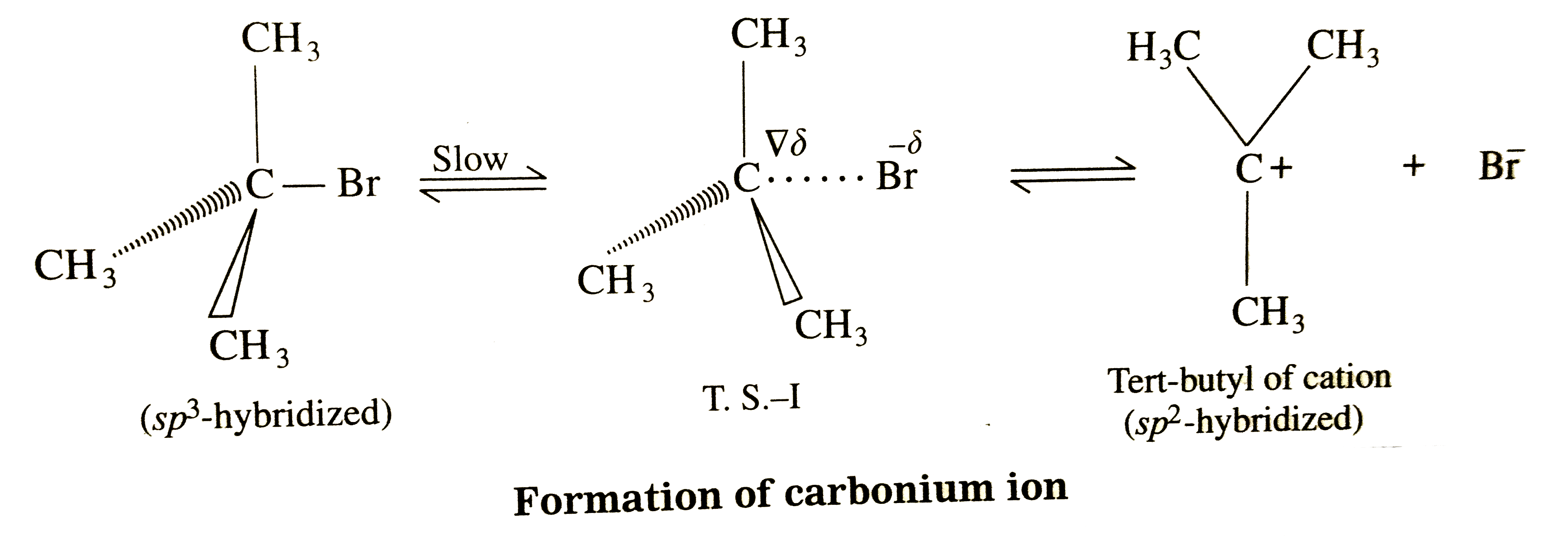 In this transition state, C -Br bondis partiallyboken, So thatcarbonatom carries partial positive`(+delta)`and Brcarries partial negative charge`(-delta)` whichfurther breaks formingcarbocationand `Br^(-)`. Tert-butyl cation has a planar structure and the `CH_(3),-C-CH_(3)` bondangleis `120^(@)` . It isthe intermediateof the rection . ITIS unstable . In thisstep,hybridisation of carbon atom charngesform `sp^(3)`(tetrahedral geometry ) to `sp^(2)`(planner geometry). 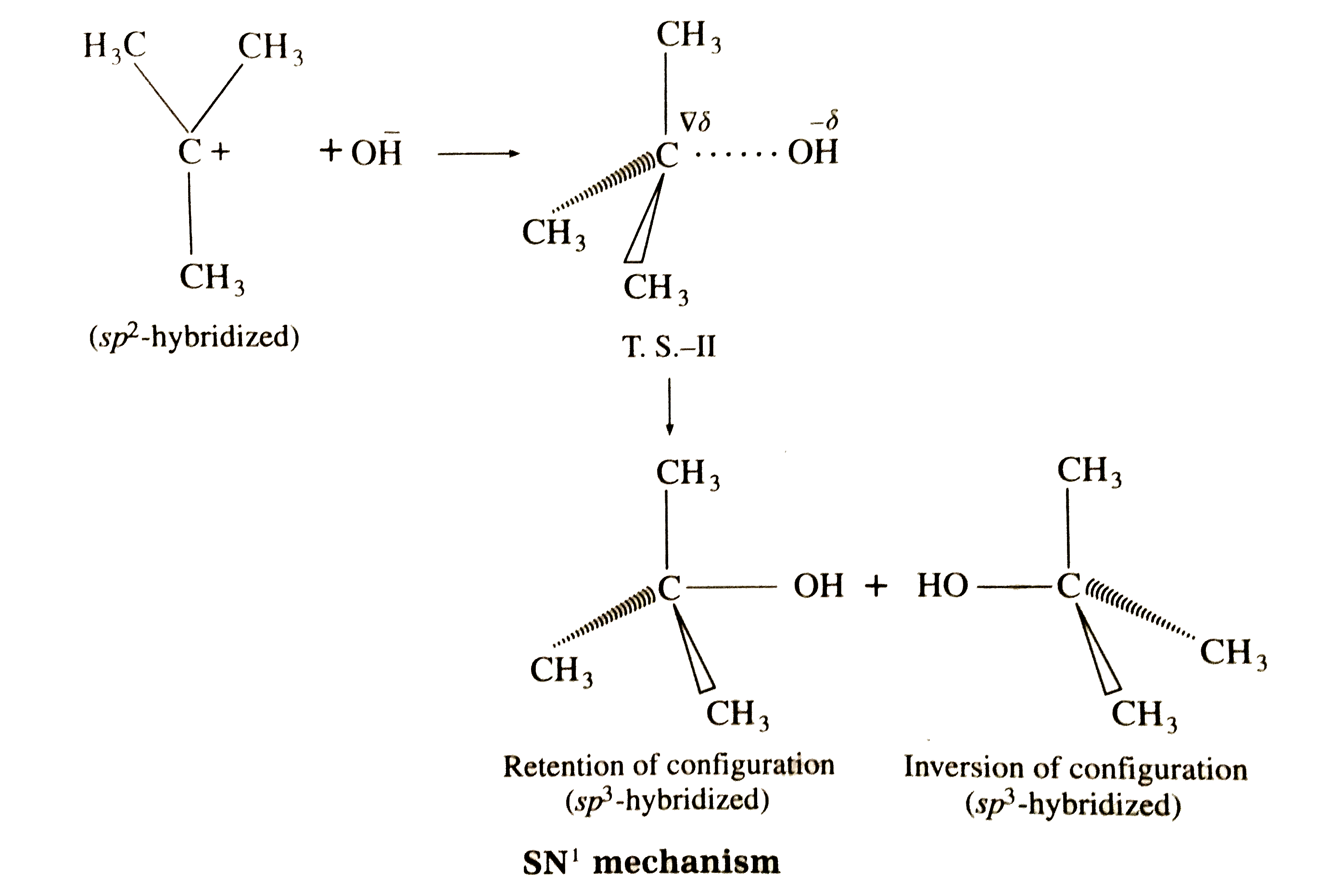 In thistransitationstate , C-OH bond ispartiallyformed so thatcarbonatomcarries partial positivecharge `(+delta)` and OH carriespartialnegativecharge `(-delta)`which furtherforms tert-butyl alchohol. Formationof a racemicmixture :Since `OH^(-)`hasequalprobability of the attack on carbocation from frontside and from backside, the products obtained are equal. In case of optical activealkyl halide, a racemic mixture is obtained. Energyprofil digram: In thediagram both thetransition state, T.S.-I and T.S.-II are shown. 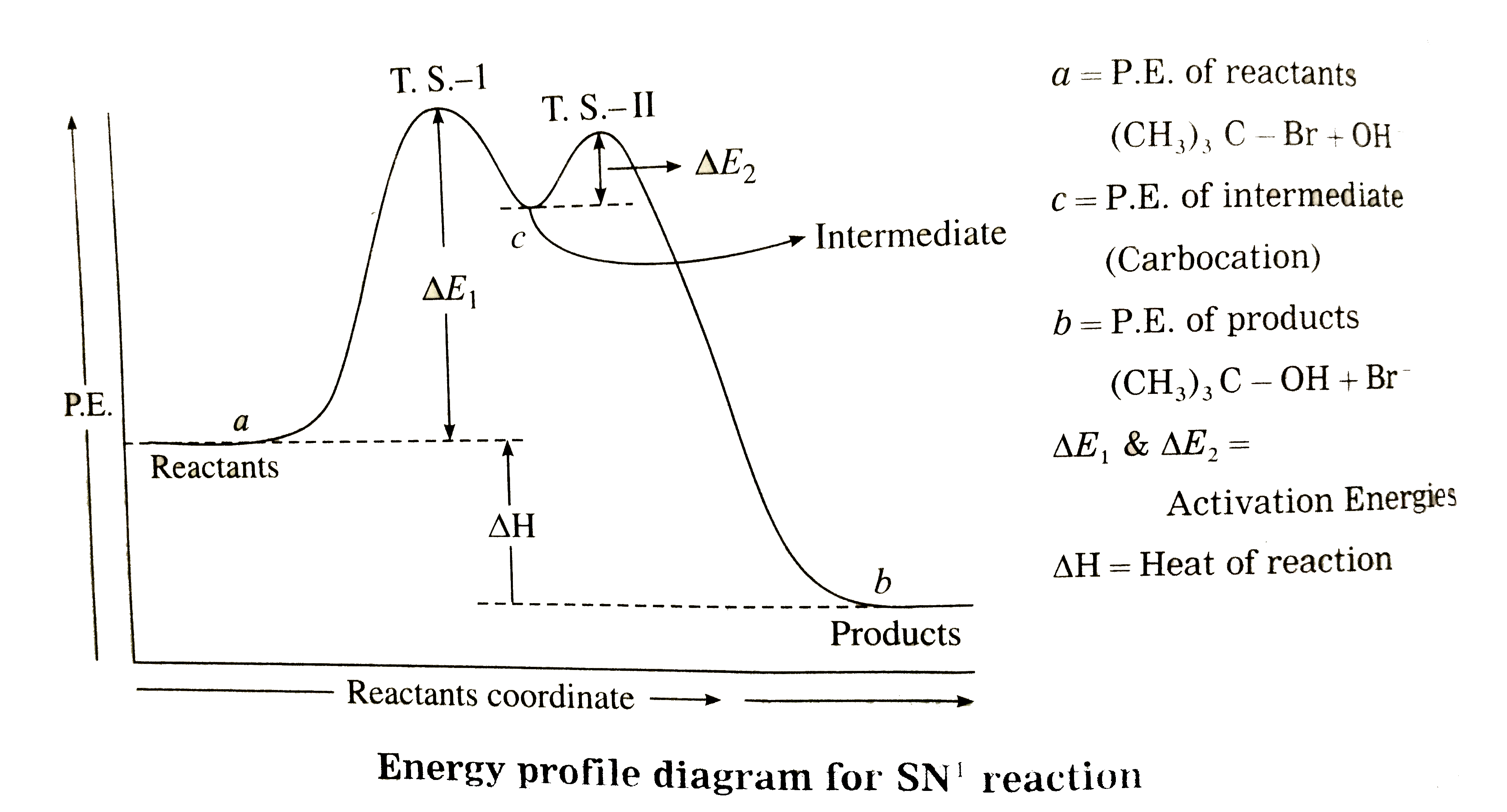 Energyof activationis `SN^(-1)` : The first step requires higher acti-vationenergy AE,. Second step requires lower activation energy `DeltaE_(2)` Heat of reaction `(DeltaH)`: Itis theenergydifferencebetweenproductsand reactants. |
|
| 10. |
Extent of adsorption of adsorbate from solution phase increases with |
|
Answer» Increase in AMOUNT of adsorbate in SOLUTION. |
|
| 11. |
Extent of adsorption of adsorbate from solution phase increases with _________. |
|
Answer» INCREASE in amount of adsorbate in SOLUTION |
|
| 12. |
Explain the mechanism of Cannizaro reaction. |
|
Answer» Solution :Cannizaro REACTION INVOLVES three steps. Step 1 : Attack of OH - on the carbonyl carbons.  Step 2 : Hydride ion transfer  Step 3 : Acid - base reaction. `C_(6)H_(5)-overset(O)overset(||)(C)-OH+C_(6)H_(5)CH_(2)O^(-)+Na^(+)underset("EXCHANGE")overset("Proton")tounderset("Sodium benzoate")(C_(6)H_(5)-overset(O)overset(||)(C)-ONa)+underset("Benzyl alcohol")(C_(6)H_(5)CH_(2)OH)` Cannizaro reaction is a CHARACTERISTIC of aldehyde having no `alpha`-hydrogen. |
|
| 13. |
Extent of adsorption of adsorbate from solution phase increases with… |
|
Answer» increase in AMOUNT of ADSORBATE in SOLUTION |
|
| 14. |
Explain the mechanism of alkaline hydrolysis of tertbutyl bromide with energy profile diagram.Define carbolic acid si prepared from benzene sulphonic acid? |
Answer» Solution :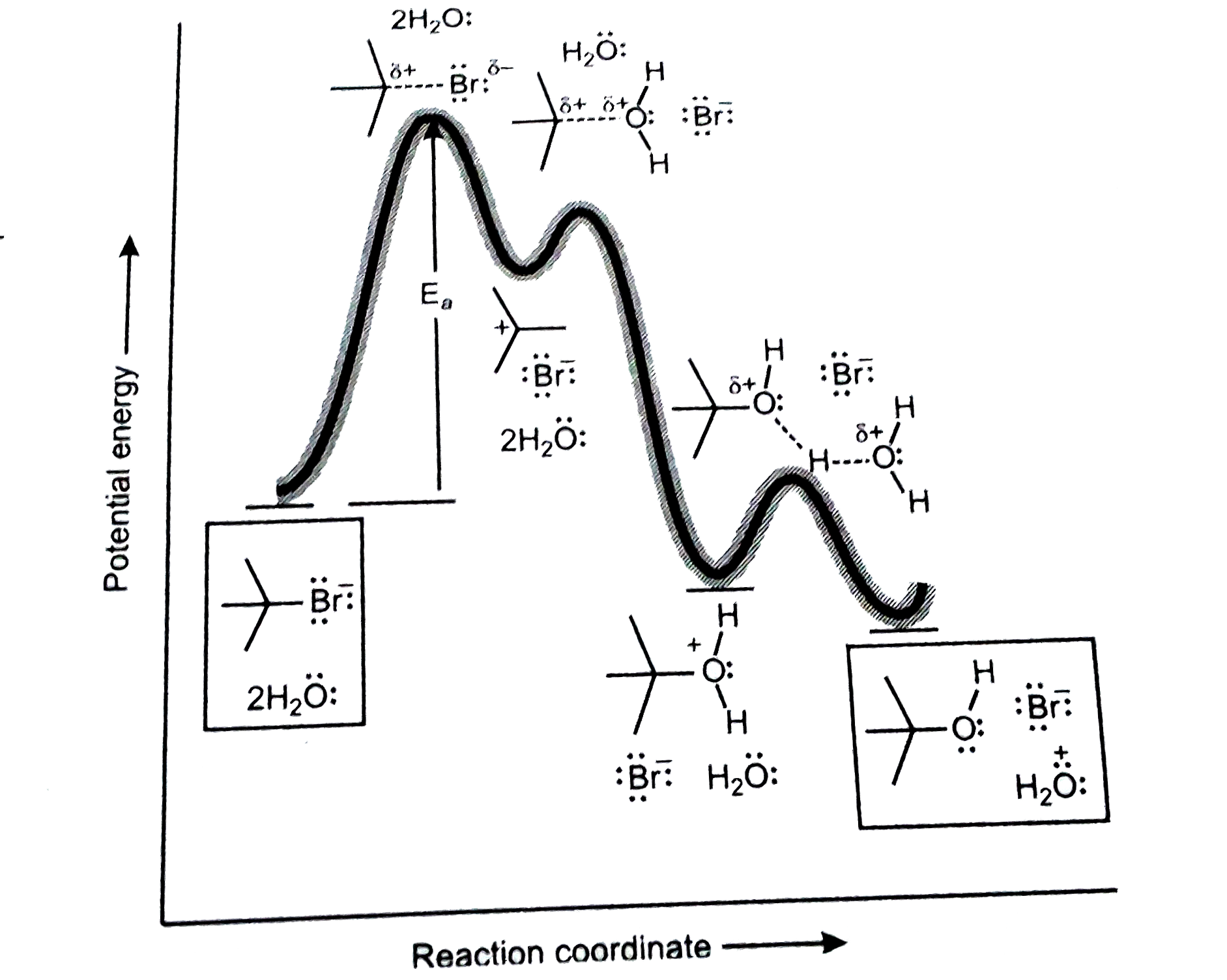 CARBOLIC acid: Phenol is also called as carbolic acid: It is a white, crystalline, water-soluble, poisonous mass, `C_(6)H_(5)OH,` obtained from coal TAR, or a hydroxyl DERIVATIVE of benzene used chiefly as a disinefectant, as an ANTISEPTIC, and in organic synthesis. Preparation of carbolic acid from benzene sulphonic acid :
|
|
| 15. |
Extent of adsorption of adsorbate from solution phase increases with ……………… |
|
Answer» DECREASE in SURFACE of the adsorbent |
|
| 16. |
Explain the mechanism of adsorption. |
|
Answer» Solution :Adsorption arises due to the fact that the surface particles of the adsorbent are not in the same environment as the particles inside the bulk. Inside the adsorbent all the forces acting between the particles are mutually balanced but on the surface the particles are not surrounded by atoms or molecules of their kind on all sides and hence they possess unbalanced or residual attractive forces. These forces of the adsorbent are RESPONSIBLE for attracting the adsorbate particles on its surface. The extent of adsorption increases with the increase of surface area per unit mass of the adsorbent at a given temperature and pressure. ANOTHER important factor featuring adsorption is the heat of adsorption. During adsorption, there is always a decrease in residual forces of the surface, i.e. there is decrease in surface energy which appears as heat. Therefore, adsorption is invariably an exothermic process. Thus, adsorption is accompanied by decrease in enthalpy as well decrease in entropy of the system. For a process to be SPONTANEOUS, the thermodynamic requirement is that at constant temperature and pressure, `DeltaG` must be negative, i.e. there is a decrease in Gibbs energy. On the basis of equation, `DeltaG = DeltaH - TDeltaS`, if `DeltaH` has sufficiently high negative value, than `DeltaG` can be negative as `-TDeltaS` is positive. Thus, in an adsorption process, which is spontaneous, a combination of these two factors MAKES AG negative. As the adsorption PROCEEDS, `DeltaH` becomes less and less negative ultimately `DeltaH` becomes equal to `TDeltaS and DetlaG` becomes zero. At this state equilibrium is attained. |
|
| 17. |
Extent of adosorption of adsorbate from solution phase increases with _________ |
|
Answer» increase in amount of adsorbate in SOLUTION. |
|
| 18. |
Explain the mechanism of aldol condensation. |
Answer» Solution :In presence of dilute base NaOH, or KOH, two molecules of an ALDEHYDE or ketone having `ALPHA` - HYDROGEN add TOGETHER to give B-hydroxyl aldehyde (aldol) or `beta`- hydroxyl ketone (ketol). The reaction is called aldol condensation reaction.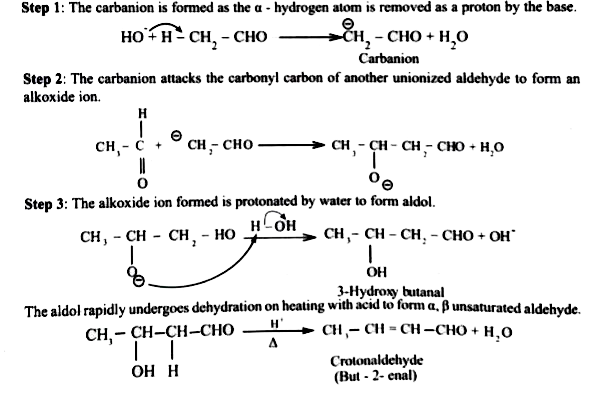
|
|
| 19. |
Expression Pk_h =pK_w - pK_a - pK_bis not applicable to – |
|
Answer» AMMONIUM ACETATE |
|
| 20. |
Expression representing the cell potential (E cell) |
|
Answer» `E_("cathode")+E_("ANODE")` |
|
| 21. |
Express the result of the given calculation to the appropriate number of significant figures : |
|
Answer» SOLUTION :`(3.24xx0.08666)/(5.006)=0.0560883"(ACTUAL result)"` As 3.24 has LEAST numbers of significant figures, VIZ, 3, the result should contain 3 significant figures only. Hence, the result will be reported as 0.0561 (after rounding off). |
|
| 22. |
Express the relationship between atomic radius (r) and edge length (a) in the bcc unit cell. |
| Answer» SOLUTION :`R = (SQRT(3)a)/(4)` | |
| 23. |
Explain the mechanism of addition of HCN to a carbonyl group in presence of a base. |
Answer» Solution :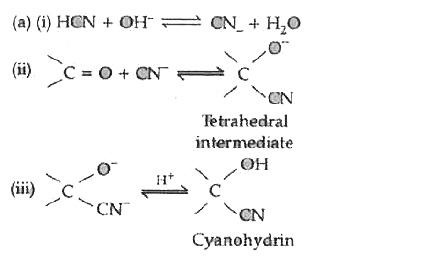 The mechanism of addition of HCN to carbonyl group takes PLACES ACCORDING to the following steps. Step - (1) : Addition of nucleophilic `(CN^(-))` to carbonyl carbon. The nucleophilic attacksthe `sp^(2)` hybridised carbonyl carbon ATOM forming tetrahedral alkoxide intermediate PRODUCT. 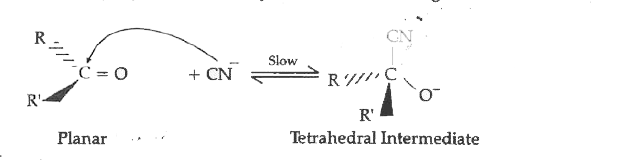 Step - (2) : Addition of proton of alkoxide ion. Alkoxide ion intermediate product picks up a proton from the reaction medium to form the ELECTRICALLY neutral final product. 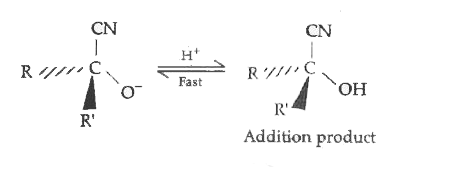
|
|
| 24. |
Express the relation between conductivity and molar conductivity of a solution held in a cell. |
|
Answer» Solution :The RELATION between conductivity (K) and molar conductivity (`Lambda_(m)` ) is given by `Lambda_(m) =kV` where V is the volume of the solution containing one MOLE of the ELECTROLYTE KEPT between two electrodes at a DISTANCE of unit length. |
|
| 25. |
Explain the mechanism of acid catalysed hydration of an alkene to from corresponding alcohol. |
Answer» SOLUTION : 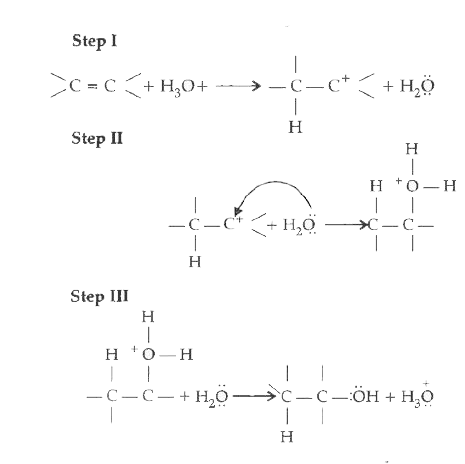
|
|
| 26. |
Explain the mechanism involved in the reaction between Tertiary alkyl halide and primary alkoxide with eample. |
Answer» SOLUTION :When TERTIARY alkyl halide REACTS with primary alkoxide, elimination dominates and succeeds over substitution to FORM an alkene. 
|
|
| 27. |
Express the relation between the conductivity and the molar conductivity of a solution. |
| Answer» SOLUTION :`A_m=k//C` | |
| 28. |
Explain the mechanism involved in the intermolecular dehydration of alcohols to give ethers. |
|
Answer» Solution :Inter MOLECULAR dehydration of alcohol: We have ALREADY LEARNT that when ethanol is treated with conc. `H SO_(2)` 4 at 443 K, elimination takes place to form ethene. If the same reaction is carried out at 413 K, substition competes over elimination to form OTHERS. `underset("ethanol")(2CH_(3)-CH_(2))-OH OVERSET(H_(2)SO_(4))underset(413 K) to underset("diethyl ether")(CH-O-CH_(2)-CH_(3))` 
|
|
| 29. |
Express the relation among cell constant, resistance of the solution in the cell and conductivity of the solution. How is molar conductivity of a solution related to its conductivity ? |
|
Answer» Solution :Relation between cell constant G*, RESISTANCE of the solution R and conductivity K of the solution is given by G* = RK Relation between MOLAR conductivity `Lambda_(m)`and conductivity k is given by `Lambda_(m) = k/C` where C is the concentration of the solution. |
|
| 30. |
Express the relation among conductivity of the solution in the cell, the cell constant and resistance of solution in the cell. |
| Answer» SOLUTION :CONDUCTIVITY `(kappa)=(1)/("Resistance (R)")XX`Cell constant. | |
| 31. |
Explain the mechanism involved in the reaction of phosphorous trichloride with Ethanol. |
Answer» SOLUTION :`SN^2` REACTION of ETHANOL with `PCl_3` : 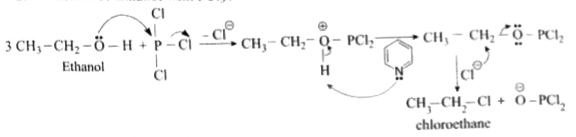
|
|
| 32. |
Express the relation among the conductivity of a solution in the cell, the cell constant and the resistance of solution in the cell. |
|
Answer» SOLUTION :Conductivity =`1/(Resistance) times CELL CONSTANT` `K=1/R times l/A` where, K= conductivity R= Resistance `l/A`= Cell constant |
|
| 33. |
Explain the meaning of the statement. 'Adsorption is a surface phenomenon'. |
| Answer» Solution :When a SOLID ADSORBENT is placed in a CLOSED vessel containing some gas or a solution. The molecules of the gas or the solute are adsorbed on the SURFACE so that their CONCENTRATION or higher on the surface. Hence, it is called a surface phenomenon. | |
| 34. |
Express the reaction between conductivity of a solution. |
| Answer» SOLUTION :`Lambda_(m)=(kxx1000)/(C )` | |
| 35. |
Explain the meaning of the statement 'Adsorption is a surface phenomenon'. |
| Answer» SOLUTION :When a solid ADSORBENT is PLACED in a closed vessel CONTAINING some gas or a solution, the molecules of the gas or the solute are adsorbed on the surface so that their CONCENTRATION is higher on the surface. Hence, it is called a surface phenomenon. | |
| 36. |
Express the rate of the following reaction in terms of different reactants and products : 4" NH"_(3)(g)+5" O"_(2)(g)to4" NO"(g)+6 H_(2)O(g) If the rate of formation of NO is 3*6xx10^(-3)" mol "L^(-1)s^(-1), calculate (i) the rate of disappearance of NH_(3) (ii) rate of formation of H_(2)O. |
|
Answer» Solution :Rate of REACTION `=(1)/(4)(d[NH_(3)])/(dt)=-(1)/(5)(d[NO_(2)])/(dt)=+(1)/(4)(d[NO])/(dt)=+(1)/(6)([H_(2)O])/(dt)` Rate of disappearance of `NH_(3)`= Rate of FORMATION of `NO=3*6xx10^(-3)" MOL "L^(-1)x^(-1)` Rate of formation of `H_(2)O=(6)/(4)xx` Rate of formation of NO i.e., `""(d[H_(2)O])/(dt)=(3)/(2)xx(3.6xx10^(-3)"mol "L^(-1)s^(-1))=5.4xx10^(-3)"mol "L^(-1)s^(-1)` Alternatively, `(1)/(6)(d[H_(2)O])/(dt)=(1)/(4)(d[NO])/(dt)implies" Rate of formation of "H_(2)O,(d[H_(2)O])/(dt)=(6)/(4)xx(d[NO])/(dt)` |
|
| 37. |
Express the rate of following reaction in terms of different reactancts andproducts of 4NH_(3)(g)+5O_(2)(g)to4NO(g)+6H_(2)O(g) If the rate of formation of NO is 3.6xx10^(-3)molL^(-1)s^(-1),calculate (i) the rate of disappearance of NH_(3). (ii)the rate of formation of H_(2)O |
|
Answer» SOLUTION :`(i)` Rate of reaction `=-(1)/(4)(d[NH_(3)])/(dt)=-(1)/(5)(d[O_(2)])/(dt)=(1)/(4)(d[NO])/(dt)=+(1)/(6)(d[H_(2)O])/(dt)` Rate of DISAPPEARANCE of `NH_(3)=` Rate of formation of `NO` `=3.6xx10^(-3)mol L^(-1)s^(-1)` Rate of formation of `H_(2)O=(6)/(4)xx` Rate of formation of `NO` `IMPLIES(d[H_(2)O])/(dt)=(3)/(2)xx3.6xx10^(-3)` `=5.4xx10^(-3)molL^(-1)s^(-1)`. |
|
| 38. |
Explain the manufacture of Potassium dichromate from chromite ore. |
|
Answer» Solution :(1) Chromine ore is heated with sodium CARBONATE in excess of air to form sodium chromate . `4 FeCr_(2)O_(4) +8Na_(2)CO_(3) +7O_(2)to 8Na_(2) CrO_(4) +2Fe_(2)O_(3) +8CO_(2)` (2) Sodium chromate is FILTERED and acidified with SULPHURIC acid to give sodium dichromate `2Na_(2) CrO_(4) +H_(2)SO_(4) toNa_(2)Cr_(2)O_(7)+ Na_(2)SO_(4) +H_(2)O` (3) Sodium dichromate is treated with KCl to form potassium dichromate. `Na_(2) Cr(2)O_(7)+2KCI to K_(2)Cr_(2)O_(7) +2NaCl` |
|
| 39. |
Express the rate of the following reaction in terms of the formation of ammonia : N_(2)(g)+3H_(2)(g) rarr 2NH_(3)(g) |
| Answer» Solution :RATE `= (-d[N_(2)])/(d t) = -(1)/(3)(d[H_(2)])/(d t) = + (1)/(2)(d[NH_(3)])/(d t)` | |
| 40. |
Explain the manufacture of glycerol from triglycerides. |
Answer» Solution :Glycerol occurs in MANY natural fats andit is also FOUND in long CHAIN fatty ACIDS in the form of glyceryl esters (Triglycerides). The alkaline HYDROLYSIS of these fats gives glycerol and the reaction is known as saponification. 
|
|
| 41. |
Express the rateof the reaction between bromideand bromateionsin acid medium. |
|
Answer» SOLUTION :The reaction between bromide and bromate ions in ACID medium is GIVEN by the EQUATION, `5Br_(" (aq)")^(-)+BrO_(3" (aq)")^(-)+6H_(" (aq)")^(+)to3H_(2)O_((l))+3Br_(2(aq))` The rate of the reaction is expressed as, Rate `=-(1)/(5)(Delta[Br^(-)])/(Deltat)=-(Delta[BrO_(3)^(-)])/(Deltat)=-1/6(Delta[H^(+)])/(Deltat)=1/3(Delta[H_(2)O])/(dt)=1/3(Delta[Br_(2)])/(Deltat)` |
|
| 42. |
Express the rate of the following reaction in terms of disappearance of hydrogen in the reaction: 3H_(2)(g)+N_(2)(g) to 2NH_(3)(g). |
| Answer» SOLUTION :`-(1)/(3) (d[H_(2)])/(DT)`. | |
| 43. |
Explain the lanthanoid contraction |
Answer» SOLUTION :In lanthanoid series, there is overall decreases in the atomic and ionic radii cumulatively. This is called lanthanoid contraction and it is the unique feature in the chemistry of lanthanoid  When moved from cerium to lutetium, there is increases in the nuclear charge with the increase in atomic number and the electrons are added in 4f orbital successively at the same time. The sheilding of one 4f-electron by ANOTHER is very poor than d-electrons. As a RESULT, the nuclear charge experienced by 4f-electrons increases which causes reduction in SIZE to an atom or ion. The nuclear charge steadily increase with the atomic number on 4f-electrons and there is constant DECREASE of size of atom/ion because of poor sheilding of 4f-electrons. This is known as lanthanoid contraction. The decrease in size is more sharp in case of tripositive ions than in atoms |
|
| 44. |
Express the number of 45000 in exponential notation to show (i) tow significant figures (ii) four significant figures. |
| Answer» SOLUTION :(i) `4.5xx10^(4)` (II) `4.500xx10^(4)` | |
| 45. |
Express the following to four significaticant figures: (i)6.45372""(ii)48.38250""(iii)70000""(iv) 2.65986xx10^(3)""(v) 0.004687. |
| Answer» Solution :`(i) 6.454""(II)48.38""7.000xx10^(4)""(IV)2.660xx10^(3)""(V)0.004687.` | |
| 46. |
Explain the IUPAC convention of representing a Galvanic cell. |
|
Answer» Solution :The GALVANIC cell is represented by a cell diagram, for EXAMPLE, Daniel cell is represented as `""Zn_((s))abs(Zn_((aq))^(2+))abs(Cu_((aq))^(2+))Cu_((s))` (i) A single vertical bar (|) represents a phase boundary. (ii) The double vertical bar `(abs())` represents the salt bridge. (III) The anode HALF cell is written on the LEFT side of the salt bridge and the cathode half cell on the right side. (iv) The anode and cathode are written on the extreme left and extreme right, respectively. (v) The emf of the cell is written on the right side after cell diagram. |
|
| 47. |
Express the following in SI units : (i) 5' 6'', the average height of an Indian man. (ii) 80 miles per hour, the average speed of a roadways bus. (iii) 100 pounds, the average weight of an Indian girl. (Take 1 lb = 454 g) (iv) -10^(@)C, the lowest temperature in Simla. (v) 2 litres of milk, the average consumption of a family of 4 persons. (vi) 14 pounds per square inch (atmospheric pressure) |
|
Answer» (after rounding off to have 3 significant figures as that of the least precise term) (ii) `("80 miles")/("1 hour")xx("80 miles")/("1 miles")xx("1760 yd")/("1 ft")xx("3 ft")/("1 yd")xx("12 in")/("1 ft")xx("2.54 cm")/("1 in")xx("1 m")/("100 cm")=35.76ms^(-1)=35.8ms^(-1)` (iii) `100lb=100lbxx(454g)/(1lb)xx(1kg)/(1000g)=45.4kg` (iv) `-10^(@)C=-10+273.15K=263.15K` (v) `2L=2Lxx(1000cm^(3))/(1L)xx(1dm)/(10cm)xx(1dm)/(10cm)xx(1dm)/(10cm)=2dm^(3)` (vi) `(14lb)/("1 inch"^(2))xx(1kg)/("2.205 LB")xx("1 inch")/("2.54 cm")xx("1 inch")/("2.54 cm")xx("100 cm")/("1 m")xx("100 cm")/("1 m")="9841.3 kg per square metre."` |
|
| 48. |
Explain the Kolbe's reaction. |
Answer» SOLUTION :When SODIUM phenate is heated with carbon dioxide to `140^(@)C` under 6-7 ATM PRESSURE sodium salicylate is obtained which on acidification gives salicylic acid 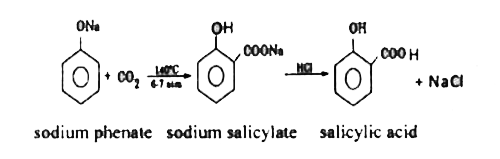
|
|
| 49. |
Express the following in S.I. base units using power of 10 notation (example 2.54 mm = 2.43xx10^(-3)m) (a)1.35mm(b)"1 day"(c)" 6.45 mL "(d) 48mug (e) 0.0426" in" |
|
Answer» Solution :S.I. unit of length is 'm' 1 m = 100 cm, 1 cm = 10 mm `therefore" Unit CONVERSTION FACTORS are"=(1m)/(100cm)=(100cm)/(1m)=1, (1cm)/(10mm)=(10mm)/(1cm)=1` `therefore""1.35mm=1.35mmxx(1cm)/(10mm)xx(1m)/(100cm)=1.35xx10^(-3)m` (b) S.I. units of TIME is 'sec' (s) `1day=1dayxx(24hour)/(1day)xx(60min)/(1HOUR)xx(60s)/(1min)=8.6400xx10^(4)s` (c) S.I. units of volume is `'m^(3)'` `6.45mL=6.45mLxx(1cm^(3))/(1mL)xx(1m)/(100cm)xx(1m)/(100cm)xx(1m)/(100cm)=6.45xx10^(-6)m^(3)` (d) S.I. unit of mass is 'kg' `48mug=48mugxx(10^(-6))/(1mug)xx(1kg)/(1000g)=4.8xx10^(-8)kg` (e) S.I. units of length is 'm' `0.0426"in"="0.0426 in"xx(2.54cm)/("1 in ")xx(1m)/(100cm)=1.082xx10^(-3)m` |
|
| 50. |
Explain the kinetics of zero order reaction. |
|
Answer» SOLUTION :In case of zero ORDER reaction, the rate of the reaction is independent of CONCENTRATION of the reactiant. For a reaction, `A rarr B` By rate law, Rate, `R=k[A]^(@)=k` where k is a rate constant. (1) The rate of the reaction remains constant even if the concentra- tion of the reactant decreases until reaction is complete. (2) The half-life of the reaction depends directly on the initial concentration of the reactant, `[A_(0)]` and given by `t_(1//2)=([A_(0)])/(2k).` |
|