

Saved Bookmarks
This section includes 7 InterviewSolutions, each offering curated multiple-choice questions to sharpen your Current Affairs knowledge and support exam preparation. Choose a topic below to get started.
| 1. |
Extractionof copperfrom copperpyrite (CuFeS_2)involves |
|
Answer» crushingfollowedby concentrationoftheoreby froth- floatation |
|
| 2. |
Extraction of copper from copper from copper pyrite (CuFeS_(2)) involves |
|
Answer» Crushing FOLLOWED by concentration of the ORE by forth FLOTATION |
|
| 3. |
Extraction ofchlrorinefrombrinesolution isbasedon |
|
Answer» ACIDIFICATION `2 Cl^(-) overset ("Oxidation")to Cl_ 2+2 e^(-) ` |
|
| 4. |
Explain the observations from the Ellingham diagram. |
|
Answer» Solution :1.For most of the metal OXIDE formation ,the slope is positive .It can be explianed as follows Oxygen gas is consumed during the formation of metal oxides which results in the decrease in randomness.Hence `DeltaS` becomes negative and it makes the term ,`TDeltaS` positive in the straight line equation. 2.The graph for the formation of carbon monoxide is a straight line with negative slope.In this case `DeltaS` is positive as 2 MOLES of CO gas is formed by the CONSUMPTION of one mole of oxygen gas.It indicates that CO is more STABLE at higher temperature. 3.AS the temprature increases ,generally `DELTAG` value for the formation of the metal oxide become less negative and becomes zero at a particular temprature.Below this temprature,`DeltaG` is negative and the oxide is stable and above this temprature .Below this temprature,`DeltaG` is negative and the oxide is stable and above this temprature `DeltaG` is positive.This general trend suggests that metal oxides become less stable at higher temprature and their decomposition becomes easier. 4.There is a sudden change in the slope at a particular temprature for some metal oxides like MgO,HgO. This is due to the phase transition (melting or evaporation). |
|
| 5. |
Explain the nucleophilic addition of HCN with ethanal? |
Answer» SOLUTION :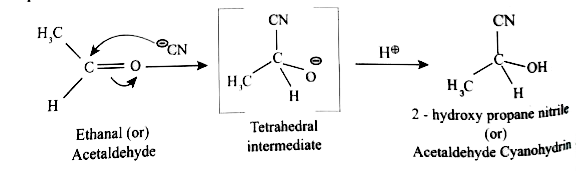
|
|
| 6. |
Extraction of aluminumcan beunderstoodbyWhich of the following statement is/are correct ? |
|
Answer» In Serpeck's process for the PURIFICATION of bauxite, ammonia is obtained as a by product In the Bayer.s process for the purification of bauxite the ore is digested with NaOH. |
|
| 7. |
Explain the nature of oxides of group-16 elements. |
|
Answer» Solution :The elements of group-16 form OXIDES of type `EO_2 `and `EO_3`. Where E = S, Se, TE or Po. `SO_(2)`is a GAS while `SeO_(2)`is solid. `SO_2` is reducing while `TeO_2` is an oxidising AGENT. The stability of oxides decreases from `SO_2` to `TeO_2`. Stability order: `SO_(2) gt SeO_(2) gt TeO_(2)` Acidic strength: `SO_(2) gt SeO_(2) gt TeO_(2)` The sulphur, selenium and tellurium also form oxides of type `EO_(3)` For example: `SO_(3), SeO_(3), TeO_(3)`. The acidic strength decreases down the group. Acidic strength: `SO_(3) gt SeO_(3) gt TeO_(3)` |
|
| 8. |
Explain the nature of hydride compounds of group-15 elements. |
|
Answer» Solution :All the elements of group-15 form hydrides of type EH3 where E = N, P, As, Sb or Bi. On moving down the group, the stability of hydrides decreases i.e.,` NH_3` is most stable while `BiH_(3)`is LEAST stable. This is due to decrease in the bond dissociation enthalpy of E-H bond as a result of increase in atomic size of the element. Consequently reducing CHARACTER of hydrides increases. Reducing strength: `NH_(3) lt PH_(3) lt AsH_(3) lt SbH_(3) lt BiH_(3)` Thermal stability: Thus ammonia is mild reducing agent while `BiH_3` is strong reducing agent. The basicity of the hydrides decreases down the group. `BiH_3` is least basic while `NH_3` is most basic. The high basicity of `NH_3` is due to high electronegativity and small size of NITROGEN. Order of basicity : `NH_(3) gt PH_(3) gt AsH_(3) gt SbH_(3) ge BiH_(3)` Ammonia (`NH_3`) exhibits hydrogen bonding both in solid and liquid state. Because of this it has higher melting and boiling points than that of `PH_3`. Order of boiling points : `BiH_(3) gt SbH_(3) gt NH_(3) gt AsH_(3) gt PH_(3)` 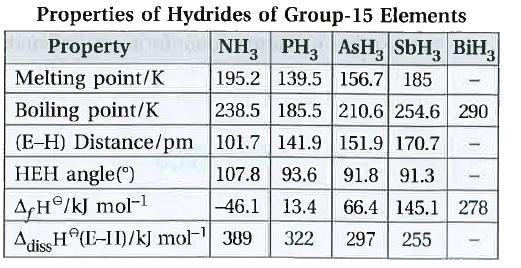
|
|
| 9. |
Explain the nature of oxide compounds of group-15 elements. |
|
Answer» Solution :All the elements of group-15 forms two types of oxides : `E_2O_3` and `E_2O_5`. The oxide in the higher oxidation STATE of the ELEMENT is more acidic than that of LOWER oxidation state. The acidic character decreases down the group. The oxides of the type `E_2O_(3)`of nitrogen and phosphorus are purely acidic, that of arsenic and antimony are amphoteric and those of bismuth are basic. `underset("Acidic")(N_(2)O_(3).P_(2)O_(3))underset("Amphoteric")(As_(2)O_(3).Sb_(2)O_(3)) .underset("Basic")(Bi_(2)O_(3))` The acidic strength of the trioxides and pentoxides decreases with the decrease in the ELECTRONEGATIVITY of central atom. Acidic strength of trioxide: `N_(2)O_(3) gt P_(2)O_(3) gt As_(2)O_(3)` Acidic strength of pentoxide: `N_(2)O_(5) gt P_(2)O_(5) gt As_(2)O_(5)` |
|
| 10. |
Extraction of aluminumcan beunderstoodbyWhat is wrong if anode is made of nickel instead of graphite ? |
|
Answer» Ni is costly Hence, (B) is the CORRECT ANSWER. |
|
| 11. |
Explain the nature of crystal defect produced when sodium chloride crystal is daped with MgCl_(2) |
| Answer» Solution :It CAUSES cation vacancies and the DEFECT is called Schottky defect. | |
| 12. |
Extraction of chlorine from brine solution is based on |
|
Answer» aciditication At CATHODE: `2H_(aq)^(+)+ 2e^(-) to H_(2(g))`(Reduction) At anode: `2Cl_(aq)^(-) to Cl_(2(g))+ 2e^(-)` (Oxidation) Overall reaction: `2NaCl_(aq)+ 2H_(2)O_(L) to Cl_(2(g))+ H_(2(g))+2NaOH_(aq)` |
|
| 13. |
Explain the nature of C - X bond in alkyl halides. |
Answer» Solution :Halogen atoms are more electronegative than carbon, therefore, carbon - halogen BOND of alkyl halide is polarised, the carbon atom bears a partial positive charge WHEREAS the halogen atom bears a partial negative charge.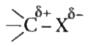 As we go down the group in the PERIODIC table, the SIZE of halogen atom is the smallest and iodine atom is the LARGEST. Consequently the carbon - halogen bond length also increases from C - F to C - I. 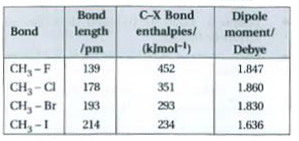 Order of dipole moment : `CH_(3)Cl gt CH_(3)F gt CH_(3)Br gt CH_(3)I` Order of bond enthalpies : `CH_(3)F gt CH_(3)Cl gt CH_(3)Br gt CH_(3)I` |
|
| 14. |
Extraction of aluminumcan beunderstoodby The purpose of adding cryolite is : |
|
Answer» to increase the ELECTRICAL CONDUCTIVITY of pure aluminium Hence, (A) is the correct answer. |
|
| 15. |
Explain the molecular structures of phosphorus trichloride and phosphorus pentachloride. |
Answer» Solution :shape similar to ammonia. The phosphorus atoms is `sp_3` hybridised with ONE LONE pair of electron. 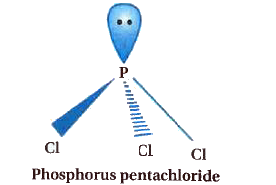 Phosphorus pentachloride is trigonal bipyramidal shape in gaseous and liquid phases. The phosphorus atom is `sp^(3)d` hybridized. In `PCl_(5)` , the three P-Cl equatorial BONDS are equivalent, while the two axial P-Cl bonds are longer than equatorial bonds. This is due to fact that axial bond pairs suffer greater REPULSIONS as compared to equatorial bond pairs. 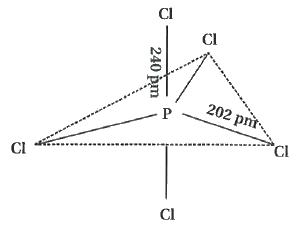
|
|
| 16. |
Extraction of aluminumcan beunderstoodby The molten electrolytes contains Na^(+), AI^(3+), Ca^(2+) but only AI gets deposited at cathode because : |
|
Answer» STANDARD reduction POTENTIAL of AI is more than those of Na & Ca Hence, (A) is the correct answer. |
|
| 17. |
Explainthe methodsof preparationof glucose . |
|
Answer» Solution :(i)When sucrose is boiledwith di`H_(2)SO_(4)`in alcoholicsolution, HYDROLYSIS take place andglucoseand FRUCTOSE are formed. ` underset("Sucrose")(C_(12)H_(22)O_(11)) + H_(2)O overset(H+) tounderset("Glucose")(C_(6)H_(12)O_(6)) + underset("Fructose")(C_(6)H_(12)O_(6))` (ii) Glucoseis PRODUCED commericallyby thehydrolysisof starchwithdiluteHClat hightemperature and pressure . `underset("Strach")((C_(6)H_(10)O_(5)))_(n)+ nH_(2)O underset("2-3atm pr")underset("393K") overset(H^(+))tounderset("Glucose")(nC_(6)H_(12)O_(6))` |
|
| 18. |
Extraction of aluminumcan beunderstoodbyIn Blast Furnace Fe_(2)O_(3) is reduced to FeO in reduction zone by CO, where temperature varies from about 300 to 800^(@)C. By using given Ellingham diagram choose the correct statement(s) of the following ? |
|
Answer» below 983 K FEO is REDUCED CO |
|
| 19. |
Explain the methods to prepare carbon dioxide. |
|
Answer» Solution :(i) On industrial scale it is produced by burning coke in excess of air. `underset(("coke"))(C)+O_(2)toCO_(2)` (ii) CALCINATION of lime PRODUCES carbon dioxide as by product. `CaCO_(3)overset(DELTA)(to)CaO+CO_(2)` (III) Carbon dioxide is prepared in laboratory by the aciton of dilute hydrochloric acid on metal carbonates. `CaCO_(3)+2HCl to CaCl_(2)+H_(2)O+CO_(2)` |
|
| 20. |
Extraction of aluminumcan beunderstoodbyThe function of fluorspar (CaF_(2)) is : |
|
Answer» to increase the melting point of electrolyte HENCE, (B) is the correct ANSWER. |
|
| 21. |
Explain the methods of preparation of colloids of (i) AS_(2)S_(3) (ii) S. |
|
Answer» Solution :(i) Double decomposition: When HYDROGEN sulphide gas is passed through a solution of arsenic OXIDE, a yellow coloured arsenic sulphide is obtained as a colloidal solution. `AS_2O_3 +3H_2S to underset("Colloid")(AS_2S_3) + 3H_2O` (ii) Decomposition:- When few drops of an acid is added to a dilute solution of sodium thiosulphate, the insoluble free sulphur produced by the decomposition of sodium thiosulphate accumulates into CLUSTERS which impart various colours blue, yellow and EVEN red to the system depending on their growth within the SIZE of colloidal dimensions. `S_2O_3^(2-) +2H^(+) to underset("sol")(S) + H_2O + SO_2` |
|
| 22. |
Extraction of aluminumcan beunderstoodby Extraction of metal from the ore cassiterite involes |
|
Answer» carbon reduction of an oxide ore The ore cassiterite CONTAINS the impurity of Fe, Mn, W and traces of Cu. |
|
| 23. |
Explainthe methodsof preparationoffructose withequations. |
|
Answer» Solution :(i) Fructosein obtainedfromsucroseby heatingwithdilute`H_(2)SO_(4)` (or) withthe enzymeinvertase. `UNDERSET("Sucrose")(C_(12)H_(22)O_(11))+ H_(2)OUNDERSET("Invertase")underset("(or)") overset("dilute")overset(H_(2)SO_(4)) tounderset("Glucose ")(C_(6)H_(12)O_(6)) +underset("Fructose")(C_(6)H_(12)O_(6))` (ii) Fructose is prepared commerciallyby thehydrolysis of Inulin (a POLYSACCHARIDE ) in acidicmedium . `underset("Inulin")((C_(6)H_(10)O_(5))_(n)) + nH_(2)O overset(H+) tounderset("Fructose")(nC_(6)H_(12)O_(6))` |
|
| 24. |
Extraction of aluminumcan beunderstoodby Among the following statements which is/are correct |
|
Answer» Calamine and Siderite are carbonate ORES. `"Malachite"-CuCO_(3).Cu(OH)_(2), "Azurite"-Cu(OH)_(2).2CuCO_(3),"Carnallite-KCI" MgCl_(2).6H_(2)O` |
|
| 25. |
Extraction of aluminumcan beunderstoodbyCoke powder is spreaded over the molten electrolyte due to : |
|
Answer» PREVENT the heat radiation from the surface Hence, (C) is the CORRECT answer. |
|
| 26. |
Explain the method to purify Titanium metal .[OR] Explain Van-Arkel method for refining Titanium.[OR] How will you purify metals by using iodine? |
|
Answer» Solution :This method is based on the thermal decomposition of metal compounds which lead to the formation of PURE metals.Titanium and zirconium can be purified using this method.For example,the impure titanium tetra-iodide. `(TiI_(4))`.The impurities are left behind,as theydo not react with iodine. `Ti_((s))+2I_(2)toTiI_(4)`(vapour) The volatile titanium tetraiodide vapour is PASSED over a tungsten filament at a temprature around 1800 K.The titanium is decomposed and pure titanium is deposited on the filament.The iodine is reused. `TiI_(4)(Vapour)toTi_(s)+2I_(2(s))` |
|
| 27. |
Extraction of Aluminium can be understand by: electrolyte reduction of AI_(2)O_(3) {:("Electrolyte":,:,(AI_(2)O_(3)+"Cryolite")),("Cathode",:,"Graphite inside the Fe container"),(Anode,:,"Graphite rods"):} What is wrong if anode is made of nickel instead of graphite? |
|
Answer» Ni is costly |
|
| 28. |
Explain the method of preparation of resorcinol from benzene. |
Answer» Solution :Benzene disulphonic ACID is OBTAINED by SULPHONATION of benzene, which on FUSION with ALKALI followed by acidicficaiton gives resorcinol. 
|
|
| 29. |
Extraction of aluminium from aluminium oxide (Al_(2)//O_(3))is het done by |
|
Answer» ELECTROLYTIC REDUCTION of `Al_2O_3` |
|
| 30. |
Explain the method of preparation of gold sol by reduction method. |
|
Answer» SOLUTION :GOLD solis PREPARED by the REDUCTION of auricchloride usingformaldehyde. `2AuCl_3 + 3HCHO + 3H_2O to 2Au"(SOL)" + 6HCl + 3HCOOH` |
|
| 31. |
Extraction of Al from bauxite is carried out by variousstages in Hall's process which involves I removal of sand and heavier impurities by gravityseparation method. II. removal of magnetic impurities by magneticseparator. III. fusing the concentrated finely divided ore withNa_2CO_3 and CaCO_3 and then extracting with H_2O. IV. ignition at 1100^@C. V. passing CO_2 Correct order of these steps are |
|
Answer» I,II,III,V,IV |
|
| 32. |
Explain the medicinal application of coordination compounds ? |
|
Answer» Solution :`(i)CA` -EDTA chelate is USED in the treatment of lead and radioactive poisoning. This is for removing lead and radioactive METAL ions from the body. `(ii)` Cis-platin is used as an ANTI tumor drug in cancer treatment. |
|
| 33. |
Explain the mechanism of the reaction of alkyl halide formation from primary alcohol. |
Answer» SOLUTION :
|
|
| 34. |
Extraction of Ag from commercial lead is possible by: |
|
Answer» PARKE's process |
|
| 35. |
Explain the mechanism of S_(N^(2)) reaction. |
Answer» Solution :Example of `S_(N^(2))` REACTION `CH_(3) Cl+ underset((AQ))(KOH) overset(Delta)toCH_(3)OH+KCl` 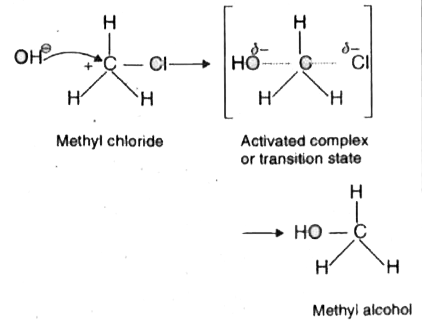 `S_(N^(2))` reaction is accompanied by inversion in configuration. |
|
| 36. |
Extraction is a process of obtaining metals in the free state from concentrated ores. The two main operations for working of the ore are, conversion of concentrated ore to its oxide from (oxidation or de-electronation) and conversion of oxide to the metal (reduction or de-electronation). The concentrated ore is converted to metal oxide by calcination and roasting. The oxide of the metal is converted to metallic form by using reducing agents such as C,CO or active metals (Na, K, Mg, Al, etc). The Ellingham diagrams help in choosing the better reducing agents. Some metals like gold and silver are extracted by leaching process which involves both oxidation and reduction. Why zinc and not copper used for the recovery of metallic silver from its [Ag(CN)_(2)]^(-) complex ? |
| Answer» SOLUTION :Zinc is more electropositive than Ag and therefore, zinc DISPLACES Ag from its solution. But copper is less electropositive than SILVER and cannot displace silver from its solution. | |
| 37. |
Extraction is a process of obtaining metals in the free state from concentrated ores. The two main operations for working of the ore are, conversion of concentrated ore to its oxide from (oxidation or de-electronation) and conversion of oxide to the metal (reduction or de-electronation). The concentrated ore is converted to metal oxide by calcination and roasting. The oxide of the metal is converted to metallic form by using reducing agents such as C,CO or active metals (Na, K, Mg, Al, etc). The Ellingham diagrams help in choosing the better reducing agents. Some metals like gold and silver are extracted by leaching process which involves both oxidation and reduction. Give two examples of metal oxides which can be reduced to metals by C or CO. |
| Answer» SOLUTION :ZNO, FEO | |
| 38. |
Extraction of a metal from ore cassiterite involves : |
|
Answer» Carbon reduction f the OXIDE ore. |
|
| 39. |
Extraction is a process of obtaining metals in the free state from concentrated ores. The two main operations for working of the ore are, conversion of concentrated ore to its oxide from (oxidation or de-electronation) and conversion of oxide to the metal (reduction or de-electronation). The concentrated ore is converted to metal oxide by calcination and roasting. The oxide of the metal is converted to metallic form by using reducing agents such as C,CO or active metals (Na, K, Mg, Al, etc). The Ellingham diagrams help in choosing the better reducing agents. Some metals like gold and silver are extracted by leaching process which involves both oxidation and reduction. What type of ores are roasted ? |
| Answer» SOLUTION :SULPHIDE ORES. | |
| 40. |
Explain the mechanism of S_N1 reaction taking 2-bromo-2-methyl propane (t-butyl bromide) |
|
Answer» SOLUTION :Tertiary butyl bromide. When treated with aqueous KOH, tertiary butyl alcohol is formed. `(CH_(3))_(3)C-Br+KOH rarr (CH_(3))C-OH+KBr`. The `S_(N)`. REACTION mechanism involves two steps. step (i) : FORMATION of Carbonation. Tertiary butyl bromide undergoes ionization to form tertiary carbo cation of bromide ion. `CH_(3)-overset(CH_(3))overset("|")underset(CH_(3))underset("|")("C ")-Br overset(" Slow ")rarr CH_(3)-overset(CH_(3))overset("|")underset(CH_(3))underset("|")("C ")+Br^(-)` This is the slow step is hence is a rate determining step. Step - (ii) : Attack of nuclephile on carbocation. The NUCLEOPHILE `OH^(-)` attacks the positive centre of carbocation from any one of the direction forming the final product i.e., tertiary butyal alcohol. `CH_(3)-overset(CH_(3))overset("|")underset(CH_(3))underset("|")(C^(+))+OH^(-) overset(" Fast ")rarr CH_(3)-overset(CH_(3))overset("|")underset(CH_(3))underset("|")("C ")-OH` |
|
| 41. |
Extraction is a process of obtaining metals in the free state from concentrated ores. The two main operations for working of the ore are, conversion of concentrated ore to its oxide from (oxidation or de-electronation) and conversion of oxide to the metal (reduction or de-electronation). The concentrated ore is converted to metal oxide by calcination and roasting. The oxide of the metal is converted to metallic form by using reducing agents such as C,CO or active metals (Na, K, Mg, Al, etc). The Ellingham diagrams help in choosing the better reducing agents. Some metals like gold and silver are extracted by leaching process which involves both oxidation and reduction. What is the basic difference between calcination and roasting . |
| Answer» SOLUTION :During CALCINATION, the concentrated ore is HEATED either in the absence or in the limited supply of air. But ROASTING is carried out in EXCESS of air. | |
| 42. |
Explain the mechanism of oxidation of HCl by air in the presence of CuCl_(2). |
|
Answer» Solution :`UNDERSET("CATALYST")(2CuCl_2) to underset("Product")(Cl_2) + Cu_2Cl_2` `2Cu_2Cl_2 + underset("REACTANT")(O_2) to underset("Intermediate CPD/")(2Cu_2OCl_2)` `2Cu_2OCl_2 + underset("Reactant")(4HCl) to underset("Product")(2H_2O) + underset("Catalyst")(4CuCl_2)` |
|
| 43. |
Explain the mechanism of nucleophilic addition to a carbonyl group and give one example of such addition reactions. |
Answer» SOLUTION :The following MECHANISM applies to the nucleophilic addition to a carbonyl GROUP. 
|
|
| 44. |
Explain the mechanism of nucleophilic addition reactions of aldehyde and ketone? |
|
Answer» Solution :The carbonyl carbon carries a small degree of positive CHARGE. (ii) Nucleophile such as `CN^-`can attack the carbonyl carbon and uses its BOND pair to form a new carbon – nucleophile . `sigma`. bond, at the same time two electrons from the carbon – oxygen double bond move to the most electronegative oxygen atom. (iii)This results in the formation of an alkoxide ion. In this PROCESS, the hybridisation of carbon changes from spa to `sp^3` 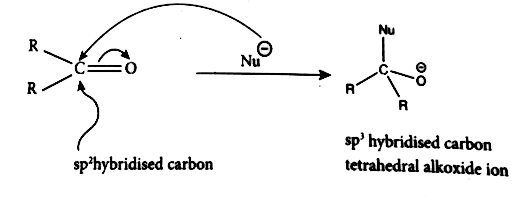 The tetrahedral INTERMEDIATE can be protonated by water or an acid to form an ALCOHOL.. 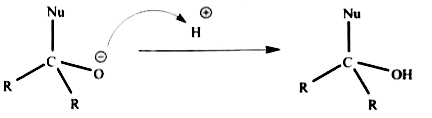
|
|
| 45. |
Extra pure N_2can be obtained by heating : |
|
Answer» `NH_3` with `CuO` `Ba(N_3)_2overset(Delta)rarr Ba+3N_2` |
|
| 46. |
Explain the mechanism of esterification. Write the reactions involved in dehydration of 1^(@), 2^(@) and 3^(@) alcohols |
Answer» Solution :The esterification of carboxylic acid with alcohol is nucleophillic acyclic substution. The carboxylic acid is protonated on its carboxyl oxygen atom. Alcohol acts as a nucleophile and attacks carboxyl CARBON thus loss of proton gives ester hydrates. 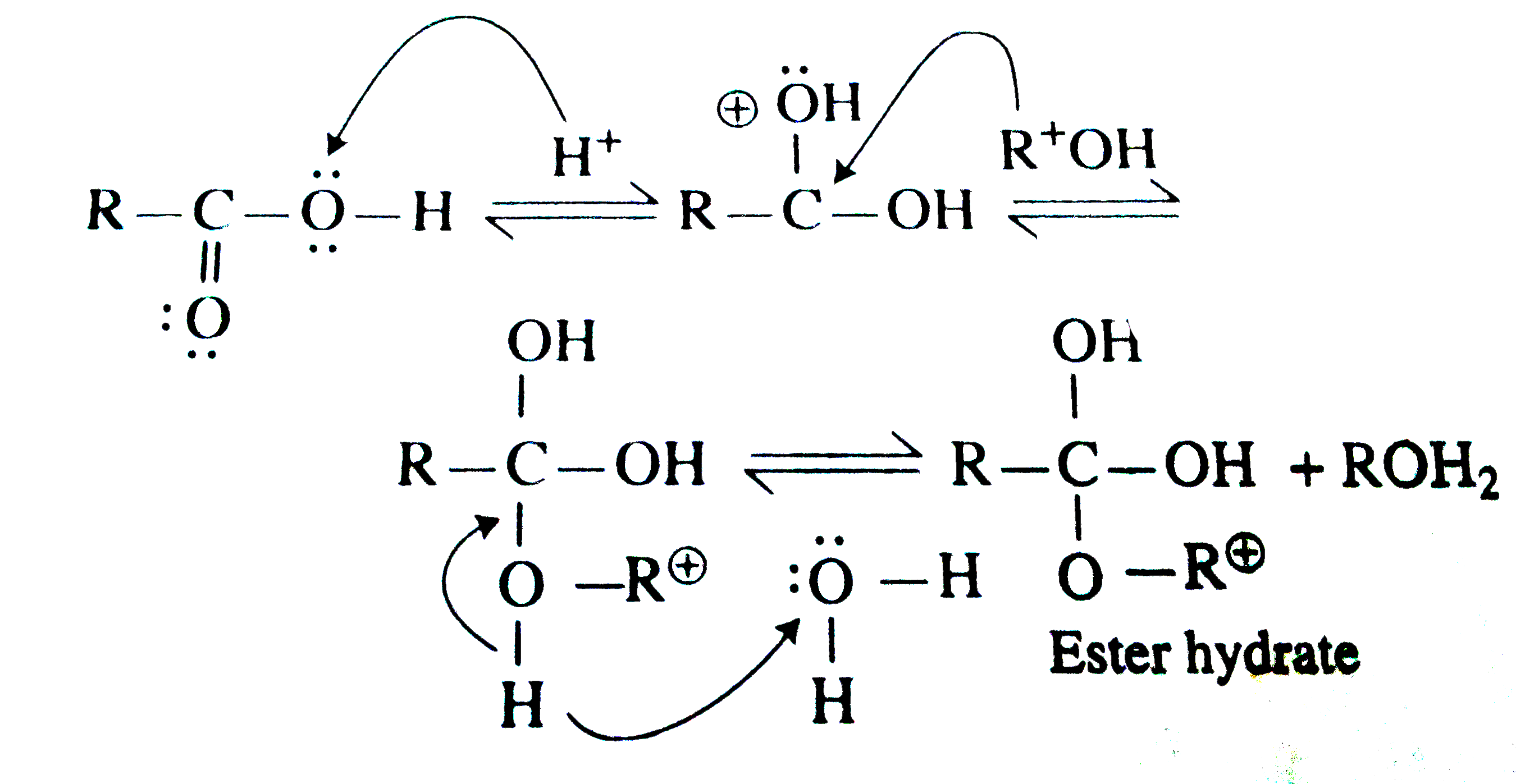 Further one of the -OH group of ester hydrate gets protonated and LOOSES a molecule of water 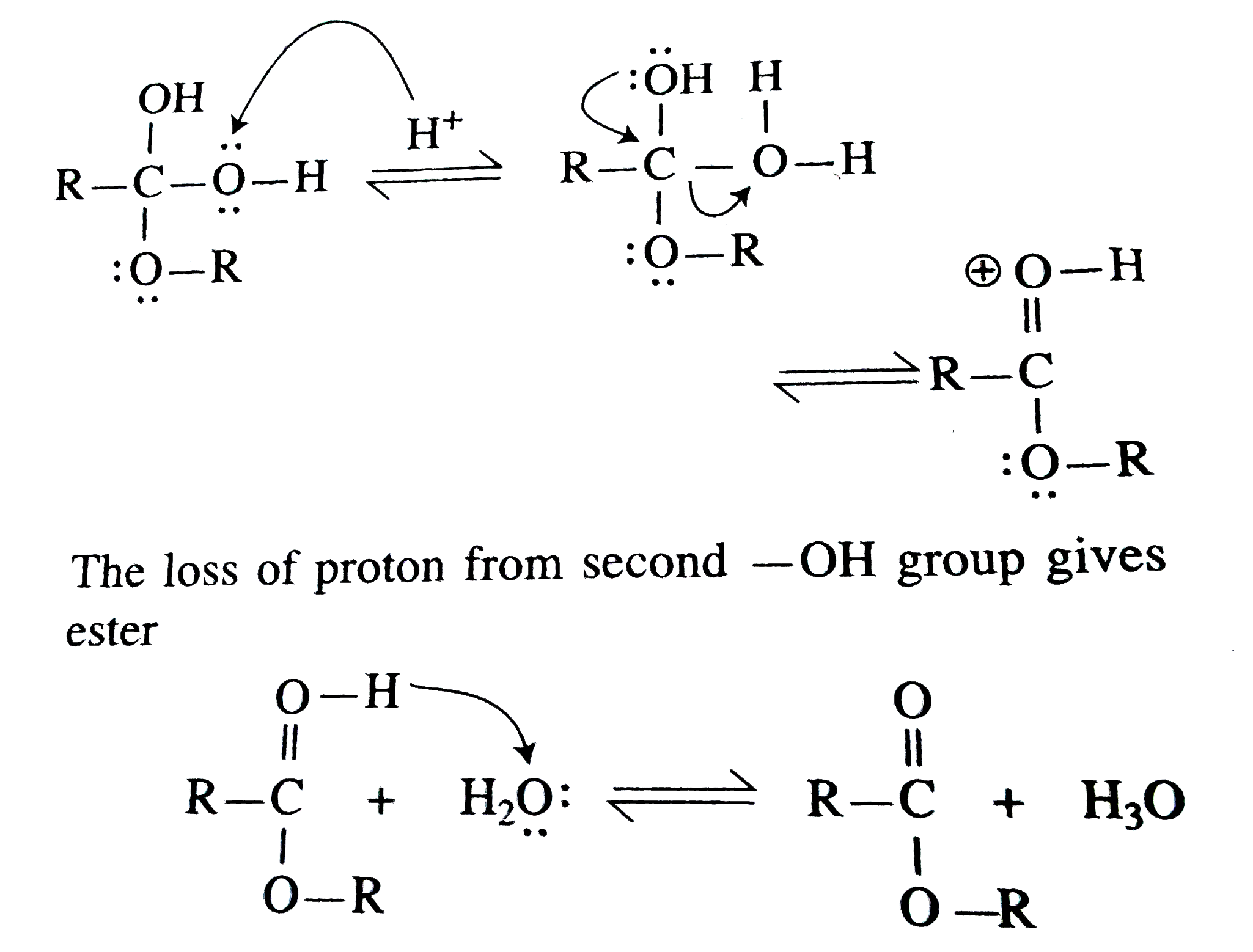 Reaction involved in dehydration of `1^(@), 2^(@)` and `3^(@)` alcohols. Primary alcohol is dehydrated by heating with 95% `H_(2)SO_(4)` at 443 K `H underset("Ethanol")(- underset(H)underset(|)overset(H)overset(|)(C ) - underset(H)underset(|)overset(H)overset(|)(C )-O) - H underset(443K)overset(95% H_(2) SO_(4))(to) H underset("Ethene")-(overset(H)overset(|)(C ) = overset(H)overset(|)(C ) )- H` Secondary alcohol is dehydratd by heating with 60% `H_(2) SO_(4)` at 373 K `H underset("Propane" 2 - ol)(-underset(H)underset(|)overset(H)overset(|)(C )- underset(OH)underset(|)overset(H)overset(|)(C ) - underset(H)underset(|)overset(H)overset(|)(C ) -) H underset(373K)overset(60% H_(2) SO_(4))(to) CH_(3) - CH = CH_(2) + H_(2) O` `CH_(3) - underset(|)underset(OH)(CH) - CH_(2) - CH_(3) underset(373 K)overset(60% H_(2) SO_(4))(to)` 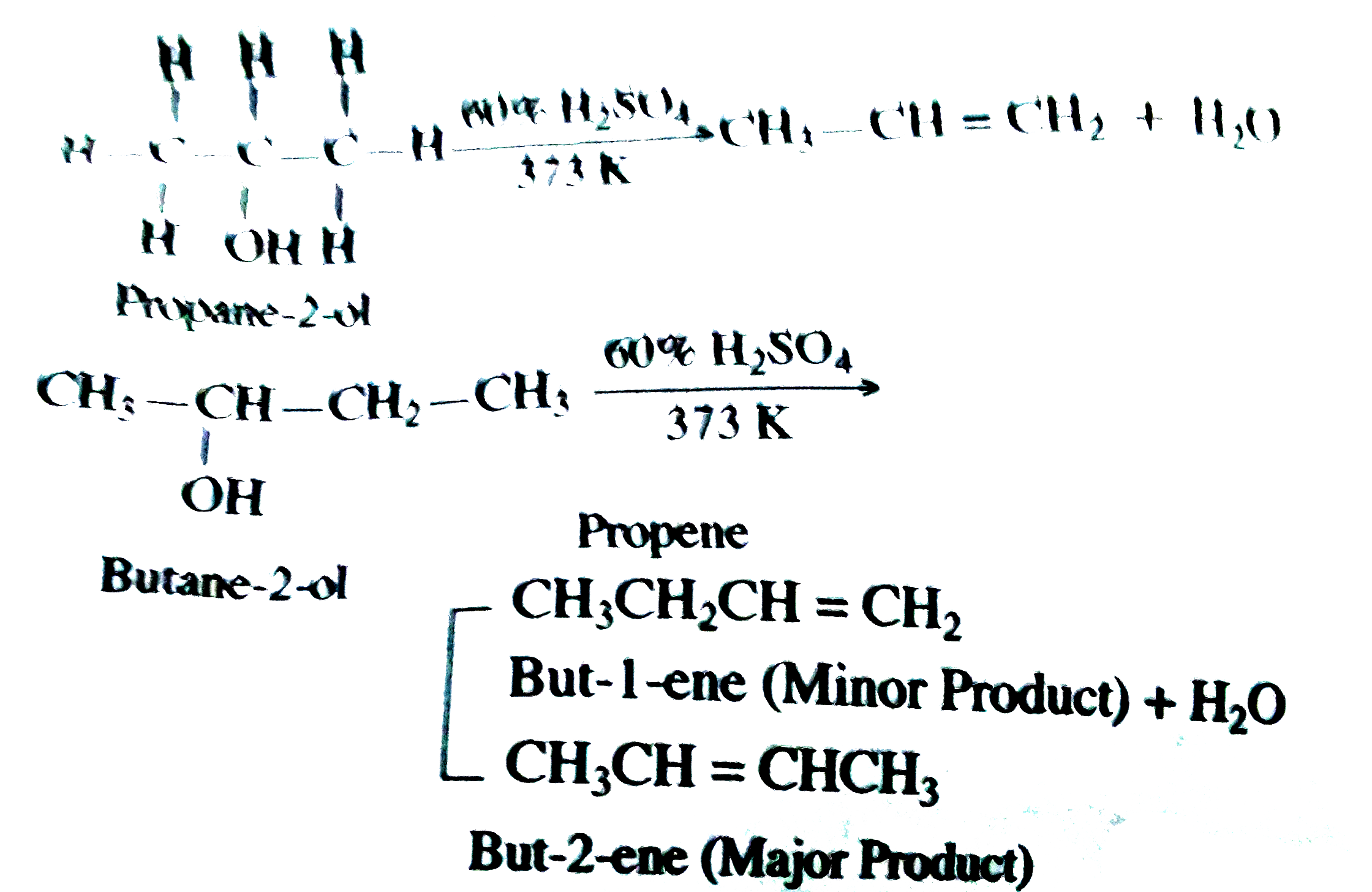 Tertiary alcohol is dehydrated by heating with 20% `H_(2)SO_(4)` at 373 K `underset(2-"methly - 2 Propanol")(CH_(3) - underset(CH_(3))underset(|)overset(CH_(3))overset(|) - OH) underset(373 K)overset(20% H_(2) SO_(4))(to) underset("2-methyl prop -2-ene")(CH_(3) - underset(CH_(3))underset(|)overset(CH_(2))overset(||) + H_(2) O)` |
|
| 47. |
Extent of physisorption of a gas increases with ________ . |
|
Answer» INCREASE in TEMPERATURE |
|
| 48. |
Explain the mechanism of esterification of carboxylic acid. (Feb. ' 16) |
Answer» Solution :The esterification of carboxylic acids with alcohols is a nucleophilic acylic SUBSTITUTION . The carboxylic ACID is protonated on its carboxyl oxygen atom . Alcohol acts as a nucleophilic and attacks carboxyl CARBON . Loss of proton gives ester HYDRATE. 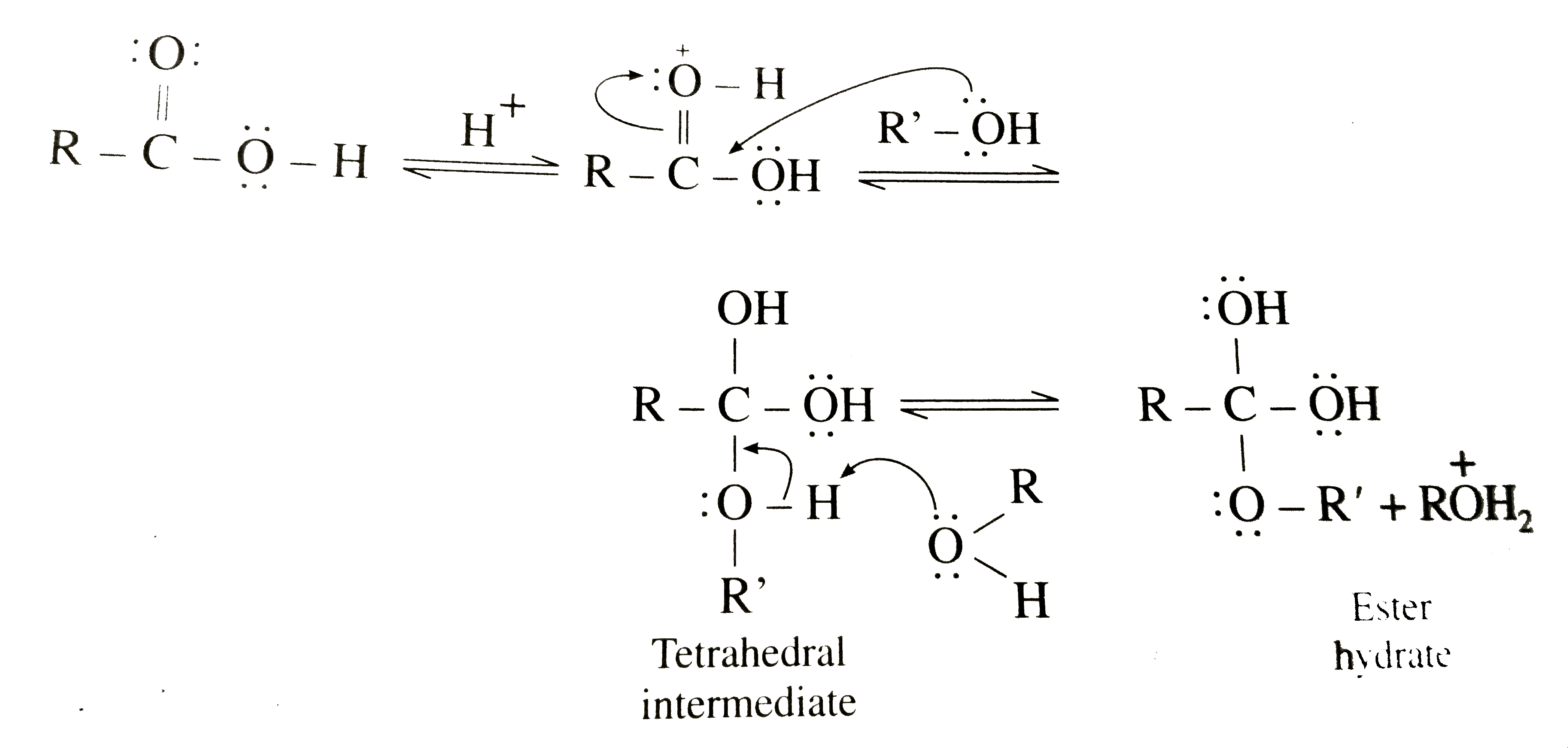 Further , one of the -OH group of ester hydrate gets protnated and water molecule departs. 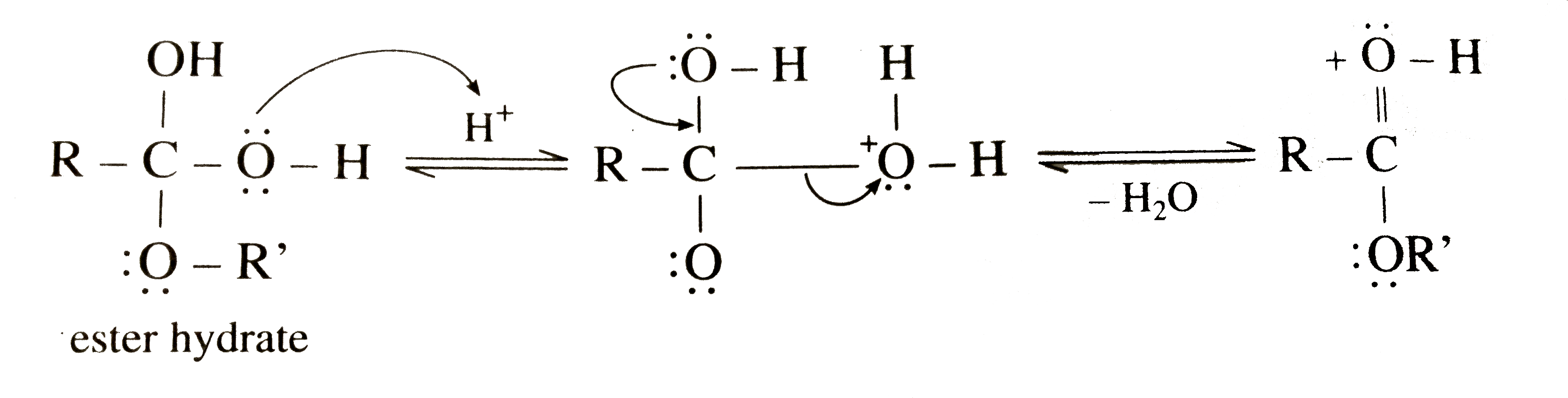 Theloss of proton from second HYDROXYL group gives ester. 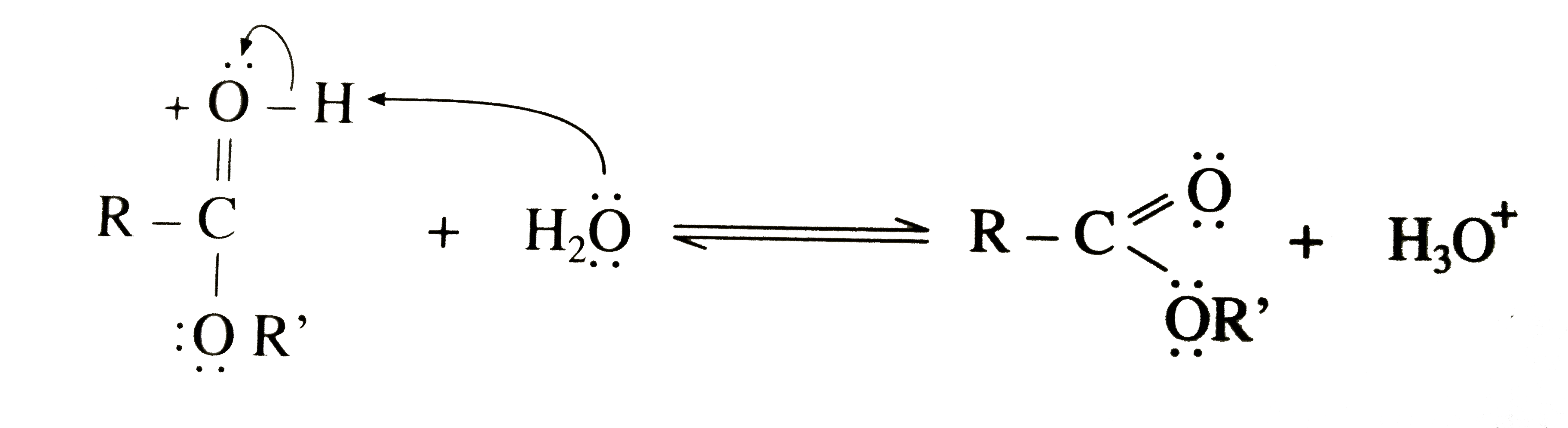 In esterification , water molecule is formed by the combination of H - atom of the alcohol and - OH group of the carboxylic acid. |
|
| 49. |
Explain the mechanism of esterification. |
Answer» SOLUTION :The Mechanism of ESTERIFICATION INVOLVES the following STEPS. 
|
|