

Saved Bookmarks
This section includes 7 InterviewSolutions, each offering curated multiple-choice questions to sharpen your Current Affairs knowledge and support exam preparation. Choose a topic below to get started.
| 1. |
Explain why propanol has higher boiling point than that of the hydrocarbon, butane ? |
Answer» Solution :This is because of presence of POLAR -OH GROUP in PROPANOL, that form INTERMOLECULAR H-bonding 
|
|
| 2. |
Explain the following with proper reasoning: (i) Although p-hydroxy benzoic acid is less acidic thanbenzoic acid but alpha-hydroxy benzoic acid (salicylic acid) is 15 times more acidic than benzoic acid. (ii) Oxidation of toluene by acidic KMnO_(4) gives poor yield of benzoic acid while oxidation of p-O_(2)NC_(6)H_(4)CH_(3) gives good yield of p-nitrobenzoic acid. |
Answer» Solution :(i) Presence of -OH group (electron withdrawing) on BENZOIC acid decreases the acidic nature because negative charge on carboxylate ion DECREASE thereby MAKING carboxylate ion less stable. The resonance effectbeing stronger as compared to inductive effect, there is net increase in electron densifty at o-and p- positions, p-hydroxy benzoic acid is, therefore, less acidicthan benzoic acid. However, in o-hydroxy benzoic acid, there is intermolecular hydrogen bonding which STABILIZES o-hydroxy benzoate ion (conjugated base) to greater extent and thereby increasing acidic nature. 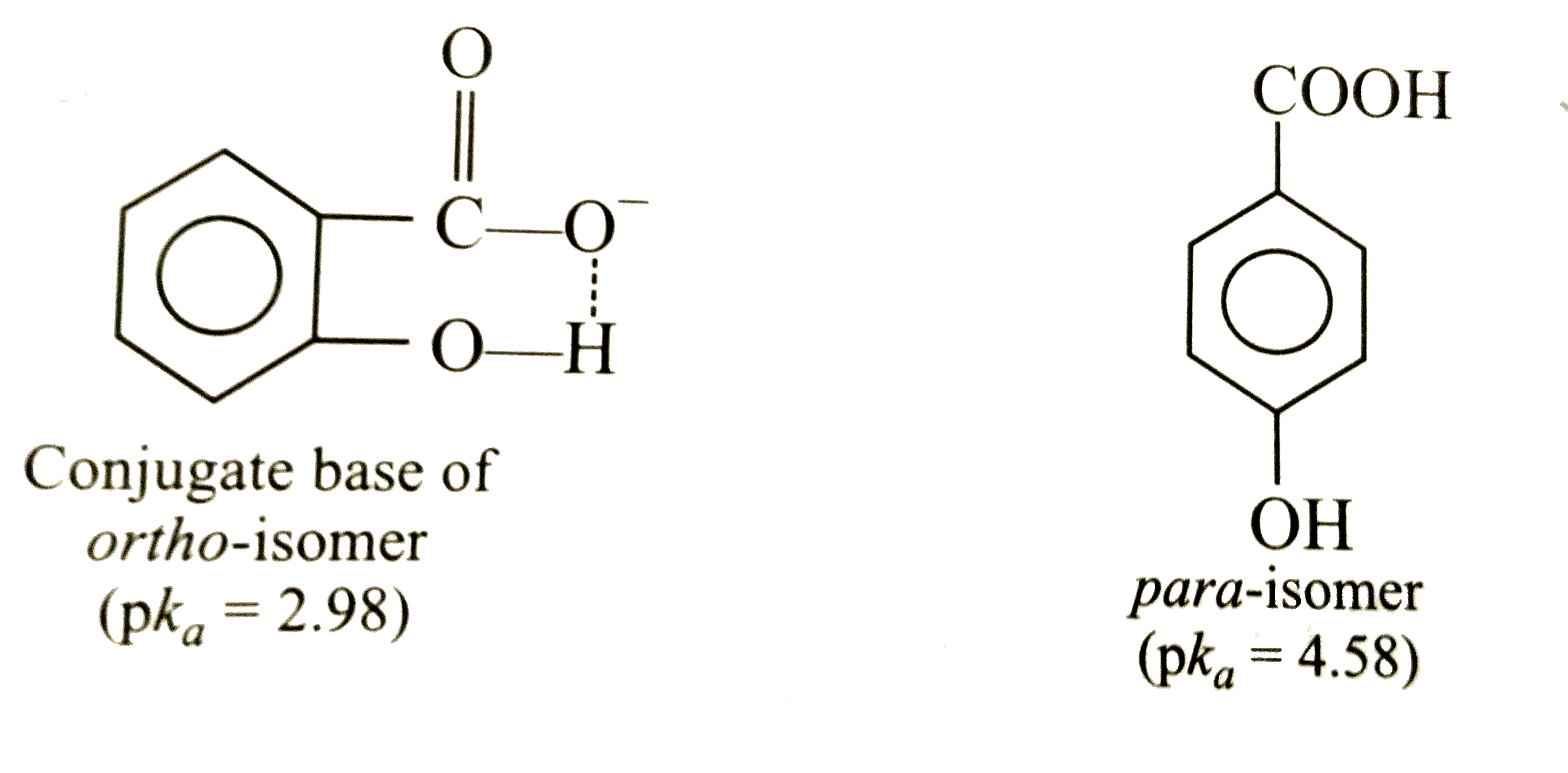 This anomalous behaviour of groups when present m ortho-position is termed ortho effect. (ii) Oxidant is an electrophile, it can DESTROY the ring in case of toluene. But in para-nitrotoluene, the `-NO_(2)~ group deactivates the benzene ring and thus increases the yield of p-nitrobenzoic acid. |
|
| 3. |
Explain why propanol has higher boiling point than that of the hydrocarbon, butene? |
Answer» SOLUTION :The molecules of butane are held togetehr by WEAK van DER waals FORCES of attraction while those of propanol are held TOGETHER by stronger intermolecular hydrogen bonding. 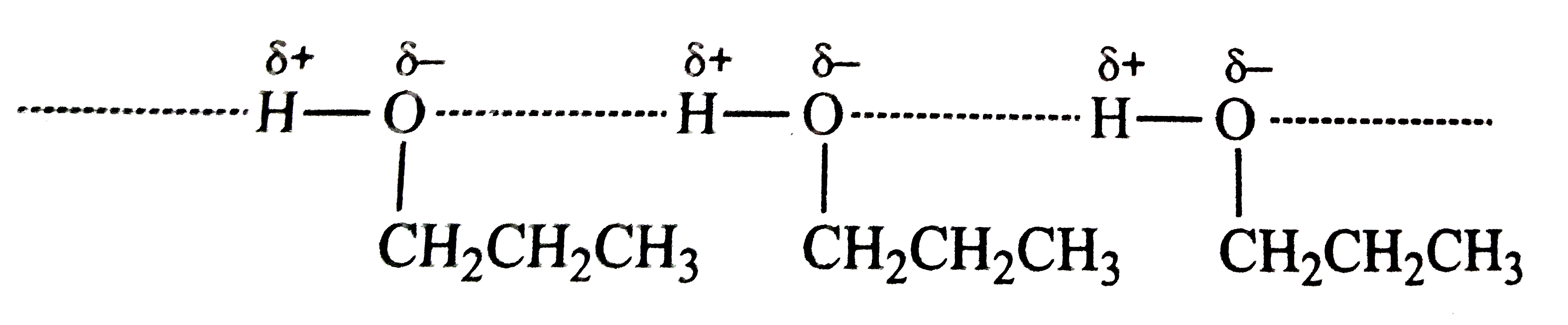 Therefore, the b.p. of propanol is much higher than that of butene. |
|
| 4. |
Explain, why propanol has higher boiling point than that of the hydrocarbon, butane? |
|
Answer» Solution :The molecules of butane are HELD together by weak van der Waals. force of attraction while those of propanol are held together by stronger INTERMOLECULAR hydrogen bonding as shown : `{:("- - - - - - - -"overset(delta+)H-overset(delta-)O"- - - - - - - -"overset(delta+)H-overset(delta-)O"- - - - - - - -"overset(delta+)H-overset(delta-)O"- - - - - - - -"),("|||"),(""CH_(2)CH_(2)CH_(3)""CH_(2)CH_(2)CH_(3)""CH_(2)CH_(2)CH_(3)):}` GREATER the intermolecular interactions, higher the BOILING point. Therefore, the boiling point of propanol is much higher than that of butane. |
|
| 5. |
Explain why polymerisation of accrylonitrile is preferred under ationic polymerisation ,wheereas polymersation of vinylic monomers containing polymersation of vinylic monomers continingEDG is preferred under cation mechanism. (b) Explain the polumerisation of buta-1,3-diene using different routes. |
|
Answer» Solution :Acrylonitrile `(CH_(2)=CH=CN)`Contains`EWG(-C-=N)`Group which stabilises the carbanion intermediate ,Moreover ,cabianion INTERMEDIATES are produced in both the chain-initiation and chain-propagation steps,hence POLUMERISATION of acrylonitriles is preferred under anionic conditions. (1)Chain-initiation step: 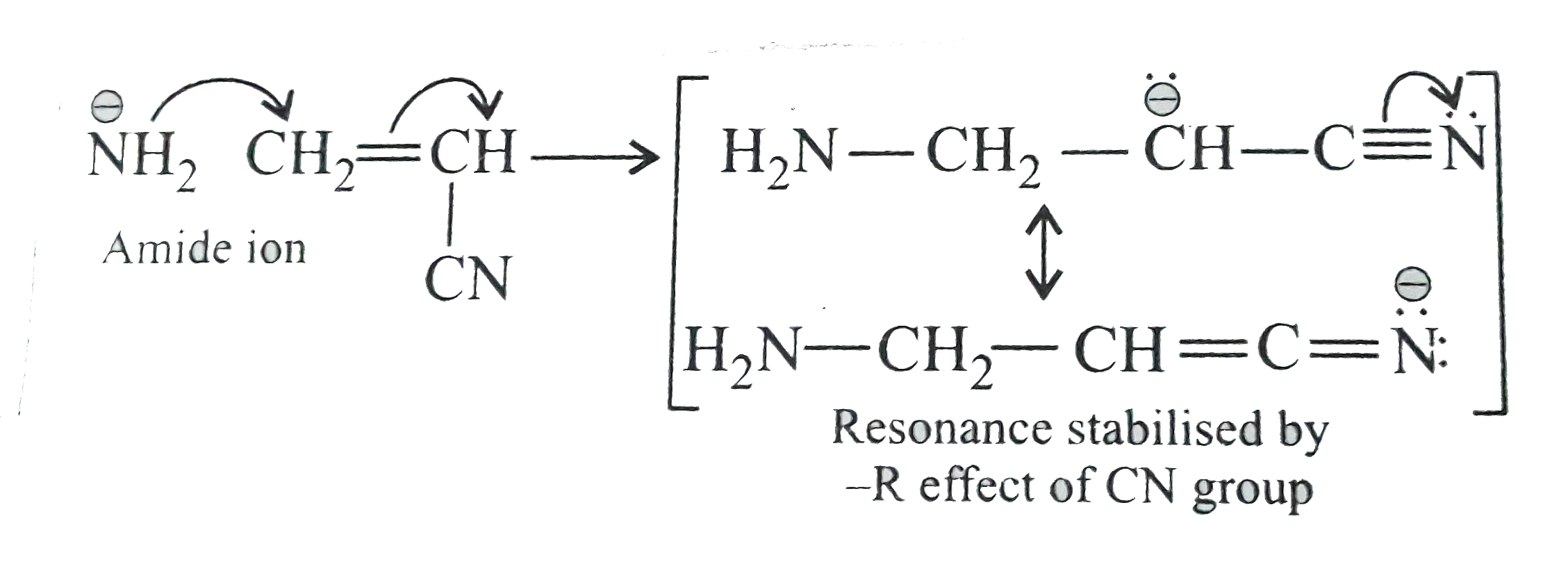 (2)Chain propagation step: 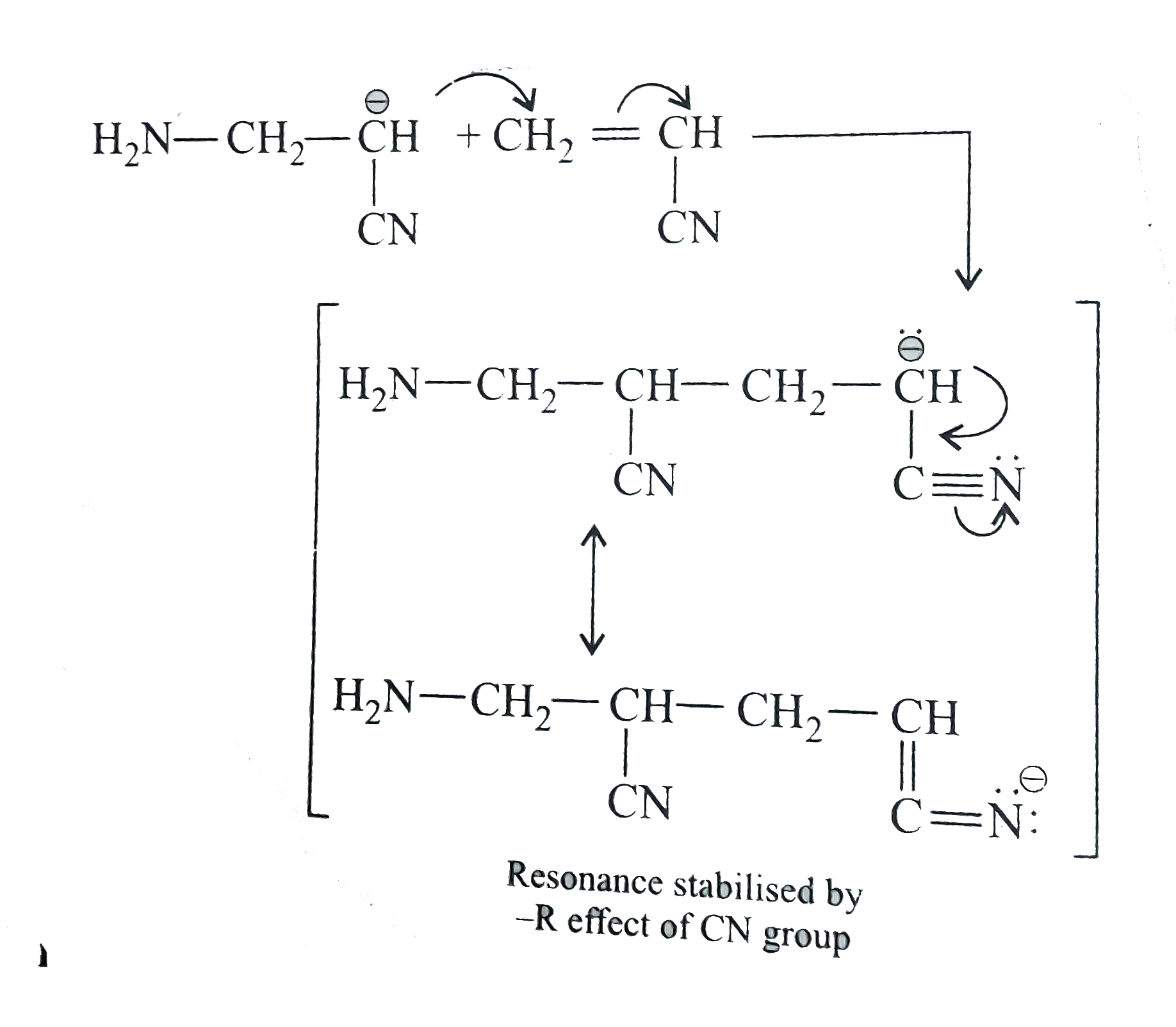 (ii)Cationic polumerisationof vinylic monomer CONTAINING`EDG`cationic polymerisation is carried out in hte presence of acids.It forms carbocation intermediate and is stabilised by`EDG`both in chain-initiation and in chain -propagation steps.Hence polymersation is preferred under cations conditions. (1)Chain-initiation step: 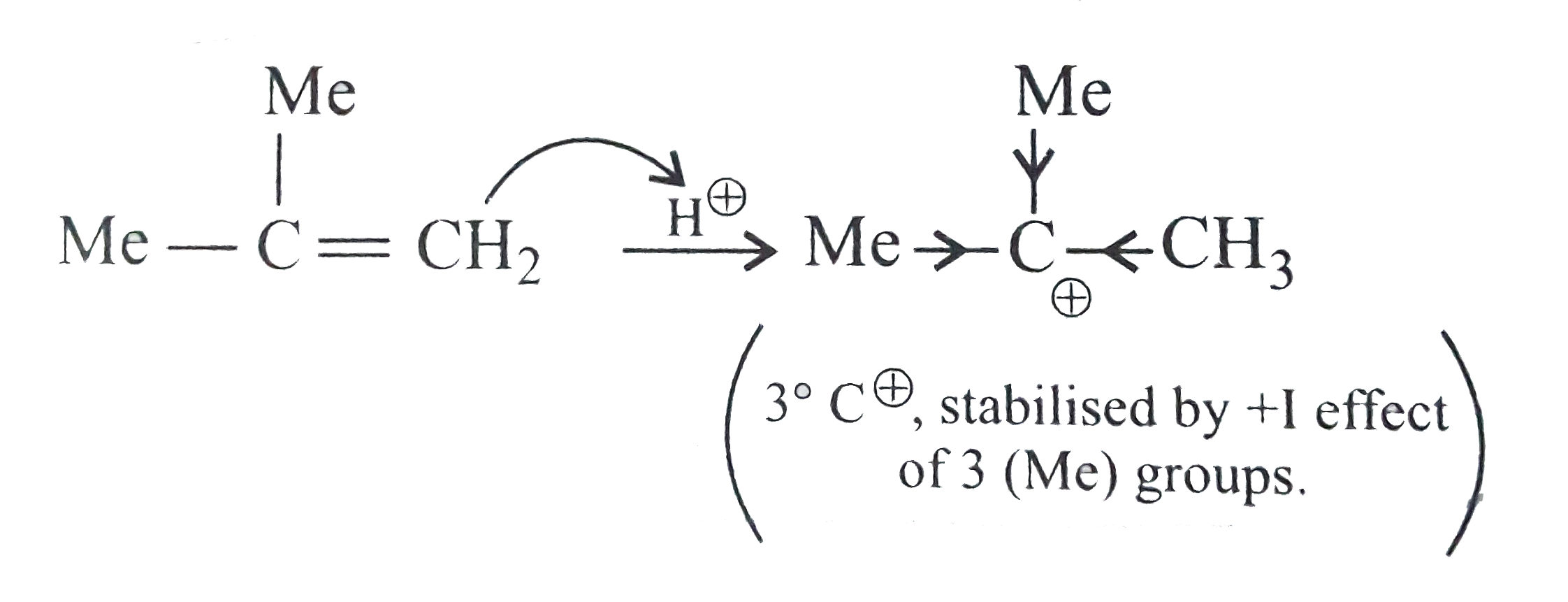 (2)Chain-propagation step: 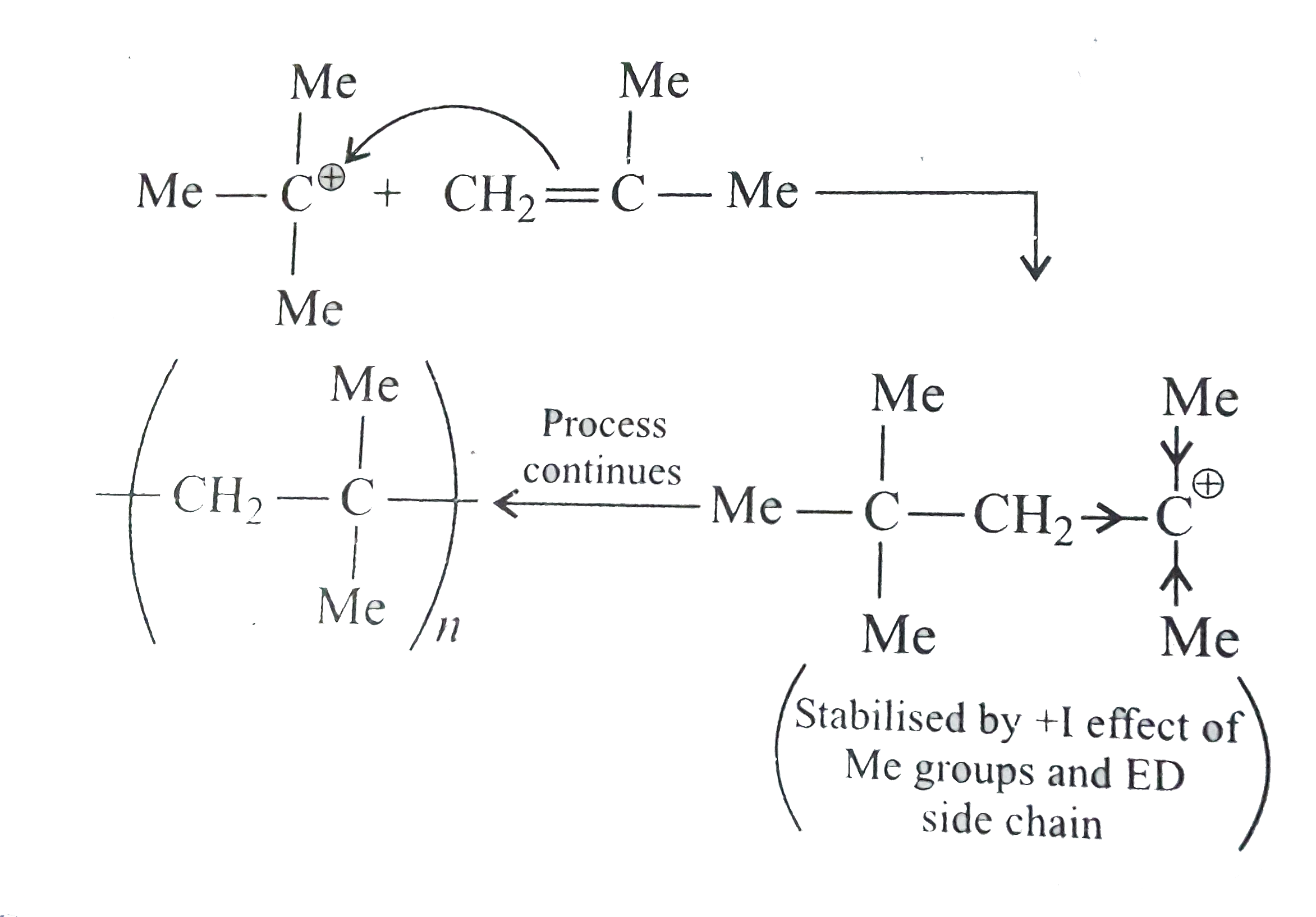 (b)Buta`-1,3-`diene is a conjugate diene which can be polymersation either by `1,4,-`addition or by`1,2-`addition MECHANISM. (i).`1,4-`Polymersation :It gives unbranced polymer. 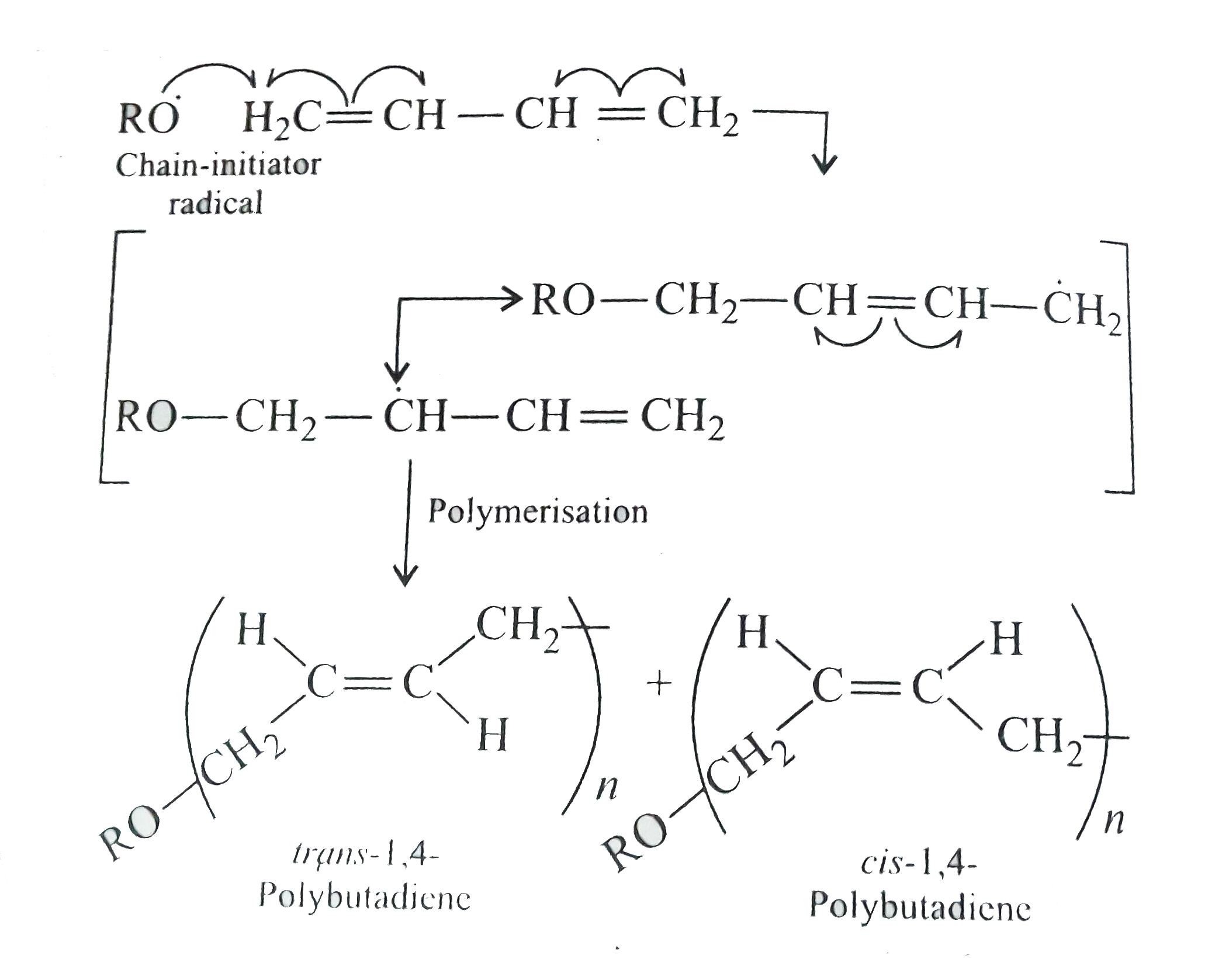 (ii)1,2-Polymersation:it gives branced polymer. 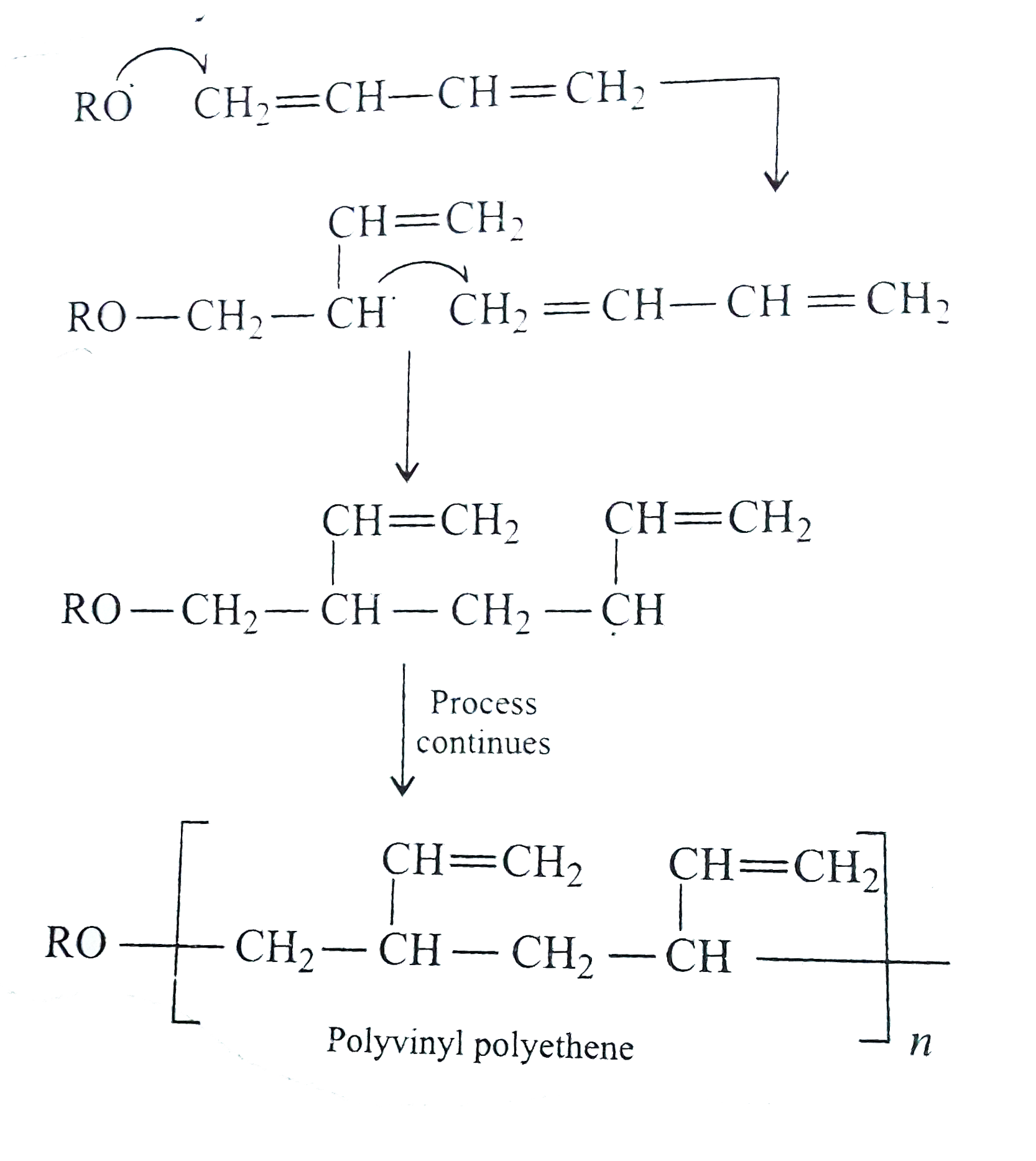
|
|
| 6. |
Explain why phenols do not undergo substitution of the -OH group like alcohols? |
| Answer» Solution :The C-O bonn in phenols has some double BOND character due to RESONANCE and hence cannot be EASILY cleaved by a nucleophile., in contrast, the C-O bond in ALCOHOLS is a pure SINGLE bond and hence can be easily cleaved by a nucleophile. | |
| 7. |
Explain the following with proper reasonin (i) Why do halogen acids which are easily added to (ii) Pure HCN fails to react with aldehydes. (iii) Why only RCHO, RCOCH_(3) and cyclic ketones react with NaHSO_(3)? (iv) Chloral hydrate is a stable compound even it is a gem-diol. (v) Formation of oximes and other ammonia derivatives from carbonyl compounds require slightly acidic media for maxiumum rate (vi) In the following reaction, three isomers are present in the equilibrium which is most stable (vii) teh strurcture of two isomeric oximes formed by the reaction of acetophenon with hydroxylamine hydrochloride. (viii) Why o-hydroxy benzaldehyde is a liquid at room temperature while p-hydroxy benzaldehyde is high metling solid? |
Answer» Solution :(i) Halogen acids readily combine to the polarised 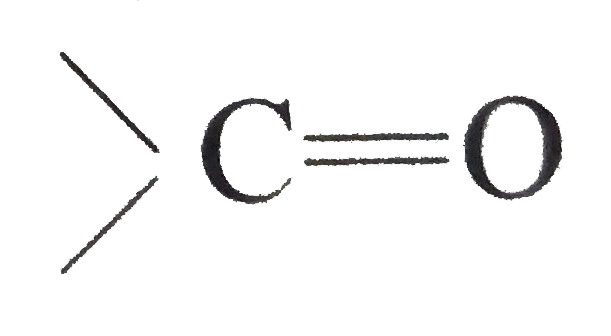  The addition product being similar to gem-dihydroxyle compound decomposes into the original substance  (ii) HCN is a covalent compound an does not furnish `CN^(-)` ions. However, in the presence of bases, it furnishes sufficient concentration of `CN^(-)` ions and the reactionproceeds. `HCN+OH^(-)rarrH_(2)CN^(-)` (iii)`SO_(3)^(2-)` is a large ion. Its addition is possible only under the condition that 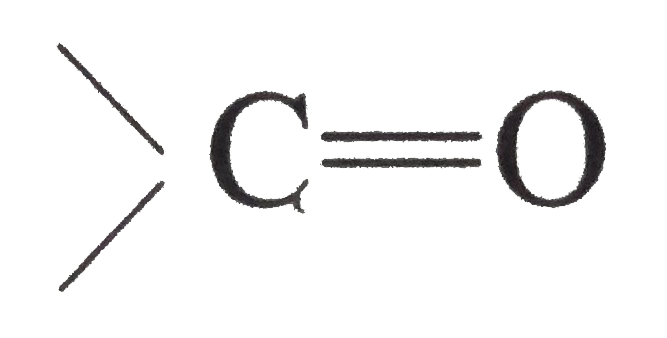 grouping is not sterically hindered as is the case for RCHO `RCOCH(3)` and CYCLIC ketones grouping is not sterically hindered as is the case for RCHO `RCOCH(3)` and CYCLIC ketones (iv) In chloral, the -I effect of three chlorine atoms destabilise the 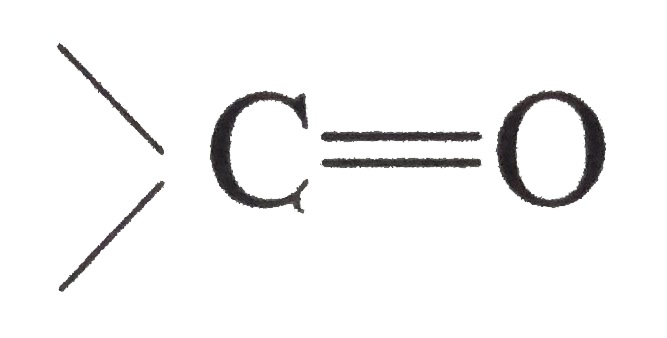 structure as it uts `delta^(+)` charge on the carbon adjacent to the carbonyl `overset(delta^(+))C`. In the chloral hydrate, adjacent positive charges are not present. AS a result, weak nucleophiles like water readily add to the structure as it uts `delta^(+)` charge on the carbon adjacent to the carbonyl `overset(delta^(+))C`. In the chloral hydrate, adjacent positive charges are not present. AS a result, weak nucleophiles like water readily add to the 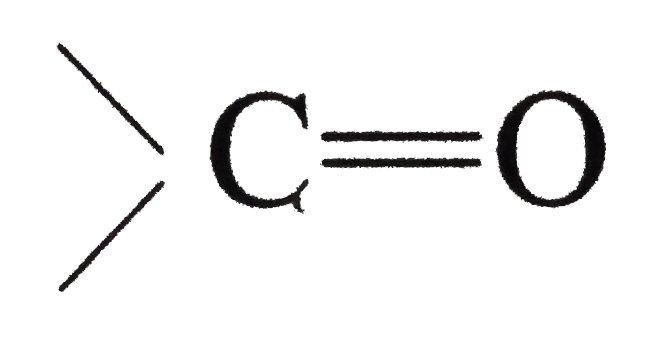 group formin chloral group formin chloral hydrate there by shifting the equilibrium almost entirely towards right. Besides this, the intramolecular H-bonding between Cl and H atom of the -OH group further stabilies the chloral hydrate molecule. The hydrogen bonding in the molecule also increases its stability 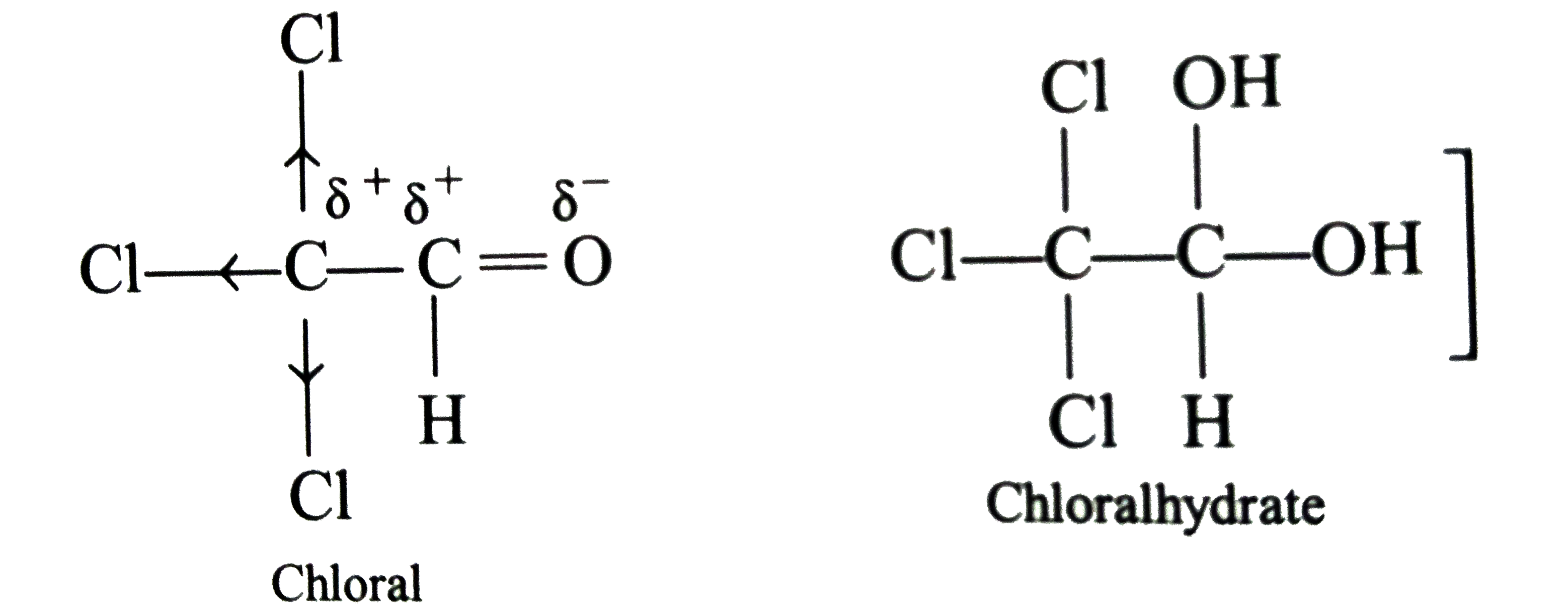 (v) In WEAKLY acidic medium, carbonyl group is protonated,  Thsi faciliates the addition of Lewis bases. However, is strongly acidic media, the nitrogen of the reagent is protonated through the unshared pair of electrons and thus the reagent ATTACK the carbonyl group. In basic, media, there is no protonation of carbonyl group. (VI) Crotonaldehyde is most stable, sicneit is a conjugatedaldehyde. (vii) 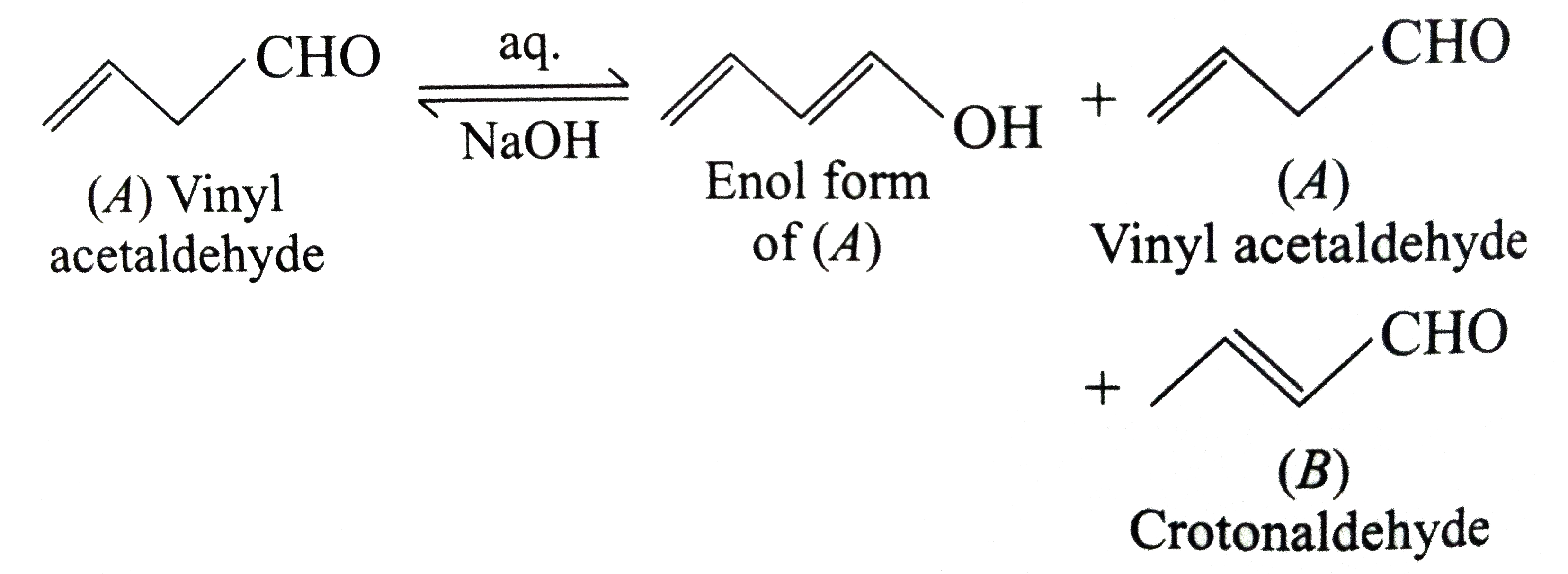 (viii) o-Hydroxy benzaldehyde involves intramolecular hydrogen bonding, hence it is a liquid because itsintermolecular forces is low. On the other hand, p-hydroxy benzaldehyde involves intramolecular hydrogen bonding and therefore, it is a soilid. 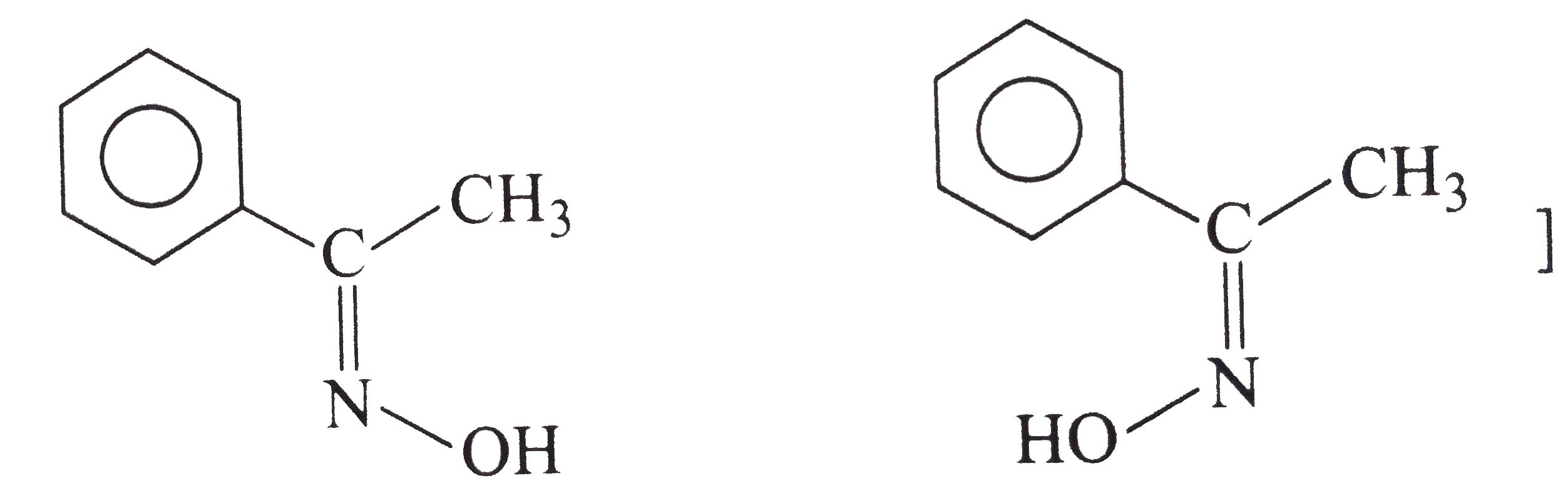 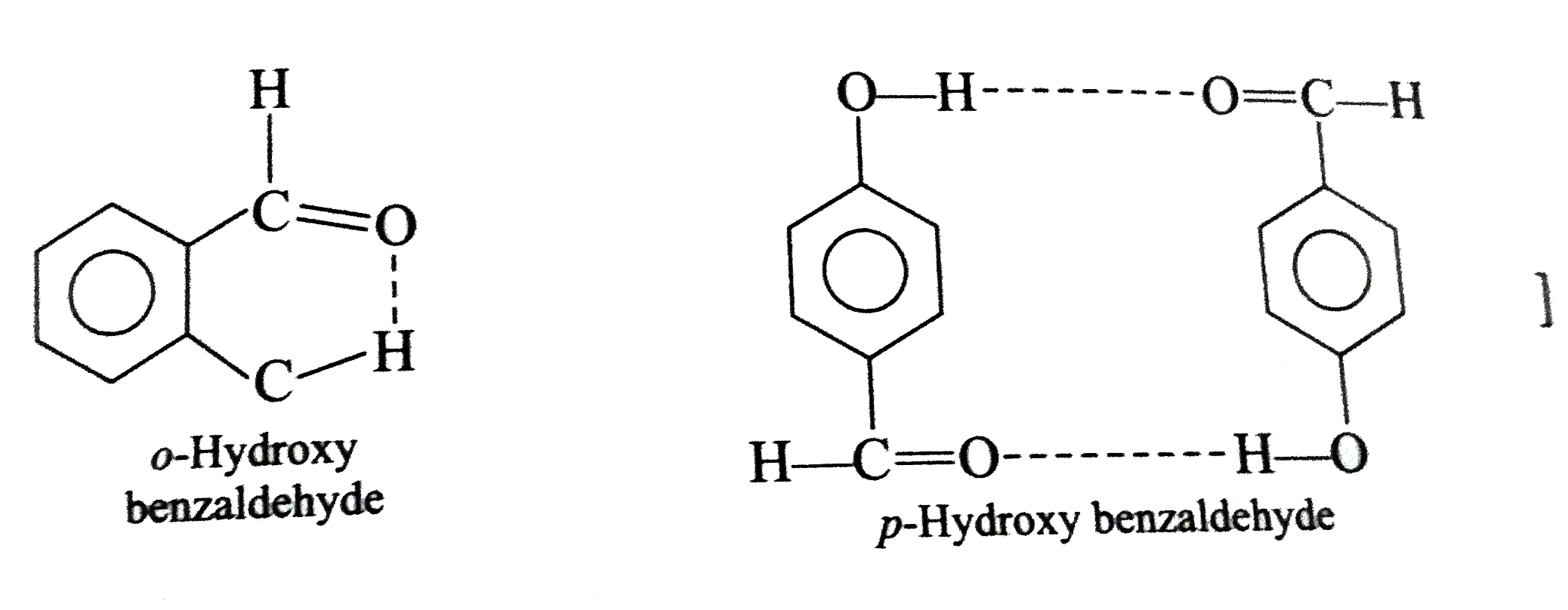
|
|
| 8. |
Explain why phenol does not undergo substiution of the -OH group like alcohol. |
| Answer» Solution :In phenol the ELECTRON density is increased in the benzene ring and hence the benzene ring is activated TOWARDS electrophilic substitution REACTION and -OH group does not undergoes substitution reactioon like alcohol. | |
| 9. |
Explain the following with proper reason : (i)Fluorine cannot be prepared from fluorides by chemical oxidation. (ii)Anhydrous HCl is a bad conductor of electricity while aqueous HCl is a good conductor. (iii)Halogens are strong oxidising agents. (iv)Bleaching of flowers by chlorine is permanent while after bleaching with SO_(2), the colour returns. (v)Iodine dissolves more in KI solution than in water. (vi)KHF_(2) is well known whereas KHCI_(2) or KHBr_(2) does not exist. (vii)Ferric iodide is very unstable but ferric chloride is stable. (viii)Fluorine does not form F_(3)^(-) (polyhalide) ion. (ix)HF is not stored in glass bottles but kept in wax lined bottles. (x)HF has a greater electronegativity difference and more ionic character than HCl, HBr and Hl but it is the weakest acid. |
|
Answer» `:ddotunderset(..)F.+e^(-)to:ddotunderset(..)F.^(-)` Thus, it cannot be oxidised by any other reagent. `F^(-)` ion is very stable due to small size and high electronegativity of fluorine atom. (ii)In anhydrous state, `HCI` is a covalent molecule. In aqueous solution, `HCI` combines with water molecule to FORM `H_(3)O^(+)` and `CI^(-)` IONS. `HCl (g)+H_(2)O(l)toH_(3)O^(+) (aq)+Cl^(-)(aq)` (iii)Halogens act as a strong oxidising agents because they have high tendency to accept electron, i.e., they have high electron affinity values.Their reduction potentials are high (positive) and decrease from `F_(2)` to `I_(2)`.Thus, oxidising nature decreases from `F_(2)` to `I_(2)`. (iv)Chlorine bleaching action is due to oxidation while that of sulphur dioxide is due to reduction.Hence, the substance bleached by `SO_(2)` is reoxidised by the oxygen of the air to its original state. `Cl_(2)` bleaches coloured material by oxidation and thus bleaching is permanent. `CI_(2) + H_(2)Oto2HCI + [O]` Coloured material +`[O] to` COLOURLESS on the other hand beaching by `SO_(2)` is by reduction and thus temporary because colourless articles are further oxidised by air. `SO_(2)+2H_(2)Oto2H_(2)SO_(4) + 2[H]` Coloured material + `[H] to` Colourless `overset([O])to` coloured (v)`I_(2)` is a covalent molecule.Thus, its solubility is less in polar solvent, i.e., water.Potassium iodide combines with iodine and forms a polyhalide with an ionic compound.Being ionic, `KI_(3)` is more soluble. `KI+I_(2)toKI_(3)(K^(+)I_(3)^(-))` (vi)Hdrofluoric acid exists as dimeric molecule `(H_(2)F_(2))` due to hydrogen bonding.It, thus, exhibits dibasic nature and forms two series of salts, `KHF_(2)` as `[K^(+)` and `F^(-)---H--F]` and `KF[K^(+)` and `F^(-)]`.`HCl` and `HBr` exists as monomeric molecules as hydrogen bonding is not present. (vii)`I^(-)` ions is a strong reducing agent.Iodide thus reduces ferric into ferrous, `Cl^(-)` ion is a weak reducing agent and does not reduce `Fe^(3+)` to `Fe^(2+)`. (viii)`F`-does not have empty `d`-orbital liked other halogen. The formation of `X_(3)^(-)` ions involves `sp^(3)d`-hydridization. (ix)`HF` attacks glass bottles. The sodium and potassium silicates are CONVERTED into flurosilicates `Na_(2)SiO_(3)+6HFtoNa_(2) SiF_(6) + 3H_(2)O` (x)The weakest acidic nature of `HF` is due to following three factors: (i)Strong `H-F` bond as the dissociation energy is high. (ii)Large heat of dehydration due to hydrogen bonding. (iii)Low value of electron affinity. |
|
| 10. |
Explain why p-nitrophenol is more acidic than phenol. |
Answer» Solution :DUE to -I and -R-effect of the `-NO_(2)` group, the electron DENSITY in the O-H bond decreases RELATIVE to O-H group in phenol  As a result, p-nitrophenol is MUCH more acidic than phenol. |
|
| 11. |
Explain the following with examples : (a) Antipyretics (b) Analgesics |
Answer» Solution :(a) Antipyretics. These are the substances used to lower the temperature of the body in high fever. Most common antipyretics are (i) aspirin (acetyl salicylic ACID), (ii) paracetamol (4-acetamidophenol) and (iii) PHENACETIN. Their structures are given below :  (B) Analgesics. These are medicines used to relieve PAINS. Aspirin and some other antipyretics are also used as analgesics. For example, MORPHINE, codeine, heroin , marijuana. These are knownto be habit forming. |
|
| 12. |
Explain why p-nitrophenol is more acidic than phenol ? |
| Answer» Solution :`to` An electron withdrawing GROUP like `-NO_(2)` stabilises the phenoxide ion by dispersal of negative charge. Thus, it increases the acidic strength of the phenol. The -M effect of `-NO_(2)` group is more pronounced at ORTHO and para POSITIONS which results in higher acidic strength of p-nitro phenol. | |
| 13. |
Explain the following with an example : (i) Kolbe.s reaction (ii) Reimer - Tiemann reaction. (iii) Williamson ether synthesis. (iv) Unsymmetrical ether. |
Answer» Solution :(iv) If the ALKYL or aryl groups attached to the oxygen atom are different, ethers are called UNSYMMETRICAL ethers. For EXAMPLE, ETHYL methyl ether, methyl phenyl ether, etc. 
|
|
| 14. |
Explain why ozone is thermodynamically less stable than oxygen ? |
|
Answer» SOLUTION :The conversion of ozone to oxygen FAVOURS by LIBERATION of heat and increase in entropy (`DeltaS`) These two factors results in large negative VALUE of free energy change (`DeltaG`) for its conversion to ozone. Thus, ozone is thermodynamically less stable than oxygen. |
|
| 15. |
Explain why ozone is thermodynamically less stable than oxygen. |
|
Answer» Solution :SINCE formation of ozone from oxygen is ENDOTHERMIC, therefore, `O_(3)` is thermodynamically less stable than `O_(2)` `3O_(2)(G) overset("Silent electric discharge")(hArr) 2O_(3)(g), DeltaH^(@)(298 K) = + 142 kJ mol^(-1)` |
|
| 16. |
Explain the following with an example. (i) Kolbe's reaction. (ii) Reimer-Tiemann reaction. (iii) Williamson ether synthesis. (iv) Unsymmetrical ether. |
| Answer» Solution :`to` (IV) UNSYMMETRICAL ethers are organic compounds in which the ETHEREAL oxygen is bonded to TWO different alkyl or aryl GROUPS. For example, `CH_(3) -O-C_(2)H_(5)`. | |
| 17. |
Explain the following with an example: (i) Kolbe's reaction (ii) Reimer-Tiemann reaction (iii) williamson ether synthesis (iv) Unsymmetrical ether. |
| Answer» Solution :(iv) If the alkyl or aryl groups ATTACHED to the oxygen ATOM are different, ethers are called unsymmetrical ethers. For example, ethyl methyl ETHER, methyl phenyl ether, 4-chlorophenyl 4-nitrophenyl ether, etc. WRITE the structures of these ethers yourself. | |
| 18. |
Explain the following with an example for each : (i) Kolbe's reaction (ii) Reimer-Tiemann reaction (iii) Williamson ether synthesis |
Answer» Solution :(i) Kolbe's reaction : when sodium phenoxide is heated carbon dioxide under pressure, sodium slaicylate is botained as mahor PRODUCT. This on ACIDIFICATION gives salicylic acid. 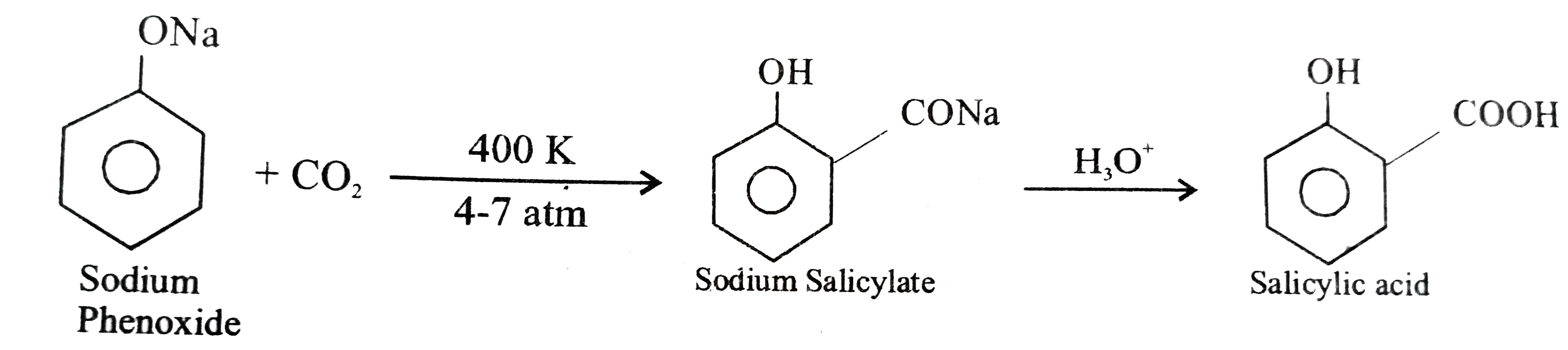
|
|
| 19. |
Explainwhyoxidationstatesof transitionelementsincreases firstfrom Sc to Mn andthendecrease ? |
|
Answer» SOLUTION :(i) Theuse of3d electronfor formation ofbondincreasesfrom SC to Mn causingthe INCREASESIN oxidationstateupto +7 . (ii) Thereasonfor Mnhavinghighestoxidationstateof +7is due tothe presenceof 7 unpairedelectronsin itsatom. (III)As thenumberof unpairedelectrons decreasesfrom Feto CU .sothere is thedecrease in oxidation state. |
|
| 20. |
Explain the following with an exampe in each : {:((i)"Kolbe's reaction.",(i)"Reimer-Tiemann reaction."),((iii)"Williamson ether synthesis.",):} |
Answer» Solution :(i) Kolbe's reaction 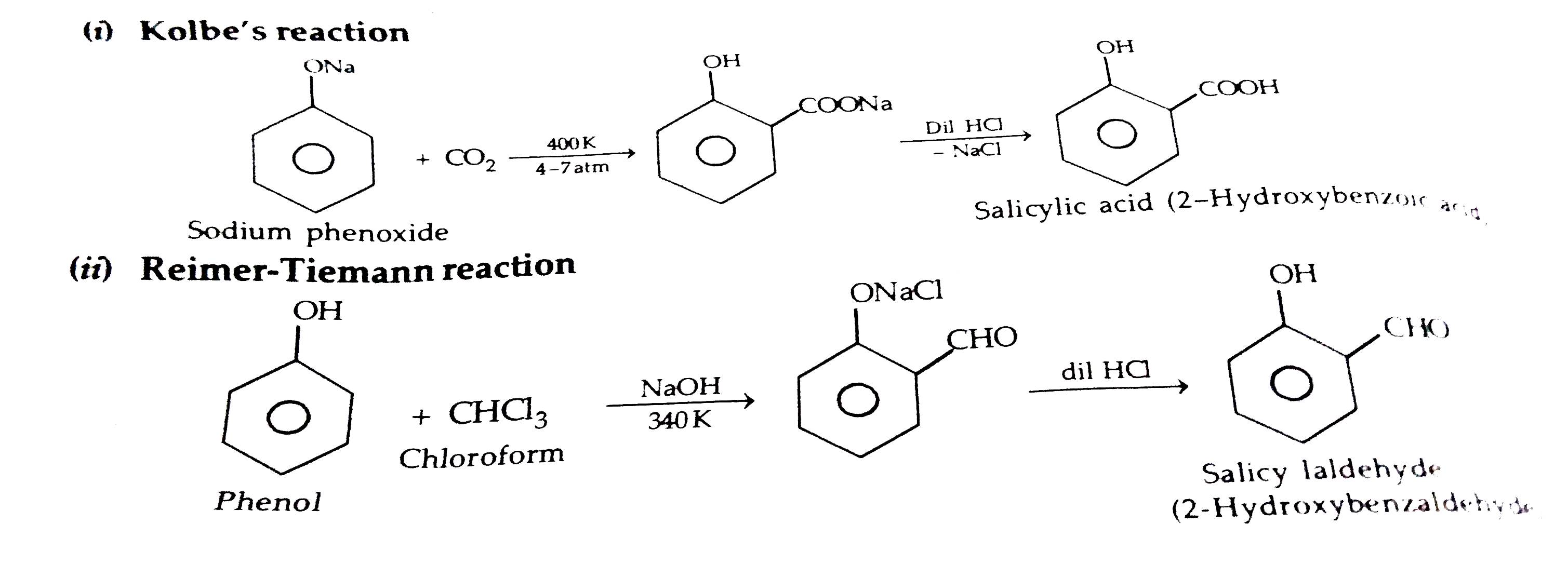 (III) WILLIAMSON ETHER synthesis : It involves treatment of ALKYL halide with sodium alkoxide. It flowers `SN(2)` fmachanism. `2ROH+2Nato2Roverset(-)ONa^(+)+H_(2)` `underset("Halide")underset("Alkly")(RONa+)RXoverset(SN_(2))tounderset("Ether")(R-O)-RNaX` `underset("Sodium ethoxide")(CH_(3)CH_(2)-)overset(-)O-overset(+)Na+underset("ethyl BROMIDE")(CH_(3)CH_(2))Br tounderset("Ether ethoxyethane")(CH_(3)CH_(2)-O-CH_(2))CH_(3)` |
|
| 21. |
Explain why organocopper and organocadmium reagents react with less reactive acid chlorides even though they do not reacts with more reactive ketones. |
Answer» Solution :`R_2 CULI`(and `Ar_2 CuLi`) and `R_2 Cd` and `Ar_2 Cd` do not REACT by the typical nucleophilic addition `(NA)` reaction of an 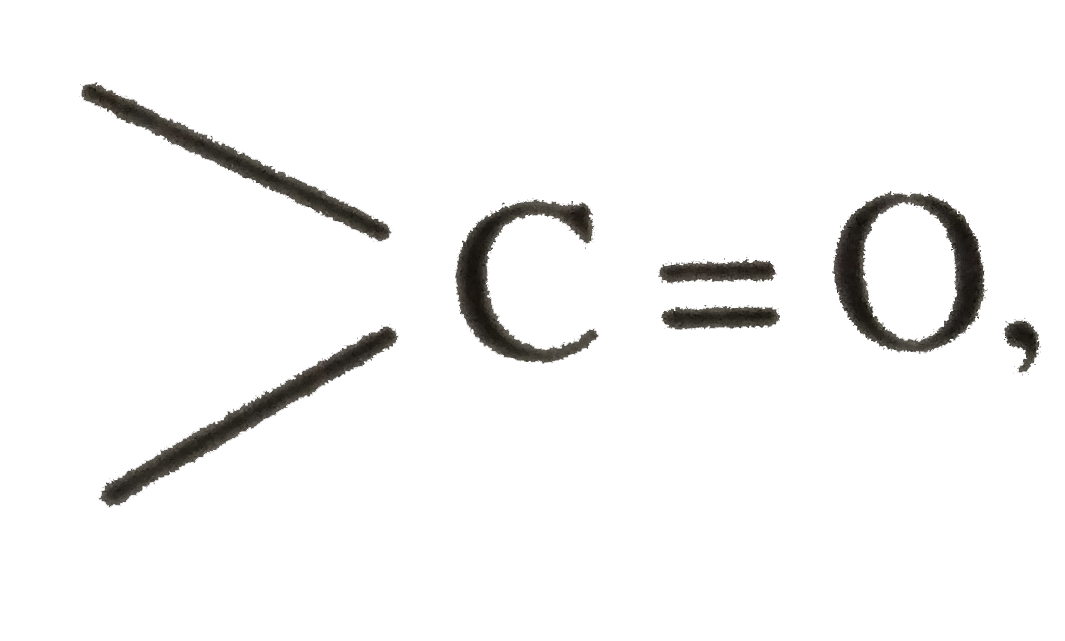 FORMING an acylium-like ion with greater `+ delta` charge on the carbon. This strong electrophilic ion can form a bond even with the weak nucleophlic `R` of `R_2 CuLi` or `R_2 Cd`. FORMING an acylium-like ion with greater `+ delta` charge on the carbon. This strong electrophilic ion can form a bond even with the weak nucleophlic `R` of `R_2 CuLi` or `R_2 Cd`. B 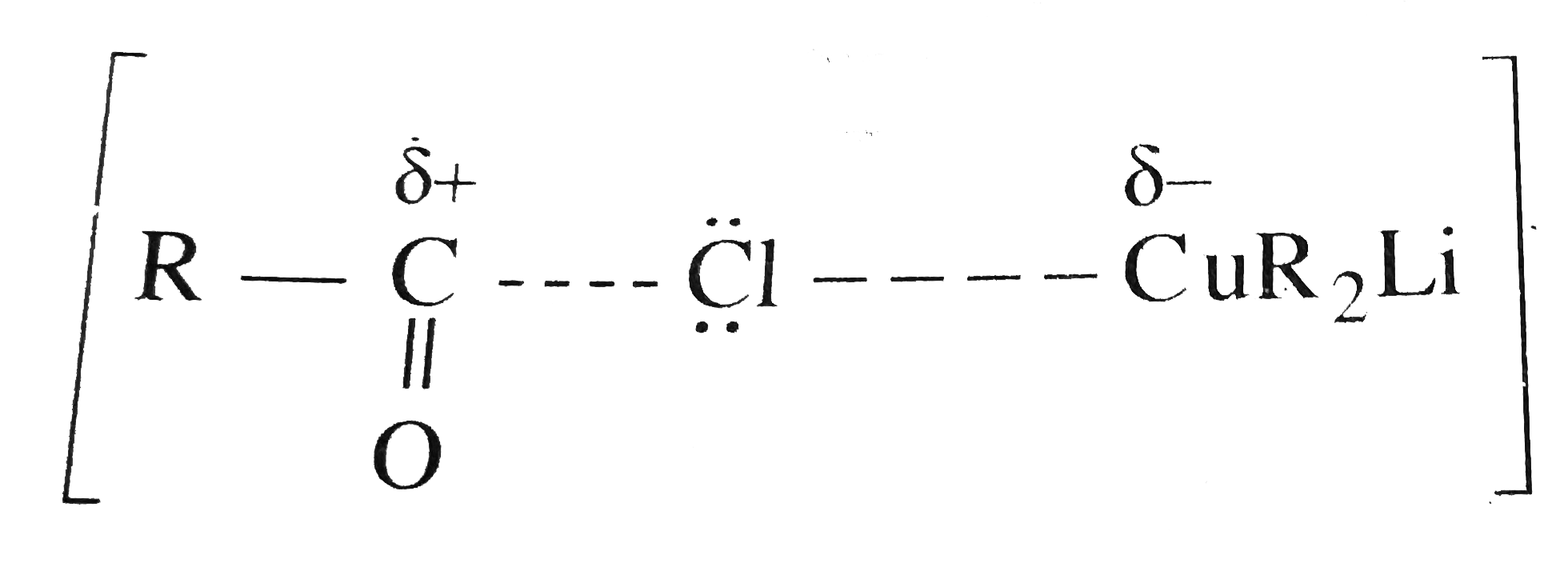
|
|
| 22. |
Explain the following : While preparing alkyl halides form alkanes , dry gaseous halogen acids are used instead of their aqueous solutions. |
| Answer» SOLUTION :AQUEOUS MEDIUM CAUSES alkyl halides to hydrolyze | |
| 23. |
Explain why orthonitrophenol is more acidic than orthomethoxyphenol? |
Answer» Solution :This is because `_NO_(2)` GROUP has `-1` effect and it decreases electron density around `O-` atom and LOSS of `H-` atom as `H^(+)` is facilitated whereas, `CH_(3)-O-` group has `+I` effect and it increases electron density around `O-` atom, loss of `H-` atom of `-O-H` group as `H^(+)` BECOMES DIFFICULT. 
|
|
| 24. |
Explain why on addition of 1 mol of NaCl to 1 litre of water, the boiling of water increases, while addition of 1 mol of methyl alcohol to one litre of water decreases its boiling point. |
| Answer» Solution :NaCl is a non-VOLATILE solute. On ADDING NaCl to water, vapour pressure of lowered and hence BOILING point of water increases. METHYL alcohol is more volatile than water. On adding methyl alcohol into water, vapour pressure of solution is greater than that of water. Hence, boiling point of water decreases. | |
| 25. |
Explain the following terms with suitable examples. (i)Gangue(ii)Slag |
|
Answer» Solution :(i)Gangue: The impurities ASSOCIATED with the minerals are known as Gangue or Matrix. (ii)Slag:A compound FORMED when gangue is combined with FLUX is called slag. Flux+Gangue `to`Slag For example,the oxide of iron be reduced by carbon MONOXIDE as follows: In this extraction a basic flux,limestone is used. Since the silica gangue present in the ORE is acidic in nature,the limestone combines with it to form Calcium silicate(Slag). `underset("Flux")(CaCO_(3))overset(Delta)toCaO+CO_(2)``underset(Flux)(CaO)+underset(Gangue)(SiO_(2))to2Fe3CO_(2)` |
|
| 26. |
Explain why on addition of 1 mol of NaCl to 1 litre of water, the boiling point of water increases, while addition of 1 mol of methyl alcohol to one litre of water decreases its boiling point. |
| Answer» Solution :Boiling point of a liquid depends on the vapour pressure of the liquid as compared to amspheric pressure. Lesser the vapour pressure higher would be the boiling point of a liquid or vice-versa, at a fixed atmospheric pressure. NACL is a NONVOLATILE solute, therefore, addition of NaCl to water lowers the vapour pressure of water. As a result, boiling point of water increases. METHYL alcohol on the other hand is more volatile than water, therefore its addition increases, and the total vapour pressure over tha solution and a decrease in boiling point of water RESULTS. | |
| 27. |
Explain the following terms with suitable examples : (i) Schottky defect (ii) Frenkel defect (iii) Interstitial defects and (iv) F-centres. |
| Answer» Solution :(iv) The ANIONIC sites OCCUPIED by an unpaired electron are called F-centres. F-centres impart colour as a RESULT of excitation of ELECTRONS when they absorb energy from visible spectrum. | |
| 28. |
Explain why o-hydroxybenzaldehye is a liquid at room temperature while p-hydroxybenzaldehyde is a high melting solid. |
Answer» Solution :Due to INTRAMOLECULAR H-bonding (chelation), o-hydroxybenzaldehyde exists as discrete 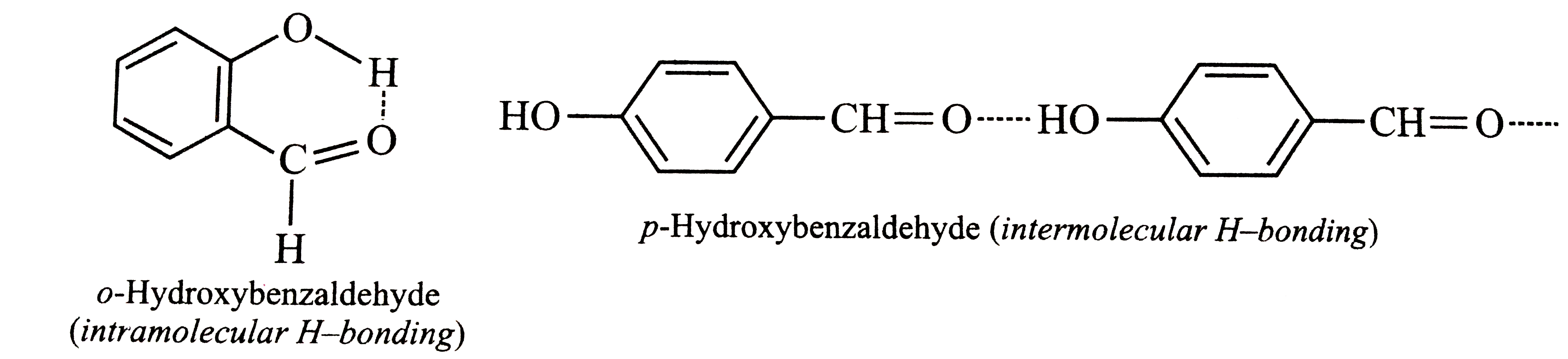 molecules while due to inetermolecular H-bonding, p-hydroxybenzaldehyde exists as associated molecules. To BREAK these intermolecular H-bonds, a large AMOUNT of energy is needed. consequently, p-hydroxy-benzaldehyde has a much higher m.p. and b.p. than that of o-hydroxybezaldehyde. as a result, o-hydroxy-benzaldehyde is a liquid at room temperature while p-hydroxybanzaldehyde is a HIGH MELTING solid. |
|
| 29. |
Explain why o - hydroxybenzaldehyde is a liquid at room temperature while p-hydroxybenzaldehyde is a high melting solid ? |
| Answer» Solution :Due to intramolecular H-bonding orthohydroxy benzaldehyde exists as DISCRETE molecule WHEREAS due to INTERMOLECULAR H-bonding, p-hydroxybenzaldehyde exists as associated molecules. To break these intermolecular H-bonds, a large AMOUNT of energy is needed. Consequently, p - hydroxybenzaldehyde has a much higher m.pt. and b.pt. than that of o-hydroxy benzaldehyde. As a RESULT, o-hydroxy benzaldehyde is a liquid at room temperature while p-hydroxy benzaldehyde is a high melting solid. | |
| 30. |
Explain why nucleophilic substitution reactions are not very common in phenols ? |
|
Answer» Solution :Resonance is an important factor in phenols. During resonance -OH GROUP in phenol gives its electrons to the benzene ring. As a result of this, the electron density on benzene ring is very HIGH. This INCREASED electron density repels nucleophiles. Therefore, nucleophiles cannot attack the benzene ring and phenols usually do not give nucleophilic SUBSTITUTION REACTION. 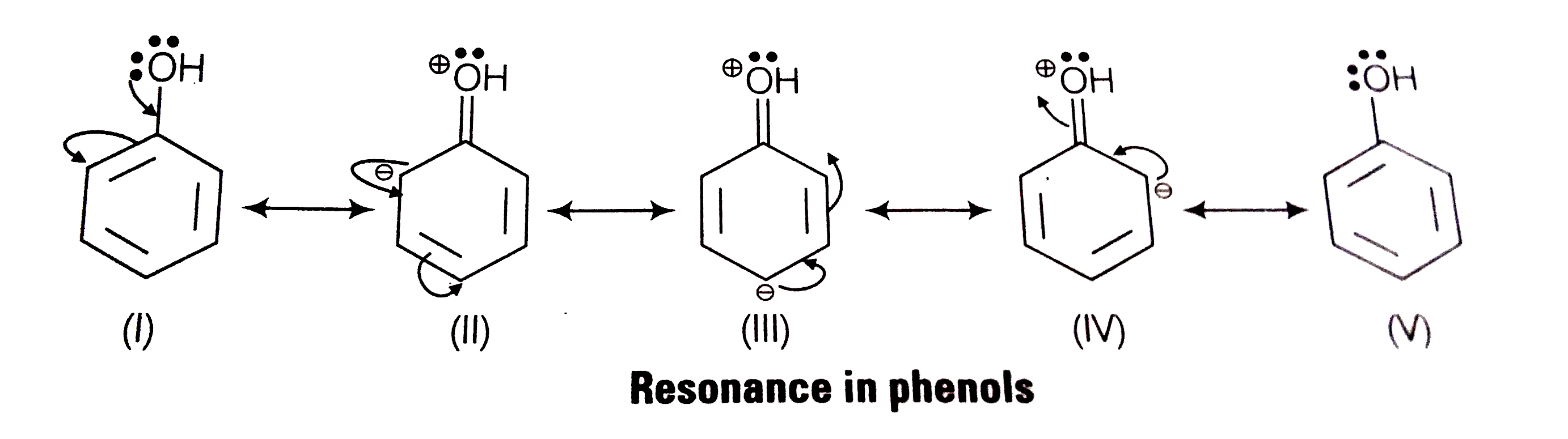
|
|
| 31. |
Explain why p-hydroxybenzaldehydeis a high melting solid? |
|
Answer» |
|
| 32. |
Explain why nitride of Lithium (Li_(3)N) is more stable than nitride of potassium (K_(3)N)? |
| Answer» SOLUTION :Lattice energy of `Li_(3)N` is very HIGH. | |
| 33. |
Explain why NH_(3)is basic while BiH_3 is only feebly basic. |
|
Answer» Solution :The basic nature of `NH_3` and `BiH_3` is because of presence of electron pair on nitrogen and bimusth respectively. HOWEVER, bismuth being very LARGE is size, the electron pair gets diffused over LARGER region as a result, the electron DENSITY on bismuth decreases which makes `BiH_3` a feebly basic. Nitrogen atom is small in size has high electron density as electron pair is concentrated on a SMALLER region. This makes ammonia a strong base. |
|
| 34. |
Explain, why NH_3 is basic while BiH_3 is only feebly basic. |
| Answer» Solution :Both N in `NH_3` and Bi in `BiH_3` have a lone pair of electrons on the central ATOM and hence should behave as Lewis BASES, But `NH_3` is much more basic than `BiH_3`. This can be explained on the basis of electron density on the central atom. Atomic size of N (70 pm) is much SMALLER than that of Bi (148 pm), therefore, electron density on the N-atom is much higher than that on Bi-atom. Consequently, the tendency of N in `NH_3` todenote its pair of electrons is much higher than that of Bi in `BH_3`. Thus, `NH_3` is much more basic than `BiH_3` | |
| 35. |
Explain the following terms with suitable examples : (i) Schottky defect (ii) Frenkel defect (iii) Interstitials (iv) F-centres. |
| Answer» SOLUTION :Refer to Point Number 14 of "CHAPTER At A GLANCE". | |
| 36. |
Explain why NH_3is basic while BiH_3is only feebly basic. |
| Answer» Solution :Both N and Bi have a lone pair of electrons in `NH_3`and `BiH_3`respectively. They can denote the electron pair and THEREFORE behave as Lewis BASE. In `NH_3` , N has small size and the lone pair is CONCENTRATED on a small REGION and electron DENSITY on it is maximum. Consequently, it has greater electron releasing tendency. But the size of Bi is large and the electron density of the lone pair is less. As a result, it has lesser tendency to donate electron pair. Hence, `NH_3`is basic while `BiH_3`is only feebly basic. | |
| 37. |
Explain the following terms with suitable examples : (i) Cationic detergents (ii) Anionic detergents and (iii) Non-ionic detergents. |
|
Answer» Solution :(i) Cationic detergents : These are QUATERNARY AMMONIUM salts. For example, cetyltrimethy- lammonium CHLORIDE. (ii) Anionic detergents : These are so called because a large part of their molecules are anions. These are of two types : (a) Sodium alkyl sulphates : For example, sodium lauryl sulphate, `C_(11)H_(23)CH_(2)OSO_(3)Na`. (b) Sodium alkylbenzenesulphonates : The most widely used domestic detergent is sodium dodecylbenzenesulphonate (SDS).  (iii) Neutral or non-ionic detergents : These are ESTERS of high molecular mass alcohols with fatty acids. For example, polyethylene glycol stearate, `UNDERSET("Polyethylene glycol stearate")(CH_(3)(CH_(2))_(16)COO(CH_(2)CH_(2)O)_(n)CH_(2)CH_(2)OH)` |
|
| 38. |
Explain why NH_(3) is basic while BiH_(3) is only feebly basic. |
| Answer» Solution :Both N in `NH_(3)` and BI in `BiH_(3)` have a lene pair of electrons on the central atom and hence should behave as Lewis BASES. But `NH_(3)` is MUCH more basic than `BiH_(3)`. This can be explained on the basis of electron density on the central atom. SINCE the atomic size of N (70 PM) is much smaller than that of Bi (148 pm), therefore, electron density on the N-atom is much higher than that on Bi-atom. Consequently, the tendency of N in `NH_(3)` to donate its pair of electrons is much higher than that of Bi in `BH_(3)`. Thus, `NH_(3)` is much more basic than `BH_(3)`. | |
| 39. |
Explain why NH_(3) is basic while BiH_(3) is only feebly basic ? |
|
Answer» Solution :The atomic SIZE of nitrogen (atomic radius = 70 pm) is less than that of bismuth (atomic radius = 148 pm). As a result, electron density on the nitrogen atom is greater than that on bismuth atom . It means that electron releasing TENDENCY of ammonia is more than `BiH_(3)`. Therefore, `NH_(3)` is basic while `BiH_(3)` is only feebly basic. NOTE : Atomic size will be CONSIDERED while comparing the basicity of `NH_(3)` with other hydrides of group - 15 elements. |
|
| 40. |
Explain the following terms with suitable examples (i) Alcosol (ii) Aersol and (iii) Hydrosol |
| Answer» Solution :(i) Alcosol. It is a colloidal dispersion having alcohol as the dispersion MEDIUM, e.G., collodion (a colloidal sol of cellulose nitrate in ethyll alcohol). (ii) Aerosol. It is a colloidal dispersion of a liquid in a gas, e,g., fog. (iii) Hydrosl. It is a colloidal sol of a solid in water as the dispersion medium, e.g., STARCH sol or GOLD sol. | |
| 41. |
Explain why mercury (I) ion exists as Hg_(2)^(2+) ions while copper (I)ion exists as Cu^(+)ion. |
| Answer» Solution :The electronicconfiguration of HG(I), i.e., `Hg^(+) ` is `[Xe] 4f^(14)5d^(10) 6s^(1)` and thus has one electron in the valence 6s-orbital. If this were so, all Hg(I) compoundsshould be paramagnetic butactually they are diamagnetic. This behaviour can be explainedif we ASSUME that the singly filled 6s-orbitals of the two `Hg^(+)` ions overlap to forma Hg-Hg covalent bond. Thus, `Hg^(+)` ions exist as dimeric species, i.e., `Hg_(2)^(2+)` . In contrast, the electronic configurationof Cu(I) ion, i.e., `Cu^(+)` is `[Ar] 3D^(10)` . Therefore, it has no unpaired electrons to form dimeric species, i.e., `Cu_(2)^(2+)` and hence it ALWAYS exists as `Cu^(+)` ion. | |
| 42. |
Explain the following terms with suitable examples : (i) Cationic detergents (ii) Anionic detergents. |
|
Answer» Solution :(i) Cationic detergents : These are quaternary ammonium salts of amines with ACETATES, chlorides and bromides, e.g., cetyltrimethyl ammonium BROMIDE. These have GERMICIDAL property. (ii) Anionic detergents : These are sodium salts of sulphonated long CHAIN ALCOHOLS or hydrocarbons e.g., sodium dodecylbenzene sulphonate. These are used in toothpaste and household works. |
|
| 43. |
Explain why methyl ethyl ether forms both methyliodide and ethyliodide on being heated with excess of HI? |
Answer» SOLUTION :The formation of both METHYL- and ETHYL iodide can be explained as follows: 
|
|
| 44. |
Explain why MeNH_(2) is stronger base than MeOH? |
| Answer» Solution :Since N is LESS electronegative O, therefore, lone PAIR of electrons on N is more easily available for donation. As a RESULT, `MeNH_(2)` is more basic than MEOH. | |
| 45. |
Explain why MeNH_(2) is stronger base than MeOH ? |
Answer» Solution : Nitrogen is LESS electronegative than oxygen. Therefore, the lone pair of electrons is more readilyavailable on nitrogen than oxygen. Therefore, `MeNH_(2)` is a stronger base than Me - OH. |
|
| 46. |
Explain why low molecularr mass alcohols are soluble in water. |
| Answer» Solution :Solubility of alcohols in water `H_(2)O` is due to H-bonding betweenn the O-H group of alcohols and `H_(2)O` MOLECULES. The hydrocarbon part (i.e., R group) on the other HAND, TENDS to PREVENT the formation of H-bonds and thus tends to decrease the solubility of alcohols in `H_(2)O`. since in lower molecular mass alcohols, the hydrocarbon part is small, therefore, lower molecular mass alcohols are soluble in water. | |
| 47. |
Explain whylanthanoids are paramagnetic in nature ? |
| Answer» Solution :All LANTHANOIDS except`La^(3+)` and `LU^(3+)` contain unpaired electrons and hence areparamagnetic. | |
| 48. |
Explain the following terms with suitable examples (i) Alcosol, (ii) Aerosol and (iii) Hydrosol. |
|
Answer» Solution : (i) Alcosol : It is a colloidal dispersion having alcohol as the dispersion MEDIUM, e.g., colloidal A colloidal SOL of CELLULOSE nitrate in ethyl alcohol. (ii) Aerosol : It is a colloidal dispersion of a liquid in a gas, e.g., FOG. (iii) Hydrosol : It is a colloidal sol of a solid in WATER (as the dispersion medium) i.e., starch sol or gold sol. |
|
| 49. |
Explain why is ortho-nitrophenol more acidic than ortho-methoxyphenol? |
|
Answer» Solution :Due to strong `-R and -I-` effect of the `-NO_(2)` groups, electron DENSITY in the `O-H` bond decreases and hence the LOSS of a proton becomes easy. o - nitrophenol is more acidic because of `-R and -I` effect of `-NO_(2)` group. Electron desntiy on O in `O-H` bond decreases that CAUSES removal of `H^(+)` easily.  Further, after the loss of a proton, the o - nitrophenodxide ion left behind is stabilised by resonance,  Thus, o - nitrophenol is a stronger acid. In contrast, due to `+R` effect of the `OCH_(3)` group, the electron - density on O in the `O-H` bond increases thereby making the release of proton difficult.  Thus, o- nitrophenol is more acidic than o - METHOXYPHENOL. |
|
| 50. |
Explain the following terms with suitable examples : Ferromagnetism and Ferrimagnetism. |
|
Answer» Solution :Ferromagnetism : (i) Substance which are ATTRACTED most easily in magnetic field is called Ferromagnetic substance. (ii) Examples : Fe, Co, Ni, `CrO_(2)` and aluaco (alloy of Co, Fe and Cu). Ferrimagnetism : (i) A substance which is weakly attracted by the magnetic field is called ferrimagnetic substanes. (ii) Examples : `Fe_(3) O_(4)`, ferrites having the formula `M^(2+) Fe_(2) O_(4)`. (where `M^(2+) = Cu^(2+) or Zn^(2+)`). (III) In these SUBSTANCES the alignment of magneitc moment in opposite direction are not equal. |
|