

Saved Bookmarks
This section includes 7 InterviewSolutions, each offering curated multiple-choice questions to sharpen your Current Affairs knowledge and support exam preparation. Choose a topic below to get started.
| 1. |
Explain why is ortho nitrophenol more acidic than ortho methoxyphenol ? |
Answer» Solution :`to` The acidic property of PHENOL arises from the loss of hydrogen of -OH group of phenol as `H^(+)`. This loss of is favoured if the polarity of the O-H bond increases and hydrogen becomes more electropositive. The presence of electron WITHDRAWING groups such as `-NO_(2)` increases the polarity of O-H bond and THUS the acidic strength of the phenol is raised. On the contrary, the `-OCH_(3)` is an electron releasing group and it decreases the polarity of O-H bond and thus MAKES the release of `H^(+)` difficult. This can be understood by the RESONATING structures : 
|
|
| 2. |
Explain the following terms with suitable examples. (a)cationic detergents , (b)anionic detergents , (c )neutral detergents |
|
Answer» Solution :1.Anionic detergents These are so CALLED because a large part of their molecules are anions. These are of two types : (i)Sodium alkyl sulphates . For EXAMPLE, sodium lauryl SULPHATE, `C_11H_23CH_2OSO_3Na` (ii)Sodium alkylbenzenesulphonates. The most widely used domestic detergent is sodium 4-(1-dodecyl) benzenesulphonate (SDS). 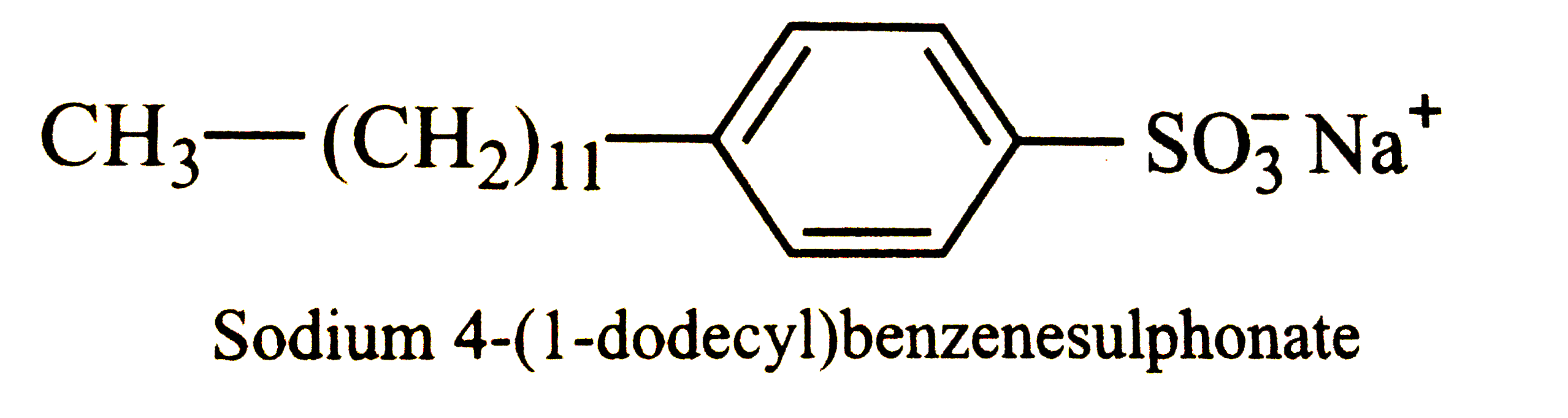 2.cationic detergents. These are quaternary ammonium salts. For example , cetytrimethylammonium chloride. `UNDERSET"Cetyltrimethylammonium chloride"([CH_3(CH_2)_15overset+N(CH_3)_3]Cl^-)` 3.Neutral or Non-ionic detergents. These are ESTERS of high molecular mass alcohols with fatty acids. For example, polyethylene glycol stearate. `underset"Polyethylene glycol stearate"(CH_3(CH_2)_16COO(CH_2CH_2O)_nCH_2CH_2OH)` |
|
| 3. |
Explain why is ortho nitrophenol more acidic than ortho methoxyphenol? |
| Answer» Solution :Ortho nitrophenol is more acidic than ortho methoxyphenol because nitro group is an electron WITHDRAWING and it will increase +ve CHARGE on the oxygen ATOM to make it more acidic whereas `OCH_3` group is an electron releas1ng group and it will decrease +ve charge on the oxygen atom, thus making it less acidic and hence the O-H bond will not BREAK casily. | |
| 4. |
Explain the following terms with suitable examples : (a) cationic detergents (b) anionic detergents and (iii) neutral detergents |
|
Answer» Solution :(a) Cationic DETERGENTS are those which have cationic hydrophilic group. These are mostly ACETATES, chlorides or bromides of quanternary ammonium SALTS. For examples , cetyltrimethyl ammonium chloride : `[CH_(3)(CH_(2))_(15)N(CH_(3))_(3)]^(+)Cl^(-)` (b) Anionic detergents are those which have anionic hydrophilic group. These are manufactured from long CHAIN alcohols. For example, sodium lauryl sulphate : `C_(11)H_(23)CH_(2)OSO_(3)Na` Sodium p-dodecyl benzene sulphonate  (c) Neutral detergents are esters of high MOLECULAR mass with fatty acids. These contain polar groups which can form hydrogen bonds woth water. For example, polythylene glycol stearate :`CH_(3)(CH_(2))_(16)COO(CH_(2)CH_(2)O)_(n)CH_(2)CH_(2)OH` |
|
| 5. |
Explain why is OH group in phenols more strongly held as compared to OH group in alcohols. |
| Answer» SOLUTION :DUE to donation of the lone pairr of electrons on the oxygen atom to the benzenne ring, phenol can be written as a resonance hybrid of five structures, IV. Out of these, structures II, III and IV CONTAIN a carbon-oxygen double bond. In other words, carbon-oxyge bond in phenols has some double bond character while in alcohols it is a pure SINGLE bond. therefore, OH group in phenols in more strongly held as compared to OH group in alcohols. | |
| 6. |
Explain the following terms with suitable examples: |
|
Answer» Solution :(1) Cationic detergents : Cationic detergents are quarter nary ammonium salts of amines with chlorides, acetates or bromides as anions. Cations are LONG chain hydrocarbons and a positive charge on nitrogen atom. They are used as germicides, cetyltrimethyl ammonium chloride is used in hair conditioners. `UNDERSET(("n - hexadecyl trimethyl ammonium chloride or cetyltrimethyl ammonium chloride"))[[CH_(3)(CH_(2))_(4) - CH_(2) - underset(CH_(3))underset(|)overset(CH_(3))overset(|)(N) - CH_(3)]]` (2) Anionic detergents : Anionic detergents are sodium salts of sulphonated long chain of alcohols or hydrocarbons. They are prepared from long chain of hydrocarbons or alcohols by treating with conc. `H_(2)SO_(4)`and then neutralizing by NaOH. In anionic detergents, the anionic PART of molecule helps in the cleansing action. Example : Sodium dodecyl benzenesulphonate.Anionicdetergentis usedin toothpasteand in thehousehold work. 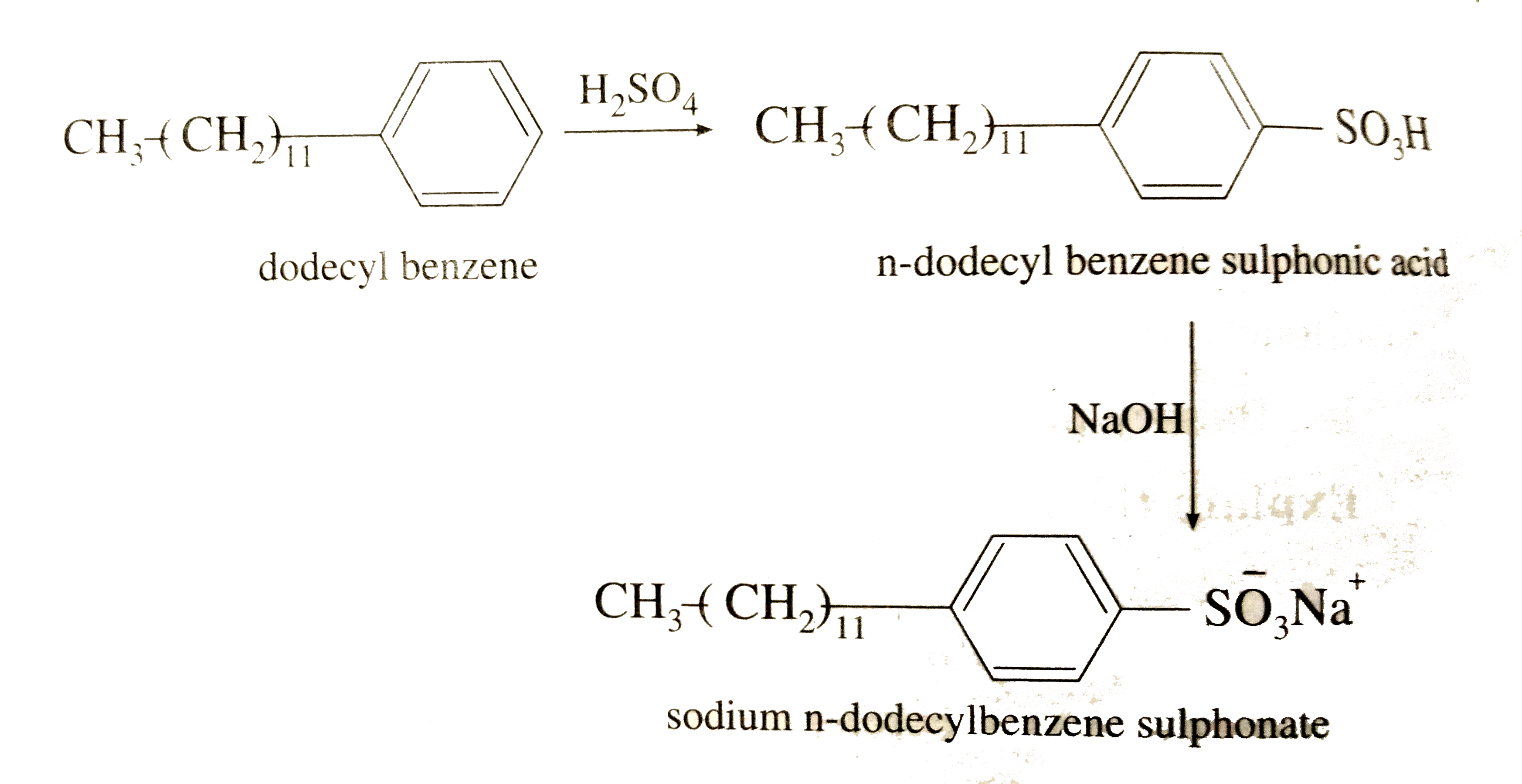 (3) Non -ionicdetegrmets : Non-ionic detergentsare eithermonoesters of polyhydicalcholsor polyethers derviedform ethylene oxide. Theyare usedfor washingvessels : Exmple : `CH_(3) -(CH_(2))_(10)overset(O)overset(||)(C) - O - CH_(2)-underset("(Polyether)")underset("Pentaerythrityl stearate")underset(CH_(2))underset(|)overset(CH_(2)OH)overset(|)(C) - CH_(2)OH,` `CH_(3)(CH_(2))_(16)COO-underset("non-ionic detergents")((CH_(2)CH_(2)O-)_(n)) CH_(2)CH_(2)OH` |
|
| 7. |
Explain the following terms with suitable examples : (a) Cationic detergents(b) Anionic detergents |
|
Answer» Solution :Synthetic detergents are classifeid into three types i) Cationic detergents:These are synthetic deterghents. a)Cationic detergents are quartenary ammonium salts of amines with acetates,chlorides (or)Bromides as anions. B)Cationic PART posses a long hydrocarbon chain and a positive charge on nitrogen atom.Hence these are called cationic detergents.E.g:Cetyl trimethyl ammonium bromide `to`It is used in hair CONDITIONERS. `[{:(""CH_(3)),("|"),(CH_(3)(CH_(2))_(15)-N-CH_(3)),("|"),(""CH_(3)):}]^(+) Br^(-)` ii)Anionicdetergents are sodium of sulphonated long chain alcohol(or)hydrocarbons. b)Anionic detergents are formed by the treatment of long chain alcohol with conc.`H_(2)SO_(4)` followed by the neutralisation with alkali. E.g:Sodium lauryl sulphate. `underset("Lauryl alcohol")(CH_(3)(CH_(2))_(10))-CH_(2)-OHoverset(H_(2)SO_(4))to underset("Lauryl hydrogen sulphate")(CH_(3)(CH_(2))_(10)-CH_(2)_(10)-CH_(2)O SO_(3)H)overset("aq. NaOH")to underset(underset(("anionic detergents"))"Sodium lauryl sulphate")(CH_(3)(CH_(2))_(10)-CH_(2)-OSO_(3)-Na^(+)` `to` these are used for house hold work and in tooth PASTES. iii)Non-IONIC detergents:THese are synthetic detergents. a)Non ionic detergents donot any ion in their constitution . b) The detergent formed by the reaction of stearic acid with poly ethylene glycol is an example of non ionic detergent.`underset("Stearicacid")(C_(17)H_(35)COOH)underset("Poly ethylene glycol") (+HO(CH_(2)CH_(2)O)_(n)) CH_(2) CH_(2)OHoverset(-H_(2)O)to C_(17)H_(35)COO(CH_(2)CH_(2)O)_(n)CH_(2)CH_(2)CH_(2)OH` `to`Non-ionic detergents are used in liquid dish washing purpose. |
|
| 8. |
Explain why is O= C = O non-polar while R-O-R is polar ? |
Answer» SOLUTION :This can be EXPLAINED by molecular geometry. The `CO_(2)` molecule is linear whereas the `R_(2)O` molecule is bent or ANGULAR in shape. Thus, in case of ethers, the bond moments do not cancel each other and so the molecule possess the net dipole MOMENT. In case of `CO_(2)` molecule, the bond moments are oriented exactly in OPPOSITE direction cancelling each other. 
|
|
| 9. |
Explain the following terms with suitable example of each : (i) Ferromagnetism (ii) Antiferromagnetism. |
|
Answer» Solution :(i) Ferromagnetism : MATERIALS which are strongly attracted by magnetic fields are called FERROMAGNETIC materials and the property thus exhibited is called ferromagnetism. Only three ELEMENTS Fe, Co and Ni show this property at room temperature. (ii) Antiferromagnetism : SUBSTANCES which have domain structure similar to ferromagnetic substances but they are oppositely ORIENTED and cancel out each other.s magnetic moment. An example of this type of materials is MnO. |
|
| 10. |
Explain why is O=C=O nonpolar while R-O-R is polar. |
Answer» Solution :`CO_(2)` is a LINEAR moleculee. The dipole moments of the two C=O bonds being equal and opposite cancel out each other and hence `CO_(2)` is a non-polar molecule.  In contrast, in R-O-R molecule, the two dipoles of the R-O bonds are INCLINED to each other at angle of `110^(@)`, i.e., the two dipoles do not cancel out and hence have a finiite resultant. in other WORDS, R-O-R is a poalr molecule. |
|
| 11. |
Explain why inspite of nearly the same electronegativity, oxygen forms hydrogen bonding while chlorine does not. |
| Answer» Solution : Although O and CI have about the same electronegativity, yet their atomic size (covalent radii) are MUCH DIFFERENT with radius of OXYGEN being 66 pm and that of chlorine being 99 pm. As a result, electron density PER unit volume on oxygen atom is much higher than that on chlorine atom. Therefore, oxygen forms hydrogen BONDS while chlorine does not even though both have approximate the same electronegativity. | |
| 12. |
Explain the following terms with suitable examples : ( a ) Schottky defect ( b ) Interstitial defect . |
|
Answer» Solution :(a) Schottky defect : It occurs when equal number of vacant cations and ANION sites are found in LATTICE STRUCTURE . It decreases the density of the substance . For example : `NaCl and KCI` . (b) INTERSTITIAL defect : When some constituent particles (atoms or molecules or ions) occupy an interstitial site , the crystal is said to have interstitial defect . This defect INCREASES the density of the substance . Non - ionic solids show this detect. |
|
| 13. |
Explain why inspite of nearly the same electronegativity, nitrogen forms hydrogen bonding while chlorine does not. |
| Answer» Solution :DUE to LARGER size of chlorine than nitrogen, the electron density per unit volume of chlorine is MUCH lower than nitrogen. Thus, nitrogen FORMS H-bond while chlorine doesnot. | |
| 14. |
Explain the following terms with one example in each case : (i) Food preservatives (ii) Enzymes (iii) Detergents. |
|
Answer» Solution :(i) Food preservatives : Substances that prevent spoilage of food DUE to microbial growth are called food preservatives. Commonly used preservatives include table salt, sugar and sodium benzoate. (ii) Enzymes : Biocatalysts which perform various chemical reactions in living organisms are called enzymes. Almost all the enzymes are globular proteins. Enzymes are very specific for a particular reaction and for a particular substrate. Maltase is the enzyme to hydrolyse maltose. `UNDERSET("Maltose")(C_(6)H_(12)O_(11))+H_(2)O overset("Maltase")rarr underset("Glucose")(2C_(6)H_(12)O_(6))` (iii) Detergents : Synthetic detergents are cleansing agents which have all the properties of soaps, but which ACTUALLY do not contain any soap. These can be used both in soft and HARD water as they give foam even in hard water. These are classified as (1) Cationic detergents, for example, catyltrinmethyl ammonium bromide. (2) Anionic detergents, for example, sodium laurylsulphate. (3) Non-ionic detergents, for example, POLYETHYLENE glycol stearate. |
|
| 15. |
Explain why in the synthesis of ether (B) using (A) or A_(1) all the three standard methods for the perparation of ether (B) fail, i.e., I.Intermolecular dehydration of alcohols II.Alkoxy mercuration-demercuration method III. williamson's synthesis Suggest an alternative method for the preparation of (B) by using (A) or (A_(1)) . |
|
Answer» Solution :i.(B) is an unsymmetrical ether, so method (I) cannot be used. Method II. ii. 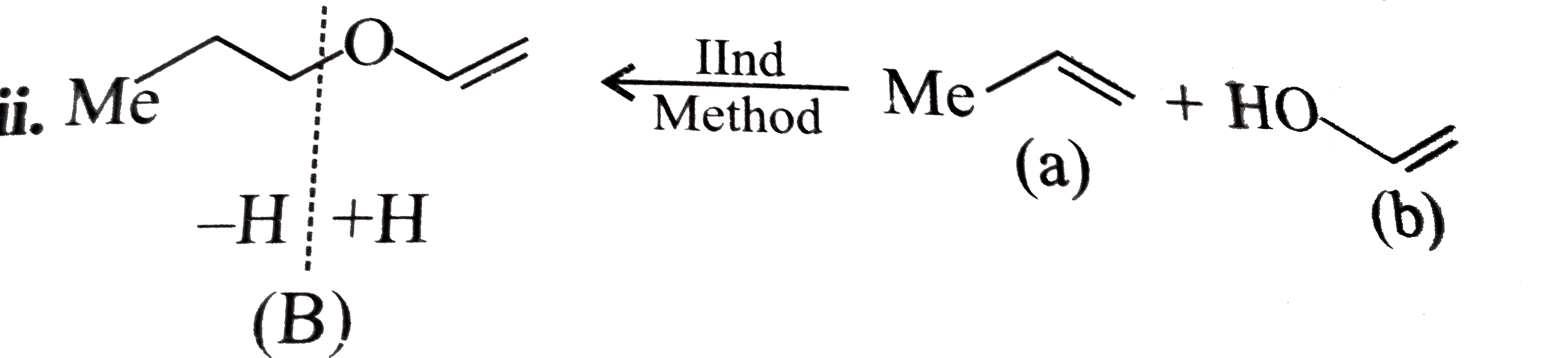 Method II of (a) with (b) would give different ethers, Similarly, method II of (a) with (A) would also give different products. 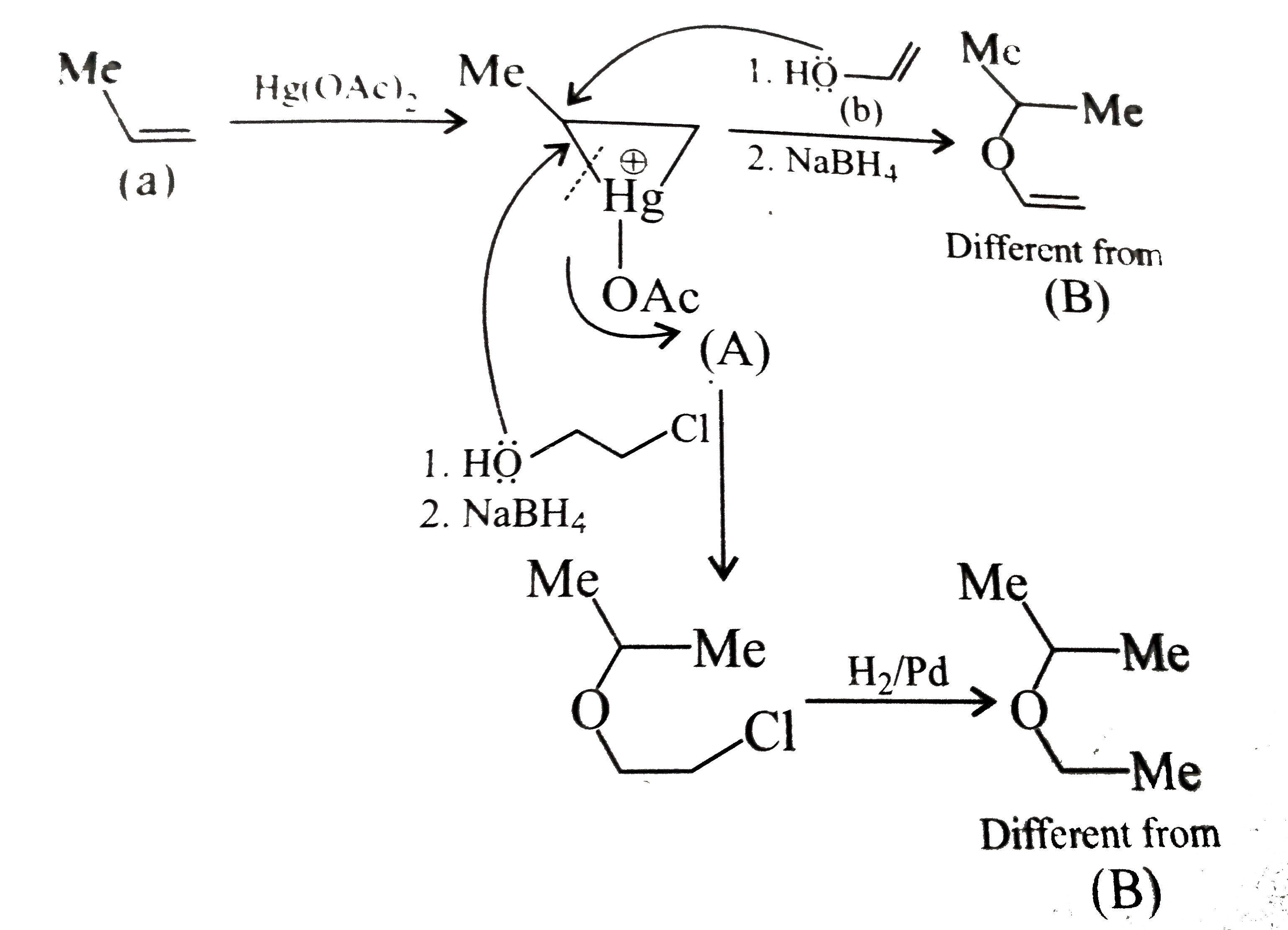 iii. Similarly, method II of `(A_(1))` 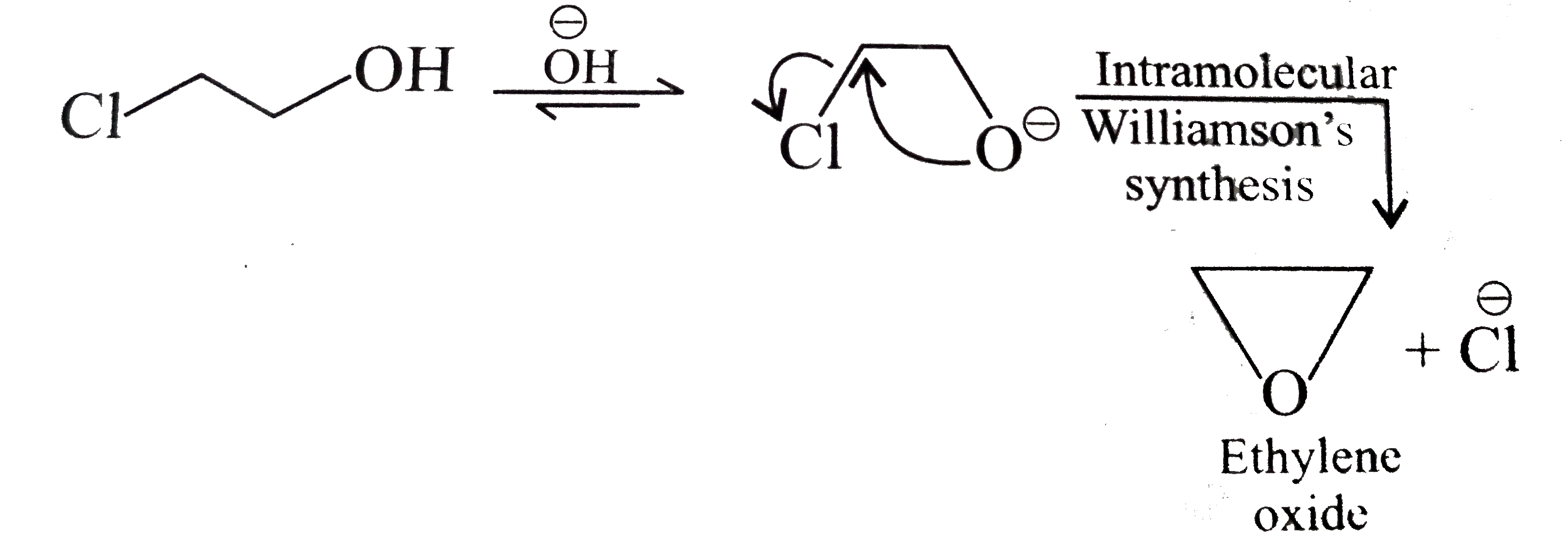 is not feasible because of the reaction of `Hg^(2+)` with CI of `(A_(1))`. is not feasible because of the reaction of `Hg^(2+)` with CI of `(A_(1))`. iv.Williamson's SYNTHESIS is also not feasible due to the following reason : 1.  2. 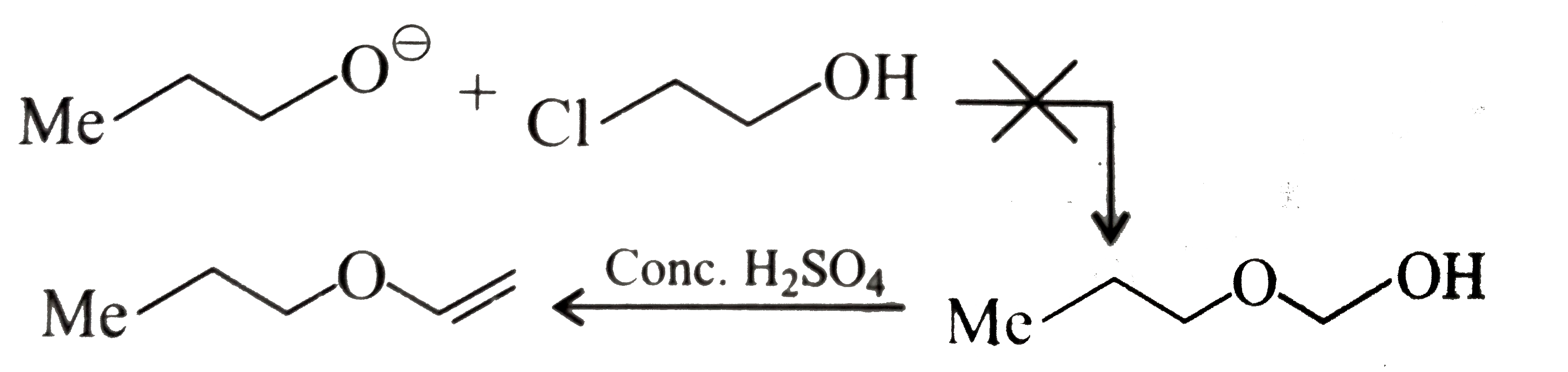 3. 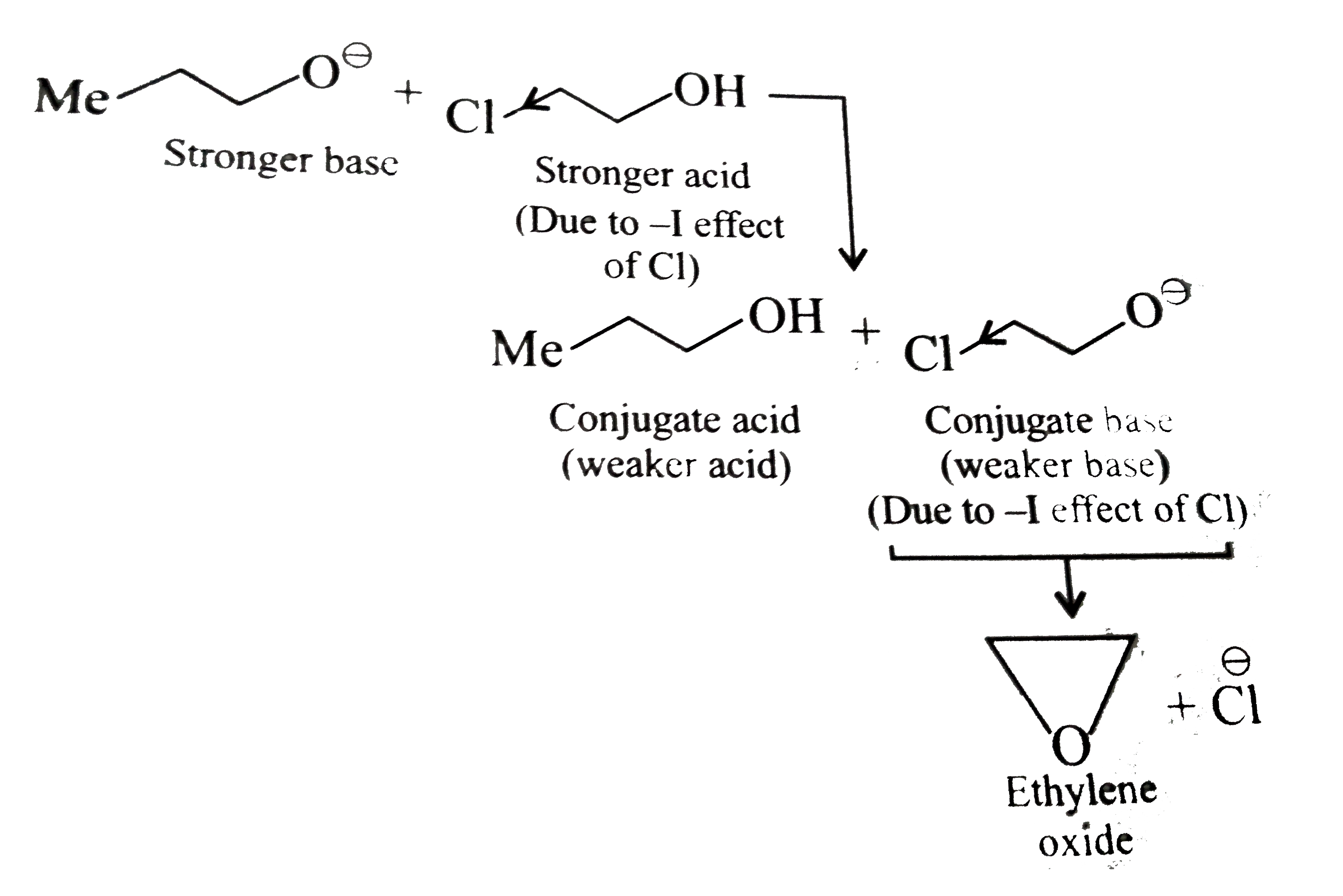 Reaction (3) does not take place, but a BRONSTED acid-base reaction occurs GIVING the epoxide.  Alternative methods for the synthesis of (B) : i.By nucleophilic addition of `RO^(-)` to ethtne `(HC-=CH)` `HC-=CH` 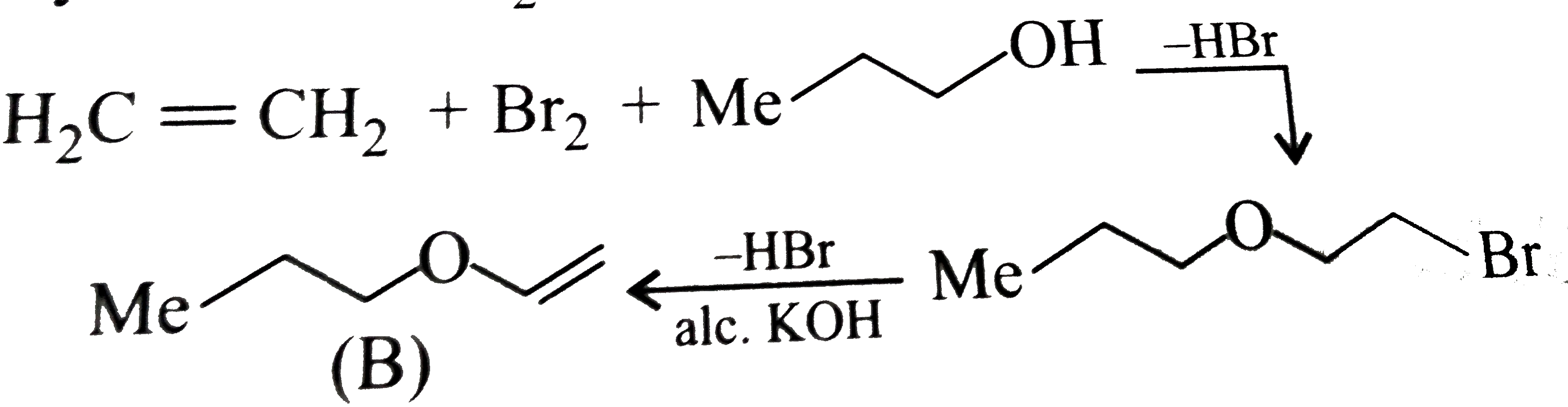 ii. By addition of `Br_(2)` in propanol (SOLVENT) to `(CH_(2)=CH_(2))` |
|
| 16. |
Explain the following terms : Tyndall effect. |
| Answer» Solution :Tyndall EFFECT: If a colloidal solution placed in dark is observed in the direction of light, it appears CLEAR but if it is observed in a perpendicular direction, it appears OPALESCENT i.e., the path of light is illuminated by a bluish light. This effect is CALLED Tyndall effect. The bright cone of light is known as Tyndall cone. This effect is observed due to scattering of light in all 8 directions by the colloidal particles. The scattering of light illuminates the path of beam in the 6 colloidal DISPERSION. | |
| 17. |
Explain Why inspite of nearly the same electronegativity,nitrogen forms hydrogen bonding while chlorine does not - Give reason. |
|
Answer» |
|
| 18. |
Explain the following terms with examples : (i) Absorption (ii) Desorption |
| Answer» | |
| 19. |
Explain why in spite of nearly the same electronegativity, oxygen forms hydrogen bonding while chlorine does not. |
| Answer» Solution :Although O and Cl have about the same electronegativity, YET their atomic size (covalent radii) are much different : O = 66 pm and Cl = 99 pm. As a rsult, electron density PER unit volume on OXYGEN atom is much higher than that on chlorine atom. Therefore, oxygen forms HYDROGEN bonds while chlorine does not even though both have approx. The same electronegativity. | |
| 20. |
Explain the following terms with an example for each: (i) Antibiotics (ii) Antiseptics (iii) Analgesics. |
|
Answer» Solution :(i) Antibiotics : Antibiotics are used as drugs to treat INFECTIONS because of their LOW toxicity for humans and ANIMALS. These substances in low concentration inhibit the growth or destroy micro-organisms, e.g., penicillin. (ii) Antiseptics : These substances are APPLIED to living tissues, such as wounds, cuts, ulcers. e.g., soframycin. (iii) Analgesics : They reduce or abolish pain without causing impairment of CONSCIOUSNESS, mental confusion or paralysis. e.g., aspirin. |
|
| 21. |
Explain why in the laboratory preparation of H_(2)O_(2) : MnO_(2) ""or PbO_(2)cannot be used instead of BaO_(2) for preparing H_(2)O_(2) - why ? |
|
Answer» SOLUTION :UNLIKE `BaO_(2)` have any PEROXO LINKAGE (-O-O-). |
|
| 22. |
Explain the following terms :Plane polarised light |
| Answer» SOLUTION :Plane polarised light : When ordinary light is ALLOWED to pass through a Nicol prism, a light of single wavelength VIBRATING in a single plane is obtained. This is KNOWN as plane polarised light. | |
| 23. |
Explain why (i) the dipole moment of chlorobenzene is lower than that of cyclohexyl chloride? (ii) Alkyl halides, though polar, are immiscible with water? (iii) Grignard reagents should be prepared under anhydrous conditions? |
Answer» Solution :(i) Due to greater s-character, a `sp^(2)`-hybrid carbon is more electronegative than a `sp^(3)-`hybrid carbon. Therefore, the `sp^(2)`-hybrid carbon of C-Cl BOND in chlorobenzene has less tendency to release electrons to Cl than `sp^(3)`-hybrid carbon of cyclohexyl CHLORIDE. 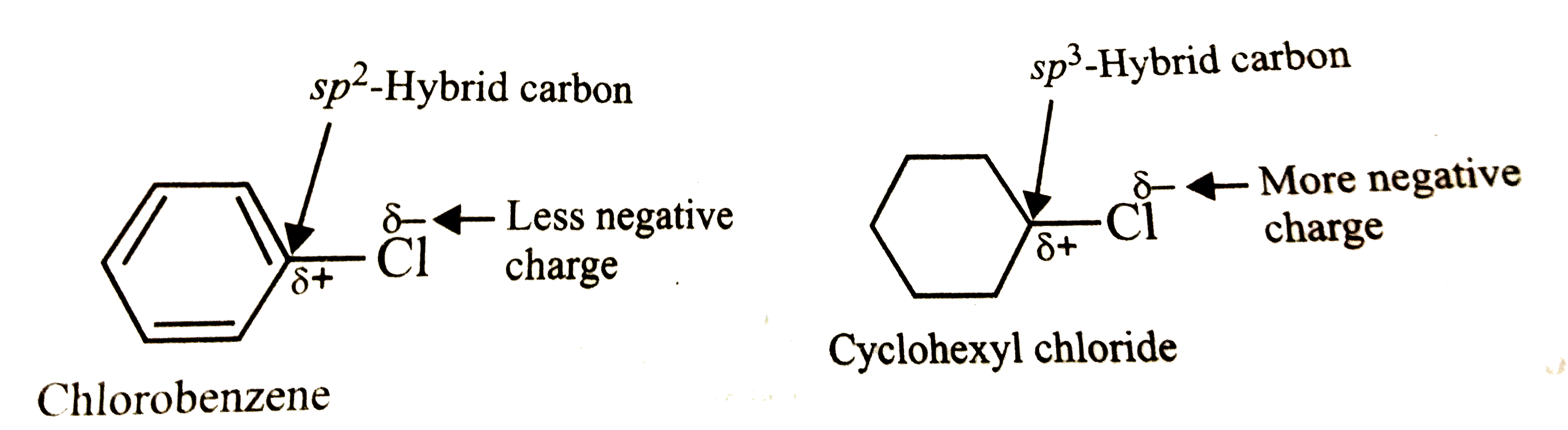 As a result, the C-Cl bond is chlorobenzene is less polar than in cyclohexyl chloride. in other words, the magnitude of negative charge, i.e., `delta^(-)` is less on Cl atom of chlorobenzene than in cyclohexyl chloride. 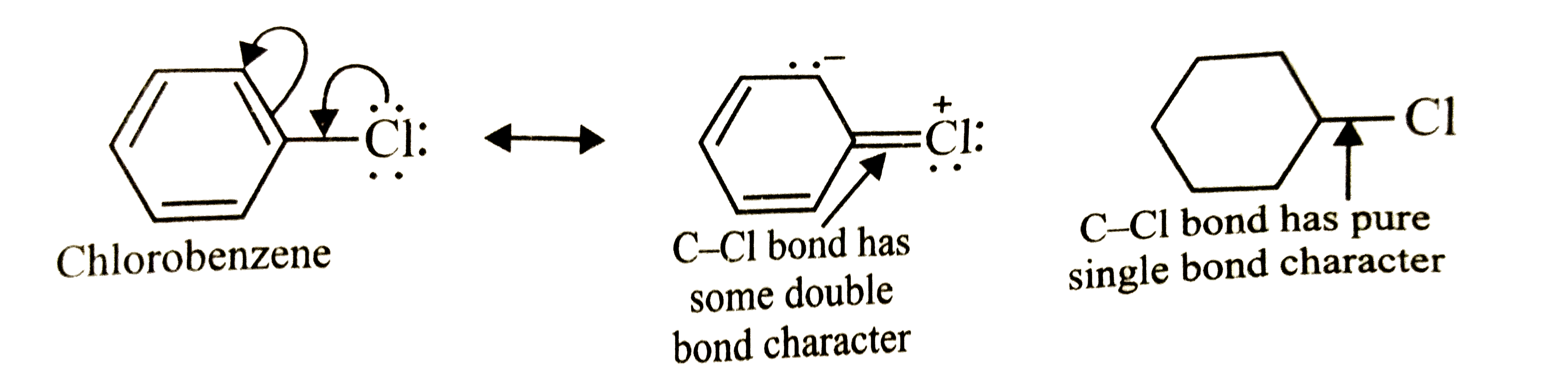 Further, due to delocalization of lone pairs of electrons of the Cl atom over the benzene ring, C-Cl bond in chlorobenzene acquires some double character while the C-Cl bond in cyclohexyl chlorie is a pure single bond. in other words, C-Cl bond in chlorobenzene is shorter than in cyclohexyl chloride. since dipole moment is a product of charge and distance, therefore, chlorobenzene has lower dipole moment than cyclohexyl chlorie due to lower magnitude of -ve charge on the Cl atom and shorter C-Cl distance. (ii) Alkyl halides are polar molecules, therefore, their molecules are held together by dipole-dipole attraction. the molecules of `H_(2)O` are held together by H-bonds. since the new forces of attaraction between water and alkyl halide molecules are weaker than the forces of attraction already existing between alkyl halide-alkyl halide molecules and water-water molecules, therefore, alkyl halides are immiscible (nor soluble) with water. (iii) Grignard reagents are very reactive. they REACT with moisture present in the apparatus or the STARTING materials, i.e., `R-X,Mg and ` the solvent (ether or THF). `underset("Grinard reagent")(overset(delta-)(R)-overset(delta+)(Mg)overset(Delta-)(X))+H-OH to R-H+Mg(OH)X` therefore, Grignard reagents must be prepared under anhydrous conditions. |
|
| 24. |
Explain the following terms : Polypeptides |
| Answer» SOLUTION :Polypeptides are polymers of amino ACIDS containing less than 100 amino acids. For EXAMPLE , oxytocin, vasopressin, etc. | |
| 25. |
Explain why (i) vinyl chloride is unreactive to nucleophilic substitution reactions. (ii) neo-Pentyl bromide undergoes nucleophilic substitution reaction very slowly.(iii) 3 - Bromocyclohexene is more reactive than 4-bromo cyclohexene in hydrolysis with aqueous NaOH. |
Answer» Solution :(i) Vinyl CHLORIDE is UNREACTIVE to nucleophilic substitution reactions because of the double bond character in C=C1 bond which is difficult to break.  (ii) neo-Pentyl bromide undergoes nucleophilic substitution reaction very slowly. This is because it is a primary alkyl halide and it forms a primary carbocation which is less stable and therefore reacts slowly `("in"S_(N)1 )`. Even in `S_(N)2` reaction, the nucleophile FACES steric hindrance. Therefore the reaction is slow. (iii)  3 Bromocyclohexene 4-Bromocyclohexene Br 3-Bromocyclohexene forms a stable carbocation which reacts with `OH^(-)`ion to FORM the product. 3 Bromocyclohexene 4-Bromocyclohexene Br 3-Bromocyclohexene forms a stable carbocation which reacts with `OH^(-)`ion to FORM the product. 4-Bromocyclohexene does not form the carbocation and therefore the reaction is slow. |
|
| 26. |
Explain the following terms :Plane of symmetry |
Answer» SOLUTION :Plane of symmetry : A plane that DIVIDES a molecule in two EQUAL halves is CALLED plane of SYMMERTY.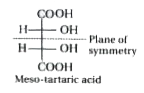
|
|
| 27. |
What is the common oxidation state of first transition series of elements ? |
Answer» SOLUTION : AMONG first transition elements, in +2 oxidation state, Mn(II) will have highest Number of upaired ELECTRONS.  (ii) +2 |
|
| 28. |
Explain the following terms : Invert sugar |
| Answer» Solution :An EQUIMOLAR mixture of glucose and fructose PRODUCED on hydrolysis of sucrose is CALLED INVERT sugar. It is called so because sucrose is DEXTRO rotatory whereas its hydrolysis product is laevo rotatory. | |
| 29. |
Explain why (i) E^(@) for Mn^(3+)//Mn^(2+) couple is more positive than that for Fe^(3+)//Fe^(2+) ? (ii) Ce^(3+) can be easily oxidised to Ce^(4+) ? [Atomic numbers : Mn = 25, Fe = 26 Ce = 58] |
|
Answer» Solution :(i) `Mn^(2+)` is more STABLE because of half-filled `(4s^0)5d^(5))` d-orbitals than `Mn^(3+)(4s^(0)3d^(4))` while `Fe^(3+)(4s^(0)3d^(5))` is more stable than `Fe^(2+)(4s^(0)3d^(6))` again because of half-filled d-orbitals. Therefore, `Mn^(3+)` can be easily reduced to `Mn^(2+)` whereas Fe3+ is not easily reduced to `Fe^(2+)`, rather `Fe^(2+)` is more easily oxidised to `Fe^(3+)`. (II) `Ce^(4+)` is more stable than `Ce^(3+)` because of stable ELECTRONIC configuration and higher hydration energy of `Ce^(4+)`, HENCE `Ce^(3+)` is easily oxidised to `Ce^(4+)`. |
|
| 30. |
Explain the following terms :Meso compounds |
Answer» Solution :Meso Compounds : The compounds that have TWO similar CHIRAL CENTRES are optically inactive due to plane of SYMMERTRY but has atleast ONE optically active diastereomer are called meso compounds.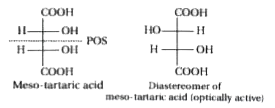
|
|
| 31. |
Explain why: (i) E^0 for Mn^(3+)//Mn^(2+) couple is more positive than that for Fe^(3+)//Fe^(2+). (At. Nos. Mn = 25, Fe = 26). (ii)Ce^(3+) can be easily oxidised to Ce^(4+). (At. No. Ce = 58). |
| Answer» SOLUTION :(ii) `CE^(3+)` ions having the configuration `4F^(1)d^(0)6d^(0)` can easily lose election to acquire the configuration `4f^0 5d^(0) 6s^(0)` and FORM `Ce^(4+)`ION. | |
| 32. |
Explain the following terms :Optical activity |
|
Answer» Solution :Optical activity : When a plane polarised light is passed through a solutions of certain compounds, the light is rotated EITHER in clockwise or in a anti - clockwise direction by a certain ANGLE. This property of a compound of rotating plane polarised light from its path is KNOWN as optical activity. If the compound rotates plane of polarised light in a clockwise direction, it is called dextrorotatory (Greek for right rotating) or the d - form and is indicated by placing a positive (+) sign before the degree of rotation. If the light is rotated towards left (anticlockwise), the compound is said to laevo-rotatory or the l - form and a negative (-) sign is placed before the degree of rotation. Such (+) and (-) isomers of compound are called optical isomers and the PHENOMENON is TERMED as optical isomerism. Louis Pasteur believed that the difference in optical activity is due to difference in 3D arrangement of atoms in a molecule. |
|
| 33. |
Explain why : (i) Glucose is soluble in waterbut cyclohexaneis not. (ii) Aldehyde group is absentin the penta acetate of D - glucose . (iii) Vitamin A isessanital for us . |
|
Answer» Solution :(i) Glucosehasfive - OH groupswhichformhydrogen bondwith water . Dueto thisextensiveintermolecular hydrogen bonding, glucoseis solublein water . Cyclohexane is non -polar molecule with no-OH group, henceit does not DISSOLVE in polarsolventwater . (ii) PentaacetateD - GLUCOSE does not CONTAIN any free aldehyde group as it is a cylic STRUCTUREOF glucose . It isthis cyclic STRUCTURE of glucosein acetylationforms penta acetate of D- glucose .  (iii)Defficiency of vitamin A causes night blindness and xerophthalma (chardeingof cornea of eye). Thatis why vitamin A is essentail for us . |
|
| 34. |
Explain the following terms: (i) Rate of a reaction(ii) Activation energy of a reaction |
|
Answer» Solution :(i) Rate of a REACTION : Rate of a reaction may be defined as change in concentration of reactant or product in unit time. (II) Activation energy of a reaction: Difference in energy of the reactants and the ACTIVATED complex in a reaction is called activation energy. Reactants must gain energy to reach the state of activated complexin order to give the PRODUCTS. |
|
| 35. |
Explain why HF is less viscous than water? |
| Answer» Solution :A molecule of `H_(2)O` can from FOUR H- BONDS while that of HF can form only two. Therefore, `H_(2)O` molecules are more highly associated than HF molecules. Consequently, `H_(2)O` has HIGHER viscosity than HF or HF is LESS viscous than `H_(2)O` | |
| 36. |
Explain the following terms : (i) Electrophoresis (ii) Coagulation (iii) Dialysis (iv) Tyndall effect. |
|
Answer» Solution :(i) Electrophoresis : The existence of charge on colloidal particles is confirmed by electrophoresis experiment. When electric potential is applied across two platinum electrodes dipping in a colloidal solution the colloidal particles MOVE towards one or the other electrode. The movement of colloidal particles under an applied electric potential is CALLED electrophoresis. (ii) Coagulation: The process of settling of colloidal particles is called coagulation of PRECIPITATION of the sol. (iii) Dialysis: It is a process of removing a dissolved SUBSTANCE from a colloidal solution by means of diffusion through a suitable membrane. (iv) Tyndall effect : If a homogeneous solution placed in dark is observed in the direction of light, it appears clear and if it is observed from a direction at right angles to the direction of light BEAM it appears perfectly dark. This effect is known as Tyndall effect. |
|
| 37. |
Explain why :Grignard reagents should be prepared under anhydrous conditions ? |
|
Answer» SOLUTION :Grignard REGENT reacts with water to form an alkane. THUS it must be prepared in anhydrous conditions. `R-MgX+H_(2)O rarr R-H+Mg(OH)X`. |
|
| 38. |
Explain the following terms : (i) Rate constant (k) (ii) Half life period of reaction (t_(1//2)). |
| Answer» Solution :(i) Rate CONSTANT (K) : Rate constant is rate of the reaction when the CONCENTRATION of reactant/s is unity. | |
| 39. |
Explain why graphite is good conductor of electricity ? |
|
Answer» Solution : The EXCEPTIONAL property of GRAPHITE of being a good conductor of electricity is because of its structure. In graphite, the carbon ATOMS are arranged in different layers and each ATOM is covalently bonded to three of its neighbouring atoms in the same layer. The fourth valence electron of each atom is present between Structure of graphite different layers and is free to MOVE about. These free electrons make graphite a good conductor of electricity. 
|
|
| 40. |
Explainthefollowing terms : (i)Inverts sugar . (ii) Polypeptides . |
|
Answer» Solution :(i) Refer S.A.T.Q.3.(ii). (ii) POLYPEPTIDES : Whenmorethan 10 AMINO ACIDS arejoined together by peptide bond (-CONH-), the product is POLYPEPTIDE . 
|
|
| 41. |
Explain why following reaction give different products : |
Answer» Solution :When reacting with weak nucleophiles under acidic conditions, epoxides react via an `S_(N)2` type mechanism. Attack occurs at the least hindered carbon atom. When reacting with weak nucleophiles under acidic conditions, epoxides react via an `S_(N)1` type mechanism. Since the nucleophile is weak, it attacks the carbon with the largest amount of `DELTA+` CHARGE, regardless of steric hindrance. This large amount of charge RESIDES where it is most stable, in this case, on the more substituted carbon. Additional charge stabilization results from resonance with the benzene ring. 
|
|
| 42. |
Explain the following terms (i) Electrophoresis (ii) Micelles (iii) Peptization. |
| Answer» | |
| 43. |
Explainthe following terms : (i) Invert sugar(ii) Polypeptides. |
|
Answer» Solution :(i)Invert sugar : SUCROSEIS dextrorotatorybut after hydrolysis it givendextrorotatory glucose and laevorotatory fructose . Laevorotation of FRUCTOSEIS morethan thedextrorotationof glucose. Thereforethe mixtureis laveorotatory. Thushydrolysis of sugarbrings about inversion of sign of rotation formdextro (+) to laevo (-). The PRODUCT OBTAINED is calledinvert sugar. (ii) Polypeptides : Peoptide linkageis an amideformedbetween - COOH group and `- NH_(2)` group. The reactionbetween twomolecules of SIMILAR ordifferent amino acidsprocceds through the combination of the amino group of onemolecule withthe carboxyl group of the otherwhen itsthe numberof suchamino group is ten m thenthe products are called polyeptides. 
|
|
| 44. |
Explain why glucose penta acetate does not react with hydroxylamine ? |
| Answer» SOLUTION :The molecule of glucose PENTA acetate has a cyclic STRUCTURE in which - CHO is involved in ring formation. | |
| 45. |
Explain why Gd^(3+) is colourless? |
|
Answer» Solution :(1) `Gd^(3+)` has electronic configuration, `[Xe]4f^(7)` (2) Due to extra STABILITY of half FILLED ORBITAL, it does not ALLOW `f rarr f` TRANSITION, and hence does not absorb radiations in the visible region. Hence `Gd^(3+)` is colourless. |
|
| 46. |
Explain the following terms : (i) Electrophoresis (ii) Coagulation (iii) Dialysis (iv) Tyndall effect. |
| Answer» Solution : (i) Electrophoresis. It is the movement of colloidal particles under the influence of external electrical field. (ii) Coagulation. It is the breaking of colloid into dispersed phase and dispersion medium. (iii) Dialysis. PURIFICATION of colloidal SOLUTIONS by USING a MEMBRANE. (IV) Tyndall effect. It is the scattering of light by the colloidal particles. | |
| 47. |
Explain the following terms : (i) Electrophoresis (ii) Coagulation (ii) Dialysis (iv) Tyndall effect. |
| Answer» Solution :(i) Electrophoresis. It is the movement of colloidal particles under the influence external electrical field. (II) COAGULATION. It is the breaking of colloid into dispersed phase and dispersion medium. (ii) Dialysis. Purification of colloidal solutions by USING a membrane. (iv) Tyndall effect. It is the SCATTERING of light by the colloidal particles. | |
| 48. |
Explain the following terms: (i) Electrophoresis (ii) Coagulation (iii) Dialysis (iv) Tyndall effect. |
|
Answer» Solution :(i) ELECTROPHORESIS : The movement of colloidal particles towards oppositely charged electrodes in the presence of an electric field is called electrophoresis. If this movement is towards cathode, the TERM used in cataphoresis. (II) Coagulation : The formation of aggregates or precipitates of colloidal particles by addition of a suitable electrolyte is called coagulation (iii) Dialysis : The process of removing a dissolved substance from the colloidal solution by means of diffusion through a suitable membrane is called dialysis. Colloidal particles are prevented from passing through this membrane due to their bigger size. (iv) TYNDALL effect: When a beam of light is passed through a colloidal solution and the solution is VIEWED at right angles to the passage of light, they show a mild to strong opalescence, i.e., the path of beam of light is illuminated. This phenomenon is called Tyndall effect. This is cause due to scattering of light by colloidal particles. |
|
| 49. |
Explain why fluorine forms only one oxoacid, HOF. |
| Answer» SOLUTION :Because of UNAVAILABILITY of d-orbitals in its VALENCE SHELL. | |
| 50. |
Explain why fluorine forms only, one oxo - acid, HOF? |
|
Answer» Solution :In FLUORINE d - orbitals are ABSENT so it shows only `-1` OXIDATION state in oxo - acid, but not `+3, +5 or +7`. That.s why unlike other members (HALOGENS) fluorine only forms : Oneoxo - acid HOF and not other like `HOFO`, `HOFO_(2) and `HOFO_(3)`. |
|