

Saved Bookmarks
This section includes 7 InterviewSolutions, each offering curated multiple-choice questions to sharpen your Current Affairs knowledge and support exam preparation. Choose a topic below to get started.
| 1. |
Explain the following terms giving one example of each type . (i) Antacids, (ii) Disinfectants, Enzymes. |
|
Answer» Solution :(i) ANTACIDS : Chemical substances which removes the EXCESS acid in the stomachand raise the `p^(H)` to appropriate level, e.g., zantac. (ii) DISINFECTANTS : These are the chemicals substances which kill microorganism or stop their growth but are harmful to living tissues. These are used to kill the micro-organism present in floors, drains toilets , etc., e.g., phenol. (III) Enzymes , Enzymes are globular proteins with high molecular mas renging from `15,000` to `1,000,000 g mol^(-1)`, and form colloidal solution in water. A number of reactions that occurs in the body animals and plants to maintain the life process are catalysed by enzymes are TERMED as biochemical catalysts. |
|
| 2. |
Explain the following terms giving one example of each type: (i) Antacids, (ii) Disinfectants, (iii) Enzymes. |
|
Answer» Solution :(i) Antacids : The chemical substances which neutralize excess acid released by gastric juices and give relief from acid, indigestion, heart burns and gastric ulcers are KNOWN as antacids e.g., `NaHCO_(3)`, (Baking soda), magnesium hydroxide ETC. (ii) Disinfectants : These are chemicals which kill micro-organisms but are not safe for contact with living tissues. e.g., 1% Phenol. (iii) ENZYMES : Enzymes are proteins which act as catalysts in many biochemical reactions. These are the important GROUP of globular proteins which act as essential biological catalysts and are specific in action .e.g., Amylase, maltase. |
|
| 3. |
Explain the following terms giving a suitable example of each. (i)Aerosol (ii) Emulsion (iii) M icelles |
| Answer» | |
| 4. |
Explain why fluorine always exhibit an oxidation state of -1 ? |
|
Answer» Solution :(i) The electronicconfiguration of fluorine is `1S^(2) 2s^(2) 2p_(x)^(2) 2p_(y)^(2)2p_(z)^(1)`. (ii) To ATTAIN the noble gas configuration it gains ONE electrons and exhibits -1 oxidation state. (iii) Fluorine is most electronegative atom so does not exhibit positive oxidation state. (iv) Since it cannot EXPAND its octet due to non availabilityof d-orbitals. |
|
| 5. |
Explain the following terms :Enantiomers |
Answer» Solution :Enantiomers : These are optically active compounds that are non - super IMPOSABLE on their mirror images.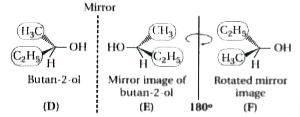 Butan-2-ol has four DIFFERENT GROUPS attached to the TETRAHEDRAL carbon as expected it is chiral. The pair of Butan-2-ol and its mirror image molecules are called enatiomers. If one isomer is dextro rotatery, the another is a laevo rotatory and vice - versa. 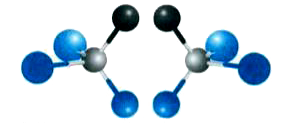
|
|
| 6. |
Explain the following terms : Electrophoresis |
| Answer» Solution :Electrophoresis : When electric POTENTIAL is applied across two platinum ELECTRODES dipping in a colloidal solution, the colloidal particles move towards one or the other electrode. The MOVEMENT of colloidal particles under an applied electrical potential is called electrophoresis. Positively charged colloidal particles move towards the CATHODE while negatively charged particles move towards the anode. | |
| 7. |
Explain the following terms :Diastereomers |
Answer» SOLUTION :Diastereomers : The OPTICALLY active COMPOUNDS that are non-mirror images of each other are CALLED diastereomers. These compounds have two dissimilar stereogenic centres.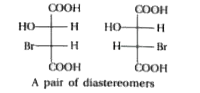
|
|
| 8. |
Explain the following terms : Dialysis |
| Answer» Solution :Dialysis: It is the process of removing a dissolved substance from a colloidal solution by means of diffusion through a suitable membrane. Tons or smaller molecules can pass through parchment PAPER but not colloidal particles. This membrane can be used for dialysis. A bag of suitable membrane containing the colloidal solution is suspended in a vessel through which fresh water continuously flows. The molecules or IONS diffuse through the membrane into OUTER water and pure colloidal solution is left BEHIND. | |
| 9. |
Explain the following terms :Chirality |
Answer» Solution :Chirality :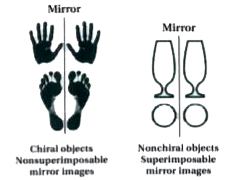 the chirality (GREEK for Handedness) refers to asymmetry in a molecule. A molecule is said to be a CHIRAL if : (i) It cannot be DIVIDED in two equal halves. (ii) It is non - super imposable in its mirror image molecule. The chirality is a necessary and sufficient condition for a molecule to be optically ACTIVE and it is a property of a molecule. For example, 2 - chlorobutane, 2, 3-dihydroxy propanal, bromo chloro iodomethane, 2-Bromo propanoic acid etc. are chiral molecules. |
|
| 10. |
Explain why fluorine always exhibit an aoxidation state of -1? |
| Answer» Solution :Fluorine the most electronegative element than other halogens and cannot exhibit any POSITIVE oxidation state. Fluorine does not have d - ORBITAL white other halogens have d - orbitals. Therefore fluorine always exhibit an oxidation state of `-1` and others in halogen family shows `+1, +3, +5 and +7` oxidation states. | |
| 11. |
Explain the following terms as used in medicinal chemistry : Target molecules |
| Answer» Solution :Drugs that INTERACT with biomolecules such as LIPIDS, carbohydrates,proteins and NUCLEIC ACIDS, are called target molecules. | |
| 12. |
Explain, why Fe(NH_(4))_(2),(SO_(4))_(2)(H_(2)O_(2))_(6) is a salt but K_(4)[Fe(CN)_(6)] isa complex compound. |
|
Answer» SOLUTION : (1) When `Fe(NH_(4))_(2)(SO_(4))_(2)(H_(2)O)_(6)` is DISSOLVED in WATER, it dissociates giving IONS `Fe^(2+), NH_(4)^(+) and SO_(4)^(2-)`. This indicates that the compound ionises into constituent ions. Hence it is a double salt, having formula `FeSO_(4) (NH_(2))_(2) SO_(4) .6H_(2)O`. `k_(4)[Fe(CN)_(6)]` when dissolved in water, the solution does not givethe testfor `Fe^(2+)`and `CN^(-)`ionsbut gives thetests for `K^(+)`and`[Fe(CN)_(6)]^(4-)`ions. lt brgt This indicates that, the constituent ions, `Fe^(2+)`and`CN^(-)`form oneentityof stablecomplex ion `[Fe(CN)_(6)]^(4-)`. Therefore`k_(4)[Fe(CN)_(6)]` is a complex compound. |
|
| 13. |
Explain the following terms :Chiral centre (atom) and Achiral molecule |
|
Answer» Solution :Chiral centre : A `sp^(3)` atom bonded with four different groups is called chiral centre or chiral different groups is called chiral centre or chiral atom. J. Van.t Hoff and C. Le Bel independently argued that the spatial arrangement of four groups around a central atoms of a carbon is tetrahedral and if all the substituents attached to that carbon are different, the mirror image of the molecule is not superimposed on the molecule. Such a carbon is called asymmetric carbon or stereocentre. 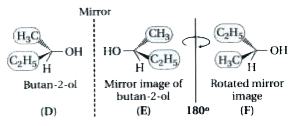 Note : The presence or absence of chiral atom is not CRITERIA for a molecule to be optically active. The optical activity is due to molecular asymmetry (Chirality). HOWEVER, a molecule with one chiral centre is ALWAYS optically active. The molecule that lacks a symmetry are called achiral molecules. These are optically inactive. 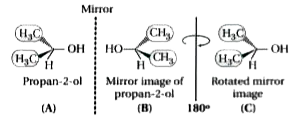 Propan-2-ol (A) does not contain an asymmetric carbon, as all the four groups attached to the tetrahedral carbon are not different. The mirror image (B) when rotated by `180^(@)` gets COMPLETELY overlap on (A) and (C ). |
|
| 14. |
Explain why [Fe(H_(2)O)_(6)]^(3+) has magnetic moment value of 5.92 BM whereas [Fe(CN)_(6)]^(3-) has a value of only 1.74 BM. |
|
Answer» Solution :Both have `Fe^(3+)(3d^(5)=3d^(1)3d^(1)3d^(1)3d^(1)3d^(1)).H_(2)O` is WEAK LIGAND. ELECTRONS do not pair up. Hybridisation is `sp^(3)d^(2)`. As `n=5, mu=sqrt(5(5+2))=5.92BM` `CN^(-)` is a strong ligand. Electrons pair up to give `3d^(2)3d^(2)3d^(1)3d^(0)3d^(0)` Hybridisation is `d^(2)sp^(3)`. As `n=1, mu=sqrt(1(1+2))=1.73 BM` |
|
| 15. |
Explain the following terms as used in medicinal chemistry : Enzyme inhibitors |
| Answer» SOLUTION :They INHIBIT the CATALYTIC ACTIVITY of the ENZYME. | |
| 16. |
Explain why Fe is a transitioin metal but Na is not ? |
| Answer» Solution :Fe contains incompletely filled 3D subshell `( 3d^(6) 4s^(2))`. Hence, it is a d-block ELEMENT, i.e., a TRANSITION element. Na has no d-subshell. LAST electron in it enters 3s orbital `( 1s^(2) 2s^(2) 2P^(6) 3s^(1))`. Hence, it belongs to s-block. | |
| 17. |
Explain the following terms :Centre of symmetry |
| Answer» Solution :CENTRE of SYMMETRY : The point present at the centre of the molecule through which if straight lines are DRAWN, then at EQUAL distance in opposite DIRECTION the identical groups are present, the point is known as centre of symmetry OR centre of inversion. | |
| 18. |
Explain why electrolysis of aqueous solution of NaCl gives H_(2)at cathode and Cl_(2) at anode. Write the overall reaction. [Given : E_(Na^(+)//Na)^(@) = -2.71 V, E_(Cl_(2)//2Cl^(-))^(@) = 1.36 V] 1/2 O_(2)(g) + 2H^(+) (aq) + 2e^(-) to H_(2)O (l), E^(@) = 1.23 V |
|
Answer» Solution :The electrode reactions may be represented as under: `NaCl(AQ) to NA^(+) (aq) + Cl^(-) (aq)` `H_(2)O(l) to H^(+) (aq) + OH^(-)` (aq) At cathode: `2H^(+) (aq) + 2E^(-) to H_(2)` (g) It is because reduction potential of `E_(H^(+)//H_(2))^(@)` is greater than that of `E_(Na^(+)//Na)^(@)` At anode: `2Cl^(-)(aq) -2 E^(-) to Cl_(2) (g)` It is because of overvoltage i.e., energy required to liberate `O_(2)`is more than that required to liberate `Cl_(2)` Overall reaction: `2NaCl (aq) + 2H_(2)O (l) OVERSET("Electrolysis") to H_(2)(g) + Cl_(2) (g) + 2Na^(+) (aq) + 2OH^(-)` (aq) |
|
| 19. |
Explain why equimolar aqueous solution chloride and sodium sulphate are not isotonic? |
| Answer» Solution :NaCl DISSOCIATES to give 2 ions`(NA^(+) and Cl^(-)). Na_(2)SO_(4)` dissociates to give 3 ions `(2Na^(+) and SO_(4)^(2-))`. Thus, EQUIMOLAR solution of NaCl and `Na_(2)SO_(4)` have different concentrations of ions in the solution. As osmotic pressure depends upon concentration of particles in the solution, they have different osmotic pressures. | |
| 20. |
Explain why E^(@) for Mn^(3+)// Mn^(@+) couple is more positive than that for Fe^(3+) //Fe^(2+)( At. Nos. Mn= 25, Fe= 26) ? Or Why is +2 oxidation state of manganese quite stablewhile the same is not true for iron ? [Mn= 25 , Fe = 26] |
|
Answer» Solution :`._(25)Mn^(2+) = [Ar] 3D^(5), . _(25) Mn^(3+) =[Ar] 3d^(4), ._(26) Fe^(2+) = [ Ar] 3d^(6) , . _(26) Fe^(3+)= [ Ar] 3d^(5)` Thus, `Mn^(2+)` has more stable configurationthan `Mn^(3+)` while `Fe^(3+)`has more stable then `Fe^92+)`. Consequently, large third ionisation enthalpy is REQUIRED to change `Mn^(2+)` to `Mn^(3+)`. As `E^(@)` is the sum of enthalpy of atomisation, IONIZATION enthalpy and hydration enthalpy, THEREFORE, `E^(@)` for `Mn^(3+)//Mn^(2+)` couple is more positive than `Fe^(3+) //Fe^(2+)` . Note `,` The large positive `E^(@)` for `Mn^(3+)//Mn^(2+)` means that `Mn^(3+)` can be easily reduced to `Mn^(2+)` , i.e. `Mn^(3+)` is less stable . `E^(@)` value for `Fe^(3+) //Fe^2+)` is positive but SMALL, i.e., `Fe^(3+)` can also be reducedto `Fe^(2+)` but less easily. Thus,`Fe^(3+)` is more stable than `Mn^(3+)` . It also explains why `+3` state of Mn is of little importance. |
|
| 21. |
Explain the following terms : (a) Chemistry of all Lanthanoids is so identical . (b) Silver atom has completely filled d- orbitals (4d^(10)) in its ground state . How can you say that is a transition elements ? |
|
Answer» Solution :(a) All the lanthanoids have similar outer electronic configuration and show +3 oxidation state in their compounds . Therefore , all the Lanthanoids have similar chemical properties . The different lanthanoids differ mainly in the number of 4f-electrons which are burried deep in the atoms and hence , do not influence the properties . Moreover , due tolanthanoidcontraction , there is very small difference in the size of all TRIVALENT lanthanoid ions . Thus the size of their ions is also almost identical which resultsin similar chemical properties . (B) According to definition , transition elements are those which have partially filled d-subshell in their elementary STATES or in their ONE of the oxidation states . Silver ( Z = 47) can exhibit +2 oxidation state in which it has incompletely filled d-subshells . Hence , silver is regarded as transition element . |
|
| 22. |
Explain why does the colour of KMnO_(4) disappear when oxalic acid is added to its solution in acidic medium. |
|
Answer» Solution :`KMnO_(4)` acts as oxidising agent. It oxidises oxalic ACID to `CO_(2)` and is itself changed to `Mn^(2+)` IONS which are colourless. The reaction is given as under : `5C_(2)O_(4)^(2-)+underset(("COLOURED"))(2MnO_(4)^(-))+16H^(+)to underset(("Colourless"))(2Mn^(2+))+8H_(2)O+10CO_(2)` |
|
| 23. |
Explain the following terms : (a) Peptization(b) Electrophoresis(c) Dialysis(d) Brownian movement |
Answer» Solution :(a) Peptization : The term has originated from the digestion of proteins by the enzyme pepsin. Peptization may be defined as (the process of converting a precipitate into colloidal sol by shaking it with dispersion mediumin the presence of a small amount of electrolyte). The electrolyte used for this purpose is called peptizing agent. This methodis applied, generally, to convert a freshly prepared precipitate into a colloidal sol. During peptization, the precipitate adsorbs one of the ION of the electrolyte on its surface. The ion adsorbed on the surface is common either with the anion or cation of the electrolyte. This causes the development of positive or negative charge on precipitates which ultimately break up into smaller particles having the dimensions of colloids.  (B) Electrical Properties (Electrophoresis) : The particles of the colloids are electrically charged and carry positive or negative charge. The dispersion medium has an EQUAL and opposite charge making the system neutral as a whole. Due to similar nature of the charge carried by the particles, they repel each other and do not combine to form bigger particles. That is why, a sol is stable and particles do not settle down. Arsenious sulphide, gold, silver and platinum particles in their respective colloidal sols are negatively charged while particles of ferric hydroxide, aluminium hydroxide are positively charged. The existence of the electric charge is shown by the phenomenon of electrophoresis. It involves the 'movement of colloidal particles either towards the cathode or anode, under the influence of the electric field'. The apparatus used for electrophoresis as shown in fig. 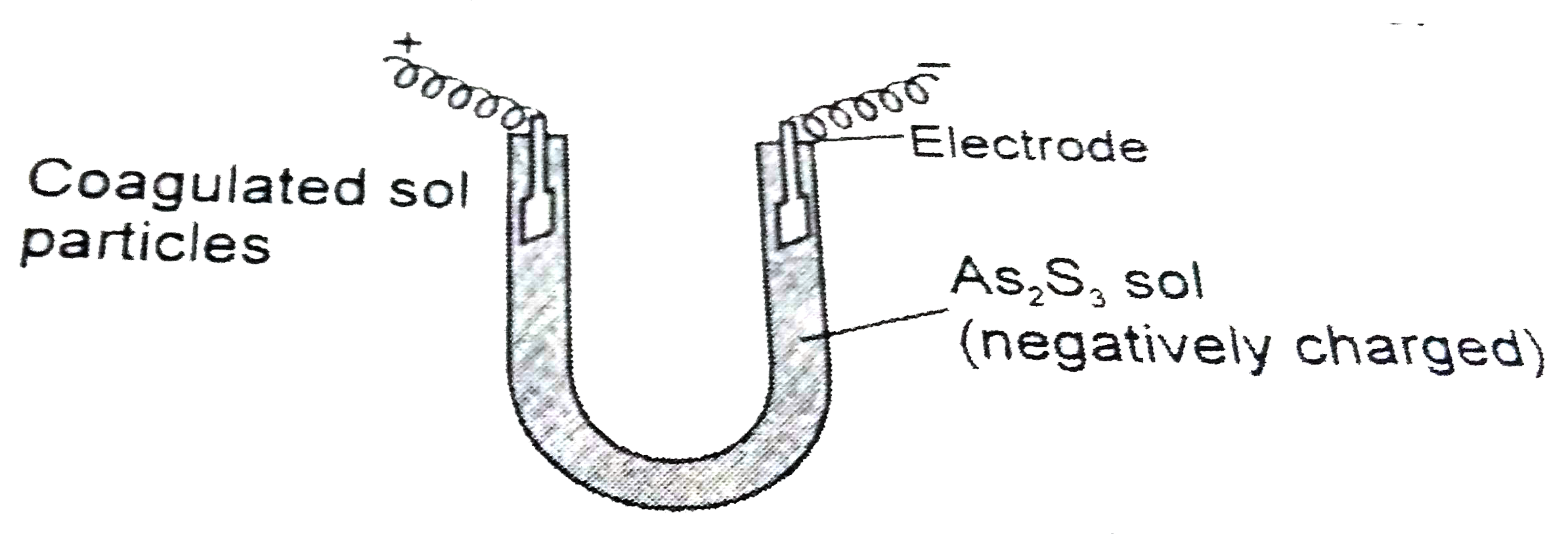 The colloidal solution is placed in a U - TUBE fitted with platinum electrodes. On passing an electric current, thecharged colloidal particles move towards the oppositely charged electrode, Thus, if arsenic sulphide sol is taken in the U - tube, in which negatively charge particleof arsenic sulphide move towards the anode. `*` Earlier this process was called cataphoresis because most of the colloidal sols studied at that time were positively charged and moved towards cathode. (c) DIALYSIS : It is a process of removing a dissolved substance from a colloidal solution by means diffusion through suitable membrane. Since particles in true solution (ions or smaller molecules) can pass through animal membrane or parchment paper or cellophane sheet but colloidal particle do not, the appratus used for this purpose is called Dialyser. A bag of suitable membrane containing the colloidal silutions is suspended in a vessel through which fresh water continously flow. The molecules and ions (crystalloids) diffuse through membrance into the outer water & pure colloidal solution is left behind. (d) Mechanical Properties : Brownian movement : Robert Brown, a botanist, discovered in 1827 that pollen grains placed in water do not remain at rest but move about continuously and randomly. Later on, this phenomenon was observed in case of colloidal and randomly. Later on, this phenomenon was observed in case of colloidal particles when they were seen under an ultramicroscope. The particles were seen to be in constant zig-zag motion as shown in fig. This zig-zag motion is called Brownian movement 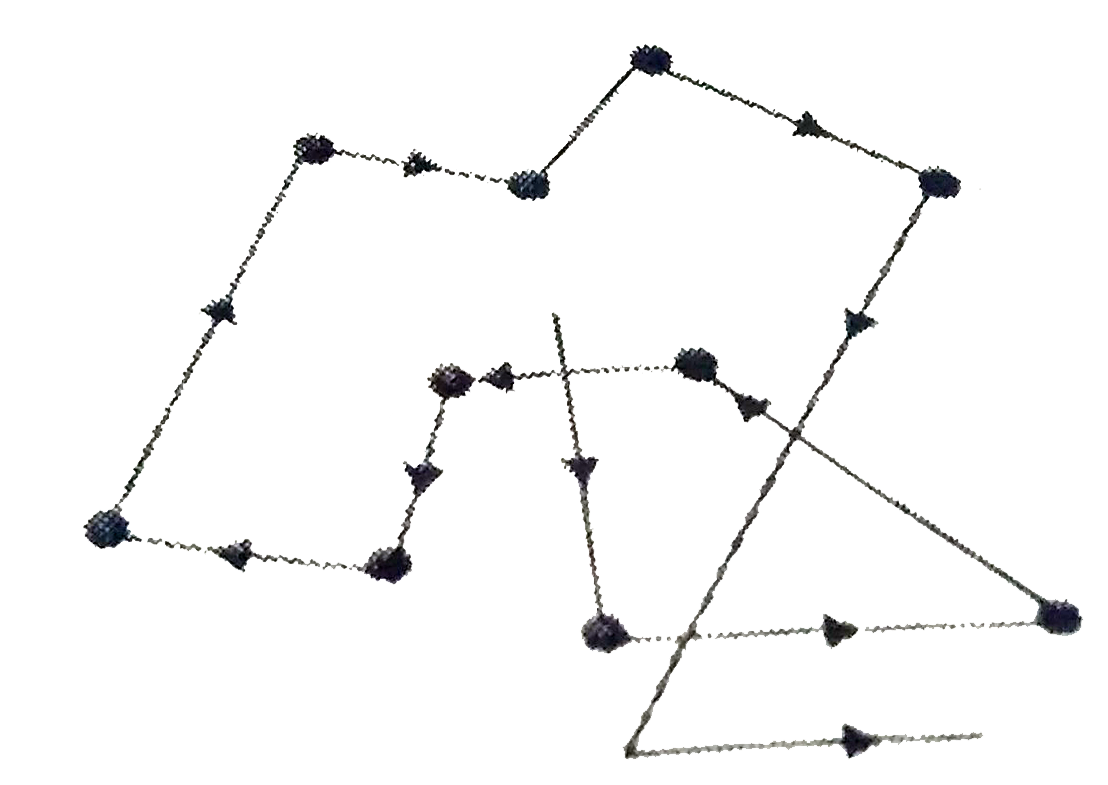
|
|
| 24. |
Explain why does nitro group nitrobenzene direct the incoming group to m-position? |
Answer» Solution :This is because `-NO_2` GROUP has -I effect and decreases ELECTRON density at o-and p-positions as compared to m-position due to resonance.  `THEREFORE - NO_2` deactivates the benzene ring towards electrophilic substitution reaction adn directs the incoming group to m-position. |
|
| 25. |
Explain the following terms : (a) Schottky defect (b) Frenkel defect. |
|
Answer» Solution :When imperfections or defects in a crystal are caused by a departure from the periodic arrangement in the vicinity of an atom or a group of atoms, the imperfections are called point defects. The imperfections are caused either by missing or dislocations of a. constitutent PARTICLE to a position meant for another particle or shifting to an interstitial position. Point defects are of two common types : 1. Schottky defects 2. Frenkel defects. 1. Schottky defects. This defect arises if some of the atoms or ions are missing from their normal lattice SITES. The lattice sites which are unoccupied are called latrice VACANCIES or holes. Since the crystal is to remain electrically neutral, equal number of CATIONS and anions are missing. The ideal AB crystal is shown in Fig. The existence of two holes, one due to a missing cation and the other due to a missing anion, is shown in Fig. Schottky defect is more common in strongly ionic compounds having a high coordination number. 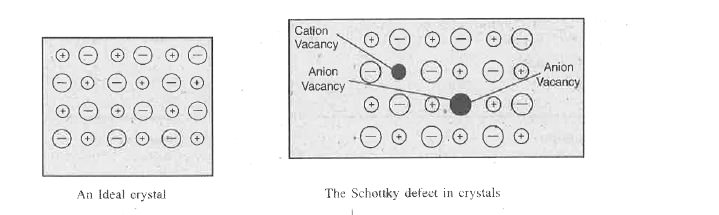 For example, NaCl and CsCl ionic solids have Schottky defects. Because of the presence of vacancies in crystals, its density is markedly lowered. 2. Frenkel defects. This defect arises when an ion is missing from its own position and occupies an interstitial SITE. The existence of one hole due to a missing cation its proper position and occupying an interstitial position is shown in Fig. In this case also, the crystal remains electrically neutral. Frenkel defects generally occur in 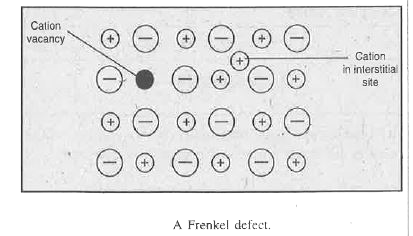 compounds in which anions are much larger than the cations and the co-ordination number is low. These defects can be found in silver halides because of the small size in the `Ag^(+)` ion. |
|
| 26. |
Explain why does conductivity of germanium crystals increase on doping with gallium. |
|
Answer» Solution :On doping germanium with gallium some of the positions of lattice of germanium are occupied by gallium. Gallium atoms has only three valance electrons that are used up on normal COVALENT band. HENCE for one gallium atoms, one hole is created at a missing site of fourth electron which are responsible for CONDUCTION. Electron from neighbouring atoms come and fill the hole. Under the influence of electric field electrons move TOWARDS POSITIVELY charged plates through these holes and conduct electricity. Holes move towards negatively charged plates. |
|
| 27. |
Explain the following term giving a suitable example : Emulsification. |
| Answer» Solution :It is a PROCESS in which emulsion is FORMED in the PRESENCE of emulsifying AGENT. For example, soap is an emulsifier for WATER - oil emulsion. | |
| 28. |
Explain why does coloure of KMnO_(4) disppear when oxalic acid is added to its solution in acidic medium. |
|
Answer» Solution :`KMnO_(4)` oxidizes OXALIC acid to `CO_(2)`and HALF is reduced to `Mn^(2+)` which is colourless. `underset("(Coloured)")(2MnO_(4)^(-)) + 16H^(+) + 5C_(2) O_(4)^(2-) rarr underset("(Colourless)")(2Mn^(2+))+ 8 H_(2)O + 10 CO_(2)` |
|
| 29. |
Explain the following term giving a suitable example, emulsification. |
| Answer» Solution :The process of making EMULSION using a mixture of two IMMISCIBLE or partially miscible liquids is CALLED EMULSIFICATION. For example, Cod liver OIL is an emulsion made up of water in oil. | |
| 30. |
Explain why does colour of KMnO_(4) disappear when oxalic acid is added to its solution in acidic medium. |
| Answer» Solution :`KMnO_(4)` being STRONG oxidizing agent in acidic medium, oxidizes OXALIC acid to `CO_(2)` and itself GETS reduces to `Mn^(2+)` ions which is colourless. `5C_(2)O_(4)^(2-) + 2MnO_(4)^(-) + 16H^(+) rarr UNDERSET(("Colourless"))(2Mn^(2+)) + 10CO_(2) + 8H_(2)O` | |
| 31. |
Explain the following situations :XeF_2 has a straight linear structure and not a bent angular structure. |
| Answer» Solution :Due to `sp^(3)d` hybridisation of Xe, it has a trigonal BIPYRAMID geometry. Three equatorial positions are occupied by lone PAIRS of electrons to minimize repulsions, giving a LINEAR shape to the MOLECULE. | |
| 32. |
Explain the following situations : SF_4 is easily hydrolysed whereas SF is not easily hydrolysed. |
| Answer» Solution :`SF_6` has a more stable symmetrical octahedral structure, with all the FSF anlges as `90^(@)`. On the other hand, `SF_4` has less stable unsymmetrical trigonal bipyramidal structure with one equatorial POSITION OCCUPIED by a lone pair of electrons. Less stable structures have a GREATER tendency to show reactivity. Thus `SF_4` is easily hydrolysed whereas `SF_6` is not easily hydrolysed. | |
| 33. |
Explain, why do aquatic animals prefer to stay at lower leval of water during summer ? |
|
Answer» Solution :To survive, AQUATIC animals must have sufficient levals of dissolved oxygen (DO) in water. Oxygen enters the water through two natural processes : (a) diffusion from the atmosphere and (b) Photosynthesis by aquatic plants. The MIXING of surface water by wind and WAVES INCREASES the rate at which oxygen from the air can be dissolved or absorbed into the water. DO levels are influenced by temperature. The solubility of oxygen or its ability to DISSOLVE in water decreases as the water temperature increases. DO levels in an aquatic ecosystem vary seasonally. Thus to get the greater amount of dissolve oxygen, aquatic life prefer to stay at lower level of water during summer. |
|
| 34. |
Explain the following situations : In the structure of HNO_3 molecule, the N - O bond (121 pm) is shorter than N - OH bond (140 pm). |
| Answer» Solution :N - O bond has a DOUBLE bond CHARACTER while N - OH bond is a single bond. A double bond has ALWAYS a smaller bond length compared to the single bond. | |
| 35. |
Explain why dialkylcadmium is considered superior to Grignard reagent for the preparation of a ketone from an acid chlorine? |
|
Answer» Solution :Since Cd(E.N.=1.7) is LESS electropositive than Mg(E.N.=1.2), therefore, dialkylcadmiums are less reactive than Grignard reagents towards nucleophilic addition reactions. As such, dialkylcadmiums reacts with the more reactive aciid chlorides to give ketones but do not react further with the less reactive ketones thus FORMED to give tert-alcohols. In contast, Grignard reagents being more reactive not only reacts with the acid chlorides but also with the ketones so formed to give tert-alcohols. `underset("Ketone")(R'-OVERSET(O)overset(||)(C)-R) underset(-RCdCl)overset(R_(2)Cd)larr underset("Acid chloride")(R'-overset(O)overset(||)(C)-Cl) unerset(-Mg(Cl)X)overset(RMgX)to underset("Ketone")(R'-overset(O)overset(||)(C)-R) underset((ii)H^(+)//H_(2)O)overset((i)RMgX)to underset(3^(@)" alcohol")(R'-underset(R)underset(|)overset(OH)overset(|)(C)-R)`. |
|
| 36. |
Explain the following reactions using nitro benzene. (i) Chlorination (ii) Nitration (iii) Sulphonation |
Answer» SOLUTION :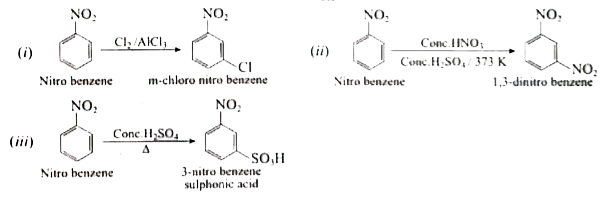
|
|
| 37. |
Explain why Cu^(+) is not stable in aqueous solution ? |
| Answer» Solution :DUE to less `-ve Delta _("hyd ") H^(8) "of " Cu^(+) //it` cannot COMPENSATE 2nd ionization POTENTIAL of Cu. | |
| 38. |
Explain the following ructions : (a) Gabriel Phthalimide reaction (b) Coupling reaction |
Answer» Solution :Gabriel.1 phthalimide synthesis : Phthalimide when treated with alcoholic potassiumhydroxide is easily converted into potassium phthalimide which on TREATMENT with alkyl halide followed by hydrolysis with acid or alkali yields phthalic add and a primary amine. 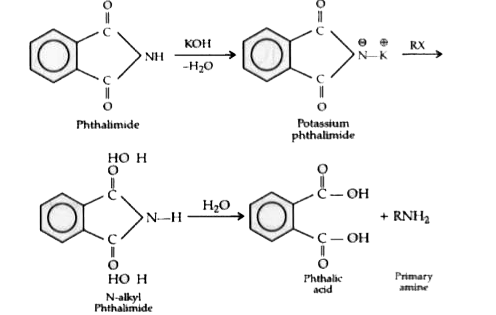 (b) Coupling reaction : It involves the reaction of bezene DIAZONIUM salts with phendols or ARYL amines. Coupling of phenol TAKES place in MILD alkaline solution while with aromatic `1^(@)` amines in mild acidic medium. 
|
|
| 39. |
Explain why Cu^(+) ion is not stable in aqueous solution? |
|
Answer» Solution :`Cu^(+)` in aqueous solution DISPROPORTIONATES to `Cu^(2+) and Cu` `2Cu_((AQ))^(+) RARR Cu + Cu_((aq))^(2+)` The `Cu^(2+)` is more stable because of its HIGH hydration enthalpy than `Cu^(+)` which more than compensates the SECOND ionization enthalpy of copper |
|
| 40. |
Explain the following reactions. (i) CH_3 - CH_2OH underset(Na_2Cr_2O_7)overset("acidified")to?(ii) CH_3-underset(OH)underset(|)(CH) - CH_3 underset(Na_2Cr_2O_7)overset("acidified")to ? (iii) CH_3 - CH_2 - CH_2OH overset(PC C)to ? |
|
Answer» Solution :(i) `underset("ethanol")(CH_3-CH_2OH) underset((O))OVERSET("acidified" Na_2Cr_2O)tounderset("ethnal")(CH_3-CHO)underset((O))overset("acidified " Na_2Cr_2O_7)to underset("ethanoicacid")(CH_3-COOH)` (ii) `underset("PROPAN - 2- ol")(CH_3-underset(H)underset(|)CH-CH_3) underset((O))overset("acidified" Na_2Cr_2O_7)to underset("Propanone")(CH_3-underset(O)underset(||)C-CH_3) underset((O))overset("acidified" Na_2Cr_2O_7) to underset("ethanoic acid")(CH_3-underset(O)underset(||)C-OH)` (III) `underset("Propan - 1- ol")(CH_3-CH_2 - CH_2-OH) overset(PC C)tounderset("Propanal")(CH_3 - CH_2 - CHO)` |
|
| 41. |
Explain why Cu^+ ion is not stable in aqueous solution? |
| Answer» Solution :In aqueous medium `Cu^(2+)` is more STABLE than `Cu^+`. This is because of much HIGHER HYDRATION enthalpy of `Cu^(2+)` compared to `Cu^+`. Therefore `Cu^+` compounds-are unstable in aqueous solution and undergoes DISPROPORTIONATION as shown below: `2Cu^+(AQ)toCu^(2+)+(aq)+Cu(s)` | |
| 42. |
Explain the following reactions. (i) Schotten-Baumann reaction (ii) Kolbe's reaction (iii) Reimer Tiemann reaction |
|
Answer» Solution :(i) Schotten-Baumann REACTION: `underset("Phenol")(C_6H_5OH) + underset("ACETYL chloride")(CH_3COCl)underset(PY)OVERSET(NaOH)to underset("Phenyl acetate")(C_6H_5 - O - COC_6H_5) + HCL` (i) Kolbe.s reaction: 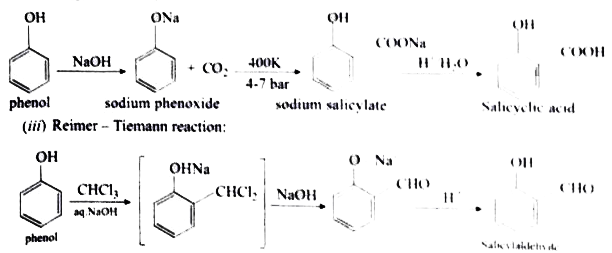
|
|
| 43. |
Explain why Cu^(+) ion is not stable in aqueous solution. |
| Answer» Solution :`Cu^(2+)` (aq) is much more stable than `Cu^(+)` (aq). Although second ionisation enthalpy of copper is large but `Delta_("HYD")` H for `Cu^(2+)` (aq) is much more negative than that for `Cu^(+)` (aq) and HENCE it more than compensates for the second ionisation enthalpy of copper. Therefore, many copper (I) compounds are UNSTABLE in AQUEOUS solution and undergo disproportionation. | |
| 44. |
Explain why Cu^(+)ion is not stable in aqueous solution ? |
| Answer» Solution :`Cu^(2+)(aq)` is much more STABLE `Cu^(+)` ( aq). This is because although SECOND IONIZATION enthalpy of copper is large bu `Delta_(hyd)` H for `Cu^(2+) (aq)` ismuch more negative than that for `Cu^(+)(aq)` and hence it more than compensates for the second ionization enthalpy of copper. Therefore, many copper (I) compoundsare unstable in aqueous SOLUTIONAND undergo disproportionation as follows `:2Cu^(+)RARR Cu^(2+) + Cu`. | |
| 45. |
Explain the following reactions. Cannizzaro reaction |
|
Answer» |
|
| 46. |
Explainwhy Cr^(2+) stronglyreducingwhileMn^(3+) isstronglyoxidizing . |
|
Answer» Solution :(I ) `Cr^(2+)` is stronglyreducing in nature. Ithasa `d^(4)`CONFIGURATION. Whileacting asa reducingagent, itgetsoxidizedto `Cr^(3+)` (ELECTRONICCONFIGURATION`d^(3)`) (II)This `d^(3) ` configurationcan be writtenas `3t^(2g)` configurationwhichis a morestableconfiguration. (III)In the caseof `Mn^(3+)(d^(4))` it actsas anoxidizingagentand getsreduced to `Mn^(2+) (d^(5))` (iv )THISHAS anexactly half- filledd- orbitaland hasan extrastability. |
|
| 47. |
Explain the following reactions : (a) Mustard oil reaction (b) Gattermann reaction |
|
Answer» Solution :(a) Mustard oil reaction . METHYL amine (primary amine) on heating with carbon disulphide in the presence of MERCURY CHLORIDE gives methyl isothiocyanide which has a pungent mustard-like odour. This reaction is mustard oil reaction. `CH_3 NH_2 + CS_2 overset(HgCl_2)to underset("Methyl isothiocyanide")(CH_3 NCS + H_2S)` (b) Gattermann reaction . Benzene diazonium chloride, on reaction with HCl in the presence of CU powder gives CHLOROBENZENE. This reaction is Gattermann reaction. `C_6 H_5 - N_2 Cl underset(HCl)overset(Cu)to underset("Chlorobenzene")(C_6 H_5 Cl) + N_2 uarr` |
|
| 48. |
Explain why compounds of Cu^(2+) are coloured but those of Zn^(2+) are colourless. |
|
Answer» Solution :Cu (Z = 29) Electronic configuration is [Ar]`3d^(10) 4s^(1)` `Cu^(2+)` : Electronic configuration is [Ar]`3d^(9)`. In `Cu^(2+)` promotion of electrons take place in outer d-orbital by the absorption of light form visible region involves d - d transition. Due to this `Cu^(2+)` compounds are coloured. Where in `Zn^(2+)` electronic configuration is `[Ar]3d^(10)`. It has completely FILLED d-orbital. So there is no chance of d-d transition. So `Zn^(2+)` compounds are COLOURLESS. |
|
| 49. |
Explain the following reaction with acetyl chloride (i) ammonolysis. |
Answer» SOLUTION :REACTION with AMMONIA is KNOWN as AMMONOLYSIS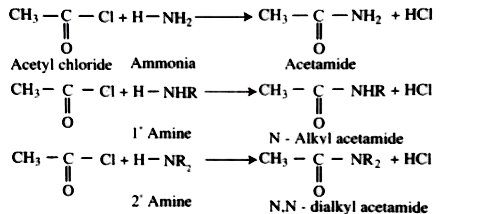
|
|
| 50. |
Explain the following reaction: n-BuBr+KCN overset("EtOH"-H_(2)O)ton-BuCN. |
Answer» Solution :KCN is RESONANCE hydride of the following two CONTRIBUTING STRUCTURES: 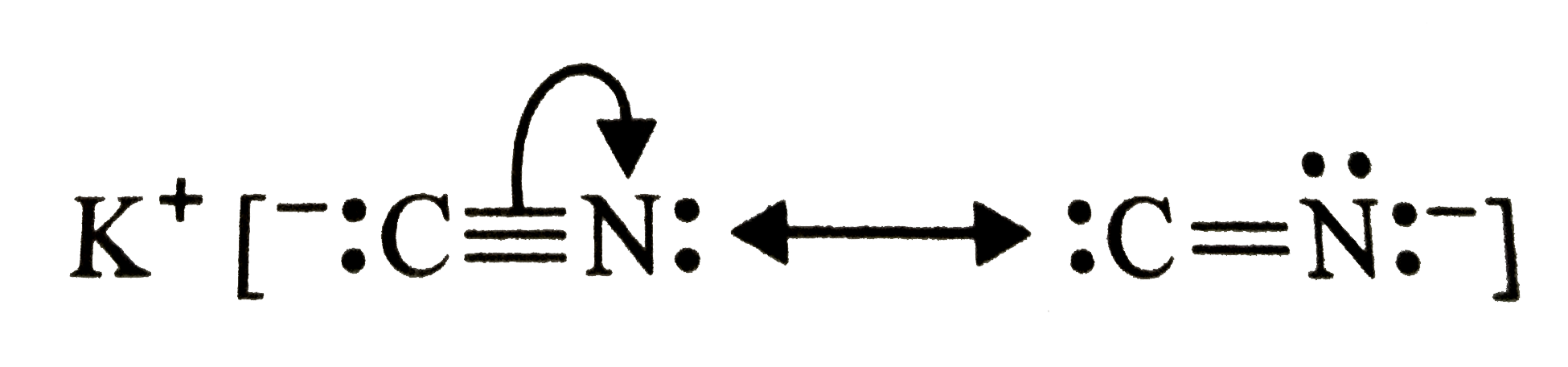 Thus, `CN^(-)` ion is an ambident nucleophile. Therefore, it can attack the carbon atom of C-Br bond in N-BuBr either through C or N. SINCE C-C bond is stronger than C-N bond, therefore, attack occurs through C to form n-butyl cyanide. 
|
|