

Saved Bookmarks
This section includes 7 InterviewSolutions, each offering curated multiple-choice questions to sharpen your Current Affairs knowledge and support exam preparation. Choose a topic below to get started.
| 1. |
Explain why Cr^(2+) is strongly reducing while Mn^(3+) is strongly oxidizing. |
|
Answer» Solution :`Cr^(2+)` is STRONG reducing while MN3+ is strongly oxidising, `E^(0)_(Cr^(3+)//Cr^(2+))` is-0.41V `Cr^(2+)+ 2e^(-) to Cr E^(0)= -091 V` If the standard electrode potential `E^(0)` of a metal is large and negative, the metal is a powerful reducing agent because it LOSES electrons easily. `Mn to Mn^(3+)+ 3e^(-)Mn^(3+) [Ar]3d^(4)` `Mn^(3+)+ e^(-) to Mn^(2+)E^(0) = +1.51V` If the standard electrode potential Eº of a metal is large and positive, the metal is a powerful oxidising agent because it gains electrons easily, |
|
| 2. |
Explain the following phenomenon given reason : (i) Tnndall effect. (ii) Brownian movement. (iii) Physical adsorption decreases with increase in temperature. |
|
Answer» Solution :(i) Tyndall effect : Scattering of light by the colloidal particles present in colloidal sol. Tyndall effect is observed only when the diameter of dispersed particles is not much smaller as compared to the wavelength of the light used and there is large difference in the refractive indiaes of dispersed phase and dispersion medium. DUE to that calloidal particles show Tyndall effect becuse their particle size lies in the range of `(10A^(@)-10000A^(@)).` (II) Brownian movement : Continuous zig-zag movement of colloidal particales in a colloidal sol is CALLED Brownian movement. The reason for Brownian movenent is based on the fact that the molecules of dispersion medium due to their KINETIC motion strike against the Colloidal Particles from all sides with different forces. The resultant force cuased them to MOVE. (iii) Physiisoption is an exothermic process `underset("adsorbent")("Solid")+underset("adsorbate")(Gas)hArr"Gas/Solid + Heat"` According to Le Chatelier's Principle, if we increase the temperature, equilibrium will shift in the backward direction, i.e., gas is released from the surface on which it is absorbed. |
|
| 3. |
Explain the following phenomena with the help of Henry's law.(i) Painful condition known as bends.(ii) Feeling of weakness and discomfort in breathing at high altitude. |
|
Answer» Solution :(i) According to Henry.s law pressure of a gas is directly proportional to solubility. Scubadivers when come towards SURFACE the air pressure GRADUALLY decreases. This reduced pressure releases the dissolved gases present in blood and leads to the formation of bubbles of nitrogen in the blood. This blocks capillaries and creates a medical CONDITION known as bends, which is painful and dangerous to life. (ii) At high ALTITUDE, partial pressure of oxygen is less than that of GROUND level. This leads to low concentrations of oxygen in blood and tissues of people living at high altitudes. Low blood oxygen causes weakness and discomfort. |
|
| 4. |
Explain why compound A has no enantiomer and why compound B has no diastereomer. |
|
Answer» |
|
| 5. |
Explain the following oreder of dipole moments of chloromethanes : CH_(3)Cl > CH_(2)Cl_(2) > CHCl_(3) > C Cl_(4). |
|
Answer» Solution :The `C Cl_(4)` molecule has a highly symmetrical tetrahedral configuration. So, the resultant of THREE C-Cl bond moments cancels the fourth C-Cl bond moment. Hence, the molecule possesses no net dipole moment `(mu-0D)`. The dipole moment of `CH_(2)Cl_(2)` in which two C-Cl bonds make and angle of neraly `109^(@)28'` is expected to be larger than that of `CH_(3)Cl` because the resultant of two C-Cl bond moments must be greater than one `C-Cl` bond moment. also, the dipole moment of `CH_(3)Cl` is expected to be equal to that of `CHCl_(3)` because the moment of a -`C Cl_3)` group is equal to that of a `C-Cl` bond and the moment of a - `CH_(3)` group is equal to that of a C-H bond. Thus, the expected order of dipole moment is: `CH_(2)Cl_(2) > CH_(3)Cl ~~ CHCl_(3) > C Cl_(4)`. This order, however , does not agree with the experimental dipole moment value. This anomaly may be explained by considering the moment acitng in the opposite direction induced by each C-Cl dipole in the order. Since there is only one C-Cl bond in `CH_(3)Cl`, the opposing induced moment is absent in it. So, it possesses the largest dipole moment. In `CH_(2)Cl_(2)`, there are two C-Cl bond. thus, there ISAN opposing induced moment that partly cancels the resultant moment of the two C-Cl bonds. So, its dipole moment is smaller than `CH_(3)Cl`. In `CHCl_(3)`, there are three C-Cl bonds. So, the magnitude of the opposing induced moment is relatively large which considerably reduces the resultant of the three C-Cl bond moments. THEREFORE, its dipole moment is smaller than that of `CH_(2)Cl_(2)` and MUCH smaller than `CH_(3)Cl`. So, the actual order of dipole moments is `CH_(3)Cl > CH_(2)Cl_(2) > CHCl_(3) > C Cl_(4)`. |
|
| 6. |
Explainwhycompounds of Cu^(2+) arecolouredbutthoseof Zn^(2+) arecolourless. |
|
Answer» Solution :Thecompoundsof `CU^(2+)` are colouredas it has ONE freeelectronitsvalenceshellwhichabsorbradiationofvisibleregionand getexcitedto emititscomplementarycolour. Zn hasno FREE ELECTRON it has fully FILLES shells Dueto extrastable orbitalselectroncan'tbeexcitedby radiations ofvisiblelighthenceits compoundsare colourless. |
|
| 7. |
Explain the following observations: The halogens are coloured. Why? |
|
Answer» SOLUTION :The halogens are coloured Halogens are coloured because they ABSORB radiations from visible light. The radiations which are transmitted is the colour of the halogen. `F_2` has YELLOW, `Cl_2` has greenish yellow, `Br_2` has RED colour and `I_2` has VIOLET colour. |
|
| 8. |
Explain the following observations : Physical adsorption is multilayered, while chemisorption is monolayered. |
| Answer» Solution :In physical adsorption, there are weak VAN der Waals forces. Therefore, it forms multilayers. In chemisorption, adsorbate is ATTACHED by CHEMICAL bond. There is a strong force of attraction. Therefore, only ONE layer is obtained. | |
| 9. |
Explain why colloidal solution is not precipitated in the presence of gelatin. |
| Answer» SOLUTION :Gelatin is one of the best protective colloidals having the smallest gold NUMBER 0.01 to 0.005. As it forms a protective sheath around the CHARGED colloidal particles, the oppositely charged flocculating ion FAILS to CAUSE coagulation by neutralizing the charge on the colloid. | |
| 10. |
Explain the following observations: Phosphorus has greater tendency for catenation than nitrogen. |
|
Answer» SOLUTION : Phosphorus has a GREATER TENDENCY for catenation than nitrogen Because of smaller SIZE of nitrogen atom, a sigma bond and two `pi`bonds are formed between two N atoms giving `N-=N` molecule. Phosphorus is a bigger atom. There is no effective overlapping of p-orbitals forming at `pi`bonds. Hence, P prefers to form single bonds with other phosphorus atoms. In other words, it has greater tendency for catenation |
|
| 11. |
Explain why cleavage of phenyl alkyl ether with HBr always gives phenol and alkyl bromide. |
Answer» Solution : It is because of double bond character between `C-O` bond which is difficult to BREAK SECONDLY, phenoxide ion is STABILISED by resonance, that is why we get phenol and `CH_(3)Br`. |
|
| 12. |
Explain the following observations: Oxygen is a gas but sulphur is a solid. |
|
Answer» Solution :Oxygen is a gas but sulphur is a solid This is because oxygen forms a `O_2` molecule due to its small size but sulphur cannot because of BIGGER size of S. Sulphur therefore EXHIBITS CATENATION forming `S_8` molecule. `S_8` having a high MOLECULAR mass has a higher boiling and melting point. Hence, it is a solid while oxygen is a gas at room temperature. |
|
| 13. |
Explain why chlorination of n-butane in presence of light at 298 K gives a mixture of 72% of 2-chlorobutane and 28% of 1-chlorobutane. |
|
Answer» Solution :According to the questions, `underset("n-Butane")(CH_(3)CH_(2)CH_(3)) underset("light")overset(Cl_(2),298K)to underset("2-Chlorobutane (72%)")(CH_(3)-underset(Cl)underset(|)(C)H-CH_(2)CH_(3))+underset("1-Chlorobutane (28%)")(CH_(3)CH_(2)CH_(2)CH_(2)-Cl)` The RELATIVE ratios of these two isomerric chlorobutanes can be easily calculated by knowing: (i) the number and type of hydrogens (i.e., `1^(@),2^(@)` or `3^(@)`) to be substituted and (ii) their relative RATES of substitution (i.e., 1:3.8:5.0 for `Cl_(2)` at 298K). THUS, `("1-Chlorobutane")/("2-Chlorobutane")=("No. of "1^(@)H)/("No. of "2^(@)H)toxx("Reactivity of "1^(@)H)/("Reactivity of "2^(@)H)=(6)/(4)XX(1)/(3.8)=(6)/(15.2)=(28%)/(72%)` |
|
| 14. |
Explain the following observations : (i) In aqueous solution the K_(b) order is ""Et_(2)NH gt Et_(3)N gt EtNH_(2) (ii) Amines are more basic than comparable alcohols. |
|
Answer» Solution :(i) It is the combination of electron RELEASING nature of alkyl group, H-bonding and steric FACTORS that determine the stability of ammonium cations formed in solution, THEREFORE `""Et_(2)NH gt Et_(3)N gt EtNH_(2)" is order of "K_(b)`. (II) Amines are more basic than alcohols due to greater stabilisation by hyperconjugation of ammonium cation formed as compared to protonated alcohol. This can also be explained in terms of greater electronegativity of O than N. Oxygen being more electronegative has lower tendency to DONATE electrons than nitrogen. Thus, amines are more basic than alcohols. |
|
| 15. |
Explain why cis-1.2-dichloroethene (Table 2.1) has a large dipole moment whereas trans-1.2-dichloro. ethene has a dipole moment equal to zero. |
Answer» SOLUTION :If we examine the NET DIPOLE moments (SHOWN in dashed line) for the bond moments (black), we see that in trans-1,2-dichloroethene the bond moments cancel each other, WHEREAS in cis-1.2-dichloroethene they augment each other. 
|
|
| 16. |
Explain the following observations: (i) Generally there is an increase in density of elements from titanium (Z = 22) to copper (Z=29) in the first series of transition elements. (ii) Transition elements and their compounds are generally found to be good catalysts in chemical reactions. |
|
Answer» Solution :(i) Density `=("Mass")/("Volume")=("Mass")/((4)/(3)pi r^(3))`, where r is the RADIUS of the atom. From titanium to copper in the first series of transition elements, there is SUCCESSIVE decrease in radius and there is successive increase in mass. THUS, the density shows an increase from Ti to Cu. (ii) This is due to their ability to adopt multiple oxidation states and to form complexes. Catalyst at the solid surface involve the formation of bonds between reactant molecules and the atoms of the surface of the catalyst. The METALS of first transition series involve 3d and 4s electrons for bonding. This results in increase in concentration of the reactants at the surface and also weakening of bonds in the reacting molecules. |
|
| 17. |
Explain the following observations: (i) Transition elements generally form coloured compounds. (ii) Zinc is not regarded as transition element. |
|
Answer» Solution :(i) Transition elements generally form COLOURED compounds on account of d-d TRANSITIONS. DUE topartial ABSORPTION of visible light (ii) Zinc, outermost configuration `3d^(10)4s^(2)` is notregarded as transition element on account of completely filled d-orbitals. |
|
| 18. |
Explain the following observations: (i) Generally, there is an increase in density ofelements from titanium (Z = 22) to copper (Z = 29) in the first series of transition elements. (ii) Transition elements and their compounds are generally found to be good catalysts in chemical rections. |
|
Answer» Solution :(i) As the atomic radii decreases moving across from titanium to Cu, so its volume will decrease and DENSITY is expected to INCREASE. (ii) Good catalytic properties are due to following reasons: Variable OXIDATION states due to which they can form a variety of unstable intermediate products. Large surface area so that the REACTANTS are adsorbed on the surface and come closer to each other facilitating the reaction process. |
|
| 19. |
Explain why CH_(3)Cl undergoes hydrolysis at a faster rate in the presence of Nal. |
Answer» Solution :The hydrolysis of methyl chloride in aquous medium TAKES place at a much slower rate because `H_(2)O` is a weak nucleophile (because it is a neutral nucleophile and the attacking oxygen atom is highly electronegative and less polarisable) and `Cl^(Theta)` is not a very good leaving group (becuase it is not a very weak base and the C-Cl bond is not very weak).  The iodide ion `(I^(Theta))` catalyses the hydrolysis of `CH_(3)Cl`. Due to high polarisability and low solvation energy, `I^(Theta)` is a good nucleophile. Again, for its weak basicity and low bond energy of the C-I bond `I^(Theta)`can ACT as an effective catalyst in substitution reactions. In the presence of NaI, the hydrolysis of `CH_(3)Cl` takes place by the following two steps-  Each of these two reactions [(2) and (3)] takes place at a faster rate than the reaction (1) because `I^(Theta)` is a better nucleophile than `H_(2)O` and it is a better leaving group than `Cl^(Theta)` . As a RESULT, the overall hydrolysis OCCURS at a faster rate in the presence of Nal. it is a case of nucleophilic catalysis. |
|
| 20. |
Explain the following observations giving appropriate reasons : The stability of +5 oxidation state decreases down the group in Group 15 of the periodic table. |
| Answer» Solution : The STABILITY of +5 oxidation state DECREASES down the group because of inert-pair EFFECT. | |
| 21. |
Explain why carboxylic acids behave as acids. Discuss briefly the effects of electron withdrawing and donating substituents on acid strength of carboxylic acids. |
Answer» Solution :Acidic nature of acids : (i) Acid molecule IONISES to produce `H^(+)` ions in solution.  (ii) The carboxylate anion is stabilised by resonance.  HENCE the CLEAVAGE of `-COOH` bond to release `H^(+)` is favoured, thereby making it to behave as acids. (iii) Any factor that weakens the `-COOH` bond will facilitate the cleavage to release `H^(+)` more easily. The degree of ionisation is increased and acid becomes relatively a STRONGER acid. (iv) When the following acids are compared, `CH_(3)-overset(CH_(3))overset(|)(CH)-COOHltCH_(3)-CH_(2)COOHltCH_(3)COOHltHCOOHltClCH_(2)COOH` Their strength varies as the above order. (v) Methyl group is a +I group (electron pair repelling group). Acid strength decreases with increasing number of electron repelling substituent attached to the `alpha` - carbon atom.  The +I effect is felt in increasing the strength of the -OH bond and the cleavage to form `H^(+)` becomes difficult. Hence they are weaker acid than formic acid (HCOOH) which does not have +I methyl group. (vi) Acid strength increases with INCREASE in electronegativity of substituents.  This effect weaknens the -O-H bond there by facilitating the removal of `H^(+)` from - OH group. This acid becomes stronger than formic acid. |
|
| 22. |
Explain the following observations : (i) A beam of light passing through a colloidal solution has a visible path. (ii) Passing an electric current through a colloidal solution removes colloidal particles from it. (iii) Ferric hydroxide sol coagulates on addition of potassium sulphate, |
|
Answer» Solution :(i) This is due to scattering of light by the COLLOIDAL particles (CALLED Tyndall effect) (ii) This is due to charge on the colloidal particles so that they migrate towards the oppositely, charge ELECTRODE. (iii) Ferric hydroxide is a positively charged sol and is coagulated by `SO_(4)^(2-)` ions given by `K_2 SO_4`. |
|
| 23. |
Explain the following observations:HF is a weaker acid than HI in aqueous solutions. |
| Answer» Solution :HF has higher BOND dissociation energy than HI. This is due to SMALLER bond length. So, HF is a WEAKER acid than HI. | |
| 24. |
Explain why carboxylic acids are stronger acids than phenols? |
Answer» Solution :Carboxylate ion is more stable due to symmetrical resonating structure (equivalent) . So carboxylate ion is a weak base and carboxylic acid is STRONGER acid.  PHENOXIDE ion is also stabilised due to RESONANCE and has non-equivalent resonance structures.  With negative charge spreading to less ELECTRONEGATIVE CARBON , phenoxide ion is less stable than carboxylate ion . |
|
| 25. |
Explain the following observations giving appropriate reasons :The HEH bond angle of the hydrides of Group 15 elements decreases as we move down the group. |
Answer» Solution :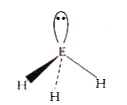 The elements in Group 15 are N, P, As, Sb and Bi. They form hydrides with the formula `EH_3`. The CENTRAL atom E is sp hybridised. One of the hybridised orbitals contains a lone pair of electrons while the other three hybridised orbitals overlap with the s-orbitals of three hydrogen atoms to form three E-H bonds. Normal angle in sp HYBRIDISATION is `109^(@)-28.` but due to greater lone pair-BOND pair repulsion, the angle is decreased to `107^(@)` in the case of `NH_3`. However the `angleHEH` decreases as we move from N to P to Sb. This is because as we move DOWNWARDS in to Bi Group 15, the bond length EH increases, the repulsion between bond pairs decreases and consequently the angle `angleHEH` decreases. |
|
| 26. |
Explain why boron does not form B_6^(3-)ion. |
| Answer» Solution :Boron ATOM does not have vacant d -ORBITAL. HENCE, it cannot expand its coordination up to SIX, | |
| 27. |
Explain the following observations giving appropriate reasons : Solid phosphorus pentachloride behaves as an ionic compound. |
| Answer» Solution :In solid STATE , `PCl_5` EXISTS as an IONIC solid having the formula `[PCl_4]^(+)[PCl_6]^(-)` in which the CATION `[PCl_4]^(+)` is tetrahedral and the anion `[PCl_6]^(-)` is octahedral. | |
| 28. |
Explain the following observations giving appropriate reasons :Ozone is thermodynamically unstable with respect to oxygen. |
| Answer» Solution :Ozone is thermodynamically UNSTABLE with RESPECT to oxygen. This is because it decomposes into oxygen with the liberation of HEAT and an increase in entropy. Thus, the more stable product is obtained. The two effects REINFORCE each other giving large negative free energy for its CONVERSION into oxygen. | |
| 29. |
Explain why blue colour of CuSO_(4) solution is discharged when Zn rod is dipped in it. |
|
Answer» SOLUTION :This is because Zn rod undergoes oxidation and the ELECTRONS lost are gained by `Cu^(2+)` ions forming copper solid. `Zn+CuSO_(4)toZnSO_(4)+Cu` THEREFORE concentration of `Cu^(2+)` ions goes on decreasing, .blue colour of `CuSO_(4)` solution is DISCHARGED. |
|
| 30. |
Explain the following observations giving appropriate reasons : Halogens are strong oxidising agents. |
|
Answer» Solution :Halogens are STRONG oxidising agents due to strongly ELECTRONEGATIVE NATURE. Chloride water on standing changes to `Cl_2 + H_2O to HCL + HCLO` HClO oxidises different substances. |
|
| 31. |
Explain that bleaching action of CL_2 is permanent, while that of SO_2 is temporary. |
|
Answer» SOLUTION :BLEACHING action of `Cl_2` is due to oxidation, so it is PERMANENT `Cl_2 +H_2O rarr 2HCL + [O]` |
|
| 32. |
Explain why aspirin finds use in prevention of heart attacks? |
| Answer» SOLUTION :DUE to antiblood CLOTTING ACTIVITY. | |
| 33. |
Explain the following observations giving appropriate reasons :Bleaching effect of chlorine is permanent. |
|
Answer» SOLUTION :Bleaching EFFECT of chlorine is permanent. This is because chlorine bleaches by OXIDATION in the presence of moisture. `Cl_2 + H_2O to 2HCl +O ` Coloured SUBSTANCE +O `to`Colourless substance There is no possibility of colourless substance CHANGING again to coloured substance. |
|
| 34. |
Explain why aspirin finds use in prevention of heart attacks ? |
| Answer» Solution : DUE to anti BLOOD clotting ACTIVITY. | |
| 35. |
Explain the following observations : Ferric hydroxide sol gets coagulated on addition of sodium chloride solution. |
| Answer» Solution :`FE(OH)_3` is POSITIVELY CHARGED sol. It GETS coagulated by the `Cl^(-)` IONS from NaCl. | |
| 36. |
Explain why aryl halides are extermely less reactive towards nucleophilic substitution reactions. |
|
Answer» Solution :Aryl halides are extremely less reactive towards nucleophilic substitution REACTIONS DUE to the following reasons : (i) Resonance effect : In haloarenes, the electron pairs on halogen atom are in conjugation with `pi` - electrons of the ring and the following resonating structures are possible. 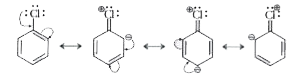 The C - Cl bond acquires a partial double bond character due to resonance. As a result, the bond cleavage in haloarene is difficult than haloalkane and therefore, they are less reactive towards nucleophilic substitution reaction. (ii) Difference in hybridisation of carbon atom in C - X bond : In haloalkane, the carbon atom attached to halogen is `sp^(3)` hybridised while in case of haloarene, the carbon atom attached to halogen is `sp^(2)` - hybridised. 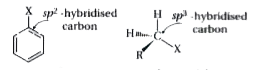 The `sp^(2)` hybridised carbon with a greater s - character is more electronegative and can hold the electron pair of C - X bond more tightly than `sp^(3)` -hybridised carbon in haloalkane with less s - chararcter. Thus, C - Cl bond length in haloalkane is 177 pm while in haloarene is 169 pm. Since it is difficult to break a shorter bond than a longer bond, therefore, haloarenes are less reactive than haloalkanes towards nucleophilic substitution reaction. (iii) INSTABILITY of phenyl cation : In case of haloarenes, the phenyl cation formed as a result of SELF - ionisation will not be stabilised by resonance and therefore, `S_(N)1` mechanism is ruled out. (iv) Electronic Repulsions : It is less likely for the electron rich nuclephile to APPROACH electron rich arenes. |
|
| 37. |
Explain the following observations: Bismuth oxide is not acidic in any of its reactions. |
| Answer» Solution :As we MOVE down a group in p-block, METALLIC CHARACTER INCREASES. Bi being the LAST element in Group 15 is distinctly metallic. Oxides of metals are basic. | |
| 38. |
Explain, why aryl halides are less reactive than alkyl halides. |
|
Answer» Solution :Aryl halidesare less REACTIVE tham alkyl halides due to the following reasons : (1)Resonance effect : In haloarenes, the electron pairs on halogen atom are in conjugation with a-electrons of the BENZENE ring. The delocalization of these electrons C-Cl bond acquires partial double bond character. 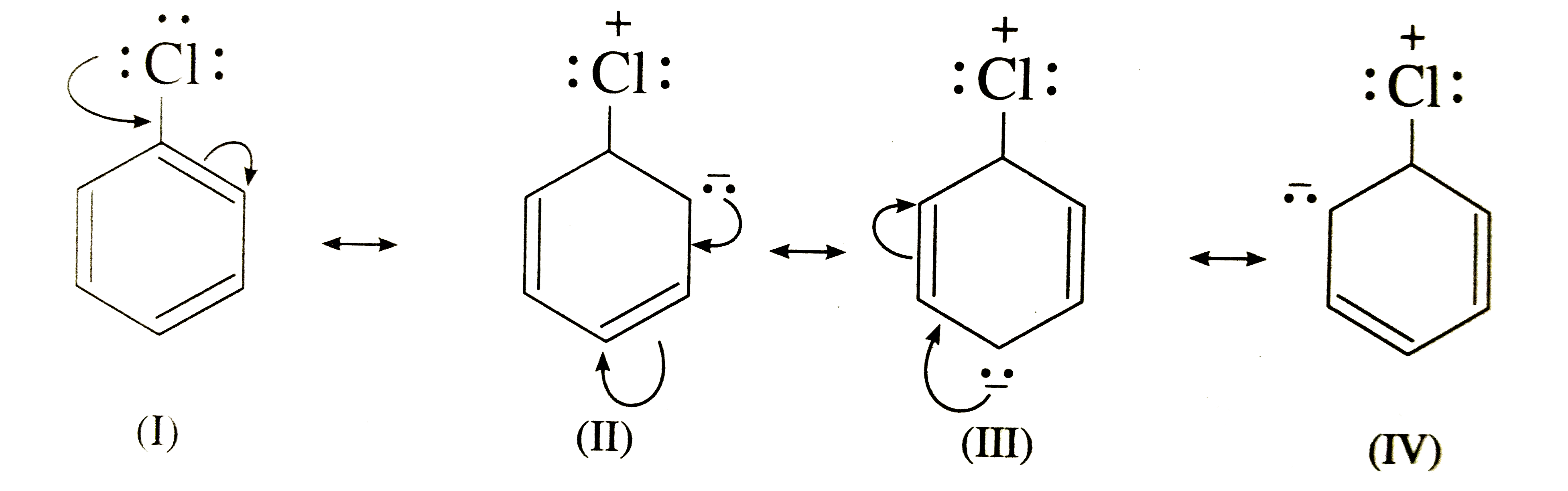 (2) Aryl halides are stabilized by resonance but alkyl halides are not. Hence, the energy of activation for the displacement of halogen from aryl halides is much greater than that of alkyl halides. DIFFERENT hybridisation state of carbon atom in C-X bond : (i) In alkyl halides, the carbon of C-X bond is `sp^(3)` hybridized with less s-character and greater bond length of 177 pm, which requires less energy to break the C-X bond. (ii) In aryl halides, the carbon of C-X bond is `sp^(2)` hybridized with more s-character and shorter bond length which requires more energy to break C-X bond. Therefore, aryl halides are less reactive than alkyl halides. (iii) Polarity of the C-X bond : In aryl halide C-X bond is less polar than in alkyl halides. Because sp?-hybrid carbon of C-X bond has less tendency to release electrons to the halogen than a `sp^(3)` -hybrid carbon in alkyl halides. Thus halogen atom in aryl halides cannot be easily DISPLACED by nucleophile. |
|
| 39. |
Explain the following observations. (a) Lyophilic colloid is more stable than lyophobic colloid. (b) Coagulation takes place when sodium chloride solution added to a colloidal solution of ferric hydroxide. ( c ) Sky appears blue in colour. |
|
Answer» Solution :(a) A lyophilic sol is stable due to the charge and the hydration of the sol particles. Such a sol can only be coagulatd by removing the water and adding solvents like alcohol, acetone, etc. and then an electrolyte. On the other hand, a lyophobic sol is stable due to charge only and HENCE it can be easily COAGULATED by adding small AMOUNT of an electrolyte. (b) The colloidal particles get precipitated, i.e., ferric hydroxide is precipitated. ( c ) The atmospheric particles of colloidal range scatter BLUE component of the white sunlight preferentially. That is why the sky appears blue. |
|
| 40. |
Explain why are low molecular mass alcohols soluble in water? |
| Answer» Solution :`to` In ALCOHOLS of low molecular mass, the size of the non-polar alkyl group is small which exerts LESS steric hindrance as a RESULT of which the intermolecular H-bonds with WATER are easily formed by alcohols. Hence, the alcohols of low molecular mass are READILY soluble in water. | |
| 41. |
Explain the following observations. (a) Lyophilic colloid is more stable than lyophobic colloid. (b) Coagulation takes place when sodium chloride solution added to a colloidal solution of ferric hydroxide. (c) Sky appears blue in colour. |
|
Answer» Solution :(a) A lyophilic SOL is stable due to the charge and the hydration of the sol particles. Such a sol can only be coagulatd by removing the WATER and adding solvents like alcohol, acetone, etc. and then an electrolyte. On the other hand, a lyophobic sol is stable due to charge only and HENCE it can be easily coagulated by adding small amount of an electrolyte. (b) The colloidal particles get precipitated, i.e., ferric hydroxide is precipitated. (C) The atmospheric particles of colloidal range scatter blue component of the WHITE sunlight preferentially. That is why the sky appears blue. |
|
| 42. |
Explain why are aryl halides extremely less reactive towards nucleophilic substitution reactions? |
|
Answer» Solution :Aryl halides are extremely less REACTIVE towards nucleo-philic substitution reaction due to the following reasons : (1) Reasonance effect : In haloarenes, the electron pairs on halogen atom are in conjugation with `pi`-electrons of the benzene ring. The DELOCALIZATION of these electrons `C-Cl` bond acquires partial double bond character. 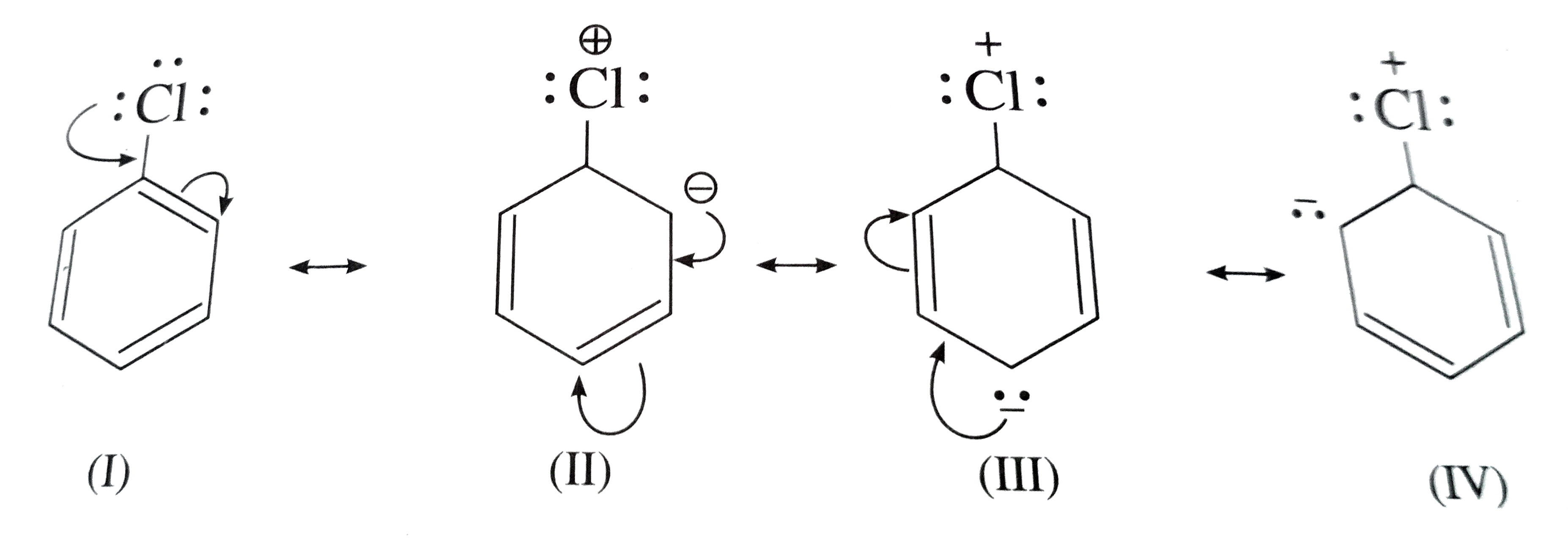 Due to partial double bond character of `C-Cl` bond in aryl halides, the bond cleavage in haloarene is difficult and are less reactive towards nucleophilic substitution. (2) Different hybridization state of carbon atom in C-X bond : In aryl halides, the carbon of C-X bond is `sp^(2)` hybridized with more s-character and shorter bond length of 169 PM which requires more energy to break C-X bond. It is difficult to break a shorter bond than a longer bond, therefore, aryl halides are less reactive towards nucleophilic substitution reaction. (3) Instabillity of phenyl cation : In aryl halides, the phenyl cation formed due to self ionisation will not be stabilized by resonance. Thus cations are not formed and hence aryl halides do not UNDERGO nucleophilic substitution reaction easily. (4) As any halides are electron rich molecules due to the presence of `pi-` bond, they repel electron rich nucleophilic. attack. Hence, aryl halides are less reactive toward nucleophilic substitution reactions. |
|
| 43. |
Explain why aniline is less basic than methylamine? |
|
Answer» Solution :(i) The lone pair of elctrons on the nitrogen atom of aniline is INVOLVED in RESONANCE and not avilable for donation to protons. (ii) Protonation BECOMES difficult. (iii) So aniline is a weaker base than methylamine. |
|
| 44. |
Explain the following observation: The members of the actinoids series exhibit a large number of oxidation states than the corresponding members of the lanthanoid series. |
| Answer» SOLUTION :In case of actinoids, 5F, 6d and 7s subshells have compareable ENERGIES. THEREFORE, actinoids exhibit +3, +4, +5, +6 and +7 oxidation STATES due to the participiation of 5f, 6d and 7s electrons in bond formation. | |
| 45. |
Explain why an orgainc liquid vaporises below its boiling point when it undergoes steam distillation. |
| Answer» Solution :In STEAM distillation, sum of the vapour pressure of WATER and orgainc liquid become equal to the atmospheirc pressure. This means that both of them distill at a pressure much LOWER than the atmospheric pressure, i.e. both of them will vapourise at a tamperature which is LESS than their normal boiling POINTS. | |
| 46. |
Explain the following observations : (i) Many of the transition elements are known to form interstitial compounds . (ii) There is a general increase in density from titanium (Z =22) to copper (Z = 29). (iii) The members of the actinoid series exhibit a larger number of oxidation states than the corresponding members of the lanthanoid series. |
| Answer» Solution :In case of actinoids, 5F, 6d and 7s subshells have compareable energies. Therefore, actinoids EXHIBIT +3, +4, +5, +6 and +7 oxidation states DUE to the participiation of 5f, 6d and 7s electrons in bond formation. | |
| 47. |
Explain the following observation: (i) Transiton elements generally from colourd compounds. (ii) Zinc is not regarded as a transition element. |
|
Answer» |
|
| 48. |
Explain the following: |
|
Answer» Solution :(a) The increasing order of acidic strength is `HF LT HCl lt HBr lt HI` (b) Structure of In `IF_(4)^(-)`, Iodine ATOM is in `sp^3d^2`hybridisation state. 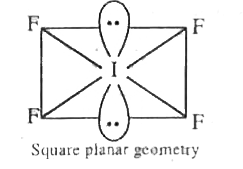 (c) Interhalogen compounds are more reactive than halogens because the bonds are more polar and weaker in interhalogens as compared to in halogens. (d) `N_2O` (e) This is because in N `-=`N, the BOND length is SMALL and it has high bond energy (945 kJ /MOL). |
|
| 49. |
Explain the following: NF_3 is an exothermic compound whereas NCl_3 is not. |
| Answer» SOLUTION :`NF_3 ` is an exothermic compound. It is a stable compound because N - F bond is strong because of SMALLER atomic SIZE of the two ELEMENTS . On the other hand , N-Cl bond is not strong because of greater atomic size of Cl. Hence, `NCl_3` is not an exothermic compound. | |