

Saved Bookmarks
This section includes 7 InterviewSolutions, each offering curated multiple-choice questions to sharpen your Current Affairs knowledge and support exam preparation. Choose a topic below to get started.
| 1. |
Explain the solubility rule ''like dissolves like'' in terms of inter - molecular forces that exist in solutions. |
| Answer» Solution :The solubility rule ..like dissolves like.. is based on the INTER - molecular force of that exist in solution as FOLLOWS : A substance (solute) dissolves in a solvent if the inter - molecular INTERACTIONS are similar in both the components (i.e. solvent and solute PARTICLES or molecules). This commonly happens when polar solutes dissolve in polar solvents and non - polar solutes in non - polar solvents. | |
| 2. |
Explain the action of Conc. H_(2)SO_(4) on potassium permanganate. |
|
Answer» Solution :(i) On treating with cold conc.`H_(2)SO_(4)` it decomposes to form MANGANESE heptoxide, which subsequently decomposes explosively. `2KMnO_(4)+ underset("(cold)")(2H_(2)SO_(4)) to underset("(Manganese Heptaoxide)")(Mn_(2)O_(7))+ 2KHSO_(4)+ H_(2)O` `Mn_(2)O_(7) overset(Delta) to underset("(Manganese dioxide)")(2MnO_(2))+3O_(2)` (ii) With hot Conc.`H_(2)SO_(4)` potassium PERMANGANATE GIVE `MnSO_(4)` [Manganese(II) sulphate) `KMnO_(4)+ underset("(Hot)")(6H_(2)SO_(4)) to 4MnSO_(4)+ 2K_(2)SO_(4)+ 6H_(2)O+ 5O_(2)uarr` |
|
| 3. |
What is spectrochemical series ? Explain the difference between a weak field ligand and a strong field ligand. |
| Answer» SOLUTION :Spectrochemical series is a LIST of ligands ORDERED on ligand STRENGTH and a list of metal ions based on OXIDATION number , group and its identity in crystal field thoery. | |
| 4. |
Explain the action of bromine wateron phenol (carbolic acid). |
Answer» Solution :Bromine water : When phenol is TREATED with bromine water, a yellowish WHITE PRECIPITATE of 2, 4, 6-tribromophenolis formed.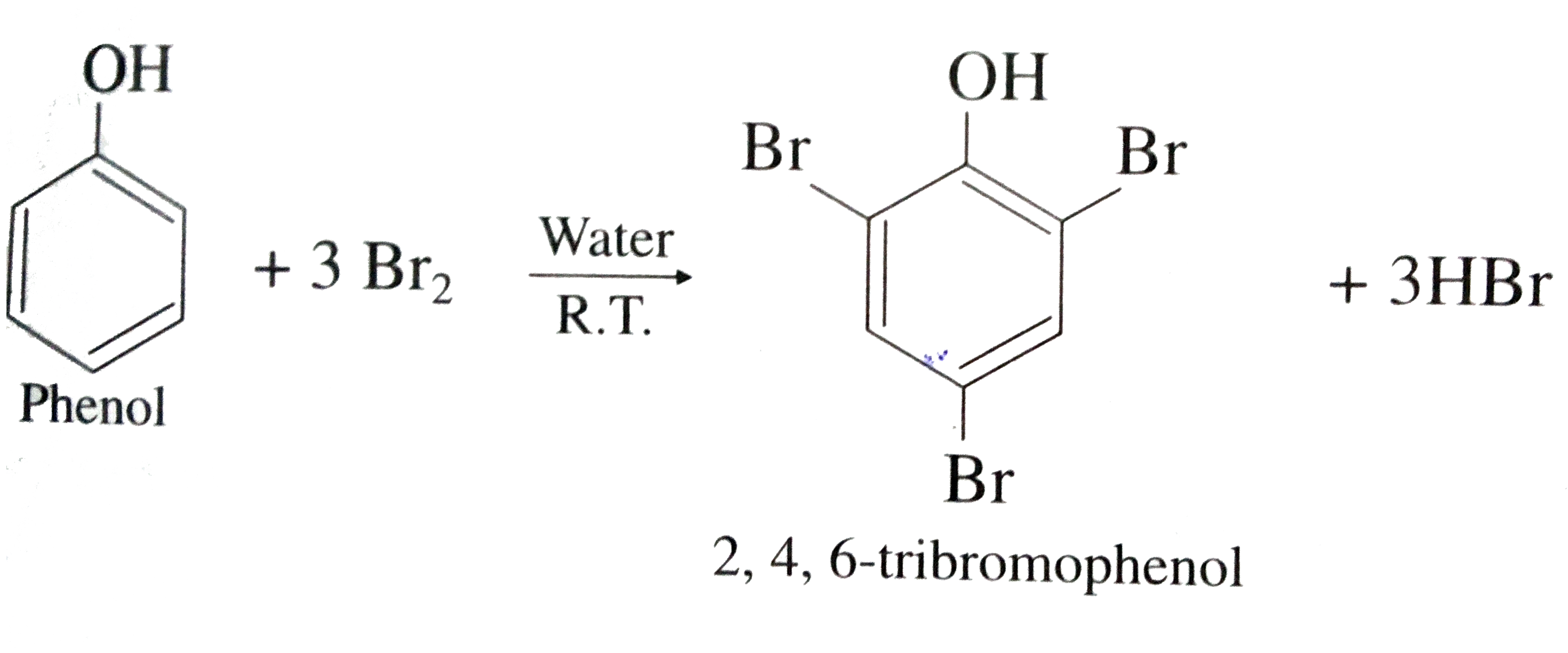
|
|
| 5. |
Explain the solubility of haloalkanes and haloarenes in water ? |
| Answer» SOLUTION :The haloalkanes and haloarenes are insoluble in WATER. This is because neither they BREAK H-bonds in water nor they form H-Bonds with water. | |
| 6. |
Explain the action of ammonia with the following compounds. (i) OHCHO (ii) CH_3CHO (iii) CH_3 - undersetoverset(||)(O)(C ) - CH_3(iv) C_6H_5CHO |
|
Answer» SOLUTION :(i) Formaldehyde reacts with ammonia to FORM hexa methylene tetramine, which is ALSO KNOWN as UROTROPINE. `6 HCHO + 4 NH_3 to underset("urotropine")((CH_2)_6N_4+6H_2O)` 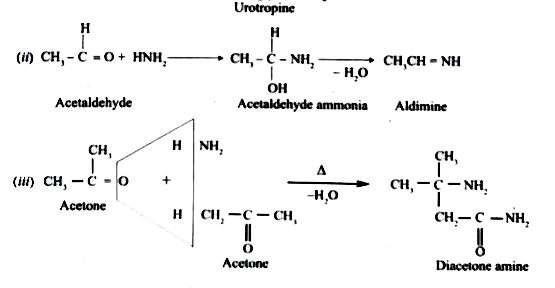
|
|
| 7. |
Explain the action of Ca on acetic acid. |
|
Answer» Solution :ACTION of calcium on acetic acid: Acetic acid reacts with calcium to give calcium ACETATE and hydrogen gas. `underset("acetic acid")(2CH_(3)-OVERSET(O)overset("||")C-OH)+Ca to underset("calcium acetate")((CH_(3)-overset(O)overset("||")C-O)_(2))Ca+H_(2)uarr` |
|
| 8. |
Explain the significance of Ellingham diagram. |
|
Answer» SOLUTION :(1) Ellingham diagram is obtained by plotting standard free energy change `DeltaG^(@)` for the formation of oxides of elements. (2) The oxides of elements which are very stable with high negative values of `DeltaG^(@)` are at the LOWER side of the Ellingham diagram. (3) The positive slope of lines indicate that the stability of metal oxides decreases due to increase in `DeltaG^(@)` with the increase in temperature and they can be reduced easily. 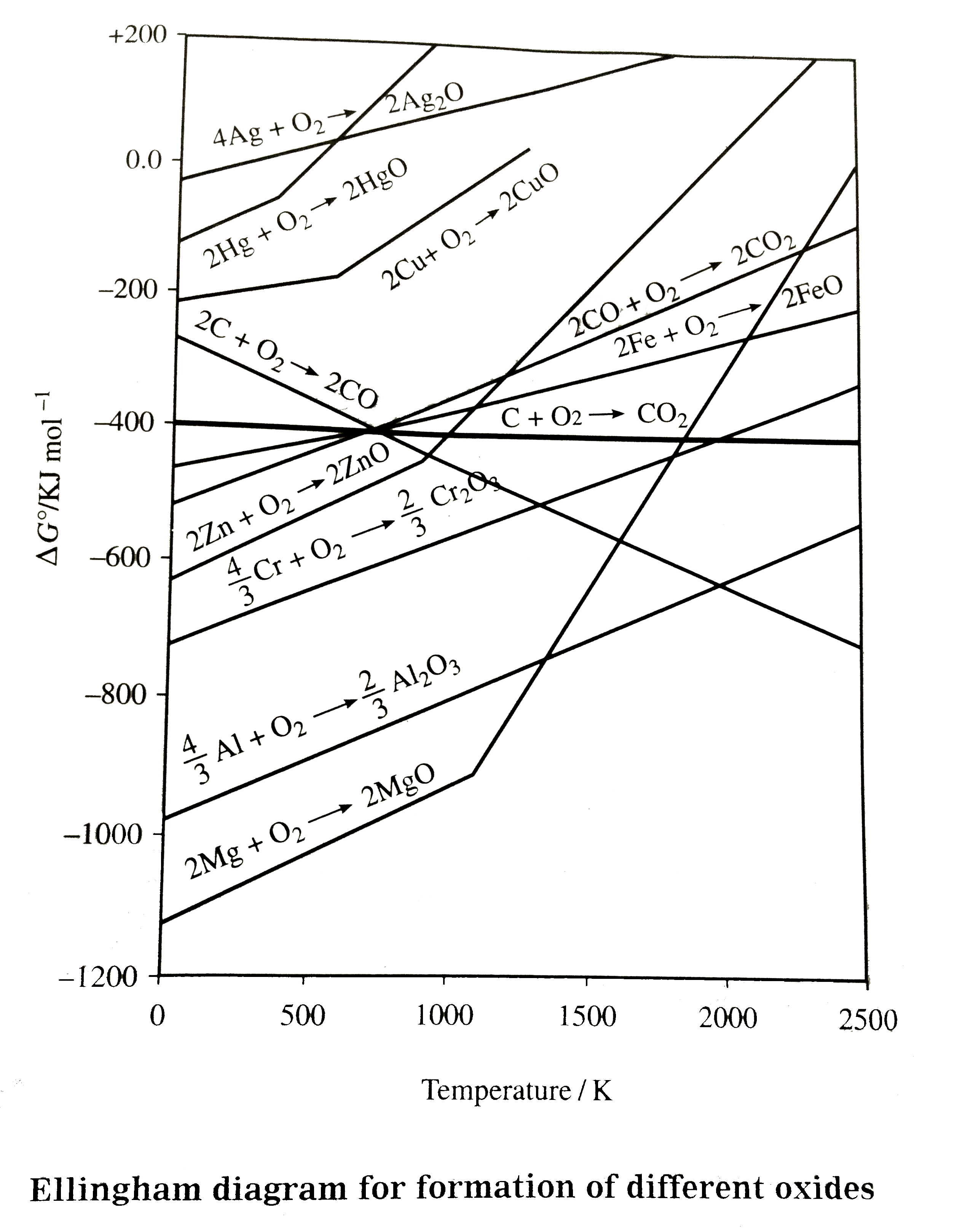 (4) The sudden change in the graphs and slopes indicates a phase change from solid to liquid or from liquid to vapour. (5) (5) The Ellingham diagram enables to select a SUITABLE REDUCING agent for the reduction of given metal oxide. An element can reduce the oxide of another element above it in Ellingham diagram. |
|
| 9. |
Explain the action of Br_(2) water with aniline. |
Answer» SOLUTION :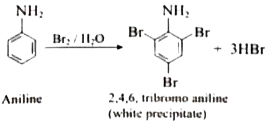
|
|
| 10. |
Explain the shape selective catalysis by zeolites. |
|
Answer» Solution :The catalytic reaction that depends upon the pore structure of the catalyst and the size of the reactant and product molecules is called shapeselective catalysis. Zeolites are good shape selective catalysts because of their honeycomb like structures. They are MICROPOROUS aluminosilicates with three dimensional network of silicates in which some silicon atoms are replaced by aluminium atoms GIVING `Al-O-Si` framework. The reactions taking PLACE in zeolites depend upon the size and shape of reactant and product molecules as well as upon the pores and cavities of the zeolites. They are found in nature as well as synthesised for catalytic selectivity. Zeolites are being very widely USED as catalysts in petrochemical industries for cracking of hydrocarbons and isomerisation. An IMPORTANT zeolite catalyst used in the petroleum industry is ZSM-5. It converts alcohols directly into gasoline (petrol) by dehydrating them to give a mixture of hydrocarbons. |
|
| 11. |
Explain the action of ammonia with ethyl acetate. |
| Answer» SOLUTION :`underset("ethyl ACETATE")(CH_3-undersetoverset(||)(O)(C ) - OC_2H_5) + underset("AMMONIA")(HNH_2) to underset("acetamide")(CH_3 - undersetoverset(||)(O)( C) - NH_2) + underset("ETHANOL")(C_2H_5OH)` | |
| 12. |
Explain the Schottky defect terms with suitable examples. |
Answer» Solution :SCHOTTKY defect : 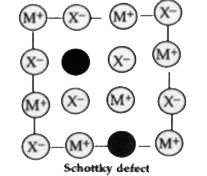 This type of defect is created when one positive ion and one negative ion are MISSING from their respective positions LEAVING behind a pair of holes. Schottky defects are more common in ionic compounds with high co-ordination number, when the SIZE of (+)ve and (-)ve ions are ALMOST equal. Examples : NaCl, KCl. |
|
| 13. |
Explain the role of thermodynamics in extraction of elements. |
|
Answer» Solution :To understand the theory of metallurgical transformations, the Gibb.s free energy changes is the most significant term. For any reaction, the Gibb.s free energy change is given by : `DeltaG = DeltaH - TDeltaS` Where, `DeltaH` = Enthalpy change T = Temperature in KELVIN. `DeltaS` = Entropy change for the process. The criterion for the feasibility of a thermal REDUCTION is that at a given temperature the Gibb.s free energy change for the reaction must be negative. When the value of `DeltaG` is negative only then the reaction will proceed. Under following conditions the value of `DeltaG` is negative. (i) If `DeltaS` is positive on increasing the temperature (T) the value of `TDeltaS` increases so that `DeltaH < TDeltaS`. In this situation `DeltaG` will become negative on increasing temperature. (ii) If coupling of the two reactions, i.e. reduction and oxidation results in negative value of `DeltaG` for overall reaction, the final reaction becomes feasible. Such coupling can be understood by studying PLOTS of `(Delta_rG^(Theta))` v/s T for the formation of oxides. These plots are drawn for free energy changes when one gram mole of oxygen is consumed. The GRAPHICAL representation of Gibb.s free energy versus temperature was first used by H.J.T. Ellingham which provides the basis for considering choice of reducing agent in the reduction of oxides. This is KNOWN as Ellingham diagram. Such diagrams helps in predicting the feasibility of thermal reduction of an ore. |
|
| 14. |
Explain the role of the following : (a) CO in the refining of Ni. (b) Limestone in the metallurgy of Fe. (c ) Depressant in the froth floatation method. |
|
Answer» Solution :(a) CO in the refining of Ni. CO forms a complex with Ni on heating. The complex is heated at a higher temperature to obtain pure metal. (b) Limestone in the METALLURGY of Fe. Limestone is decomposed to CaO which removes silicate impurity of the ore as slag. The slag is in molten state and separatesfrom iron. `CaO +SiO_(2) to underset("CALCIUM silicte (slag)")(CaSiO_(3))` (c ) Depressant in the forth floatation method. Depressant is a substance which helps to separate two SULPHIDE ores in FROTHFLOATATION process.In the case of an are containing ZnS and PbS, the depressant used in NaCN. It selectivelyprevents ZnS from coming to the FROTH but allows PbS to come with the froth. |
|
| 15. |
Explain the action of alkaline potassium permanganate with toluene? |
Answer» SOLUTION :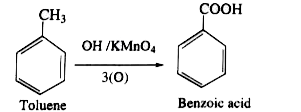
|
|
| 16. |
Explain the role of reducing agent in a reduction of metal oxides. |
|
Answer» Solution :During the reduction process the oxide of a metal decomposes and the reducing agent takes away the oxygen. The role of reducing agent is to provide `Delta_(r)G^(Theta)` negative and large enough to make the sum of `Delta_(r)G^(Theta)` of the two reactions, i.e, oxidation of the reducing agent and reduction of the metal oxide negative. If reduction is carried out by carbon the oxidation of the reducing agent (i.e., C) will be there `C_((s)) + 1/2O_(2(g)) to CO_((g)) , Delta_(r)G_(C,CO)^(Theta) "" ....(ii)` Also the COMPLETE oxidation of carbon to carbon dioxide may take place. `1/2C_((s)) + 1/2 O_(2(g)) to 1/2CO_(2(g)) , 1/2 Delta_rG_(C,CO_2)^(Theta)"".....(iii)` On coupling the reactions (i) and (ii) we get `M_(x)O_((s)) + C_((s)) to ""_(x)M_((s " or " l)) + CO_((g)) "" ....(iv)` On coupling reactions (i) and (iii), we have `M_(x)O_((s)) + 1/2 C_((s)) to xM_((s " or " l)) + 1/2 CO_(2(g)) "" ...(v)` Similarly if carbon monoxide is reducing agent, it would oxidised as follows: `CO_((g)) + 1/2O_(2(g)) + CO_(2(g)) - Delta_(r)G_(CO, CO_2)^(Theta) ""..... (vi)` On coupling reaction (i) and (vi), we have `M_(x)O_((s)) + CO_((g)) to xM_((s " or " l)) + CO_(2(g)) "" ...(vii)` The reactions (iv) and (vii) actually describe the reduction of metal oxide` M_xO` that is need to be accomplished. The values of `Delta_r G^(@)` for these reactions in general, can be obtained from the corres-ponding `Delta_rG^@` values of oxides. The temperature chosen for the reaction MUST be such that `Delta_rG^@`for two combined redox processes must be negative. This is indicated by the point of intersection of the two curves`Delta_rG^@`v/s T in Ellingham diagram, ie, curve for the formation of `M_xO` and that of the formation of oxide of the reducing substance. After that point, the`Delta_rG^@`becomes large negative for the combined process that MAKES reduction of `M_xO` possible. The difference in the two`Delta_rG^@`values after that point determines whether reduction of the oxide of the element of the UPPER line is feasible by the element of which oxide formation is represented by the lower line. If the difference is large the reduction is easier. |
|
| 17. |
Explain the action of air on diborane. |
|
Answer» Solution :At ROOM temperature PURE diborane does not react with air or oxygen but in impure form it gives `B_(2)O_(3)` ALONG with large AMOUNT of heat. `B_(2)H_(6)+3_(3)toB_(2)O_(3)+3H_(2)O` |
|
| 18. |
Explain the role of redox reactions in titrimetre processes and galvanic cells. |
|
Answer» Solution :Role of redox REACTIONS in titrimetric quantitative analysis : Titrimetric analysis involves two substances. They are (1) a solution of known concentration or a standard solution and (2) a solution of unknown concentration. The first solution is also known as Titrant. The second solution is also knwon as Titrand. The process of adding a standard solution to the titrand till the reaction is just complete is called titration. The point at which the titrand just completely reacts with the standard solution is called "equivalence point" or "end point," In redox reactions the completion of the titration is detected by a suitable method like (a) observing a physical change. Ex : The light pink colour of `KMnO_(4)` titrations. (b) by USING a reagent known as indicator which gives a clear visual change in its colour. Ex(1) In `Cr_(2)O_(7)^(-2)` (dichromate) titrations, diphenyl amine is used as a reagent and at the end point it produces intense blue colour due to its oxidation by `Cr_(2)O_(7)^(-2)`. Ex (2) In the titration of `Cu^(+2)` with `I^(-)` (Iodometry) `2Cu_((aq))^(+2)+4I_((aq))^(-)toCu_(2)I_(2(s))+I_(2(aq))` The `I_(2)` formed in the redox reaction gives a deep blue colour with starch solution, added to the flask. IN this way redox reaction are taken as the basis for titrimetric analysis with `MnO_(4)^(-),Cr_(2)O_(7)^(-2)` etc. as oxidising agents and `S_(2)O_(3)^(-2)` etc. as reducing agents. Role of Redox reaction in galvanic cells : When a zinc rod is kept in copper sulphate solution then the following redox reaction takes place. 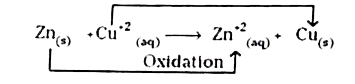 In this redox reaction the transfer of electrons from `Zn_((s))` to `Cu_((aq))^(+2)` takes place directly. The same transfer of clcctrons can also be done indirectly in a galvanic call (Daniel cell). Cells in which chemical energy is converted into electrical energy are called galvanic cells. Daniel cell is a best example for a galvanic cell. The Daniel cell consists of two beakers containing zinc rod dipped in `ZnSO_(4(aq))` solution in ONE beaker and a copper rod dipped in `CuSO_(4(aq))` solution in a second beaker. The two beakers are connected by an inverted U-tube, known as salt bridge. The two rods are connected by means of wires to the terminals of an ammeter. Redox reaction takes place contains both oxidised and reduced forms of the respective species. The two types of species present together in each beaker is called a redox COUPLE. Each beaker contains a redox couple. The oxidised and reduced forms are separated by a vertical line or a slash. Ex : `Zn_((s))//Zn_((aq))^(+2)` 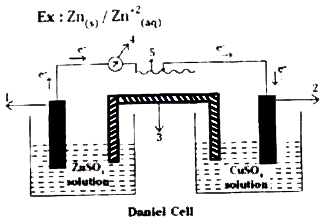 In the above arrangement the two redox couples are represented by `Zn^(+2)//ZnandCu^(+2)//Cu`. As the metal is in two different oxidation states at the interface (say `Zn//Zn^(+2)`), some potential is developed, which is called 'electrode potential'. These electrode potentials are very useful in METALLURGY, electro-plating etc. In this way redox reaction play an important role in galvanic cells. |
|
| 19. |
Explain the action of agonist and antagonist with proper example. |
| Answer» SOLUTION :When ADENOSINE binds to the adenosine receptors, it induces SLEEPINESS. So adenosine is an agonist. On the other hand, the antogonist drug coffeine binds to the adenosine receptor and makes it INACTIVE. This results in the REDUCED sleepiness (wakefulness). | |
| 20. |
Explain the role of Hardy-Schulze rule in flocculating sols. |
|
Answer» Solution : Hardy-Schulze rule. It can be STATED as: (i) The IONS having opposite charges are EFFECTIVE in flocculating the colloidal particles. (ii) The more the charge on the flocculating ion, the more will be its flocculating power. |
|
| 21. |
Explain the action of acidified K_(2)C_(2)O_(7) with (i) Iodide (ii) Sulphide |
|
Answer» Solution :(i) Acidified `K_(2)C_(2)O_(7)` OXIDISES iodide ions to iodine. `Cr_(2)O_(7)^(2-)+ 6I^(-)+ 14H^(+) to 2Cr^(3+)+ 3I_(2)+ 7H_(2)O` (II) Acidified `K_(2)C_(2)O_(7)`oxidises Sulphido ions to Sulphur, `Cr_(2)O_(7)^(2-)+ 3S^(2-)+ 14H^(+) to 2Cr^(3+)+ 3S+ 7H_(2)O` |
|
| 22. |
Explain the role of each of the following in the extraction of metals from their ores : Zinc in the extraction of silver. |
|
Answer» Solution :Silver is leached in a solution of `CN^(-)` ions to form a SOLUBLE compound. The METAL is recovered by displacement method by the addition of zinc. The reations are as under : `4Ag (s) +8CN^(-) (aq) +2H_(2)O (aq) +O_(2) (g) to 4[Ag (CN)_(2)]^(-) (aq) +4OH^(-) (aq)` `2[Ag (CN)_(2)]^(-) (aq) +ZN (s) to 2Ag (s) +[Zn(CN)_(4)]^(2-) (aq)` Zinc acts as a reducing agent. |
|
| 23. |
Explain the action of acidified K_(2)C_(2)O_(7) with (i) Sulphur dioxide (ii) Alcohols. |
|
Answer» Solution :(i) ACIDIFIED `K_(2)C_(2)O_(7)` oxidises So, to sulphate ion. `Cr_(2)O_(7)^(2-) +3SO_(2)+ 2H^(+) to 2CR^(3+)+ 3SO_(4)^(2-)+ H_(2)O` (ii) Acidified`K_(2)C_(2)O_(7)` oxidises alcohol to acid. `2K_(2)C_(2)O_(7) + 8H_(2)SO_(4)+ UNDERSET("Ethanol")(3CH_(3)CH_(2)OH) to 2K_(2)SO_(4)+ 2Cr_(2)(SO_(4))_(3)+ underset("ACETIC acid")(3CH_(3)COOH)+ 11H_(2)O` |
|
| 24. |
Explain the role of each of the following in the extraction of metals from their ores : COin the extraction of nickel. |
|
Answer» SOLUTION :This is Mond.s process for the refining of nickel. Nickel is heated in a stream of CO FORMING a volatile COMPLEX `NI(CO)_(4)`, nickel tetracarbonyl. `Ni +4CO overset(330-350K) (to) Ni(CO)_(4)` The carbonyl is subjected to HIGHER temperature to decompose to give pure metal. `Ni(CO)_(4) overset(450-470K) (to) Ni +4CO`. |
|
| 25. |
Explain the role of each of the following in the extraction of metals from their ores : Silica in the extraction of copper. |
|
Answer» Solution :The COPPER ore is heated in a REVERBERATORY furnace after MIXING with silica. In the furnace, iron oxide SLAG off as iron silicate and copper is produced in the form of copper MATTE. `{:(FeO + SiO_(2) to FeSiO_(3)), ("Slag"):}`. |
|
| 26. |
Explain the action of acetyl chloride with ethyl amine? |
| Answer» Solution :`underset("ETHYLAMINE")(C_(2)H_(5))-NH_(2)+CH_(3)-underset("Acetylechloride")underset(O)underset(||)(C)-Cloverset("Pyridine")(to) C_(2)H_(5)NH-underset("N-Ethyl acetamide")underset(O)underset(||)(C)-CH_(3)+HCl` | |
| 27. |
Explain the role of : Cryolite in the electrolytic reduction of alumina. |
| Answer» SOLUTION :The ROLE of cryolite is to lower the MELTING point and to INCREASE the conductivity of aluminia. | |
| 28. |
Explain the action of acetic anhydrideon ethanol. |
|
Answer» Solution :Acetic anhydride : When ethanol is TREATED with acetic anhydride in the presence of conc. sulphuric acid, ethyl acetate (ESTER) is formed. `underset("Ethanol")(C_(2)H_(5)OH)+underset("acetic anhydride")((CH_(3)CO)_(2)O)overset(H^(+))HARR underset("ethyl acetate")(CH_(3)-overset(O)overset("||")C-O-C_(2)H_(5))+CH_(3)COOH` |
|
| 29. |
Explain the role of : Carbon monoxide in the purification of nickel. |
|
Answer» SOLUTION :Carbon monoxide reacts with nickel to form nickel tetracarbonyl. `{:(Ni+4CO overset(330-350K)(to)Ni (CO)_(4)),("Nickel tetracarbonyl "):}` The IMPURITIES remain unreacted. `Ni(CO)_(4)` on heating to a higher temperature DECOMPOSES to GIVE pure nickel. `Ni(CO)_(4) overset(450-470K)(to)Ni+ 4CO`. |
|
| 30. |
Explain the action of acetyl chloride on ethanol. |
|
Answer» SOLUTION :Acetyl chloride : When ethanol is treated with acetyl chloride in the presence of pyridine, ethyl acetate (ester) is formed. `underset("Ethanol")(C_(2)H_(5)OH)+underset("acetyl chloride")(CH_(3)-overset(O)overset("||")C-Cl)overset("pyridine")tounderset("ethyle acetate")(CH_(3)-overset(O)overset("||")C-OC_(2)H_(5))+HCL` (Pyridine NEUTRALISES HCl formed during reaction ) |
|
| 31. |
Explain the role of carbon monoxide in the purification of nickel? |
|
Answer» SOLUTION :During the purification of Nickel by Mond.s process ,carbon monoxide (CO) is used to CONVERTED IMPURE nickel to nickel carbonyl. Nickel carbonyl is an UNSTABLE compound .Heating to higher temprature decomposes it to give PURE Nickel. |
|
| 32. |
Explain the action of acetic acidon ethanol. |
|
Answer» Solution :Acetic acid : When ethanol is TREATED acetic acid in the presence of CONC. sulphuric acid, ethyl ACETATE (ester)is formed. `underset("Ethanol")(C_(2)H_(5)OH)+underset("acetic acid")(CH_(3)-overset(O)overset("||")C-OH)overset(H^(+))hArr underset("ethyl acetate")(CH_(3)-overset(O)overset("||")C-O-C_(2)H_(5))+H_(2)O` |
|
| 33. |
Explain the acidic nature of phenols. |
|
Answer» Solution :Phenols react with active metal like sodium to forin sodium PHENOXIDE. `2C_(6)H_(5)OH_2Na to 2C_(6)H_(5)ONa_H` Phenols react with aqueous sodium hydroxide to form sodium phenoxide. `C_(6)H_(5)OH+NaOH to C_(6)H_(5)ONa+H_(2)O` The above reactions shows that phenols are acidic in nature, Le. phenols are Bronsted acids. The acidic nature of phenol is due to : • The hydroxyl group ir phenol is directly attached to `SP^(2)` hylbridised carbon of benzene RING which acts as an electron WITHDRAWING group. Due to this phenol easily donates hydrogan ion. • The phenoxide ion is more stable due to resonance stabilisation and hence it favours the ionisation of phenols. • The electron withdrawing group increases the ACIDITY of phenols. Ex: Nitrophenols are more acidic than phenols. • The electron donating group decreases the acidity of phenols. Ex, Cresols are less acidic than phenols. |
|
| 34. |
Explain the role of allosteric site in enzyme inhibition ? |
|
Answer» Solution :Some drugs do not bind to the enzyme.s active site. These bind to a different site of enzyme which is CALLED allosteric site. This binding of INHIBITOR at allosteric site changes the SHAPE of the active site in such a way that substrate cannot recognise it. If the bond formed between an enzyme and an inhibitor is a strong covalent bond and cannot be broken easily, then the enzyme is BLOCKED permanently. The body then degrades the enzyme-inhibitor complex and synthesises the new enzyme. |
|
| 35. |
The concept of DeltaG^@ of coupled reaction are used explain reductions in metallurgy. Explain the above statement. |
|
Answer» |
|
| 36. |
Explain the relationship between Gibb's standard energy change of the reaction and equilibrium constant. |
|
Answer» Solution :Gibb's free energy is the standard free energy which is equal to the difference in free energies of FORMATION of the products and reactanst both in their standard states. It is denoted by `Delta G^(@)`. Relationship between Free Energy and EQUILIBRIUM constant: when Equilibrium has not been ATTAINED, the free energy change of the reaction in any state is denoted as `Delta G` which is related to the standard free energy change of the reaction `Delta G^(@)`. `Delta G = Delta G^(@) + RT In Q` Where Q is the reaction quotient Where Q is the reaction quotient When equilibrium is attained, there is no further free energy change i.e., `Delta G = 0` and reaction quotient Q BECOMES equal to equilibrium constant. Hence, the above equation (i) COMES to be: `Delta G^(@) = - RT In K_(eq)` or `Delta G^(@) = - 2.303 RT log K_(eq)` This is the required equation. |
|
| 37. |
Explain the 12-16 compounds terms with one suitable example : |
|
Answer» Solution :12-16 compounds are those which are prepared by the combination of elements from group-12 (ZINC family) and group-16 (oxygen family. These compounds are ionic in nature. But their ionic nature DEPENDS on the difference in electronegativity value of the elements involved. EXAMPLES : ZnS, CdS, CDSE, Hg Te etc. These compounds show OPTICAL, electronic properties and are used in electronic industries in making semiconducting nano particles, quantam dots etc. |
|
| 38. |
Explain the relative acidity of ethanoic acid and methanoic acid. |
| Answer» SOLUTION :ETHANOIC acid is weaker acid than methanoic acid DUE to weaker +I EFFECT. | |
| 39. |
Explain that enol form of acetoacetic ester is said to be more volatile than keto form. |
Answer» SOLUTION :It is DUE to intramolecular H-bonding in enolic form which REDUCES INTERMOLECULAR association and lowers the BOILING point. 
|
|
| 40. |
Explain the relationship between free energy of the cell and its emf. |
|
Answer» Solution :The maximum work that can be OBTAINED from a galvanic CELL is `(W_(max))_(cell)=-nFE_(cell)"…(1)"` Here the (-) sign is introduced to indicate the work is done by the system on the surroundings. According to SECOND Law of thermodynamics, the maximum work done by the system is equal to the change in the Gibbs free ENERGY of the system. i,e, `W_(max)=DeltaG "...(2)"` From (1) and (2), `DeltaG=-nFE_(cell)"...(3)"` For a spontaneous cell reactions, the `DeltaG` should be negative. The above expression (3) indicates that `E_(cell)` should be positive to get a negative `DeltaG` value. When all the cell components are in their standard STATE, the equation becomes `DeltaG^(@)=-nFE_(Cell)^(@)` |
|
| 41. |
Explain the relation between rate of reaction and stoichiometric coefficients of balance chemical equation with examples. |
|
Answer» Solution :If the reactant and product each have stoichiometric COEFFICIENT one than each has one mole stoichiometric .So representation of rate is easy:`RtoP` reaction. `r_(av)=-(Delta[R])/(Deltat)=(Delta[P])/(Deltat)` eg. `Hg_(l)+Cl_(2(g))to HgCl_(2(s))` Velocity=`-(Delta[Hg])/(Deltat)=-(Delta[Cl_(2)])/(Deltat)=(Delta[HgCl_(2)])/(Deltat)` If stoichiometric co-efficients are DIFFERENT and not one then the rate is divided by their respective stoichiometric coefficient. eg.-1:`2HI_((g))toH_(2(g))+I_(2(g))` Velocity =`-(1)/(2)-(Delta[HI])/(Deltat)=(Delta[H_(2)])/(Deltat)=(Delta[I_(2)])/(Deltat)` eg-2:`2NH_(3(g))toN_(2(g))+3H_(2(g))` `therefore` Rate of reaction =`-(1)/(2)-(Delta[NH_(3)])/(Deltat)=(Delta[N_(2)])/(Deltat)=(1)/(3)-(Delta[H_(2)])/(Deltat)` |
|
| 42. |
Explain that alpha-methyl acetyl acetone undergoes enolisation to a smaller extent than acetyl acetone. |
Answer» SOLUTION :
|
|
| 43. |
Explain the relation between activation energy and the rate of the reaction using catalyst. |
|
Answer» Solution :(i) For a chemical reaction to OCCUR, the reactants are to be activated to form a activated COMPLEX. The energy required for the reactants to reach the activated complex is called the activation energy. The activation energy can be decreased by increasing the reaction temperature. (ii) In the PRESENCE of catalyst, the reactants are activated at REDUCED temperatures. i.e., the activation energy is lowered. The catalyst adsorbs the reactants activates them by weakening the bonds and allow them to react to form products. (III) As activation energy is lowered in the presence of a catalyst, more molecules take part in the reaction and hence the rate of the reaction increases. |
|
| 44. |
Explain that for any chemical reaction to occur proper orientation must be require |
|
Answer» Solution :The collision in which molecules collide with sufficient kinetic energy . The molecules are arrange in PROPER orientation,so as to facilitate breaking of BONDS between REACTING species and formation of new bonds to form products.  E.g.:Formation of METHANOL from bromo-ethane depends UPON the orientation of reactant molecules. |
|
| 45. |
i) Explain the reduction of nitrocompounds to amines with an examples. ii) Why aromatic primary amines cannot be prepared by Gabriel synthesis? |
|
Answer» SOLUTION :EXPLANATION EXAMPLE NITRO compounds are reduced to amine by PASSION `H_2` gas in the presence of pallaldium. 
|
|
| 46. |
Explain target molecules or drug targets used in medicinal chemistry . |
| Answer» SOLUTION :Target molecules or drug targets. Drug interact with macromolecules such as proteins, CARBOHYDRATES , lipids and nucleic acids and these are CALLED drug targets. These macromolecules or drug targets are known to PERFORM several roles in the BODY. | |
| 47. |
Explain the reducing behaviour of carbon in the extraction of iron using Ellingham diagram. |
|
Answer» Solution :The formation CO from coke has `/_\G^0` that `Fe_2O_3` above 1073K. CO is more stable than `Fe_2O_3`. Hence Coke reduces `Fe_2O_3` into MOLTEN FE above 1073 K `Fe_2O_3(s)overset(gt1073K)to2Fe_((s))2FE((s))+3CO((g))` |
|
| 48. |
Explain the reason for the fusion of an organic compound witt metallic sodium for testing nitrogen, sulphur and halogen. |
|
Answer» |
|
| 49. |
Explain synergic effect in the formation of metal carbonyls. |
|
Answer» SOLUTION :Metal - carbon had both o and a BOND between them `M-C SIGMA` bond by donating electron pair from c to metal `M-C pi` bond by donating electron pair from filled d of metal to it. of carbon Thus `M-C` bond is STRENGTHENED. This is synergic effect |
|
| 50. |
Explain symbolic representation of galvanic cell (electrochemical cell) by suitable example. |
|
Answer» Solution :In SYMBOLIC REPRESENTATION of electrochemical cell, th reaction of anode (left side) and cathode (right side) half-cell are denoted by placing single vertical line between metal ion and ion/ metal respectively. * Anode and cathode are represented on right side and left respectively. * (-) and (+) signs are denoted on anode and cathode respectively. * Two parellel vertical lines are PLACED to denote the salt BRIDGE between these two half-cells. * If inert electrode is used, then to denote such inert electrode use sign like Pt or C which ever metal is used. Example-1: Symbolic representation of Daniell cell:  Example-2: Symbolic representation of galvanic cell constructed with inert electrode `Pt|H_(2)` and copper half-cell.  Reaction: `underset("Oxidation (left side)")(H_(2(g))to2H_((AQ))^(+)+2e^(-))|underset("Reduction (right side)")(Cu_((aq))^(2+)+2e^(-) to Cu_((S))` |
|