

Saved Bookmarks
This section includes 7 InterviewSolutions, each offering curated multiple-choice questions to sharpen your Current Affairs knowledge and support exam preparation. Choose a topic below to get started.
| 1. |
Explain the term copolymerization and give two examples. |
| Answer» SOLUTION :In this TYPE of polymerisation , the polymer is made up of TWO or more DIFFERENT types of MONOMERS. E.g Nylon-66, Terylene etc. | |
| 2. |
Explain the action of of nitrous acid with N-methyl aniline. |
Answer» Solution :N-methyl ANILINE react with NITROUS acid to give N-nitroso amine as yellow OILY liquid which is INSOLUBLE in WATER. 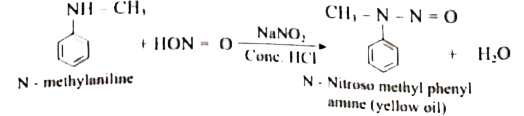
|
|
| 3. |
Explain the term copolymerization andgive two examples. |
| Answer» Solution :When two or more different monomers are allowed to polymerize , together , the PRODUCT formed is CALLED a copolymer and the process is called copolymerization. Thus , a copolymer CONTAINS a LARGE NUMBER of units of each monomer used in the same polymeric chain. For example , Buna- S and Buna- N. Whereas Buna -S is a copolymer of 1,3-butadiene and styrene while Buna -N is a copolymer of 1,3-butadiene and acrylonitrile. | |
| 4. |
Explain the action of NH_(3) on acetic acid. |
|
Answer» Solution :ACTION of `NH_(3 )` : Acetic ACID reacts with ammonia to give ammonium acetate. `underset("acetic acid")(CH_(3)-OVERSET(O)overset("||")C-OH)+NH_(3) to underset("ammonium acetate")(CH_(3)-overset(O)overset("||")C-ONH_(4))` |
|
| 5. |
Explain the term copolymerisation and give two examples. |
Answer» Solution :When two or more different monomers polymerise together, the PRODUCT formed is called a COPOLYMER and the process is called copolymerisation. Thus, a copolymer contains a LARGE NUMBER of units of each monomer lised in the same polymeric chain. For example, Buna-S and Buna-N. Buna-S is a copolymer of 1,3-butadiene and styrene while Buna-N is a copolymer of 1, 3-butadiene and acrylonitrile . 
|
|
| 6. |
Explain the action of Na_(2)CO_(3) on acetic acid. |
|
Answer» SOLUTION :Action of SODIUM carbonate on acetic ACID : It gives sodium acetate and carbon DIOXIDE gas. `underset("acetic acid")(2CH_(3)-overset(O)overset("||")C-OH)+Na_(2)CO_(3) to underset("sodium acetate")(2CH_(3)-overset(O)overset("||")C-overset(-)O Noverset(+)a)+H_(2)O+CO_(2)uarr ` |
|
| 7. |
Explain the stucture of ammonia. |
Answer» Solution :AMMONIA molecule is pyramidal in shape `N-H` BOND distance is `1.016Å` and `H-H` bond distance is `1.645Å` with a bond angle `107^(@)`. The structure of ammonia may be regarded as a tetrahedral with ONE lone PAIR of electrons in one tetrahedral position HENCE it has a pyramidal shape as shown in the figure. 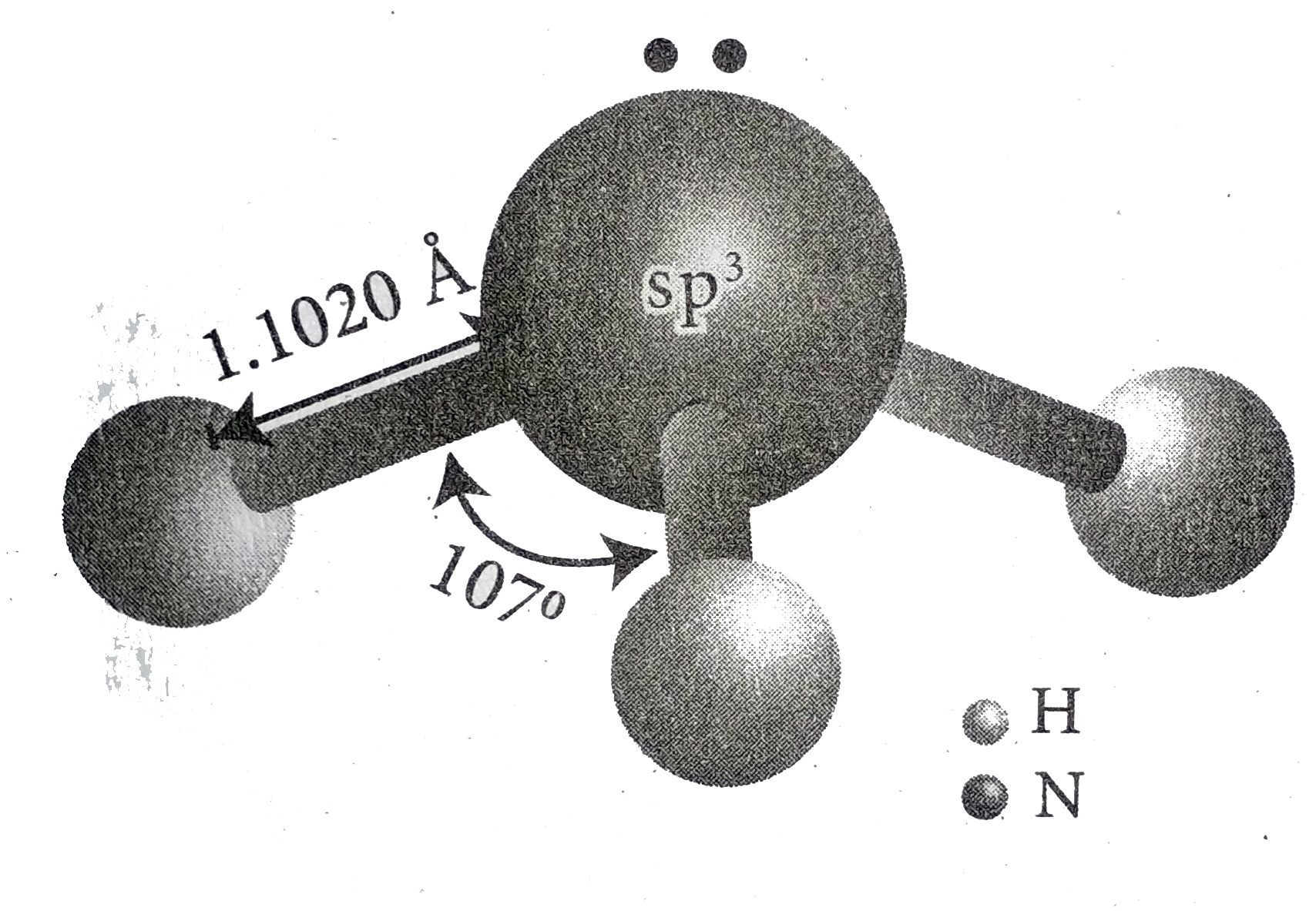
|
|
| 8. |
Explain the action of hypophosxphrous acid with Benzene diazonium chloride (or) Explain the action of ethanol with benzene diazonium chloride. |
|
Answer» Solution :`underset("Benzene diazonium chloride")(C_(6)H_(5)N_(2)""^(+)Cl^(-))+H_(3)PO_(2)+H_(2)O overset(CuCl)(to) underset("Benzene")(C_(6)H_(6))+H_(3)PO_(3)+HCl+N_(2)uarr` `C_(6)H_(5)N_(2)""^(+)Cl^(-)+CH_(3)-CH_(2)OHto underset("Benzene")(C_(6)H_(6))+N_(2)+CH_(3)CHO+HCl` |
|
| 9. |
Explain the structures of alcohols and phenols. |
|
Answer» Solution :In ALCOHOLS, the -OH group is bonded to the `sp^(3)` hybridized carbon. The oxygen of the -OH group is also `sp^(3)` hybridized with two lone pair of ELECTRONS. Thus, the carbon-oxygen bond in alcohol is formed by the straight overlapping of `sp^(3)` orbitals of carbon and oxygen. `to`In alcohols, the bond angle is slightly less than the regular tetrahedral angle (`109^(@) 28.`) because of lone-lone pair REPULSIONS on oxygen atom. The bond angle in methanol is `108.9^(@)`. In phenols, the C-O bond length in phenol is smaller than methanol because (i) PARTIAL double bond character on account of conjugation of unshared electron pair of oxygen with the aromatic ring and (ii) The `sp^(2)` hybridized state of carbon to which the oxygen of -OH group is bonded. The bond angle in phenol is `109^(@)`. The -O bond length in methanol is 142 pm and in phenol it is 136 pm.  The dipole moment of phenol (1.54 D) is smaller than methanol (1.71 D) because the C-O bond in phenol is less polar due to electron withdrawing effect of benzene ring while in methanol, the C- bond is more polar due to electron donating effect of methyl group. |
|
| 10. |
Explain the action of magnesium amalgam and water with acetone? |
Answer» SOLUTION :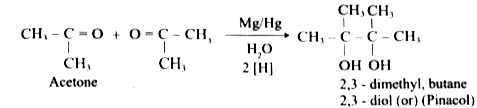
|
|
| 11. |
Explain the structures of : (A) Manganateion (B) Permangate ion. |
|
Answer» SOLUTION :(A) (i) The manganate ion, `MnO_(4)^(2-)` is tetrahedral in structure. (ii) It is green and paramagnetic since it has one unpaired ELECTRON. (B) (i) The permanganate ion, Mno, is tetrahedral in structure. (ii) It is purple and diamagnctic since it has all electrons paired. (iii) MN in `MnO_(4)^(2-)`, undergoes sp' hybridisation and four oxygen atoms are PLACED at the four corners of a tetrahedron and Mn at the centre. (IV) p-orbitals of oxygen atoms overlap with d-orbitals of Mn and form `pi` bonds. `Mn^(7+)`has electronic configuration `3d^(0)`.Hence there is no d-d transition of electron possible in `MnO_(4)^(-)` . (vi)The purple colourarisedue to chargetransfer. 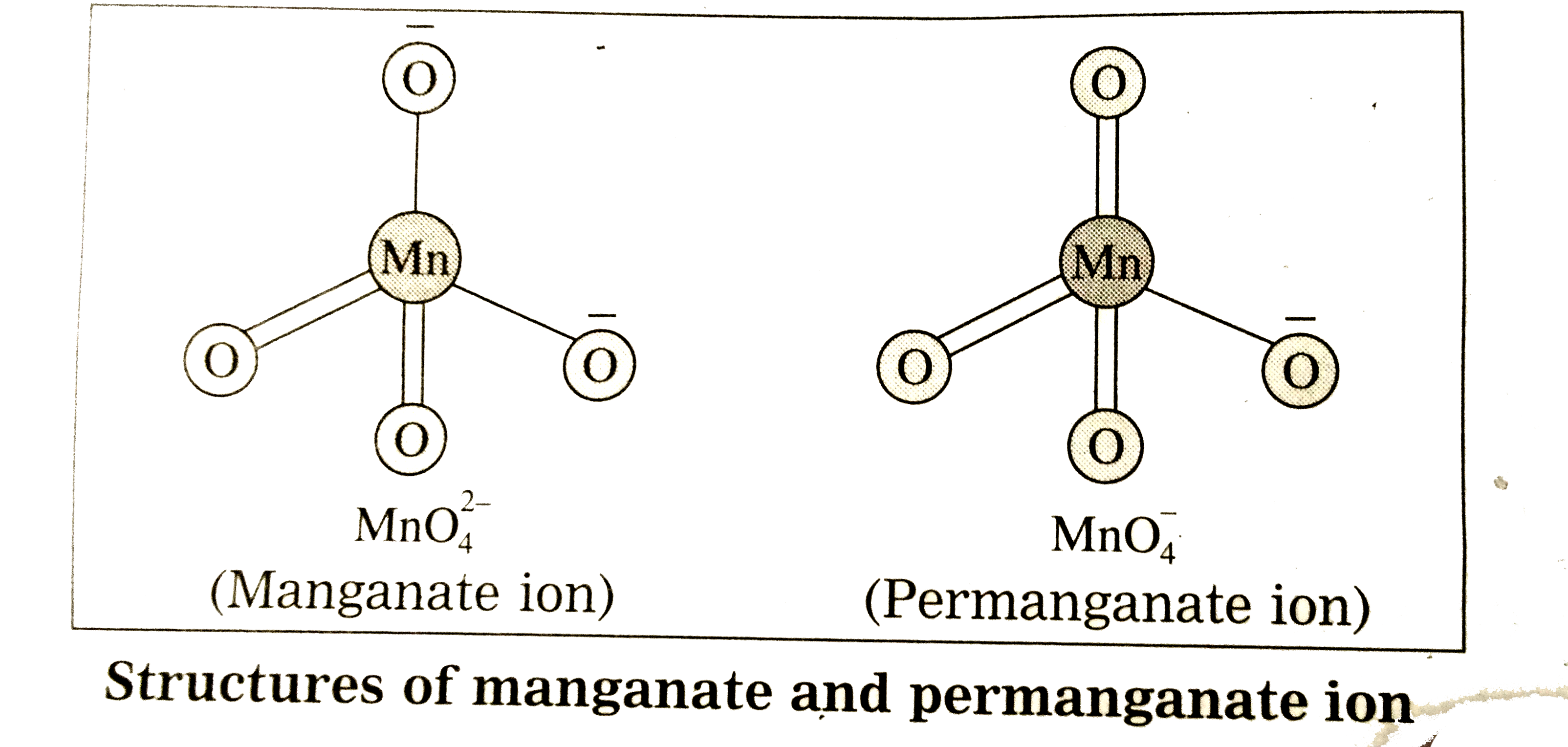
|
|
| 12. |
Explain the action of heat on potassium permanganate. |
| Answer» SOLUTION :`underset("Potassium Permanganate")(2KMnO_(4)) to underset("Potassium Maganate")(K_(2)MnO_(4))+underset("Manganese DIOXIDE")(MnO_(2))+O_(2)UARR` | |
| 13. |
Explain the action of hydrogen iodide with anisole (or) methoxy benzene. |
| Answer» Solution :`UNDERSET("(or) ANISOLE")underset("Methoxy benzene")(C_6H_5-O-CH_3) + HI to underset("Phenol")(C_6H_5OH) + underset("METHYL iodide")(CH_3I)` | |
| 14. |
Explain the structure of sulphur dioxide. |
|
Answer» Solution :Structure of sulphur DIOXIDE : (i) The structure of `SO_(2)` molecule is V - shape with S-O-S bond angle `119^(@)` and bond dissociation enthalpy is `297kJ//mol`. (ii) In `SP_(2)`, each oxygen atom is bounded to sulphur by a `sigma` and a `pi` bond and the `sigma` bonds between S and O are formed by `sp^(2)-p` OVERLAPPING. (iii) Sulphur in `SO_(2)` is `sp^(2)` hybridised FORMING three hybrid orbitals. Due to line pair eletrons, bond angle is reduced from `120^(@)` to `119^(@)`. (iv) One of `pi` bonds is formed by `p pi- p pi` overlapping while other `pi` bond is formed by `p pi-d pi` OVERLAP. 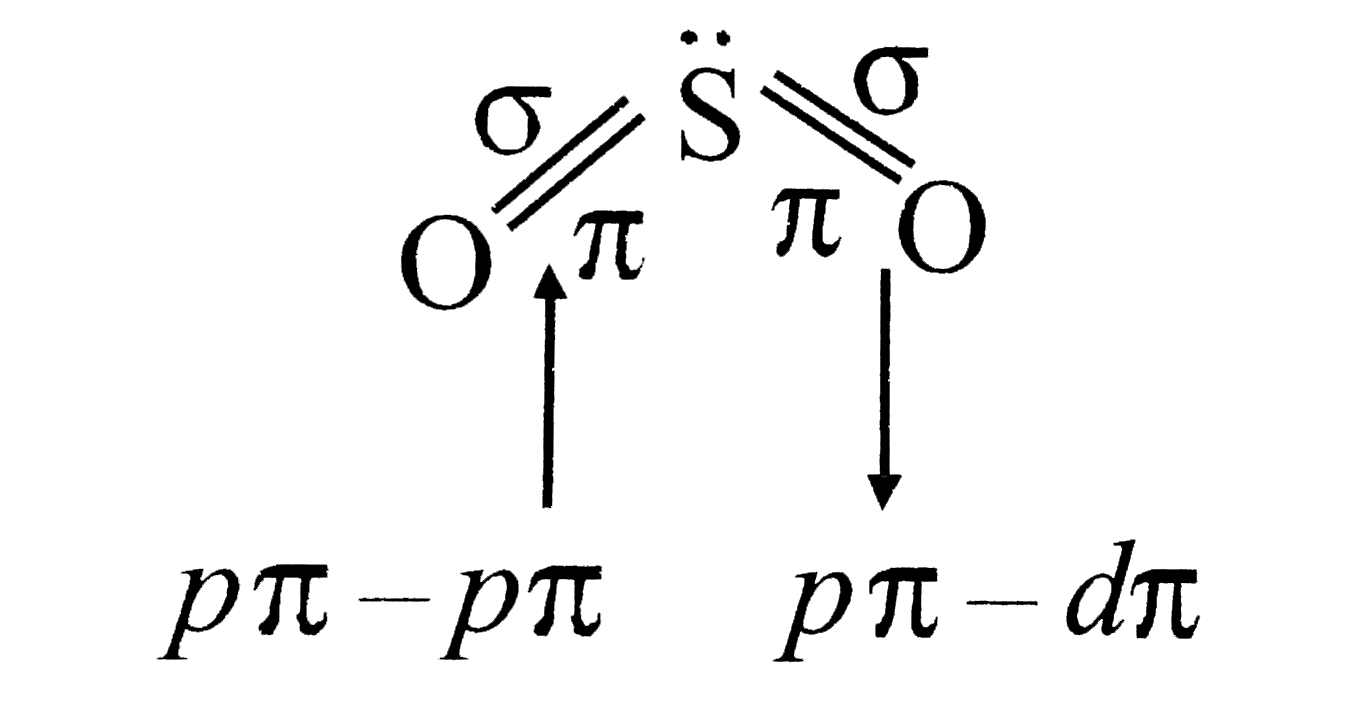
|
|
| 15. |
Explain the action of heat on potassium dichromate. |
| Answer» Solution :`underset("POTASSIUM dichromate")(4K_(2)CR_(2)O_(7)) overset(Delta)to underset("Potassium chromate")(4K_(2)CrO_(4))+ underset("Chromic oxide")(2Cr_(2)O_(3))+ 3O_(2)uarr` | |
| 16. |
Explainthestructureofstarch. |
|
Answer» Solution : Starch ISA storagepolysaccharidein PLANTS. It isapolymerof` PROP`- D-Glucoseunitsand it consistsoftwocomponents. (a) Watersolubleamylose. (b) Waterinsolubleamylopectin. Amyloseisalonglinearchain with200 - 1000` prop`-D - Glucose units. Amylopectinisabranchedchainpolymerof` prop ` - D - Glucoseunits. |
|
| 17. |
Explain the structure of SO_2 molecule. |
| Answer» Solution :It has resonating STRUCTURE. It is HYBRID of structure I and II. The shape of MOLECULE is ANGULAR, the bond ANGLE O-S-O is `119.5^@` | |
| 18. |
Explain the action of heat on potassium dichromate . |
| Answer» Solution :`UNDERSET("POTASSIUM DICHROMATE")(4 K_(2) Cr_2 O_7) overset(Delta)(to) underset("Potassium chromate")(4 K_(2) CrO_(4)) + underset("Chromic oxide")(2 Cr_(2) O_(3)) + 3 O_(2) UARR ` | |
| 19. |
Explain the structure of phosphorous trioxide (P_(2)O_(3)). |
Answer» Solution :In phosphorous TRIOXIDE four phosphorous atoms lie at the CORNERS of a tetrahedron and six OXYGEN atoms along the edges. The `P-O` bond distance is 165.6 pm which is SHORTER tha the angle bond distance of `P-O` (184 pm) due to `ppi-dpi` bonding and results in considerable double bond character. 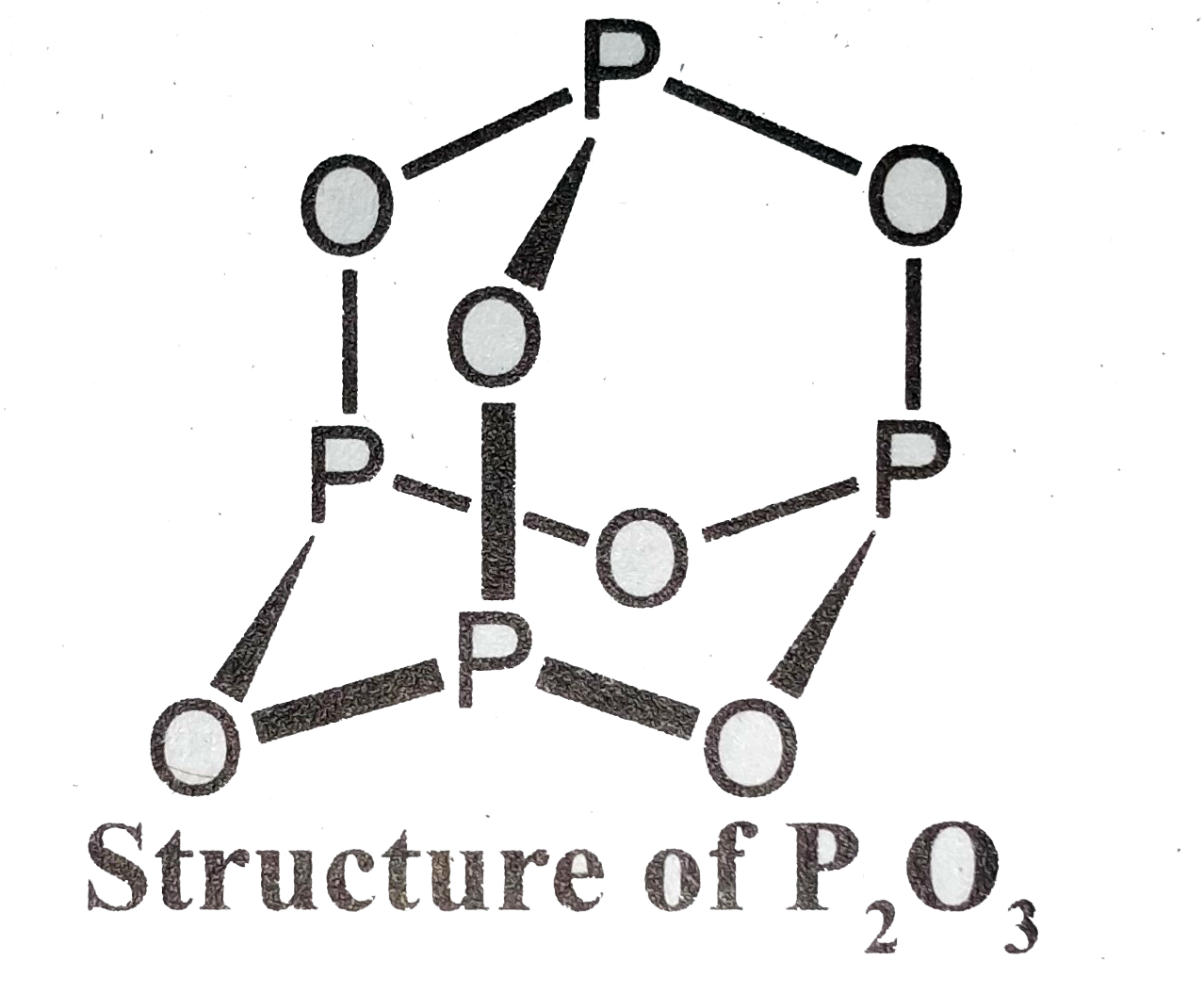
|
|
| 20. |
Explain the action of heat on boric acid. |
|
Answer» Solution :Boric acid when HEATED at 373 K gives METABORIC acid and at 413 K, it gives tetraboric acid. When heated at red hot, it gives boric anhydride which is a glassy mass. `4H_(3)BO_(3)overset(373K)(to)4HBO_(2)+H_(2)O` `4HBO_(2)overset(413K)(to)H_(2)B_(4)O_(7)+H_(2)O` `H_(2)B_(4)O_(7)overset("Red hot")(to) 2B_(2)O_(3)+H_(2)O` |
|
| 21. |
Explain the structure of proteins. |
|
Answer» Solution : The structure and shape of proteins can be studied at FOUR different levels called primary, secondary, tertiary and quaternary. Each level is more complex than the previous one. (1) Primary structure : In primary structure, proteins contain polypeptide chain. Each PROTEIN has amino acids linked with each other in a SPECIFIC sequence and this sequence of amino acids is termet as primary structure. Any change in the primary structures creates different protein molecule. (2) Secondary structure : When long amino acid chain is coiled, looped or folded, it gives particular shape to a protein molecule, it is referred as secondary structure. There are two differet types of structures`alpha`helix and `beta` - pleatedsheets . 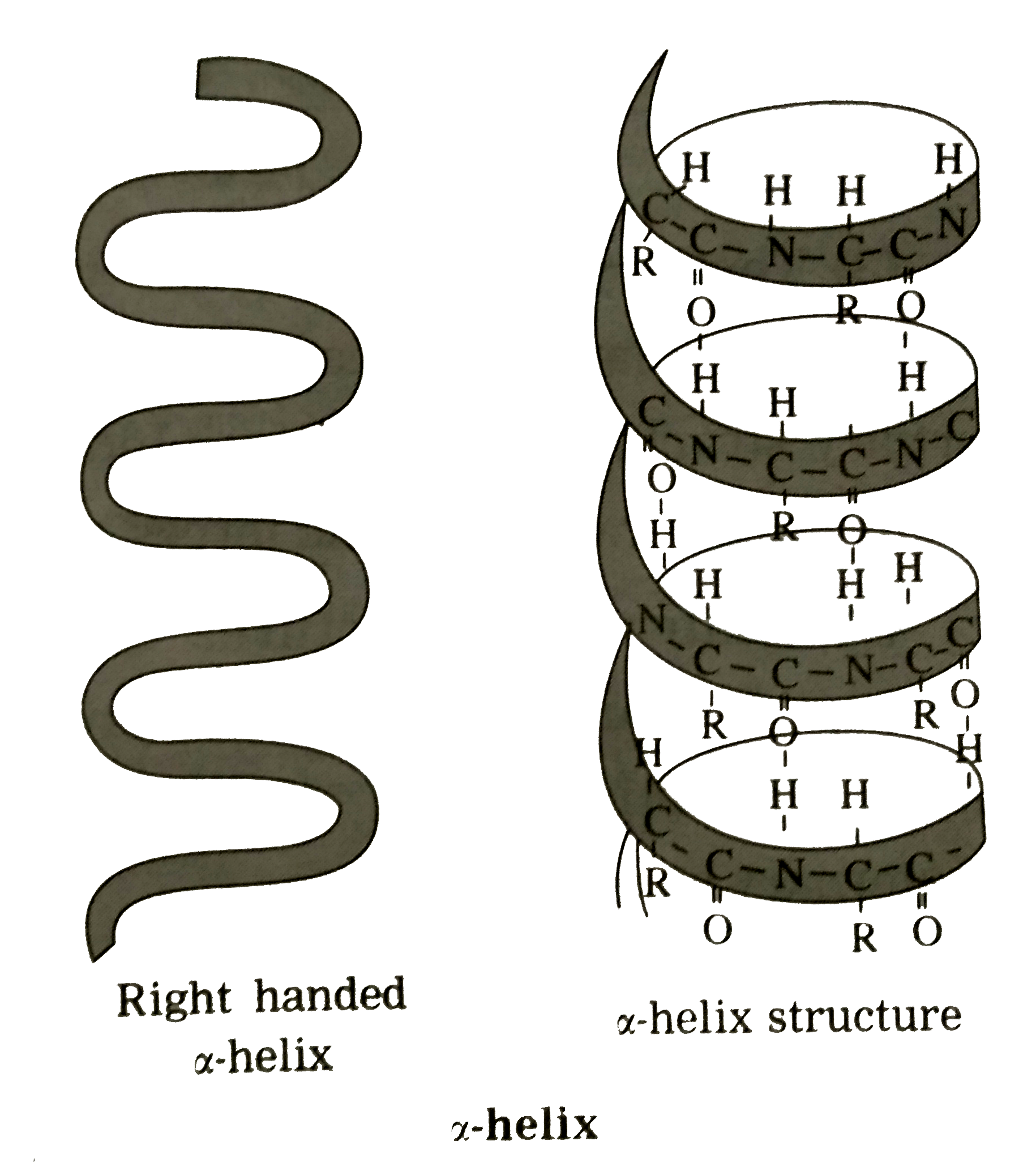 (i) `alpha`-Helix structure : In`beta`- Helix structure a polypeptide chain gets coiled by twisting into right handed spiral known as `alpha` -helix. The hydrogen bonding between`-overset(|)(C) =O` and -NH GROUPS occursin differentparts of the samechainresultingin foldingof polypeptide chain. (ii) `beta`- pleatedstructure: The polypeptide chain lie side by side and are held together by intermolecular hydrogen bonding. The poly peptide chains are stretched out resulting in a flat sheet. The contraction results in a pleated sheets called `beta`-pleated sheet. 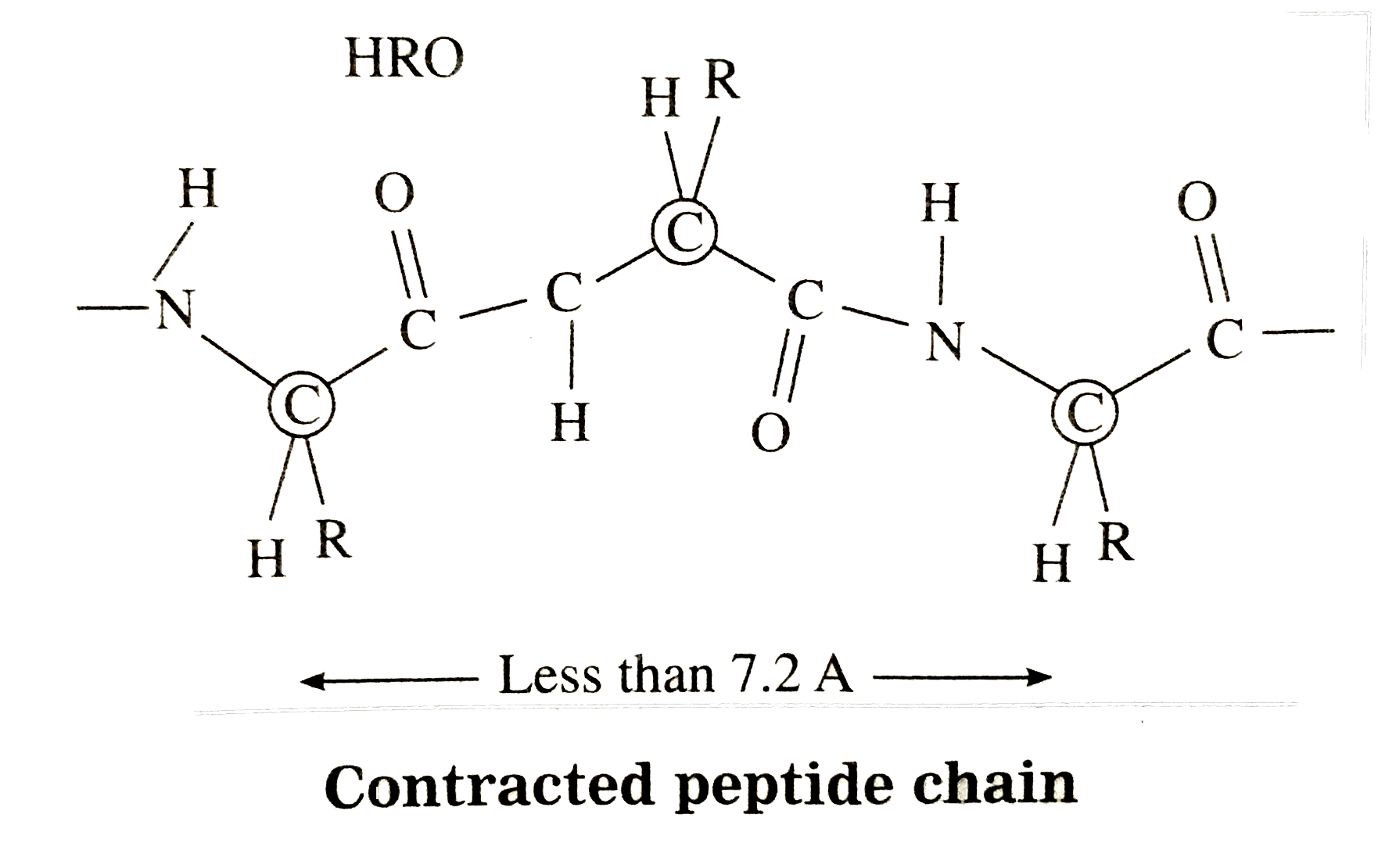 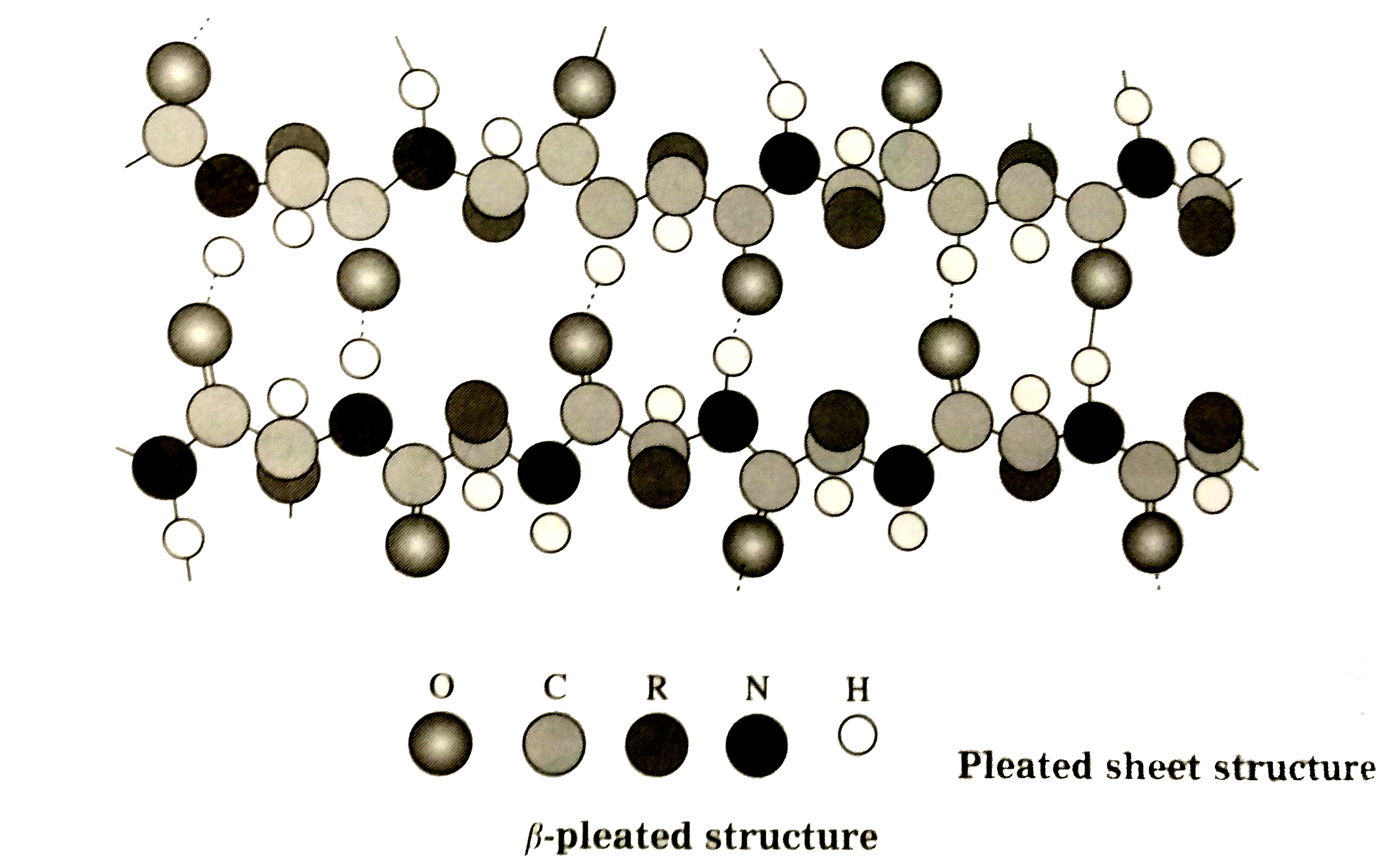 (3) Tertiary structure : The secondary structure on folding givesriseto molecularshapesi.e.,fibrousandglobular . Thepolypeptide intertiarystrcuture heldby disulphideor hydrogenbondsor van derWaalsforcesor electrostaticforces ofattraction. (4)Quaternary structure : Two ormore AMINOACIDS chainsor polypeptidechains forms complexprotein. Thespatialarrangement ofthesepolypeptidechains withrespect to eachotheris knowas quaternary structure . |
|
| 22. |
Explain the action of heat on ammonia. |
|
Answer» Solution :Above `500^(@)C` ammonia DECOMPOSES into its elements. The decomposition may be accelerated by METALLIC CATALYSTS like Nickel, Iron. Almost COMPLETE dissociation occurs on continuous sparking. `2NH_(3) overset(gt500^(@)C)rarr N_(2)+3H_(2)` |
|
| 23. |
Explain the action of heat on acetic acid in the presence of phosphorous pentoxide. |
Answer» SOLUTION :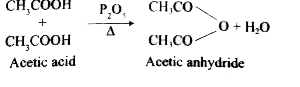
|
|
| 24. |
Explain the structure of phosphine. |
|
Answer» Solution :In phosphine, phosphorus shows `sp^(3)` hybridisation. Three ORBITALS are OCCUPIED by BOND pair and fourth corner is occupied by bond pair and fourth corner is occupied by LONE pair of electrons. Hence, bond angle is reduced to `94^(@)`. Phosphine has a pyramidal SHAPE. Structure of phosphine 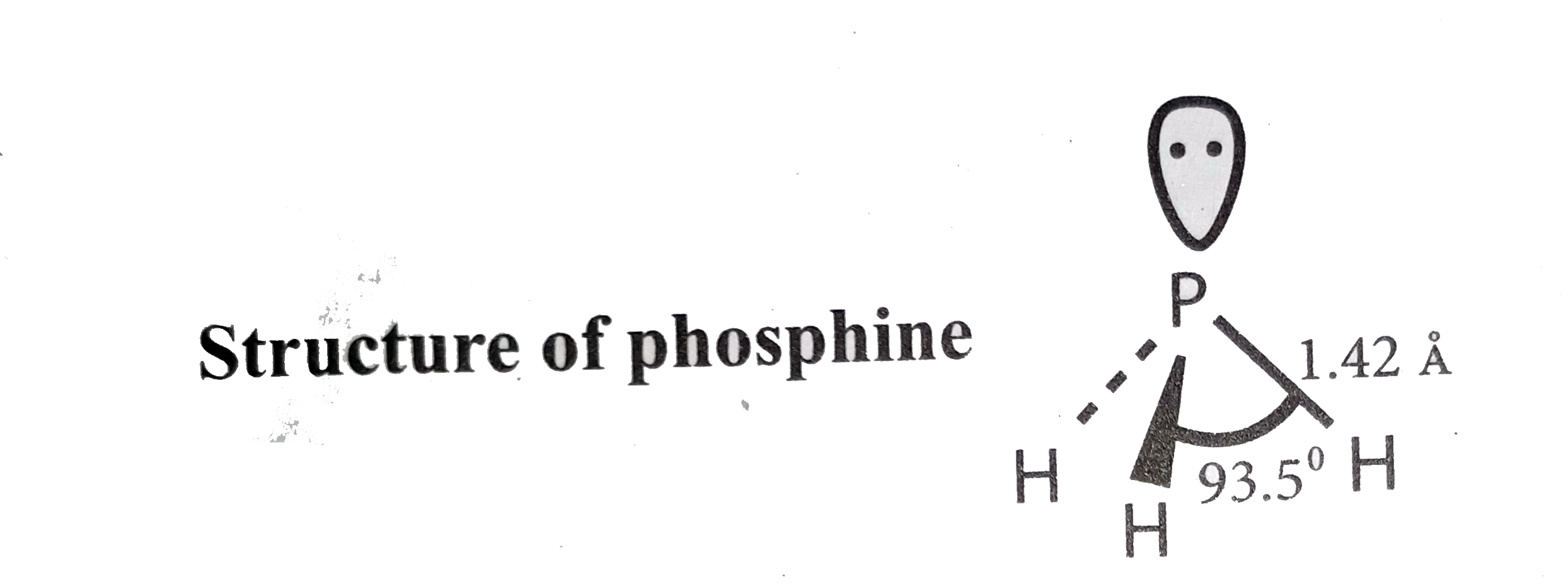
|
|
| 25. |
Explain the action of heat on boric acid . |
|
Answer» Solution :Boric acid when HEATED at 373 K given metaboric acid and at 413 K, it gives tetraboric acid . When heated at RED hot , it gives boric ANHYDRIDE which is a GLASSY mass. `4H_3BO_3overset(375K)rarr4HBO_2+H_2O` `4HBO_2overset(413K)rarrH_2B_4O_7+H_2O` `H_2B_4O_7overset("Red hot ")rarr2B_2O_3+H_2O` |
|
| 26. |
Explain the structure of ozone molecule. |
Answer» Solution :It is considered to be a resonance HYBRID of the FOUR structures. Its shape is ANGULAR. 
|
|
| 27. |
Explain the action of followng reagent with ethane nitrile (i) Dilute mineral acid (ii) Ni//H_(2) |
|
Answer» Solution :(i) `UNDERSET("ETHANENITRILE")(CH_(3)-CN)+H_(2)underset("Partial hydrolysis")overset(H_(2)O_(2)//H^(+))(to)CH_(3)-underset("ACETAMIDE")underset(O)underset(||)(C)-NH_(2)underset("Complete hydrolysis")overset(2H_(2)"O"//H^(+))(to)CH_(3)COOH` (ii) `underset("Ethanenitrile")(CH_(3)-CN)+2H_(2)overset(Ni)(to)underset(Ethanamine")(CH_(3)-CH_(2)NH_(2))` |
|
| 28. |
Explain the structure of [Ni(CN)_(4)]^(2-) on the basis of valencebond theory. |
|
Answer» Solution :(1) Tetracyanonickelate (II) ion, `[Ni(CN)_(4)]^(2-)` isananioniccomplex, oxidation stateof NIIS +2and thecoordination numberis 4. (2) Electronic configuration : `""_(28) Ni [Ar]^(18) 3d^(8) 4s^(2) 4p^(6)` Electronic configuration : `Ni^(2+) + [Ar]^(18) 3d^(8) 4s^(0) 4p^(0)` `Ni^(2)` (Groundstate)  (3)Since `CN^(-)` is a strong ligand, one of the unpaired electrons in3d- orbitalis promotedgivingtwo pairedelectrons and onevacant3d-orbital. `Ni^(2+)` (Excited state)  (4) Since the coordination number is 4, `Ni^(2+)` gets 4 vacant hybrid orbitalsby hybridisation of one 3d, one 4s and two 4p-orbitals formingfour`dsp^(2)`hybrid orbitals. Thishas square planargeometory. `Ni^(2+)`  (5) 4 lone pairs from `4CN^(-)` ligands are accommodated in the vacantfour `dsp^(-)`hybridorbitals. THUS four `DPS^(2)` hybrid orbitals of `Ni^(2+)`overlap with filledorbitalsof `CN^(-)`forming 4 coordinatebondsgivingsquareplaner gemoeteryto thecomplex. Itis an inner complex. `[Ni(CN)_(4)]^(2-)`  Since the complex ion has all electrons paired, it is diamagnetic. 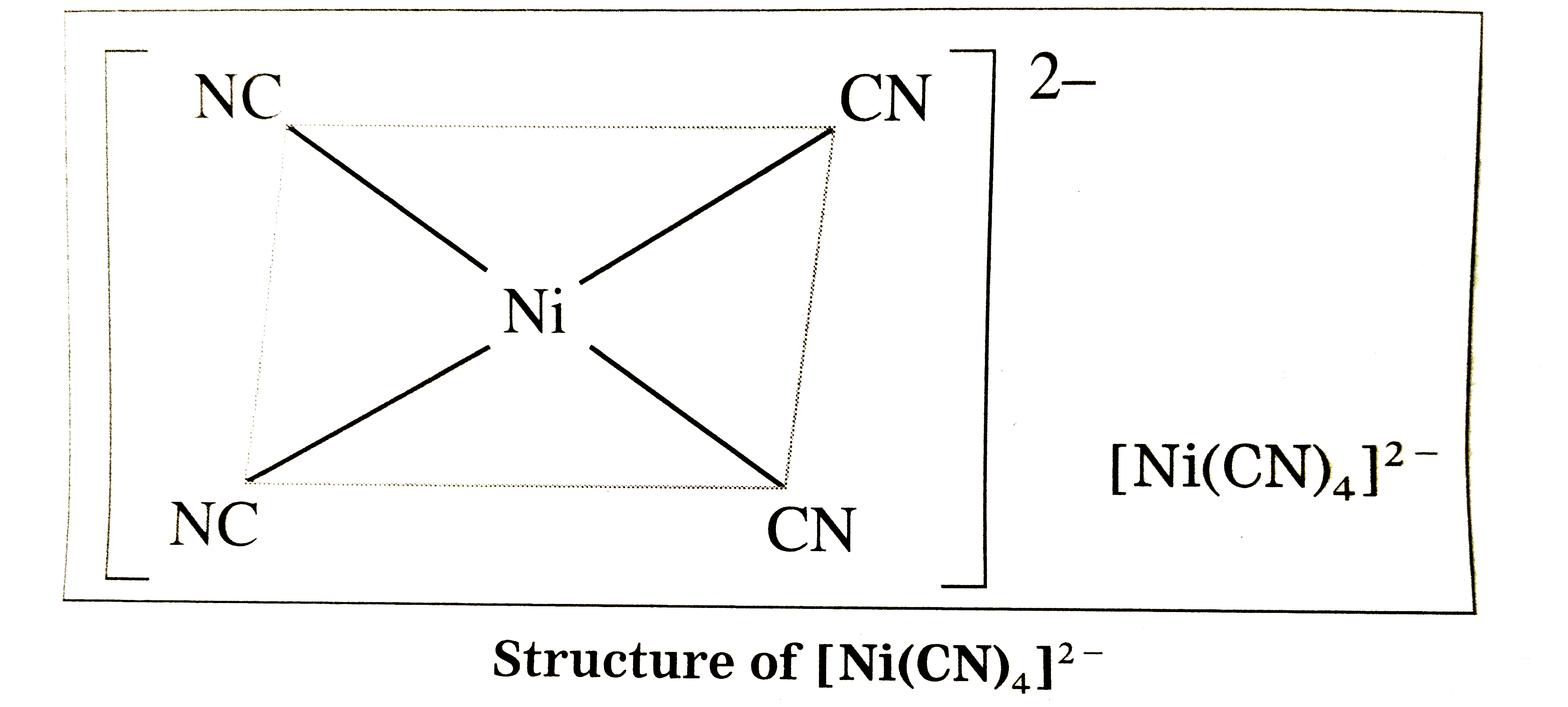
|
|
| 29. |
Explain the action ofdilute HNO_(3) on phenol (carbolic acid) . |
Answer» Solution :DILLUTE nitric acid : When phenol is treated with dilute nitric acid, a MIXTURE of o-nitrophenol and p-nitrophenol (major) is formed. In this REACTION, p-nitrophenol is formed as the major PRODUCT. 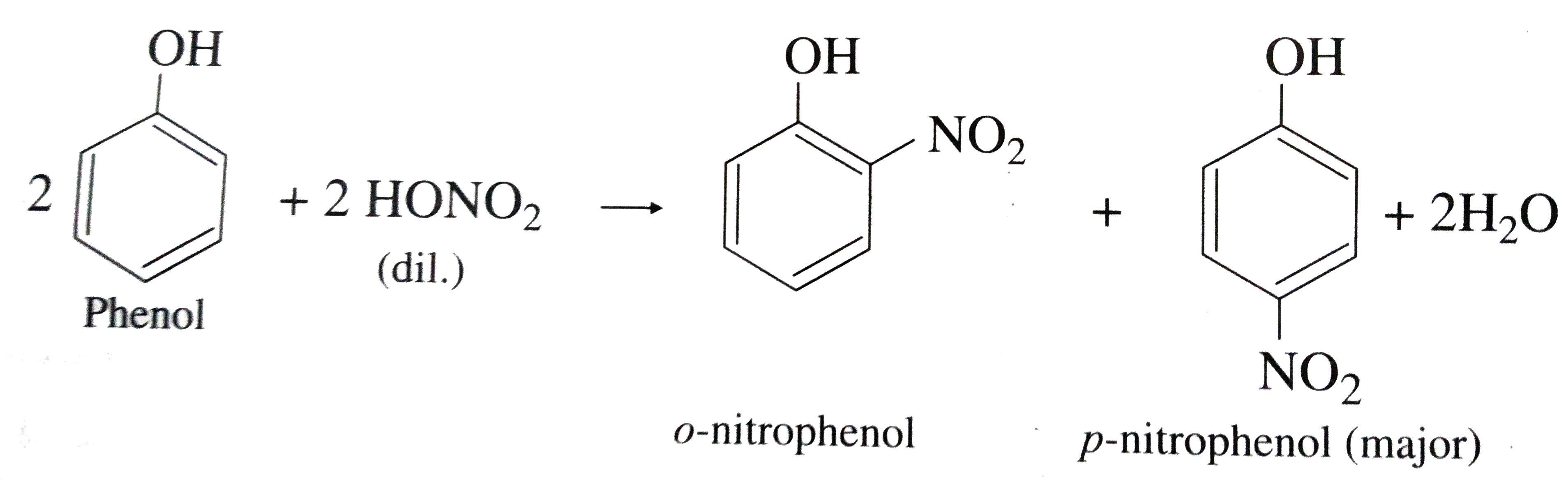
|
|
| 30. |
Explain the structure of nickel tetracarbonly on the basis of valence bond theory. OR Why is Ni(CO)_(4) tetrahedral ? |
|
Answer» Solution :(1) Nickel tetracarbonyl, `NI(CO)_(4)` is a neutral complex, oxidation state of Ni is zero and the coordination number is 4. (2) Electronic configuration: `._(28)Ni[Ar]^(18)3d^(8)4s^(2)4p^(0)`  (3) Since CO is a strong ligand, TWO electrons from 4s-orbital are promoted to 3d- orbital giving all electrons PAIRED due to spin pairing process.  (4) Since the coordination number Ni is 4, gets 4 vacant hybrid ORBITALS by `sp^(3)` hybridisation (one 4s and three 4p orbitals).  (5) 4 lone pairs from 4C) ligand molecules are accommodated in the four vacant `sp^(3)` hybrid orbitals of Ni. Thus four `sp^(3)` hybrid orbitals of Ni overlap with filled orbital of four CO forming four coordinate bonds giving tetrahedral geometry to the complex. Since the complex has all electrons paired, it is diamagnetic. 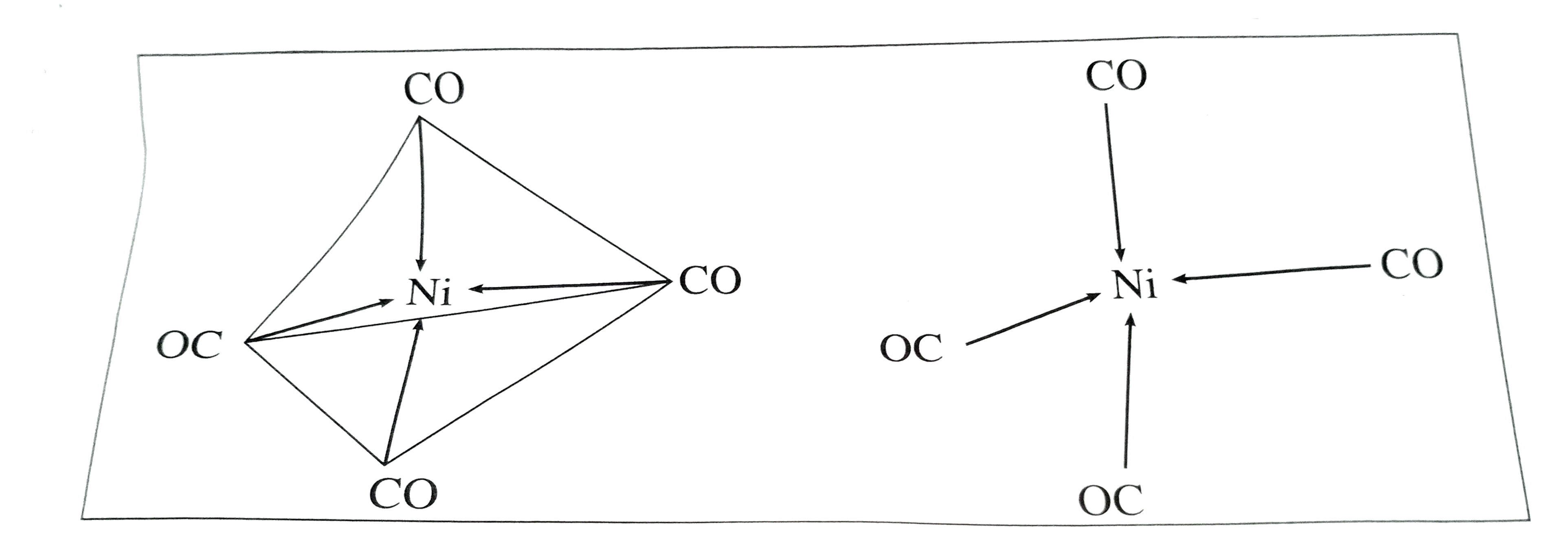
|
|
| 31. |
Explain the action of Diisobutyl aluminium hydride (DIBAL-H) and H_2Owith hex - 4- en nitrile. |
| Answer» Solution :`UNDERSET("hex-4-en nitrile")(CH_3-CH = CH-CH_2-CH_2-CN) underset((II)H_2O)OVERSET((i) AIH (Iso - BU)_2) (to) underset("hex-4-enal")(CH_3-CH=CH-CH_2-CH_2-CHO)` | |
| 32. |
Explain the structure of interhalogen compound of the type XX_(5). |
|
Answer» Solution :(i) Interhalogen compound of the type `XX_(5)` POSSESSES square pyramidal structure. (ii)The central halogen atom `X (X = Br, I)` undergoes `sp^(3)d^(2)` hybridisation forming six hybrid orbitals. (III) One hybrid orbital is OCCUPIED by a lone PAIR of electrons. Ground state of Br 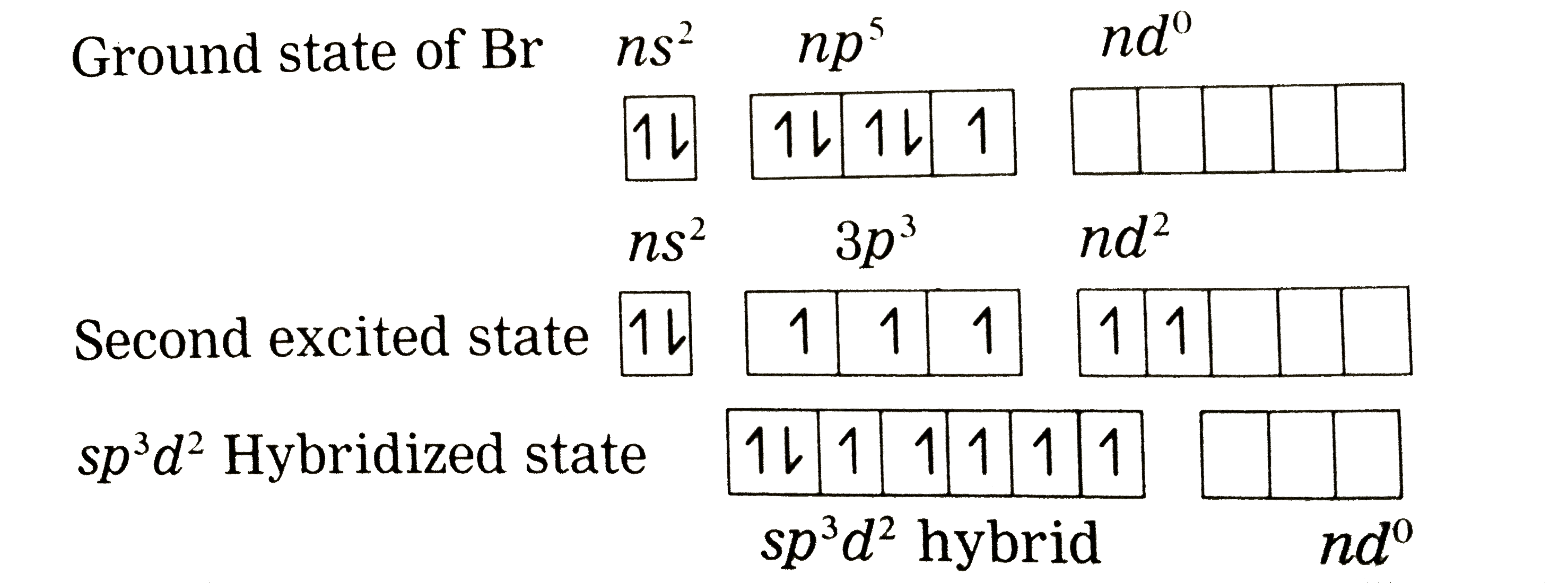 Consider `IF_(5)`molecule : 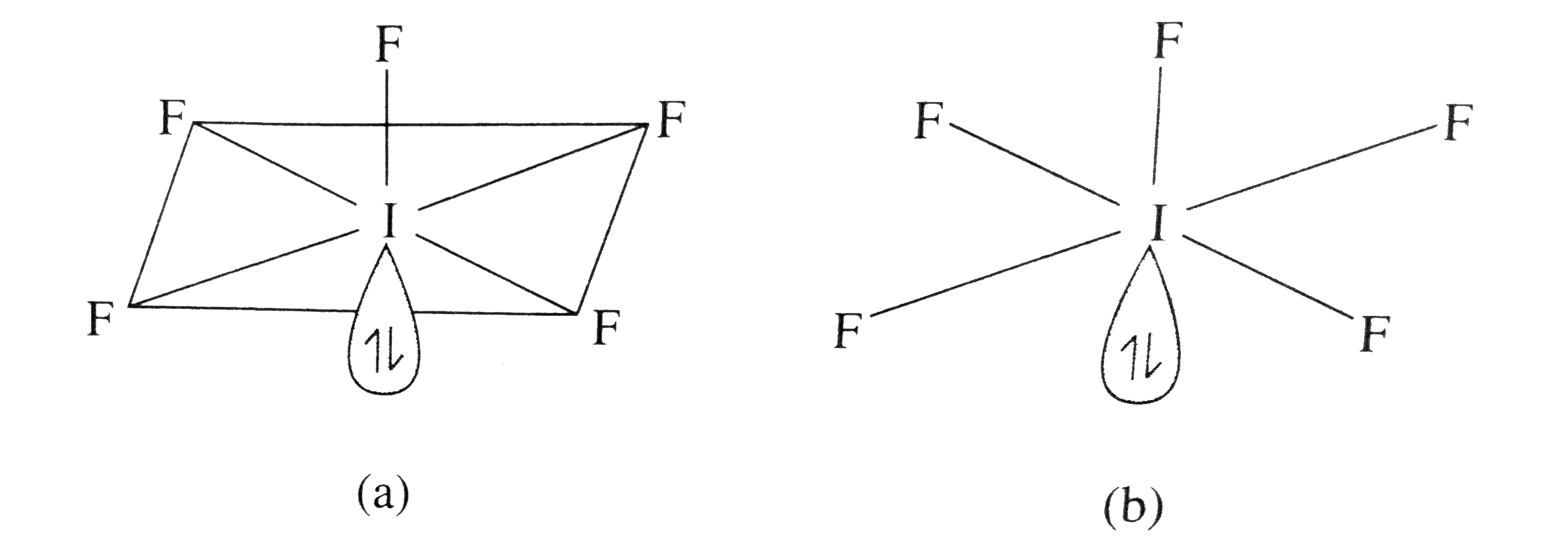
|
|
| 33. |
Explain the action of Diisobutyl aluminium hydride (DIBAL-H) and H_(2)O with hex-4-en nitrile. |
| Answer» Solution :`underset("Hex - 4- en nitrile")(CH_(3)-CH=CH-CH_(2)-CH_(2)-CN)overset((i)AIH(Iso-bu)_(2))underset((II)H_(2)O)tounderset("Hex - 4 - enal")(CH_(3)-CH=CH-CH_(2)-CH_(2)-CHO` | |
| 34. |
Explain the structure of inter halogen compounds. |
|
Answer» 
|
|
| 35. |
Explain the action of diazomethane with ethanol. |
|
Answer» SOLUTION :Methyl ethers can be prepared when ethanol is treated with diazomethane in presence of tluoro BORIC ACID. `underset("Ethanol")(CH_3-CH_2OH)+underset("Diazomethane")(CH_2N_2) underset(DELTA) overset(HBF_4)to underset("Methoxy ETHANE") (CH_3-CH_2 - O - CH_3) + N_2 uarr` |
|
| 36. |
Explain the structure of DNA and RNA . |
|
Answer» Solution :Structure of DNA : To understand the structure of DNA , we should known the charagaff's rule , which states that : 1. Base composition on DNA for a particular organism is constant throughout all the somatic cells 2. Base composition ALWAYS varies from one organism to another and is expressed by the dissymmetry ratio , `(A+T)/(G+C)` 3. Organisms closely related to ech other often have similar base composition and hence have closed values for their dissymmetry ratio. 4. In a given organism the amount of adenine is always equal to the amount of thymine (A=T) and amount of guanine is equal to amount of cytosine (G=C). 5. In a given organism the total amount of purine bases are always equal to total numberof pyrimidine bases (i.e.,) (A+G=T+C). M. wilkins found that within the crystal there is a repeat distance of 3.4 NM and there are ten subunits per turn. watson - Crick model for DNA : From the above observations watson and crick constructed a model for DNA. This model consists of two right handed polynucleotide chains that are complimentary and coiled about the same axis to form DOUBLE - helix .Some specific base pairs can be spatially accommodated and these are A-T and G-C pairs. The bases are closely associated with each other by hydrogen bonding. The helix has diameter of about 2.0 nm and contains 10 nucleotide pairs in each turn of helix as shown above: 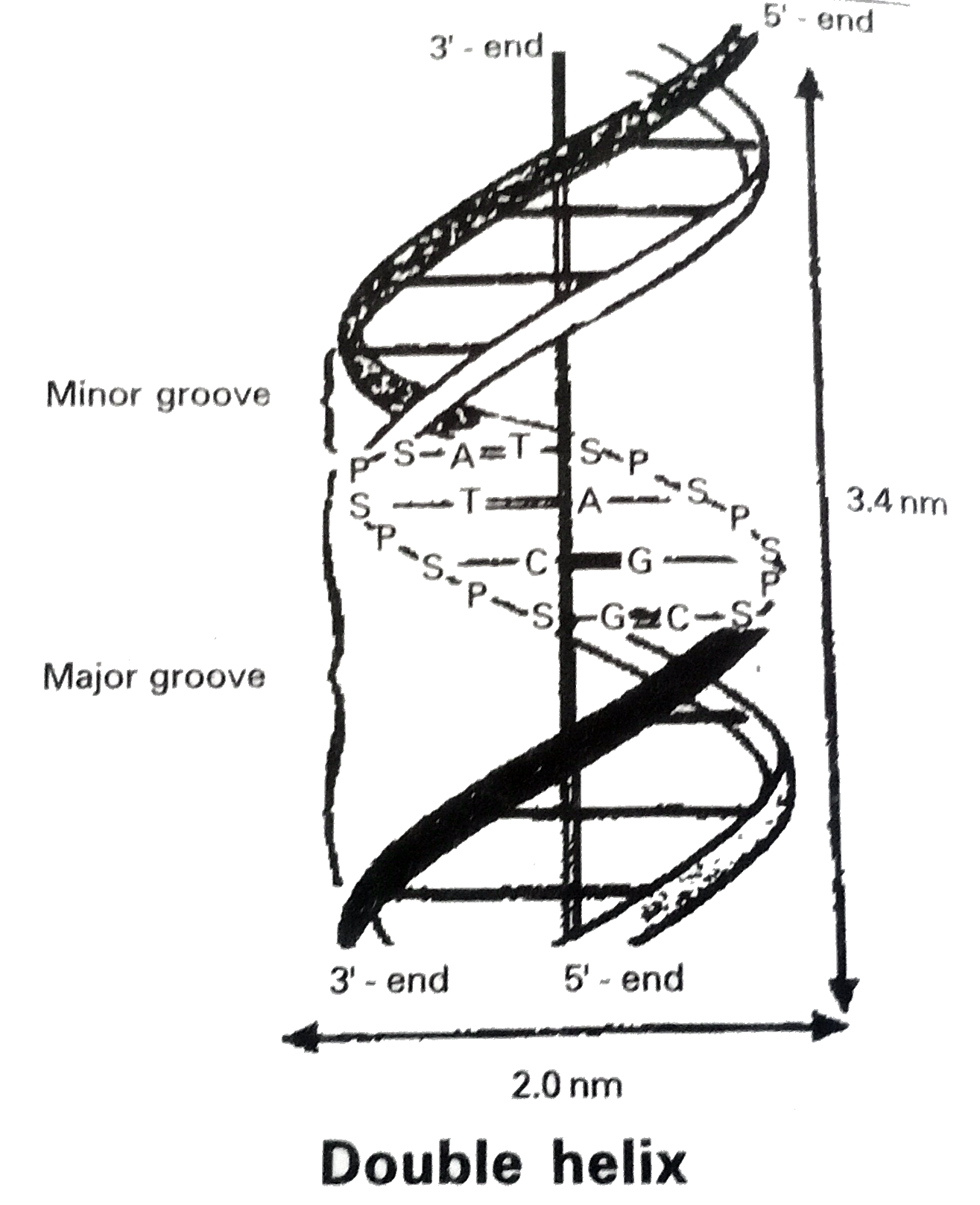 Structure of RNA : The native RNA is single stranded rather than a double stranded helical structure CHARACTERISTICS of DNA. However , given the complementary base sequence with opposite polarity , the single of RNA may fold back on itself like a hairpin and thus acquire double stranded pattern. In the region of hairpin loops, "A" pairs with U and G pairs with C.The base pairing inRNA hairpins is frequency imperfect. The proportion of helical regions in various type of RNA varies over a wide range . 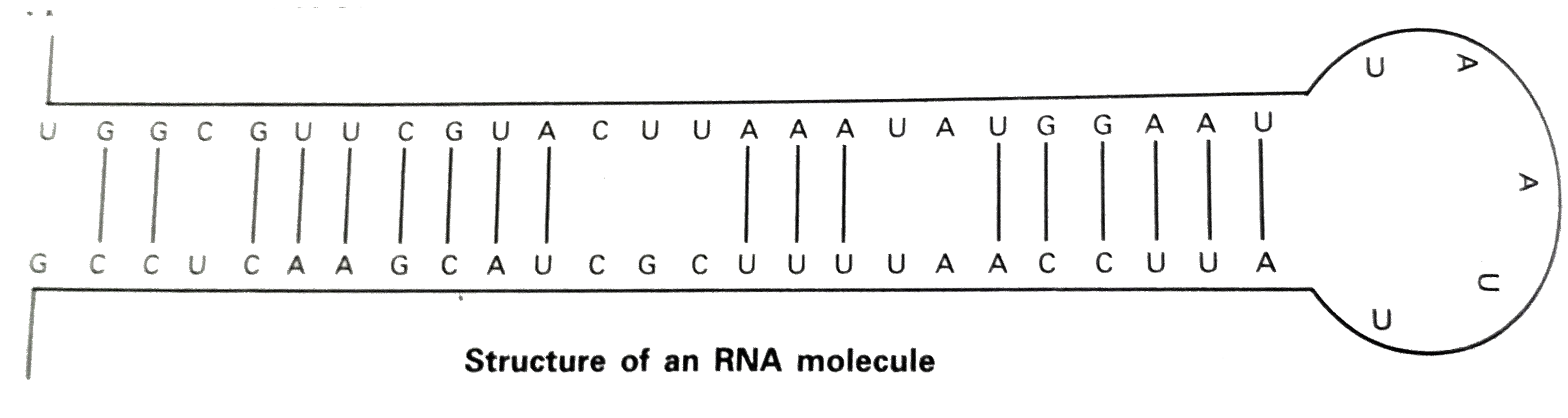
|
|
| 37. |
Explainthe actionof conc. HNO_(3)withfructosewith equation. |
Answer» SOLUTION :
|
|
| 38. |
Explain the structure of Fructose |
|
Answer» Solution :Structure of fructose :Fructose is thesweetest of all known sugars. It isreadily solublein water. Freshsolution of fructosehas a specificrotation -` 133^(@)`which changesto `- 90^(@)`at equilibriumdue to mutarotation . SIMILAR to glucose , the structureof fructoseis deducedfromthe followingfacts. (i) Elementalanalysisand molecularweight determination of fructoseshow that it hasthe molecularformula ` C_(6)H_(12)O_(6)` (ii) Fructoseor redcutionwith HI and redphosphorusgivesa mixtureof n- hexane(major product) and 2 - iodohexane ( minor product). Thisreactionindicatesthat the sixcarbonatomsin fructose are ina straight chain. ` " Fructose " overset(" HI/P") underset(" Reducation")to CH_(3) - CH_(2) - ._(4) CH_(3) + CH_(3) -underset(|)CH ( CH_(2))._(3) CH_(3)` (iii)Fructosereactswith ` NH_(2)OH and HCN`. it shows the presenceof carbonyl groups in the moleculeof fructose. (iv) Fructosereacts withaceticanhydridein thepresence of pyridineto formpentaacetate . Thisreaction indicates the presence of fivehydroxylgroups in a fructose molecule. (v)Fructose is notoxidized by brominewater . This rulesout the possbility of presenceof an ALDEHYDE (-CHO) group. (vi) Partial reduction of fructose withsodiumamalgam and water produces mixturesof sorbitoland manitol whichare epimersat secondcarbon. New asymmetric carbon is formedat C-2. Thisconfirms the presence of keto group  (vii) On oxidation whichnitricacid,it givesglycolic acidand tartaric acidswhichcontainsmallernumberof carbonatomsthan in fructose.  This shows that a ketogroupis present in C-2. It ALSO shows the presence of 10 alcoholicgroups at C-1 and C-6. ` (##SUR_CHE_XII_V02_QP_E01_041SSS_S03.png" width="80%"> |
|
| 39. |
Explain the structure of [CO(NH_(3))_(6)]^(3+)on thebasis of valencebond theory. |
|
Answer» Solution :(1)Hexaamminecobalt (III) ion, `[CO(NH_(3))_(6)]^(3+)` is a cationiccomplex, theoxidationstate of cobalt is `+3`and thecoordinationnumberis 6 . (2) Electronicconfiguration `: ""_(27)Co[Ar]^(18) 3d^(7) 4s^(2)` Electronicconfiguration `Co^(3+)[Ar]^(18) 3d^(6)4s^(0)4p^(0)` `Co^(3+)1`(Ground state)  (3) Since `NH_(3)`is a strong ligand ,dueto spinpariringeffect, all thefour unpairedelectrons in 3d-orbital are paired givingtwo vacant3d-orbitals. `Co^(3+)` (Excited state)  (4) since the coordinationnumber is 6 `Co^(3+)`ion gets sixvacantorbitals by hybridisationof two 3d vacantorbitals , one4sand three 4p-orbitalsformingsix `d^(2) sp^(3)`hydridorbitalsgivingoctahedral geometry . It ISAN inner complex. `Co^(3+)`` (##NVT_21_CHE_XII_C13_E09_002_S03.png" width="80%"> (5) 6 lone pairsof electrons form `6NH_(3)`ligands are accommodated in the sixvacant`d^(2)sp^(3) ` hydrid orbitals. Thussixhydridorbitalsof `Co^(3+)` overlap withfille d orbitals of `NH_(3)`forming 6 coordinatebonds givingoctahedral geometry to thecomplex. 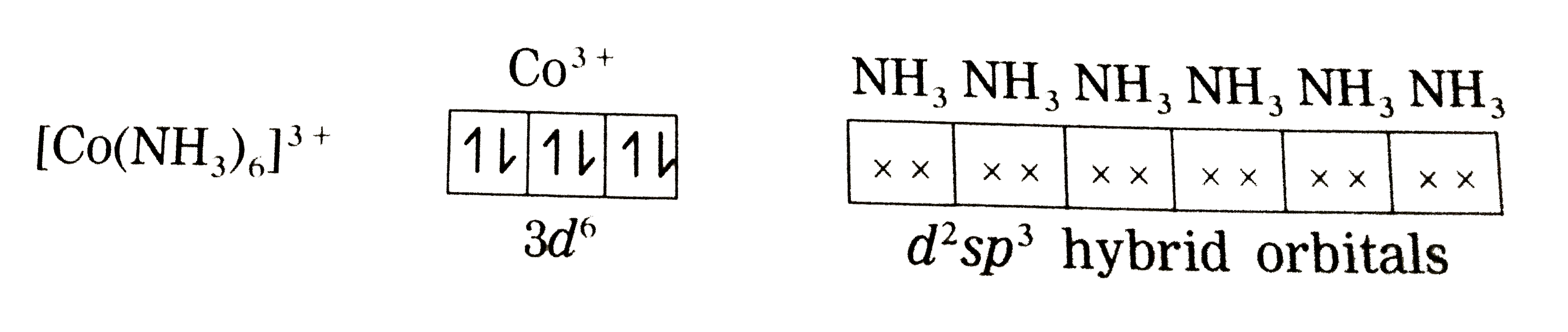 Sincethe complexhas all electronspaired , ITIS diamagentic . 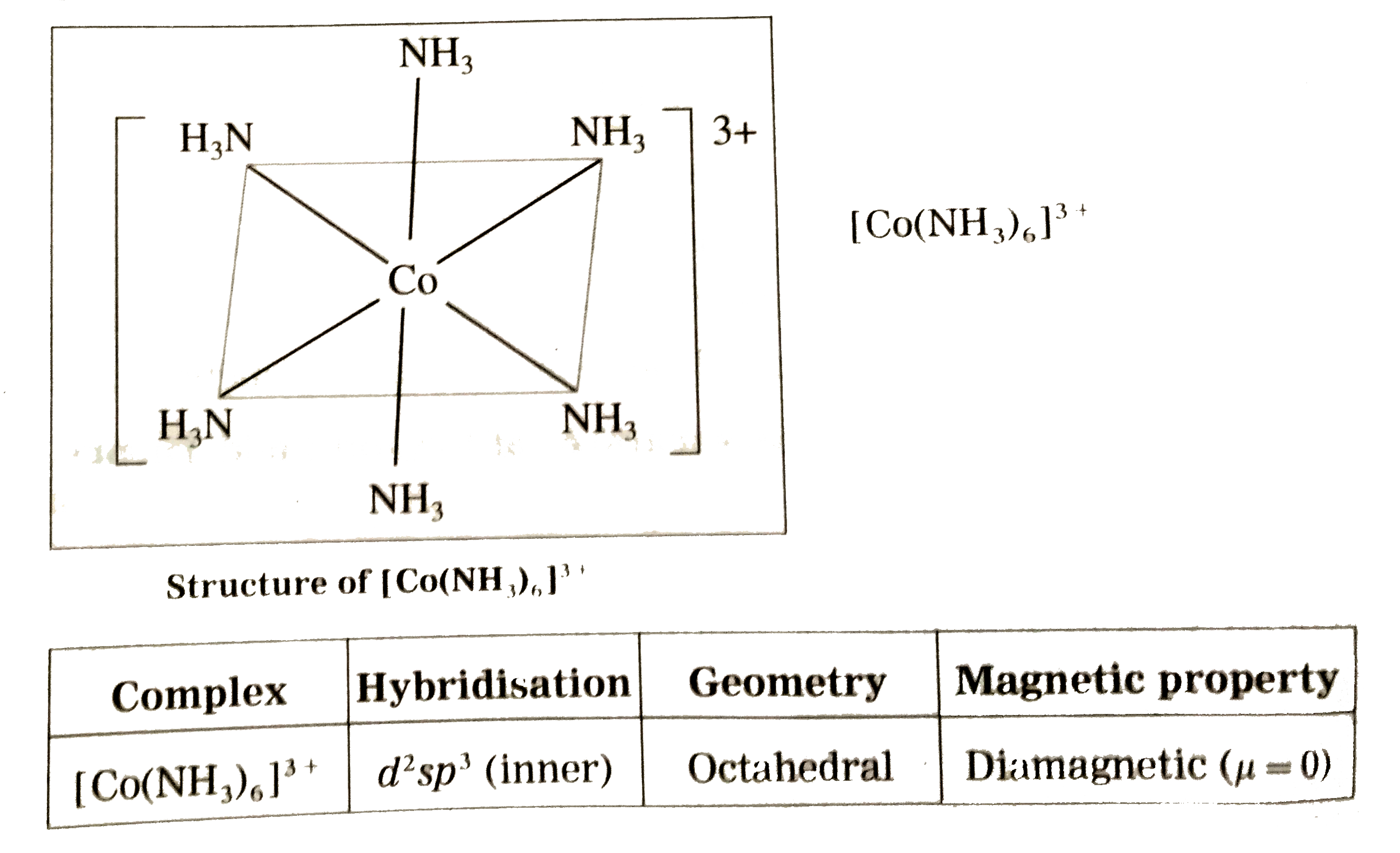 . .
|
|
| 40. |
Explain the action of dialkyl cadmium with acetyl chloride? |
Answer» SOLUTION :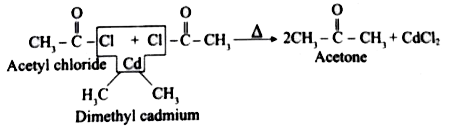
|
|
| 41. |
Explain the structure of CIF_(3). |
|
Answer» Solution :(i) Interhalogen compound of the type `XX_(5)`, possessestrigonalbipyramidalor T- shaped structure. (ii) The central halogen atom `X (X= CL, Br, I)` undergoes `sp^(3)d` hydridisation formingfivehydrid orbitals. (iii)Two hybrid orbitals contain lone pairs of ELECTRONS. Groundstate of X 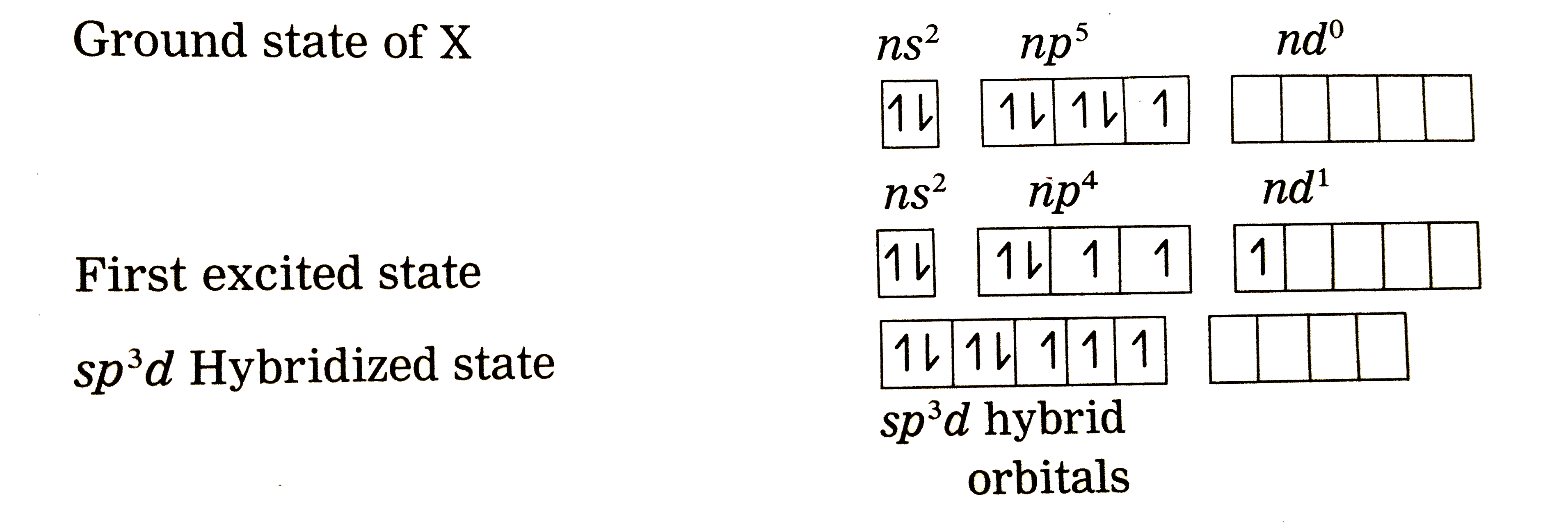 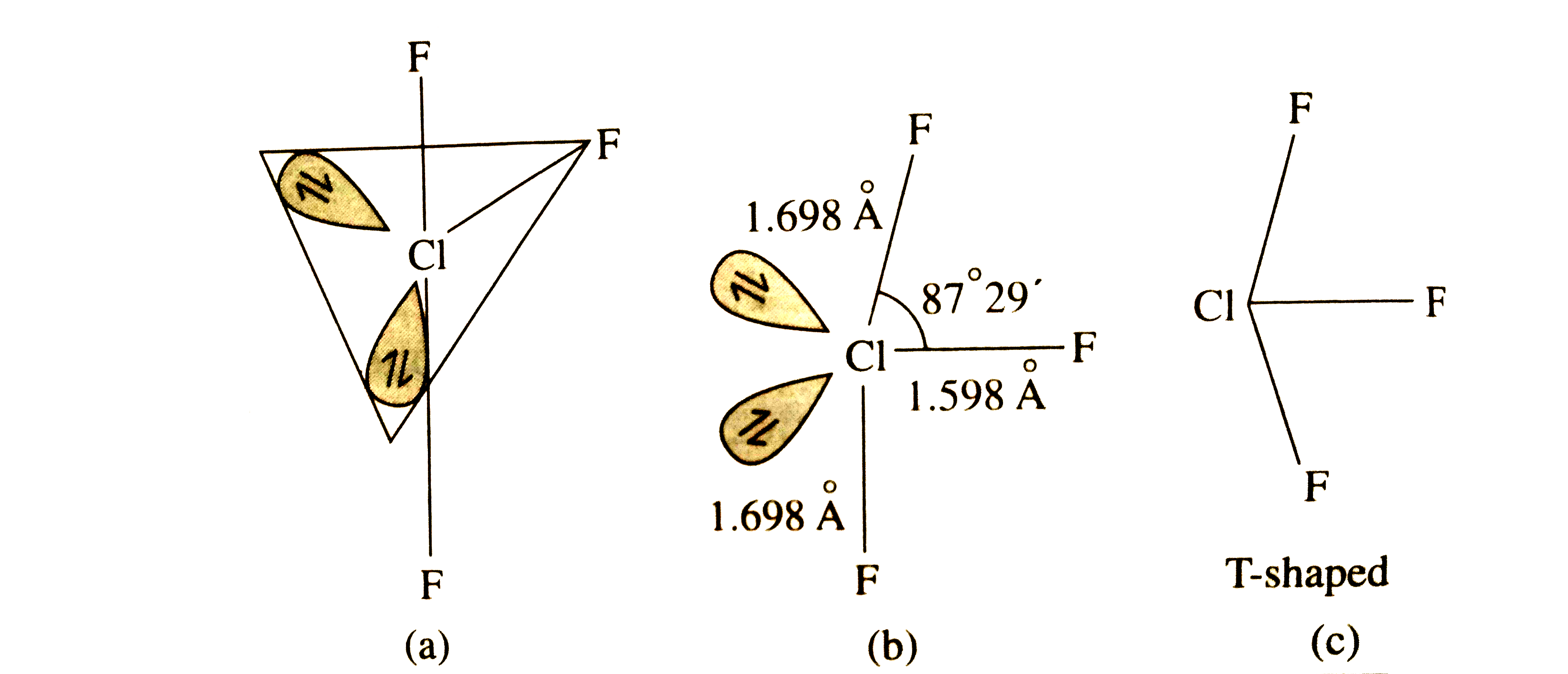 The bond angle `F-Cl-F` is `87^(@) 29`CLOSE to `90^(@)` due to REPULSION betweenlonepairs - lonepairsand lonepairs- bondpairs. |
|
| 42. |
Explain the action of conc.HNO_3 and conc.H_2SO_4 with ethan-1,2-diol. |
Answer» SOLUTION :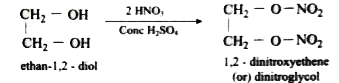
|
|
| 43. |
Explain the structure of Boric acid. Structure of boric acid. |
|
Answer» Solution :(i) BORIC acid has a TWO dimensional layereed structure. (ii) It CONSISTS of `[BO_(3)]^(3-)` UNIT and these are linked to each other by HYDROGEN bonds. 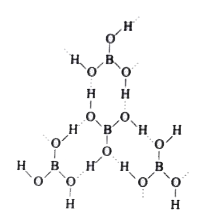
|
|
| 44. |
Explain the action of conc. HNO_(3) on phenol (carbolic acid). |
Answer» Solution :Conc. NITRIC acid (NITRATING mixture) : When PHENOL is warmed with a mixture of conc. nitricacid and conc. sulphuric acid (a nitrating mixture or the mixed acid), 2, 4, 6-trinitrophenol, COMMONLY called pictric acid, is formed.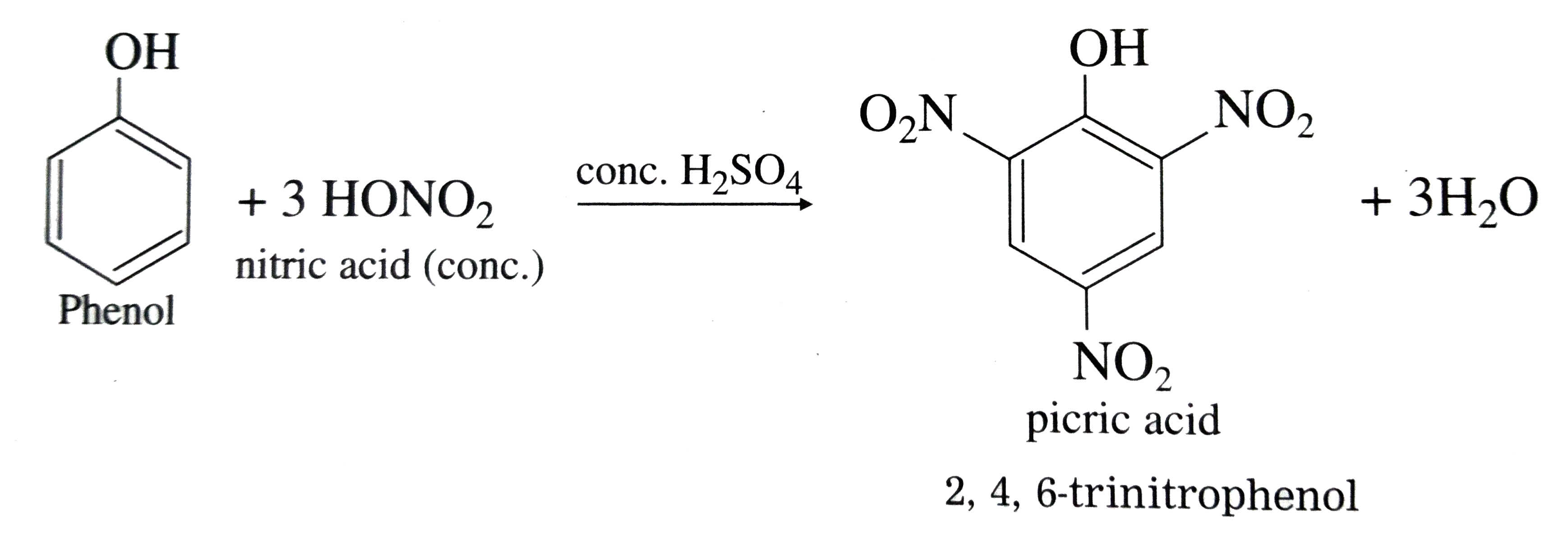
|
|
| 45. |
Explain the stability of m^(2+) ions in aqueous medium. |
|
Answer» Solution :The stability of `M^(2+)` ions in aqueous medium depends on three factors: (i) ENTHALPY of ATOMISATION (ii) Summation of first and second IONIZATION enthalpies (iii) Hydration enthalpy An elements in `Mn^(2+)` state in aqueous medium is more stabler if the electrode potential `(M^(2+)//M)` value of more negative. Across the period, the TENDENCY to form `M^(2+)` ion decreases. Except copper, all elements of first transition series show negative values of electrode potentials. The exceptional BEHAVIOUR of the copper due to low enthalpy of atomisation and very high summation of first and second ionization enthalpies which is not compensated by its hydration enthalpy `(Cu^(2+)`. Because of positive electrode potential, copper doesnot liberate hydrogen gas from dilute acids and reacts only with oxidizing acids such as nitric acid and hot concentrated sulphuric acid. The electrode potentials of Mn, Ni and Zn are more negative than expected. However, the electrode potential values of Mn and Zn are lowered because of low second ionization enthalpies while Ni has exceptionally more negative electrode potential due to its high hydration enthalpy.  Across the period `M^(2+)//M` value decreases because of increase in first and second ionization enthalpies |
|
| 46. |
Explain the action of conc. H_(2)SO_(4) at 373 K on phenol (carbolic acid). |
Answer» SOLUTION :Conc. `H_(2)SO_(4)` at 373K : When phenol is treated with conc. `H_(2)SO_(4)` at about 373 K, p-phenol sulphonic acid is FORMED.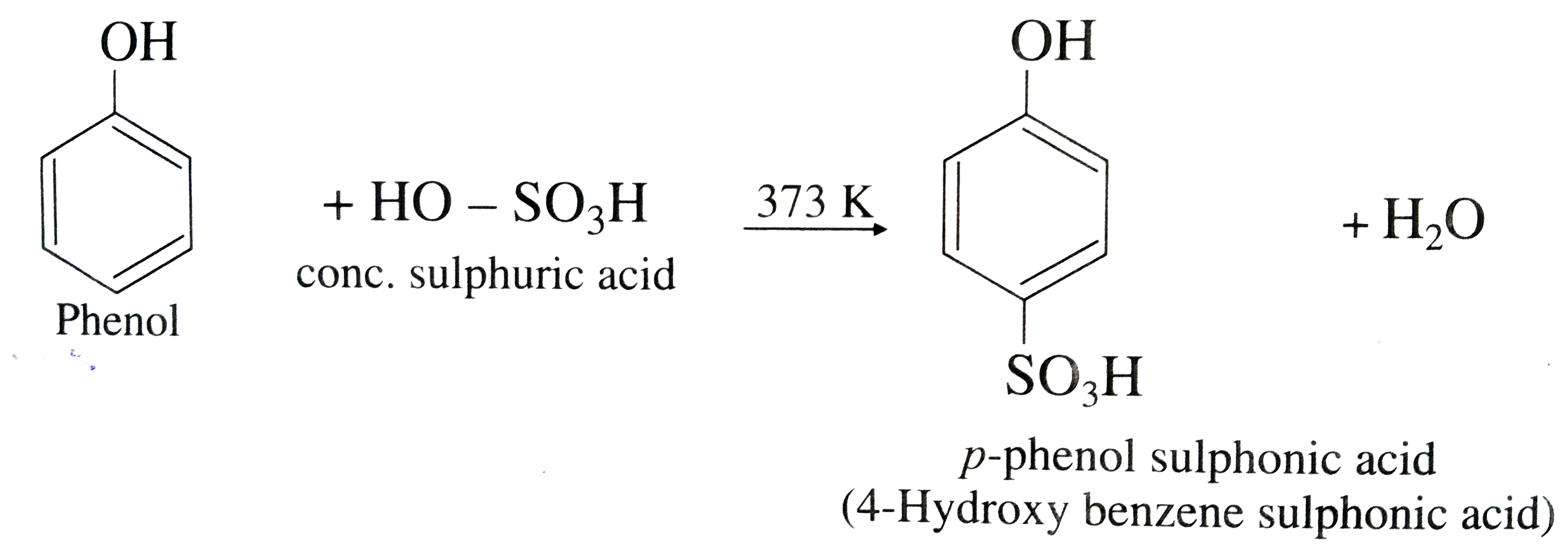
|
|
| 47. |
Explain the solubility rule "like dissolves like" in terms of intermolecular forces that exist in solutions. |
| Answer» SOLUTION : A substance (SOLUTE) dissolves in a solvent if the intermolecular INTERACTIONS are similar in BOTHTHE components, for example, polar solutes dissolve in polar SOLVENTS and non-polar solutes in non-polar solvents. | |
| 48. |
Explain the action ofconc. H_(2)SO_(4) at room termperature on phenol (carbolic acid) . |
Answer» SOLUTION :Conc. `H_(2)SO_(4)` at room TEMPERATURE : When PHENOL is treated with conc. `H_(2)SO_(4)` at room temperature (about300 K), o-phenol sulphonic acid is formed .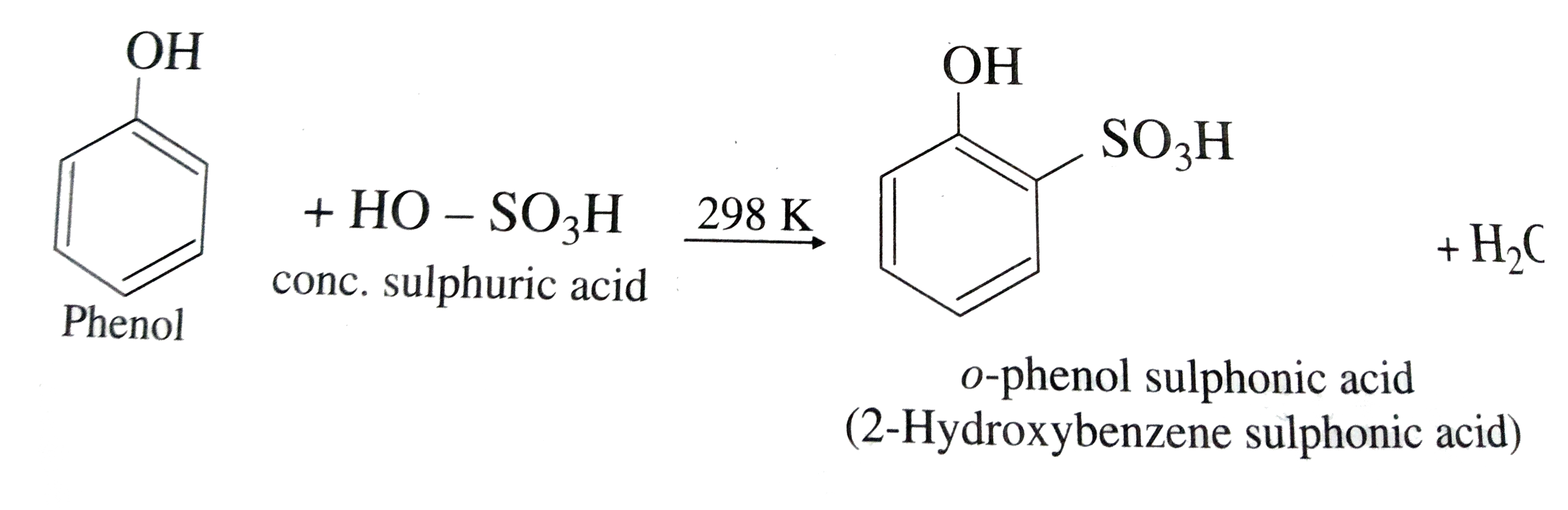
|
|
| 49. |
Explain the solubility rule ''like dissolves like'' in terms of intermolecular forces that exist in solutions. |
| Answer» Solution :For one substance to dissolve into ANOTHER substance, the two substances should have similar intermolecular interactions. This is so only when either both the substances (SOLUTE and solvent) are polar or both are non-polar. This RULE is called ''LIKE dissolves like.'' | |