

Saved Bookmarks
This section includes 7 InterviewSolutions, each offering curated multiple-choice questions to sharpen your Current Affairs knowledge and support exam preparation. Choose a topic below to get started.
| 1. |
Explain the reactivity of group - 16 elements with oxygen. |
|
Answer» SOLUTION :All group - 16 elements from OXIDES of the type `EO_(2)` and `EO_(3)` where `E=S, Te and Po. O_(3) and SO_(2)` are gas while `SeO_(2)` is solid. Reducing properties of DIOXIDES decreases from `SO_(2)` to `TeO_(2)` examples for `EO_(3)` type are `SO_(3), SeO_(y), TeO_(3)`. |
|
| 2. |
Explain Swern oxidation. |
|
Answer» Solution :(i) In Swern oxidation method, DIMETHYL sulfoxide (DMSO) is USED as the oxidising AGENT and it converts alcohols to ketones / aldehydes. (ii) When propan-2-ol is TREATED with DMSO and oxalyl chloride followed by the addition of TRIETHYLAMINE, it produces Propanone. 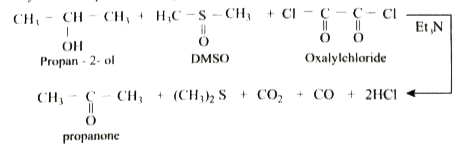
|
|
| 3. |
Explain Swern oxidation of propan-2-ol to propanane. |
|
Answer» Solution :(i) In this method, DIMETHYL sulfoxide (DMSO) is used as the oxidising agent, which converts ALCOHOLS to ketones l aldehydes. (ii) In this method an alcohol is TREATED with DMSO and oxalyl chloride FOLLOWED by the addition of triethylamine. `underset("Propan-2-ol")(CH_(3)-overset(OH)overset(|)CH-CH_(3)) + H_(3)C-underset(darr)underset(DMSO)overset(O)overset(||)S-CH_(3) +underset("Oxalychloride")(Cl-overset(O)overset(||)C-overset(O)overset(||)C-Cl)` `underset("propanone")(CH_(3)-overset(O)overset(||)C-CH_(3)) +(CH_(3))_(2)S + CO_(2) + CO + 2HCl` |
|
| 4. |
Explain the reactivity of acyl compounds in the order: |
|
Answer» acid CHLORIDE `GT` amide `gt` ANHYDRIDE `gt` ESTER |
|
| 5. |
Explain the reactions taking place in the anode and cathode of a lead storage battery. |
|
Answer» Solution :Oxidation OCCURS at the anode `""Pb_((s)) rarr PB^(2+)""_((aq))+2e^(-)` The `pb^(2+)` ions combine with `SO_(4)^(-2)` to from `PbSO_(4)` precipitate. `""Pb^(2+)""_((aq))+SO_(4)^(2-)""_((aq)) rarr PbSO_(4(s))` REDUCTION occurs at the cathode `PbO_(2(s))+4H_((aq))^(+)+2e^(-) rarr Pb_((aq))^(2+)+2H_(2)O(L)` The `Pb^(2+)` ions also combine with `SO_(4)^(2-)` ions from sulphuric acid to form `PbSO_(4)` precipitate. `""Pb_((aq))^(2+)+SO_(4(aq))^(-2) rarr PbSO_(4)` |
|
| 6. |
Explain the reaction which Indicates the presence of ketonk group ln fructose. |
|
Answer» Solution :(i) OXIDATION of fructose YIELDS a mixture of gJycollic acid and tartaric acid. (II) When fructose is treated with HCN, it FORMS an addition product which upon hydrolysis and. SUBSEQUENT reduction with hydroiodic acid and red phosphorous gives 2-methyl-hexanoic acid. This ndicates that the ketone group is adjacent to one of the terminal carbon atoms. 
|
|
| 7. |
Explain the reactions of water with ammonia by proton theory. |
|
Answer» Solution :(i) When AMMONIA dissolved in water, it ACCEPTS a proton from water. In this case, ammonia `(NH)_3` acts as a base and `H_2O` is a acid. (ii) The REACTION is represented as `H_2O+NH_3 leftrightarrow NH_4^(+)+OH^-` Acid 1 Base 1Acid 1 Base 1 (iii) The species that REMAINS after the donation of a proton is a base `(Base_1)` and is called the conjugate base of BRonsted acid `(Acid_1)` In other words, chemical species that differ only by a proton are called conjugate acid base pairs. 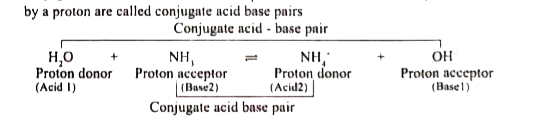
|
|
| 8. |
Explain structures of manganate and permanganate ions |
Answer» Solution :Both jmanaganate and permanganate ions are tetrahedral in shape  The `pi-`bonding takes place by overlapping of p-orbitals of oxygen with d-orbitlas of manganese in both permanganate and manganate ions. Hence, there is `DPI - p pi`-bonding. The green manganate is permanganatic because of PRESENCE of one unpaired electron while PURPLE permanganate is diamagnetic DUE to absence of unpaired electron |
|
| 9. |
Explain structure of nucleic acids. |
Answer» Solution :A nucleoside is FORMED when the nitrogenous base is attached to 1. position of sugar. In nucleosides, the sugar CARBONS are numbered as 1., 2., 3. etc. in order to distinguish these from the BASES. When nucleoside is linked to phosphoric acid at 5.-position of sugar moiety, a nucleotide is obtained.  Nucleotides are joined by TOGETHER by phosphodiester linkage between 5. and 3. carbon atoms of pentose sugar which results in formation of dinucleotides.  A simplified version of nucleic acid chain is`-overset("Base")overset("| ")("Sugar")-"Phosphate"-(--overset("Base")overset("|")("Sugar")-"Phosphate"--)_(n)-overset("Base")overset("|")("Sugar")--` |
|
| 10. |
Explain the reaction of metals with nitric acid. |
|
Answer» Solution :The reaction of metals with nitric acid are explained in 3 steps as follows: Primary reaction : Metal nitrate is formed with the RELEASE of nascent hydrogen `M+HNO_(3)rarr MnO_(3)+(H)` SECONDARY reaction : Nascent hydrogen PRODUCES the reduction products of nitric acid. `HNO_(3)+2H rarr underset("Nitrous acid")(HNO_(2)+H_(2)O)` `HNO_(3)+6Hrarr underset("Hydroxylamine")(NH_(2)OG+2H_(2)O)` `HNO_(3)+8Hrarr underset("Ammonia")(NH_(3))+3H_(2)O` `2HNO_(3)+8H rarr underset("Hypop nitrous acid")(H_(2)N_(2)O_(2))+4H_(2)O` Tertiary reaction : The secondary products either decompose or react to give final products `underset("Nitrous acid")(3HNO_(2))rarr underset("Nitric acid")(HNO_(3))+underset("Nitric oxide")(2NO+H_(2)O)` Tertiary reacton : The secondary products either decompose or react to give finalproducts `underset("Nitrous acid")(3HNO_(2))rarr underset("Nitric acid")(HNO_(3))+underset("Nitric oxide")(2NO)+H_(2)O` `undeerset("Nitrous acid")(2HNO_(2))rarr underset("Dinitrogentrioxide")(N_(2)O_(3))+H_(2)O` `underset("Hypo nitrous acid")(H_(2)N_(2)O_(2))rarr underset("Nitrouc oxide")` For examples : Copper reacts with nitric acid in the following manner `3Cu+6HNO_(3)rarr 3Cu(NO_(3))_(2)+6(H)` `6(H)+3HNO_(3)rarr 3HNO_(2)+3H_(2)O` `3HNO_(2)rarr HNO_(3)+2NO+H_(2)O` Overall reaction `3Cu+8HNO_(3)rarr 3Cu(NO_(3))_(2)+2NO+4H_(2)O` The concentrated acid has a tendency to FORM nitrogen dioxide `Cu+4HNO_(3)rarr Cu(NO_(3))_(2)+2NO_(2)+2H_(2)O` |
|
| 11. |
Explain stoichiometric defects shown by non ionic solids. |
Answer» Solution :(i) Vacancy Defect : When some of the LATTICE sites are vacant, the crystal is said to have vacancy defect. This results in decrease in DENSITY of substance.  The density of the crystal can also be DECREASED by HEATING. (ii) Interstitial Defect : When some of the atoms or molecules occupy an interstitial site, the crystal is said to have interstitial defects. The density of crystal INCREASES by this defect. 
|
|
| 12. |
Explain the reaction of ammonia with chlorine and chlorides different conditions. |
|
Answer» (II) The reactions are different under different conditions as given below. (iii) With excess ammonia `2NH_(3)+3Cl_(2) rarr N_(2)+6HCl` `6HCl+6NH_(3) rarr 6NH_(4)Cl` (IV) With excess of chlorine ammonia reacts to give nitrogen trichloride, anexplosive substance. With excess of chlorine ammonia reacts to give nitrogen trichloride, an EXPLOSIVE substance. `2NH_(3)+6Cl_(2) rarr 2NCl_(3)+6HCl` `2NH_(3)(g)+HCl(g)rarrNH_(4)Cl(s)` |
|
| 13. |
Explain the reaction of ammonia with acetic anhydride. |
| Answer» SOLUTION :`UNDERSET("acetic ACID")(CH_3- undersetoverset(||)(O) (C ) - O - undersetoverset(||)(O)(C ) -CH_3 ) + underset("ammonia")(HNH_2) to underset("acetamide")(CH_3 - undersetoverset(||)(O)(C ) - NH_2 + underset("acetic acid ")(CH_3 - undersetoverset(||)(O)( C) - OH)` | |
| 14. |
Explain the reaction mechanism of addition of HCN to benzaldehyde ? |
Answer» Solution :With pure HCN REACTION is very slow , THEREFORE it is catalysed ny base . Thus `CN^(-)`ION being a strong nucleophile adds to carbonyl GROUP`({:("\"),("/"):}C=O)` toto form an intermediate alkoxide. 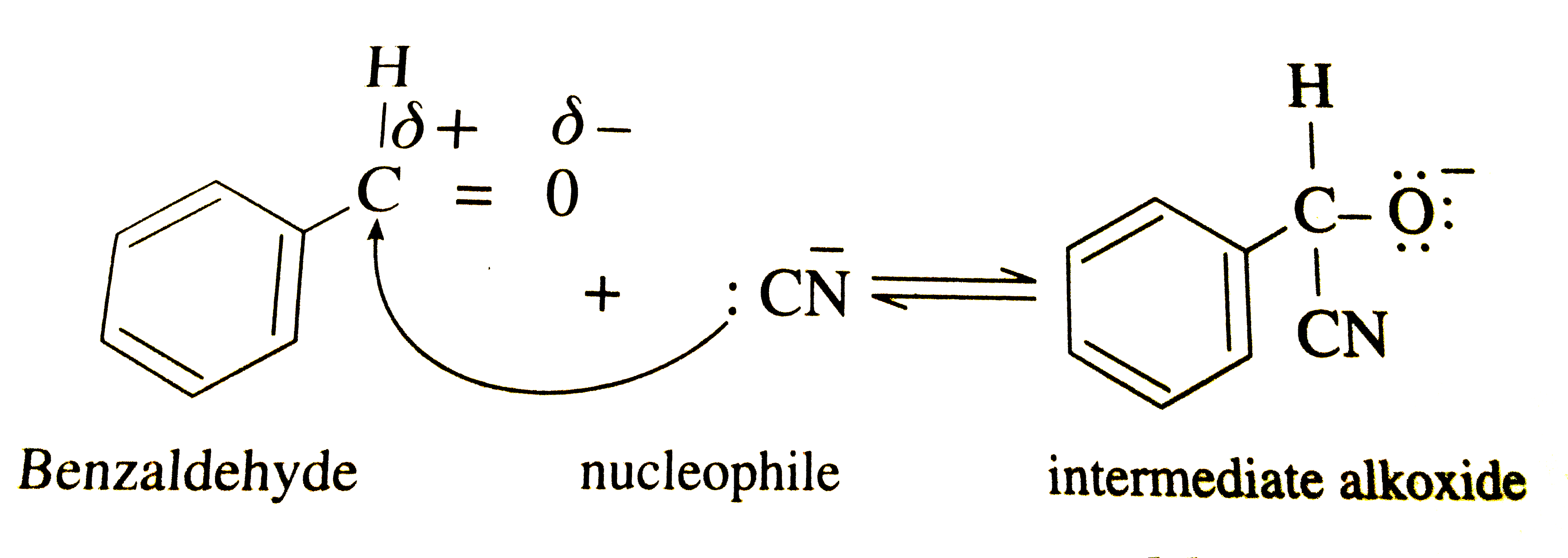 The alkoxide ion FORMED is protonated by a week acid to GIVE an addition product cyanohydrin. 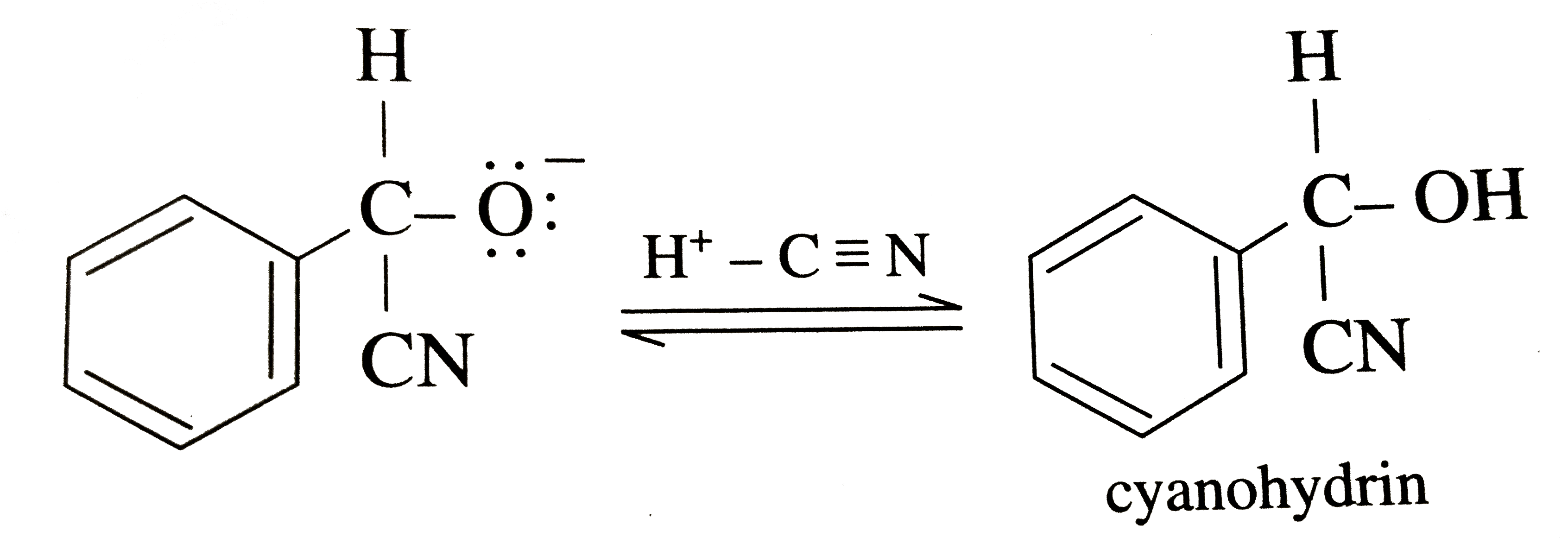
|
|
| 15. |
Explainstructureandshapeofproteins. |
|
Answer» SOLUTION :Structure andshapeofproteinsarestudiedinfourlevels. Primarystructure :Polypeptidechainsofa proteinhasamino acidslinkedwitheachother in aspecificsequence. Thisiscalledprimarystructure. Secondary structure : Thesecondarystructure ofproteinis the SHAPE inwhicha longpolypeptidechainscanexists. They foundto EXISTIN twodifferenttypesofstructure. (a)` prop`-helixstructure (B)`beta ` -pleatedsheetstructure In `prop`-helix , righthandedscrew( helix)structureisformedwhenpolypeptidechain twistwiththehelpofhydrogenbonds. In `beta`- structureall peptidechainsarestrechedoutand laidsidebysidewhich areheldtogetherbyhydrogenbonding. Tertiarystructure:Itrepresents overallfoldingof thepolypeptidechains. It givestwomajorshapes. (a) Fibrous (b) Globular The mainforce whichstabilizethestructures ofproteinsarehydrogenbondsanddisulphidelinkages. Quaternarystructure :Proteinsare composedoftwoormorepolypeptidesubunits.Thespatialarrangement ofthesesubunitswithrespectto eachotherisknownasquaternarystructure. |
|
| 16. |
Explain the reaction between PCl_(5) and water. |
|
Answer» SOLUTION :Phosphorous pentachloride reacts with water to give phosphoryl chloride and orthophosphoric acid. `PCl_(5)+H_(2)Orarr UNDERSET("(phosphoryl chloride)")(POCl_(3))+2HCl` `PCl_(5)+underset("(Excess)")(3H_(2)O)rarr underset("(orthophosphoric acid)")(H_(3)PO_(4))+3HCl` |
|
| 17. |
Explain stoichiometric defects shown by ionic solids. |
Answer» Solution : (i) Schottky DEFECT : Schottky defects is basically a vacancy defect in ionic solids in which the electrical neutrality is maintained by absence of equal number of cations and anions from lattice sites.  Like simple vacancy defect, Schottky defect also decreases the density of the substance. The number of such defects are quite significant in ionic solids. For Ex. : In NaCl at room temperature, there are `10^6` Schottky pairs PER cm and there are about `10^22` ions per `cm^3`, thus, there is one Schottky defect per `10^16` ions. Ionic compounds with high co-ordination number and having cation and anion of COMPARABLE size shows Schottky defect. Ex. : NaCl, KCl, CsCl and AgBr shows Schottky defects. (ii) Frenkel Defect: Ionic compounds with low co ordination number and having large difference in size of cation and anion shows Frenkel defects. In Frenkel defect, the smaller ion generally the cation is dislocated from its normal site to an interstitial site.  Frenkel defects Frenkel defect is also called dislocation defect and because of dislocation of cation, a vacancy defect is created at its original site and interstitial defect is created at new location. Frenkel defect doesnot alter density of crystal. Ex. : Zns, AgCl, AgBr and Agl shows Frenkel defects due to SMALL size of `Zn^(2+)` and `Ag^(+)` ions. It is to be NOTED that AgBr shows both Frenkel and Schottky defects. |
|
| 18. |
Explain the reaction between methyl iodide and magnesium metal. |
|
Answer» Solution :Methyl iodide reacts with magnesium in the PRESENCE of DRY ether to GIVE methyl magnesium iodide (Grignard REAGENT). `CH_(3)I+Mg overset "Dry Ether"rightarrow CH_(3)MGI` |
|
| 19. |
Explain the reaction between benzene and sulphuric acid. |
|
Answer» Solution :Sulphuric ACID reacts with benzene to give benzene sulphuric acid. `underset("(benzene)")(C_(6)H_(6)+H_(2)SO_(4))rarr underset("(Benzene sulphonic acid)")(C_(6)H_(5)SO_(3)+H_(2)O)` |
|
| 20. |
Explain stereochemistry of S_(N)2 reaction with suitable example. |
Answer» SOLUTION :In case of optically active alkyl HALIDES, the product formed as a result of `S_(N)2` reaction has the inverted configuration as compared to the reactant. This is because the nucleophile attaches itself on the side opposite to the one where the halogen atom is present. For example, when (-) -2-bromooctane is reacted with sodium hydroxide, (+) -octan-2-ol is formed with the -OH group OCCUPYING the position opposite to bromide ion.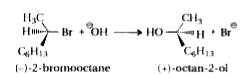 Thus, `S_(N)2` reactions of optically active halides are accompanied by inversion of configuration. |
|
| 21. |
Explain the reaction between diborane and ammonia? |
|
Answer» Solution :When treated with excess ammonia at low TEMPERATURES diborane gives diborane diammonate on heating at HIGHER temperature diobrane gives borazole. (i) `3B_(2)H_(6)+6NH_(3)OVERSET(-153K)(to)3B_(2)H_(6).2NH_(3)` (ii) `3B_(2)H_(6)+2NH_(3)UNDERSET("closed vessel")("High temperature")(to)underset(("Borazole"))(2B_(3)N_(3)H_(6))` 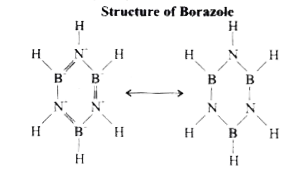
|
|
| 22. |
Explain the rate of reaction with examples. |
|
Answer» Solution :Very fast reaction:Certain reactions are very fast so complete instantaneously LIKE ionic reaction. Example:Silver nitrate and sodium chloride mix together and instantly precipitation of silver chloride from. `AgNO_(3(aq))+Nacl_((aq))toAfCl_((s))+NaNO_(3(aq))` (b)Very slow reaction :Certain reaction take place with slow rate and require very long time in completion.Such reaction are called very slow reaction. Example:Corrosion of metal in presence of air and moisture. (c )Moderate reactions:e.g. HYDROLYSIS of STRACH ,INVERSION of sugar. |
|
| 23. |
Explain the rate of reaction with energy of activation and temperature with the help of Arrhenius equation state its importance . |
|
Answer» Solution :The EQUATION of correspond relation between rate of chemical reaction and temperature is given by Arrhenius k=`Ae^(-(E_(a))/(RT))` Where ,k=Rate constant of reaction `prop` Rate `E_(a)`=Activation ENERGY J `K^(-1) mol^(-1)` T=Absolute temperature R=gas constant =8.314 J `mol^(-1) K^(-1)` A=Arrhenius frequency =Frequency factor Pre expancial factor Taking natural logarithm of both side of above reaction. In K=`(-E_(a))/(RT)`+In A  The equation is y=mx+c,straight line type . The PLOT of in `kto(1)/(T)` is obtaine by following figure.The plot is straight line and forn negative slope and intercept.  Calculation of `E_(a)` and A:In fig. the slop= `(-E_(a))/(R)`=In A. So calculate `E_(a)` and A USING these values. According to Arrhenius equation : `-E_(a)prop(1)/(T)` (Means,Increasing the temperature or decreasing the activarion energy `E_(a)`) k=Rate `prop` T (Increase the temperature so rate is increase) K=Rate `prop(1)/(E_(a))` (Activation eneergy is less so,Rate is more) |
|
| 24. |
Explain the rate determining step with an example. |
|
Answer» Solution :(i) Let us consider reaction, the decomposition of hydrogen peroxide catalysed by `I^(-)`. `2H_(2)O_(2(aq))rarr 2H_(2)O_((l))+O_(2(g))` (II)It is experimentally FOUND that the reaction is first order with respect to both `H_(2)O_(2)` and `I^(-)`, which indicates that `I^(-)` is also involved in the reaction. The MECHANISM involves the following steps. Step : 1 `H_(2)O_(2(aq))+I_((aq))^(-)rarr H_(2)O_((l))+OI_((aq))^(-)` Step : 2 `H_(2)O_(2(aq))+OI_((aq))^(-)rarr H_(2)O_((l))+I_((aq))^(-)+O_(2(g))` Overall reaction is `2H_(2)O_(2(aq))rarr 2H_(2)O_((l))+O_(2(g))` (iii) Thesetwo reactions are elementary reactions. Adding equ (1) and (2) gives the overall reaction. Step 1 is the rate determining step, since it involves both `H_(2)O_(2)` and `I^(-)`, the overall reaction is bimolecular. |
|
| 25. |
Explain stereochemistry of S_(N)1 reaction with suitable example. |
Answer» Solution :In `S_(N)1` reaction, if the substrate i.e., alkyl halide is optically active, then it will resuly in PARTIAL racemisation. The carbocation is obtained as an intermediate product has DIFFERENT GROUPS and is planar and thus, the nucleophile can attack from either side. If the nucleophile attacks from same side of leaving groups, the retention of configuration takes place and if it attacks from opposite side of leaving group, inversion of configuration takes place. The attack from opposite side is more favourable and thus enantiomers are obtained in unequal amount. If the enantiomers are obtained in 50 : 50 PROPORTION, it is called recemic mixture and the product is optically inactive. The process is known as racemisation. Racemic mixture is DENOTED as `(pm)`.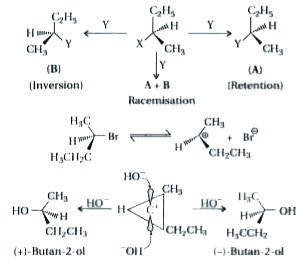 The hydrolysis of optically active 2-bromobutane results in formation of `(pm)` -Butan-2-ol. |
|
| 26. |
Explain the rate of reaction depends on concentration and temperature. |
|
Answer» Solution :AVERAGE rate depends on : (i)Its temperature ,pressure and catalysts (II)The change in concentration of reaction and PRODUCTS (ii)The time taken for that change in concentraton to occur. This fact is CLEAR by following two GRAPHS.  This both graph are seen following .In it change in concentration of reactant and product with time. 
|
|
| 27. |
Explain Stephen's reaction. |
|
Answer» Solution :When alkylcyanides are reduced USING `SnCl_(2)//HCl`, imines are formed, which on HYDROLYSIS gives CORRESPONDING ALDEHYDE. `CH_(3)-C-=Nunderset((H))overset(SnCl_(2)//HCl)toCH_(3)-CH-=NHoverset(H_(3)O^(+))toCH_(3)-CHO` |
|
| 28. |
Explain the rate law with example. Give illustrations . |
|
Answer» SOLUTION :Explanation : CONSIDER the following reaction. `AA + bB rarr "products "` It the rate of the reactiondepends on the concentrations of the reactantsA and B, thenby rate law, `R prop [A]^(a) [B]^(b)` `:. R = k[A]^(a)[B]^(b)` Where [A] = concentrationof A and [B] = concentration of B The proportionality constant k is calledthe VELOCITY constant, rate constant or specific rate of the reaction. a and b are the exponents or the powersof the concentrations of the reactants A and B respectivelywhen observedexperimentally. Example : `H_(2^((g))) + I_(2(g))` `R = k[H_(2)][I_(2)]` |
|
| 29. |
Explain the rate determining step with an example . |
|
Answer» Solution :(i) Most of the chemical reaction OCCUR by multistep reactions. In the sequence of steps it is found that one of the steps is considerably slower that the others. The overall rate of the the reaction cannot be LOWER in value than the rate fo the slowest step. (ii) Thus in a multistep reactions the experimentally determined rate corresponds to the rate of the slowest step. The step which has the lowest rate value among the other steps of the reaction is called as the rate determining step (or) rate limiting step. (iii) Consider the reaction, `2A+B rarrC+D` going by two steps as follows, `{:(A+Boverset(k_(1))underset(k_(2))rarrC+S,"1 step [slow]"),(Z+Aoverset(k_(2))rarrD,"2 step [fast]"),(ulbar(2A+BrarrC+D""),):}` Here the overallrate of the the reaction corresponds to the rate of the first step which is the slow step and thus the first step is called as the first step is called as the rate of the determining step of the reaction. In the above equation , the rate of the reaction depends upon the rate constant k, only . The rate of second step don.t contributed experimentally determined overall rate of the reaction . For example . `NO_(2(G))+CO_((g))rarrNO_((g))+CO_(2(g))` Which occurs in two elementary steps, `NO_2+NO_2rarrNO+NO_3"(Slow) "` `NO_3+COrarrNO_2+CO_2"(fast)"` Because the first step is the lowest step, the overall reaction cannot proceed any faster than the rate of the first elementary step The first elementary step in this example is therefore the rate determining step . The rate equation for this reaction is EQUAL to the rate is constant of step-I multiplied by the reactants of thatfirst step . If the rate constant of step-I is denoted as k, then the rate of the step in the reaction ( and the TOTAL reaction ) will be, Rate `=k_1[NO_2][NO_2]` `k_1[NO_2]^2` |
|
| 30. |
Explain solubility of solution formed by gaseoius solute and liquid solvent. |
|
Answer» Solution :Solubility of a gas is maximum amount gaseous solute that can be dissolved in a SPECIFIED amount of solvent at a specified temperature and pressure. Oxygen dissolves only to a small extent in water. It is this dissolved oxygen which sustains all aquatic life. On the other hand, hydrogen chloride gas (HCl) is highly soluble in water.Solubility of gases in liquids is greatly affected by pressure and temperature. 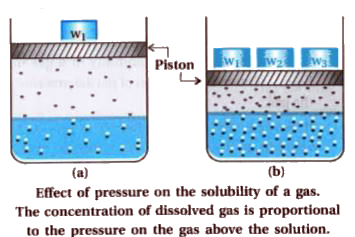 Effect of pressure on the solubility of a gas. The concentration of dissolved gas is proportional to the pressure on the gas above the solution. (i) Effect of pressure : The solubility of gases increase with increases of pressure. For solution of gases in a solvent, consider a system as shown in Fig. (a). The lower PART is solution and the upper part is gaseous system at pressure P and temperature T. ASSUME this system to be in a state of dynamic equilibrium, i.e., under these conditions rate of gaseous particles entering and leaving the solution phase is the same. Now increase the pressure over the solution phase by compressing the gas to a smaller volume [Fig. (b)]. This will increase the number of aseous particles per unit volume over the solution and also the rate at which the gaseous particles are striking the surface of solution to enter it. The solubility of the gas will increase untill a new equilibrium is reached resulting in an increase in the pressure of a gas above the solution and thus its solubility increases. (II) Effect of temperature :Solubility of gases in liquid decreases with increase in temperature. When gases are dissolves at that time they are in liquid phase and phenomenon of dissolution is called condensation. In this reaction heat produces. Dissolution process is exothermic in nature so on increase in temperature solubility decreases. |
|
| 31. |
Explain ''Solubility of gaseous solute and vapour pressure of liquid solution follows Henry's and Raoult's law''. |
|
Answer» <P> Solution :According to Raoult.s law, the vapour pressure of a VOLATILE component in a given solution is given by `p_(i)=x_(i)p_(i)^(0)`In the solution of a gas in a liquid, one of the components is so volatile that it exists as a gas and we have already seen that its solubility is given by Henry.s law which states that `p=K_(H).x` If we COMPARE the EQUATIONS for Raoult.s law and Henry.s law, it can be seen that the partial pressure of the volatile component or gas is directly proportional to its mole fraction in solution.Only the proportionality constant `K_(H)` differs from `p_(i)^(0)`. Thus, Raoult.s law becomes a special case of Henry.s law in which `K_(H)` becomes equal to `p_(i)^(0)`. |
|
| 32. |
Explain SN^1 mechanism of Tertiary alcohols reaction with HBr. |
Answer» SOLUTION :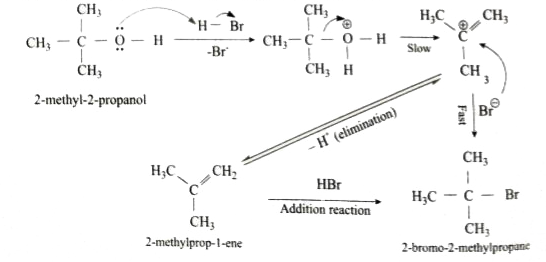
|
|
| 33. |
Explain S_(N)2 mechanism taking an example of chloromethane. |
|
Answer» Solution :When methyl bromide undergoes hydrolysis with aqueous potassiumhydroxide, methyl alcohol is formed. `CH_3 - CL + KOH to CH_3 - OH + KCl` This mechanism involves only one step.  The nucleophile `OH^(-)` attack from the rear side of the leaving group. A transition state with partial formation of C - OH bond and partial BREAKING of C - Br bond takes place simultaneously. The rate of the REACTION DEPENDS both on the concentration of nucleophile as WELL as alkyl halide. Hence, it is a second order reaction. In `S_(N^2)` reaction, complete inversion of configruation takes place. |
|
| 34. |
Explain S_(N) - 2 reaction mechanism ? |
|
Answer» Solution :The REACTION is: `CH_(3)Br + AqNaOH rightarrowCH_(3)OH + NaBr` The nucleophile OH attacks from rear side of the bromide atom to gives a transition STATE in which C-O-H bond is partially formed and C-Br bond is partially BROKER.  FIRST step is raet determining step. |
|
| 35. |
Explain S_(N) - 1 reaction mechanism. |
|
Answer» Solution : `SN^(1)`reaction When tertiary butyl bromide is heated with aqueous POTASSIUM hydroxide, tertiary butyl alcohol is formed and follows the FIRST order kinetics. i.e. The rate of reaction depends on the concentration of only one reactant i.e. tertiary butyl bromide `underset(""r=K[(CH_(3))_(3)CBr]^(1))((CH_(3))CBr+KOH to CH_(3)-underset(CH_(3))underset(|)overset(CH_(3))overset(|)C-OH+KBr)` Mechanism : Step-1 : Formation of Carbocation. `CH_(3)-underset(CH_(3))underset(|)overset(CH_(3))overset(|)C-Br overset("Slow")toCH_(3)-underset(CH_(3))underset(|)overset(CH_(3))overset(|)(" C"^(o+))+Br^(-)` This is the rate determining step. Step-2: Attack of nucleophile on carbocation The nucleophile `OH^(-)` ATTACKS the positive center of carbocation from any one of the direction FORMING tertiary butyl alcohol 
|
|
| 36. |
Explain silver mirror Test. |
|
Answer» Solution :Tollen's reagent is a SILVER ammonia complex. `[Ag(NH_(3))_(2)](+) OH^(-)` (2) When an aldehyde, like acetaldehyde is heated with Tollen's reagent, it is oxidised to acetic acid and silver ions ` Ag^(+)` in Tollen's reagent complex are REDUCED to silver (Ag) giving greyish black precipitate or DEPOSITION of silver on innter suface of the test TUBE which shines like a mirror. Hence this test is also called silver mirror test.  (3) This test is not given by KETONES. (4)Hence Tollen's reagentis used to distinguish between aldehydes and ketones. |
|
| 37. |
Explain Schottky defect and Frenkel defect. |
Answer» Solution : (i) Schottky Defect : Schottky defects is basically a vacancy defect in ionic solids in which the ELECTRICAL neutrality is maintained by absence of equal number of CATIONS and anions from lattice sites.  Like simple vacancy defect, Schottky defect also decreases the density of the substance. The number of such defects are quite significant in ionic solids. For Ex. : In NaCl at room temperature, there are `10^6` Schottky pairs per cm and there are about `10^22` ions per `cm^3`, thus, there is ONE Schottky defect per `10^16` ions. Ionic compounds with high CO-ordination number and having cation and anion of comparable size shows Schottky defect. Ex. : NaCl, KCl, CsCl and AgBr shows Schottky defects. (ii) Frenkel Defect: Ionic compounds with low co ordination number and having large difference in size of cation and anion shows Frenkel defects. In Frenkel defect, the smaller ion generally the cation is dislocated from its normal site to an interstitial site.  Frenkel defects Frenkel defect is also called dislocation defect and because of dislocation of cation, a vacancy defect is created at its ORIGINAL site and interstitial defect is created at new location. Frenkel defect doesnot alter density of crystal. Ex. : Zns, AgCl, AgBr and Agl shows Frenkel defects due to small size of `Zn^(2+)` and `Ag^(+)` ions. It is to be noted that AgBr shows both Frenkel and Schottky defects. |
|
| 38. |
Explain Schiff's reagent test. |
|
Answer» SOLUTION :(1) Schiff's reagent is prepared by dissolving pink p-rosaniline HYDROCHLORIDE (dye Fuchsin) in water and passing ` SO_(2)`GAS till the pink solution is decolourised. (2) Schiff's reagent is an oxidising agent. (3) When an aldehyde is added to Schiff's reagent. The colourless solution turns pink or in MAGENTA colour and aldehyde is oxidised to a carboxylic acid. (4) This test is not given by ketones, hence, used to distinguish between aldehyde and KETONE. |
|
| 39. |
Explain Schottky defect. |
|
Answer» Solution :Schotky defect arises due to the missing of equal mumber of cations and anions from the crystal lattice.This effect does not change the stoichiometry of the crystal. lonic solids in which the cation and ANION are of almost of similar size show SCHOTTKY defect. Example : `NaCl`. Presence of large number of schottky defects in a crystal, lowers its DENSITY. For example, the theoretical density of vanadium MONOXIDE (VO) calculated using the edge length of Schottky Defect the unit cell is `"6.5 g cm"^(-3)`, but the actual experimental density is `"5.6 g cm"^(-3)`. It indicates that there is APPROXIMATELY `14%` Schottky defect in VO crystal. Presence of Schottky defect in the erystal provides a simple way by which atoms or ions can move within the crystal lattice. 
|
|
| 40. |
Write short notes on the following Schotten - Baumann reaction |
|
Answer» Solution :The reactions of phenols with benoyl CHLORIDE in presence of sodium hydroxide to form benzoates is known as Schotten-Baumann reaction. `C_(6)H_(5)OH +C_(6)H_(5)Ocl overset(NaOH)UNDERSET(py) to underset("Phenyl benzoate") (C_(6)H_(5)OCOC_(6)H_(5)) + HCL` |
|
| 41. |
Explain saponfication of olis/fats with equation. |
Answer» SOLUTION :When oils or fats are heated with SODIUM HYDROXIDE soaps are formed: This REACTION is known as saponification 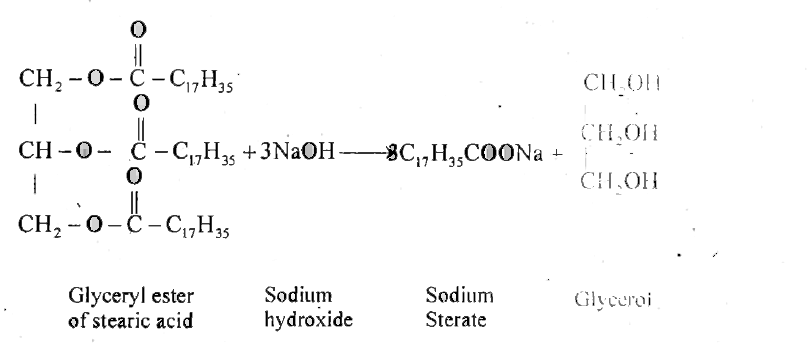
|
|
| 42. |
Explain Sandmeyer reaction with example. |
Answer» Solution :On mixing freshly PREPARED solution of benzene diazonium CHLORIDE with cuprous halides, aryl halides are FORMED. This reaction is called SANDMEYER reaction. 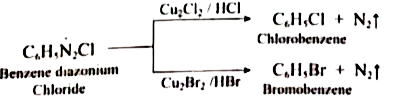
|
|
| 43. |
Explain Sabatier -Mailhe method. |
|
Answer» Solution :When vapour of an alcohol and AMMONIA are PASSED over alumiana, `W_(2)O_(5)` (or) siliea at `400^(@)C` all TYPES of amines are formed. This METHOD is called Sabatier- Mailhe method. `underset("Ethanol")(C_(2)H_(5)OH)underset(Al_(2)O_(3)/-H_(2)O)overset(overset(..)(N)H_(3))(to)underset("Ethyl amine")(C_(2)H_(5)overset(..)(N)H_(2))underset(-H_(2)O) overset(C_(2)H_(5)OH)(to) underset("Diethyl amine")((C_(2)H_(5))_(2)overset(..)(N)H) underset(Triethyl amine")((C_(2)H_(5))_(3)overset(..)(N))` |
|
| 44. |
Explain Rosenmund reduction of benzoyl chloride. |
Answer» Solution :When benzoyl chlorides are treated with HYDROGEN gas through boiling XYLENE in the presence of PALLADIUM CATALYST supported over barium sulphate they get reduced to benzaldehyde. This reaction is called Rosenmund.s reduction. 
|
|
| 45. |
Explain Rosenmund reduction with equation. |
Answer» SOLUTION :Benzoyl CHLORIDE is hydrogenated over CATALYSTS, pauodium on bariumsulphate. This REACTION is called Rosenmund reaction. 
|
|
| 46. |
ExplainRosenmundreduction |
|
Answer» Solution :Aldehydescan bepreaparedby thehydrogenationof acidchloricin thepresenceof palladiumsupported byBarium sulphate.Thisreactionis calledRosenmundreduction `CH_(3)- underset(O)underset(||)(C ) - CI +H_(2)overset(Pd//BaSO_(4))(to) CH_(3)-underset(O)underset(||)(C )- H + HCI` Inthe abovereaction`BaSO_(4)` ACT ascatalyticpoisonto palladiumcatalystso thataldeyde cannotbefurtherreducedto alcohol. |
|
| 47. |
Explain Rosenmund reduction. |
|
Answer» SOLUTION :Aldehydes can be PREPARED by the hydrogenation of acid chloride, in the presence of palladium supported by Barium sulphate. This reaction is called Rosenmund reduction `underset("Acetyl chloride")(CH_3 - undersetoverset(||)(O)(C )- Cl + H_2) overset(Pd//BaSO_4)(to) underset("Acetaldehyde")(CH_3-undersetoverset(||)(O)(C ) - H + HCl)` In the above reaction, `BaSO_4`act as a catalytic poison to palladium CATALYST, so that aldehyde cannot be further REDUCED to ALCOHOL. |
|
| 48. |
Explain reverse osmosis and purification of water. |
Answer» Solution :The direction of osmosis can be REVERSED if a pressure LARGER than the osmotic pressure is applied to the solution SIDE. That is, now the pure solvent flows out of the solution through the semi permeable membrane. This phenomen on is called reverse osmosis.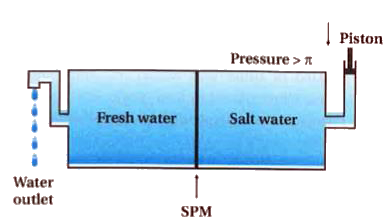 The pressure required for the reverse osmosisis quite high . A workable porous membrane is a film of cellulose acetate placed over a suitale support. Cellulose acetate is permeable to water but IMPERMEABLE to impurities and ions present in sea water. These days many countries used esalination plants to MEET their potable water requirements. |
|
| 49. |
Relative lowering of vapour pressure |
|
Answer» Solution :Relative lowering of vapour PRESSURE : If `P_(0)` and P are the respective vapour PRESSURES of a pure LIQUID (solvent) and the solution containing a nonovolatile solute then `P LT P_(0)`. Hence, `P_(0)-P` represents the lowering of the vapour pressure due to addition of a nonvolatile solute. `therefore` Relative lowering of vapour pressure. |
|
