

Saved Bookmarks
This section includes 7 InterviewSolutions, each offering curated multiple-choice questions to sharpen your Current Affairs knowledge and support exam preparation. Choose a topic below to get started.
| 1. |
Explain mechanism of micelle formation by giving an example. |
|
Answer» Solution :Let us take the example of soap solution. Soap is sodium or potassium salt of a higher fatty acid and may be represented as `RCOO-Na^(+)` (e.g. sodium stearate `CH_(3)(CH_(2))_(16)COO^(-)Na^(+)`, which is a major component of many bar soap). When dissolved in water, it dissociates into `RCOO^(-) and Na^(+)` ions. The `RCOO^(-)` ions however consist of two parts - a long hydrocarbon chain R (also called non-polar .tail.) which is HYDROPHOBIC (water repelling) and a polar group `COO^(-)` (also called polar ionic .head.) which is hydrophilic (water loving).  The `RCOO^(-)` ions are present on the surface with their `COO^(-)` groups in water and the hydrocarbon CHAINS R staying away from it and remain at the surface. But at c.itical micelle concentration, the anions are pulled into the bulk of the solution and aggregate to form a SPHERICAL shape with their hydrocarbon chains pointing towards the centre of the sphere with `COO^(-)` PART remaing outwards on the surface of the sphere. An aggregate thus formed is known as .ionic micelle.. These micelles may contain as many as 100 such ions.  Similarly in case of detergents e.g. sodium laurylsulphate, `CH_(3)(CH_(2))_(11)SO_(4)^(-)Na^(+)`, the polar group is `SO_(4)^(-)` along with the long hydrocarbon chain. Hence the mechanism of micelle formation here also is same as that of SOAPS. |
|
| 2. |
Explain measurement and calculation of resistivity of electrolytic solution. |
|
Answer» Solution :* First, determine conductivity cell constant `(G^(**))`. By using this cell MEASURE the resistance and IONIC conductivity of any solution. * (A) MEASUREMENT of resistance of solution : The set up for the measurement of the resistance is shown in the FIGURE below:  * It consists of two RESISTANCES `R_(3) and R_(4)`, a variable resistance `R_(1)` and the conductivity cell having the unknown resistance `R_(2)`. the Wheatstone bridge is fed by an oscillator O (a source of a.c. power in the audio frequency range 550 to 5000 cycles per second). * P is a suitable detector (a headphone or other electronic device) and the bridge is balanced when no current passes through the detector. * (B) Calculation for resistance of solution : In this condition, unknown resistance of unknown solution is obtained by following formula: `(R_(2)=(R_(1)R_(4))/(R_(3))=R)` * These days, inexpensive conductivity meters are available. * Electric resistance R is measured in ohm which has `Omega` symbol. `(R=rho((l)/(A))=(1)/(kappa)((l)/(A))=(G^(**))/(kappa))` Where, R=Resistance `G^(**)`=Cell constant=`G^(**)=(l)/(A)` `rho`=Resistivity `kappa` (kappa)=Conductivity of solution. |
|
| 3. |
Explain magnetic separation process of ores with the help of a neat , labelled diagram. |
Answer» Solution :In the ore and gangue, if one them is magnetic and the other is non-magnetic. Then they are separated by magnetic SEPARATION method. The magnetic ores like IRON PYRITES `(FeS_(2))` and magnetic `(Fe_(3)O_(4))` are concentrated by this method. The crushed ore is allowed to pass through ELECTROMAGNETIC belts, then the mineral particles are retained and gangue are thrown away. The finely powdered and gangue are thrown away. The finely powdered ore is passed over a converyer belt moving over two rollers,oneof which is fitted with an electromagnet. The magnetic material is attracted by the magnet and falls in a separate heap. In this way magnetic impurities are separated from non-magnetic material. 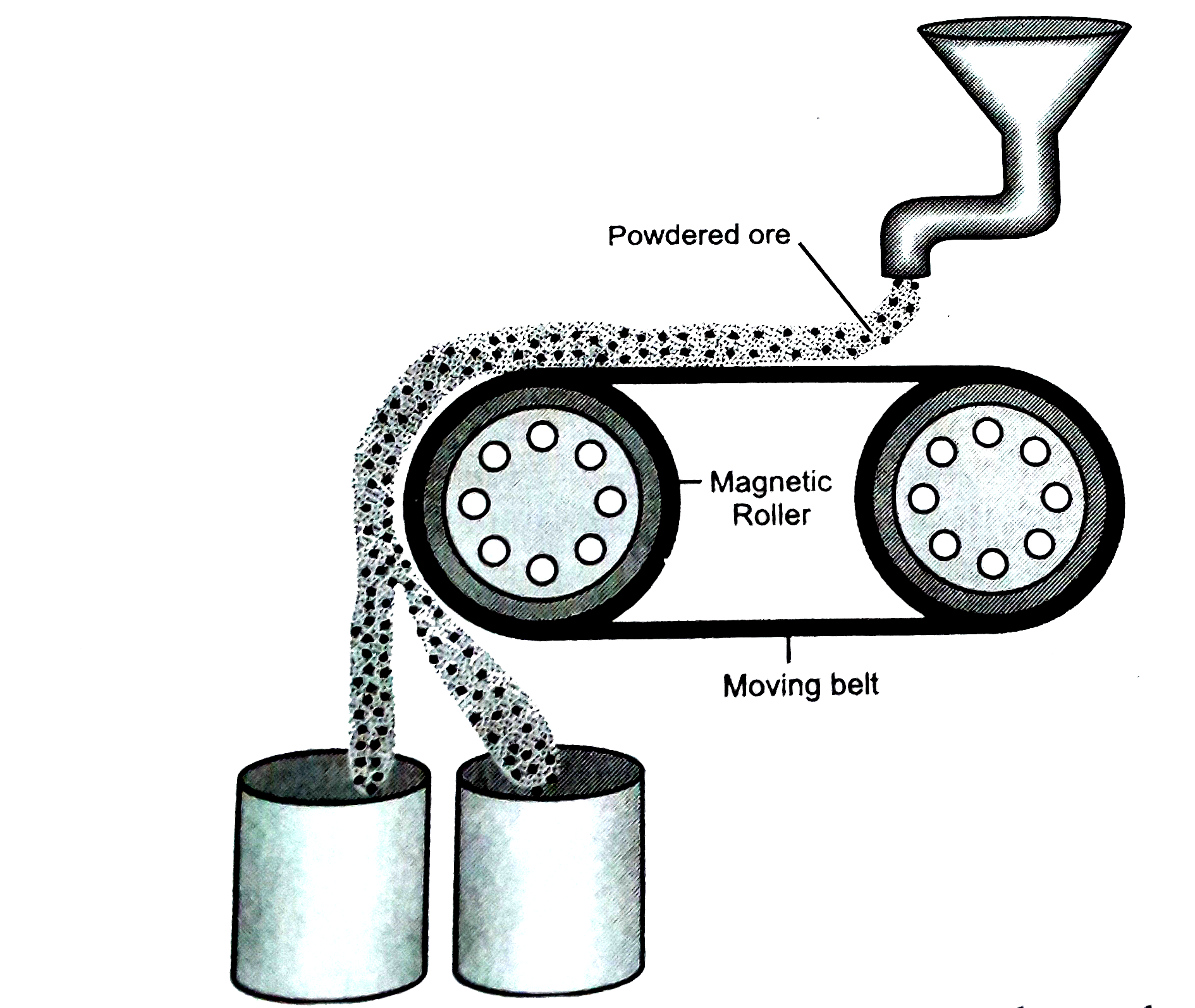
|
|
| 4. |
Explain the magnetic properties of transition metals. |
Answer» Solution :Thus method is used when either the ore or the impurities are magnetic in nature. 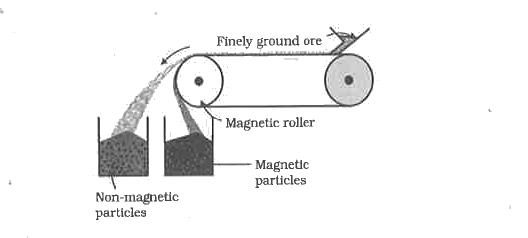 The powdered ore is allowed to FALL on a belt which moves over two roller's one of which is magnetic. As the ore particles move over the magnetic roller magnetic particles fall near the roller. Where as non-magnetic particles fall away from the roller DUR to CENTRIFUGAL force. |
|
| 5. |
Explain magnetic behaviour of transition metals. |
|
Answer» SOLUTION :Magnetic BEHAVIOUR. Most of the compounds of transition elements contain UNPAIRED electrons in their (n-1)d sub-shells. Therefore, they are paramagnetic in nature and are attracted by the magnetic field. The magnetic character is expressed in terms of magnetic moment. The larger the number of unpaired electrons in a substance, the greater is the paramagnetic character and larger is the magnetic moment. The magnetic moment is expressed in Bohr magneton abbreviated as B.M. For example, `Ti^(2+)` has 2 unpaired electrons and has less magnetic moment than `V^(2+)` which has 3 unpaired electrons. `Mn^(2+)` has 5 unpaired electrons and has maximum magnetic moment among the divalent transition metal ions because d-sub-shell can have maximum of 5 unpaired electrons. |
|
| 6. |
Explain magnetic behavior of transistion elements. |
| Answer» Solution :Since atoms of TRANSITION elements and their ions are PARAMAGNETIC in nature, they are attracted by magnetic field. The PROCESS is attributed to the presence of UNPAIRED electrons in them. | |
| 7. |
Explain Lucas test. |
|
Answer» Solution :`to` With hydrogen halides, the alcohols react to form alkyl halides. The difference in the reactivities of three classes of alcohols with HCl DISTINGUISHES from one another. `to` The alcohol reacts with Lucas reagent (conc. HCI and `ZnCl_(2)`) while their halides are immiscible and produce turbidity in solution. In case of tertiary alcohols, the turbidity is produced IMMEDIATELY as they form halides easily. Primary alcohols do not produce turbidity at room temperature. `to` The reaction of tertiary alcohols take place by SYL mechanism WHEREAS primary and secondary alcohols reacts by `S_(N)2` mechanism. `(CH_(3))_(3)C-OH overset(ZnCl_(2)//HCl) to (CH_(3))_(3)C- Cl+ H_(2)O` |
|
| 8. |
Explain Lowry- Bronsted theory of acid and base. |
|
Answer» Solution :(i) According to Lowry- Bronsted theory, an acid is DEFINED as a substance that has a tendency to donate a PROTON to another substance and base is a substance that has a tendency to accept a proton from other substance. (ii) An acid is a proton DONOR and a base is a proton ACCEPTOR. (iii) When HCl is dissolved in `H_2O`, HCL donates a proton to `H_2O`. Thus HCl BEHAVES as an acid and `H_2O` is a base. |
|
| 9. |
Explain linkage , isomerism in co-ordinate compounds . |
| Answer» SOLUTION :fFor ANSWER , CONSULT SECTION 6 . | |
| 10. |
Explain linkage isomerism with example. |
|
Answer» SOLUTION :Compounds having the same molecular formula but differ in the MODE of attachment of a ligand to the central metal atom/ion. OR A type of structure in which isomers differ in the ligating atom of AMBIDENT ligand. OR A type of structural isomerism that occurs when more than one type of atom in a monodentate ligand acts as a donor atom. `[Co NO_2 (NH_3)_5] Cl_2 ` & `[Co ONO (NH_3)_5] Cl_2` or its COMPLEX ions. OR `[Cr SCN (H_2 O)_5)^(2+) ` & `[Cr NCS (H_2 O)_5]^(2+)` |
|
| 11. |
Explain Levine and hauser acetylation. |
|
Answer» Solution :The nitriles containing `ALPHA`- hydrogen also undergo condensation with esters in the presence of sodamine in ETHER to form ketonitriles. This reaction is known as Levine and hauser acetylation. `CH_(3)-underset("Ethyl PROPIONATE")(CH_(2))-overset(O)overset(||)(C)-OC_(2)H_(5)+underset("Ethane nitrile")(CH_(3)CN)underset((ii) H^(+))overset((i)NaNH_(2)-NH_(3))(to)underset(3-"Ketopentane nitrile")(CH_(3)-CH_(2)-overset(O)overset(||)(C)-CH_(2)CN)+underset("Ethanol")(C_(2)H_(5)OH)` |
|
| 12. |
Explain Leaching of: (i) Alumina from Bauxite (Bayer's Process) (ii) Gold and Silver (Cyanide Process) |
|
Answer» Solution :Principle : It works on the difference in the solubilities of ore and impurities in a suitable solvent. (i) LEACHING of Alumina from Bauxite (Bayer.s process): Bauxite is the principal ore of aluminium. It has the impurities of ferric oxide `(Fe_2O_3)`, Silica `(SiO_2)` and titanium oxide `(TiO_2)`. The powdered ore is digested with concentrated NAOH solution at 473-523 K temperature and 35-36 bar pressure. The alumina gets dissolved as aluminate while `Fe_2O_3, TiO_2` are left behind. `SiO_2` gets dissolve as sodium silicate. `Al_2O_(2(s)) + 2NaOH_((aq)) + 3H_2O_((aq)) underset("473-523 K")overset("35-36 bar pressure")(rarr) 2Na[Al(OH)_4]_((aq))`sodium aluminate `SiO_(2(s)) + 2NaOH_((aq)) overset("473-823K"(rarr)Na_2SiO_(3(aq)) + H_2O` The sodium aluminate present in solution is neutralised by passing `CO_2` gas and hydrated `Al_2O_3` is precipitated. At this stage a small amount of freshly prepared sample of hydrated `Al_2O_3` is added to a solution. This is called seeding. It induces precipitation. `2Na[Al(OH_4)]_((aq)) + 2CO_(2(G)) to Al_2O_3 cdot xH_2O + 2NaHCO_(3(g))` Sodium silicate remains in the solution and hydrated alumina is filtered to give BACK pure `Al_2O_3.` `Al_2O_3 cdot xH_2O overset(1470 K)(rarr)Al_2O_(3(s)) + xH_2O_((g))` (ii) Cyanide Process (Leaching of Gold and Silver) : In the metallurgy of gold and silver, the respective metal is leached with KCN or NaCN in the presence of air which supplies `O_2`. The metal is obtained later by replacement reaction. `4M_((s)) + 8CN_((aq))^(-)+ 2H_2O_((aq)) + O_2_((g)) to 4[M(CN)_2]_((aq)) + 4OH_((aq))^(-)` `M = Ag or Ar`. Ag and Au is recovered from solution by addition of electropositive elements such as zinc. `2[M(CN)_(2)]_((aq))^(-) + Zn_((s)) to [Zn(CN)_(4)]_((aq))^(2-) + 2M_((s))`. |
|
| 13. |
Explain Kolbe's reaction |
Answer» Solution :When sodium phenate is heated with carbon DIOXIDE to `140^(@)C` under 6-7 ATM PRESSURE sodium SALICYLATE is obtained which on acidification gives salicylic acid. 
|
|
| 14. |
Explain Kolbe's electrolytic decarboxylation. |
Answer» Solution :The aqueous solution of SODIUM or potassium salts of carboxylic acid on ELECTROLYSIS gives ALKANES at ANODE. This reaction is called kolbe.s electrolysis 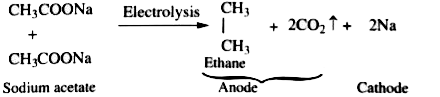
|
|
| 15. |
Explain Kohlrausch law of independent migration of ions. |
|
Answer» SOLUTION :* Law: The law STATES that LIMITING molar conductivity of an electrolyte can be represented as the sum of the individual contributions of the anion and cation of the electrolyte. * For example, if limiting molar conductivity of positive and negative ions is `lamda_(m^(+))^(@) and lamda_(m^(-))^(@)`, respectively then limiting molar conductivity of solution `(lamda_(m)^(@))` will be as FOLLOWS: `Lamda_(m)^(@)=v_(+)lamda_(m^(+))^(@)+v_(-)lamda_(m^(-))^(@)` * Explanation: If `K^(+)` of `lamda_(m^(+))^(@)=73.5` and `lamda_(m^(-))^(@)` of `Br^(-)=78.1" S "cm^(2)mol^(-1)` then limiting molar conductivity of KBr solution at infinite dilution is as follows. `Lamda_(m)^(@)(KBr)=lamda_(m)^(@)(K^(+))+lamda_(m)^(@)(Br^(-))` `=73.5+78.1` `=151.6" S "cm^(2)mol^(-1)` 
|
|
| 16. |
State Kohlrausch's Law for the independent migration of ions. Mention the applications of the Law. |
|
Answer» Solution :It states that at infinite dilution, molar conductivity of an electrolyte is equal to sum of contributions DUE to CATION as well as ANION. `Lambda_(m(Na_(2)SO_(4)))^(OO)=2Lambda_(m(Na^(+)))^(@)+Lambda_(m(SO_(4)^(2-)))^(oo)` |
|
| 17. |
Explain the Kolbe's reaction with equation. |
Answer» Solution :Sodium phenoxide GENERATED by treating PHENOL with sodium hydroxide. It is treated with CARBON dioxide to form ortho - hydroxybenzoic acid (salicylic acid). 
|
|
| 18. |
Explain K_(b) order : Et_(2)NH gt Et_(3)N gt EtNH_(2) in aqueous solution. |
|
Answer» Solution :Basicity of amines in AQUEOUS solution depends UPON : (i) + I effect on an alkyl group. (ii) Extent of hydrogen BONDING with `H_(2)O`. (III) Steric EFFECTS of alkyl groups. |
|
| 19. |
Explain IUPAC nomenclature of Co-ordination compounds with suitable examples. |
|
Answer» Solution :IUPAC nomenclature : The formula of a compound is an abreviated description of the CONSTITUTION of the compound. The following rules are prescribed by IUPAC for naming of Co-ordination compounds. i) Positive ions are named first followed by negative ions. eg. : Potassium hexacyanoferrate (II), `K_(4)[Fe(CN)_(6)]` i) Within the Co-ordination sphere ligands are named before the metal atom/ion. However, in formulae, metal ion is written first. eg. : Tetraammine copper (II) sulphate `[Cu(NH_(3))_(4)]SO_(4)` iii) Prefixes are used to denote the number of same ligands that the present in the Coordination sphere. Complex ions are denoted in paranthesis ( ) and prefixed by bis, tris etc. Examples : 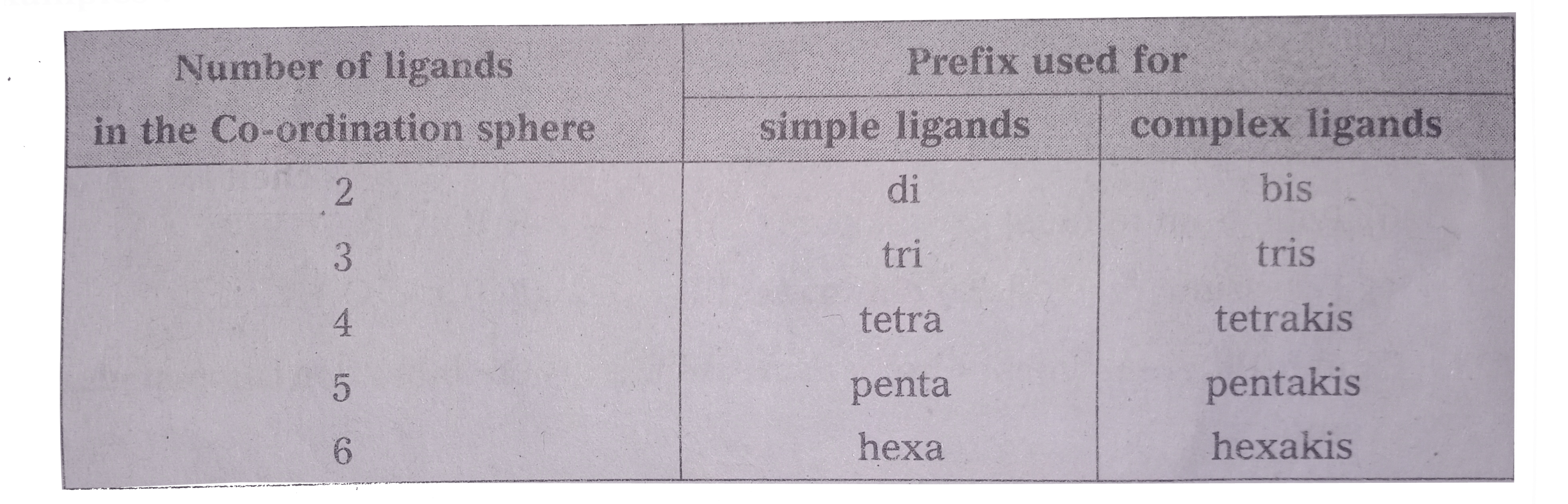 eg. : `[Co(NH_(2)CH_(2)CH_(2)NH_(2))Cl_(2)` Cl is named as dichloro bis (ethylendeiamine) cobalt (III) chloride iv) Ligands are named in alphabetical order. eg. : `[PtCl_(2)(NH_(3))_(2)` diammine dichloro platinum (II) v) Anionic ligands are denoted by a suffix 'O' and netural ligands are denoted by their original NAMES. eg. : `Cl^(-)-" Chloro", CN^(-)-"Cyano"` Exception for the above are indicated below. 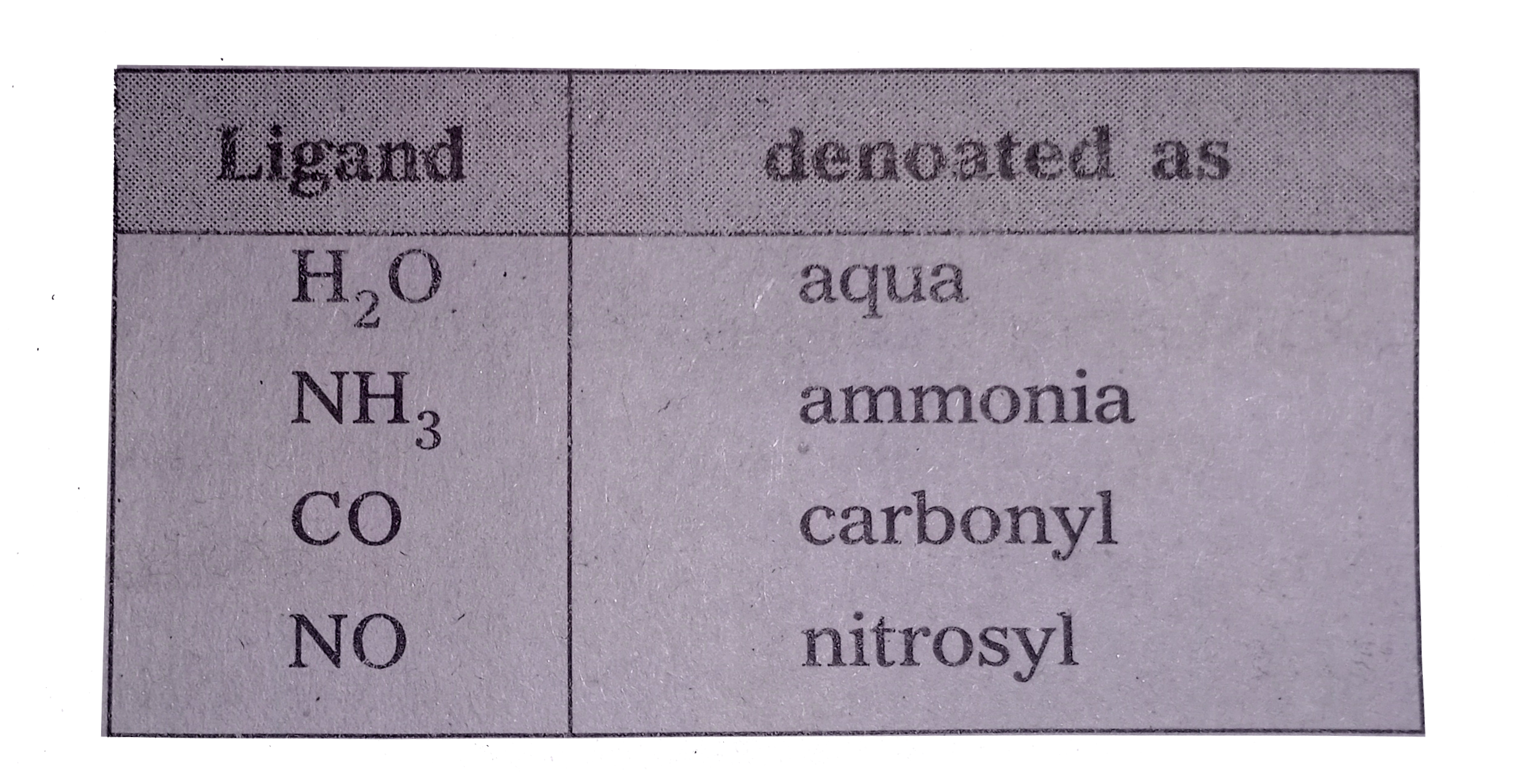 vi) Oxidation state of the metal ion is indicated by Romen numerical in parenthesis. eg. : `[AG(NH_(3))_(2)][Ag(CN)_(2)]` is named as diammine silver (I) dicyanoargentate (I). vii) If the charge of the Co-ordination entity is negative, the name of the metal ends with a suffix-ate. eg. : `[Co(SCN)_(4)]^(2-)-tetrahiocyanato cobaltate (II) Some metal ions are denoted by their names from which their symbols are derived eg. : Fe-ferrate Pb-plumbate Sn-stannate Ag- argentate Au-aurate viii) Prefixes cis - and trans are used to designate adjacent and opposite geometric locations of the ligands, in a complex. eg. : 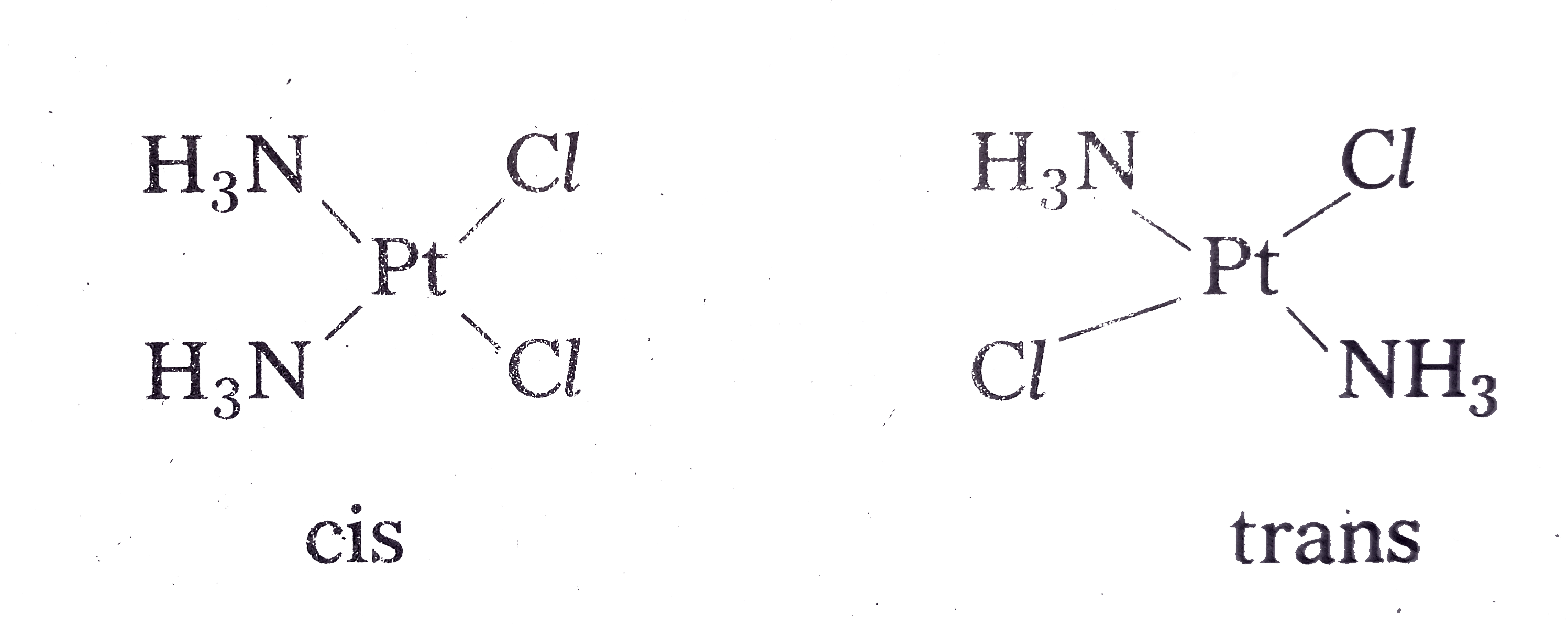 ix) Bridging ligands between two metal ions in a Co-ordination entity are denoted by prefix `mu`(greek letter 'mu'). eg. : `[(NH_(3))_(4)Co(OH)(NH_(2))Co(NH_(3))_(4)]^(+)` is named as `mu`amido-`mu` hydroxo bis (tetraammine) cobalt (IV). i) Tetrahydroxozincate (II) - `[Zn(OH)_(4)]^(-2)` ii) Hexa ammine cobalt (Ill) sulphate - `[Co(NH_(3))_(6)]_(2)(SO_(4))_(3)` iii) Potassium tetrachloropalladate - `K_(2)[PdCl_(4)]` iv) Potassium tri(oxalato) chromate (III) - `K_(3)[Cr(C_(2)O_(4))_(3)]` |
|
| 20. |
Explain IUPAC nomenclature for halosubstituted hydrocarbons. |
|
Answer» Solution :Scheme : `2^(@)` prefix - `1^(@)` prefix - Rootword - `1^(@)` suffix - `2^(@)` suffix For halosubstituted hydrocarbons : `1^(@)` suffix `rArr` - ane (for `-overset("|")underset("|")("C")-overset("|")underset("|")("C")-`) - ene (for `gt C = C lt`) - yne (for `-C-=C-`) Rootword `rArr` Depending upon total number of carbon atom in a parent chain. Ex. : Meth, ETH - , PROP - etc. `1^(@)` Prefix `rArr` Cyclo - (for ALIPHATIC cyclic compounds) `2^(@)` Prefix `rArr` Halo - Ex. : Fluoro -, Chloro - , Bromo - , Iodo - and alkyl grops. `2^(@)` Suffix `rArr` Suffix of most senior functional group (Not applicable in alkylhalides) Examples : 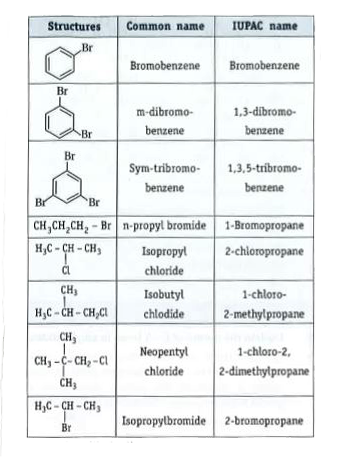 The dihaloalkanes having the same type of halogen atoms are named as alklidene or alkylene dihalides. Both halogens on ADJACENT carbon atom `rArr` Vicinal dihalide Both halogens on same atom `rArr` Geminal dihalide Common name of Geminal dihalides `rArr` Alkylidene halides Common name of Vicinal dihalides `rArr` Alkylene dihalides `{:(CH_(3)-CHCl_(2),"(Geminal dihalide)"),("1,1-dichloroethane","(IUPAC)"),("Ethylidene chloride","(Common name)"),(underset("Cl")underset("|")(CH_(2))-underset("Cl")underset("|")(CH_(2)),"(Vicinal dihalide)"),("1,2-Dichlorethane","(IUPAC)"),("Ethylene dichloride","(Common name)"):}` 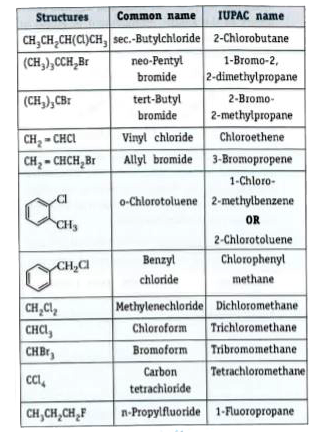
|
|
| 21. |
Explain IUPAC naming of alcohols, phenols and ethers. |
Answer» Solution : Alcohols : `2^(@)` PREFIX -`1^(@)` Prefix- ROOT WORD -`1^(@)` suffix- `2^(@)` suffix (-ol/-diol/-triol) Ether: Alkoxy (SMALL chain) alkane (parent chain)  
|
|
| 22. |
Explain isomerism in Haloalkanes. |
|
Answer» Solution :Haloalkanes show three types of isomerism : (i) Chain isomerism (ii) Position isomerism (iii) Optical isomerism (i) Chain isomerism : When two or more haloalkanes with same molecular FORMULA differ in the size of chain of carbon atoms, they are SAID to chain isomers of each other. `UNDERSET("1-chlorobutane")(CH_(3)-CH_(2)-CH_(2)-CH_(2)-Cl) "" underset("1-chloro-2-methylpropane")(CH_(3)-overset(CH_(3)" ")overset("|")("CH")-CH_(2)-Cl)` (ii) Position isomerism : When two or more haloalkanes with same molecular formula differ in the position of halogen atoms ATTACHED to different carbon atams of the chain, they are said to be position isomers of each other. `underset("1-Chloropropane")(CH_(3)-CH_(2)-CH_(2)-Cl)""underset("2 - Chloropropane")(CH_(3)-overset("Cl ")overset("|")("CH")-CH_(3))` (iii) Optical isomerism : The haloalkanes with same molecular formula and structural formula when differs in the spatial arrangement of atoms or group of atoms rotates the plane polarised light are called optical isomers. 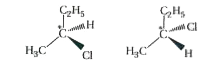
|
|
| 23. |
Explain isotonic solutions. |
|
Answer» Solution :Two solutions having same osmotic pressure at a given temperature are called ISOTONIC solutions. When such solutions are SEPARATED by semipermeable membrane no osmosis occurs between them. For example, the osmotic pressure associated with the fluid inside the blood cell is equivalent to that of 0.9% (mass/volume) sodium chloride solution, called NORMAL saline solution and it is safe to inject intravenously. Hypertonic solution :The solution which POSSESS more osmotic pressure with respect to other solution possessing LESS osmotic presure is known as Hypertnic solution. For example : Out of 10 %w/V and 20 % w/V urea solutions. 20% w/V is hypertonic. Hypotonic solution : The solution which possess less osmotic pressure, such solution is known as hypotonic solution with respect to the solution possessing more osmotic pressure. For example : Out of 10 % w/V and 20% w/V urea solutions. 10% w/V solution is hypotonic. |
|
| 24. |
Explain isolation of metals from concentrated ore. |
|
Answer» Solution :The PROCESS of ISOLATION of metals from concentrated ore involves two steps: (i) Conversion to oxide and (ii) Reduction of the oxide to metal Step-1 : Conversion to oxide : (i) Calcination : Calcination involves heating. It removes the volatile MATTER which escapes leaving behind the metal oxide : `Fe_2O_(3) cdot xH_2O_((s)) overset(Delta)(rarr) Fe_(2)O_(3(s)) + xH_2O_((g))` `ZnCO_(3(s)) overset(Delta)(rarr)ZnO_((s)) + CO_(2(g))` `CaCO_(3) cdot MgCO_(3(s)) overset(Delta)(rarr) CaO_((s)) + MgO_((s)) + 2CO_(2(g))` . (ii) Roasting: In roasting, the ore is heated in a regular supply of air in a furnace at a temperature below the MELTING point of the metal. Some of the reactions involving sulphide ores are : `2Zn_((s)) + 3O_(2(g)) to 2ZnO_((g)) + 2SO_(2(g))` `2PbS_((s)) + 3O_(2(g)) to 2PbO_((s)) + 2SO_(2(g)) ` `2Cu_(2)S_((s)) + 3O_(2(g)) to 2Cu_(2)O_((s)) + 2SO_(2(g))`. The sulphide ores of copper are heated in reverberatory furnace. If ore contains iron, it is mixed with silica before heating. Iron oxide "slags off" as iron silicate and copper is produced in the form of copper matte which contains `Cu_2S and FeS.`  The `SO_2` produced is utilised in manufacturing of `H_2SO_4`. The sulphide ores are usually converted to oxide ores before reduction because reduction of oxide ore is easier. Step-2 : Reduction of oxide to the metal : Reduction of the metal oxide usually involves heating it with a reducing agent such as carbon or carbon monoxide or even another metal. The reducing agent (e.g., carbon) combines with the oxygen of the metal oxide. `M_xO_y + yC to xM + yCO` Some metal oxides get reduced easily while others are very difficult to be reduced (reduction means electron gain by the metal ion). In any case, heating is required. |
|
| 25. |
Explain in brief aldoseand ketose with example. |
|
Answer» Solution :Adose : Monosaccharide whichcontain an aldehyde (-CHO) group are called aldose . e.g., `CH_(2)OHCHOHCHO` (Glyceraldehyde). `CH_(2)OH(CHOH_(4))CHO` (Glucose). KETOSE : Monosaccharide which contains a ketonic`( GT C=O)` group are called ketone. e.g., `CH_(2)OHCOCH_(2)OH` (Dihydroxyacetone). `CH_(2)OH(CHOH)_(3) COCH_(2)OH` (Fructose). |
|
| 26. |
Explain ionisation isomerism with suitable example. |
|
Answer» Solution :`(i)` IONISATION isomerism arises when an ionisable counter ion (SIMPLE ion) itself can act as a ligand. `(ii)` Th exchange of such counter ions with one or more ligands in the coordination ENTITY will result in ionisation isomers. These isomers will give different ions in solution. `(iii)` For example , consider the coordination COMPOUND `[Pt(en)_(2)Cl_(2)]Br_(2)`.In this compound, both `Br^(-)` and `Cl^(-)` have the ABILITY to act as a ligand and the exchange of these two ions result in a different isomer `[Pt(en)_(2)Br_(2)]Cl_(2)`. In solution, the first compound `Br^(-)` ions while the later gives `Cl^(-)` ions and hence these compounds are called ionisation isomers. |
|
| 27. |
Explain intermediate compound formation theory of catalysis with an example. |
|
Answer» Solution :The intermediate compound formation theory: A catalyst acts by providing a new PATH with low energy of activation. In homogeneous catalysed reactions a catalyst may combine with one or more reactant to form an intermediate which reacts with other reactant or DECOMPOSE to give products and the catalyst is regenerated. Consider the reactions: `A+B to AB` (1) `A+C to AC` ( intermediate ) (2) C is the catalyst `AC+B to AB +C` (3) Activation ENERGIES for the reactions (2) and (3) are lowered compared to that of (1). Hence the formation and decomposition of the intermediate accelerate the rate of the reaction. Example: The mechanism of Fridel crafts reaction is given below `C_6H_5+CH_3Cl overset("anhydrous" AlCl_3) to C_6H_5CH_3+HCl` The actionof catalyst is explainedas follows `CH_3Cl +AlCl_3 tounderset(" It is an intermediate ")([CH_3]^(+))[AlCl_4]^(-)` `C_6H_6 +[CH_3]^(+) [AlCl_4]^(-) to C_6H_5CH_3 + AlCl_3 +HCl` Thistheroy describes , (i) The specificity of a catalyst . (ii) The increasein the rate of the reaction wiht increasein the concentration of a catalyst . Limitations (i) The intermediate compound theory fails to EXPLAIN the action of CATALYTIC poison and activators (promoters). (ii) This theory is unable to explain the mechanism of heterogeneous catalysed reactions. |
|
| 28. |
Explain industrial manufacturing of sulphuric acid. |
Answer» Solution :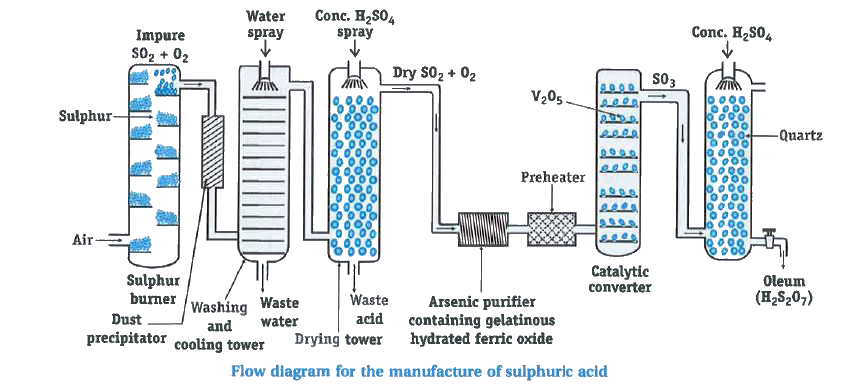 In contact process, the following steps are involved : (i) Burning of sulphur or sulphide ores in presence of air to generate `SO_2`. (ii) Conversion of `SO_2` to `SO_3` by the reaction with oxygen in the presence of a catalyst (`V_2O_5`). (iii) Absorption of `SO_3` in `H_2SO_4` to give oleum (`H_2S_2O_7`). The `SO_2` produced is purified by removing DUST and other impurities such as arsenic compounds. The key step is the catalytic oxidation of `SO_2` with `O_2` to give `SO_3` in the presence of `V_2O_5` (catalyst). `2SO_(2)(g) + O_(2)(g) OVERSET(V_(2)O_(5))to 2SO_(3)(g), Delta_(r)H^(-) = -196.6 kJ//mol^(-1)` The reaction is exothermic, reversible and the forward reaction leads to a decrease in volume. Therefore, low temperature and high pressure are the favourable conditions for maximum yield. But the temperature should not be very low otherwise. In practice, the process is carried out at 2 bar pressure and 720 K temperature. The `SO_3` gas from the catalytic convertor is absorbed in concentrated `H_2SO_4` of the desired concentration. In the industry, TWO steps are carried out simultaneously to make process continuous and cost effective. `SO_(3) + H_(2)SO_(4) to H_(2)S_(2)O_(7)` (Oleum) The sulphuric acid obtained by contact process is 96-98% pure. |
|
| 29. |
Explain induced catalysis with an example. |
| Answer» | |
| 30. |
Explain in which of the following , there is a change in oxidation number ? (a) Cr_(2)O_(7)^(2-) solution is madealkaline. (b) An aqueous solution of CrO_(4)^(2-) is acidified. (c ) SO_(2) is passed through acidified Cr_(2)O_(7)^(2-) solution. (d) CrO_(2)Cl_(2)is dissolved in NaOH. |
|
Answer» Solution :(A) `[ overset(+6) (Cr_(2))O_(7) ]^(2-) + 2OH^(-) RARR 2[overset(_6)(Cr)O_(4)]^(2-) +H_(2)O`. No change in OX. no. (v)` [2overset(+6)(Cr)O_(4)]^(2-)+ 2H^(+) rarr [ overset(+6)(Cr_(2)O_(7))]^(2-)+ H_(2)O`, No change in ox. no. (c )`[overset(+6)(Cr_(2))O_(7)]^(2-) + 3SO_(2)+ 2H^(+) rarr 2 [ overset(3+)(Cr)]^(3+)+ 3 [ overset( +6)(SO_(4))]^(2-)+H_(2)O` , Ox. no. changes (d) `overset( + 6) (Cr)O_(2)Cl_(2) + 2NaOH rarr Na_(2)overset( 6) (Cr)O_(2)`. No change in ox. no. |
|
| 31. |
Explain in brief the intermolecular compound formatio and the adsorption theories for catalysis. |
| Answer» | |
| 32. |
Explain impurity defect. |
|
Answer» Solution : Impurity defect: (i)This defect ARISES when a cation from its regular site in ionic crystal lattice is replaced by different cations. (ii) If the impurity cation is SUBSTITUTED in the place of regular cation, then it is called substitution impurity defect. 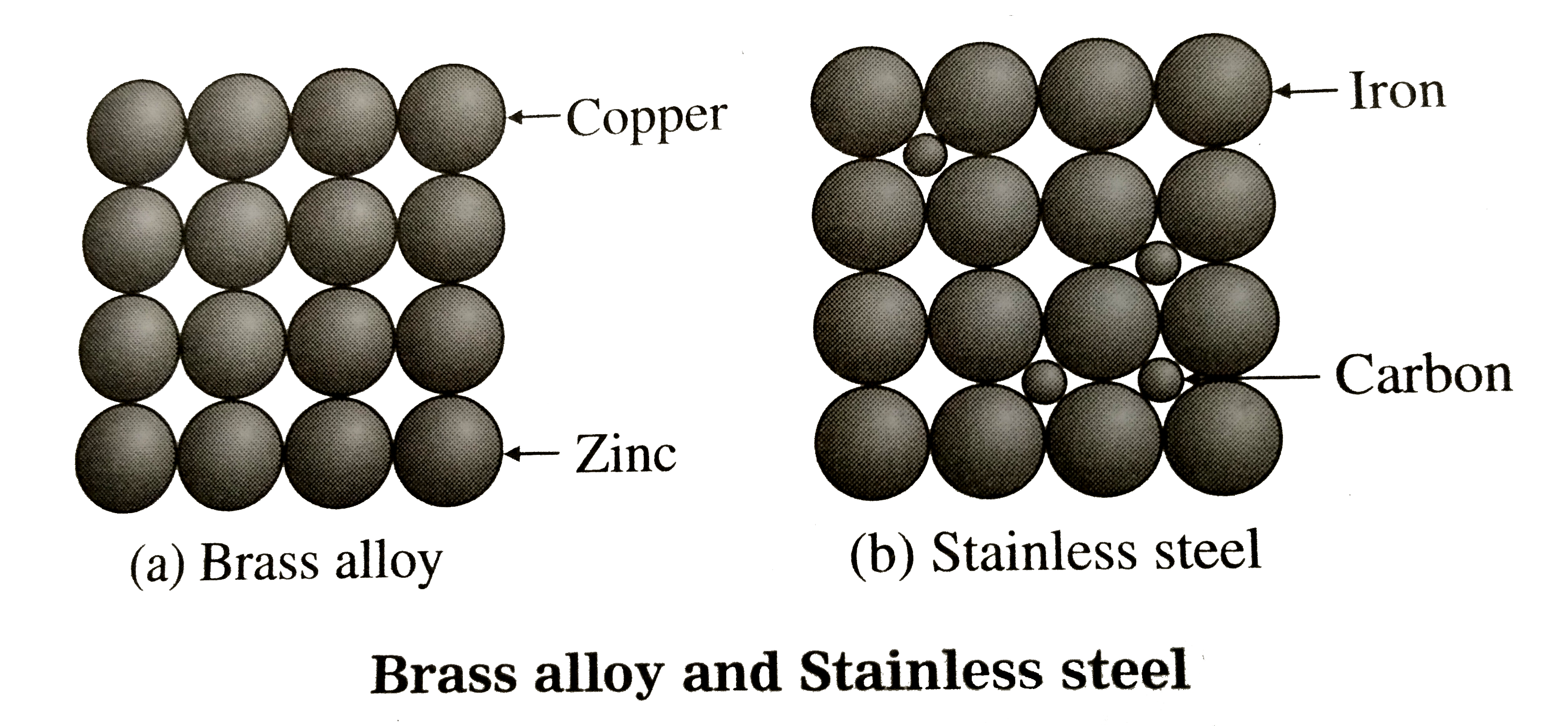 (III) If the impurity of cation is present in the interstitial positionsthen it is called interstitial impurity defect. (iv) Theinterstitialimpurity defectchanges the propertiesof the ORIGNAL CRYSTALLINE soilds. |
|
| 33. |
Explain in brief homocatalysis of enzymes along with their |
| Answer» | |
| 34. |
Explain importance of chemicals in food and also explain its types. |
|
Answer» Solution :Chemicals are added to food for (i) their preservation, (II) enhancing their APPEAL, and (iii) adding nutritive value in them. Main categories of food additives are as follows: (i) Food COLOURS (ii) Flavours and SWEETENERS (iii) Fat emulsifiers and stabilizing agents (iv) Flour improvers-antistaling agents and bleaches (v) Antioxidants (vi) Preservatives (VII) Nutritional supplements such as minerals, vitamins and amino acids. Except for chemicals of category (vii), none of Norethindrone Ethynylestradiol (novestrol) the above additives have nutritive value. These are added either to increase the shelf life of 16.4 Chemicals in food : stored food or for cosmetic purposes. In this Section we will discuss only sweeteners and food preservatives. |
|
| 35. |
Explain impurity defect in stainless steel with diagram. |
|
Answer» Solution :The IMPURITY defect found in stainless steel interstitial impurity defect. In interstitial impurity defect, the impurity of cation is present in the interstitional position and make crystal defected. Stainless steel is an alloy of Iron and `4%` Chromium mixed with it. Stainless steel typically contains about `1%` Carbon, `1-5%` Manganese, `0.05%` PHOSPHOROUS, `1-3%` Silicon, `5%-10%` Nickel and `15%-20%` Chromium. Carbon is a second - period element that is non-metallic and MUCH SMALLER that iron. Carbon will therefore tend to occupy interstitial SITES in the iron lattice. 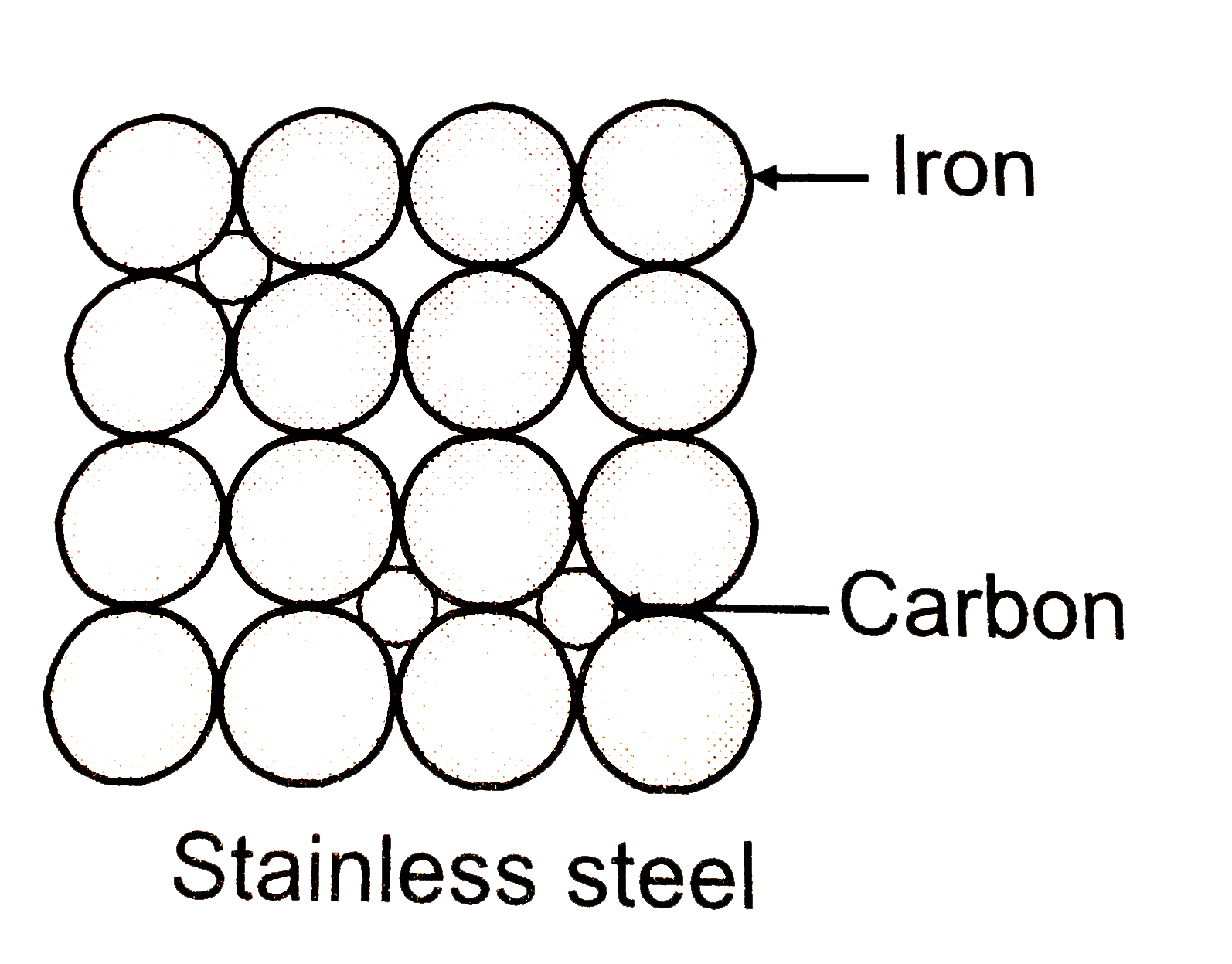
|
|
| 36. |
Explain importance and remedies to stop metal corrosion. |
|
Answer» Solution :* Prevention of corrosion is of prime importance. * Damage due to corrosion is as follows: (i) Due to metal wastage, economical losses are occurred. (ii) Due to corrosion of bridge, collapse of bridge is possible and causes accidents. (iii) Due to corrosion in machines, they wont.s work properly and their EFFICIENCY get decreased and so it stops working. * Different ways to stop corrosion of metals: (i) Covering the surface with PAINT. (ii) Covering the surface by some chemicals like bisphenol. (iii) Another simple method is to cover the surface by other metals(Sn, Zn, etc.) that are inert or react to same the object. An ELECTROCHEMICAL method is to provide a sacrificial electrode of another metal (like Mg, Zn, etc.) which corrodes itself but SAVES the object. (iv) Cover the surface by inert metal to save metals. E.g., Ag layer on Cu and Au layer on Ag metals. |
|
| 37. |
Explain: (i) The basis of similarities and differences between metallic and ionic crystals. (ii) lonic solids are hard and brittle. |
|
Answer» SOLUTION :(i) Similarities: Both ionic and metallic crystals have electrostatic forces of attraction. In ionic crystals these forces are between oppositely charged ions. In METALS, these forces are among the valence electrons and positvely charged kernels. Both have HIGH melting POINT. Differences : Ionic bond is strong due to electrostatic forces of attraction whereas metallic bond may be weak or strong depending upon the number of valence electrons and the size of kermels. In ionic bond, ions are not FREE to move. Hence, they cannot conduct electricity in solid state. They can do so only in molten state or in aqueous solution. clectronsIn metals, electrons are free to move. Hence, they conduct electricity in solid state. clectrons(ii) lonic crystals are hard due to strong electrostatic forces between them. They brittle because ionic bond is non-directional. |
|
| 38. |
Explain ideal solution. |
|
Answer» Solution :The solutions which obey Raoult.s law over the entire range of concentration are known as ideal solutions. The ideal solutions have two other IMPORTANT properties. The enthalpy of mixing of the pure components to form the solution is zero and the volume of mixing is ALSO zero, i.e., `Delta_(mix)H=0, Delta_(mix)V=0` It means that no heat is absorbed or EVOLVED when the components are mixed. Also, the volume of solution would be equal to the sum of volumes of the two components. At molecular level, ideal behaviour of the solutions can be explained by considering two components A and B. In pure components, the INTERMOLECULAR attractive interactions will be of types A - A and B - B, whereas in the binary solutions in addition to these two interactions, A - B type of interactions will also be present. If the intermolecular attractive forces between the A - A and B - B are nearly equal to those between A - B, this leads to the formation of ideal solution. A perfectly ideal solution is rare but some solutions are nearly ideal in behaviour. Solution of n - hexane and n - heptane, bromoethane and chloroethane, benzene and toluene, etc. fall into this category. |
|
| 39. |
Explain : (i) Zone refining (ii) Column chromatography. |
Answer» SOLUTION :(ii) Column Chromatography : In column chromatography, an adsorbent such as `Al_2O_3` is packed in a column. This is known as stationary phase. As shown in figure, the column is fitted with a stop cock at its lower end. The mixture to be separated is dissolved in a SUITABLE solvent (MOBILE phase) and applied to the top of the column. The components of the mixture will get adsorb on the adsorbent depending on its affinity towards adsorbent. The adsurbed components arc cluted from the column with suitable solvent. The component which is more strongly adsorbed on the column takes longer time to TRAVEL through the column than a component which is weakly adsorbed. |
|
| 40. |
Explain (i) The basis of similarities and differences between metallic and ionic crystals. (ii) Ionic solids are hard and brittle. |
|
Answer» Solution : (i) The BASIS of similarities : In both metallic solids there is electrostatic forces of attraction. The bonds in both the solids are non-directional. These solids having high melting points. The points of differences : IONIC solids have cations and anions as constituent particles whereas in metallic solids, there are positive ions called kernels located in sea of electrons. In solid state, the ionic solids are ELECTRICAL insulators while metallic solids conduct electricity because of MOBILE electrons. Ionic solids are hard but brittle. However, metallic crystals are hard, malleable and ductile. Some metallic solids are also soft. (ii) Ionic solids are hard due to strong electrostatic forces between cations and anions. The brittleness of ionic solids is due to fact that when a force is applied, the layers slip over the other as a RESULT of which like charges come closer. As a result of repulsions the crystal breaks. |
|
| 41. |
Explain (i) The basis of similarities and differences between metallic and ionic crystals. (ii) Ionic solids are hard and brittle. |
|
Answer» Solution :(i) Similarities : 1. Both types of solids have high melting point. This is because of strong force of attraction. In IONIC solids, it is the attraction between oppositely charged ions while in metallic solids, it is the attraction between electrons and kernels. 2. There is non-directional BOND in both types of solids. Differences : 1. Ionic crystals do not conduct electricity in solid state while metallic crystals can. This is because of structural differences between the two. In ionic crystals, the positions of particles (ions) is fixed, which prevents from conducting electricity. In metallic crystals, there are electrons and kernels. All electrons are COMMON to all the kernels. Electrons are free to move and conduct electricity. However, in molten ionic crystals, ions become mobile and conduct electricity. 2. Ionic bond is definitely strong because of ELECTROSTATIC forces of attraction between the oppositely charged ion. Metallic bond may be strong or weak. This depends upon the number of valence electrons and size of kernels. Greater the number of valence electrons, greater will be the STRENGTH of metallic bond. (ii) Ionic crystals are hard due to strong electrostatic force of attraction. On applying a small force, similarly charged ions come into contact causing repulsion and making the lattice unstable and is thus brittle. |
|
| 42. |
Explain (i) Perkin's reaction (ii) Knoevenagal reaction. |
|
Answer» Solution :(i) Perkin.s reaction When an AROMATIC aldehyde is HEATED with an aliphatic acid anhydride in the presence of the sodium salt of the acid CORRESPONDING to the anhydride, CONDENSATION takes place and an `alpha , BETA`unsaturated acid is obtained. This reaction is known as Perkin.s reaction. 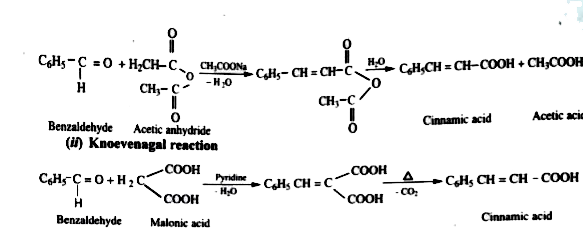
|
|
| 43. |
Explain: (i) Dipole moment of chlorobenzene is lower than that of cyclohexylchloride (ii). Alkyl halide though polar, are immiscible with water. (iii). Grignard reagents should be prepared under anhydrous conditions. |
Answer» Solution :(i).  The polarity of `C-Cl` bond in chlorobenzene is less than that of same bond in cyclohexyl chloride because of carbon atom involved in chlorobenzene is more electronegative (GREATER s-character) as compared to the carbon atom in CASE of cyclohexyl chloride (lesser s-character). therefore, the dipole moment of chlorobenzene is less with respect to cyclohexyl chloride. (ii). In water, `H_(2)O` molecules are linked to each other by intermolecular hydrogen bonding. although alkyl halide also cantain polar `C-X` bonds, they cannot break the hydrogen bonding in `H_(2)O` molecules. this means that there is hardly any scope for association between molecules of alkyl HALIDES and water. they therefore, exist as separate layers and are immiscible with each other. for more details, consult section 6. (iii). Grignard reagents `(R-Mg-X)` should be PREPARED under anhydrous CONDITIONS because these are readily decomposed by water to form alkanes.  That is why ether used as solvent in the preparation of grignard reagents is completely anhydrous in nature. |
|
| 44. |
Explain (i) Shape selective catalysis (ii) homogeneous catalysis. |
| Answer» | |
| 45. |
Explain : I. Dehydrohalogenation of |
|
Answer» Solution :` (##KSV_CHM_ORG_P2_C15_S01_011_S01.png" width="80%"> II. ` overset (Delta) (rarr) 3% ` (cis and transs ) ` + ( 97 %)` ` E2` elimination of an alkyl halide with base `(EtO^(Θ))` gives mainly the Saytzeff alkene (i.e., more-substityted alkence ). whereas `4^(@)` AMONIUM salt undergoes Hofmann elimination to give less-substituted alkene, resulting from a loss of more ACIDIC `beta-H (1^(@) gt 2^(@) gt 3^(@))` called Hofmann's RULE. Thus, the ACIDITY of `beta-H` is more important than the stability of the alkene that is formed. |
|
| 46. |
Explain (i) Cyclic silicates, (ii) Ino silicates. |
|
Answer» Solution :(i) Cyclic silicates: Silicates which contain `(SiO_(3))_(n)^(2n-)` ions which are formed by linking three or more tetrahedral `SiO_(4)^(4-)` units cyclically are called cyclic sicitates. Each silicate unit shares tow of its oxygen atoms with other units. EXAMPLE Beryl `[Be_(3)Al_(2)(SiO_(3))_(6)]` (an aluminosilicate with each aluminium is surrounded by 6 oxygen atoms octahedraly). 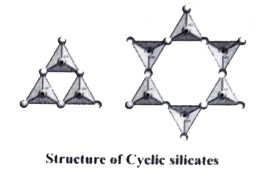 (ii) Ino silicones: Siliciates which contain n number of silicate units liked by sharing two or more oxygen atoms are called inosilicates. They are further classified as chain silicates and double chain silicates. 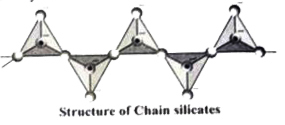 Chain silicates (or pyroxenes): These silicates contain `[(SiO_(3))_(n)]^(2n^(-)` ions formed by linkin n number of tetrahderal `[SiO_(4)]^(4-)` units lineary. Each silicate unit shares two of its oxygen atoms with other units. Example: Spondumene-`LiA[SIO_(3))_(2)`. Dougle chain silicates (or amphiboles): These silicates contains `[Si_(4)O_(11)]_(n)^(6n-)` ions. In these silicates there are two different typea of TETRAHEDRA, (i) Those sharing 3 vertices (ii) those sharing only 2 vertices. Examples, Absestos: These are are fibrous and noncombustible silicates. Therefore they are used for thermal insulation material, brake linings, construction material and filters. Asbestos being carcinogenic silicates, their APPLICATIONS are restricted. 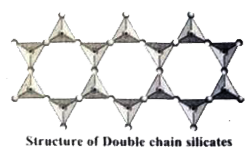
|
|
| 47. |
Explain (i) coagulation value (ii) cataphoresis. |
| Answer» | |
| 48. |
Explain : (i) Actinoid contraction is greater from element to element than canthanoid contraction. Why? (ii) The enthalpies of atomisation of the transsition metals are high. Why? Complete the reactions : (i) Fe^(2+)+MnO_(4)^(-)+8H^(+)rarr (ii) CuO_(4)^(2-)+H^(+)rarr |
|
Answer» Solution :(i) Due to poor shielding EFFECT of 5f electrons. (ii) Because of large number of unpaired electrons in their atoms they have stronger interatomic INTERACTION resulting in higher enthalpies of atomisation. (i) `5Fe^(2+)+MnO_(4)^(-)+8H^(+)rarrMn^(2+)+5Fe^(3+)+4H_(2)O` (ii) `2CrO_(4)^(2-)+2H^(+)rarrCr_(2)O_(7)^(2-)+H_(2)O` |
|
| 49. |
Explain hydrometallurgical process with suitable example. |
|
Answer» Solution :The extraction of metals by USING their AQUEOUS solution is called HYDROMETALLURGY. Example : Au, Ag, Cu etc. are extracted by this method. The copper from LOW grade ores and scraps is extracted by hydrometallurgy. It is leached out using acid or bacteria. The solution containing `Cu^(2+)` is treated with scrap iron or `H_2`. `Cu_((aq))^(2+)+ H_(2(g)) to Cu_((s)) + 2H_((aq))^(+)`. |
|
| 50. |
Explain hydraulic washing used for ore concentration. |
Answer» Solution :Hydraulic classifier METHOD : Hydraulic classifier is a CONICAL reservoir having a hopper at the top and a pipe at the bottom. Finely divided ORE particles are dropped in through the hopper and a powerful current of water is introduced through the pipe at the bottom. Gangue particles are lighter and are CARRIED away by the current of water at the top. The heavier ore particles collect at the APEX of the cone bottom of the reservoir. 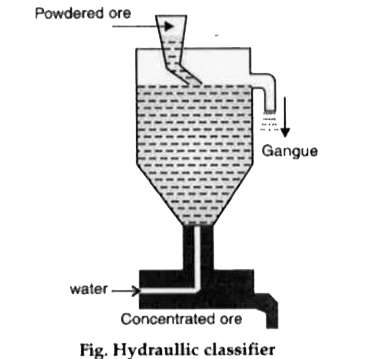
|
|