

Saved Bookmarks
This section includes 7 InterviewSolutions, each offering curated multiple-choice questions to sharpen your Current Affairs knowledge and support exam preparation. Choose a topic below to get started.
| 1. |
Explain hydrate isomerism. Give some examples. |
|
Answer» Solution :This ISOMERISM is due to different role of water molecule present in the COMPLEX compound. Water molecule can either act as ligand or it MAY present OUTSIDE the coordination SPHERE as anion water. |
|
| 2. |
With the help of Valence Bond theory account for hybridisation, geometry and magnetic property of [Ni(CN)_(4)]^(2-) complex ion [Z" for "Ni=28] |
|
Answer» Solution :In the given COMPLEX ion central metal is nickel with electronic configuration `[Ar]^(18)3d^(8)4s^(2)` Nickel is in `+2` oxidation state thereofre electronic configurations is `Ni^(+2)`  In the given complex, `CN^(-)` is a strong ligand. On the approach of strong ligand the unpaired 3d electron will get pair up. As a RESULT one d - orbital becomes vacant.  The one vacant 3d orbital, one vacant 4s orbital and two vacant 4P orbitals hybridize to give four hybrid orbitals.  Four pairs of electrons one from each `CN-` molecule occupy the four hybridized orbitals.  Due to `dsp^(2)` hybridization the complex ion is square planar in shape. There are no unpaired electrons in the complex so it is diamagnetic. Hybridisation `-dsp^(2)` Geometrical shape - Square planar Magnetic property - Diamagnetic |
|
| 3. |
Explain HVZ reaction. |
|
Answer» Solution :(i) Carboxylic acids having an `alpha`-hydrogen are halogenated at the `alpha`-position on treatment with chlorine or bromine in the PRESENCE of small amount of red phsosphorus to form `alpha` halo carboxylic acids. This REACTION is known as Hell - Volhard - Zelinsky reaction (HVZ reaction) (ii) The `alpha` - Halogenated acids are convenient starting materials for PREPARING `alpha` - SUBSTITUTED acids. |
|
| 4. |
Explain HVZ (Hell-Volhard-Zelinsky) reaction with equation. |
Answer» SOLUTION :Halogenation takes place in carboxylic ACID with chlorine or bromine is the presence of small quantities of red phosphorus to FORM `prop`-halo acids. The reaction is called as Hell-Valhard-Zelinsky reaction. 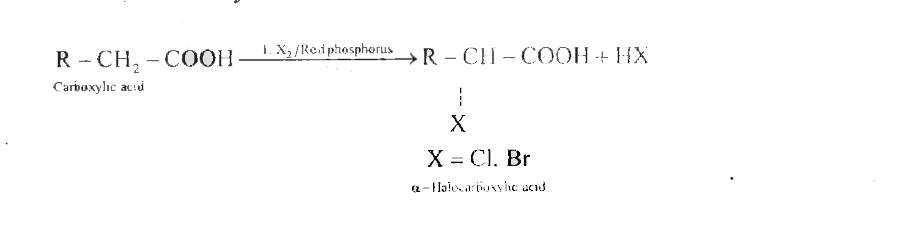
|
|
| 5. |
Explain how you can determine the atomic mass of an unknown metal if you know its mass density and the dimensions of unit cell of its crystal. |
|
Answer» Solution :The RELATION between different quantities in a SOLID is given by `M=(d"xxa^(3)xxN_(A))/(z)` where M = Atomic mass of the element, d = DENSITY of the solid, a = Edge length of the unit cell `N_(A)` = Avogadro.s number, z = Number of atoms present in a unit cell Thus, KNOWING d, a, `N_(A)` and Z, we can calculate M, the atomic mass of the unknown METAL. |
|
| 6. |
Explain how will you find activation energy of a reaction by graphical method. (or) Draw the graph between log k vs (1)/(T). What is the relationship between its slope and acitivation energy. |
Answer» Solution :A plot of log K against `(1)/(T)` VALUES gives a straight line with slope value equal to - `E_(a)//2.303 R` and intercept value equals to log A. (II) The plot gives a NEGATIVE slope straight line also. (iii) From the slope of straight line `E_(a)` can be calculated. |
|
| 7. |
Explain how vacanciesare introduced in an ionic solid when a cation of higher valence is added as an impurity in it. |
| Answer» Solution :Each cation of higher valence will replace two or more cations of LOWER valence in the crystal lattice in order to MAINTAIN electrical neutrality. Thus some cation vacancies are created. For EXAMPLE, if `SrCl_2` is added to NaCl during crystalisation, some of the sities of `NA^+` are replaced by `Sr^(2+)`. Each `Sr^(2+)` ions replaces two `Na^+` to maintain electrical neutrality, `Sr^(2+)` occupies one of the sites of `Na^+` and the other site remains VACANT. | |
| 8. |
Explain how thermodynamics is helfpul in selection of reducing agent for metallurgical operations. |
|
Answer» Solution :To understand the theory of metallurgical transformations, the Gibb.s free energy changes is the most significant term. For any reaction, the Gibb.s free energy change is given by : `DeltaG = DeltaH - TDeltaS` Where, `DeltaH` = Enthalpy change T = Temperature in kelvin. `DeltaS` = Entropy change for the process. The criterion for the feasibility of a thermal reduction is that at a given temperature the Gibb.s free energy change for the reaction must be negative. When the value of `DeltaG` is negative only then the reaction will proceed. Under following conditions the value of `DeltaG` is negative. (i) If `DeltaS` is positive on increasing the temperature (T) the value of `TDeltaS` INCREASES so that `DeltaH < TDeltaS`. In this situation `DeltaG` will become negative on increasing temperature. (ii) If coupling of the two reactions, i.e. reduction and OXIDATION results in negative value of `DeltaG` for overall reaction, the final reaction becomes feasible. Such coupling can be understood by studying plots of `(Delta_rG^(THETA))` v/s T for the formation of oxides. These plots are drawn for free energy changes when one gram mole of oxygen is consumed. The graphical representation of Gibb.s free energy VERSUS temperature was first used by H.J.T. Ellingham which provides the basis for considering choice of reducing agent in the reduction of oxides. This is known as Ellingham diagram. Such diagrams helps in predicting the feasibility of thermal reduction of an ore. |
|
| 9. |
Explain how the voids can be located in a crystal lattice ? |
Answer» Solution :(i) Locating tetrahedral voids :  A unit cell of fcc or ccp is divided into eight SMALL cubes where each small cube has four atoms at alternate corners. The four atoms at the corners when joined to each other MAKES a regular tetrahedron. THUS each cube has one tetrahedral void and therefore there are eight tetrahedral voids in a unit cell of FOC. (ii) Locating octahedral voids :  In a fcc, the body centre of the cube is surrounded by six atoms located at the centre of faces. If these face atoms are joined, a regular octahedron is formed. Hence there is one octahedral void at the body centre of the cube. Besides the body centre, there is one octahedral void at the centre of each of the 12 edges of the cube. It is surrounded by six atoms, three of same unit cell and three of adjacent unit cell. Since each edge of the cube is shared th between four adjacent unit cells, Only `(1/4)^(th)` of each octahedral void belongs to particular unit cell. Thus in a cubic close packed structure the total NUMBER of octahedral voids are 4. `(12 xx 1/4) + 1` (Body centre) = 4. |
|
| 10. |
Explain how the phenomenon of adsorption finds application in each of the following processes : (i) Production of vacuum(ii) Heterogeneous catalysis (iii) Froth floatation process. |
|
Answer» Solution :(i) Production of vacuum : The remaining traces of air can be adsorbed by charcoal from a vessel which has been evacuated by vacuum pump. This brings about complete vacuum in the vessel. (ii) Heterogeneous catalysis : When the catalyst and the REACTANTS in a reaction are in different physical states (solid, liquid, gas), it is known as heterogeneous catalysis. For example, oxidation of sulphur dioxide to sulphur trioxide takes place in the presence of Pt. `2SO_2 (G)+O_2(g) overset(Pt)to 2SO_3` This is an example of heterogeneous catalysis. (iii) Froth floatation process : A low grade sulphide ore is concentrated by separating it from silica and other earthy IMPURITIES USING pine oil and frothing agent. On passing air, the sulphide particles are WETTED by oil and rise upwards and are collected separately. The impurity are not wetted by oil and remain suspended. |
|
| 11. |
Explain how the nature of ligand affects the stability of complex ion. |
|
Answer» SOLUTION :STRONG ligand: More stability Weak ligand : LESS stability |
|
| 12. |
Explain how sustitution and elimination reactions compete in the same reaction ? |
Answer» Solution :The substitution reactions and elimination reacts ALWAYS take place in a competition. The PATH of the reaction and the product formed depends on the following factors : (i) Nature of substrate (II) Strength of the nucleophiles (iii) Strength of the base (iv) Nature of solvents (v) Temperature of the reaction High temperature favours elimination reaction whereas low temperature favours substitution reaction. 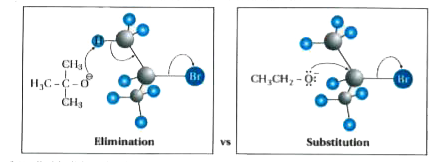 In case of `3^(@)` - alkyl halides, the `S_(N)1` is major product when substitution reaction and elimination reactions take place in competition in the presence of weak base. The tertiary but OXIDE is a strong base but bulky nucleophile. So, it will prefer to abstract a proton from tertiary halide and thus cause the elimination reaction to form alkene as a major product. However, if alkyl halide is primary, the `S_(N)2` reaction takes place. The ethoxide ion is a strong nucleophile and also a stronge base. With tertiary halide it causes both elimination and substitution `(S_(N)1)` reaction, however, elimination product (alkene) will be major due to strong basic CHARACTER of ethoxide ion. If alkyl halide is primary, the ethoxide ion cause `S_(N)2` reaction. |
|
| 13. |
Explain how rusting of iron is envisaged as setting up of an electrochemical cell. |
|
Answer» Solution :The moisture on the surface of iron dissolves acidic oxides in the air like`CO_(2),SO_(2)`etc., to form acids which dissociate to give `H^(+)`ions `H_(2)O + CO_(2) to H_(2)CO_(3) `Fe(s) to Fe^(2+) (aq) + 2e^(-)`(oxidation) The electrons thus released move through the metal to reach another spot where H+ ions and the dissolved oxygen TAKE up these electrons and reduction reaction takes place. Hence, this spot acts as the cathode `O_(2)(g) + 4H^(+) (aq) + 4e^(-) to2H_(2)O (L)` reduction) The overall reaction MAY be written as `2Fe(s) + O_(2)(g) + 4H^(+)(aq) to 2Fe^(2+)(aq) + 2H_(2)O (l)` Thus, an electrochemical CELL is set up on the surface. |
|
| 14. |
Explain how rusting of iron is envisaged as electrochemical cell. |
|
Answer» Solution :In corrosion, a metal is oxidised by loss of ELECTRONS to oxygen with the formation of oxides. So, an electrochemical cell is set up. EG: Rusting of iro involves the following steps : i) The water layer present on the surface of iron dissolved acidic oxides from air like `CO_(2)` and forms acid to PRODUCE `H^(+)` ions. `H_(2)O +CO_(2)H_(2) CO_(3)hArr2H^(+)+CO_(3)^(2-)` ii) I the PRESENCE of `H^(+)` ions, iron starts losing electrons at some spot to form ferrous ions. This spot behaves as anode. `Fe(s)overset("Oxidation")rarrFe_((aq))^(2+)+2e^(-), [E_((Fe^(2+)//Fe))^(@)=-0.44 V]` iii) The electronic released at anode move to another spot, where `H^(+)` ions and the dissolved oxygen gain these electrons. This spot becomes a cathode. `O_(2(g))+4H_((aq))^(+)+4e^(-) overset("Reduction")rarr2H_(2)O_((l)),` `[E_((H^(+)//O_(2)//H_(2)O)^(@)=1.23 V]` iv) Overall reaction, i.e., redox reaction is : `2Fe_((s))+O_(2(g)) +4H_((aq))^(+) rarr 2Fe_((aq))^(2+)+2H_(2)O_((l)), [E_("cell")^(@)=1.67 V]` v) Ferrous ions are further oxidised by the atmospheric oxygen to ferric ions which combine with water molecules to form hydrated ferric oxide, `Fe_(2)O_(3). xH_(2)O`. (Rust) 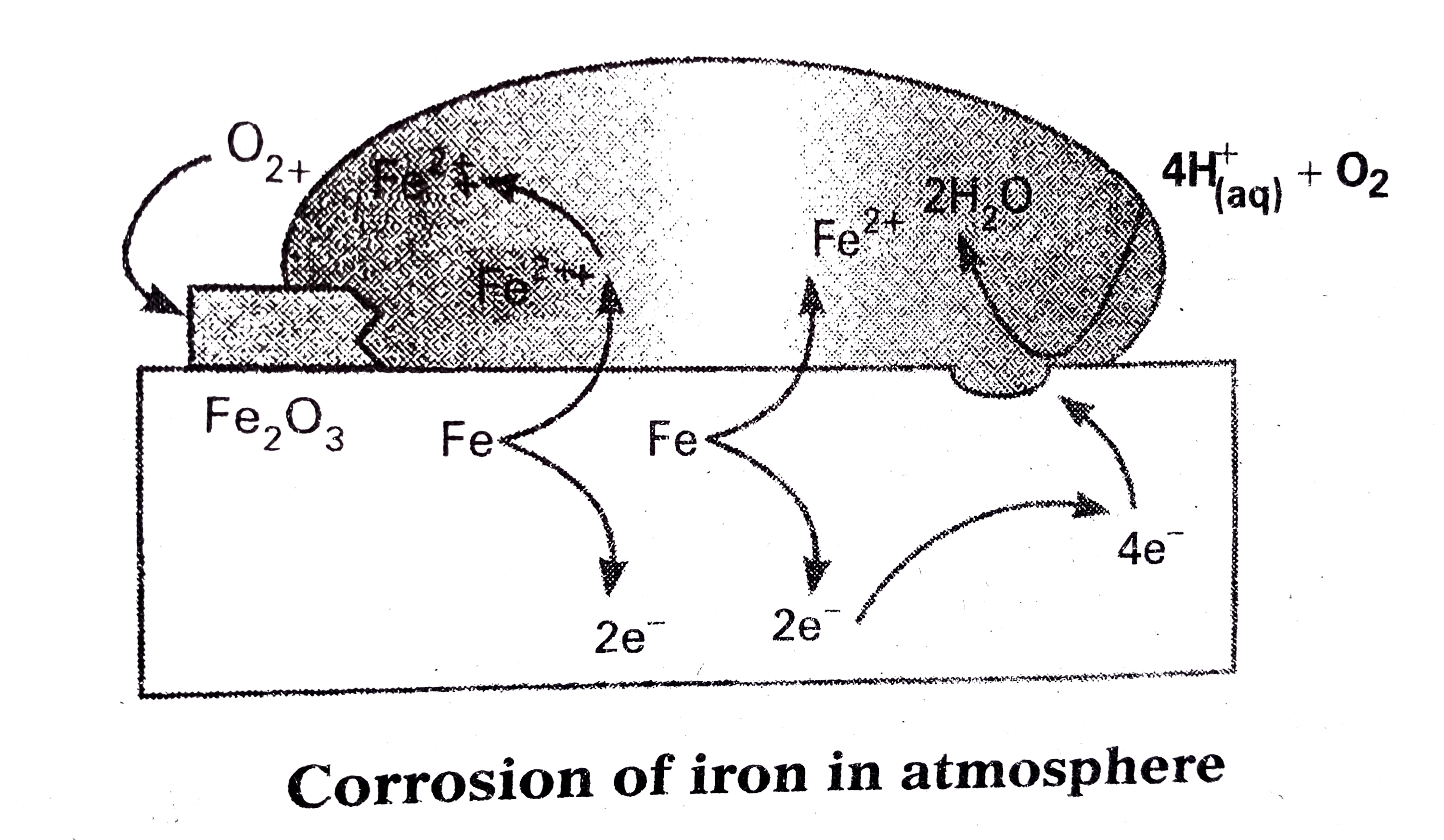 Oxidation `:Fe_((s))rarr Fe_((aq))^(2+)+2e^(-)` Reduction `:O_(2(g))+4H_((aq))^(+)+4e^(-) rarr 2H_(2)O_((l))` Atmospheric oxidation `:2Fe_((aq))^(+)+2H_(2)O_((l))+(1)/(2)O_(2(g))rarr Fe_(2)O_(3(s))+4H_((aq))^(+)` |
|
| 15. |
Explain how physical adsorption of a gas on the solid surface depends upon temperature. |
| Answer» | |
| 16. |
Explain how much portion of an atom located at (i) corner and (ii) body-centre of a cubic unit cell is part of its neighbouring unit cell. |
|
Answer» SOLUTION :(i) The atom located at the corner of a cubic unit cell is SHARED by EIGHT neighbouring unit cells. Hence, it shares `( 1/8)^(th)` a PORTION of an atom. (ii) The atom located at body-centred shares no portion of it with any neighbouring unit cell. It BELONGS fully to only one unit cell. |
|
| 17. |
Explain how nitrogen gets adsorbed on surface of iron. |
| Answer» SOLUTION :NITROGEN is physisorbed at LOW TEMPERATURE and chemisorbed at HIGH temperature. | |
| 18. |
Explain how much portion of an atom located at (i) corner and (i) body-centre of a cubic unit cell is part of its neighbouring unit cell. |
|
Answer» Solution :(i) An atom at the corner of a UNIT cell is shared by 8 neighbouring cells. Hence, portion of the atom that belongs to ONE unit cell is `1//8`. (ii) Atom at the CENTRE of BODY of cubic unit cell belongs completely to that unit cell. Thus, full portion of that atom belongs to the unit cell. |
|
| 19. |
Explain how much portion of an atom located at corner and body centre of a cubic unit cell is part of its neighbouring unit cell. |
| Answer» Solution :An ATOM PRESENT at the body CENTRE is not shared by any other unit CELL. It completely belongs to that unit cell. | |
| 20. |
Explain how much portion of an atom located at corner and body centre. |
| Answer» Solution :An atom at the corner is SHARED by eight other unit CELLS in three- DIMENSIONAL arrangement hence CONTRIBUTION of each atom at the corner is `frac{1}{8}` | |
| 21. |
Explain how monosaccharides are classified : |
|
Answer» Solution :Monosaccharides are classified as : (1) Aldoses: Aldoses contain aldehydic `(-OVERSET(H)overset(|)C=O)` group in their structure . Example : Glucose . Aldoses are further classified depending upon the number of CARBON atoms PRESENT in the monosaccharide . The number of carbon atoms presents in the molecule in indicated by the prefix tri for 3-carbon, tetrafor 4-carbon , etc. The ALDOSE accordingly is called Aldotriose, Aldotetrose, Aldopentose, Aldohexose, etc. Examples: Glyceraldehyde`""C_(3)H_(6)O_(3)""` Aldotriose Erythose `""C_(4)H_(8)O_(4)""` Aldotetrose Ribose, Arabinose , Xylose `""C_(5)H_(10)O_(5)""` Aldopentose Glucose , Mannose `""C_(6)H_(12)O_(6) ""` Aldohexose (2) Ketoses : Ketoses contain ketonic , 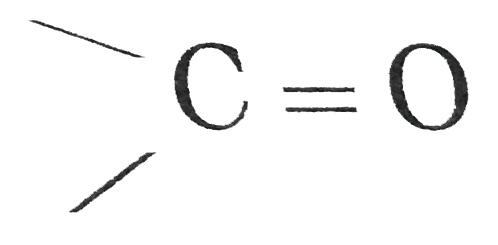 group in their structures. Example: Fructose. group in their structures. Example: Fructose. Ketoses are further classified depending upon the number of carbon atoms present in the monosaccharide. The number of carbon atoms present in the molecules is indicated by the prefix, tri for 3-carbons , tetra for 4-carbons, etc. The ketoses accordingly are called ketotriose, Ketotetrose, Ketopentose, KETOHEXOSE, etc. Examples :Dihydroxy acetone `""C_(3)H_(6)O_(6)""`Ketotriose Erythrulose `""C_(4)H_(8)O_(4)""`Ketotetrose Ribulose `""C_(5)H_(10)O_(5)""` Ketopentose Fructose `""C_(6)H_(12)O_(6)""` Ketohexose |
|
| 22. |
Explain how iron is protected from corrosion by coating with magnesium. |
| Answer» Solution :In this technique, METALS such as Mg or zinc which is corroded more easily than IRON can be used as a sacrifical anode and the iron MATERIAL ACTS as a cathode. So iron is protected, but Mg or Zn is corroded. | |
| 23. |
Explain how he should proceed to get p-nitroaniline from aniline. |
| Answer» SOLUTION :Before nitration, the `NH_2` GROUP in aniline should be protected by ACETYLATION. | |
| 24. |
Explain how each sphere (particles) contributes in formation of particular unit cell. |
|
Answer» Solution : To study the contribution of atoms or particles per unit cell following POINTS are noted : (i) Each ATOM located at the corner of the unit CELLS is shared between eight adjacent unit cells i.e., four unit cells of same layer and four unit cells of the immediate upper or lower layer. Hence, `(1/8)^(th)`part of the atom belongs to a one only unit cell.  (ii) An atom present at the centre of the face of the cubic unit cell is shared EQUALLY by two unit cells having the COMMON face. Hence, the atom present at the centre of the face of a cubic unit cell contribute only `(1/2)` of a particular cell  An atom located at the centre of body of a cubic unit cell belongs to that particular cell only. Hence, the atom at body centred of unit cell contributes 1 to a particular unit cell.  (iv) An atom located at the centre of edge of a cubic unit cell is shared equally by four unit cell. Hence, the atom at edge centre of unit cell contributes `(1/4)^(th)` to a unit cell.  . .
|
|
| 25. |
Explain how does the presence or absence of hydrogen on nitrogen of amines affect the modes of their reactions with nitrous acid. |
| Answer» Solution :Primary, sec. and ter. AMINES have TWO one and no H-atoms attached to nitrogen respectively and differ in their action towards NITROUS acid. | |
| 26. |
Explain how does the -OH group attached to a carbon of benzene ring activate it towards electrophilic substitution ? |
Answer» Solution :`to` The -OH group is electron releasing groups. It increases the electron density at ortho and para positions through resonance. The electrophiles being electron deficient in nature attacks the ring at electron high density regions, i.e., ortho and para- positions. THUS, -OH group of benzene activates the ring towards electrophilic substitution reaction.  `to` From the structures II, III and IV, it is clear that ortho and para positions are most active sites for the electrophilic ATTACK. |
|
| 27. |
Explain how does the -OH group attached to a carbon of benzene ring activate it towards electrophilic substitution? |
Answer» Solution :Phenol may be regarded as a resonance hybrid of structures, I-V.  As a result of `+R-`effect of the OH GROUP, the electron density in thebenzene ring increases thereby facilitating the attack by an electrophile. In other WORDS, presence of `OH` group, activates the benzene ring towards electrophilic substitution reactions. Further, SINCE the electron density is relatively higher at the two o - and ONE p - position, therefore, electrophilic substitution occurs mainly at o - and p - positions. |
|
| 28. |
Explain how does -OH group attached to a carbon of benzene ring activate it towards electrophilic substitution? |
| Answer» Solution :Phenol may be REGARDED as a resonance hybrid of STRUCTURES, As a result of +R-efffect of the OH group, the electron density in the benzene RING increases thereby facilitating the attacck by an electrophile. In other words, presence of OH group, activates the benzene ring towards electrophilic substitution reactions. further SINCE the electron density is relatively higher at the two o- and one p- POSITION, therefore, electrophilic substitution occurs mainly at o- and p-positions. | |
| 29. |
Explain how does 1,3-butadiene polymerize by different routes ? |
|
Answer» Solution :1,3-Butadiene is a conjugated diene. It can polymerize either by 1,4-addition or by 1,2-addition MECHANISM as shown below : (i) 1,4-Polymerization : When the polymerization occurs at the terminal CARBON atoms , i.e., `C_1 and C_4` of 1,3-butadiene molecules , an unbranched POLYMER is formed. 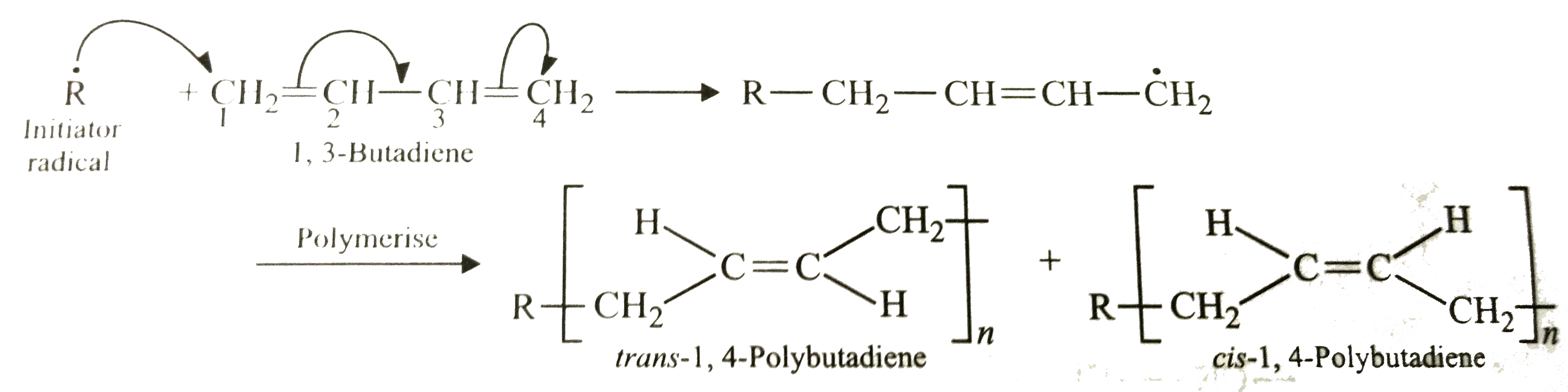 Each repeating unit of this polymer contains a double bond , each carbon ATOM of which has two DIFFERENT substituents , therefore , these polymers can exist in two geometrical isomeric forms , i.e., forms , i.e., cis -and trans. (ii) 1,2-Polymerization : Alternatively , 1,3, butadine can undergo polymerization at `C_1 and C_2` positions of 1,3-butadiene to yield the branched polymer called polyvinlylpolythene.
|
|
| 30. |
How are carbon and hydrogen of an organic compound estimated? |
Answer» Solution :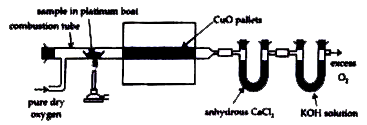 A known weight of the organic compound is taken and completely burnt in excess of air and copper (II) oxide. Then carbon oxidises to `CO_(2)` and hydrogen oxidises to `H_(2)O`. The `CO_(2)` and `H_(2)O` so obtained are passed through already weighed U TUBES containing anhydrous `CaCl_(2)` and caustic potash RESPECTIVELY. The increased weights of these TWO tubes give the weights of `H_(2)O` and `CO_(2)` formed. Suppose that 'a'g of organic compound on combustion gives 'b' g of water vapour and 'c'g of `CO_(2)`. % of carbon: 44 g of `CO_(2)` contains 12 g of carbon. `therefore` 'c'g of `CO_(2)` contains . ..? `=(12xxc)/44` g of carbon 'a' g of organic compound contains `(12xxc)/44` g of carbon `therefore` 100 organic compound contains ………………. ? `= (100 xx 12 xx c)/(a xx 44)` g of carbon (% of C) % of hydrogen : 18 g of water contains 2 g of `H_(2)` `therefore ` b of water contains …………… ? `= (b xx 2)/(18)` g of hydrogen a g of organic compounds contains `(b xx 2)/(18)` g of hydrogen . `therefore` 100 g of organic compound contains ........... ? `= (b xx 2 xx 100)/(18 xx a)` g of hydrogen (% of H) |
|
| 31. |
Explain how colloids get coagulated on addition of salts. |
|
Answer» |
|
| 32. |
Explain how coagulation of colloid is carried out by (i) Electrophoresis (ii) By mixing two oppositely changed sols (iii) By boiling. |
|
Answer» Solution :(i) Electrophoresis: In electrophoresis, charged particles migrate to the electrodes of opposite sign. It is due to neutralization of the charge of the colloids. The particles are discharged and so they GET precipitated. (ii) By mixing two oppositely charged sols: When colloidal sols with opposite charges are MIXED, mutual coagulation takes PLACE. It is due to migration of ions from the SURFACE of the particles. (iii) By boiling: When colloidal sol is boiled, due to increased collisions, the sol particles combine and SETTLE down. |
|
| 33. |
Explain how artificial rain can be caused by spraying charged dust particles over colloids |
| Answer» Solution :Clouds represent the colloidal solutions of water drops in air (liquid in gas type). These drops are EXPECTED to carry some charge (positive or NEGATIVE). In order to neutralize the charge on these, charged dust particles CARRYING opposite charge are SPRAYED over a certain layer of cloud. These will neutralize the charge on water droplets resulting in their coagulation. The BIGGER water drops can no longer be retained by the atmosphere and will result in the artificial rain. | |
| 34. |
Explain how an OH group attached to a carbon in the benzene ring activates benzene towards electrophilic substitution. |
Answer» Solution :An `-OH` group activates the benzene ring towards electrophilic SUBSTITUTION by increasing NEGATIVE charge on the ring through RESONANCE.  SINCE there is `-ve` charge at o - and p - POSITION, it means `-OH` group activates benzene ring toward electrophilic substitution reaction. |
|
| 35. |
Show how Acetophenonecompound can be convered to benzoic acid. |
|
Answer» Solution :Acetophenone on oxidation with IODINE and alkali gives iodoform and sodium benzoate . The latter on acidification gives benzoic acid . `C_(6) H_(5) CO CH_(3) OVERSET(I_(2) //KI)underset(NaOH)(to) C_(6) H_(5) COONA + CHI_(3)` `C_(6) H_(5) COO Na overset(HCl) (to) C_(6) H_(5) COOH` |
|
| 36. |
Explain Hoffmann's exhaustive methylation. |
|
Answer» Solution :METHYLATION of amines : The reaction in which a hydrogen ATOM attached to nitrogen atom of amines is replaced by methyl group is called methylation of amines. HOFFMANN's exhaustive methylation : The process of convert- ing a primary, secondary or tertiary amine into quaternary ammonium halide by heating them with excess of methyl iodide, is called exhaustive methylation or Hoffmann's exhaustive methylation. Thus when methyl amine is heated with excess of methyl iodide it forms dimethylamine (secondary amine), then trimethylamine (a tertiary amine) and finally of quaternary ammonium iodide. The reaction is carried out in the PRESENCE of mild base `NaHCO_(3)`, to neutralize the large quantity of HI formed. (1) `underset("Propanamide")(CH_(3)-N)H_(2)+ underset("methyl iodide")( CH_(3)-I)overset(triangle)(rarr) underset("dimethylamine")((CH_(3))_(2)N-) H +HI` (2)`underset("dimethylamine")((CH_(3))_(2)N-)H+ underset("methyl iodide")( CH_(3)-I)overset(triangle)(rarr) underset("trimethylamine")((CH_(3))_(4)N+)HI` (3)`underset("dimethylamine")((CH_(3))_(2)N)+ underset("methyl iodide")( CH_(3)-I"")overset(triangle)(rarr) underset(underset(("quaternary ammonium aslt"))("tetramethyl ammonium iodide"))((CH_(3))_(4)overset(+)(N)overset(-)(I)"")` |
|
| 37. |
Explain Hoffmann degradation of amides. OR Write a note on Hoffmann bromide reaction. |
|
Answer» Solution :The conversion of amides into aminse in the PRESENCE of bromine and alkali is known as Hoffmann degradation of amides. An important characteristic of this reaction is that an amine with one carbon LESS than those in the amide is formed. This reaction is an example of molecular rearrangement and involves the migration of an alkyl or aryl group from the carbonyl carbon to the adjacent nitrogen atom. For example, (1) When propanamide is treated with bromine and aqueous or alcoholic sodium hydroxide, ethanamine is obtained which has one carbon atom less. `underset("Propanamide")(CH_(3)-C)H_(2)-overset(overset(O)(||))(C)- NH_(2) + br_(2)+4NaOH rarr` `underset("Ethanamine")(CH_(3)-C)H_(2)- NH_(2) + Na_(2)CO_(3)+2NaBr+2H_(2)O` (2) When benzamide is treated with bromine and aqueous of alcoholic sodium Hydeoside, aniline is obtained. 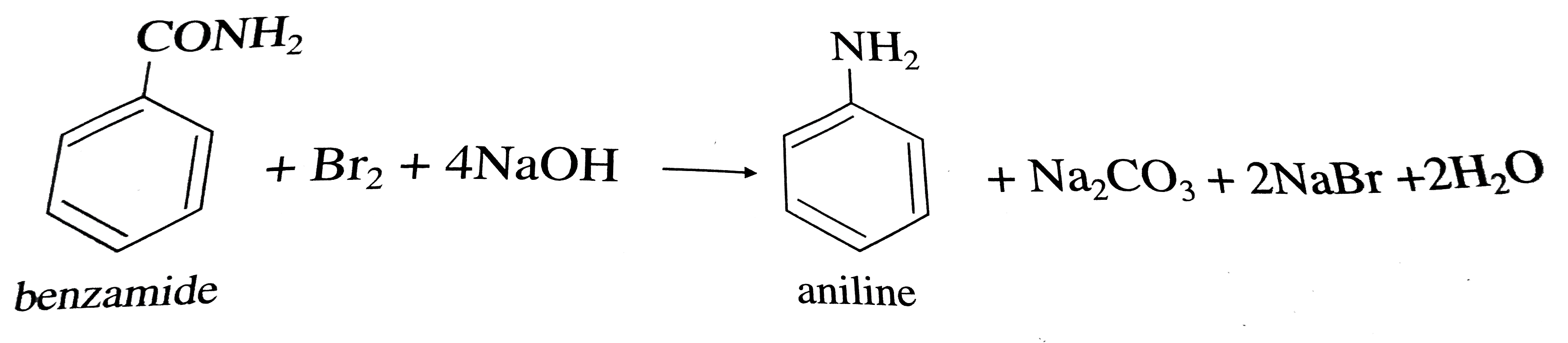
|
|
| 38. |
Explain Hoffmann's bromamide degradation reaction for the preparation of methanamine. |
|
Answer» Solution :Hoffmann.s Bromamide reaction : When an ACID amide is heated with BROMINE and potassium HYDROXIDE solution, a primary amine is OBTAINED `R-CONH_2+Br_2+4KOHoverset(3)toR-NH_3+K_2CO_3+2KBr+2H_2O` and `R=CH_3` |
|
| 39. |
Explain Hoffmann bromamide degradation reaction. |
| Answer» Solution :Amides when TREATED with `Br_(2)` in ag `NaOH`, amine is formed, contains one carbon less than that present in amide. <BR> `RCONH_(2)+Br_(2)+4NaOHrarr RNH_(3)+Na_(2)CO_(3)+2NaBr+2H_(2)O` | |
| 40. |
Explain Hoffmann bromamide degradation for the preparation of methanamine. |
|
Answer» Solution :b) When acetamides are heated with bromine and `NaOH//KOH` (alcoholic/aqueous) Hoffmann.s bromamide DEGRADATION takes place LEADING to the FORMATION of methanamine is obtained. `underset("Acetamide")(CH_(3)-overset(O)overset(||)C-NH_(2))+Br_(2)+4NaOH overset(Delta)rarr underset("Methanamine")(CH_(3)-NH_(2)+Na_(2)CO_(3))+2NaBr+2H_(2)O` |
|
| 41. |
Explain Hoffman mustard oil reaction. (or) Explain the action of CS_(2) with aniline. |
Answer» Solution :When aniline is TREATED with `CS_(2)`, or heated together, S-diphenylthio UREA is formed, which on boiling with strong HCl, phenyl isotiocyanate (phenyl MUSTARD oil), is formed.  The above REACTION is known as Hoffmann mustard oil reaction. |
|
| 42. |
Explain : Grignard reagents should be prepared under anhydrous conditions. |
|
Answer» Solution :Grignard REAGENTS react with moisture (WATER) to produce ALKANES. Therefore, they are prepared under anhydrous conditions. `RMgX + H_(2)O to R - H + Mg(OH) X` . |
|
| 43. |
Explain Haloform reaction. |
|
Answer» Solution : A ketone containing `-COCH_(3)`group is oxidised by sodium hypohalite and results in the formation of sodium salt of carboxylic acid having one carbon atom less than that of ketone and METHYL group is converted to HALOFORM. `CH_(3) - overset(O)overset(||)(C) - CH_(3)+3NaOl underset(Delta) overset(NaOH//X_(2))to R- overset(O)overset(||)C-overset(-)Ooverset(+)N + underset("haloform")(CHX_(3)) + 2NAOH` Acetaldehyde is the only aldehyde which gives haloform reaction. In this reaction, R may be hydrogen, methyl group or aryl group and X may be Cl , Br or I. When a methyl ketone is warmed with iodine and sodium hydroxide, a YELLOW precipitate of iodoform is obtained. The iodoform reaction is used as a qualitative test for detection of CH,CO-group in an organic compound . `CH_(3) - overset(O)overset(||)(C) - CH_(3)+ 3NaOl underset(Delta) overset(NaOH//I_(2))to CH_(3)-overset(O)overset(||)(C) - overset(-)Ooverset(+)Na+ underset("(Yellow percipitate)")underset("iodoform")(CHI_(3))+2NaOH` |
|
| 44. |
Explain Gravity separation process or Hydraulic washing process?[OR] How will you concentrate oxide ores?[OR] Explain the suitable method to concentrate hematite and tinstone ores. |
| Answer» Solution :In thismethod,the ore having high SPECIFIC gravity is separated from the gangue that has low specific gravity by simply washing with running water.Ore is crushed to a finely powered from and treated with rapidly flowing current of water.During this process the lighter gangue particles are WASHED away by the running water.This method is generally applied to concentrate the natice ore such as GOLD and oxide ORES such as hematite `(Fe_(2)P_(3))`,tin stone `(SnO_(2))` ETC. | |
| 45. |
Explain graphicalrepresentations of the firstorder reaction. |
|
Answer» Solution :(1) A graph of rateof a reaction andconcentration : The differentialrate law for firstorder reaction, `A to` Products isrepresented as, RATE` = -(d[A])/(dt) = k[A]` `therefore` Rate `= k xx [A]_(t)""(y= mx)` WHENTHE rateof a firstorderreactionis plottedagainst concentration, `[A]_(t)` , a straightlinegraph is OBTAINED. With the increase in the concentration `[A]_(t)`, rate R, increases. The slope of the line gives the value of rate constant k. (2)A graph of concentration against time : When the concentration of the reactant is plotted against time t, a curve is obtained. The concentration `[A]_(t)` ofthereactant decreases exponentiallywith time. The variationin theconcentration can be represented as,`[A]_(t)= [A]_(0) e^(-kt)` where [A], and [A] are initial and final CONCENTRATIONS the reactant and k is the rate constant. The time required to complete the first order reaction is infinity. (3) A graph of half-life period and concentration : The half -lifeperiod `t_(1//2)` of a firstorderreaction is given by `t_(1//2) = (0.693)/(k)` where k is therate constant . Forthe givenreactionat constant temperature , `t_(1//2)`is constant adn independentof the concentrationof thereactant. Hence when a graphof `t_(1//2)` is plottedagainstconcentration, a stringht lineparallel to theconcentrationaxis (slope = zero) is obtained. 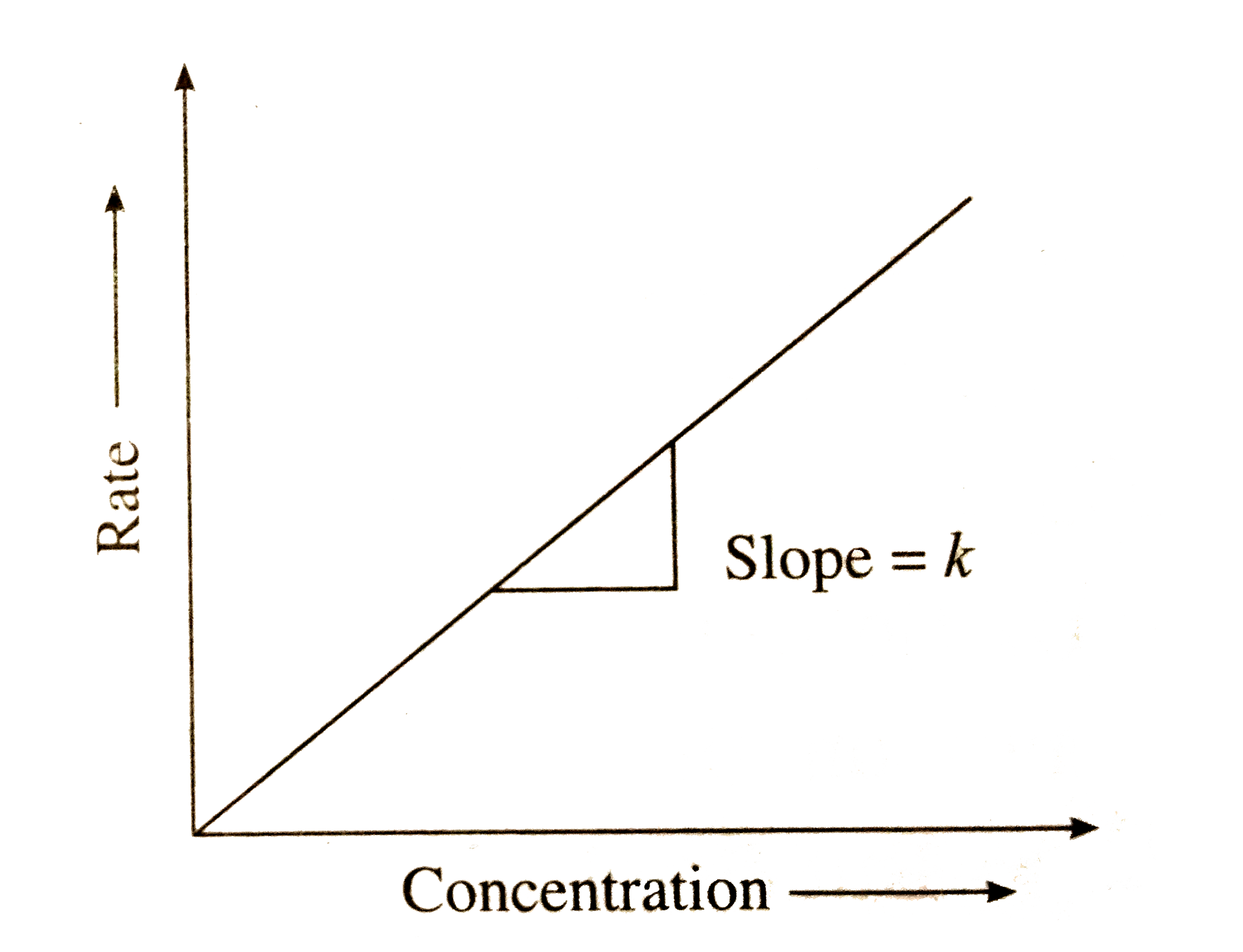 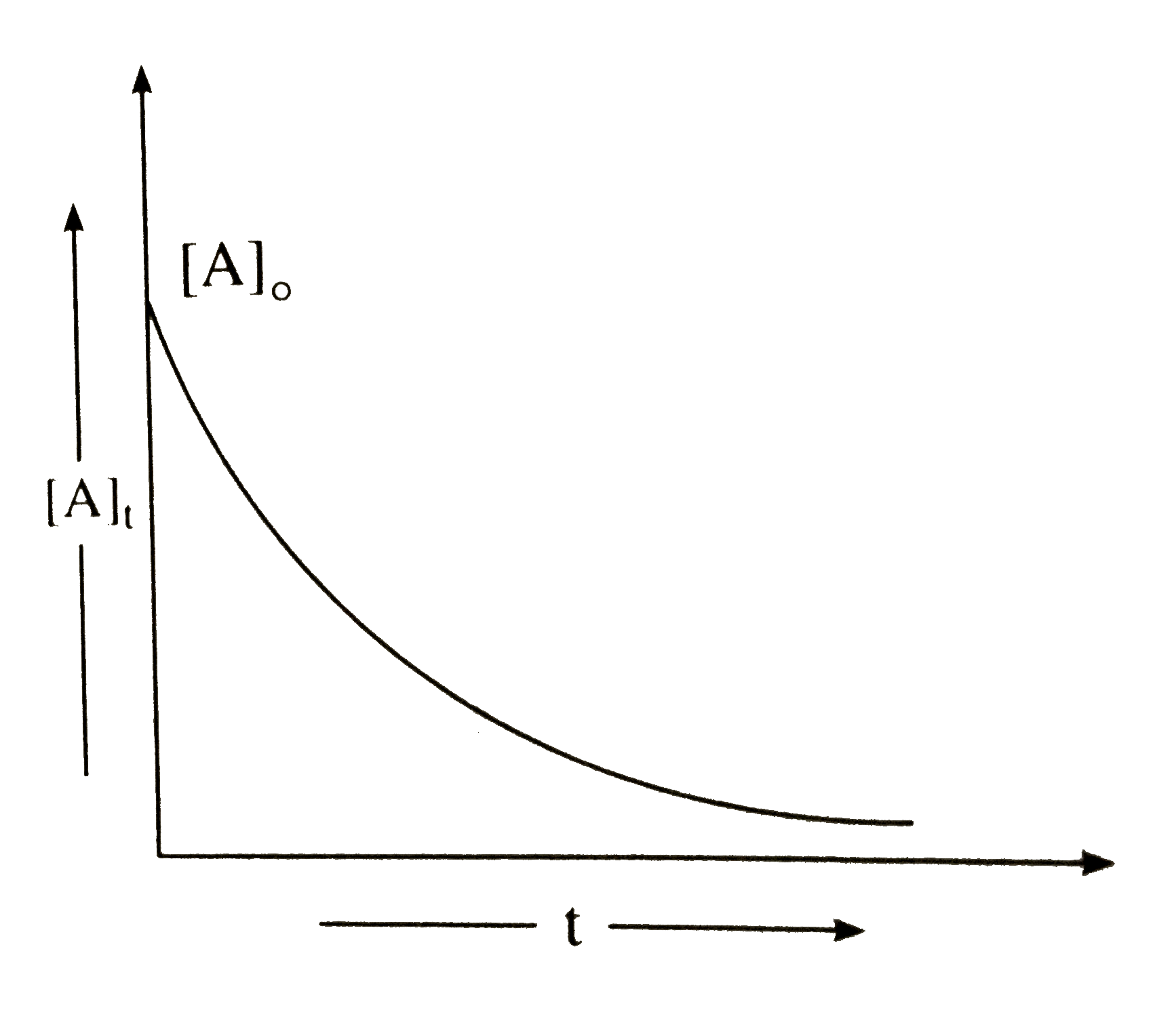 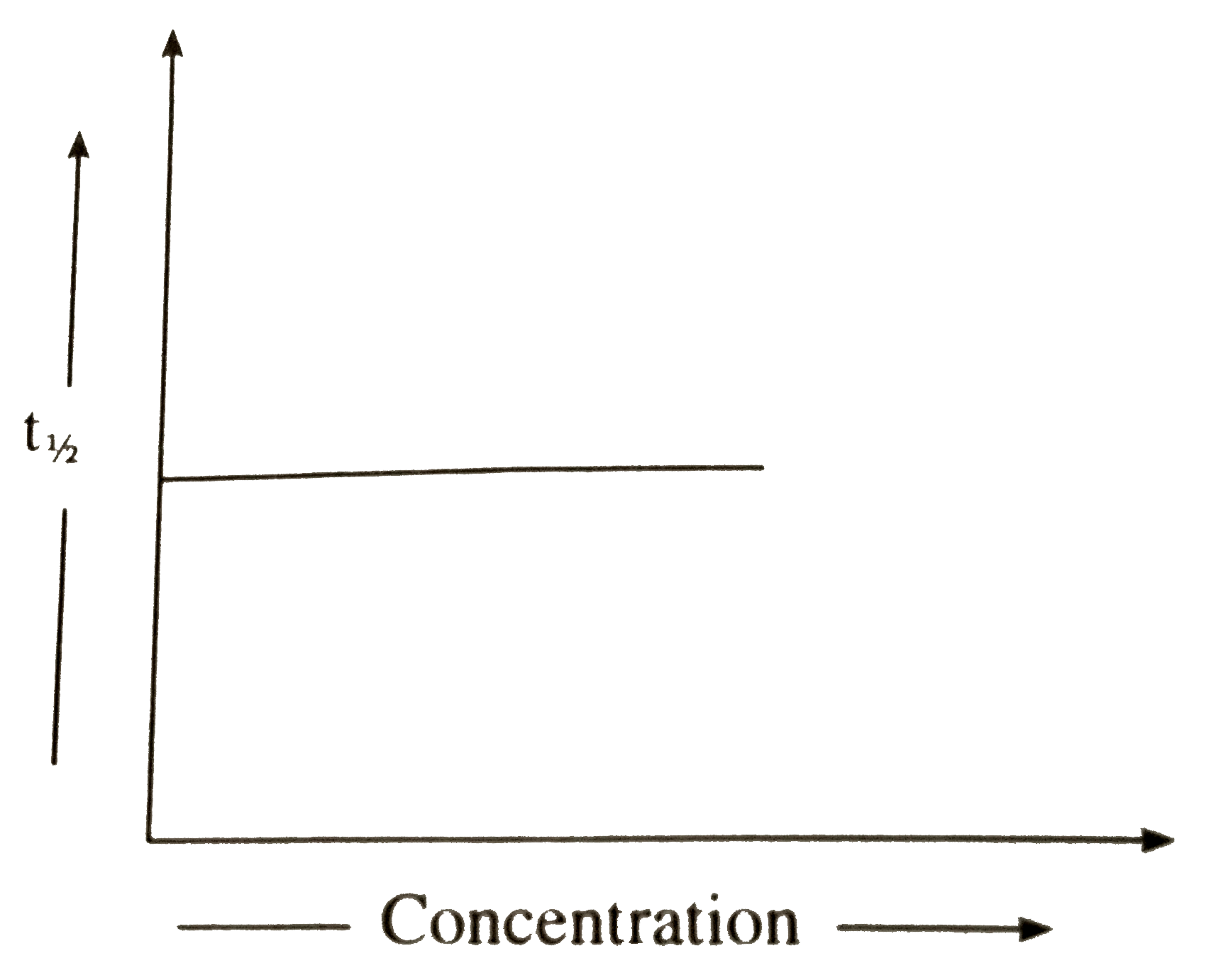
|
|
| 46. |
Explain graphical representation of chemical adsorption and physical adsorption. |
|
Answer» Solution :(i) Adsorption isotherms represents the variation of adsorption at constant temperature. (ii) When amount of adsorption is plotted versus temperature at constant PRESSURE is called adsorption iso bar 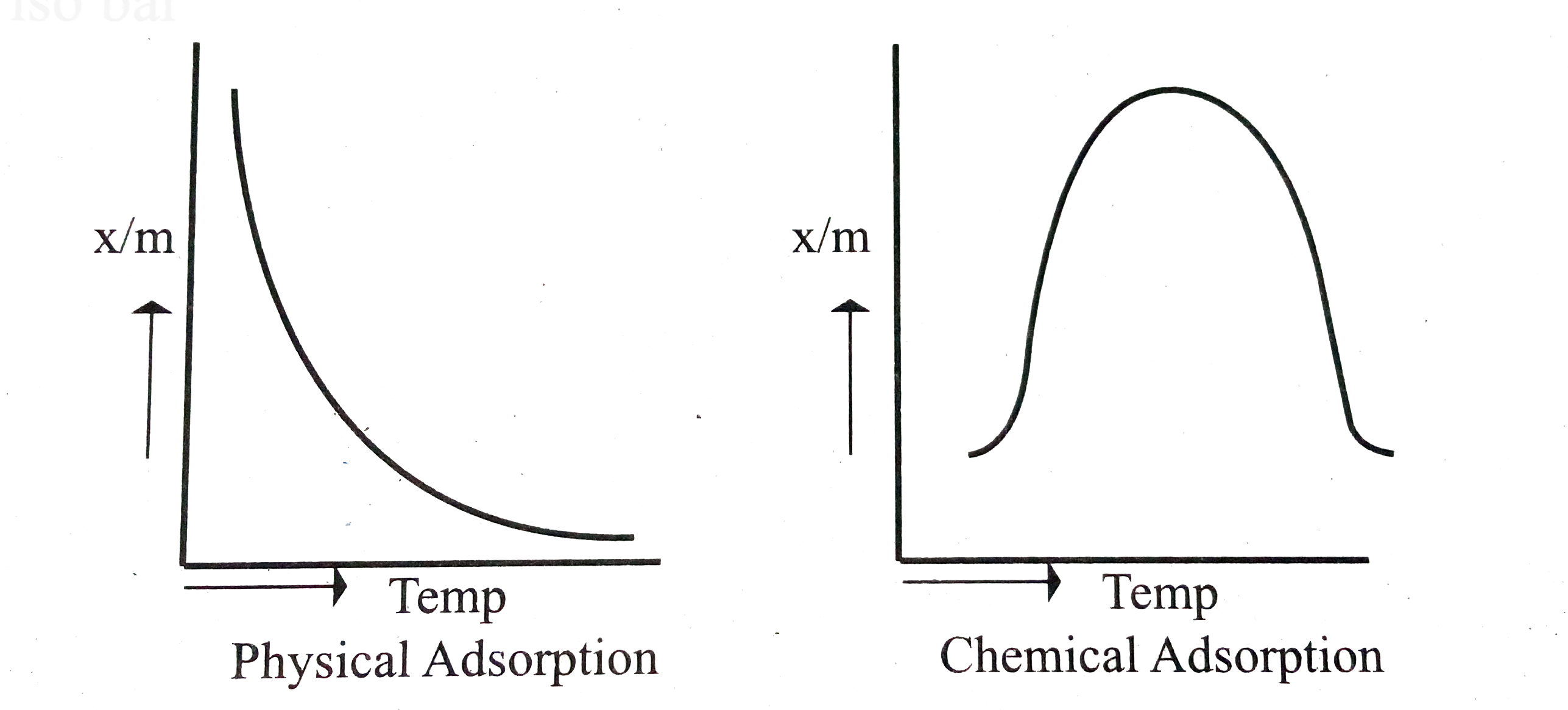 (iii) In physical adsorption x/m decreases with INCREASE in T. But in chemical adsorption x/m increases with RISE in temperature and then decreases. The increase illustrate the requirement of activation of the SURFACE for adsorption is due to the fact that formation of activated complex require certain ENERGY. The decrease at high temperature is due to desorption, as the kinetic energy of the adsorbate increases. |
|
| 47. |
Explain graphicalrepresentation of chemicaladsorptionand physicaladsorption. |
|
Answer» Solution :(i) Adsorptionisothermsthe variationof adsorptionat constanttemperature . (II)Whenamountof adsorptionis plottedversustemperatureat constantpresure is calledadsorptionisobar. 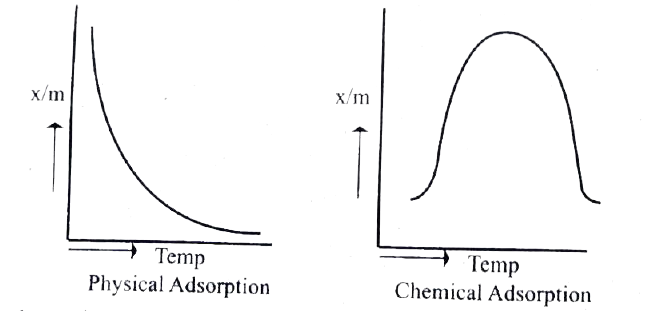 (iii)In physicaladsorption`x//m` decreaseswithin T.Butin chemicaladsorption`x//m` increaseswithrisein TEMPERATUREAND thendecreases. THEDECREASE at HIGHTEMPERATURE is DUE todesportion as thekineticenergyof theadsorbateincrease. |
|
| 48. |
Explain giving the resonating structures as well. |
Answer» SOLUTION :
|
|
| 49. |
Explain giving reasons why ionic solids conduct electricity in molten state, but not in solid state. |
| Answer» Solution : In solid state, IONS are not free to MOVE | |
| 50. |
Explain giving reasons : Transition metals and many of their compounds show paramagnetic behaviour. |
| Answer» Solution :Paramagnetism arises due to the presence of unpaired electrons in atomic and ionic species. Most of the transition metal atoms and their ions contain unpaired electrons in their penultimate (N - 1)d orbitals. Therefore, most of the transition metal ions and their compounds exhibit paramagnetic behaviour. Paramagnetic character increases as the number of unpaired electrons. The 'spin only' magnetic MOMENT is represented by, `mu_(s)=sqrt(n(n+2))BM`, where n = no. of unpaired electrons. | |