

Saved Bookmarks
This section includes 7 InterviewSolutions, each offering curated multiple-choice questions to sharpen your Current Affairs knowledge and support exam preparation. Choose a topic below to get started.
| 1. |
Explain giving reasons : The transition metals generally form coloured compounds. |
| Answer» Solution :In MANY COMPOUNDS of transition metals, the CENTRAL metal ion incompletely filled d - orbitals. Under the influence of surrounding groups or ions, the d - orbitals of the metal ion do not remain degenerate, but split usually into two sets of d - orbitals (within the same SUBSHELL). By absorption of radiation of a certain wavelength from the visible light, an electron from lower energy d - orbital is excited to a higher energy d - orbital. The compound appears to have colour which corresponds to the complementary colour of the radiation ABSORBED. The compounds, in which no d - d transition occurs, are colourless. | |
| 2. |
Explain giving reasons : The enthalpies of atomisation of the transition metals are high. |
| Answer» Solution :Due to the PRESENCE of large number of unpaired electrons in transition metal atoms, they have strong INTERATOMIC attraction and hence, stronger metallic bonding between atoms RESULTING in higher enthalpies of ATOMISATION. | |
| 3. |
Explain giving reasons : (i) Transition metals and many of their compounds show paramagnetic beaviour. (ii) The enthalpies of atomisation of the transition metals are high. (iii) The transition metals generally form coloured compounds. (iv) Transition metals and their many compounds act as good catalyst. |
|
Answer» SOLUTION :(ii) ENTHALPIES of atomisation of the transition metals are high. Energy required to separate the atoms from the lattice is known as enthalpy of atomisation. Transition metals have a high value of enthalpy of atomisation. This is indicated by high m.p. and b.p. of transition elements. They DISPLAY typical metallic properties such as high tensile strength, malleability, ductility, high thermal and electrical conductivity and metallic lustre. High value of enthalpy of atomisation is attributed to involvement of (n - 1)d electrons in addition to the ns electrons in the interatomic metallic bonding. The maxima at about the middle of each series indicate that one unpaired electron per d orbital is particularly favourable for strong interatomic interactions. In general, greater the NUMBER of valence electrons, stronger is the resultant bonding. Enthalphy of atomisation is an important factor in determining the standard electrode potential of a metal, metals with very high enthalpy of atomisation (i.e., very high boiling POINT) tend to be unreactive. It is found from the figure below that the metals of the second and third transition series have greater enthalpies of atomisation than the corresponding elements of first series. 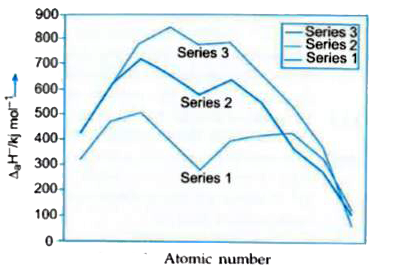
|
|
| 4. |
Explain giving reasons: (i) Transition metals and many of their compounds show paramagnetic behaviour. (ii) The enthalpies of atomisation of the transition metals are high. (iii) The transition metals generally form coloured compounds. (iv) Transition metals and their many compounds act as good catalyst. |
|
Answer» Solution :(i) Paramagnetic behaviour arises from presence of unpaired electrons. Transition metal ions have unpaired electrons. With each unpaired electron, the magnetic moment is associated with its spin angular momentum and orbital angular momentum. The orbital angular momentum for first series of transition elements is of no significance and hence the magnetic moment is determined by the number of unpaired electrons and is calculated by using spin only formula `mu= sqrt(n(n+2))`B.M, n= no, of unpaired electrons. For example, if there is one unpaired electron, `mu = sqrt(1(1 +2)) = sqrt3= 1.73` B.M. (iii) This because of incompletely filled d-orbitals and d-d transition, the transition metal ions are COLOURED. When an electron is excited from lower ENERGY d-orbitals to higher energy d-orbitals, the energy of excitation corresponds to the frequency of the light absorbed from visible spectrum. The colour of the ion corresponds to the complementary colour of the light absorbed.  (iv) This is because transition elements have tendency to adopt the multiple oxidation states and to FORM complex and adsorb the reactants on their surface thereby decreasing the activation energy of the reaction. Ex `V_(2)O_(5)` in contact PROCESS, FE in Haber.s process, Ni in catalytic hydrogenation etc |
|
| 5. |
Explain giving reasons : (i) Transition metals and their compounds generally exhibit a paramagnetic behaviour. (ii) The chemistry of actinoids is not so smooth as that of lanthanoids. |
|
Answer» Solution :(i) The TRANSITION elements involve the partial filling of d-subshells. Most of the transition METAL ions have unpaired electrons in d-subshell (from `d^(1 to 10))` and therefore they give rise to paramegnetic CHARACTER. (ii) In lanthanoids, the DIFFERENTIATING ELECTRON enters in 4f-orbital but in actinoids the differentiating electron enters in 5f-orbital which makes its chemistry slightly typical. |
|
| 6. |
Explain giving reasons each of the following : (i) Chloroacetic acid has lower pK_(a) value than acetic acid (ii) Carboxylic acids have higher boiling points than alcohols of comparable molecular masses (iii) Electrophilic substiution in benzoic acid takes place at the meta position. |
|
Answer» |
|
| 7. |
Explain general characteristics of actinoids |
|
Answer» Solution :The actinoids are all silvery in appearance and has variety of structures. The structureal variability isobtained due to IRREGULARITIES in metallic radii which are far greater than lanthanoids The actinoids are highly reactive especially when finely divided. The action of boiling water on them, for example gives a mixture of oxide and hydride. They reacts with non-METALS at moderate temperatures. Hydrochloric acid attacks all metals HOWEVER theyare passive TOWARDS nitric acid because formation of protective layer of oxides on them. Alkalies have no action. Many of the actinoids in tripositive and tetrapositive state exhibit PARAMAGNETISM because of unpaired electrons in 5f orbitals. Ex : `Th^(3+), U^(3+), Pa^(4+), Pu^(4+)` etc. are para-magnetic. The early actinoids have lower ionization enthalpies than early lanthanoids because when 5f orbitals began to occupy, they will penetrate less into the inner core of electrons. Thus, 5f electrons will therefore be more effectively sheilded from nuclear charge than the 4f electrons of the corresponding lanthanoids. Because outer electrons are less firmly held, they are available for bonding. |
|
| 8. |
Explain Gattermann-Koch synthesis. |
Answer» Solution :When benzene is treated with VAPOURS of CARBON monoxide and hydrogen chloride in the presence of a catalyst MIXTURE ofand CuCl under HIGH pressure benzaldehyde is obtained. This REACTION is called Gattermann-Koch synthesis. 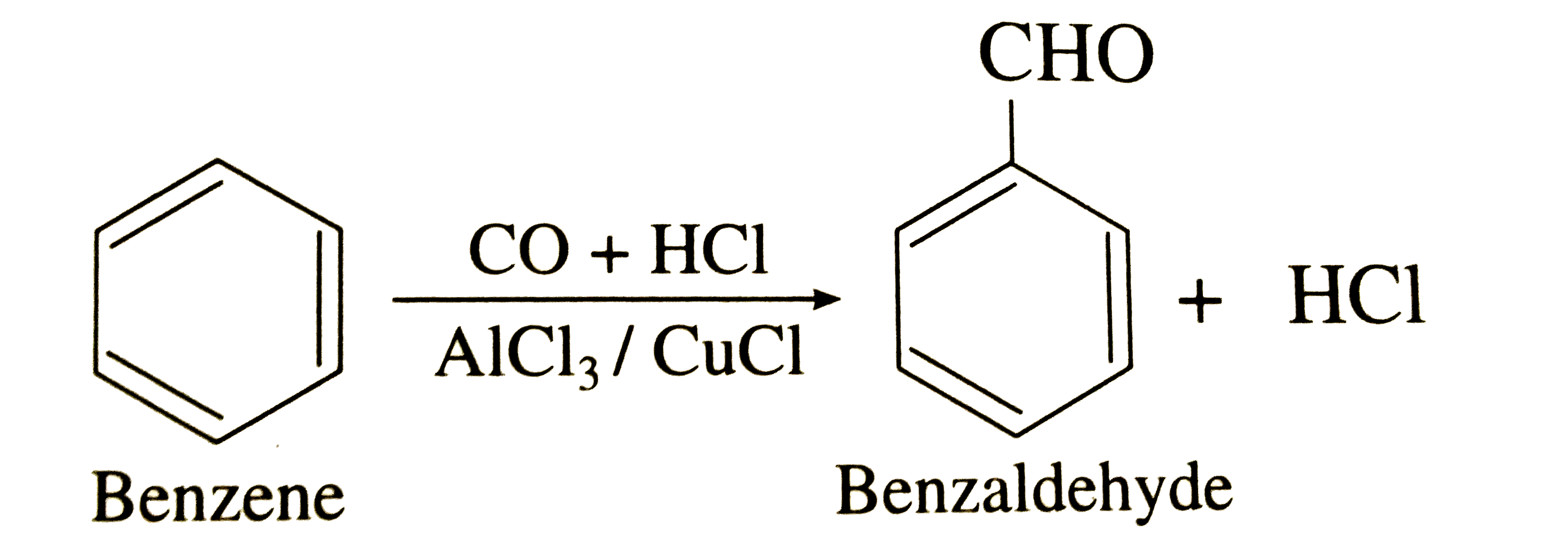
|
|
| 9. |
Explain functional isomerism in ethers. |
|
Answer» SOLUTION :Functional ISOMERISM : An ether and a monohydricalcohol containing same NUMBERS of carbon atoms are functional isomers. Example : `CH_(3)-O-CH_(3)` DIMETHYL ether and `CH_(3)-CH_(2)-OH` ethyl alcohol are the functional isomers. |
|
| 10. |
Explain Gattermann - Koch reaction. |
Answer» Solution :This REACTION is a variant of Friedel - CRAFTS acylation reaction. In this method, reaction of carbon monoxide and HCl GENERATE an intermediate which reacts LIKE FORMYL chloride. 
|
|
| 11. |
Explain froth floatation process.[OR] How will you concentration sulphide ores? [OR] Explain the concentration of copper pyrites and galena ores. |
|
Answer» Solution :Froth flotation:This method is commonly used to concentrate sulphide ores such as galena(PbS),Zinc blende (ZnS) etc.Inthis method ,the method ,the metalic ore particles which are preferentially wetted by oil be separated from gangue.In this method,the crushed ore is suspended in water and mixed with frothing AGENT such as pine oil,eucalyptus oil etc.A small quantity of sodium ETHYL xanthate which acts as a collector is also added.A froth is generated by blowing air through this mixture.The collector molecules attach to the ore particle and make them water repellent.As a result,ore particles wetted by the oil,rise to the surface along with the forth .The forth is skimmed off and dried to recover the concentrared ore.The gangue particles that are preferentially wetted by water settle at the bottom. When a sulphide ore of a metal of intrest contains other metal sulphides as inpurities,Depressing agents such as sodium cyanide ,sodium etc are used to selectively prevent other metal sulphides from coming to the forth.For example,when IMPURITIES such as ZNS is present in galena (PbS),sodium cyanide (NaCN) is added to depresses the flotation PROPERTY of ZnS by forming a layer of zinc COMPLEX `Na_(2)[Zn(CN)_(4)]` on the surface of zinc sulphide 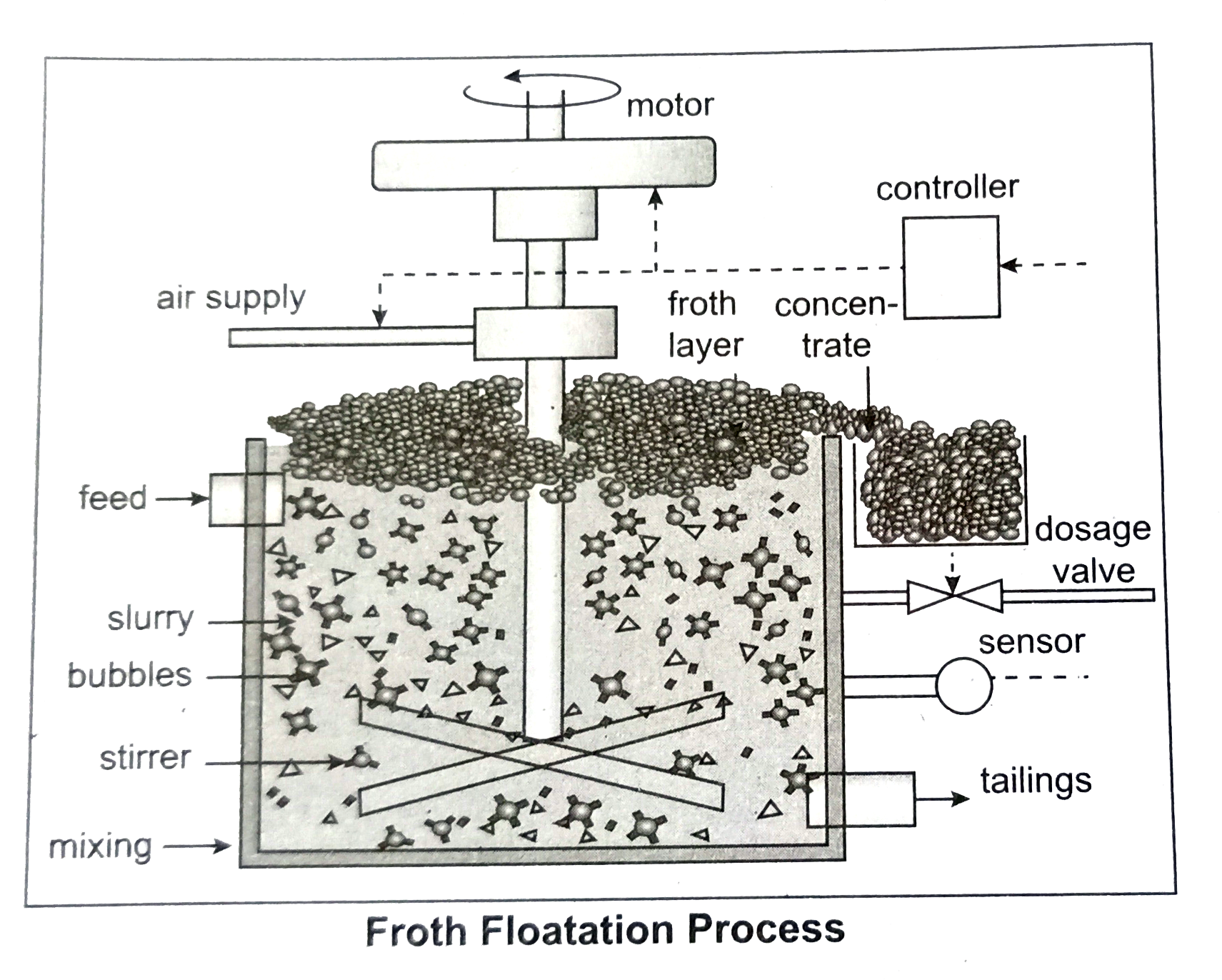
|
|
| 12. |
Explain froth floatation process for the concentration of Ore. |
|
Answer» |
|
| 13. |
Explain froth flotation on process. |
Answer» Solution :This process is based on the difference in the wetting characteristics of the ORE andgangue PARTICLES with oil and water. 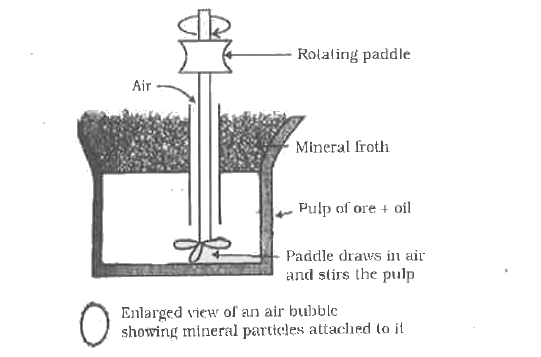 Powdered ore is suspended into a tank containing water. Pine oil or xanthates (collector) and aniline or cressols (stabilizer) are added. A rotating paddle agitates the mixture and DRAWS air in it. As a result froth is formed which carries the ore particles. THus METHOD is suitable for sulphide ORES. |
|
| 14. |
Explain Friedel -Crafts alkylation for chlorobenzene. Give equation. |
Answer» Solution :An alkyl group can be added to a benzene MOLECULE by an electrophile AROMATIC SUBSTITUTION REACTION called the friedel-crafts ALKYLATION reaction.
|
|
| 15. |
Explain Freundlich adsorption isotherm. |
|
Answer» <P> Solution :At a given temperature, the mass of the gas adsorbed by solid adsorbent at VARIOUS pressure is given by an empirical solution known as Freundlich equation :`x/m=kp^(1//n)` where .r. is amount (mass) of gas adsorbed by m GRAM of the solid adsorbent at pressure (P), k and .n. are constants at a given temperature for a gas and solid adsorbent. (n is `gt` 1). The graph can be sub-divided into three parts (i) At lower temperature , `(x)/(m)prop^(1)` ( straight LINE ) (ii) At higher pressure , `(x)/(m) prop^(0)` ( independent) (iii) At intermediate pressure , `(x)/(m) prop p^(1/n)` ( curve ) , `(x)/(m)=kP^(1//n)` (curve), (`(1)/(n)` is FRACTIONAL power ) 
|
|
| 16. |
Explain free radical polymerisation with example. |
|
Answer» Solution :(i) When alkenes are heated with free radical initiator such as benzoyl peroxide, they undergo polymerisation reaction. For example, styrene polymerises to polystrene when it is heated with a peroxide initator. The mechanism involves the following steps. (ii) INITIATION - Formation of free radical:  The stabilised radical attacks another monomer molecule to GIVE an ELONGATED radical  (iv) Chain growth will CONTINUE with the successive addition of several THOUSANDS of monomer units. (v) Termination: The above chain reaction can be stopped by stopping the supply of monomer or by coupling of two chains or reaction with an impurity such as oxygen. 
|
|
| 17. |
Explain formation of face centred cubic unit cell and hexagonal close packing in three dimensions. |
Answer» Solution :In hexagonal close packing layer in two dimensions, there are two SETS of triangular voids. The three dimensional arrangement is obtained by stacking the two dimensional hexagonal layers one above the other.  Over the first layer (say "A") of two dimensional hexagonal arrangement, if the second layer (say "B") is placed, the one set of triangular VOID of layer "A" is covered by the SPHERES of layer "B".  Over the second layer "B", there are again two sets of triangular voids. If the third layer is placed over the triangular voids of second layer such that the spheres of third layer an first layer in exact alignment, the hexagonal close packing in three dimensional is obtained.  The third layer and first layer are exactly same and hence it is CALLED "A" type. Thus the arrangement obtained is ABABAB.... Pattern. Ex. : Zn and Mg shows this type of arrangement.  . . If the third layer of the spheres are placed over the triangular voids of the second layer that are formed just above the unoccupied voids of the first layer, the face CUBIC centred unit cell is formed. The third layer is different from layers A and B. Hence, if the third layer is called "C", the arrangement obtained is ABCABCABC... ie., fourth layer of sphere and first layer of spheres are exactly same.  Ex. : Metals such as Cu, Ag, etc. crystallizes in FCC structure. In both type of close packing structures, the packing efficiency is 74% and co-ordination number is 12.` |
|
| 18. |
Explain Food Preservatives and antioxidant in food. |
|
Answer» Solution :(i) FOOD preservatives : Food preservatives prevent spoilage of food due to microbial growth. The most commonly used preservatives include table salt, sugar, vegetable oils and sodium benzoate, `C_(6)H_(5)COONa`. Sodium benzoate is used in limited quantities and is metabolised in the body. Salts of sorbic acid and propanoic acid are also used as preservatives. (ii) Antioxidants : These are important and necessary food additives. These help in food preservation by retarding the action of oxygen on food. These are more reactive towards oxygen than the food material which they are protecting The TWO most familiar antioxidants are butylated hydroxy TOLUENE (BHT) and butylated hydroxy anisole (BHA). The addition of BHA to butter increases its shelf LIFE from months to years. Sometimes BHT and BHA along with citric acid are added to produce more effect. Sulphur DIOXIDE and sulphite are useful antioxidants for wine and beer, sugar syrups and cut, peeled or dried fruits and vegetables. |
|
| 19. |
Explain fitting reaction . |
Answer» Solution :When ARYL halides react with SODIUM METAL in dry ETHER it forms DIPHENYL compound. 
|
|
| 20. |
Explain ferromagnetism. |
|
Answer» Solution :(1) The substances which possess unpaired electrons and high paramagnetic character and when placed in amagnetic field are strongly attracted and show permanent magnetic moment even when the external magnetic field is removed are SAID to be ferromagnetic. They can be permanently magnetised. (2) In the solid state, the metal IONS of ferromagnetic substance are grouped together into small regions called DOMAINS, where each domain acts as a tiny magnet. 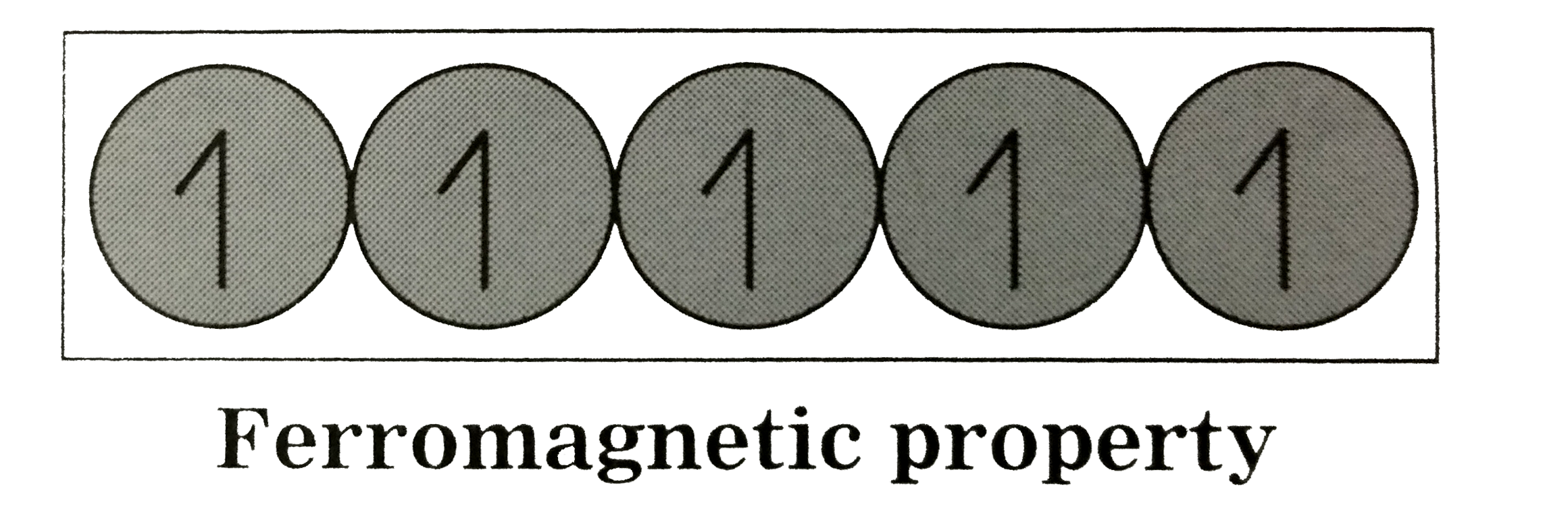 For example : Fe, Co, Gd, `CrO_(2)` , etc. |
|
| 21. |
Explain Fittig reaction with equation. |
|
Answer» Solution :Fittig reaction When aryl HALIDES are heated with sodium metal in DRY ether, two aryl group JOIN together forms diphenyl/ diphenyl. EXAMPLE: 
|
|
| 22. |
Explain Ferrimagnetism. |
Answer» SOLUTION :FERRIMAGNETISM is observed when the domains in the substance are aligned in parallel and anti-parallel directions in unequal numbers. They are weakly attracted by a MAGNETIC field as compared to ferromagnetic substances. These substances ALSO become PARAMAGNETIC when heated at high temperature and lose ferrimagnetism. Ex. : `MgFe_2O_4, Fe3O_4, ZnFe_2O_4` etc. are ferrimagnetic substance. |
|
| 23. |
Explain the following terms with suitable examples : (i) Schottky defect (ii) Ferromagnetism. |
|
Answer» Solution :(1) The SUBSTANCES which possess unpaired electrons and high paramagnetic character and when placed in a magnetic field are strongly attracted and show PERMANENT magnetic MOMENT even when the external magnetic field is removed are said to be ferromagnetic. They can be permanently magnetised. (2) In the solid state, the metal ions of ferromagnetic substance are grouped together into small regions called domains, where each domain acts as a tiny magnet. 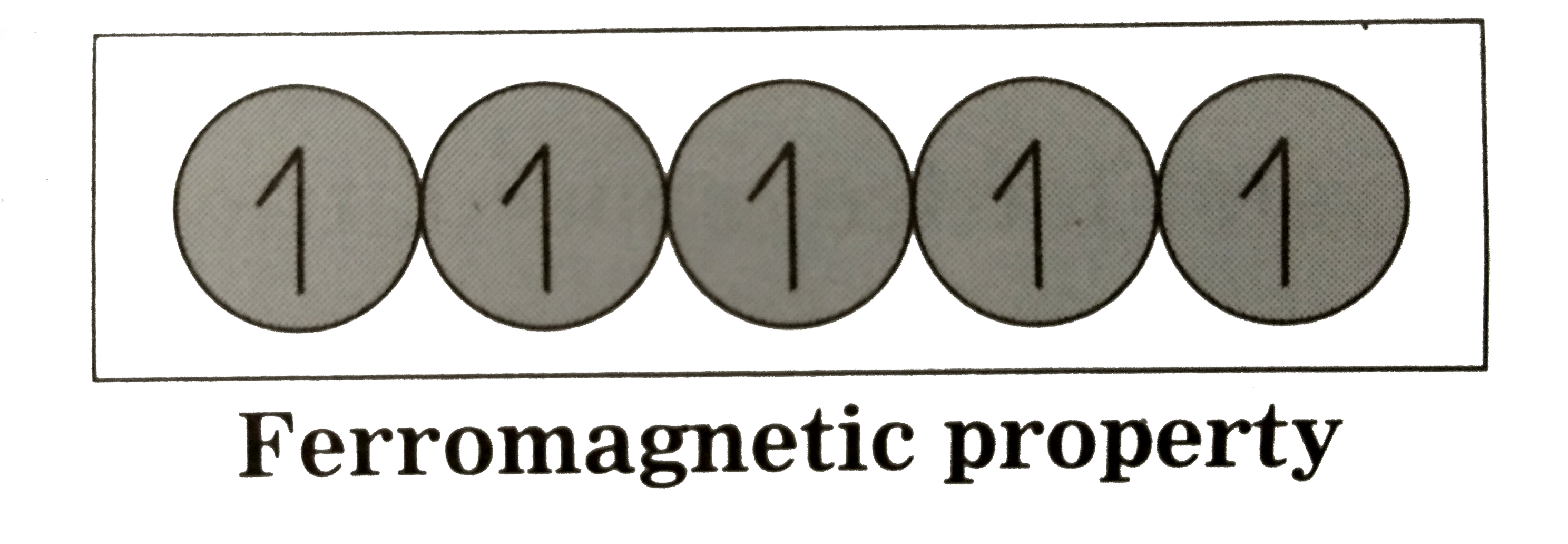 For example : `Fe, Co, GD, CrO_(2),` etc. |
|
| 24. |
Explain Fehling's solution Test. |
|
Answer» Solution :(1) Fehling 's solution is MIXTURE of Fehling's solution 'A' CONTAINING `CuSO_(4)`solution and Fehling'ssolution 'B' contaning SODIUM potassium tartarate (Rochelle salt) in caustic soda (NaOH) solution . (2) Whenan aldehyde is heated with fehling's solution. The deep blue colour of the solution disappears, and`Cu^(+2)`(cupric ion) is reduced and a red precipitate of cuprous oxide, `Cu_(2)O` is obtained while aldehyde is oxidised to a carboxylic acid. (3) For example , 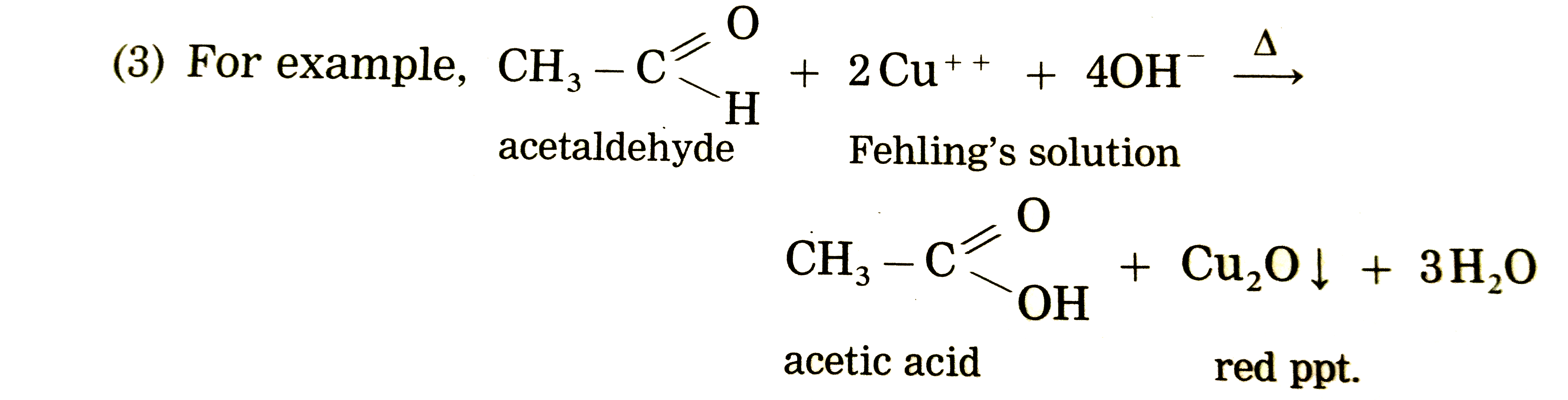 (4)This testis not given by ketones, since they cannot be oxidised by Fehling solution. (5) Aromatic aldehydes are not oxidised by Fehling solution. (6) Hence this test is used to distinguish between aldehydes and ketones. |
|
| 25. |
Explain extraction of iron from its oxides. |
Answer» Solution :After concentration, mixture of oxide ores of iron `(Fe_2O_3, Fe_3O_4)` is subjected to calcination/ roasting to remove water, to decompose carbonates and to oxidise sulphides. After that these are mixed with limestone and coke and fed into a blast furnace from its top, in which the oxide is reduced to the metal. In the blast furnace, reduction of iron oxides takes place at different TEMPERATURE ranges.  In a blast furnace, a blast of hot air is blown from the bottom of the furnace by burning coke in the lower portion to give temperature upto about 2200K. The burning of coke, therefore, supplies most of the heat required in the process. The CO and heat move to the upper part of the furnace. Where the temperature is lower and the iron oxides `(Fe_2O_3` and `Fe_3O_4)` coming from the top are reduced to Feo. At temperature range of 500 - 800 K: `Fe_2O_3`is first reduced to `Fe_3O_4` and then to FeO. It is lower temperature range in the blast furnace. `3Fe_2O_3 + CO to 2Fe_3O_4 + CO_2"" .....(i)` `Fe_3O_4 + 4CO to 3Fe + 4CO_2 "".....(ii)` `Fe_2O_3 + CO to 2Fe_3O_4 + CO_2"" ....(i)` `Fe_3O_4 + 4CO to 3Fe + 4CO_2 "" .....(ii)` `Fe_(2)O_(3) + CO to 2FeO + CO_2 "" ....(iii)` In this temperature range, limestone is also decomposed to CAO which removes silicate impurity of the ore as slag. The slag is in molten state and separates out from iron. `CaCO_(3) overset(Delta)(rarr)CaO + CO_2 uarr "" ....(iv)` At temperature range of 900 - 1500K : Burning of coke takes place as : `C + O_2 + CO_2 "".....(v)` The `CO_2` gas moves upwards and meets with a red hot coke to produce CO. ` CO_2 + C to2CO "" .....(vi)` FeO is reduced to Fe. CaO combines with silica to form a slag `FeO + CO to Fe + CO_2 "".....(vii)` `CaO + underset("impurity")(SiO_2) + underset(("slag"))(CaSiO_3)"".....(viii)` The iron obtained from blast furnace contains about 4% carbon and many impurities in smaller amount (e.g. S, P, SI, Mn). This is known as PIG iron. It can be moulded into various shapes. Cast iron is different from pig iron and is made by melting pig iron with scrap iron and coke using hot air blast. It has slightly lower carbon conten (about 3%) and is extremely hard and brittle. Wrought iron (malleable iron) is the purest form of commercial iron and is prepared from cas iron by oxidising impurities in a reverberator furnace lined with haematite. The haematit oxidises carbon to carbon monoxide. `Fe_2O_3 + 3C to 2Fe + 3CO `. Limestone is added as a FLUX and sulphur, silicon and phosphorus are oxidised and passed into the slag. The metal is removed and freed from the slag by passing through rollers. |
|
| 26. |
Explain extraction of elements by oxidation. |
|
Answer» Solution :Besides reductions, some extractions are based on oxidation particularly for non-metals. (i) Extraction of chlorine from brine : The extraction is based on oxidation. `2Cl_((aq))^(-) + 2H_2O_((l)) to 2OH_((aq))^(-) + H_(2(g)) + Cl_(2(g))` The change in Gibb.s free energy for the reaction is `+ 422 kJ`. When it is converted to `E^@` using equation `DeltaG^@ = -nFE^@`, we get `E^@ = -2.2 V`. Thus external emf higher than 2.2 V needs to supplied to carry out the process. The electrolysis HOWEVER, acquires an excess potential to OVERCOME some other hindering reactions. Thus, `Cl_2`, is obtained by electrolysis giving out `H_2` and aqueous NaOH as by-products. Electrolysis of molten NaCl is also carried out. But in that case, NA metal is produced and not NaOH. (ii) Gold CYANIDATION process : Extraction of gold or silver involves leaching with `""^(-)CN`. This is also an oxidationreaction `(Ag to Ag^(+), Au to Au^(+))`. The metal is later recovered by displacementmethod. `4Au_((s)) + 8CN_((aq))^(-) + 2H_2O_((aq)) + O_(2(g)) to 4[Au(CN_2)]_(aq)^(-) + 4OH_((aq))^(-))` `2[Au(CN)_(2)]_(aq)^(-) + Zn_((s)) to 2Au_((s)) + [Zn(CN)_(4)]_((aq)^(2-)` Zinc acts as a reducing agent. |
|
| 27. |
Explain extraction of : (i) Copper from Copper(I) Oxide (ii) Zinc from zinc oxide. |
|
Answer» Solution :(i) Extraction of copper from Cu(I) oxide : In the Ellingham diagram, the `Cu_2O` line is almost at the top. Hence, it is QUITE easy to reduce oxide ores of copper directly to the metal by heating with coke. The lines `(C, CO) and (C, CO_2)` are at much lower positions in the GRAPH particularly after 500 - 600 K. However, many of the ores are sulphides and some may also contain iron. The sulphide ores are roasted/smelted to give oxides. `2Cu_2S + 3O_2 to 2Cu_2O + 2SO_2` The oxide can then be easily reduced to metallic copper using coke : `Cu_2O + C to 2Cu + CO` In ACTUAL process, the ore is heated in a reverberatory furnace after mixing with silica. In the furnace, iron oxide .slags of. asiron silicate is formed. Copper is produced in the form of copper matte. This contains `Cu_2S` and FeS `FeO + SiO_2 to underset(("Slag"))(FeSiO_3)` Copper matte is then charged into silica LINED convertor. Some silica is also added and hot air blast is blown to convert the remaining `Fes, FeO and Cu_2S//Cu_2O`to the metallic copper. `2FeS + 3O_2 to 2FeO = 2SO_2` `FeO + SiO_2 to FeSiO_3` `{:(2Cu_2S + 3O_2 , to , 2Cu_2O + 2SO_2),(2Cu_2O + Cu_2S , to , 6Cu + SO_2):}}` Auto reduction Process The solidified copper obtained has blistered appearance due to the evolution of `SO_2` and so it is called Blister Copper. (ii) Extraction of zinc from zinc oxide : The reduction of zinc oxide is done using coke. The temperature in this case is higher than that in the case of copper. For this purpose of heating, the oxide is made into brickettes with coke and clay. `ZnO + C underset("1673 K")overset("Coke")(rarr) Zn + CO` The metal is distilled off and collected by rapid chilling. |
|
| 28. |
Explain 'esterification' reaction with an example. |
|
Answer» Solution :Alcohols REACT with carboxylic acids in the presence of an acid to GIVE esters. `CH_(3)-UNDERSET("ethanol")(CH_(2))-OH + underset("ethanoiacid")(HO -overset(O)overset(||)C)-CH_(3) overset(H^(+)) to underset("ethylethanoate") overset(O)overset(||)C-O -CH_(3) -CH_(3)` |
|
| 29. |
Explain esterification reaction with an example. |
|
Answer» SOLUTION :When carboxylic acids are treated with alcohol in the presence of CONC. `H_(2)SO_(4)` as catalyst to GIVE ester is called esterification. `underset("Acelicacid")(CH_(3)-COOH)+underset("methylalcohol")(HO-CH_(3))overset(H^(+))rarrunderset("methylacetate")(CH_(3)COOCH_(3))+H_(2)O` |
|
| 30. |
Explain equilibrium state in Daniell cell and derive its equilibrium constant. |
|
Answer» Solution :* Daniell cell reaction: `Zn_((S))+Cu_((aq))^(2+) to Zn_((aq))^(2+)+Cu_((S))` In anode half cell the oxidation of Zn into `Zn^(2+)` take place and so the concentration of `Zn^(2+)` keeps on INCREASING while the concentration of `Cu^(2+)` keeps on decreasing. At the same time voltage of the cell as read on the VOLTMETER keeps on decreasing. After some time, we shall note that there isno changein the concentration of `Cu^(2+) and Zn^(2+)` ions and at the same time, voltmeter gives zero reading. this indicates that equilibrium has been attained. `Zn_((S)) +Cu_((aq))^(2+) hArr Zn_((aq))^(2+)+Cu_((S))` * Equilibrium constant at equilibrium `=K_(C)` Concentration of `Zn^(2+)` at equilibrium=`[Zn^(2+)]` Concentration of `Cu^(2+)` at equilibrium=`[Cu^(2+)]` Then, `K_(C)=([Zn_((aq))^(2+)])/([Cu_((aq))^(2+)])` * So in this CONDITION `E_(cell)=0.0V and n=2`, then nernst equation for Daniell cell at equilibrium will be as follows: `0=E_(cell)=E_(cell)^(THETA)-(2.303RT)/(2F)"log"([Zn^(2+)])/([Cu^(2+)])` `THEREFORE E_(cell)^(Theta)=(2.303RT)/(2F)logK_(C)""therefore E_(cell)^(Theta)=(0.059)/(2)log" "K_(C)|"Where, "R=8.314JK^(-1)mol^(-1)""F=96487" C "mol^(-1)``T=298K` but `E_(cell)^(Theta)=1.1V` is in Daniell cell `therefore log" "K_(C)=(1.1xx2)/(0.059)=37.288` `therefore K_(C)="Antilog "37.288=2xx10^(37)` |
|
| 31. |
Explain enzyme catalysis by giving an example. |
|
Answer» Solution :Enzymes are complex nitrogenous organic compounds which are produced by LIVING plants and animals. They are actually protein molecules of high molecular mass and form colloidal solution in water. They are very effective catalysts. Catalyse numerous reactions, especially those connected with natural process. Numerous reactions that occurs in the bodies of animals and plants to MAINTAIN the life process are catalysed by enzyms. Thus, the enzymes are termed as biochemical catalysts and the phenomenon is known as biochemical catalysis. Many enzymes have been obtained in pure crystalline state from living cells. However the first enzyme was synthesised in the laboratory in 1969. The following are some of the examples of enzyme catalysed reactions : (i) Inversion of cane sugar : The invertase enzyme converts cane sugar into GLUCOSE and fructose. `underset("Cane")(C_(12)H_(22)O_(11(aq)))+H_(2)O_((l))overset("Invertase")rarrunderset("Glucose")(C_(6)H_(12)O_(6(aq)))+underset("Fructose")(C_(6)H_(12)O_(6(aq)))` (ii) Conversion of glucose into ethyl alcohol : The zymase enzyme converts glucose into ethyl alcohol and carbon dioxide. `underset("Glucose")(C_(6)H_(12)O_(6(aq)))overset("Zymase")rarrunderset("Ethyl alcohol")(2C_(2)H_(5)OH_((aq)))+2CO_(2(g))` (iii) Conversion of starch into maltose : The DIASTASE enzyme converts starch into maltose. `underset("Starch")(2(C_(6)H_(12)O_(5))_(N(aq)))+nH_(2)O_((l))overset("Diastase")rarr underset("Maltose")(nC_(12)H_(22)O_(11(aq)))` (iv) Conversion of maltose into glucose : The maltose enzyme converts maltose into glucose. `underset("Maltose")(C_(12)H_(22)O_(11(aq)))+H_(2)O_((l))overset("Maltase")rarr underset("Glucose")(2C_(6)H_(12)O_(6(aq)))` (v) Decomposition of urea into ammonia and carbon dioxide : The enzyme urease catalyses this decomposition. `NH_(2)CONH_(2(aq))+H_(2)O_((l))overset("Urease")rarr 2NH_(3(g))+2NH_(3(g))+CO_(2(g))` (vi) In stomach the pepsin enzyme converts proteins into peptides while in intestine the pancreatic trypsin converts proteins into amino acids by hydrolysis. (vii) Conversion of milk into curd : It is an enzymatic reaction brought about by lacto bacilli enzyme present in curd. |
|
| 32. |
Explain entropy changes for various phase changes. |
|
Answer» SOLUTION :A phase CHANGE always takes place at CONSTANT pressure and temperature. During a phase change, both the phases exist at equilibrium. (1) Entropy change for fusion of a solid : `underset("(ice)")(H_(2)O_(s)) overset(Delta_("fus")H^(0))tounderset("(water)")(H_(2)O_((l))) OR " Solid" overset(Delta_(fus)H^(0))to"liquids"` If `Delta_("fus")H^(0)` is the standardenthalphyof fusion atabsolutetemperatureT,then theentropychangewill be , `Delta_("fus")S = (Delta_(fus)H^(0))/(T)` (2) Entropy change for varporisationof a liquids. `underset("(water)")(H_(2)O_((l))) overset(1 atm, 100^(@)C) to underset("(vapour)")(H_(2)O_((g)))` OR `"Liquid" to "vapour"` If `Delta_(vap)H^(0)` is the standard enthalphychangefor evaporationat absolute temperatureT, thentheentropychangewill be . `Delta_(vap)S = (Delta_(vap)H^(0))/(T)` (3) Entropy changefor the sublimationof a solid . `"Solid" tooverset(Delta_("SUB")H^(0))"Vapour"` If `Delta_("sub")H^(0)` is the standard enthalphychange for thesublimationat absolutetemperatureT then,theentropy changewill be . `Delta_("sub")S = (Delta_("sub"H^(0)))/(T)` |
|
| 33. |
Explain electrophilic substitution reactions of benzoic acid. |
|
Answer» Solution :Some common electrophilic substitution REACTION of BENZOIC ACID are given below (i) HALOGENATION :  (ii) Nitration :  (iii) Sulphonation :  (iv) Benzoic acid does not undergo friedal craft's reaction. This is due to the strong DEACTIVATING nature of the carboxyl group. |
|
| 34. |
Explain Elimination reactions of alkyl halides. |
|
Answer» Solution :When a haloalkane with `beta` - hydrogen ATOM is heated with alcoholic solution of potassium HYDROXIDE, there is elimination of hydrogen atom from `beta` - carbon and a halogen atom from the `alpha` - carbon atom. As a RESULT, an alkene is formed as a product. Since `beta` - hydrogen atom is formed as a product. Since `beta` - hydrogen atom is involved in elimination, it is often called `beta` - elimination. If there is possibility of formation of more than ONE alkene due to the availability of more than one `beta` - hydrogen atoms, usually one alkene is formed as the major product.  These form part of a pattern first observed by Russian chemist, ..Alexander Zaitsev... He formulated rule which can be SUMMARISED as : ..In dehydrohalogenation reactions, the preferred product is that alkene which has greater number of alkyl groups attached to doubly bonded carbon atoms... Thus, 2-bromopentane gives pent-2-ene as the major product. 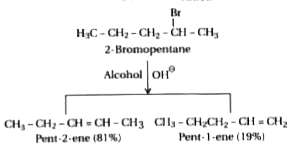
|
|
| 35. |
Explain Electrophoresis. |
|
Answer» SOLUTION :The existence of charge on colloidal particles is confirmed by electrophoresis experiment. When electric potential is applied ACROSS two platinum electrodes DIPPING in a colloidal solution the colloidal particles move towards one or the other electrodes. The movement of colloidal particles under an applied electric potential is called electrophoresis. Positively charged particles move towards the cathode while negatively charged particles move towards the anode. This can be demonstrated by the following experimental set up. (See figure)  When electrophoresis i.e. movement of particles is PREVENTED by some suitable, means it is observed that the dispersion medium beging to move in an electric field. This PHENOMENON is termed electroosmosis. |
|
| 36. |
Explain electrometallurgy in detail. |
|
Answer» Solution :The extraction of electropositive elements from their salts in molten state or in aqueous state by electrolytic reduction or by addition of some reducing agent (element) is called electrometallurgy. In the reduction of a molten METAL salt, electrolysis is done. Such methods are based on electrochemical principles which could be understood through the equation, `DeltaG^(0) = -nF E_("cell")^(@) "" .....(i)` Where n = Number of electrons `E^@` = Electrode potential of the redox couple formed in the system. The more reactive metals have large NEGATIVE values of reduction potential. So their reduction is difficult. If the difference of two `E^@` values corresponds to a positive `E^@` and consequently negative AG° in equation (i), then the less reactive metal will come out of the solution and the more reactive metal will go into the solution, e.g. `Cu_((aq))^(2+) + Fe_((s)) to Cu_((s)) + Fe_((aq))^(2+) "" ..... (ii)` During electrolysis, the `M^(n+)`ions are discharged at negative electrodes (cathodes) and deposited there. Precautions are taken considering the REACTIVITY of the metal produced and suitable materials are USED as electrodes. Sometimes flux is added to make the molten mass more conducting. The Hall-Heroult process, Castner.s process, Down.s cell process etc. are based on electrochemical principles of metallurgy. |
|
| 37. |
Explain electrolytic refining. |
|
Answer» Solution :In this method, the IMPURE metal is made to act as anode. A strip of the same metal in pure form is used as cathode. They are put in a suitable ELECTROLYTIC bath containing soluble salt of the same metal. The more basic metal remains in the solution and the less basic ones go to the anode mud. The electrolytic refining works on the concept of electrode potentials, over potential, and Gibbs free ENERGY. The reactions taking place at anode and cathode are : Anode : `M to M^(n+) + n e^(-)` Cathode : `M^(n+) + n e^(-) to M` Copper is refined using an electrolytic method. Anodes are of impure copper and pure copper strips are taken as cathode. The electrolyte is acidified solution of copper sulphate and the net result of electrolysis is the transfer of copper in pure form from the anode to the cathode : Anode : `Cu to Cu^(2+) + 2e^(-)` Cathode :` Cu^(2+) + 2e^(-) → Cu` Impurities from the blister copper deposit as anode mud which contains antimony, selenium, tellurium, silver, gold and platinum, recovery of these elements may meet the cost of refining. Zinc may also be refined this WAY. |
|
| 38. |
Explain electrodialysis. |
Answer» Solution :(i) The presence of electric field increases the speed of removal of electrolytes from COLLOIDAL solution. (II) The colloidal solution containing an electrolyte as IMPURITY is placed between two dialysing membranes enclosed into two compartments filled with water. (iii) When current is PASSED, the impurities pass into water compartment and get removed periodically. (iv) This process is faster then dialysis, as the rate of diffusion of electrolytes is increased by the application of electricity. 
|
|
| 39. |
Explain each statement using resonance theory. (a) The indicated C-H bond in propene is more acidic than the indicated C-H bond in propane. (b) The bond dissociation energy for the C-C bond in ethane is much higher than the bond dissociation energy for the indicated C-C bond in 1-butene. |
|
Answer» |
|
| 40. |
Explain each of the following with a suitable example: Piezoelectric effect. |
|
Answer» SOLUTION :Since `AlCl_3` is an ionic compound. Al is present as CATION `(Al^(3+))`. This results in cation vacancy. The number of cation VACANCIES = 2 `xx` no. of `Al^(3+)` IONS |
|
| 42. |
Explain doping. |
|
Answer» Solution : The conduction of electricity in semi-conductors when takes place by addition of suitable impurities, it is known as EXTRINSIC semiconductor and this process of addition of impurities is known as "doping” and impurities added are called "dopants". Doping can be done with an impurity which is electron rich or electron DEFICIENT as COMPARED to the intrinsic semiconductor SILICON & germanium. Such impurities introduce electronic defects in them as a result two types of extrinsic semiconductors are obtained : (i) n-type semi-conductors (II) p-type semi-conductors. |
|
| 43. |
Explain Distillation process with suitable example. |
| Answer» Solution :This method is employed for low BOILING volatile metas like zinc (boiling point 1180 K) and mercuty (630 K).In this method,the inpure metal is heated is heated to EVAPORATE and the vapours are condensed to GET PURE metal. | |
| 44. |
Explain different types of unit cells. |
Answer» Solution : (a) Primitive unit cells : When constituent particles are present only on the corner POSITIONS of a unit cell, it is called as primitive unit cell.  (b) Centred Unit Cells : When a unit cell contains one or more constituent particles present at positions other than CORNERS in ADDITION to those at corners, it is called a centred unit cell. Centred unit cells are of three TYPES : (b) Centred Unit Cells : When a unit cell contains one or more constituent particles present at positions other than CORNERS in ADDITION to those at corners, it is called a centred unit cell. Centred unit cells are of three TYPES :(i) Body-Centred Unit Cells: Such a unit cell contains one constituent particle (atom, molecule or ion) at its bodycentre besides the ones that are at its corners. (ii) Face-Centred Unit Cells : Such a unit cell contains one constituent particle present at the centre of each face, besides the ones that are at its corners. (iii) End-Centred Unit Cells : In such a unit cell, one constituent particle is present at the centre of any two opposite faces besides the ones present at its corners.  There are seven types of primitive unit cells.  Unit cell of 14 types of Bravals Lattices: 
|
|
| 45. |
Explain different types of isomerism exhibited by Co-ordination compounds, giving suitable examples. |
|
Answer» Solution :Isomerism in Co-ordination compounds : Isomers are compounds that have the same chemical formula but different arrangement of atoms. Two principal types of isomerism are known among Co-ordination compounds namely stereo isomerism and structural isomerism. a) Stereoisomerigm : Stereoisomerism is a form of isomerism in which two substances have the same composition and structure but differ in the relative spatial positions of the ligands. This can be sub divided into two classes namely. i) Geometrical isomerism and ii) optical isomerism b) Structural isomerism: i) Linkage isomerism ii) Co-ordination isomerism iii) Ionisation isomerism iv) Hydrate isomerism a) (i) Geometrical isomerism : `RARR` Geometrical isomerism aries in Co-ordination complexes due to different possible geometric arrangements of the ligands. `rarr` This isomerism found in complexes with Co-ordination numbers 4 and 6 `rarr` In a square planar complex of formula `[Mx_(2)L_(2)]` the two ligands may be arranged in adjacent to each other in a cis isomer (or) opposite to each other in a trans isomer 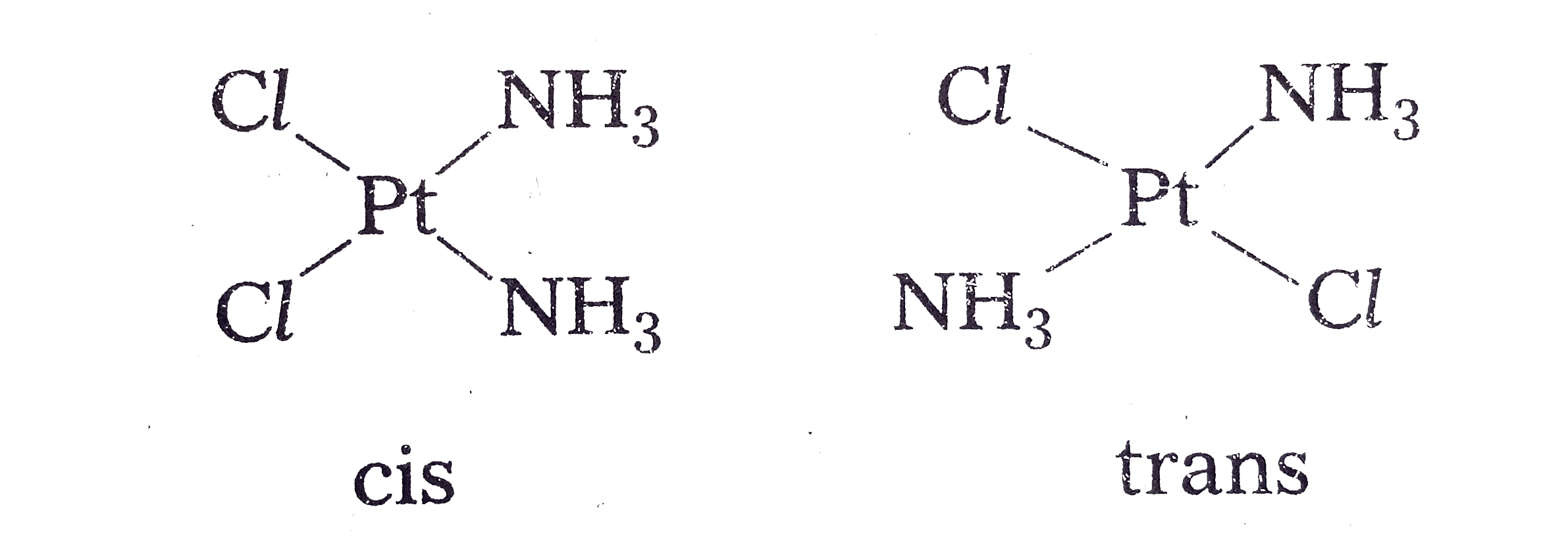 `rarr`Square planar complex of type [MAB XL] shows three isomers two-cis and one trans. (A, B, X, L are unidentate ligands is square planar complex). `rarr` Geometrical isomerism is not possible in tetrahedral geometry. `rarr` In octahedral complexs of formula `[MX_(2)L_(4)]` in which two ligands X may be oriented cis or trans to each other. 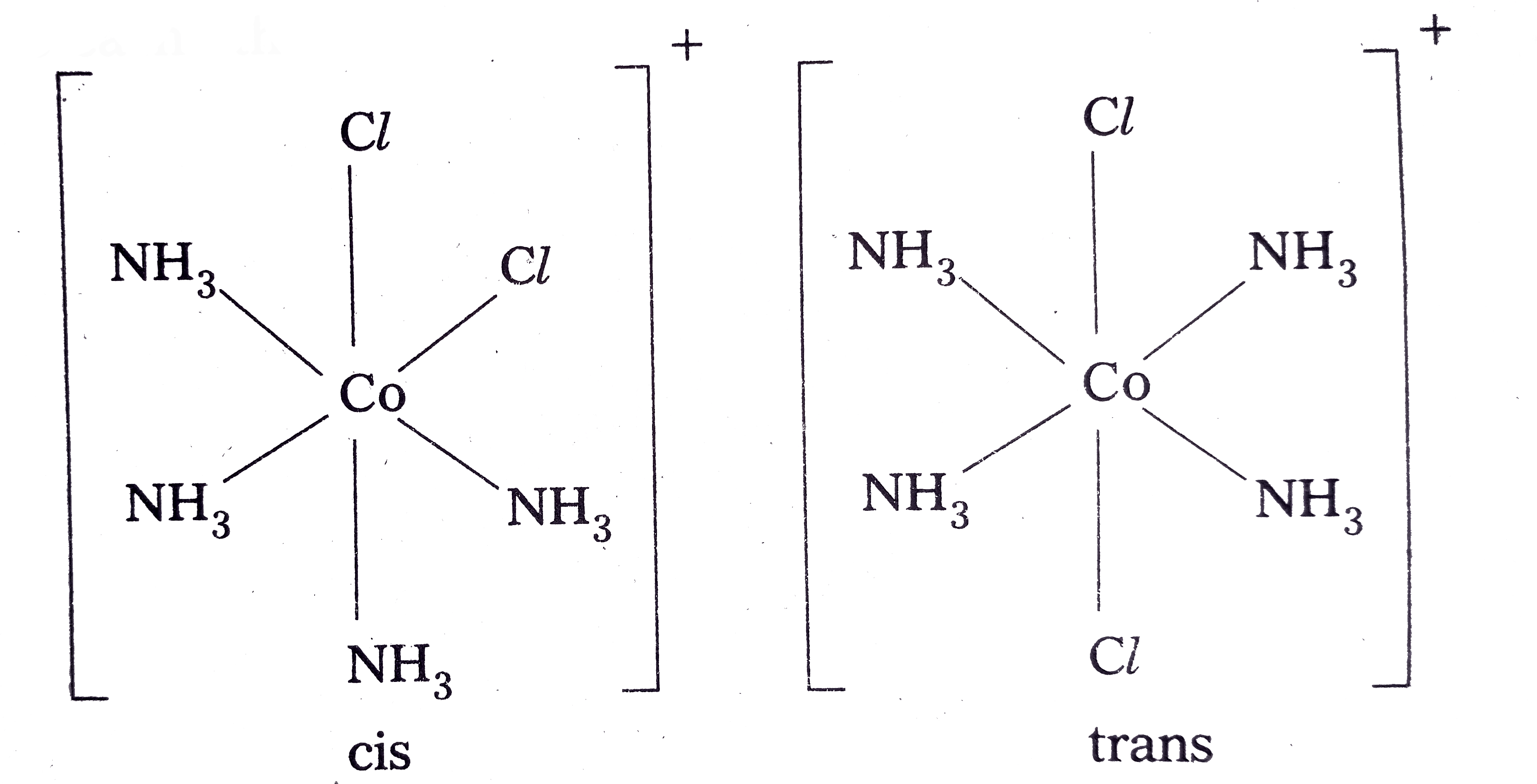 `rarr` Another type of geometrical isomerism occurs in octahedral Co-ordination compounds of type `[Ma_(3)b_(3)]` if three donar atoms of the same ligands occupy adjacent positions at the comers of an octahedral face then it is facial (fac) isomer. When the positions occupied are around the meridian of the octahedran then it is meridonial (mer) isomer. 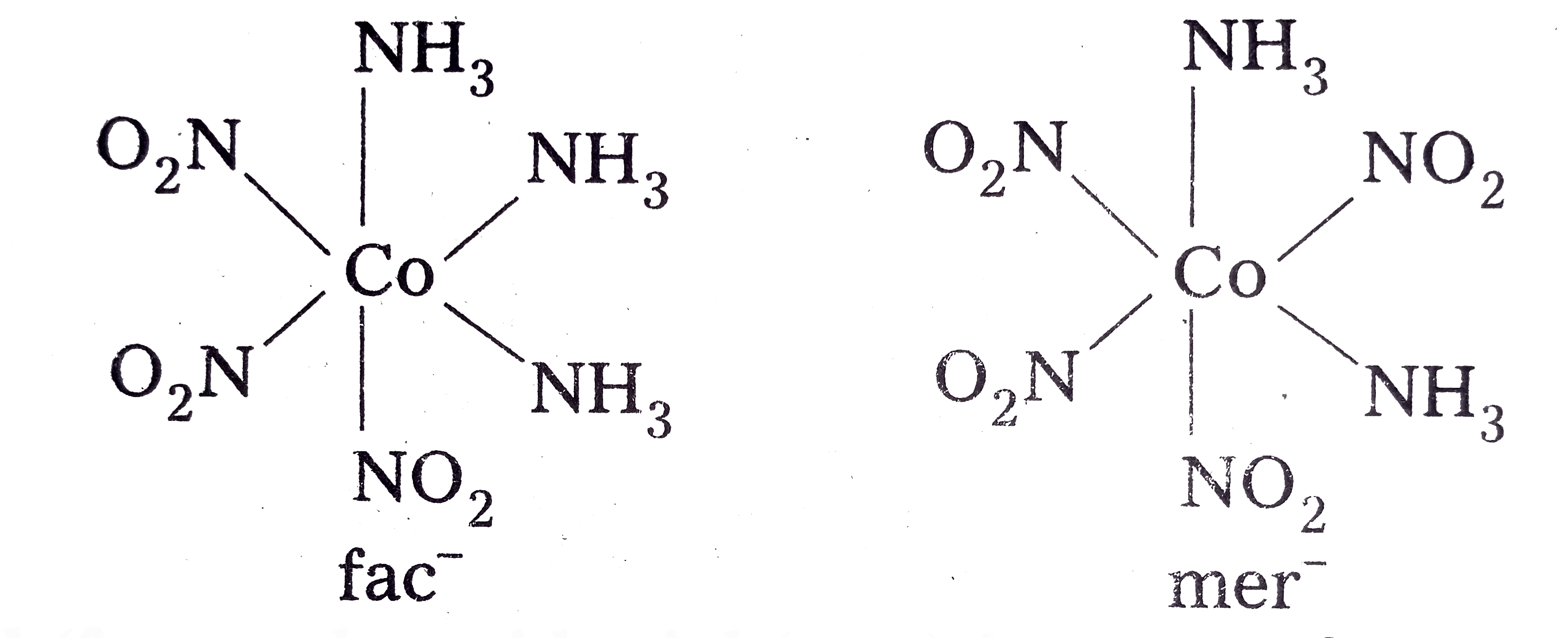 a(ii) Optical isomerism : Optical isomerism arises when two isomers of a compound exist such that one isomer is a mirror image of the other isomer. Such isomers are called optical isomers or enantiomers. The MOLECULES or ions that cannot be superimposed are called chiral. The two forms are called dextro (d) and laevo (l) depending upon the direction they rotate the plane of polarise·d light in a polarimeter (d rotates to the right, l to the left). Optical isomerism is common in octahedral complexes involving bidentate ligands. b (i) Linkage isomerism : Linkage isomerism arises in Co-ordination compound containing: ambidentate ligand. A simple example is provided by complexes containing the thiocyanate ligand-`NCS^(-)`, which may bind through the nitrogen to give M-NCS or through sulphur to give M-SCN. eg.: `[Mn(CO)_(5)SCN] and [Mn(CO)_(5)NCS]` (ii) Co-ordinate isomerism : This type isomerism arises from the interchange of ligands between cationic and anionic entities of different metal ions present in a complex. eg. : `[Co(NH_(3))_(6)] [Cr(CN)_(6)] and [Co(CN)_(6)] [Cr(NH_(3))_(6)]` (iii) Ionisation isomerism : This form of isomerism arises when the counter ION in a complex SALT is itself a potential ligand and can displace a ligand which can then become the counter ion eg.: `[Co(NH_(3))_(5)SO_(4)]Br and [Co(NH_(3))_(5)Br]SO_(4)` (iv) Hydrate isomerism : This form of isomerism is known as hydrate isomerism SINCE water is involved as a sdlvent. Hydrate isomers differ by whether or not a hydrate molecule is directly bonded to the metal ion or merely present as free solvent molecules in the crystal lattice. |
|
| 46. |
Explain different condition when external potential is applied in opposite direction in galvanic cell (Voltaic cell) by taking suitable cell example. |
|
Answer» Solution :(a) Condition-I: (Condition in which the flow of current continue through the galvanic cell or `E_(ext) lt 1.1V`): According to diagram-(a) if an external opposite potential is applied in the galvanic cell and increased slowly, we find that the reaction continues to take place TILL the opposing voltage reaches the value 1.1 V. Redox reaction continues in forward direction and reaction does not stops. (a)  In such condition in Daniel cell -(i) Electrode potential is between 0 to 1.1 V. (ii) Electrons flow from Zn rod to Cu rod hence current flows from Cu to Zn. (iii) dissolves at anode and hence its weight gets reduced. (iv) Cathode plate is of Cu and copper deposits at cathode. (b) Condition-II: (Condition in which galvanic cell is stopped or `E_(ext)=1.1V`) : According to the diagram-(b), when the reaction stops altogether and no current flows through the cell. any further increase in the external potential again STARTS the reaction but in the opposite direction. (b)  In such condition in Daniell cell-(i) in Daniell cell when opposite external electrical potential `E_(ext)=1.1V` and Daniell cell potential is 0.0V (ii) No flow of electrons or current. (iii) No chemical reaction. (iv) Daniell cell does not work. (c) Condition-III: (condition in which electrochemical cell becomes electrolytic cell or `E_(ext)gt1.1V)`: It now functions as an electrolytic cell, a device for using electrical energy to carry non-spontaneous chemical reactions. (c)  When `E_(ext)gt1.1V`, (i) Such cell BECOME NEGATIVE (ii) Daniell cell becomes electrolytic cell. (iii) Electrical energy gets converted into chemical energy and such electrical energy is utilized for non-spontaneous reaction. (iv) electrons flow from Cu to Zn and current flows from Zn to Cu. (v) Zinc is deposited at the zinc electrode. (vi) Copper dissolves at copper electrode and it will present as `Cu^(2+)` ions. |
|
| 47. |
Explain diagrammatically the boundary surfaces for three 2p orbitals and five 3dorbitals. |
Answer» Solution :Shape of p - ORBITAL : Shape of p -orbital is dumb-bel . There are three 2p - orbitals . They are `2p_(x),2p_(y)and2p_(z)` orbitals . Each orbital has two lobes . These lobes are oriented along their RESPECTIVE axes . Each p orbital has one nodal plane.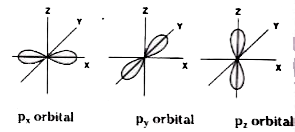 Shape of d-orbital : d -orbital has double dumb -bell shape . There are five d-orbit als. They `d_(xy),d_(xz),d_(x^(2)-y^(2)) andd_(z^(2))`. Each d orbital has 4 lobes . In`d_(xy)` orbital , the lobes are placed in- between the x andy axes, similar is the case with other orbitals, `d_(yz) and d_(xz) . " In " d_(z^(2))` orbital , two lobes lie along z aixs and there is a ring of electron-cloud AROUND the centre. In `d_(x^(2)-y^(2))`orbital , the lobes lie along x and y axes. Each d orbital has two nodal planes. 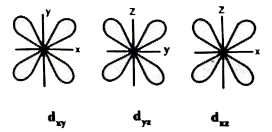 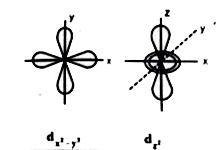
|
|
| 48. |
Explain depression in freezing point. Show that it is a colligative property. |
|
Answer» SOLUTION :Depression in freezing point. The freezing point is the temperature at which the solid and liquid states of the substances have the same VAPOUR pressure. Since the addition of a non-volatile solute to the pure solvent lowers its vapour pressure, so the freezing point of a solution is expected to be less than that of the pure solvent. This is known as depression in freezing point. This has been represented graphically in Fig. The curves BC and DE represent the vapour pressure of the pure solvent and the solution respectively. The curve AB represents the vapour pressure of the solvent at different temperatures. At point B, the liquid solvent and the solid solvent meet, hence it CORRESPONDS to the freezing point of the pure liquid `(Delta T_(f)^(@))`. Since the vapour pressure of a solution is always less than that of the pure solvent, the vapour pressure curve for the solution runs parallel 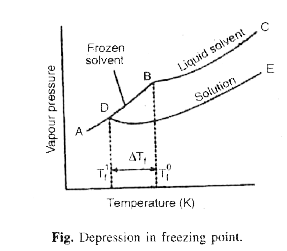 but below the pure solvent curve. The vapour pressure curve for the solution meets the solid solvent curve at D which corresponds to the freezing point of the solution `T_f`. It is evident that `T_f` is less than `T_(f)^(@)` , indicating that there is depression in the freezing point of a solvent. Therefore, depression in freezing point, `Delta T_f = T_(f)^(0)-T_(f).` It has been experimentally found that depression in freezing point of a solution is proportional to the concentration of solute, i.e. `Delta t_f prop m ` `or deltaT_f = K_f m` where `K_f` is the molal depression constant. It is ALSO called molal cryoscopic constant. |
|
| 49. |
Explain desalination process and its and application. |
|
Answer» Solution :The phenomenon of the passage of solvent like water under high pressure from the concentrated aqueous solution like sea water into pure water through a semipermeable membrane is called reverse osmosis. The osmotic pressure of sea water is about 30 atmospheres. HENCE when pressure more than 30 atmospheres is APPLIED on the solution side, regular osmosis stops and reverse osmosis starts. Hence pure water from sea water enters the other side of pure water. 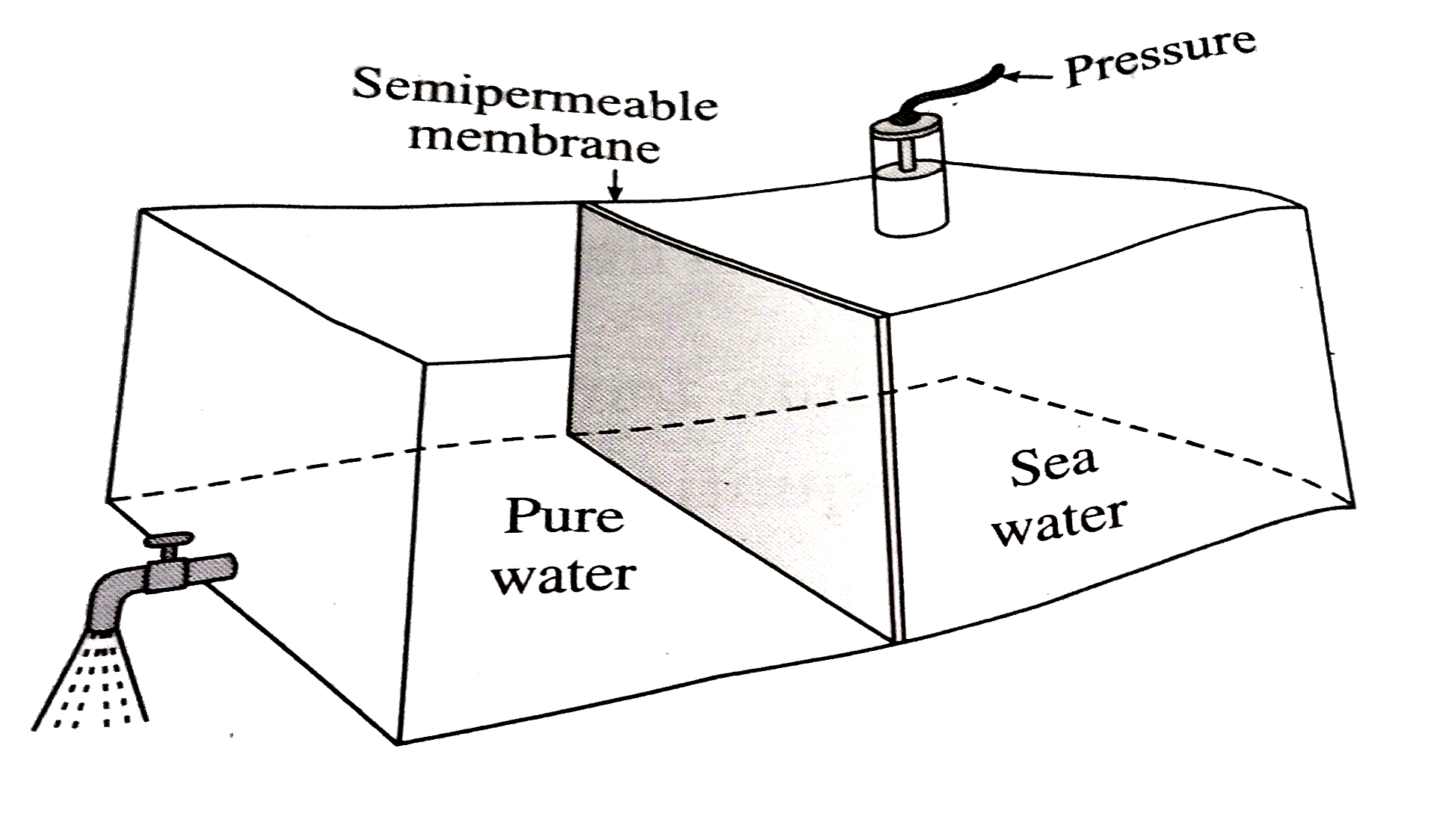 For this purpose of suitable semipermeable mem- brane is required which can withstand high pressure conditions over a long period. This method is USED successfully in FLORIDA since 1981 producing more than 10 million litres of pure water PER day. |
|
| 50. |
Explain denaturation of proteins with example. |
|
Answer» Solution :LOSS of biological ACTIVITY of protein by heating or CHANGE in pH is called DENATURATION Example: Coagulation of egg white on BOILING or curdling of milk. |
|