

Saved Bookmarks
This section includes 7 InterviewSolutions, each offering curated multiple-choice questions to sharpen your Current Affairs knowledge and support exam preparation. Choose a topic below to get started.
| 1. |
Explain dehydrohalogenation reaction. |
|
Answer» SOLUTION :Elimination reaction (ordehydrohalogenation reaction ) : <BR> This is a reaction in which two atoms or groups are removed from the aduacent carbon atoms (`alpha-beta` positions ) in the (organic ) molecule forming unsaturated COMPOUND. Explanation : When an alkyl halide is heated with alcoholic solution of KOH an alkene is formed DUE to removal of H and halogen X atoms from the adjacent carbon atoms (`alpha-beta` positions ) and this elimination reaction is called dehydrohalogenation reaction. `-overset(overset(H)(|beta))underset(|)(C)-overset(overset(H)(|alpha))underset(|)(C)-underset(("alc."))(KOH)overset(triangle)(rarr)-underset(|)(C)=underset(|)(C) -+KX+H_(2)O` For example, `{:(overset(beta)(CH_(3))-overset(alpha)(CH_(2))-Br + ,KOH overset(triangle)(rarr),H_(2)C=CH_(2)+KBr+H_(2)O),("ethyl bromide","(alc.)","isobutylene"):}` Thertiary butyl bromide when heated with alcoholic solution of potassium hydroxide forms isobutylene. `CH_(3)-overset(overset(CH_(3))(alpha|beta))underset(underset(Br)(|))(C)-CH_(3)+underset(("alc."))(KOH)overset(triangle)(rarr)underset("isobutylese")(CH_(3)-)overset(overset(CH_(3))(|))(C)=CH_(2)+KBr+H_(2)O` If by elimination reaction, two isomers are formed than more stable SYMMETRICAL alkene which has the greater number of alkyl groups attached to the doubly bonded carbon atoms is formed to a greater extent giving major product. For example : `underset("2-Bromobutane")(CH_(3)-CH_(2)-CHBr)-CH_(3) + underset("alc.")(KOH)overset(triangle)(rarr)` `{:(Ch_(3)- CH=CH,-CH_(3)+,CH_(3)-CH_(2)-CH=CH_(2)+KBr+H_(2)O), ("but-2-ene(80%)",,"but-1-ene(20%)"),("(major product)",,"(minor product)"):}` |
|
| 2. |
Explain dehydrohalogenation (beta - elimination) of alkyl halides. |
|
Answer» Solution :When a haloalkane with `beta` - hydrogen atom is heated with alcoholic solution of potassium hydroxide, there is elimination of hydrogen atom from `beta` - carbon and a halogen atom from the `alpha` - carbon atom. As a result, an alkene is formed as a product. Since `beta` - hydrogen atom is formed as a product. Since `beta` - hydrogen atom is involved in elimination, it is often called `beta` - elimination. If there is possibility of formation of more than one alkene due to the availability of more than one `beta` - hydrogen atoms, usually one alkene is formed as the MAJOR product.  These form part of a pattern first OBSERVED by Russian CHEMIST, ..Alexander Zaitsev... He formulated rule which can be SUMMARISED as : ..In dehydrohalogenation reactions, the preferred product is that alkene which has greater number of alkyl groups attached to doubly bonded carbon atoms... Thus, 2-bromopentane gives pent-2-ene as the major product. 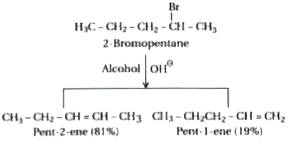
|
|
| 3. |
Explain dehydration of alcohols. |
|
Answer» Solution :In the presence of strong dehydrating agents such as conc. `H_(2)SO_(4)` or `H_(3)PO_(4)`, the alcohols dehydrate to form alkenes. The reaction is also carried out in presence of catalyst such as alumina or anhydrous zinc chloride. The alkene is formed as per Saitzev.s rule. `to` The reaction proceeds by formation of carbocation intermediate. Thus, the relative ease of dehydration of alcohols is `3^(@) gt2^(@) gt1^(@)`  `to ` Ethanol dehydrates to form ethene by heating with conc. `H_(2)SO_(4)` at 443 K TEMPERATURE. `C_(2)H_(5)OH underset(443K)overset(H_(2)SO_(4))to CH_(2)= CH_(2)H_(2)O` `to` Secondary and tertiary alcohols are dehydrated under milder CONDITIONS. For EXAMPLE, `CH_(3)overset(OH)overset(|)CHCH_(3) underset(440K)overset(85% of H_(3)PO_(4))to CH_(3)-CH= CH_(2)+ H_(2)O` `CH_(3)- underset(CH_(3))underset(|)overset(CH_(3))overset(|)C0OH underset(358K)overset(20% of H_(3)PO_(4))to CH_(3)-overset(CH_(2))overset(||)C-CH_(3)+H_(2)O` |
|
| 4. |
Explain defects caused by impurity in ionic solids. |
|
Answer» Solution : When in a pure crystal STRUCTURE, if the defect is arised by addition of foreign substance in SMALL amount it is known as impurity defect. In case of ionic solids, the impurity DEFECTS can be introduced by addition of IONS. The defect is arised only if the ions to be ADDED are in higher oxidatio state than the ions of crystal lattice. If a molten NaCl containing a little amount of `SrCl_2` is crystallised, some of the sites of `Na^+` ions are occupied by `Sr^(2+)`. Each `Sr^(2+)` replaces two `Na^(+)` ions and it occupies the site of one Nat ion and other site remains vacant. Thus cationic vacancies thus produced are equal in number to that of `Sr^(2+)` ions. Another similar example is the solid solution of `CdCl_2` and AgCl`. 
|
|
| 5. |
Explain cumene process. |
Answer» Solution :Phenol is MANUFACTURED from the hydrocarbon, cumene. Cumene (isopropylbenzene) is OXIDIZED in the PRESENCE of air to cumene hydroperoxide. It is converted to phenol and acetone by treating with DILUTE acid. Acetone, a by-product of this reaction is also obtained in large quantities by this METHOD. By this method, the phenol of high purity is obtained.
|
|
| 6. |
Explain Cyanide leaching. |
|
Answer» Solution :In the concentration of gold ore,the crushed ore of gold is leached with aerated DILUTE solution of sodium cyanide.Gold is converted into a soluble cyanide complex.The gangue,aluminosilicate REMAINS insoluble. `4AU(s)+8CN^(-)(AQ)+O_(2)(g)+2H_(2)O(l)to4[Au(CN)_(2)]^(-)(aq)+4OH^(-)(aq)` |
|
| 7. |
Explain CuSO_(4) is blue while CuSO_(4)is colourless ? |
| Answer» SOLUTION :Because water MOLECULES ACT as ligands and results in crystal field SPLITTING of d-orbitals of `Cu^(2+)` ion. | |
| 8. |
Explain crystalline and amorphous solids. |
|
Answer» Solution :Based on the arrangement of particles, solids are broadly classified as : (i) Crystalline solids (ii) Amorphous solids (i) Crystalline Solids : A solid in which the constituent particles have definite ordered arrangements are called crystalline solids. A crystalline solid consits of a large number of small crystals, each of them having a definite characteristic geometrical shape.  In a crystal, the arrangement of constituent particles (atoms, molecules or ions) is ordered and repetitive in three dimensions. If we observe the pattern in one region of the crystal, we can predict accurately the position of a particles in any other region of a crystal however far they may be from the place of observation. It has a long range order which means that there is a regular pattern of arrangement of particles which repeats itself periodically over the entire crystal. Crystalline solids have a sharp melting point and at characteristic temperature they melt abruptly and become liquid. Crystalline solids are anisotropic. It means in the same crystal, some of their physicalproperties like electrical resistance or refractive index etc, show different values when measured along different directions. Examples of crystalline solids are sodium chloride, quartz etc. (ii) Amorphous Solids : The term "Amorphous" is derived from the Greek word "Amorphos" meaning "no form". A solid in which there is irregular arrangement of constituent particles are called amorphous solids.  The arrangement of constituent particles (atoms, molecules or ions) in such a solid has only short range order. Thus a regular and periodically repeating pattern is observed over short distances only. Regular patterns are scattered and in between the arrangement is disordered. EX. : Glass, Rubber etc. Amorphous solids soften, melt and start flowing over a range of temperature and can be moulded and blown into various shapes. Amorphous solids have same structural features as liquids and are conveniently regarded as extremely viscous liquid. They may become crystalline at some temperature. For example, some glass objects from ancient civilisations are found to be milky in appearance because of some crystallisation. The amorphous solids have a tendency to flow like a liquids though very slowly. Therefore, some time they are referred as "Pseudo Solids" or super cooled liquids. For example, A glass panes fixed to a windows or doors of old buildings are found to be thicker at the bottom than at the top. Amorphous solids are isotropic in nature. This is due to ABSENCE of long range order in them and arrangement of particles is not definite along all directions. Hence, overall arrangement becomes equivalent in all directions. Therefore value of any physical property such as mechanical STRENGTH, refractive index & electrical conductivity etc. are same in all directions. Amorphous SILICON is best PHOTOVOLTAIC material for conversion of sunlight to electricity. |
|
| 9. |
Explain coordination number with examples. |
|
Answer» Solution :It is the number of LIGANDS attached DIRECTLY to the central METAL atom or ion by coordinate bonds in the given complex or co-ordinate ion. Example:(i) In ion `Ni(CO)_4rarr` ligand is `COrarr`COORDINATION number is 4.(ii)`[Ag(NH_3)_2]^+rarr` Ligand is `NH_3rarr`Coordination number is. 2. |
|
| 10. |
Explain coordination isomerism with suitable example. |
|
Answer» Solution :`(i)` Coordination ISOMERISM arises in the coordination compounds having both the cation and anion as complex ions. The interchange of one or more ligands between cationic and the anionic coordination entities result in different isomers. `(ii)` For e.g., in the coordination compound `[Co(NH_(3))_(6)][CR(CN)_(6)]`, the ligands ammonia and cyanide were BOUND respectively to cobalt and chromium while in its coordination ISOMER `[Cr(NH_(3))_(6)][Co(CN)_(6)]`, they are reversed. |
|
| 11. |
Explain contact process. |
Answer» Solution :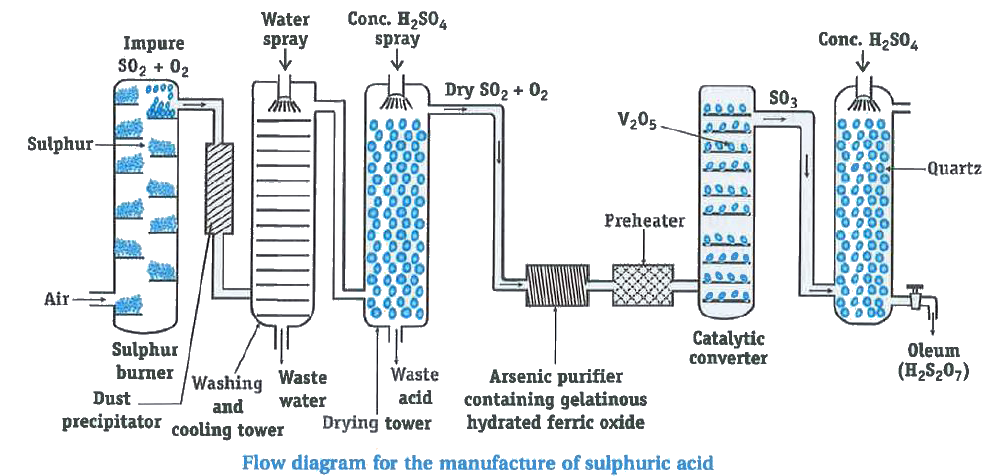 In contact process, the following steps are involved : (i) Burning of sulphur or sulphide ores in PRESENCE of air to generate `SO_2`. (ii) Conversion of `SO_2` to `SO_3` by the reaction with oxygen in the presence of a catalyst (`V_2O_5`). (iii) Absorption of `SO_3` in `H_2SO_4` to give oleum (`H_2S_2O_7`). The `SO_2` produced is purified by removing dust and other impurities such as arsenic compounds. The key step is the catalytic oxidation of `SO_2` with `O_2` to give `SO_3` in the presence of `V_2O_5` (catalyst). `2SO_(2)(g) + O_(2)(g) overset(V_(2)O_(5))to 2SO_(3)(g), Delta_(r)H^(-) = -196.6 kJ//mol^(-1)` The reaction is EXOTHERMIC, reversible and the forward reaction leads to a decrease in volume. Therefore, low temperature and high pressure are the favourable conditions for maximum yield. But the temperature should not be very low otherwise. In practice, the process is carried out at 2 BAR pressure and 720 K temperature. The `SO_3` gas from the catalytic convertor is absorbed in concentrated `H_2SO_4` of the desired concentration. In the INDUSTRY, two steps are carried out simultaneously to make process continuous and cost effective. `SO_(3) + H_(2)SO_(4) to H_(2)S_(2)O_(7)` (Oleum) The sulphuric acid obtained by contact process is 96-98% pure. |
|
| 12. |
Explain construction of the galvanic cell according to Daniell cell. I galvanic cell explain positive and negative electrode with suitable chemical reaction. |
|
Answer» Solution :(a) Galvanic cell according to Daniell cell: We can construct innumerable number of galvanic cell on the pattern of Daniell cell by TAKING combinations of different half-cell. (i) Each half-cell consists of a metallic electrode dipped into an electrolyte. (ii) The two half-cells are connected by a metallic wire though a voltmeter and a switch externally. (iii) The electrolytes of the two half-cells are connected internally through a salt bridge as shown n the figure (A-2). Sometimes, both the electrodes dip in the same electrolyte solution and in such cases, we do not require a salt bridge. (b) Positive and negative electrodes and reactions occurs in Daniell cell: Positive electrode: At each electrode-electrolyte interface there is a tendency of metal ions from the solution to deposit on the metal electrode trying to make it positively charged. `underset((aq)" metal")(M_((aq))^(+n))+n E^(-) to underset("electrode (positive)")M_((S))("Reduction")` Note: Number of electrons on the surface of the metal get decreases and it will become positive. The electrode which perform reduction reaction is cathode. e.g., in Daniell cell CU electrode is cathode and is positive electrode, where reduction reaction is carried out. Negative electrode: At the same time, metal atoms of the electrode tend to go into the solution as ions and leave behind the electrons at the electrode trying to make it negatively charged. `M_((S))TOM^(n+)+n e^(-)` Positive ions `M^(n+)` of metal M is dissolved in the solution and hence, electrons moves on the surface of the metal and so the metal will become negatively charged. Note: At equilibrium, there is a separation of charges and depending on the tendencies of the two opposing reactions,, the electrode may be positively or negatively chargd with respect to the solution. |
|
| 13. |
Explain (Co(NH_(3))_(6)]^(3+) is an inner orbital complex whereas [NI(NH_(3))_(6)]^(2+) is an outer orbital complex. |
| Answer» Solution :In `[Co(NH_(3))_(6)]^(3+)` Co is in +3 STATE with the configuration `3d^(6)` In the PRESENCE of `NH_(3)` 3d electrons pair up LEAVING two d - orbitals empty. Hence, the hybridization is dspo forming an inner orbital complex. In `[Ni(NH_(3))_(6)]^(2+)` Ni is in +2 state with the configuration `3d_(8)`. In presence of `NH_(3)` the 3d electrons, do not pair up. The hybridization involved is `sp^(3)d^(2)` forming an outer orbital complex | |
| 14. |
Explain [Co(NH_(3))_(6)]^(3+) is an inner orbital complex whereas [Ni(NH_(3))_(6)]^(2+) is an outer orbital complex. |
|
Answer» Solution :In `[Co(NH_(3))_(6)]^(3+)`, oxidation STATE of `Co=+3` Electronic CONFIGURATION `=3d^(6)` In presence of `NH_(3)`, `3d` electrons pair up leaving two `d`-orbitals empty. HENCE , the hybridisation is `d^(2)sp^(3)` forming an inner orbital complex. In `[Ni(NH_(3))_(6)]^(2+)` Oxidation state `=+2`, Electronic Configuration `=3d^(8)`. In the presence of `NH_(3)`, `3d` electrons do not pair up. The hybridisation involved is `sp^(3)d^(2)` and it forms an outer orbital complex. |
|
| 15. |
Explain [Co(NH_3)_6 ]^(3+) is an inner orbital complex whereas [Ni(NH_3)_6]^(2+) is an outer orbital complex. |
| Answer» SOLUTION :in `[COO (NH_3)_6 ]^(3+)` , the centralmetalionis ` CO^(3+)` | |
| 16. |
Explain concentration of ore by : (i) Hydraulic Washing (ii) Magnetic Separation |
|
Answer» Solution :(i) HYDRAULIC Washing: Principle : The method is based on the difference between specific gravities of the ORE and the gangue particles. In hydraulic washing, an upward stream of running water is used to wash the powdered ore. The lighter gangue particles are washed away and the heavier ore particles are left behind. The method is also referred as Gravity SEPARATION (ii) Magnetic Separation :  Principle : The method is based on differences in magnetic properties of the ore components. In this method, the powdered ore is dropped over a conveyer BELT which moves over a magnetic roller as shown in a figure. Magnetic separation, either ore or gangue particles remains attracted towards the belt and falls close to it. For example : IRON ores are concentrated by this method. |
|
| 17. |
Explain conduction of electricity in metals. |
|
Answer» Solution : A CONDUCTOR may conduct ELECTRICITY through movement of ELECTRONS or ions. Metals conduct electricity through electrons while ELECTROLYTES conduct electricity through ions. Metals conduct electricity in solid as well as in molten state. The conductivity of metals depend upon the number of valence electrons available per atom. The atomic orbitals of metal atoms form molecular orbitals which are so close in energy to each other as to form a band. If this band is partially filled or it overlaps with a higher energy unoccupied conduction band, then electrons can flow easily under an applied electric field and the metal shows conductivity.  However, if the GAP between filled valence band and the next higher unoccupied band (conduction band) is large, electrons cannot jump to it and such a substance has very small conductivity and it behaves as insulator. 
|
|
| 18. |
Explain common ion effect with an example. |
|
Answer» Solution :The dissociation of a week acid `(CH_3 COOH)` is suppressed in the presence of a salt `(CH_3 COONa)` containing an ion common to the weak ELECTROLYTE. It is CALLED the common ion effect. Eg: Acetic acids is a weak acid. It is not completely dissociated in aqueous solution and hence the following equilibrium exists. `CH_3COOH_((aq)) hArr H_((aq))^(+)+CH_3 COO_(((aq))` However, the added salt, sodium acetate, completely DISSOCIATES to produce `Na^+` and `CH_3 COO^(-) "ion"`. `CH-3 COONa_((aq)) to Na_((aq))^(+)+CH_3COO_((aq))^(-)` Hence, the overall concentration of `CH_3 COO^(-)` is increased , and the acid dissociation equilibrium is disturbed. According to Le chatelier's principle, the excess `CH_3 COO^(-)` ions combines with `H^+` ions to produce much more unionized `CH_3 COOH` i.e., the equilibrium will shift towards the left. In other words, the dissociation of `CH_3 COOH` is suppressed. |
|
| 19. |
Explain column chromatography with the help of a suitable diagram. |
|
Answer» Solution :Column chromatorgaphy is a technique for separation of components of a mixture. The technique works on the principle of DIFFERENTIAL adsorption of the components on the adsorbent. In column chromatography `Al_(2)O_(3)` is teken as adsorbent which ACTS as stationary phase. The mixture of substances to be SEPARATED is dissolved in suitable solvent called eluent which acts as mobile phase. The components get separated due to differential adsorption by the adsorbent (stationary phase). The component which gets adsorbed on the adsorbent to the maxium extent MOVES at the slowest speed and that which gets adsorbed to the minimum extent moves at the fastest speed down the column. The elution is continued till all the components cross the column and are received in the receives separately. 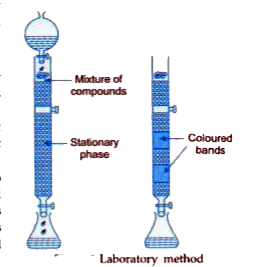
|
|
| 20. |
Explain close packing in two dimensions. |
|
Answer» SOLUTION : The close packing in two DIMENSIONS can be done in two ways by stacking the rows of closed PACKED spheres : (i) Square Close Packing (ii) Hexagonal Close Packing (HCP) (i) Square Close Packing : In square close packing, the spheres of second row are placed exactly above the spheres of first row such that spheres of these two rows are aligned horizontally as well as vertically. If the first row of spheres is called "A" type row, the second row being exactly the same as the first one is also of ..A.. type and hence by placing more rows, AAAA..... type of arrangement is obtained.  In this arrangement, each sphere is in contact with four of its neighbours and hence the coordination number of a sphere is four. If the centres of the four immediate neighbours are joined a square is FORMED and hence it is named Square Closed Packing. (ii) Hexagonal Closed Packing (HCP) :  In hexagonal close packing, the spheres of second row are fit in the depressions of the spheres of first row. If the spheres of first row is called ..A.. type, the one in second row may be called ..B.. type. The spheres of third row are placed in depressions of the spheres of second row such that spheres of first row and third row are in same alignment horizontally and vertically. As the third row is exactly same as that of first row it is called ..A.. type. Hence, we get ABABAB .... type of arrangement. In this arrangement each sphere is in contact with six of its neighbour and thus in two dimensional the co-ordination number is six. The centres of these six spheres are at the corners of regular hexagon hence this packing is called two dimensional hexagonal close packing. In this arrangement, there is less free space and so this packing is more efficient than square close packing. The empty spaces called voids are surrounded by three spheres in this arrangement. The centres of these three touching spheres form a TRIANGLE and hence it is called Triangular Voids. In one row, the apex of the triangles are pointed upwards and in the next layer dowards. Hence, we get two types of triangular voids. |
|
| 21. |
Explain colour of transition metal compounds based on crystal field splitting. |
|
Answer» Solution :Colour of transition METAL compounds is possible when they have PARTIALLY filled .d. sub-shell or have unpaired electrons. When visible light (white light) falls on these, a part of the RADIATION is absorbed to excite or promote an ELECTRON from one set of d-orbitals to the other, or diagram. Unabsorbed radiations are transmitted. This gives colour to the COMPOUND. |
|
| 22. |
Explain close packing in one dimension. |
Answer» Solution :The spheres in one dimension can be arranged only in one WAY that is to ARRANGE them in a row and TOUCHING each other.  In this arrangement, each SPHERE is in contact with two of its NEIGHBOURS. The numbers of nearest neighbours of a particle is called coordination number. Thus, in one dimensional arrangement, the co-ordination number is two. |
|
| 23. |
Explain classification of monohalogen compounds on the basis of sp^(3)(C-X) bonds. (X = F, Cl, Br, I). |
|
Answer» Solution :(a) Alkyl Halides : DEPENDING upon the nature of carbon to which the halogen is bonded, the alkyl halides are classified as `1^(@)` (primary), `2^(@)` (secondary) and `3^(@)` (tertiary compounds. `underset("Primary "(1^(@)))(R.-overset("H")overset("|")underset("H")underset("|")("C")-X) ""underset("Secondary" (2^(@)))(R..-overset("R.")overset("|")underset("H")underset("|")("C")-X)"" underset("Tertiary "(3^(@)))(R.-overset("R.")overset("| ")underset("R...")underset("| ")("C ")-X)` `underset("Alkane")(C_(N)H_(2n+2))overset(+X" ")underset(-H" ")rarr underset("(Homologous Series)")underset("Haloalkane")(C_(n)H_(2n+1)X)` `1^(@)` Alkyl Halide `rArr` Halogen is bonded to `1^(@)` carbon `2^(@)` Alkyl Halide `rArr` Halogen is bonded to `2^(@)` carbon `3^(@)` Alkyl Halide `rArr` Halogen is bonded to `3^(@)` carbon (b) Benzylic Halides : These are the compounds in which the halogen atom is bonded to an `sp^(3)` hybridized carbon atom attached to an aromating ring. 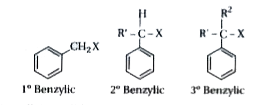 (c ) Allyic Halides : These are the compounds in which the halogen atom is bonded to an `sp^(3)` - hybridised carbon atom adjacent to carbon - carbon double bond `(gt C = C LT)` i.e., allylic carbon. 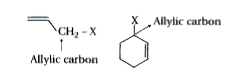
|
|
| 24. |
Explain cleansing action of soaps. |
Answer» Solution :A micelle consists of a HYDROPHOBIC hydrocarbon like CENTRAL core. The cleansing action of soap is due to the FACT that soap molecules form micelle around the oil droplet in such a way that hydrophobic part of the stearate ions is in the oil droplet and hydrophilic part projects out of the grease droplet like the bristles.  The polar groups can interact with water, the oil droplet surrounded by stearate ions is ow pulled in water and removed from the dirty SURFACE. Thus soap helps inemulsification and washing away of oils and fats. The negatively charged sheath around the globules prevents them from coming together and forming AGGREGATES. |
|
| 25. |
Explain Clemmensen reduction with an example. |
|
Answer» Solution :Aldehydes and ketones are heated with zinc amalgam and conc. HCL, to FORM corresponding HYDROCARBONS. `R-overset(O)overset(||)C-R.+4[H\] UNDERSET("heat")overset((Zn//Hg+"con.HCl"))toRCH_(2^(-))R.+H_(2)O` Example: `C_(6)H_(5)COCH_(3)+4[H]underset((Zn//Hg+"con.HCl")) overset("heat")to underset("ethyl benzene")(C_(6)H_(5)CH_(2)CH_(3))+H_(2)O` |
|
| 26. |
Explain classification of haloalkanes and haloarenes on the basis of number of halogen atoms. |
|
Answer» Solution :Depending upon the NUMBER of hydrogen atoms(s) replaced by the HALOGEN atoms(s) these are classified as MONO, di, or polyhalogens (tri - , tetra-, etc.) For example 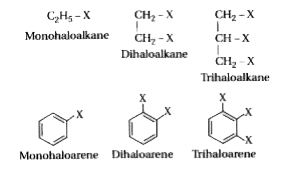 The monohalogen derivatives of ALKANE are known as Alkyl Halides or Haloalkanes.They have general formula. A - X, X = F, Cl, Br, I, = Alkyl group. |
|
| 27. |
Explain classification of drugs. |
|
Answer» Solution :Drugs can be classified mainly on criteria outlined as follows : (a) On the basis of pharmacological effect : This classification is based on pharmacological effect of the drugs. It is useful for doctors because it PROVIDES them the WHOLE range of drugs available for the treatment of a particular type of problem. For example, analgesics have pain killing effect, antiseptics KILL or arrest the growth of microorganisms. (b) On the basis of drug action : It is based on the action of a drug on a particular biochemical process. For example, all antihistamines inhibit the action of the compound, histamine which causes inflammation in the body. There are various ways in which action of histamines can be BLOCKED. (c) On the basis of chemical structure : It is based on the chemical structure of the drug. Drugs classified in this way share common structural features and often have similar pharmacological activity. For example, sulfonamides have common structural feature, given below.  Structural features of sulfonamides (d) On the basis of molecular targets : Drugs usually interact with biomolecules such as carbohydrates, lipids, proteins and nucleic acids. These are called target molecules or drug targets. Drugs possessing some common structural features may have the same mechanism of action on targets. The classification based on molecular targets is the most useful classification for MEDICINAL chemists. |
|
| 28. |
Explain classification based on type of particles of the dispersed phase, multimolecular, macromolecular and associatedcolloids. |
|
Answer» Solution :Depending upon the type of the particles of the dispersed phase, colloids are CLASSIFIED as: multimolecular, macromolecular and associated colloids. (i) Multimolecular colloids: On dissolution a large number of atoms or smaller molecules of a substance aggregate TOGETHER to form species having size in the colloidal range `(1-1000 nm)`. The species thus formed are called multimolecular colloids. For example, a gold solution may contain particles of VARIOUS sizes having many atoms. Sulphur sol consists of particles containing a thousand or more of Sg sulphur molecules. (ii) Macromolecular colloids : Macromolecules in suitable solvents form solutions in which the size of the macromolecules may be in the colloidal range. Such system are called macromolecular colloids. These colloids are quite stable and resemble true solutions in many respects. Examples of naturally occurring macromolecules are starch, cellulose, proteins and enzymes and those of man-made macromolecules are polythene, nylon, polystyrene, synthetic rubber etc. (iii) Associated colloids (Micelles) : There are some substances which at low concentrations behave as normal strong electrolytes, but at higher concentration exhibit colloidal behaviour due to the formation of aggregates. The aggregrated particles thus formed are called micelles. These are also known as associated colloids. The formation of micelles takes place only above a particular temperature called Kraft temperature `(T_(k))` and above particular concentration called critical micelle concentration (CMC). On dilution, these colloids revert back to individual ions. Surface active agents such as soaps and synthetic detergents belong to this class. For soaps the CMC is `10^(-4)` to `10^(-3) MOL L^(-1)`. These colloids have both lyophobic and LYOPHILIC parts. Micelles may contain as many as 100 molecules or more. |
|
| 29. |
Explain classification of colloids. |
|
Answer» Solution :Colloids are classified on the basis of the following criteria : (i) Physical state of DISPERSED phase and dispersion medium. (ii) Nature of interaction between dispersed phase and dispersion medium. (iii) Type of particles of the dispersed phase. Classification based on physical state of dispersed phase and dispersion medium : Depending upon whether the dispersed phase and the dispersion medium are solids, LIQUIDS or gases, eight types of COLLOIDAL systems are possible. A gas mixed with another gas forms a homogeneous MIXTURE and hence is not a colloidal system. The examples of the various types of colloids along with their typical names are listed below in table.  Many FAMILIAR commercial products and natural objects are colloids. For example, whipped cream is a foam, which is a gas dispersed in liquid. Fire fighting foam used at emergency airplane landings are also colloidal systems. Most biological fluids are aqueous sols. Within a typical cell, proteins and nucleic acids are colloidal sized particles dispersed in an aqueous solution of ions and small molecules. Out of the various types of colloids given in table, the most common are sols (solid in liquids), gels (liquid in solids) and emulsion (liquid in liquid). Depending upon the nature of interaction between the dispersed phase and the dispersion medium, colloidal sols are divided into two categories, namely lyophilic (solvent attracting) and lyophobic (solvent repelling). If water is the dispersion medium, the terms used are hydrophilic and hydrophobic. |
|
| 30. |
Explain chromatographic methods to refine the elements. |
|
Answer» Solution :Principle: The method is BASED on the difference in ADSORPTION of different COMPONENTS on the mixture to a different extent on an adsorbent. The mixture is put onto a stationery phase which may be a solid or a liquid. A pure solvent, a mixture of solvents or a gas is allowed to move slowly over the stationary phase. Different components of the mixture get separated gradually as the moving phase moves.  There are several chromatographic techniques such as paperchromatography, gas chromato-graphy, thin layer chromatography, column chromatography etc. column chromatography (as shown in figure) is very useful for purification of the elements which are AVAILABLE in minute QUANTITIES and the impurities are not very different in chemical properties from the element to be purified. |
|
| 31. |
Explainchromyl chlorideTest |
|
Answer» Solution :(i)When POTASSIUMDICHROMATE is heatedwithany chloride saltin the presence of Conc. ` H_(2)SO_(4)`orangered vapoursof CHROMYL chloride` (CrO_(2)Cl_(2))` is evolved. (iii) This reaction is usedto confirm the presenceof chlorideion in inorganic qualitativeanalysis . ` K_(2)Cr_(2)O_(7) + 4NaCI + 6H_(2)SO_(4) to2KHSO_(4) + 4NaHSO_(4)underset(" Chromylchloride " ) ( 2 CrO_(2) CI_(2))uarr + 3H_(2)O` (iii) The chromyl chloride vapoursare dissolvedin sodiumhydroxidesolution and thenacidified withacetic ACID andtreated with lead acetate. A yellowprecipitateof lead chromateis OBTAINED. ` CrO_(2)Cl_(2) + 4NaOH toNa_(2)CrO_(4) + 2NaCI + 2H_(2)O` `Na_(2)CrO_(4) + (CH_(3)COO)_(2) Pb tounderset( " Leadchromate Yellowprecptiate")darr + 2CH_(3) COONa` |
|
| 32. |
Explain chemical reactivity of halogens. |
|
Answer» SOLUTION :Bond dissociation enthalpy : The bond dissociation enthalpy of HALOGEN increases with the increase in size of halogen atom. However, fluorine has lower bond dissociation enthalpy because of its small size and large electron-electron repulsions between lone pairs of fluorine. Bond dissociation energy sequence : `Cl_(2) gt Br_(2) gt F_(2) gt I_(2)` The electron pairs in fluorine are much more closer than in chlorine. (ii) Oxidizing NATURE : Halogens are strong oxidizing agents. This is due to fact that halogens readily accepts the electrons. Fluorine is strongest oxidizing agent. It oxidizes other halide in ions in solution or even in the solid phase. For example : `F_(2) + 2X^(-) to 2F^(-) + X_(2) (X = Cl, Br, I)` `Cl_(2) + 2X^(-) to 2Cl^(-)+ X_(2) (X = Br, l)` `Br_(2) + 2I^(-) to 2Br^(-) + I_(2)` The oxidizing strength of halogens depend on enthalpy of fusion, enthalpy of vapourisation, enthalpy of dissociation, electron gain enthalpy and hydration enthalpy. `1/2X_(2)(g) overset(1/2Delta"diss"H^(-)) to X(g) overset(Delta_(eg)H^(-))to X_(g)^(-) overset(Delta"hyd"H^(-))to, X_(aq)^(-)` The relative oxidizing power of halogens can be illustrated by their reactions with water. `2F_(2)(g) + 2H_(2)O(l) to 4H_(aq)^(+) + 4F_(aq)^(-) + O_(2)(g)` `X_(2)(g) + H_(2)O(l) to HX(aq) + HOX (aq) (X=Cl, Br)` Fluorine oxidizes water to OXYGEN where as chlorine and bromine forms CORRESPONDING hydrohalic acid. The reaction of iodine with water is non spontaneous and infact `I^(-)`is oxidized by oxygen in acidic medium, just the reverse of the reaction observed with fluorine. `4l_(aq)^(-) + 4H_(aq)^(+) + O_(2)(g) to 2l_(2)(s) + 2H_(2)O(l)` Fluorine has less negative electron enthalpy than chlorine though it is a strongest oxidizing agent because of low bond dissociation enthalpy and high hydration enthalpy. |
|
| 33. |
Explain Claisen - Schmidt condensation. |
Answer» Solution :Benzaldehye condenses with acetaldehyde or ACETONE in the presence of dil. alkali at room temperature to FORM unsaturated aldehyde (or) KETONE. This TYPE of reaction is called Claisen – Schmidt CONDENSATION. 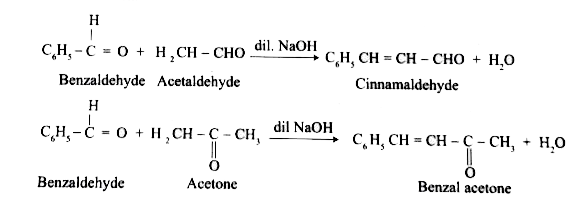
|
|
| 34. |
Explain chemical methods, Bredig's Arc method and peptization method for the preparation of colloids. |
|
Answer» Solution :Chemical methods : Colloidal dispersions can be prepared by chemical reactions leading to formation of molecules by double decomposition, oxidation, reduction or hydrolysis. These molecules then aggregate leading to formation of sols. `As_(2)O_(3)+3H_(2)Soverset("Double decomposition")rarrAs_(2)O_(3("sol"))+3H_(2)O` `SO_(2)+2H_(2)Soverset("Oxidation")rarr3S_("(sol)")+2H_(2)O` `2AuCl_(3)+3HCHO+3H_(2)Ooverset("Reduction")rarr2Au_(("sol"))+3HCOOH+6HCl` `FeCl_(3)+3H_(2)Ooverset("Hydrolysis")rarr FE(OH)_(3)" (sol)"+3HCl` Electrical disintegration or Bredig.s Arc method : This process involves dispersion as well as condensation. Colloidal sols of metals such as gold, silver, platinum ETC., can be prepared by this method. In this method, electric arc is struck between electrodes of the metal immersed in the dispersion medium. The intense HEAT produced vapourises the metal, which then condenses to form particles of colloidal size.  Peptization : Peptization may be defined as the process of converting a precipitate into colloidal sol by shaking it with dispersion medium in the presence of a small amount of electrolyte. The electrolyte used for this purpose is called peptizing agent. This method is applied to convert a freshly prepared precipitate into a colloidal sol. During peptization the precipitate adsorbs one of the ions of the electrolyte on its surface. This CAUSES the development of positive or negative charge on precipitates, which ultimately break up into smaller particles of the size of a COLLOID. |
|
| 35. |
Explain chemical behaviour of oxoacids of phosphorus. |
|
Answer» Solution :The oxoacids having phosphorus in (+3) oxidation state tend to disproportionate to higher and lower oxidation states. For example, Orthophosphorus acid on heating disproportionate to give orthophosphoric acid and phosphine. `underset(+3)(4H_(3)PO_(3)) to underset(+5)(3H_(3)PO_(4)) + underset(-3)(PH_(3))` The acids which has P-H BOND have strong reducing properties. Thus, hypophosphorus acid is a good reducing agent as it contains two P-H bonds and reduces, for example, `AgNO_(3)`to METALLIC silver: `4AgNO_(3) + 2H_(2)O + H_(3)PO_(2) to 4Ag + 4HNO_(3) + H_(3)PO_(4)` The hydrogen of P-H bonds are non-ionisable and do not give `H^+` and donot play any role in basicity. Only those hydrogen atoms which are attached to oxygen in P-OH bond are ionisable and give `H^+`. Hence `H_3PO_(4)`is tribasic, `H_3PO_3` is dibasic while `H_3PO_2` is monobasic. |
|
| 36. |
Explain charring action of concentrated sulphuric acid on carbohydrate. Give the equation. (ii) Complete the equation : 2PbO_(2)(s)overset(Delta)rarr "……………. + ………………" |
|
Answer» Solution :(i) Concentrated sulphuric acid is a strong dehydrating agent, it removes WATER from carbohydrate to form carbon. `C_(12)H_(22)O_(11) overset(H_(2)SO_(4))rarr 12C+11H_(2)O` (ii) `2PbO_(2)(s)overset(Delta)rarr 2PbO(s)+O_(2)(G)`. |
|
| 37. |
Explain characteristics of enzyme catalysis. |
|
Answer» Solution :The characteristics of enzyme catalysis are as below: (i) Most highly efficient : One molecule of an enzyme may transform one million molecules of the reactant per minute. (ii) Highly specific nature : Each enzyme is specific for a given reaction i.e. one CATALYST cannot catalyse more then one reaction. For example the enzyme urease catalyse the hydrolysis of urea only. It does not catalyse hydrolysis of any other amide. (iii) Highly active under optimum temperature: The rate of the enzyme reaction becomes maximum at a definite temperature called optimum temperature. On either side of optimum temperature the enzyme activity decreases. The optimum temperature range for ENZYMATIC activity is `298-310 K`. Human body temperature being 310 K is suited for enzyme catalysed REACTIONS. (iv) Highly active under optimum PH: The rate of an enzyme catalysed reaction is maximum at particular pH called optimum pH, which is between pH values `5-7`. (v) Increasing activity in presence of activators and co-enzymes : The enzymatic activity is increased in the presence of certain substance known as co-enzymes. It has been observed that when a small nonprotein (vitamin) is present along with an enzyme, the catalytic is enhanced considerably. (vi) Influence of inhibitors and poisons : Like ordinary catalysts, enzymes are also inhibited or poisoned by the presence of certain substances. The inhibitors or poisons interact with the active functional groups on the enzyme surface and often reduce or COMPLETELY destroy the catalytic activity of the enzyme. The use of many drugs is related to their action as enzyme inhibitors in the body. |
|
| 38. |
Explain chain growth polymerisation and step growth polymerisation. |
|
Answer» Solution :Chain growth polymerisation. Chain growth polymerisation involves the formation of polymers by addition of monomers through a chain reaction. The reaction is initiated by a free radical or an ion obtained from an organic peroxide or a SUITABLE acid or base added in a small quantity. The polymers formed by the above PROCESS are KNOWN as chain growth polymers. Polythene, PVC and polystyrene are IMPORTANT examples of chain growth polymerisation. Step growth polymerisation. Step growth polymerisation involves the formation of polymers through a series of inter-molecular condensation reactions which take PLACE in a step-wise manner. The polymers formed by the above process are called step growth polymers. Nylon-66 and bakelite are examples of step growth polymerisation. |
|
| 39. |
Explain Cationic detergentswith suitable examples ? |
| Answer» SOLUTION :Those in which CATIONIC PART of the molecule is involved in cleansingaction. E.g., cetyltrimethyl AMMONIUM bromide. | |
| 40. |
Explain cationic complexes and anionic complexes of coordination compounds. write the structure and IUPAC names of isomeric aldehyde having molecular formula C_(6)H_(10)O. Draw the structure of aspirin. |
|
Answer» Solution :Cationic complexes of coordination compound : A complex ion or coordination ENTITY which has a net positive charge is called cationic complex. For Example : `[CO[NH_(3)]_(6)]^(3+), [Ni(NH_(3))_(6)]^(2+)`. Anionic complexes of coordination compound : A complex ion or coordination entity which has a net negative charge is called anionic complex. For Example : `[Ag(CN)_(2)]^(-), [Fe(C_(2)O_(4))^(3-)]` Structure and IUPAC names of ISOMERIC aldehyde `(C_(5)H_(10)O)` : (i) underset("n-pentan-1-al")(CH_(3)-CH_(2)-CH_(2)-CH_(2)-CHO)` `IUPAC rarr` Pentanal (ii) `{:(CH_(3)-CH-CH_(2)-CHO),("|"),(""CH_(3)),("iso-pentanal"):}` `IUPAC rarr 3`-METHYL butanal (iii) `{:(""CH_(3)),("|"),(CH_(3)-C-CHO),("|"),(""CH_(3)),("neo-pentnal"):}` `IUPAC rarr 2, 2`-Dimethyl propanal Structure of Aspirin : 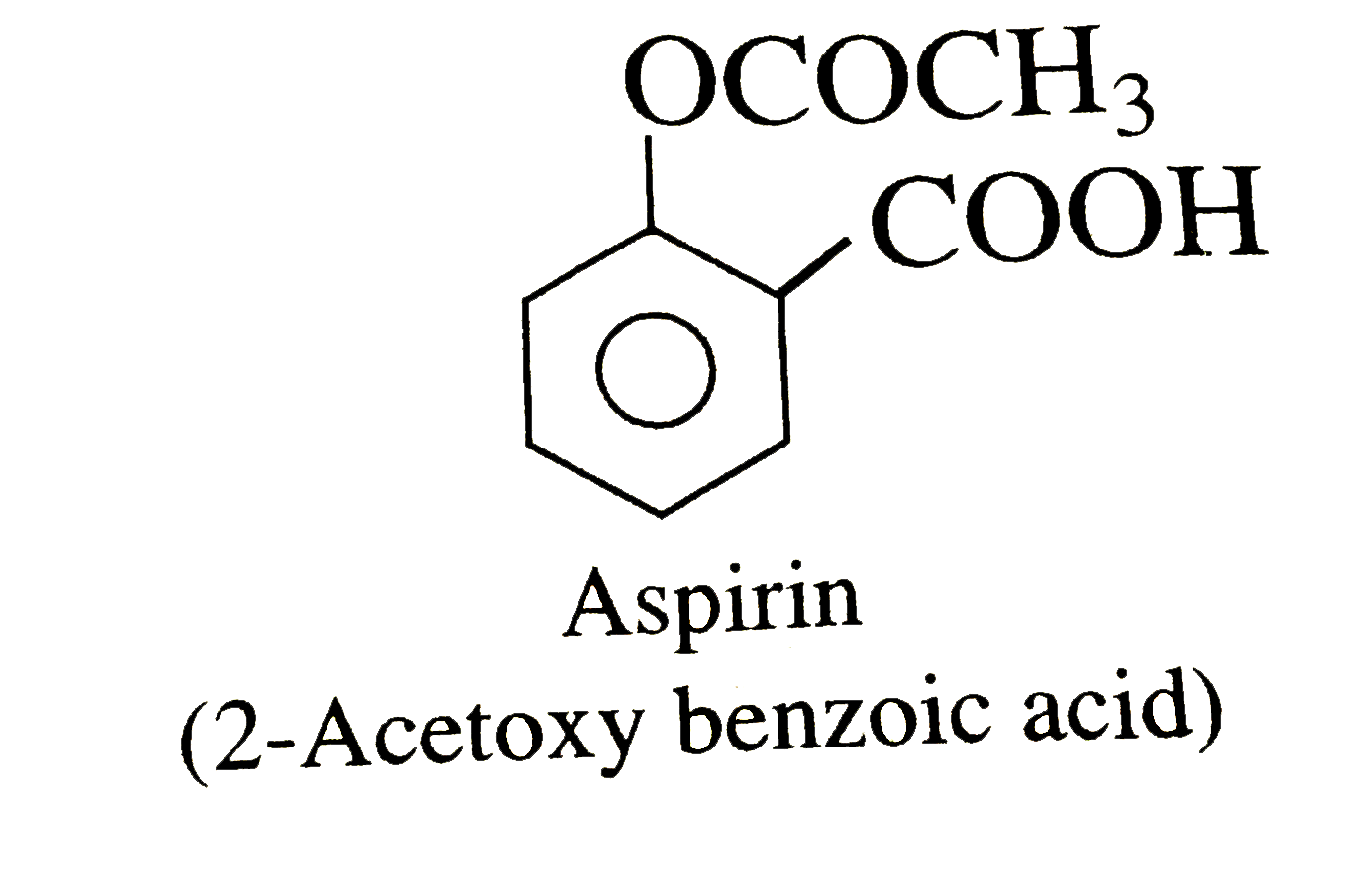
|
|
| 41. |
Explain Carius method for the determination of Halogens quantatively in an organic compound . |
|
Answer» Solution :Halogens can be estimated by Carius method . In this method a known weight of the organic compound is heated with fuming nitric acid in presence of `AgNO_(3)` in a hard glass tube. Carbon and hydrogen are oxidised to `CO_(2)` & `H_(2)O` . Halogens are converted into sivler halides . The silver halide is filtered off , washed , dried and weighted 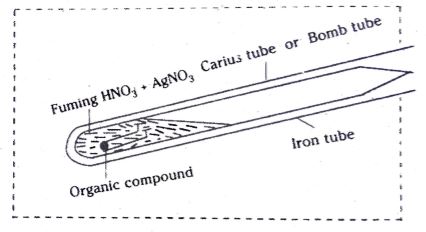 Calculation : Mass of the organic compound = a g Mass of silver halide FORMED (AG X) = B g `therefore` Mass of halogen in b g of Ag X ............ ? `= ("(Atomic mass of X" xx " b) g")/( "Molecular mass of AGX") = 'C' g . ` a g of organic compound has C g of halogen `therefore` 100 g of organic compound has ................ ? `= (100 xx C)/( a) = (100 xx b xx "Atomic mass of X")/(a xx "Molecular mass of AgX")` (Molecular Masses : AgCl = 143.5(108 + 35.5) , AgBr= 188 (108 + 80) , Agl = 235 (108 + 127) ) |
|
| 42. |
Explain cationic, anionic and non-ionic detergents. |
Answer» SOLUTION :(a) Cationic detergents are those detergents in which large PART is cationic.  Anionic detergents are those detergents in which large part of DETERGENT is aniomic. e.g. `CH_3-(CH_2)_10-CH_2OSO_3-Na^+` ( c ) Non-ionic detergents do not have ions. They are formed polyethylene glycol and STEARIC acid. e.g. `CH_3-(CH_2)_16-COO-(CH_2-CH_2O)_n-CH_2_CH_2OH` |
|
| 43. |
Explain Carbyl amine reaction |
| Answer» SOLUTION :`P^0`Qmine REACT with chloroturn a KOH (ALCO) to FORM alky Isolyanide | |
| 44. |
Explain cannizzaro's reaction taking benzaldehyde as an example. |
Answer» SOLUTION :BENZALDEHYDE when treated with STRONG NAOH solution, a mixture of sodium benzoate and benzyl ALCOHOL is formed 
|
|
| 45. |
Explain Cannizaro reaction with an example. |
|
Answer» |
|
| 46. |
Explain : C_(6)H_(5)CHClCH_(3) is hydrolysed more easily with KOH than C_(6)H_(5)CH_(2)Cl. |
Answer» Solution : SECONDARY BENZYLIC halide Primary benzylic halide Secondary benzylic carbocation can stabilise itself more than primary benzylic carbocation because of addition inductive effect of` - CH_(3)` GROUP. It neutralises the `+ ve `charge on the carbocation. Of course stabilisation through resonance is common to both.  THEREFORE, `C_(6)H_(5)CHClCH_(3)` ishydrolysed moreeasily than `C_(6)H_(5)CH_(2)Cl " with " KOH` . |
|
| 47. |
Explain Cannizzaro reaction with an example. |
Answer» SOLUTION :When aldehydes which do not CONTAIN a-hydrogen atom react with sodium or potassium HYDROXIDE, they undergo self-oxidation and reduction to form alcohol and a SALT of the carboxylic acid. This reaction is called Cannizzaro reaction. 
|
|
| 48. |
Explain Buffer action with suitable example. |
|
Answer» |
|
| 49. |
Explain buffer action with example. |
|
Answer» Solution :Let us explain the buffer action in a solution containing `CH_3 COOH and CH_3 COONa.` The dissociation of the buffer components occurs as below. `CH_3 COONa_((s)) overset(H_2O(I))(to) CH_3 -COO_((aq))^(-)+Na_((aq))^(+)` If an acid is added to this mixture. it will be consumed by the conjugate base `CH_3 COO^-` to FORM the undissociated weak acid i.e, the INCREASE in the concentration of `H^+` does not reduce the PH significantly. `CH_3 COO_((aq))+H_((aq))^(+) to CH_3 COOH_((aq))` if a base is added , it will be neutralized by `H_3O^+` and the acetic acid is DISSOCIATED to maintain the equilibrium. Hence the pH is not significantly altered. `OH_((aq))^(-)+H_3O_((aq))^(+) to H_2O(I)` `CH_3 COOH_((aq)) overset(H_2O(I))( HARR )CH_3 COO_((aq))^(-) +H_3O_((aq))^(+)` `OH_((aq))+CH_3 COOOH_((aq)) to CH_3 COO_((aq))+H_2O(I)` |
|
| 50. |
Explain brown ring with the help of chemical equation. |
|
Answer» Solution :Brown RING test can be PERFORMED by adding Iron (II) sulphate to a solution of a NITRATE then slowly adding concentrated `H_(2)SO_(4)` such that it forms a layer below the AQUEOUS solution. A brown ring will form at the junction of the two layers indicating the presence of nitrate ion. Theoverall reaction is the reduction of the nitrate ion by iron (II) which is reduced of the nitrate ion by iron (II) which is reduced to iron (I) and formation of nitrosonium complex where nitric oxide is oxidised to `NO^(+)`. `NO_(2)^(-)3Fe^(2+)+4H^(+)to3Fe^(3+)+NO+2H_(2)O` `[Fe(H_(2)O_(6))]^(2+)+NOtounderset("Brown ring")([Fe(H_(2)O)_(5)NO]^(2+))+H_(2)O` |
|