

Saved Bookmarks
This section includes 7 InterviewSolutions, each offering curated multiple-choice questions to sharpen your Current Affairs knowledge and support exam preparation. Choose a topic below to get started.
| 1. |
Explain Reimer-Tiemann reaction. |
Answer» SOLUTION :
|
|
| 2. |
Explain refining by fractional crystallization. |
Answer» Solution :Principle : Difference in the solubility of impurities in molten and solid state of the metal. As SHOWN in figure, a mobile HEATER surrounding the rod of impure metal is fixed at its one end. The molten zone moves along with the heater which is moved forward. As the heater moves forward, the pure metal crystallises out of the MELT left BEHIND and the impurities pass on into the adjacent new molten zone created by movement of heaters. The process is repeated several times and the heater is moved in the same direction again and again. Impurities get CONCENTRATED at one end & this end is cut off. This method is very useful for producing semiconductor and other metals of very high purity, e.g., germanium, silicon, boron, gallium and indium. |
|
| 3. |
Explain refining by Distillation and Liquation. |
|
Answer» Solution :(a) Distillation : This is very useful for low boiling metals like zinc and MERCURY. The impure metal is evaporated to obtain the PURE metal as distillate. (b) LIQUATION : In this method a low melting metal like tin can be made to flow on a SLOPING surface. In this way it is separated from higher melting impurities. |
|
| 4. |
Explain reactivity of halogens with oxygen. OR Write a note on oxides of halogens. |
|
Answer» Solution :Halogens form many oxides with oxygen but most of them are unstable. Fluorine does not forms oxides. The compounds of oxygen with fluorine are called fluorides because fluorine is more electronegative than oxygen. Fluorides of oxygen are `OF_2` and `O_2F_2`. Both are strong fluorinating agents. `O_2F_2` oxidises Pu to `PuF_6` and the reaction is used in removing plutonium as `PuF_6` from spent nuclear fuel. Chlorine oxides, `Cl2_O, ClO_2, Cl_2O_6` and `Cl_2O_7` are highly REACTIVE oxidising agents. They tend to explode.`ClO_2` is used as a bleaching agent for PAPER pulp and textiles and in water treatment. The STABILITY of oxides of chlorine can be explained due to fact that multiple bond formation between oxygen and chlorine takes place due to availability of d-orbitals in chlorine. The bromine oxides, `Br_2O, BrO_(2), BrO_3` are the least stable halogen oxides (middle row anomanously) and exist only at LOW temperatures. They are very powerful oxidising agents. The bromine oxides are least stable because : (i) Bromine cannot form multiple bonds with oxygen. (ii) Very less polarizability of Br-0 bond. The iodine oxides, `I_(2)O_(4), I_(2)O_(5), I_(2)O_(7)` are insoluble solids and decompose on heating. `I_2O_5` is a very good oxidising agent and is used in the estimation of carbon monoxide. The kinetic and thermodynamic studies show that stability of oxides of halogen follows the order : I > CI > Br. Iodine oxides are highly stable because of greater polarizability of bond between iodine and oxygen. The stability of oxides increases with the increase in NUMBER of oxygens in the compound. 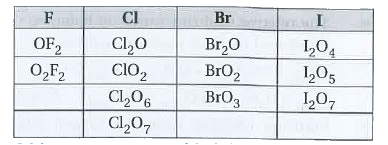
|
|
| 5. |
Explain reactivity of halogens with metals. |
|
Answer» Solution :Halogens react with metals to FORM metal halides. For example, bromine reacts with MAGNESIUM to give magnesium bromide. `Mg(s) + Br_(2)(l) to MgBr_(2)(s)` Order of reactivity of Halogens: `F_(2) gt Cl_(2) gt Br_(2) gt I_(2)` The ionic character of the halides decreases in the order MF > MCI > MBr > MI where M is a monovalent metal. For example: `OVERSET(NaF gt NaCl gt NaBr gt Nal)underset("Ionic character decreases")to` If a metal exhibits more than one oxidation state, the halides in HIGHER oxidation state will be more covalent than the one in lower oxidation state. For example: `SnCl_4, PbCl_4, SbCl_5` and `UF_6` are more covalent than `SnCl_2, PbCl_2, SbCl_3` and `UF_4` respectively. |
|
| 6. |
Explain Rcimer - Tiemann reaction with an example . |
Answer» Solution : When phenol is HEATED with CHLOROFORM and sodium HYDROXID slotuion. Sodium salt of salicyladehyde isabtained which on ACIDIFICATION gives salicyladehyde . 
|
|
| 7. |
Explain Reactant selectivity |
| Answer» Solution :Reactant SELECTIVITY : When bulkier MOLECULES in a reactant MIXTURE are prevented from reaching the active sites within the zeolite CRYSTAL, this selectivity is called reactant shapeselectivity | |
| 8. |
Explain preparation of ozone. |
|
Answer» Solution :When a slow dry stream of oxygen is passed through a silent electrical DISCHARGE, a conversion of oxygen to ozone (10 %) occurs. The product is known as ozonised oxygen. `3O_2 to2O_3 DeltaH^(-)`(at 298 K) = +142 kj `mol^(-1)` Since the FORMATION of ozone from oxygen is an endothermic process, it is necessary to use a silent electrical discharge in its PREPARATION to prevent its decomposition. If concentrations of ozone greater than 10 percent are required, a battery of ozonisers can be USED, and pure ozone (b.p. 101.1 K) can be condensed in a vessel surrounded by liquid oxygen. |
|
| 9. |
Explain pseudo first order by giving exaple . |
|
Answer» Solution :Pseudo first order reaction:The order of a reactionis sometimes altered by conditions.Considers a chemical reaction between two substances when one reactant is present in large excess and remain almost constant at the end of the reaction.This reaction are called pseudo first order reaction. Example:During the hydrolysis of 0.01 mol of ETHYL acetate with 10 mol of water,amounts of the various CONSTITUENTS at the BEGINNING (t=0) and completion (t) of the reaction are given as under. Reaction:`CH_(3)COOC_(2)H_(5)+H_(2)O(l)toCH_(3)COOH+C_(2)H_(5)OH` t=0 0.01 mole 10 mole 0 mole 0 mole t=t 0.0 mole 9.99 mole 0.01 mole 0.01 mole The concentration of water does not get altered the rate equation . `therefore` Rate=`(-d[R])/(DT)=k.[CH_(3)COOC_(2)H_(5)][H_(2)O]` the term `[H_(2)O]` can be taken as constant .The equation .Thus becomes Rate =k`[CH_(3)COOC_(2)H_(5)]` Where k=k. `[H_(2)O]` `therefore` Rate `k[CH_(3)COOC_(2)H_(5)]` And the reaction behave as first order reaction Such reaction are called pseudo first order reaction. |
|
| 10. |
Explain pseudo first order reaction with an example. |
|
Answer» Solution :Pseudo first order reaction : (i) Kinetic STUDY of a HIGHER order reaction is difficult to FOLLOW, for example, in a study of a second order reaction involving two DIFFERENT reactants , the simultaneous measurement of change in the concentration of both the reactants is very difficult. (ii)To overcome such difficulties, A second order reaction can be altered to a first order reaction by taking one of the reactant in large excess, such reaction is called pseudo first order reaction. (iii) Let us consider the acid hydrolysis of an ester, `CH_(3)COOCH_(3(aq))+H_(2)O_((l))overset(H^(+))rarr CH_(3)COOH_((aq))+CH_(3)OH_((aq))` Rate `= k[CH_(3)COOCH_(3)][H_(2)O]` (iv) If the reaction is carried out with the large excess of water, there is no significant change in the concentration of water during hydrolysis, i.e., concentration of water remains almost a constant. (v) Now, we can define `k [H_(2)O]=k'`, Therefore the above rate equation becomes Rate `= k' [CH_(3)COOCH_(3)]` (vi) Thus it follows first order KINETICS. |
|
| 11. |
Explain properties of sulphur dioxide. State its uses. |
Answer» Solution :(i) Physical properties : Sulphur dioxide is a COLOURLESS gas with pungent smell and is highly soluble in water. It boils at 263 K and liquefies at room temperature under a pressure of 2 atm. The shape of `SO_(2)`is angular. It is resonance hybrid of two canonical forms. 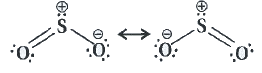 (ii) Chemical properties : S02 when passed through water forms a solution of sulphurous acid. `SO_(2)(g) + H_(2)O(l) Mimplies H_(2)SO_(3)(aq)` It readily reacts with NaOH solution, forming sodium sulphite, which reacts with more sulphur dioxide to form sodium hydrogen sulphite. `2NaOH + SO_(2) to Na_(2)SO_(3) + H_(2)O` `Na_(2)SO_(3) + H_(2)O + SO_(2) to 2NaHSO_(3)` The S02 behaves very similar to `CO_(2)`in its reaction with water and alkalies. Sulphur dioxide reacts with chlorine in the presence of charcoal (Catalyst) to give sulphuryl chloride `SO_2Cl_2`. `SO_(2)(g) + Cl_(2)(g) to SO_(2)Cl_(2)(g)` In presence of vanadium (V) oxide, it oxidizes to `SO_3`. `2SO_(2)(g) + O_(2)(g) overset(V_(2)O_(5))to 2SO_(3)(g)` The moist sulphur dioxide act as reducing agent. For example, it CONVERTS Fe(III) ions to Fe(II) and decolourises potassium permanganate solution. The reaction with potassium permanganate is used for TEST of `SO_(2)(g)` `2Fe^(3+) + SO_(2) + 2H_(2)O to 2Fe^(2+) + SO_(4)^(2-) + 4H^(+)` `5SO_(2) + 2MnO_(4)^(-) + 2H_(2)O to 5SO_(5)^(2-) + 4H^(+) + 2Mn^(2+)` Uses of `SO_(2)`: i)In refining of petroleum and sugar. (ii)In bleaching of wool and silk. (iii)As an anti colour, disinfectant and preservative. Industrial CHEMICALS such as `H_2SO_4, NaHSO_3` and `Ca(HSO_3)_2` are prepared from `SO_2`. Liquid `SO_2` is used as SOLVENT to dissolve a number of inorganic and organic chemicals. |
|
| 12. |
Explain properties of ozone and state its uses. |
|
Answer» Solution :Physical properties : Pure ozone is a pale blue gas, dark blue liquid and violet-black solid. Ozone has a characteristic odour and in small concentrations it is harmless. However, if the concentration rises above about 100 ppm, breathing becomes uncomfortable resulting in headache and nausea. Ozone has two resonating structures. The two oxygen-oxygen bond lengths in the ozone molecule are identical (128 pm) and the bond angle is expected 117°. It molecular shape is angular (bent). 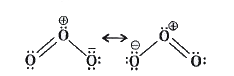 Chemical properties : High concentrations of ozone can be dangerously explosive. This is due to fact that ozone is thermodynamically unstable with respect to oxygen since its decomposition into oxygen results in the liberation of heat (`DeltaH lt 0`) and increase in entropy (`DeltaS gt 0`). These two effects reinforce each other, resulting in large NEGATIVE Gibbs free energy (`DeltaG`) change for its conversion to oxygen. Ozone act as powerful oxidizing agent because it easily liberates ATOMS of nascent oxygen. `O_(3) to O_(2) + [O]` For example: `PbS_(s) + 4O_(3)(g) to PbSO_(4)(s) + 4O_(2)(g)` `2I^(-)(aq) + H_(2)O(l) + O_(3)(g) to 2OH_(aq)^(-) + I_(2)(s) + O_(2)(g)` The nitrogen monoxide (NO) combine very rapidly with ozone and thus, there is possibility that nitrogen OXIDES emitted from the exhaust systems of supersonic jet aeroplanes might be slowly depleting the concentration of the ozone layer in the upper atmosphere. `NO(g) + O_(3)(g) to NO_(2)(g) + O_(2)(g)` Another threat to this ozone layer is use of freons in aerosol sprays and as refrigerants. When ozone reacts with an excess of potassium iodide solution buffered with a borate buffer (pH = 9.2), iodine is liberated which can be titrated against a standard solution of sodium thiosulphate. This is a quantitative method for ESTIMATING `O_(3)` `2I^(-) + H_(2)O + O_(3) to 2OH^(-) + I_(2) + O_(2)` `I_(2) + 2Na_(2)S_(2)O_(3) to Na_(2)S_(4)O_(6) + Nal` Uses of ozone : It is used as a germicide, disinfectant and for STERILISING water. It is also used for bleaching oils, ivory, flour, starch. It acts as an oxidising agent in the manufacture of potassium permanganate. |
|
| 13. |
Explain properties of hydrogen chloride. |
|
Answer» Solution :(i) Physical properties : It is a colourless and pungent smelling gas. It is easily liquefied to a colourless liquid (b.p.189 K) and freezes to a white crystalline solid (f.p. 159 K).It is HIGHLY soluble in water. Its aqueous solution is known as hydrochloric ACID. (ii) Chemical properties : In aqueous medium, it ionizes as `HCl(G) + H_(2)O (l) It reacts with `NH_3` and gives white fumes of `NH_(4)Cl` `NH_(3) + HCl to NH_(4)Cl` When three parts of CONCENTRATED HCl and one part of concentrated `HNO_3` are mixed, aqua regia is formed which is used for dissolving NOBLE metals, e.g., gold, platinum. `Au + 4H^(+) + NO_(3)^(-) + 4Cl^(-) to AuCl_(4)^(-) + NO + 2H_(2)O` `3Pt + 16H^(+) + 4NO_(3)^(-) + 18Cl^(-) to 3PtCl_(6)^(2-) + 4NO + 8H_(2)O` Hydrochloric acid decomposes salts of weaker acids, e.g., carbonates, hydrogen carbonates, sulphites, etc. `Na_(2)CO_(3) + 2HCl to 2NaCl + H_(2)O + CO_(2)` `NaHCO_(3) + HCl to NaCl + CO_(2) + H_(2)O` `Na_(2)SO_(3) + 2HCl to 2NaCl + H_(2)O + SO_(2)` |
|
| 14. |
ExplainProduct selectivity |
| Answer» Solution :PRODUCT SELECTIVITY : It is encountered when CERTAIN product molecules ONE too big to DIFFUSE out of the zeolite pores. | |
| 15. |
Explain preparation of polyacrylonitrile and also write down its uses. |
|
Answer» Solution :PREPARATION The ADDITION polymerization of ACRYLONITRILE in PRESENCE of a peroxide catalyst leads to the formation of polyacrylonitrile. Uses: Polyacrylonitrile is used as a substitute for wool in making commercial fibres as orlon or acrilan. |
|
| 16. |
Explain preparation of Nylon-6 and also write its uses. |
Answer» Solution :Preparation : It is obtained by heating CAPROLACTUM with WATER at a high temperature.  Uses : NYLON 6 is used for the manufacture of tyre cords, FABRICS and ropes. |
|
| 17. |
Explain preparation of alkyl halides by halogen exchange methods. |
|
Answer» Solution :(i) Finkelstein Reaction : ALKYL iodides are often prepared by the reaction of alkyl chlorides or alkyl bromides with NaI in dry acetone. `underset("Bromoethane")(CH_(3)-CH_(2)-Br)+NaI overset(" Acetone ")RARR underset("Iodoethane")(CH_(3)CH_(2))-I + NaBr` `underset("Chloroethane")(CH_(3)CH_(2)Cl)+NaI overset(" Acetone ")rarr underset("Iodoethane")(CH_(3)CH_(2)I)+NaCl` NaCl or NaBr thus formed is PRECIPITATED in dry acetone. It facilitates the forward reaction according to Le Chatelier.s Principle. (ii) Swartz Reaction : The synthesis of alkyl fluorides is best accomplished by heating an alkyl chloride or alkyl BROMIDE in the presence of a metallic fluoride such as `AgF, Hg_(2)F_(2), CoF_(2)` or `SbF_(3)`. `H_(3)C-Br+AgF to H_(3)C-F+AgBr`. |
|
| 18. |
Explain polling process. |
|
Answer» Solution :(1) Polling process is a process of refining IMPURE metals. (2) This method is GENERALLY used in the purification of Cu and Sn which contain oxide impurities. (3) In this process, the impure melted and sitrred with green logs of wood. (4) Due to the heat of molten metal, the green logs LIBERATE hydrocarbon gases which reduce metal oxides if FORMED to pure metal. (5) In case of impure copper (98% pure), may be made `99.5%` pure after the polling process. |
|
| 19. |
Whatis a peptide bond? |
| Answer» SOLUTION :The LINKAGE which comnine TWO AMINO ACID is calledpeptidelinkage . | |
| 20. |
Explain paramagnetism and diamagnetism. |
|
Answer» Solution : (i) Paramagnetic substances OR Paramagnetism : If a substance has atom, ions or molecules with one or more unpaired electrons they are weakly attracted by magnetic field. Such substances are called paramagnetic. These substances are magnetised in magnetic field in same direction and lose their magnetism in the ABSENCE of magnetic field. Examples: `O_2, Cu^(2+), Fe^(3+), Cr^(3+)` ETC. (ii) Diamagnetism OR Diamagnetic substances : The substances that are weakly repelled by magnetic field are KNOWN as diamagnetic. These substances have atoms with completely FILLED ORBITALS i.e. all electrons are paired. They are weakly magnetised in a magnetic field in opposite direction. Pairing of electrons cancels their magnetic moments and they lose their magnetic character. Ex : `H_2O, NaCl, C_6H_6` etc. |
|
| 21. |
Explain parts per million in brief. |
|
Answer» Solution :When a solute is present in trace QUANTITIES, it is convenient to express CONCENTRATION in parts PER million (ppm) Parts per million `= ("Number of parts of the component")/("Total number of parts of all components of the solution")xx10^(6)` As in the case of percentage, concentration in parts per million can also be expressed as mass to mass, volume to volume and mass to volume. A litre of seas water (which weights 1030 g) contains about `6xx10^(-3)` g of dissolved OXYGEN `(O_(2))`. Such a small concentration is also expressed as 5.8 g per `10^(6)` g (5.8 ppm) of seawater. The concentration of pollutants in water or atmosphere is often expresed in terms of `MU g mL^(-1)` or ppm. |
|
| 22. |
Explain, Ozone as protective umbrella for UV from sun. |
| Answer» SOLUTION :The stratopheric pool of ozone which is a LAYER above earth's SURFACE and protects from HARMFUL high energetic ULTRAVIOLET (UV) rays is called ozone umbrella or ozonosphere. | |
| 23. |
Explain oxidation states of lanthanoids. |
|
Answer» Solution :(1) The common oxidation state of the Lanthanoids is 3+ due to the loss of 2 electrons from OUTERMOST 6s orbital amd one electron from the penultimate 5d-sub-shell. (2) `Gd^(3+)` and `Lu^(3+)`e showextrastabilitydue to theirhalffilledandcompletely filled f-sub-shells. `Gd^(3+) = [Xe]4f^(7)` `Lu^(3+) = [Xe]4f^(14)` (3) Ce and Tb ATTAIN the `4f^(0)` and `4f^(7)` configurations in the 4+ oxidation states. Eu and Yb attain the `4f^(7)` and `4f^(14)` configurations in the 2+ oxidation states. Sm and Tm also SHOW the 2+ oxidation state although their stability can be explained based on thermodynamic factors. (4) Somelanthnoidsshow 2+ and 4+ oxidationstateseven THOUGH theydo nothavestableelectronicconfigurationof `4f^(0)` , `4f^(7)` or `4f^(14)` E.g. `Pr^(4+) (4f^(1)),Nd^(2+),Sm^(2+)(4f^(6)),DY^(4+)(4f^(8)),` etc |
|
| 24. |
Explain : Oxidation of Cl^(-) ion is carried out near anode when electrolysis of aqueous (Concentrated) NaCl solution is carried out using inert electrode. OR Oxidation of species depend upon its oxidation potential, oxidation reaction is possible for E^(Theta) whose value is less. |
|
Answer» Solution :* `NaCl_((aq)) to Na_((aq))^(+)+Cl_((aq))^(+)` Here, near anode `Cl^(-)` ions of NaCl and WATER is present. So, two OXIDATION reaction is possible: (i) `Cl_((aq))^(-) to (1)/(2) Cl_(2(g)) +e^(-)""E_(cell)^(Theta)=1.36V` (ii) `2H_(2)O_((L)) to O_(2(g)) + 4H_((aq))^(+)+4e^(-)""E_(cell)^(Theta)=1.23V` * "Reaction with less `E^(Theta)` value will occur near anode." So, INSTEAD of `Cl^(-)` ions oxidation of water occur. But due to over potential of oxygen, water does not GET oxidized but oxidation of `Cl^(-)` near anode is possible and produced `Cl_(2)` gas. |
|
| 25. |
Explain oxidation method of preparation of colloids with two examples. |
|
Answer» Solution :Oxidation : (i) When hydroiodic ACID is TREATED with iodic acid `I_(2)` sol is obtained. `HIO_3 + 5HI to 3H_2O + 3I_2`(sol) (ii) When `O_(2)` is PASSED through `H_2Se` , a sol of SELENIUM is obtained. ` H_2Se + O_2to 2H_2O + Se `(sol ) |
|
| 26. |
Explain Ostwald's isolation method for the determination of order of a reaction. |
|
Answer» Solution :CONSIDER a REACTION `A+B RARR` products CASE (i) A is taken in small amounts and B in large excess. Order with RESPECT to A is determined. Let it be x. Case (ii) B is taken in small amounts and A in large excess. Order with respect to B is determined. Let it be y. Order of the reaction is x+y. |
|
| 27. |
Explain origin of magnetic properties in a substance. |
|
Answer» Solution : The origin of magnetic properties in a substance is because of two types of motions of electrons : (i) Orbital motion around the nucleus (II) Spin motion around its axis  An electron in an atom behaves like a tiny magnet. Electron being charged particle and undergoing these motions can be considered as a small loop of current which possesses a magnetic moment. Each electron thus has a permanent spin and an orbital magnetic moment associated with it. MAGNITUDE of magnetic moment is very small and is measured in the unit CALLED Bohr magneton, `(mu_B)` which is equal to `9.27 xx 10^(-24) Am^2`. On the basis of their magnetic properties the substances is classified as : (i) Paramagnetic (ii) Diamagnetic (iii) Ferromagnetic (IV) Antiferromagnetic and (V) Ferrimagnetic . |
|
| 28. |
Explain order of reaction of complex reaction by giving examples. |
Answer» Solution :(a)The example of complex reaction involving more than THREE molecules :The complex reaction involving more than three molecules in the stoichiometric equation MUST take place in more than one step e.g  This reaction which apparently seems to be of tenth order is actually a second order reaction. This shows that this reaction takes place in several steps but slowest step determine the rate of reaction ."The overall rate of the reaction is controlled by the slowest step in a reaction called the rate determining step" Example :The decomposition of hydrohen proxide which is catalysed by iodide ion in an alkaline medium. `2H_(2)O_(2)(I^(-))/("alkaline medium ")2H_(2)O+O_(2)` The rate equation for this reaction is found to be Rate=`-(d[H_(2)O_(2)])/(dt)=k[H_(2)O_(2)][I^(-)]` If the order of reaction =`(5)/(2)` then unit of rateconstant k is `L^((+3)/(2)) mol ^((-3)/(2))S^(-1)` Thus,in respect of `H_(2)O_(2)`, the order of reaction =1 and In respect of `I^(-)` ,the order of reaction =1 and overall order of reaction =(1+1)=2 So,this reaction is second order reaction. The decomposition of `H_(2)O_(2)` takes place in two steps. (i)`H_(2)O_(2)+I^(-)toH_(2)O+IO^(-)` (slow step) (II)`underset("molecule")underset("second")(H_(2)O_(2))""underset("species")underset("Intermediate")(+IO^(-)toH_(2)O)+underset(("fast step"))(I^(-)+O_(2))` Overall reaction (i)+(ii):`2H_(2)O_(2)to2H_(2)O+O_(2)` Both the steps are bimolecular elementary reaction .Species `IO^(-)` is called as an intermediate since it is formed during the COURSE of the reaction but not in the overall balance equation. The first tep,being slow is the rate determining step.Thus,the rate of formation of intermediate will determined the rate of this reaction. The order of the slowest step=molecularity of the slowest step. |
|
| 29. |
Explain optical isomerism in coordination comounds with an example. |
|
Answer» Solution :`(i)` COORDINATION compounds which possess chairality exhibit optical isomerism similar to organic compounds. `(ii)` The pair of two optically acitve isomers which are mirror images of each other are called enantiomers. `(iii)` Their solutions rotate the plane of the plane polarised light either clockwise or anticlockwise and the corresponding isomers are called `d` (dextrorotatry) and `I` (levelortatory) forms respectively. `(iv)` The octahedral complexes of type `[M(x x)3]^(n+-)`, `[Mx x)_(2)AB]^(n+-)` and `[M(x x)_(2)B_(2)]^(n+-)` exhibit optical isomerism. Examples : `(i)` The optical isomers of `[Co(en)_(3)]^(3+)` are shown below. 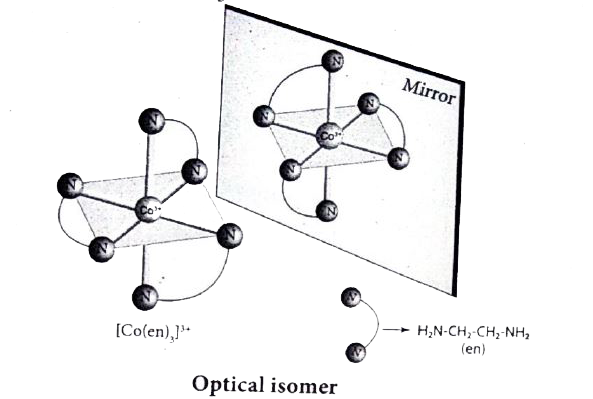 `(ii)` The coordination complex `[CoCl_(2)(en)_(2)]^(+)` has three isomers, two optically active cis forms and one optically INACTIVE trans form. These STURCTURES are shown below. 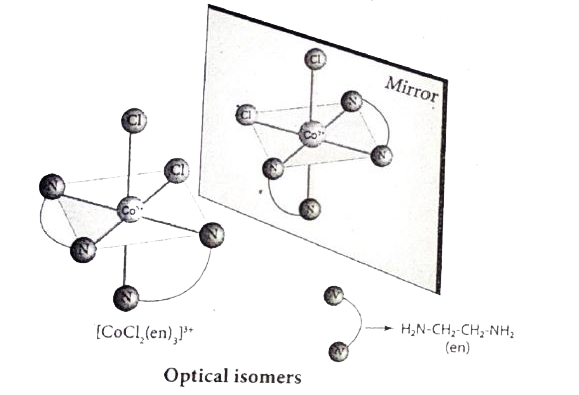 `(iii)` In a coordination compound of type `[PtCl_(2)(en)_(2)]^(2+)`, two geometrical isomers are possible . They are cis and trans. Among these two isomers cis isomer shows optically active isomerism because the whole molecule is asymmetric. 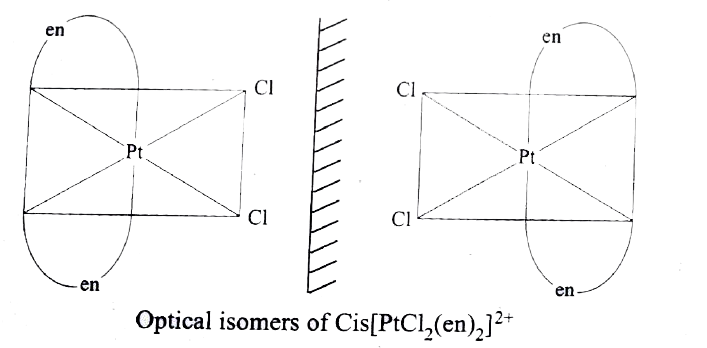
|
|
| 30. |
Explain optical isomerism in coordination compounds with an example. |
|
Answer» Solution :Coordination compounds which possess chairality exhibity optical ISOMERISM simillar to organic compounds.The pair of two optically active isomers which are mirror images of each other are called enantiomers .Their solution rotate the PLANE of the plane polarised light either CLOCKWISE or anticlockwise and the corresponding isomers are called 'd' (dextro rotatory) and 'I' rotatory laevo FORMS respectively Eg. ` [Co(EN)_3 ]^(3+) ` 
|
|
| 31. |
Explain on the basis of valence bondy theory that [Ni(CN)_(4)]^(2-) ion with square planar structure is diamagnetic and the [NiCl_(4)]^(2-) ion with tetrahedral geometry is paramagnetic. |
|
Answer» Solution :Nickel in `[Ni(CN)_(4)]^(2-)` is in the `+2` oxidation state , i.e. Nickel is persent as `Ni^(+2)` ion. `dsp^(2)`-hybrid orbitals -Diamagnetic `CN^(-)` is a strong ligand as it approaches the metal ion , So the electrons should getpaired up. In `[NiCl_(4)]^(2-)`, `CL^(-)` provides a WEAK ligand field. It is therefore UNABLE to pair up the unpaired electrons of the `3D` orbital. Hence the hybridisation is `SP^(3)` and it is paramagnetic . 
|
|
| 32. |
Explain on what factors the ionization enthalpies of elements having d^(10) configuration depends upon? |
|
Answer» Solution :The ionization enthalpy depends on THREE factors. (i) Nucleus- electron attraction (ii) Electron - Electron repulsion (iii) Exchange ENERGY Exchange energy is responsible for the stabilization of the energy state. It is approximately PROPORTIONAL to the toal number of possible pairs of parallel spin degenerate orbitals. When a several electrons occupy a set of degenerate orbitals, the lowest energy state CORRESPONDS to the maximum possible extent of single occupation of orbitals and parallel spinds (Hund.s Rule). The loss of exchange energy increases the stability and HENCE the ionization enthalpy increases. |
|
| 33. |
Explain on the basis of valence bond theory that [Ni(CN)_(4)]^(2-) ion with square planar structure is diamagnetic and the [NiCl_(4)]^(2-) ion with tetrahedral geometry is paramagnetic. |
|
Answer» Solution :`[Ni(CN)_(4)]^(2-)` Nickel in the above complex ion is in +2 oxidation state. Formation of `[Ni(CN)_(4)]^(2-)` may be explained through hybridisation as FOLLOWS : Configuration of `Ni^(2+)` Pairing of ELECTRONS 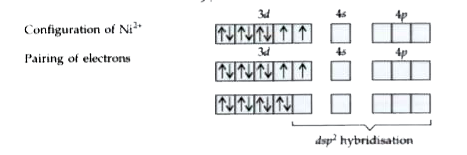 followed by `dsp^(2)` hybridisation It is because of the strong ligand `CN^(-)` that the pairing of electrons takes place. As there are no unpaired electrons, the complex is diamagnetic. `[NiCl_(4)]^(2-)` Formation of the above complex may be explained through hybridisation. Ni in the above complex is in +2 oxidation state i.e., as `Ni^(2+)`. Configuration of `Ni^(2+)` No pairing of electrons `sp^(3)` hybridisation 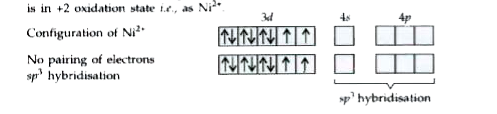 As `Cl^(-)` is a weak ligand, pairing of electrons does not take place. `sp^(3)` hybridisation of orbitals takes place giving RISE to tetrahedral geometry. As there are two unpaired electrons in the complex, it is paramagnetic. |
|
| 34. |
Explain on the basis of standard reduction potentials, fluorine is a strong oxidising agent while potassium is a strong reducing agent. |
|
Answer» SOLUTION :(1) Fluorine has very high standard reduction POTENTIAL (positive reduction potential). (2) It has a STRONG tendency to accept electrons and get reduced. (3) HENCE, fluorine is a strong oxidising agent. (4) Potassium has very low reduction potential (negative reductin potential). (5) It has a strong tendency to donate electrons and get oxidised. () Hence, potassium is a strong reducing agent. |
|
| 35. |
Explain occurence of group-16 elements. |
|
Answer» SOLUTION :(i) Oxygen : Oxygen is the most abundant of all the ELEMENTS on earth. Oxygen forms about 46.6% by mass of earth.s crust. Dry air contains 20.946 % oxygen by volume. (ii) Sulphur : The abundance of sulphur in the earth.s crust is only 0.03 - 0.1 % combined sulphur exists primarily as sulphates such as gypsum (`CaSO_4 . 2H_2O`), epsom salt (`MgSO_4 . 7H_2O`), baryte (`BaSO_4`) and sulphides such as galena (PbS), zinc blende (ZnS), copper PYRITES (`CuFeS_2`). The traces of sulphur occur as hydrogen sulphide in volcanoes, in ORGANIC materials such as eggs, proteins, GARLIC, onion, mustard, hair and wool. (iii) Selenium and tellurium : Selenium and tellurium are found as metal selenides and tellurides in sulphide ores. (iv) Polonium and livermorium : Polonium occurs in nature as a decay product of thorium and uranium minerals. Livermorium is a synthetic radioactive element. Its has been produced only in a very small amount and has very short life period (only a small fraction of one second). This limits the study of properties of livermorium. |
|
| 36. |
Explain occurence of elements of group-15. |
|
Answer» Solution :(i) NITROGEN : Molecular nitrogen comprises 78% by volume of the atmosphere. In the earth.s crust it occurs as sodium NITRATE, `NaNO_3` (called chile saltpetre) and POTASSIUM nitrate, `KNO_(3)` (Indian saltpetre). It is found in the form of proteins in plants and animals. (ii) (ii) Phosphorus : Phosphorus occurs in minerals of the apatite family `Ca_(9)(PO_(4))_(6).CaX_(2) (X =F,Cl or OH)` For example: Fluoraptite `[Ca_(9)(PO_(4))_(6).CaF_(2)]` Chlorapatite: `[Ca_(9)(PO_(4))_(6).CaCl_(2)]` and HYDROXYAPATITE: `[Ca_(9)(PO_(4))_(6).Ca(OH)_(2)]` which are main components of phosphate rocks. Phosphorus is an essential constituent of animal and plant matter . It is present in bones as well as in living cell. Phosphoproteins are present in milk and eggs. (iii) Arsenic, antimony and bismuth are found mainly as sulphide minerals. (iv) Moscovium is a synthetic radioactive element with atomic mass-289 and very short half-life period. Due to very short half life time, it is available in very litde amount. |
|
| 37. |
Explain occurence of elements in nature. |
|
Answer» Solution :ELEMENTS are obtained naturally in (i) Native state (ii) Combined state. The combined ores are further classified as oxidised ores, sulphide ores, carbonate ores, halide ores etc. For example, elements like carbon, SULPHUR, gold and noble gases occurs in free state while other elements are found in combined form in earth.s crust. The elements vary in abundance. Among metals, Aluminium is the most abundant. Infact, it is the third most abundant element in earth.s crust (8.3 % approx by weight). It is also a major component of many igneous minerals INCLUDING mica and clays. Many gemstones are impure forms of `Al_2O_3` For example : "Ruby" and "Sapphire" have impurities of chromium and cobalt RESPECTIVELY. Iron is the second most abundant metal in the earth.s crust. It forms a VARIETY of compounds and their various uses make it very important element and it is also one of the most important element in biological systems. The principal ores of aluminium, iron, copper and zinc are :  Generally for extraction, the oxide ore is preferred over sulphide ore because, (i) The reduction is easier (ii) Oxide ore does not produce polluting gases like `SO_2` as produced from sulphide ores. |
|
| 38. |
Explain O/W and W/O types of emulsions with examples. |
| Answer» Solution : (i) In the O/W SYSTEM water acts as dispersion MEDIUM. Examples of this type of emulsions are milk and vanishing cream. In milk, LIQUID fat is DISPERSED in water. (ii) In the W/O system oil acts as dispersion medium. COMMON examples of this type are butter and cream. | |
| 39. |
Explain Non-ionic detergentswith suitable examples ? |
| Answer» SOLUTION :Which do not CONTAIN any ION in their CONSTITUTION. E.g., Lauryl alcoholethoxylate.] | |
| 40. |
Explain Neurologically active drugs. |
|
Answer» Solution :There are two types of Neurologically active DRUGS : (a) Tranquilizers (b) Analgesics. (a) Tranquilizers : Tranquilizers are a class of chemical compounds used for the treatment of stress, and mild or even severe mental diseases. These relieve anxiety, stress, irritability or excitement by inducing a sense of well-being. They form an essential component of sleeping pills. There are various types of tranquilizers. They function by different mechanisms. For example, noradrenaline is one of the neurotransmitters that plays a role in mood changes. If the level of noradrenaline is LOW for some reason, then the signal-sending activity BECOMES low, and the person suffers from depression. In such situations, antidepressant drugs are required. These drugs inhibit the enzymes which catalyse the degradation of noradrenaline. If the enzyme is inhibited, this important neurotransmitter is slowly metabolised and can ACTIVATE its receptor for longer periods of time, thus counteracting the effect of depression. Iproniazid and phenelzine are two such drugs.  Some tranquilizers namely, chlordiazepoxide and meprobamate, are relatively mild tranquilizers suitable for relieving tension. Equanil is used in controlling depression and hypertension.  `{:(""O""CH_(3)""O),("|||||"),(H_(2)N-C-O-CH_(2)-C-CH_(2)-O-C-NH_(2)),("|"),(""(CH_(2))_(2)CH_(3)),("Meprobamate"):}` `{:(""O""CH_(3)""O),("|||||"),(H_(2)N-C-O-CH_(2)-C-CH_(2)-O-C-NH_(2)),("|"),(""CH_(2)),("Equanil"):}` Derivatives of barbituric acid viz., veronal, amytal, nembutal, luminal and SECONAL constitute an important class of tranquilizers. These derivatives are called barbiturates. Barbiturates are hypnotic, i.e., sleep producing agents. Some other substances used as tranquilizers are valium and serotonin. 
|
|
| 41. |
Explain Narcotic and Non-narcotic analgesics. |
|
Answer» Solution :(b) Analgesics : Analgesics reduce or abolish pain without causing impairment of consciousness, mental confusion, incoordination or paralysis or some other disturbances of nervous system. These are classified as follows: (i) Non-narcotic (non-addictive) analgesics (ii) Narcotic drugs (i) Non-narcotic (non-addictive) analgesics : ASPIRIN and paracetamol belong to the class of non-narcotic analgesics. Aspirin is the most familiar example. Aspirin inhibits the synthesis of CHEMICALS known as prostaglandins which stimulate inflammation in the tissue and cause pain. These drugs are effective in relieving skeletal pain such as that due to arthritis. These drugs have many other effects such as reducing FEVER (antipyretic) and preventing platelet coagulation. Because of its anti blood clotting action, aspirin finds use in prevention of heart attacks. (ii) Narcotic analgesics : Morphine and many of its homologues, when administered in medicinal doses, relieve pain and produce sleep. In poisonous doses, these produce stupor, coma, convulsions and ultimately death. Morphine narcotics are sometimes referred to as opiates, since they are obtained from the opium POPPY. These analgesics are chiefly used for the relief of postoperative pain, cardiac pain and pains of terminal CANCER, and in child birth. 
|
|
| 42. |
Explain Nef carbonly synthesis. |
Answer» SOLUTION :
|
|
| 43. |
Explain n-type and p-type semiconductors. |
|
Answer» Solution : (i) n-type semiconductors : This type of semi conductors are obtained by addition of electron rich impurities in silicon or germanium. Silicon and germanium belong to group-14 and have four valance electrons in each. In their crystals each atom forms four covalent bonds with its neighbours.  When doped with a group-15 elements like P or As, which contains five valance electrons, they occupy some of the lattice sites in silicon and germanium crystal. Four out of five electrons are used in formation of four covalent bonds with four neighbouring silicon atoms. The fifth electron is extra and is delocalized. The delocalized electrons increase the conductivities of doped silicon or germanium and the increase in conductivity is due to negatively charged electron. Hence silicon doped with .TRON rich impurity is called n-type of semiconductor. (ii) p-type semiconductors: This type of conductors are obtained by addition of electron deficient impurities in silicon and germanium. When silicon or germanium is doped with a group-13 element such as B, Al or Ga which contains only three VALENCE electrons, the electron hole is formed where fourth electron is missing. This is also known as electron vacancy or hole.  An electron from neighbouring atom can come and fill the electron hole leaving behind electron hole at original position. If it happens, it would appear as if the electron hole has moved in the direction opposite to that of the electron that FILLED it. In presence of electric field, electrons would move towards the positively charged plate through electronic HOLES, but it would appear as if electron holes are positively charged and are MOVING towards negatively charged plate. This type of semiconductors are called p-type semiconductors. |
|
| 44. |
Explain mutarotation in glucose. |
| Answer» Solution :The specific ROTATION of pure `alpha` and `beta-(D)` glucose are `112^(@)` & `18.7^(@)` RESPECTIVELY. However, when pure form of any ONE of these sugars dissolved in water, slow interconversion of `alpha`-D glucose and `beta`-D glucose via open chain form until EQUILIBRIUM is established giving constant specific rotation`+ 53^(@)`. This phenomenon is called MUTAROTATION. | |
| 45. |
Explain molecularity of a reaction. |
| Answer» Solution :It is the NUMBER of SPECIES INVOLVED in the rate DETERMINING STEP | |
| 46. |
Explain molarity and molality in short. |
|
Answer» Solution :Molarity : Molarity (M) is defined as number of moles of solute dissolved in one litre (or one cubic decimeter) of solution. Molarity `=("Molaes of solute")/("VOLUME of solution in litre")` For example :`0.25 mol L^(-1)` (or 0.25 M) solution of NaOH means that 0.25 mol of NaOH has been dissolved in one litre (or one cubic decimeter). MOLALITY :Molality (m) is defined as the number of moles of the solute per KILOGRAM (kg) of the solvent and is expressed as: Molality `(m)=("Moles of solute")/("Mass oif solvent in kg")` For example :1.00 mol `kg^(-1)` (or 1.00 m) solution of KCl means that 1 mol (74.5 g) of KCl is dissolved in 1 k of water. Each method of expressing concentration of the solutions has it sown merits and demerits. Mass % ppm, mole fraction and molality are independent of temperature, whereas not only molarity but also %w/V, %V/V and normality are temperature. Dependant this is because volume DEPENDS on temperature and the mass does not. |
|
| 47. |
Explain micelle formation in soap solution. |
| Answer» | |
| 48. |
Explain metal excess defects. |
|
Answer» Solution : (i) Defects due to anionic vacancies : Alkali halides such as NaCl, KCL etc. show this type of defects. In this type of defects, the ANION is ABSENT from its lattice site and the same site is occupied by an electron. As a result of occupancy of an electron in place of anion, the electrical neutrality is maintained.  When a crystal of sodium chloride are heated in an atmosphere of sodium vapours, the sodium atoms are deposited on the surface of crystal and the `Cl^(-)` ions diffuse to the surface of the crystal and combine with Na atoms to give NaCl. The NaCl is formed by loss of electron by sodium atom to form Nations and the released electrons diffuse into the crystal and occupies anionic site. The crystal now has EXCESS of sodium. The anionic site occupied by unpaired electrons are called F-centres (from the Greek word Farbenzenter for colour centre). They impart yellow colour to the crystals of NaCl as a result of excitation of these electrons when they absorb energy from the visible light falling on crystals. Similarly excess lithium makes Lici pink and excess potassium makes KCl violet or lilac. (ii) Defects due to extra cations at interstitial sites : Zinc oxide (ZNO) is white in colour at a room temperature. Upon heating, it loses oxygen and turns yellow. `ZnO overset("Heating")(rarr) Zn^(2+) + 1/2O_2 + 2e^(-)` The crystal has now excess of zinc and its formula becomes `Zn_(1 + x)O`. The excess of `Zn^(2+)` ions thus formed moves to interstitial sites and electron to neighbouring interstitial sites. |
|
| 49. |
Explain metal deficiency defects. |
|
Answer» Solution : There are many solids which are difficult to prepare in stoichiometric compositions and contain less amount of the metal as compared to stoichiometric proportion. Metal deficiency defects are generally observed in a compounds of those elements that SHOW variable valency. The metal ions is absent from its lattice site and the electrical neutrality is maintained by a presence of metal in higher oxidation state. A typical example of this type is FeO which is mostly found with a composition of `Fe_(0.95)O` and it may ACTUALLY ranges from `Fe_(0.93)O` to `Fe_(0.96)O`. In a crystals of `FeO`, some `Fe^(2+)` cations are missing and LOSS of positive charge is BALANCED by the presence of required NUMBER of `Fe^(3+)` ions. |
|