Saved Bookmarks
This section includes 7 InterviewSolutions, each offering curated multiple-choice questions to sharpen your Current Affairs knowledge and support exam preparation. Choose a topic below to get started.
| 1. |
Draw the primitive cubes (i) trigonal (i) triclinic |
Answer» SOLUTION :
|
|
| 2. |
During froth flotation process the student observed that the froth was disappeared after formation . The student added _________ to the container to overcome the difficulty . |
| Answer» Solution :Cresol ACT as emulsifier | |
| 3. |
During formation of unhydride from P_(2)O_(5) and acid. The acid molecule under goes |
|
Answer» INTERMOLECULAR DEHYDRATION |
|
| 4. |
Draw the most stable Newman projection formula along C_(1)-C_(2) bonds of following compounds. (I) overset(1)(C)H_(3)-overset(2)(C)H_(2)-CH_(3)(ii) overset(1)(C)H_(3)-overset(2)underset(overset(|)(CH_(3)))(C)H-CH_(3)(iii) CH_(3)-overset(underset(|)(CH_(3)))(underset(1)(C))H-overset(underset(|)(CH_(3)))(underset(2)(C))H-CH_(3)(iv) HO-overset(1)(C)H_(2)-overset(2)(C)H_(2)-F |
|
Answer» |
|
| 5. |
Duringextraction of ironfrom haemetite, the fluxused is ………….. . |
|
Answer» |
|
| 6. |
Draw the neat lableled diagram of SHE and write its symbolic representation. |
|
Answer» Solution :SHE is a primary reference ELECTODE because its SRP value `(E^0)` is zero V. Construction : It consists of a platinum foil fused to a platinum WIRE. lt is ENCLOSED in a narrow glass tube. It is surrounded by a CYLINDRICAL glass jacket having an inlet at the top and the platinum foil is dipped in 1M HCI solution. Working : Pass pure and dry hydrogen gas continuously at 1 atm pressure into the HCI solution through an inlet. The hydrogen gas GETS adsorbed on the surface of the Pt foil . The absorbed hydrogen is in contact with the `H^+` ions of 1 M HCl. The electrode reaction is as shown below `H_2(g) 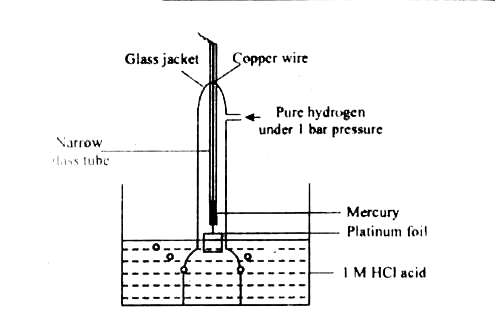 |
|
| 7. |
Draw the most stable conformer of 3-hydroxypropanal. |
|
Answer» |
|
| 8. |
During fermentation little H_2SO_4 is added : |
|
Answer» To get ACIDIC medium |
|
| 9. |
Draw the most stable conformation of meso -CH_(3)CHD-CHDCH_(3) |
|
Answer» |
|
| 10. |
Duringextractionof ironfromhaematite, the slag formed consists of ............while the slag formedduring extraction of copperfrom copper pyrites consists of ............. . |
|
Answer» |
|
| 11. |
During explosion of gunpowder , which of the following gases are evolved in the proportion of 1 :3 ? |
|
Answer» Oxygen : Nitrogen hence , nitrogen and carbon dioxide EVOLVE in 1:3 ratio. |
|
| 12. |
Draw the most stable conformation of (a) 1,2-dimethylcyclohexane, (b) cyclohexane-1,3-diol |
|
Answer» |
|
| 13. |
During extraction of a metal the ore is roasted if it is a |
|
Answer» sulphateore |
|
| 14. |
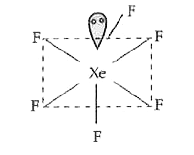
Draw the molecular structures of the following compounds : (i) N_(2)O_(5) "" (ii) XeOF_(4) Explain the following observations : (i) Sulphur has a greater tendency for catenation then oxygen. (ii) ICI is more reactive than I_(2). (iii) Despite lower value of its electron gain enthalpy with negative sing , fluorine (F_(2)) is a stronger oxidising agent than Cl_(2). |
|
Answer» Solution :(b) (i) Due to small size of oxygen, lone pair of electron on oxygen ATOM repel the bond pair of O-O bond to greater extent than the lone pairs of electrons on the S atom is S-S bond . Hence S-Sbond is much stronger and hence much stronger tendency of for catenation than O (ii) ICI is more reactive than `I_(2)` because `I-Cl` bond is weaker than I-I bond because of less effective OVERLAPPING between orbitals of dissimilar atoms than those between similar atoms Consequently , ICI breaks easily to form halogen atoms which readily BRING about the reactions. (iii) It is due to Low enthalpy of dissociation of F-F bond . HIGH hydration enthalpy of `F^(-)`. |
|
| 15. |
During estimation of oxalic acid Vs KMnO_(4) self indicator is : |
| Answer» Answer :A | |
| 16. |
During estimation of nitrogen present in an organic compound using Kjeldahl's method, the NH_3 evolved from 0.25 g of the compound was neutralised by 10 ml of 1.25 NH_2SO_4 What is the percentage of nitrogen in the organic compound? |
|
Answer» 0.56 |
|
| 17. |
Draw the molecular structures of the monomers of. (i) PVC(ii)Teflon . |
| Answer» SOLUTION :(i) `underset("Viny chloride ")(CH_(2) = CHCl)` (II) `underset("Tetrafluorethene") F_(2)C = CF_(2)` | |
| 18. |
During electrophoresis of colloidal sol of Fe(OH)_(3), the colloidal particles |
|
Answer» move towards anode and cathode both. `FE(OH)_(3)` is a TYPE of positive sol. So partical moves towards cathode during ELECTROPHORESIS. |
|
| 19. |
During emission of beta- particles |
|
Answer» ONE electron increases |
|
| 21. |
During electrophilic substitutionreactionprotectionof - NH_(2) group) |
|
Answer» REDUCTION |
|
| 22. |
During electrolytic refining ofzinc, anode and cathode used are made up of __________. |
|
Answer» ALUMINIUM and LEAD |
|
| 23. |
During the process of electroytic refining of copper some metals present as impurity settle as 'anode mud'. These are |
|
Answer» SN and Ag |
|
| 24. |
Duringelectrolyticrefiningof copper,somemetalspresent asimpuritysettle as 'anodemud '. Theseare |
|
Answer» SN and Ag |
|
| 25. |
During electrolyticconductance and lower the temperature of melt in order to make fused mixture very conducting. X and Y are: |
|
Answer»
|
|
| 26. |
Draw the major product formed when 1-ethoxyprop-1-ene is heated with one equivalent of HI |
Answer» Solution :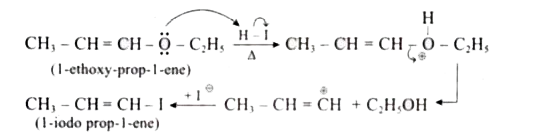 This reaction follows `SN^(1)` MECHANISM because in this reaction the more stable carbocation is formed that is double bonded carbocation. THEREFORE, the given molecule reacts with HI to form ETHANOL and 1-iodo prop-1-ene. `CH_(3)-CH=CH-O-C_(2)H_(5) overset(HI//Delta)(RARR)underset(("1-iodo prop-1-ene"))(CH_(3)-CH=CH-I)+underset(("ethanol"))(C_(2)H_(5)OH)` |
|
| 27. |
During electrolytic refining of blister copper, __________. |
|
Answer» COPPER IONS from the anode goes into the electrolyte |
|
| 28. |
During electrolysis of us |
|
Answer» Anide |
|
| 29. |
Draw the hexagonal primitive erystal structure. |
Answer» SOLUTION :
|
|
| 30. |
During electrolysis of aqueous solution of NaCl at which electrode chlorine is liberated. |
|
Answer» Anide |
|
| 31. |
During electrolysis of one mole or aq HCOOK . How many moles of H_2 is formed overall ? |
|
Answer» |
|
| 32. |
During electrolysis of NaCl solution, part of the reaction is Na^(+)e^(-) Na. This is termed as |
|
Answer» Oxidation |
|
| 33. |
During electrolysis of NaOH |
|
Answer» `H_(2)` is liberarted at cathode `4OH^(-)rarr2H_(2)O+O_(2)+4e^(-)` |
|
| 34. |
Draw the geometrical isomers of complex [Pt(en)_(2)Cl_(2)]^(2+) . |
Answer» SOLUTION :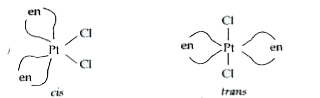
|
|
| 35. |
During electrolysis of molten sodium chloride, the time required to produce 0.1 mol of chlorinegas using a current of 3A is …………. |
|
Answer» 55 minutes `t = m/(ZI) ( :. "mass of 0.1 mole of " Cl_2 gas = 7.1 g mol^(-1))` `= (7.1)/((71)/(2 xx 96500) xx 3) (2 CL^(-) to Cl_2 + 2e^(-))= (2 xx 96500 xx 7.1)/(71 xx 3) = 6433.33 sec = 107.2` min. |
|
| 36. |
Draw the graph for [R] versus time (t) for a zero order reaction. Give the relationship between the rateconstant and the slope of the curve. |
Answer» SOLUTION : `K=([R]_(0)-[R])/(t)` |
|
| 37. |
Draw the geometrical isomers of complex [Pt(NH_(3))_(2)Cl_(2)]. |
Answer» Solution :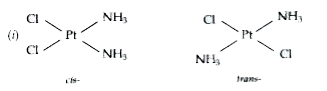 `PT(NH_(3))_(2)Cl_(2)` |
|
| 38. |
Draw the figure to show the splitting of d-orbitals in an octahedral crystal field. How does the magnitude of Delta_(0) decide the actual configuration of d-orbitals in a coordination entity? (i) Write IUPAC Name of the complen [Co(en)_(3)]^(3+) (ii) Draw all the isomers (geometrical and optical) of (a) [PtCl_(2)(en)_(2)]^(2+) (b) [CrCl_(2)(o x)_(2)]^(3-) |
|
Answer» Solution :If `Delta_(0) lt P`, the fourth electron enters one of the eg ORBITALS giving the configuration `t_(2g)^(2)eg^(1)`. (High spin complex) If `Delta_(0) gt P`, the fourth electron enters `t_(2g)` orbital with configuration `t_(2g)^(4)eg^(0)`. (LOW spin complex) trisethylenediamminecoblat (III) ion. 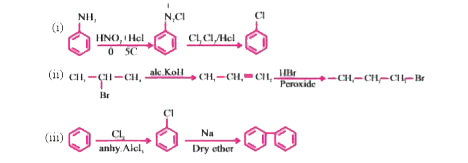
|
|
| 39. |
During electrolysis of molten sodium chloride, the time required to produce 0.1 mol of chlorine gas using a current of 3A is |
|
Answer» 55 MINUTES |
|
| 40. |
During electrolysis of molten NaCl, some water is added, what will happen? |
|
Answer» Electrolysis will stop. Reaction at cathode : `Na^(+)+e^(-)rarr Na` Reaction at anode : `CL^(-)rarr(1)/(2)Cl_(2)+e^(-)` By adding some water. `Na+H_(2)OrarrNaOH+(1)/(2)H_(2)uarr`. A fire is likely to take place due to vigorous reaction of sodium with water. |
|
| 41. |
Draw the flow chart for the manufacture of sulphuric acid by Contact process.Name the catalyst used in the process. |
Answer» SOLUTION :(i)  (ii) Vanadium pentoxide `(V_(2)O_(5))` |
|
| 42. |
Duringelectrolysis of molten copperchloride,the timerequiredto produce 0.2 moleo f chlorine gas usinga currentof 2A is |
|
Answer» 32.66 MIN |
|
| 43. |
Draw the enantiomers of 3-bromo-cyclohexene and give R/S designation for each. |
Answer» SOLUTION :
|
|
| 44. |
During electrolysis of molten NaCl, some water is added, What will happen : |
|
Answer» ELECTROLYSIS will STOP. At anode : `Cl^(-) to 1//2 Cl_(2)+e^(-)` On adding water, `Na+H_(2)O to NaOH+1//2 H_(2)` The reaction is highly exothermic. As a result, `H_(2)` EVOLVED is likely to catchfire. |
|
| 45. |
Draw the Ellingham diagram for the formation of carbon monoxide with the increasein temperature? |
Answer» SOLUTION :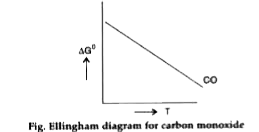 STABILITY of CARBON MONOXIDE INCREASES. |
|
| 46. |
During electrolysis of H_2SO_4(aq) with high charge density, H_2 S_2O_8 is fromed as by product In such electrolysis 44.8 L H_2(g) and 15LO_2(g) liberated at STP Hence, the moles of H_2 S_2 O_8 formed is approximately equal to |
|
Answer» 0.25 |
|
| 47. |
Draw the diastermers of 2- chloro-1,3- dimethyl cyclohexane and indicate the diasteromers that cannot undergo E2 eliminationand givethe productfrom these that react. |
|
Answer» Solution :`D.U`, in `(A) = ((2nC + 2)-n_(H))/(2)` `= ((27+2)-8)/(2) = 4^(@)` `4 D.U`and ``C.H = 1:1` suggest that it contains benzene ring and THEREFORE, `(A0` is toulene. Reactions: 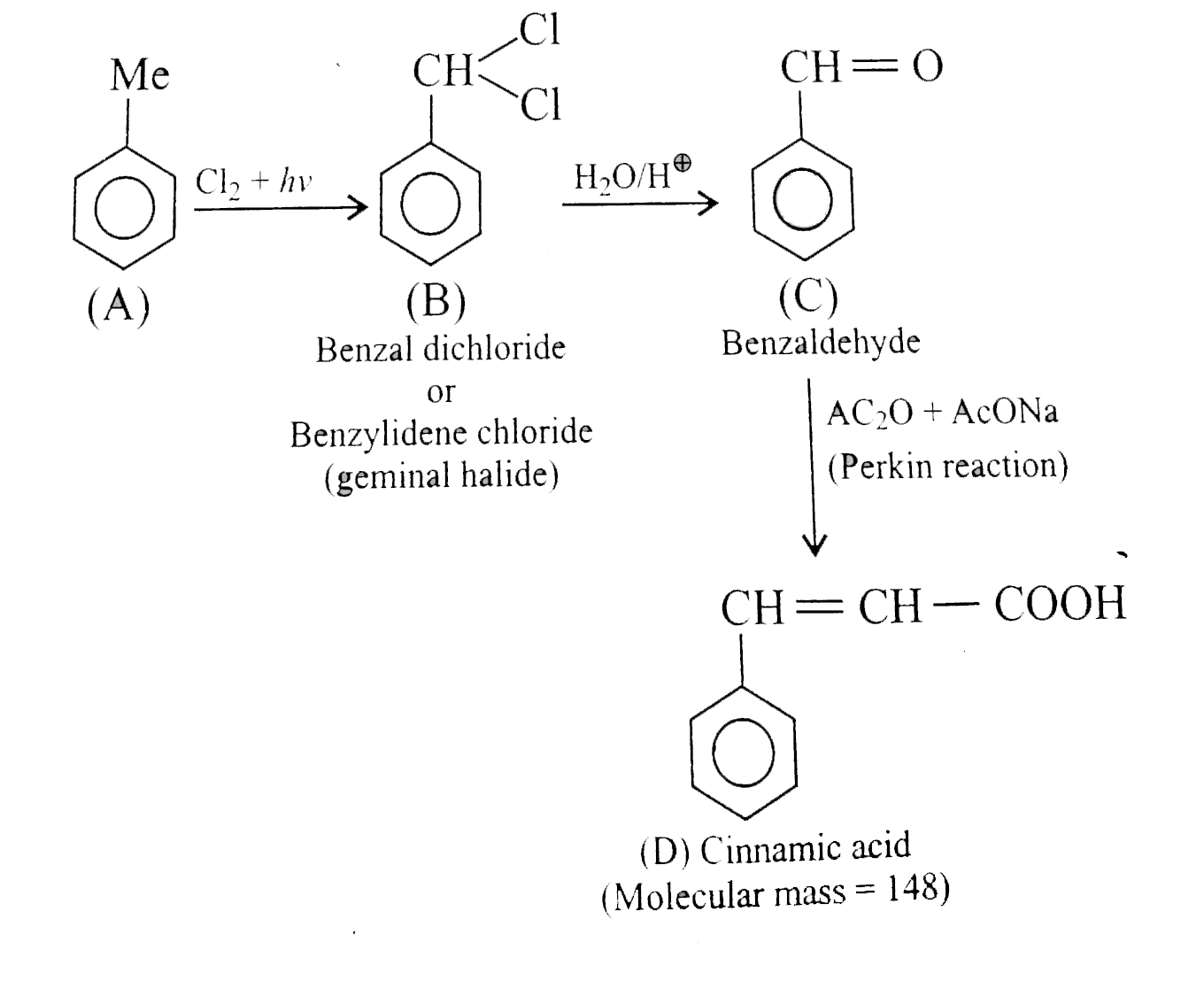
|
|
| 48. |
During electrolysis of H_2O , the molar ratio of H_2 and O_2 formed is: |
|
Answer» `2:1` |
|
| 50. |
Draw the diagram showing micelle formation by the following detergent. CH_(3)(CH_(2))_(10)CH_(2)OSoverset(-)O_(3)overset(+)Na |
|
Answer» Solution :Sodium laurylsulphate, `CH_(3)(CH_(2))_(10)CH_(2)OSoverset(-)(O_(3))overset(+)Na` is an example of anionic detergent. When added to WATER, it DISSOCIATES as follows `CH_(3)-(CH_(2))_(10)-CH_(2)OSO_(3)^(-)overset(+)Naoverset(+H_(2)O)rarr CH_(3)-(CH_(2))_(10)CH_(2)-OSO_(3)^(-)+overset(+)Na` These anions are PRESENT on the surface with their `-OSO_(3)^(-)` groups in water and hydrocarbon part staying a way from it and remain at the surface. At higher concentration, these anions are pulled into the bulk of the solution and from an aggregate of spherical shape with their hydrocarbon part pointing towards the centre and `OSO_(3)^(-)` part outwards on the surface of the sphere. 
|
|